

ASTM D3766-24a
(Terminology)Standard Terminology Relating to Catalysts and Catalysis
General Information
- Abstract
SCOPE
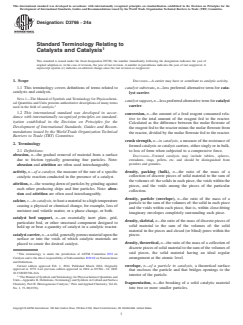
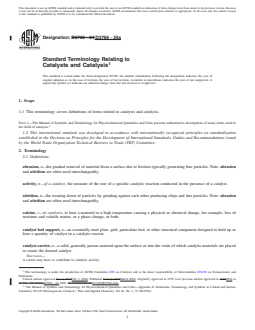
1.1 This terminology covers definitions of terms related to catalysts and catalysis.
Note 1: The Manual of Symbols and Terminology for Physicochemical Quantities and Units presents authoritative descriptions of many terms used in the field of catalysis.2
1.2 This international standard was developed in accordance with internationally recognized principles on standardization established in the Decision on Principles for the Development of International Standards, Guides and Recommendations issued by the World Trade Organization Technical Barriers to Trade (TBT) Committee.
- Status
- Published
- Publication Date
- 31-Jan-2024
- Technical Committee
- D32 - Catalysts
- Drafting Committee
- D32.92 - Nomenclature and Definitions




Overview
ASTM D3766-24a: Standard Terminology Relating to Catalysts and Catalysis provides authoritative definitions for terms used in the field of catalysis and catalyst technology. Developed by ASTM Committee D32, this standard supports consistency and clarity in communication, technical documentation, and research by creating a common vocabulary for professionals in chemistry, engineering, and allied fields.
As an internationally recognized terminology resource, ASTM D3766-24a aligns with principles from the World Trade Organization Technical Barriers to Trade (TBT) Committee, facilitating harmonization of terms across industries and global markets.
Key Topics
ASTM D3766-24a covers essential terms and concepts, such as:
- Abrasion and Attrition: Definitions clarify the mechanisms by which catalytic particles or carriers lose material due to friction or grinding.
- Catalyst Carrier/Support: Outlines the roles and characteristics of solid, generally porous materials used to enhance catalyst performance.
- Conversion: Explains measurement of feed reagent consumption, vital for process calculation in catalytic reactors.
- Crush Strength: Describes resistance to compressive forces, significant for catalyst handling and reactor design.
- Density Terms: Covers packing density, particle density, skeletal density, and theoretical density for comprehensive material characterization.
- Particle Size and Distribution: Details the methods and definitions for measuring and describing catalyst particle dimensions.
- Porosity and Pore Size Distribution: Addresses the importance of internal structure in catalysts and carriers.
- Metals Dispersion and Distribution: Provides explanations for evaluating the effectiveness and performance of catalytic metals.
- Gas, Liquid, and Weight Hourly Space Velocity (GHSV, LHSV, WHSV): Defines crucial flow and processing parameters for reactor operation.
- Selectivity and Activity: Clarifies how to assess catalyst performance in producing desired reaction outcomes.
- Sintering and Surface Area: Covers terms related to catalyst stability, surface characteristics, and longevity.
These definitions are designed to support accurate reporting, research, manufacturing, and regulatory compliance in catalysis.
Applications
ASTM D3766-24a terminology applies across numerous areas:
- Catalyst Manufacturing: Ensures uniform terminology in design, testing, and quality control for catalyst production.
- Chemical Process Optimization: Supports engineers and chemists in interpreting reactor data, calculating conversions, and specifying catalysts.
- Academic Research: Assists researchers in publishing clear, precise, and consistent literature within the field of catalysis.
- Industrial Operations: Aids operators and technical staff in process troubleshooting, safety, and maintenance by standardizing key catalyst-related terms.
- Material Characterization: Provides clear definitions for laboratory analysis, quality assurance, and R&D of catalysts and carriers.
- Business and Procurement: Enables accurate specification and comparison in procurement documents, contracts, and product datasheets.
By referencing ASTM D3766-24a, professionals worldwide ensure they are aligned on foundational concepts, minimizing misunderstandings and maximizing process efficiency.
Related Standards
ASTM D3766-24a aligns and complements several international standards and references, such as:
- The Manual of Symbols and Terminology for Physicochemical Quantities and Units (Pure and Applied Chemistry, Vol 46, No. 1) - comprehensive reference for colloid and surface chemistry definitions.
- Other ASTM Standards in catalyst testing, material characterization, and chemical processes.
- ISO and IUPAC terminology standards relevant to catalysts, materials science, and process engineering.
For rigorous scientific communication and global trade in catalyst technology, adoption of ASTM D3766-24a terminology is highly recommended. For official and up-to-date information, users should always refer to the latest edition available from ASTM International.
Relations
- Effective Date
- 01-Feb-2024
- Effective Date
- 01-Feb-2024
- Referred By
ASTM D4824-24 - Standard Test Method for Determination of Catalyst Acidity by Ammonia Chemisorption - Effective Date
- 01-Feb-2024
- Effective Date
- 01-Feb-2024
- Effective Date
- 01-Feb-2024
- Effective Date
- 01-Feb-2024
- Effective Date
- 01-Feb-2024
- Effective Date
- 01-Feb-2024
- Effective Date
- 01-Feb-2024
- Effective Date
- 01-Feb-2024
- Effective Date
- 01-Feb-2024
- Effective Date
- 01-Feb-2024
- Effective Date
- 01-Feb-2024
- Effective Date
- 01-Feb-2024
- Effective Date
- 01-Feb-2024
Get Certified
Connect with accredited certification bodies for this standard

ECOCERT
Organic and sustainability certification.

Eurofins Food Testing Global
Global leader in food, environment, and pharmaceutical product testing.

Intertek Bangladesh
Intertek certification and testing services in Bangladesh.
Sponsored listings
Frequently Asked Questions
ASTM D3766-24a is a standard published by ASTM International. Its full title is "Standard Terminology Relating to Catalysts and Catalysis". This standard covers: SCOPE 1.1 This terminology covers definitions of terms related to catalysts and catalysis. Note 1: The Manual of Symbols and Terminology for Physicochemical Quantities and Units presents authoritative descriptions of many terms used in the field of catalysis.2 1.2 This international standard was developed in accordance with internationally recognized principles on standardization established in the Decision on Principles for the Development of International Standards, Guides and Recommendations issued by the World Trade Organization Technical Barriers to Trade (TBT) Committee.
SCOPE 1.1 This terminology covers definitions of terms related to catalysts and catalysis. Note 1: The Manual of Symbols and Terminology for Physicochemical Quantities and Units presents authoritative descriptions of many terms used in the field of catalysis.2 1.2 This international standard was developed in accordance with internationally recognized principles on standardization established in the Decision on Principles for the Development of International Standards, Guides and Recommendations issued by the World Trade Organization Technical Barriers to Trade (TBT) Committee.
ASTM D3766-24a is classified under the following ICS (International Classification for Standards) categories: 71.040.30 - Chemical reagents. The ICS classification helps identify the subject area and facilitates finding related standards.
ASTM D3766-24a has the following relationships with other standards: It is inter standard links to ASTM D3766-24, ASTM D4781-03(2018)e1, ASTM D4824-24, ASTM D7442-22, ASTM D4780-23, ASTM D6175-03(2019), ASTM D4699-23, ASTM D6761-22a, ASTM D3908-20, ASTM D7084-23, ASTM D4464-15(2020), ASTM D4512-22, ASTM D4641-17, ASTM C1770-21, ASTM D4180-23. Understanding these relationships helps ensure you are using the most current and applicable version of the standard.
ASTM D3766-24a is available in PDF format for immediate download after purchase. The document can be added to your cart and obtained through the secure checkout process. Digital delivery ensures instant access to the complete standard document.
Standards Content (Sample)
This international standard was developed in accordance with internationally recognized principles on standardization established in the Decision on Principles for the
Development of International Standards, Guides and Recommendations issued by the World Trade Organization Technical Barriers to Trade (TBT) Committee.
Designation: D3766 − 24a
Standard Terminology Relating to
Catalysts and Catalysis
This standard is issued under the fixed designation D3766; the number immediately following the designation indicates the year of
original adoption or, in the case of revision, the year of last revision. A number in parentheses indicates the year of last reapproval. A
superscript epsilon (´) indicates an editorial change since the last revision or reapproval.
DISCUSSION—A carrier may have or contribute to catalytic activity.
1. Scope
1.1 This terminology covers definitions of terms related to
catalyst substrate, n—less preferred alternative term for cata-
catalysts and catalysis.
lyst carrier.
NOTE 1—The Manual of Symbols and Terminology for Physicochemi-
catalyst support, n—less preferred alternative term for catalyst
cal Quantities and Units presents authoritative descriptions of many terms
carrier.
used in the field of catalysis.
1.2 This international standard was developed in accor-
conversion, n—the amount of a feed reagent consumed rela-
dance with internationally recognized principles on standard-
tive to the total amount of the reagent fed to the reactor.
ization established in the Decision on Principles for the
Calculated as the difference between the molar flowrate of
Development of International Standards, Guides and Recom-
the reagent fed to the reactor minus the molar flowrate from
mendations issued by the World Trade Organization Technical
the reactor, divided by the molar flowrate fed to the reactor.
Barriers to Trade (TBT) Committee.
crush strength, n—in catalysis, a measure of the resistance of
2. Terminology
formed catalysts or catalyst carriers, either singly or in bulk,
2.1 Definitions: to loss of form when subjected to a compressive force.
abrasion, n—the gradual removal of material from a surface
DISCUSSION—Formed catalysts may include tablets, spheres,
extrudates, rings, pellets, etc. and should be distinguished from
due to friction typically generating fine particles. Note:
powders and granules.
abrasion and attrition are often used interchangeably.
density, packing (bulk), n—the ratio of the mass of a
activity, n—of a catalyst, the measure of the rate of a specific
collection of discrete pieces of solid material to the sum of
catalytic reaction conducted in the presence of a catalyst.
the volumes of: the solids in each piece, the voids within the
attrition, n—the wearing down of particles by grinding against
pieces, and the voids among the pieces of the particular
each other producing chips and fine particles. Note: abra-
collection.
sion and attrition are often used interchangeably.
density, particle (envelope), n—the ratio of the mass of a
calcine, v—in catalysis, to heat a material to a high temperature
particle to the sum of the volumes of: the solid in each piece
causing a physical or chemical change, for example, loss of
and the voids within each piece, that is, within close-fitting
moisture and volatile matter, or a phase change, or both.
imaginary envelopes completely surrounding each piece.
catalyst bed support, n—an essentially inert plate, grid,
density, skeletal, n—the ratio of the mass of discrete pieces of
particulate bed, or other structural component designed to
solid material to the sum of the volumes of: the solid
hold up or bear a quantity of catalyst in a catalytic reactor.
material in the pieces and closed (or blind) pores within the
catalyst carrier, n—a solid, generally porous material upon the
pieces.
surface or into the voids of which catalytic materials are
density, theoretical, n—the ratio of the mass of a collection of
placed to create the desired catalyst.
discrete pieces of solid material to the sum of the volumes of
said pieces, the solid material having an ideal regular
This terminology is under the jurisdiction of ASTM Committee D32 on
arrangement at the atomic level.
Catalysts and is the direct responsibility of Subcommittee D32.92 on Nomenclature
and Definitions.
Current edition approved Feb. 1, 2024. Published March 2024. Originally envelope, n—of a particle in catalysis, a theoretical surface
approved in 1979. Last previous edition approved in 2024 as D3766 – 24. DOI:
that encloses the particle and that bridges openings to the
10.1520/D3766-24A.
interior of the particle.
“The Manual of Symbols and Terminology for Physicochemical Quantities and
Units—Appendix II. Definitions, Terminology and Symbols in Colloid and Surface
fragmentation, n—the breaking of a solid catalytic material
Chemistry. Part II: Heterogeneous Catalysis,” Pure and Applied Chemistry, Vol 46,
No. 1, 73–90(1976). into two or more smaller particles.
Copyright © ASTM International, 100 Barr Harbor Drive, PO Box C700, West Conshohocken, PA 19428-2959. United States
D3766 − 24a
gas hourly space vel
...
This document is not an ASTM standard and is intended only to provide the user of an ASTM standard an indication of what changes have been made to the previous version. Because
it may not be technically possible to adequately depict all changes accurately, ASTM recommends that users consult prior editions as appropriate. In all cases only the current version
of the standard as published by ASTM is to be considered the official document.
Designation: D3766 − 24 D3766 − 24a
Standard Terminology Relating to
Catalysts and Catalysis
This standard is issued under the fixed designation D3766; the number immediately following the designation indicates the year of
original adoption or, in the case of revision, the year of last revision. A number in parentheses indicates the year of last reapproval. A
superscript epsilon (´) indicates an editorial change since the last revision or reapproval.
1. Scope
1.1 This terminology covers definitions of terms related to catalysts and catalysis.
NOTE 1—The Manual of Symbols and Terminology for Physicochemical Quantities and Units presents authoritative descriptions of many terms used in
the field of catalysis.
1.2 This international standard was developed in accordance with internationally recognized principles on standardization
established in the Decision on Principles for the Development of International Standards, Guides and Recommendations issued
by the World Trade Organization Technical Barriers to Trade (TBT) Committee.
2. Terminology
2.1 Definitions:
abrasion, n—the gradual removal of material from a surface due to friction typically generating fine particles. Note: abrasion
and attrition are often used interchangeably.
activity, n—of a catalyst, the measure of the rate of a specific catalytic reaction conducted in the presence of a catalyst.
attrition, n—the wearing down of particles by grinding against each other producing chips and fine particles. Note: abrasion
and attrition are often used interchangeably.
calcine, v—in catalysis, to heat a material to a high temperature causing a physical or chemical change, for example, loss of
moisture and volatile matter, or a phase change, or both.
catalyst bed support, n—an essentially inert plate, grid, particulate bed, or other structural component designed to hold up or
bear a quantity of catalyst in a catalytic reactor.
catalyst carrier, n—a solid, generally porous material upon the surface or into the voids of which catalytic materials are placed
to create the desired catalyst.
DISCUSSION—
A carrier may have or contribute to catalytic activity.
This terminology is under the jurisdiction of ASTM Committee D32 on Catalysts and is the direct responsibility of Subcommittee D32.92 on Nomenclature and
Definitions.
Current edition approved Jan. 1, 2024Feb. 1, 2024. Published January 2024March 2024. Originally approved in 1979. Last previous edition approved in 20182024 as
D3766 – 08 (2018).D3766 – 24. DOI: 10.1520/D3766-24.10.1520/D3766-24A.
“The Manual of Symbols and Terminology for Physicochemical Quantities and Units—Appendix II. Definitions, Terminology and Symbols in Colloid and Surface
Chemistry. Part II: Heterogeneous Catalysis,” Pure and Applied Chemistry, Vol 46, No. 1, 73–90(1976).
Copyright © ASTM International, 100 Barr Harbor Drive, PO Box C700, West Conshohocken, PA 19428-2959. United States
D3766 − 24a
catalyst substrate,n—less preferred alternative term for catalyst carrier.
catalyst support,n—less preferred alternative term for catalyst carrier.
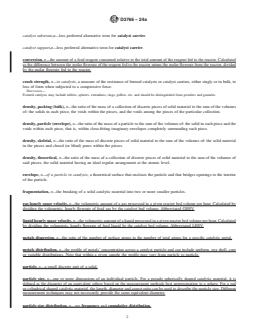
conversion, n—the amount of a feed reagent consumed relative to the total amount of the reagent fed to the reactor. Calculated
as the difference between the molar flowrate of the reagent fed to the reactor minus the molar flowrate from the reactor, divided
by the molar flowrate fed to the reactor.
crush strength, n—in catalysis, a measure of the resistance of formed catalysts or catalyst carriers, either singly or in bulk, to
loss of form when subjected to a compressive force.
DISCUSSION—
Formed catalysts may include tablets, spheres, extrudates, rings, pellets, etc. and should be distinguished from powders and granules.
density, packing (bulk), n—the ratio of the mass of a collection of discrete pieces of solid material to the sum of the volumes
of: the solids in each piece, the voids within the pieces, and the voids among the pieces of the particular collection.
density, particle (envelope), n—the ratio of the mass of a particle to the sum of the volumes of: the solid in each piece and the
voids within each piece, that is, within close-fitting imaginary envelopes completely surrounding each piece.
density, skeletal, n—the ratio of the mass of discrete pieces of solid material to the sum of the volumes of: the solid material
in the pieces and closed (or blind) pores within the pieces.
density, theoretical, n—the ratio of the mass of a collection of discrete pieces of solid material to the sum of the volumes of
said pieces, the solid material having an ideal regular arrangement at the atomic level.
envelope, n—of a particle in catalysis, a theoretical surface that encloses the particle and that bridges openings to the interior
of the particle.
fragmentation, n—the breaking of a solid catalytic material into two or more smaller particles.
gas hourl
...