

ASTM C1770-21
(Test Method)Standard Test Method for Determination of Loose and Tapped Bulk Densities of Small Quantities of Plutonium Oxide
General Information
- Abstract
SIGNIFICANCE AND USE
5.1 This test method is intended for determination of loose or tapped bulk density or both for PuO2 powders or compounds in the nuclear industry. It is intended for use when the quantity of available material for performing the measurements is limited because of reasons such as nuclear safety or laboratory scale limits on nuclear inventory.
5.2 This test method can be applied to other metal powders in the nuclear industry provided that appropriate validation has been performed.
5.3 Values of loose bulk density obtained using this test method should be used with caution since they can vary considerably depending on factors such as the initial state of dispersion of the test specimen, height-to-diameter ratio of the specimen in the graduated cylinder, the dryness of the powder, and operator-to-operator variation (for example, the speed with which the sample is poured into the cylinder).
5.4 The data from the tapped bulk density test can be used to estimate the needed volume of small containers holding a fixed mass of powder that has been compacted.
5.5 This test method may be useful for the determination of the Carr Compressibility Index as described in Test Method D6393.
SCOPE
1.1 This test method specifies a method for the determination of loose and tapped bulk density of plutonium oxide (PuO2) powder.
1.2 This test method is applicable when limited quantities of powder are available for performance of the measurements. Alternative test methods, such as Test Methods B527 or D7481, may be used when sufficient quantities are available.
1.3 This test method contains notes that are explanatory and are not part of the mandatory requirements of the method.
1.4 The values stated in SI units are to be regarded as standard. No other units of measurement are included in this standard.
1.5 This standard does not purport to address all of the safety concerns, if any, associated with its use. It is the responsibility of the user of this standard to establish appropriate safety, health, and environmental practices and determine the applicability of regulatory limitations prior to use. Some specific hazards statements are given in Section 7 on Hazards.
1.6 This international standard was developed in accordance with internationally recognized principles on standardization established in the Decision on Principles for the Development of International Standards, Guides and Recommendations issued by the World Trade Organization Technical Barriers to Trade (TBT) Committee.
- Status
- Published
- Publication Date
- 31-Dec-2020
- Technical Committee
- C26 - Nuclear Fuel Cycle
- Drafting Committee
- C26.05 - Methods of Test
Buy Documents

ASTM C1770-21 - Standard Test Method for Determination of Loose and Tapped Bulk Densities of Small Quantities of Plutonium Oxide
REDLINE ASTM C1770-21 - Standard Test Method for Determination of Loose and Tapped Bulk Densities of Small Quantities of Plutonium Oxide
Overview
ASTM C1770-21: Standard Test Method for Determination of Loose and Tapped Bulk Densities of Small Quantities of Plutonium Oxide provides a reliable and practical method for measuring the loose and tapped bulk densities of plutonium oxide (PuO₂) powder. This test method is specifically designed for situations in the nuclear industry where only limited quantities of material are available, often due to nuclear safety requirements or laboratory inventory constraints. The standard is equally relevant for other metal powders in the nuclear industry if proper validation steps are followed.
Understanding the bulk density of nuclear materials like plutonium oxide is critical for process control, fuel fabrication, storage, and safe handling. Bulk density measurements help estimate container volumes, assess packing properties, and support characterization and quality assurance of nuclear materials.
Key Topics
- Loose Bulk Density: The bulk density measured when PuO₂ powder is poured into a container without applied compression. Influenced by powder dispersion, dryness, and handling technique.
- Tapped Bulk Density: The bulk density determined after mechanically tapping the container to settle the powder. Provides more consistent and reproducible results.
- Small Quantities: Designed for use when material amounts are limited, avoiding the need for bulk inventory or excessive handling of radioactive substances.
- Precision Considerations: Loose bulk density values can display variability due to specimen preparation and operator technique. Tapped bulk density offers improved repeatability.
- Safety and Compliance: The method includes considerations for safety, health, and regulatory requirements, essential in nuclear material handling.
- Data Reporting: Guidance is provided for recording masses, volumes, densities, and procedural details for traceability and quality control.
Applications
ASTM C1770-21 is widely applicable across the nuclear industry, including:
- Nuclear Fuel Fabrication: Determining powder characteristics for pellet pressing and sintering processes in MOX (Mixed Oxide) fuel manufacturing.
- Storage & Packaging: Estimating the required volume for safe and efficient storage and transport of small quantities of plutonium oxide or similar powders.
- Quality Control: Supporting the consistency and uniformity of PuO₂ powder used in energy generation or research.
- Process Development: Benchmarking powder behavior for process optimization and specification development.
- Safety Assessments: Minimizing nuclear safety risks by enabling critical material characterization using small, manageable sample sizes.
- Additional Powders: With validation, the method can be extended to other metal powders relevant in nuclear materials management.
Related Standards
ASTM C1770-21 references and aligns with several other important ASTM standards for consistency and completeness in powder density measurement and terminology:
- ASTM B527: Test Method for Tap Density of Metal Powders and Compounds
- ASTM D7481: Test Methods for Determining Loose and Tapped Bulk Densities of Powders using a Graduated Cylinder
- ASTM D6393: Test Method for Bulk Solids Characterization by Carr Indices
- ASTM C859: Terminology Relating to Nuclear Materials
- ASTM D3766: Terminology Relating to Catalysts and Catalysis
- ASTM E135: Terminology Relating to Analytical Chemistry for Metals, Ores, and Related Materials
- ASTM E1272: Specification for Laboratory Glass Graduated Cylinders
These related standards provide additional test methods, reference terminology, and equipment requirements, complementing the core procedures specified in ASTM C1770-21.
Keywords: ASTM C1770-21, plutonium oxide, loose bulk density, tapped bulk density, nuclear materials, powder characterization, metal powders, nuclear industry, test method, quality control, safety compliance.
Relations
- Effective Date
- 01-Feb-2024
- Effective Date
- 01-Jan-2024
- Effective Date
- 01-Jan-2024
- Effective Date
- 01-Jan-2020
- Effective Date
- 15-May-2019
- Effective Date
- 01-Jan-2019
- Effective Date
- 01-Nov-2018
- Effective Date
- 15-May-2016
- Effective Date
- 01-Jul-2015
- Effective Date
- 15-May-2015
- Effective Date
- 15-Aug-2014
- Effective Date
- 15-Jun-2014
- Refers
ASTM B527-14 - Standard Test Method for Determination of Tap Density of Metal Powders and Compounds - Effective Date
- 01-Apr-2014
- Effective Date
- 01-Apr-2014
- Effective Date
- 15-Feb-2014
Buy Documents
ASTM C1770-21 - Standard Test Method for Determination of Loose and Tapped Bulk Densities of Small Quantities of Plutonium Oxide
REDLINE ASTM C1770-21 - Standard Test Method for Determination of Loose and Tapped Bulk Densities of Small Quantities of Plutonium Oxide
Get Certified
Connect with accredited certification bodies for this standard

DNV
DNV is an independent assurance and risk management provider.

Lloyd's Register
Lloyd's Register is a global professional services organisation specialising in engineering and technology.
DNV Energy Systems
Energy and renewable energy certification.
Sponsored listings
Frequently Asked Questions
ASTM C1770-21 is a standard published by ASTM International. Its full title is "Standard Test Method for Determination of Loose and Tapped Bulk Densities of Small Quantities of Plutonium Oxide". This standard covers: SIGNIFICANCE AND USE 5.1 This test method is intended for determination of loose or tapped bulk density or both for PuO2 powders or compounds in the nuclear industry. It is intended for use when the quantity of available material for performing the measurements is limited because of reasons such as nuclear safety or laboratory scale limits on nuclear inventory. 5.2 This test method can be applied to other metal powders in the nuclear industry provided that appropriate validation has been performed. 5.3 Values of loose bulk density obtained using this test method should be used with caution since they can vary considerably depending on factors such as the initial state of dispersion of the test specimen, height-to-diameter ratio of the specimen in the graduated cylinder, the dryness of the powder, and operator-to-operator variation (for example, the speed with which the sample is poured into the cylinder). 5.4 The data from the tapped bulk density test can be used to estimate the needed volume of small containers holding a fixed mass of powder that has been compacted. 5.5 This test method may be useful for the determination of the Carr Compressibility Index as described in Test Method D6393. SCOPE 1.1 This test method specifies a method for the determination of loose and tapped bulk density of plutonium oxide (PuO2) powder. 1.2 This test method is applicable when limited quantities of powder are available for performance of the measurements. Alternative test methods, such as Test Methods B527 or D7481, may be used when sufficient quantities are available. 1.3 This test method contains notes that are explanatory and are not part of the mandatory requirements of the method. 1.4 The values stated in SI units are to be regarded as standard. No other units of measurement are included in this standard. 1.5 This standard does not purport to address all of the safety concerns, if any, associated with its use. It is the responsibility of the user of this standard to establish appropriate safety, health, and environmental practices and determine the applicability of regulatory limitations prior to use. Some specific hazards statements are given in Section 7 on Hazards. 1.6 This international standard was developed in accordance with internationally recognized principles on standardization established in the Decision on Principles for the Development of International Standards, Guides and Recommendations issued by the World Trade Organization Technical Barriers to Trade (TBT) Committee.
SIGNIFICANCE AND USE 5.1 This test method is intended for determination of loose or tapped bulk density or both for PuO2 powders or compounds in the nuclear industry. It is intended for use when the quantity of available material for performing the measurements is limited because of reasons such as nuclear safety or laboratory scale limits on nuclear inventory. 5.2 This test method can be applied to other metal powders in the nuclear industry provided that appropriate validation has been performed. 5.3 Values of loose bulk density obtained using this test method should be used with caution since they can vary considerably depending on factors such as the initial state of dispersion of the test specimen, height-to-diameter ratio of the specimen in the graduated cylinder, the dryness of the powder, and operator-to-operator variation (for example, the speed with which the sample is poured into the cylinder). 5.4 The data from the tapped bulk density test can be used to estimate the needed volume of small containers holding a fixed mass of powder that has been compacted. 5.5 This test method may be useful for the determination of the Carr Compressibility Index as described in Test Method D6393. SCOPE 1.1 This test method specifies a method for the determination of loose and tapped bulk density of plutonium oxide (PuO2) powder. 1.2 This test method is applicable when limited quantities of powder are available for performance of the measurements. Alternative test methods, such as Test Methods B527 or D7481, may be used when sufficient quantities are available. 1.3 This test method contains notes that are explanatory and are not part of the mandatory requirements of the method. 1.4 The values stated in SI units are to be regarded as standard. No other units of measurement are included in this standard. 1.5 This standard does not purport to address all of the safety concerns, if any, associated with its use. It is the responsibility of the user of this standard to establish appropriate safety, health, and environmental practices and determine the applicability of regulatory limitations prior to use. Some specific hazards statements are given in Section 7 on Hazards. 1.6 This international standard was developed in accordance with internationally recognized principles on standardization established in the Decision on Principles for the Development of International Standards, Guides and Recommendations issued by the World Trade Organization Technical Barriers to Trade (TBT) Committee.
ASTM C1770-21 is classified under the following ICS (International Classification for Standards) categories: 27.120.30 - Fissile materials and nuclear fuel technology. The ICS classification helps identify the subject area and facilitates finding related standards.
ASTM C1770-21 has the following relationships with other standards: It is inter standard links to ASTM D3766-24a, ASTM C859-24, ASTM D3766-24, ASTM E135-20, ASTM E135-19, ASTM E1272-02(2019), ASTM D3766-08(2018), ASTM E135-16, ASTM E135-15a, ASTM E135-15, ASTM E135-14b, ASTM C859-14a, ASTM B527-14, ASTM E135-14a, ASTM E135-14. Understanding these relationships helps ensure you are using the most current and applicable version of the standard.
ASTM C1770-21 is available in PDF format for immediate download after purchase. The document can be added to your cart and obtained through the secure checkout process. Digital delivery ensures instant access to the complete standard document.
Standards Content (Sample)
This international standard was developed in accordance with internationally recognized principles on standardization established in the Decision on Principles for the
Development of International Standards, Guides and Recommendations issued by the World Trade Organization Technical Barriers to Trade (TBT) Committee.
Designation: C1770 − 21
Standard Test Method for
Determination of Loose and Tapped Bulk Densities of
Small Quantities of Plutonium Oxide
This standard is issued under the fixed designation C1770; the number immediately following the designation indicates the year of
original adoption or, in the case of revision, the year of last revision. A number in parentheses indicates the year of last reapproval. A
superscript epsilon (´) indicates an editorial change since the last revision or reapproval.
1. Scope C859 Terminology Relating to Nuclear Materials
D3766 Terminology Relating to Catalysts and Catalysis
1.1 This test method specifies a method for the determina-
D6393 Test Method for Bulk Solids Characterization by
tion of loose and tapped bulk density of plutonium oxide
Carr Indices
(PuO ) powder.
D7481 Test Methods for Determining Loose and Tapped
1.2 Thistestmethodisapplicablewhenlimitedquantitiesof
Bulk Densities of Powders using a Graduated Cylinder
powder are available for performance of the measurements.
E135 Terminology Relating to Analytical Chemistry for
Alternative test methods, such as Test Methods B527 or
Metals, Ores, and Related Materials
D7481, may be used when sufficient quantities are available.
E1272 Specification for Laboratory Glass Graduated Cylin-
ders
1.3 This test method contains notes that are explanatory and
are not part of the mandatory requirements of the method.
3. Terminology
1.4 The values stated in SI units are to be regarded as
3.1 Definitions:
standard. No other units of measurement are included in this
3.1.1 For definitions of terms used in this test method but
standard.
not defined herein, refer to Terminology C859 and Terminol-
1.5 This standard does not purport to address all of the
ogy E135.
safety concerns, if any, associated with its use. It is the
3.2 Definitions of Terms Specific to This Standard:
responsibility of the user of this standard to establish appro-
3.2.1 bulk density, n—ratio of the mass of a collection of
priate safety, health, and environmental practices and deter-
discrete pieces of solid material to the sum of the volumes of
mine the applicability of regulatory limitations prior to use.
the solids in each piece, the voids within the pieces, and the
Some specific hazards statements are given in Section 7 on
voids among the pieces of the particular collection. D3766
Hazards.
3.2.2 loose bulk density, n—bulk density that results from
1.6 This international standard was developed in accor-
pouring the powder into a heap or container in the absence of
dance with internationally recognized principles on standard-
any applied compression. D7481
ization established in the Decision on Principles for the
3.2.3 tapped bulk density, n—bulkdensityresultingfromthe
Development of International Standards, Guides and Recom-
application of compression, for example, impact or vibration.
mendations issued by the World Trade Organization Technical
D7481
Barriers to Trade (TBT) Committee.
4. Summary of Test Method
2. Referenced Documents
4.1 Loose bulk density is determined by measuring the
2.1 ASTM Standards:
volume of a known mass of PuO powder poured into a
B527 Test Method for Tap Density of Metal Powders and
graduatedcylinderwithacapacityof10mL,25mL,50mL,or
Compounds
100 mL. The cylinder size should be selected based on the
amount of PuO powder available for the test.
This test method is under the jurisdiction ofASTM Committee C26 on Nuclear
4.2 The cylinder is then mechanically tapped at a dropping
Fuel Cycle and is the direct responsibility of Subcommittee C26.05 on Methods of
height of 3 mm for 2 min at 250 taps per minute, and the
Test.
resulting volume is then measured.This process is repeated for
Current edition approved Jan. 1, 2021. Published February 2021. Originally
cycles of 2 min until the difference in tapped volumes is less
approved in 2013. Last previous edition approved in 2013 as C1770 – 13. DOI:
10.1520/C1770-21
than 4 % (this corresponds to a change of less than one
For referenced ASTM standards, visit the ASTM website, www.astm.org, or
graduation on the 10 mL, 25 mL, and 50 mL graduated
contact ASTM Customer Service at service@astm.org. For Annual Book of ASTM
cylinders and two graduations on the 100 mL graduated
Standards volume information, refer to the standard’s Document Summary page on
the ASTM website. cylinder).
Copyright © ASTM International, 100 Barr Harbor Drive, PO Box C700, West Conshohocken, PA 19428-2959. United States
C1770 − 21
5. Significance and Use
5.1 This test method is intended for determination of loose
ortappedbulkdensityorbothforPuO powdersorcompounds
in the nuclear industry. It is intended for use when the quantity
of available material for performing the measurements is
limited because of reasons such as nuclear safety or laboratory
scale limits on nuclear inventory.
5.2 This test method can be applied to other metal powders
in the nuclear industry provided that appropriate validation has
been performed.
5.3 Values of loose bulk density obtained using this test
method should be used with caution since they can vary
considerably depending on factors such as the initial state of
dispersion of the test specimen, height-to-diameter ratio of the
specimen in the graduated cylinder, the dryness of the powder,
and operator-to-operator variation (for example, the speed with
which the sample is poured into the cylinder).
5.4 The data from the tapped bulk density test can be used
to estimate the needed volume of small containers holding a
fixed mass of powder that has been compacted.
5.5 This test method may be useful for the determination of
the Carr Compressibility Index as described in Test Method
D6393.
6. Apparatus
6.1 Balance, analytical, 0.1 mg sensitivity.
6.2 Graduated glass cylinder, with a capacity of 10 mL, 25
mL, 50 mL, or 100 mL, Class A, meeting the requirements of
Specification E1272.
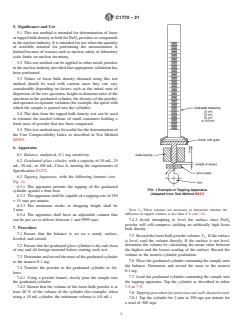
6.3 Tapping Apparatus, with the following features (see
Fig. 1).
6.3.1 The apparatus permits the tapping of the graduated
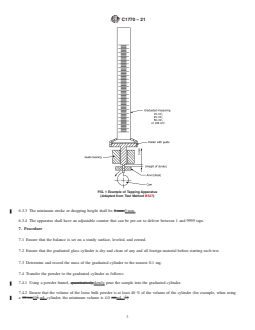
FIG. 1 Example of Tapping Apparatus
cylinder against a firm base.
(Adapted from Test Method B527)
6.3.2 Theapparatusshallbecapableofatappingrateof250
+ 15 taps per minute.
6.3.3 The minimum stroke or dropping height shall be
NOTE 1—These volumes are necessary to determine whether the
3 mm.
difference in tapped volumes is less than 4 % (see 7.8).
6.3.4 The apparatus shall have an adjustable counter that
can be pre-set to deliver between 1 and 9999 taps. 7.4.3 Avoid attempting to level the surface since PuO
powder will self-compress yielding an artificially high loose
7. Procedure
bulk density.
7.1 Ensure that the balance is set on a sturdy surface,
7.5 Record the loose bulk powder volume, V . If the surface
L
leveled, and zeroed.
is level, read the volume directly. If the surface is not level,
determine the volume by calculating the mean value between
7.2 Ensure that the graduated glass cylinder is dry and clean
the highest and the lowest reading of the surface. Record the
of any and all foreign material before starting each test.
volume to the nearest cylinder graduation.
7.3 Determineandrecordthemassofthegraduatedcylinder
7.6 Place the graduated
...
This document is not an ASTM standard and is intended only to provide the user of an ASTM standard an indication of what changes have been made to the previous version. Because
it may not be technically possible to adequately depict all changes accurately, ASTM recommends that users consult prior editions as appropriate. In all cases only the current version
of the standard as published by ASTM is to be considered the official document.
Designation: C1770 − 13 C1770 − 21
Standard Test Method for
Determination of Loose and Tapped Bulk Density of
Densities of Small Quantities of Plutonium Oxide
This standard is issued under the fixed designation C1770; the number immediately following the designation indicates the year of
original adoption or, in the case of revision, the year of last revision. A number in parentheses indicates the year of last reapproval. A
superscript epsilon (´) indicates an editorial change since the last revision or reapproval.
1. Scope
1.1 This test method specifies a method for the determination of loose and tapped bulk density of plutonium oxide (PuO ) powder.
1.2 This test method is applicable when limited quantities of powder are available for performance of the measurements.
Alternative test methods, such as Test Methods B527 or D7481, may be used when sufficient quantities are available.
1.3 This test method contains notes that are explanatory and are not part of the mandatory requirements of the method.
1.4 The values stated in SI units are to be regarded as standard. No other units of measurement are included in this standard.
1.5 This standard does not purport to address all of the safety concerns, if any, associated with its use. It is the responsibility
of the user of this standard to establish appropriate safety safety, health, and healthenvironmental practices and determine the
applicability of regulatory limitations prior to use. Some specific hazards statements are given in Section 77 on Hazards.
1.6 This international standard was developed in accordance with internationally recognized principles on standardization
established in the Decision on Principles for the Development of International Standards, Guides and Recommendations issued
by the World Trade Organization Technical Barriers to Trade (TBT) Committee.
2. Referenced Documents
2.1 ASTM Standards:
B527 Test Method for Tap Density of Metal Powders and Compounds
C859 Terminology Relating to Nuclear Materials
D3766 Terminology Relating to Catalysts and Catalysis
D6393 Test Method for Bulk Solids Characterization by Carr Indices
D7481 Test Methods for Determining Loose and Tapped Bulk Densities of Powders using a Graduated Cylinder
E135 Terminology Relating to Analytical Chemistry for Metals, Ores, and Related Materials
E1272 Specification for Laboratory Glass Graduated Cylinders
3. Terminology
3.1 For definitions of terms used in this test method but not defined herein, refer to Terminologies C859 and E135.
This test method is under the jurisdiction of ASTM Committee C26 on Nuclear Fuel Cycle and is the direct responsibility of Subcommittee C26.05 on Methods of Test.
Current edition approved Jan. 1, 2013Jan. 1, 2021. Published February 2013February 2021. Originally approved in 2013. Last previous edition approved in 2013 as C1770
– 13. DOI: 10.1520/C1770-1310.1520/C1770-21
For referenced ASTM standards, visit the ASTM website, www.astm.org, or contact ASTM Customer Service at service@astm.org. For Annual Book of ASTM Standards
volume information, refer to the standard’s Document Summary page on the ASTM website.
Copyright © ASTM International, 100 Barr Harbor Drive, PO Box C700, West Conshohocken, PA 19428-2959. United States
C1770 − 21
3.1 Definitions:
3.1.1 For definitions of terms used in this test method but not defined herein, refer to Terminology C859 and Terminology E135.
3.2 Definitions:Definitions of Terms Specific to This Standard:
3.2.1 bulk density, n—ratio of the mass of a collection of discrete pieces of solid material to the sum of the volumes of:of the solids
in each piece, the voids within the pieces, and the voids among the pieces of the particular collection. D3766
3.2.2 loose bulk density, n—bulk density that results from pouring the powder into a heap or container in the absence of any
applied compression. D7481
3.2.3 tapped bulk density, n—bulk density resulting from the application of compression, for example, impact or vibration. D7481
4. Summary of Test Method
4.1 Loose bulk density is determined by measuring the volume of a known mass of plutoniumPuO oxide powder poured into a
graduated cylinder with a capacity of 10, 25, 50, 10 mL, 25 mL, 50 mL, or 100 cmmL. . The cylinder size should be selected based
on the amount of plutoniumPuO oxide powder available for the test.
4.2 The cylinder is then mechanically tapped at a dropping height of 3 mm for 2 min at 250 taps per minute, and the resulting
volume is then measured. This process is repeated for cycles of 2 min until the difference in tapped volumes is less than 2 %. 4
% (this corresponds to a change of less than one graduation on the 10 mL, 25 mL, and 50 mL graduated cylinders and two
graduations on the 100 mL graduated cylinder).
5. Significance and Use
5.1 This test method is intended for determination of bulk loose or tapped bulk density or both for plutoniumPuO oxide or similar
metallic powders or compounds in the nuclear industry. It is intended for use when the quantity of available material for performing
the measurements is limited because of reasons such as nuclear safety or laboratory scale limits on nuclear inventory.
5.2 This test method can be applied to other metal powders in the nuclear industry provided that appropriate validation has been
performed.
5.3 Values of loose bulk density obtained using this test method should be used with caution since they can vary considerably
depending on factors such as the initial state of dispersion of the test specimen, height-to-diameter ratio of the specimen in the
graduated cylinder, the dryness of the powder, and other factors.operator-to-operator variation (for example, the speed with which
the sample is poured into the cylinder).
5.4 The data from the tapped bulk density test can be used to estimate the needed volume of small containers holding a fixed mass
of powder that has been compacted.
5.5 This test method may be useful for the determination of the Carr Compressibility Index as described in Test Method D6393.
6. Apparatus
6.1 Balance, analytical, 0.1-mg 0.1 mg sensitivity.
6.2 Graduated glass cylinder, with a capacity of 10, 25, 50, 10 mL, 25 mL, 50 mL, or 100 cmmL, , Class A, meeting the
requirements of Specification E1272.
6.3 Tapping Apparatus, with the following features (see Fig. 1).
6.3.1 The apparatus permits the tapping of the graduated cylinder against a firm base.
6.3.2 The apparatus shall be capable of a tapping rate of 250 + 15 taps per minute.
C1770 − 21
FIG. 1 Example of Tapping Apparatus
(Adapted from Test Method B527)
6.3.3 The minimum stroke or dropping height shall be 3 mm.3 mm.
6.3.4 The apparatus shall have an adjustable counter that can be pre-set to deliver between 1 and 9999 taps.
7. Procedure
7.1 Ensure that the balance is set on a sturdy surface, leveled, and zeroed.
7.2 Ensure that the graduated glass cylinder is dry and clean of any and all foreign material before starting each test.
7.3 Determine and record the mass of the graduated cylinder to the nearest 0.1 mg.
7.4 Transfer the powder to the graduated cylinder as follows:
7.4.1 Using a powder funnel, quantitativelyslowly pour the sample into the graduated cylinder.
7.4.2 Ensure that the volume of the loose bulk powder is at least 40 % of the volume of the cylinder (for example, when using
3 3
a 10-cm10 mL cylinder, the minimum volume is 4.0 cmmL.) .)
C1770 − 21
NOTE 1—These volumes are necessary to determine whether the difference in tapped volumes is less than 24 % (see 7.8).
7.4.3 Avoid attempting to level the surface since plutoniumPuO oxide powder will self-compress yielding an artificially high
loose bulk density.
7.5 Record the loose bulk powder volume, V . If the surface is level, read the volume directly. If the surface is not level, determine
L
the volume by calculating the mean value between the highest and the lowest reading of the surface. Record the volume to the
3 3 3 3
nearest 0.1 cmcylinder graduation. when using a
...