

ASTM D4180-23
(Test Method)Standard Test Method for Vibratory Packing Density of Formed Catalyst Particles and Catalyst Carriers
General Information
- Abstract
SIGNIFICANCE AND USE
5.1 This test method is to be used for measuring the vibratory packing density of formed particles that will not break up during sampling, filling, or vibrating of the measuring cylinder under test conditions.
SCOPE
1.1 This test method covers the determination of the vibratory packing density of formed catalyst and catalyst carriers. For the purpose of this test, catalyst particles are defined as extrudates, spheres, or formed pellets of 0.8-mm to 4.8-mm (1/32-in. to 3/16-in.) nominal diameter.
1.2 The values stated in SI units are to be regarded as the standard. The values given in parentheses are for information only.
1.3 This standard does not purport to address all of the safety concerns, if any, associated with its use. It is the responsibility of the user of this standard to establish appropriate safety, health, and environmental practices and determine the applicability of regulatory limitations prior to use.
1.4 This international standard was developed in accordance with internationally recognized principles on standardization established in the Decision on Principles for the Development of International Standards, Guides and Recommendations issued by the World Trade Organization Technical Barriers to Trade (TBT) Committee.
- Status
- Published
- Publication Date
- 30-Sep-2023
- Technical Committee
- D32 - Catalysts
- Drafting Committee
- D32.02 - Physical-Mechanical Properties
Buy Documents


ASTM D4180-23 - Standard Test Method for Vibratory Packing Density of Formed Catalyst Particles and Catalyst Carriers
REDLINE ASTM D4180-23 - Standard Test Method for Vibratory Packing Density of Formed Catalyst Particles and Catalyst Carriers
Overview
ASTM D4180-23: Standard Test Method for Vibratory Packing Density of Formed Catalyst Particles and Catalyst Carriers establishes a reliable procedure for determining the vibratory packing density of formed catalyst particles and catalyst carriers. This method is essential in quality control and process optimization for industries utilizing catalysts in the forms of extrudates, spheres, or pellets within a nominal diameter range of 0.8 mm to 4.8 mm.
This international standard ensures repeatability and reproducibility by specifying procedures and apparatus for testing. Accurate vibratory packing density measurements help optimize catalyst performance, handling, and transportation.
Key Topics
- Test Scope: Applies to formed catalyst particles and catalyst carriers that are stable during sampling, filling, and vibrating in a measurement cylinder under specified test conditions.
- Test Method Outline:
- Preconditioning samples by drying, usually at 400 °C, with careful consideration for heat-reactive materials.
- Careful sample handling to prevent breakage and moisture adsorption, such as cooling in a desiccator.
- Vibrating the catalyst within a graduated measuring cylinder using a standardized vibration device and measuring both mass and final packed volume.
- Calculation of vibratory packing density (mass divided by vibrated volume), typically reported to three significant figures.
- Units and Precision: Values are stated in SI units, with precision assessments supported by interlaboratory studies for consistency in measurement.
- Safety and Compliance: Users are responsible for ensuring appropriate safety, health, and environmental practices. The method complies with World Trade Organization (WTO) TBT Committee principles for international standards development.
Applications
The vibratory packing density test holds significant value in several practical contexts:
- Catalyst Manufacturing: Provides critical data for assessing physical properties, enabling manufacturers to control product quality and uniformity.
- Process Engineering: Accurate density measurements inform reactor design and loading procedures, influencing catalyst effectiveness and efficiency.
- Material Handling and Transport: Ensures safe and consistent bulk handling by predicting void space, optimizing shipping and storage parameters.
- Research and Development: Facilitates evaluation and comparison of new catalyst carriers and forms, supporting innovation in catalyst technology.
- Quality Control: Routine use enables ongoing monitoring and verification of consistency from batch to batch.
By ensuring that only robust, unbroken particles are tested, this method delivers reliable packing density values that reflect real-world handling and use conditions.
Related Standards
When implementing ASTM D4180-23, consider the following related documents and standards to ensure a comprehensive quality management approach:
- ASTM E1272: Specification for Laboratory Glass Graduated Cylinders - outlines requirements for measurement apparatus.
- ASTM B215: Practices for Sampling Metal Powders - offers sampling guidance relevant for catalyst composite sampling.
- ASTM D3766: Terminology Relating to Catalysts and Catalysis - provides standardized industry vocabulary.
- ASTM E105: Guide for Probability Sampling of Materials – helps in constructing representative sampling plans.
- ASTM E122: Practice for Calculating Sample Size - assists in determining appropriate test sample sizes.
- ASTM E177: Practice for Use of Terms Precision and Bias in ASTM Test Methods.
- ASTM E456: Terminology Relating to Quality and Statistics.
Combining ASTM D4180-23 with these related standards will enhance reliability, repeatability, and the practical value of vibratory packing density measurements in catalyst-based processes.
Keywords: vibratory packing density, catalyst carriers, formed catalyst particles, ASTM D4180-23, catalysts, density measurement, process optimization, catalyst quality control, laboratory test method
Relations
- Effective Date
- 01-Oct-2023
- Effective Date
- 01-Feb-2024
- Effective Date
- 01-Jan-2024
- Effective Date
- 01-Apr-2022
- Effective Date
- 01-Apr-2022
- Effective Date
- 01-Nov-2018
- Effective Date
- 01-Oct-2023
Buy Documents
ASTM D4180-23 - Standard Test Method for Vibratory Packing Density of Formed Catalyst Particles and Catalyst Carriers
REDLINE ASTM D4180-23 - Standard Test Method for Vibratory Packing Density of Formed Catalyst Particles and Catalyst Carriers
Get Certified
Connect with accredited certification bodies for this standard

ECOCERT
Organic and sustainability certification.

Eurofins Food Testing Global
Global leader in food, environment, and pharmaceutical product testing.

Intertek Bangladesh
Intertek certification and testing services in Bangladesh.
Sponsored listings
Frequently Asked Questions
ASTM D4180-23 is a standard published by ASTM International. Its full title is "Standard Test Method for Vibratory Packing Density of Formed Catalyst Particles and Catalyst Carriers". This standard covers: SIGNIFICANCE AND USE 5.1 This test method is to be used for measuring the vibratory packing density of formed particles that will not break up during sampling, filling, or vibrating of the measuring cylinder under test conditions. SCOPE 1.1 This test method covers the determination of the vibratory packing density of formed catalyst and catalyst carriers. For the purpose of this test, catalyst particles are defined as extrudates, spheres, or formed pellets of 0.8-mm to 4.8-mm (1/32-in. to 3/16-in.) nominal diameter. 1.2 The values stated in SI units are to be regarded as the standard. The values given in parentheses are for information only. 1.3 This standard does not purport to address all of the safety concerns, if any, associated with its use. It is the responsibility of the user of this standard to establish appropriate safety, health, and environmental practices and determine the applicability of regulatory limitations prior to use. 1.4 This international standard was developed in accordance with internationally recognized principles on standardization established in the Decision on Principles for the Development of International Standards, Guides and Recommendations issued by the World Trade Organization Technical Barriers to Trade (TBT) Committee.
SIGNIFICANCE AND USE 5.1 This test method is to be used for measuring the vibratory packing density of formed particles that will not break up during sampling, filling, or vibrating of the measuring cylinder under test conditions. SCOPE 1.1 This test method covers the determination of the vibratory packing density of formed catalyst and catalyst carriers. For the purpose of this test, catalyst particles are defined as extrudates, spheres, or formed pellets of 0.8-mm to 4.8-mm (1/32-in. to 3/16-in.) nominal diameter. 1.2 The values stated in SI units are to be regarded as the standard. The values given in parentheses are for information only. 1.3 This standard does not purport to address all of the safety concerns, if any, associated with its use. It is the responsibility of the user of this standard to establish appropriate safety, health, and environmental practices and determine the applicability of regulatory limitations prior to use. 1.4 This international standard was developed in accordance with internationally recognized principles on standardization established in the Decision on Principles for the Development of International Standards, Guides and Recommendations issued by the World Trade Organization Technical Barriers to Trade (TBT) Committee.
ASTM D4180-23 is classified under the following ICS (International Classification for Standards) categories: 71.040.30 - Chemical reagents. The ICS classification helps identify the subject area and facilitates finding related standards.
ASTM D4180-23 has the following relationships with other standards: It is inter standard links to ASTM D4180-13(2018), ASTM D3766-24a, ASTM D3766-24, ASTM E456-13a(2022)e1, ASTM E456-13a(2022), ASTM D3766-08(2018), ASTM D7084-18. Understanding these relationships helps ensure you are using the most current and applicable version of the standard.
ASTM D4180-23 is available in PDF format for immediate download after purchase. The document can be added to your cart and obtained through the secure checkout process. Digital delivery ensures instant access to the complete standard document.
Standards Content (Sample)
This international standard was developed in accordance with internationally recognized principles on standardization established in the Decision on Principles for the
Development of International Standards, Guides and Recommendations issued by the World Trade Organization Technical Barriers to Trade (TBT) Committee.
Designation: D4180 − 23
Standard Test Method for
Vibratory Packing Density of Formed Catalyst Particles and
Catalyst Carriers
This standard is issued under the fixed designation D4180; the number immediately following the designation indicates the year of
original adoption or, in the case of revision, the year of last revision. A number in parentheses indicates the year of last reapproval. A
superscript epsilon (´) indicates an editorial change since the last revision or reapproval.
1. Scope E691 Practice for Conducting an Interlaboratory Study to
Determine the Precision of a Test Method
1.1 This test method covers the determination of the vibra-
E1272 Specification for Laboratory Glass Graduated Cylin-
tory packing density of formed catalyst and catalyst carriers.
ders
For the purpose of this test, catalyst particles are defined as
extrudates, spheres, or formed pellets of 0.8-mm to 4.8-mm
3. Terminology
1 3
( ⁄32-in. to ⁄16-in.) nominal diameter.
3.1 Definitions—See Terminology D3766.
1.2 The values stated in SI units are to be regarded as the
4. Summary of Test Method
standard. The values given in parentheses are for information
only.
4.1 A preconditioned sample of formed catalyst or catalyst
1.3 This standard does not purport to address all of the carrier is vibrated in a cylinder. The vibratory packing density
is determined from a known mass and vibrated volume.
safety concerns, if any, associated with its use. It is the
responsibility of the user of this standard to establish appro-
5. Significance and Use
priate safety, health, and environmental practices and deter-
5.1 This test method is to be used for measuring the
mine the applicability of regulatory limitations prior to use.
vibratory packing density of formed particles that will not
1.4 This international standard was developed in accor-
break up during sampling, filling, or vibrating of the measuring
dance with internationally recognized principles on standard-
cylinder under test conditions.
ization established in the Decision on Principles for the
Development of International Standards, Guides and Recom-
6. Apparatus
mendations issued by the World Trade Organization Technical
6.1 Glass Cylinders, capacity 250 mL, feed and measuring,
Barriers to Trade (TBT) Committee.
conforming to Specification E1272, Class A.
2. Referenced Documents 3
6.2 Vibrator, conventional handheld, with hard rubber or
2.1 ASTM Standards:
metal impactor.
B215 Practices for Sampling Metal Powders
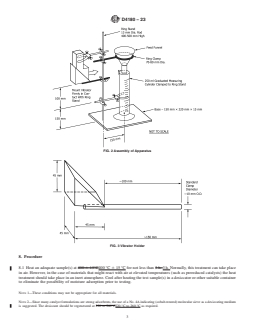
6.3 Feed Funnel, plastic, glass, or metal as shown in Fig. 1.
D3766 Terminology Relating to Catalysts and Catalysis
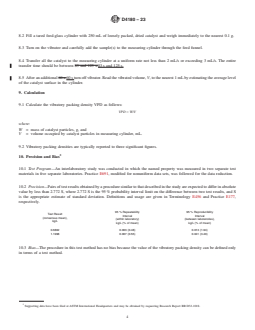
6.4 Ring Stand, Vibrator Holder and Clamps as shown in
E105 Guide for Probability Sampling of Materials
Figs. 2 and 3.
E122 Practice for Calculating Sample Size to Estimate, With
Specified Precision, the Average for a Characteristic of a
6.5 Desiccator, with a desiccant grade molecular sieve such
Lot or Process
as a No. 4A.
E177 Practice for Use of the Terms Precision and Bias in
6.6 Balance having sensitivity of 0.1 g.
ASTM Test Methods
6.7 Drying Oven.
E456 Terminology Relating to Quality and Statistics
7. Sampling
This test method is under the jurisdiction of ASTM Committee D32 on 7.1 Test sample(s) shall be obtained from larger composites
Catalysts and is the direct responsibility of Subcommittee D32.02 on Physical-
by riffling or splitting in accordance with subsection 5.12 of
Mechanical Properties.
Current edition approved Oct. 1, 2023. Published October 2023. Originally
approved in 1988. Last previous edition approved in 2018 as D4180 – 13 (2018). The sole source of supply of the vibrator known to the committee at this time
DOI: 10.1520/D4180-23. is Wahl Clipper Corp., Sterling, IL. Model 4120 used at low speed is recommended
For referenced ASTM standards, visit the ASTM website, www.astm.org, or to replace Model 4180, which is discontinued. If you are aware of alternative
contact ASTM Customer Service at service@astm.org. For Annual Book of ASTM suppliers, please provide this information to ASTM International Headquarters.
Standards volume information, refer to the standard’s Document Summary page on Your comments will receive careful consideration at a meeting of the responsible
the ASTM website. technical committee, which you may attend.
Copyright © ASTM International, 100 Barr Harbor Drive, PO Box C700, West Conshohocken, PA 19428-2959. United States
D4180 − 23
8.4 Transfer all the catalyst to the measuring cylinder at a
uniform rate not less than 2 mL/s or exceeding 3 mL/s. The
entire transfer
...
This document is not an ASTM standard and is intended only to provide the user of an ASTM standard an indication of what changes have been made to the previous version. Because
it may not be technically possible to adequately depict all changes accurately, ASTM recommends that users consult prior editions as appropriate. In all cases only the current version
of the standard as published by ASTM is to be considered the official document.
Designation: D4180 − 13 (Reapproved 2018) D4180 − 23
Standard Test Method for
Vibratory Packing Density of Formed Catalyst Particles and
Catalyst Carriers
This standard is issued under the fixed designation D4180; the number immediately following the designation indicates the year of
original adoption or, in the case of revision, the year of last revision. A number in parentheses indicates the year of last reapproval. A
superscript epsilon (´) indicates an editorial change since the last revision or reapproval.
1. Scope
1.1 This test method covers the determination of the vibratory packing density of formed catalyst and catalyst carriers. For the
purpose of this test, catalyst particles are defined as extrudates, spheres, or formed pellets of 0.80.8-mm to 4.8-mm ( ⁄32-in. to
⁄16-in.) nominal diameter.
1.2 The values stated in SI units are to be regarded as the standard. The values given in parentheses are for information only.
1.3 This standard does not purport to address all of the safety concerns, if any, associated with its use. It is the responsibility
of the user of this standard to establish appropriate safety, health, and environmental practices and determine the applicability of
regulatory limitations prior to use.
1.4 This international standard was developed in accordance with internationally recognized principles on standardization
established in the Decision on Principles for the Development of International Standards, Guides and Recommendations issued
by the World Trade Organization Technical Barriers to Trade (TBT) Committee.
2. Referenced Documents
2.1 ASTM Standards:
B215 Practices for Sampling Metal Powders
D3766 Terminology Relating to Catalysts and Catalysis
E105 Guide for Probability Sampling of Materials
E122 Practice for Calculating Sample Size to Estimate, With Specified Precision, the Average for a Characteristic of a Lot or
Process
E177 Practice for Use of the Terms Precision and Bias in ASTM Test Methods
E456 Terminology Relating to Quality and Statistics
E691 Practice for Conducting an Interlaboratory Study to Determine the Precision of a Test Method
E1272 Specification for Laboratory Glass Graduated Cylinders
3. Terminology
3.1 Definitions—See Terminology D3766.
This test method is under the jurisdiction of ASTM Committee D32 on Catalysts and is the direct responsibility of Subcommittee D32.02 on Physical-Mechanical
Properties.
Current edition approved May 1, 2018Oct. 1, 2023. Published May 2018October 2023. Originally approved in 1988. Last previous edition approved in 20132018 as
D4180 – 13.D4180 – 13 (2018). DOI: 10.1520/D4180-13R18.10.1520/D4180-23.
For referenced ASTM standards, visit the ASTM website, www.astm.org, or contact ASTM Customer Service at service@astm.org. For Annual Book of ASTM Standards
volume information, refer to the standard’s Document Summary page on the ASTM website.
Copyright © ASTM International, 100 Barr Harbor Drive, PO Box C700, West Conshohocken, PA 19428-2959. United States
D4180 − 23
4. Summary of Test Method
4.1 A preconditioned sample of formed catalyst or catalyst carrier is vibrated in a cylinder. The vibratory packing density is
determined from a known mass and vibrated volume.
5. Significance and Use
5.1 This test method is to be used for measuring the vibratory packing density of formed particles that will not break up during
sampling, filling, or vibrating of the measuring cylinder under test conditions.
6. Apparatus
6.1 Glass Cylinders, capacity 250 mL, feed and measuring, conforming to Specification E1272, Class A.
6.2 Vibrator, conventional handheld, with hard rubber or metal impactor.
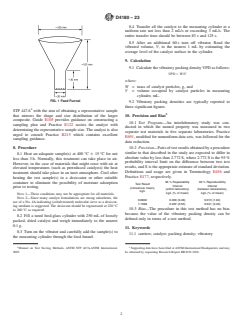
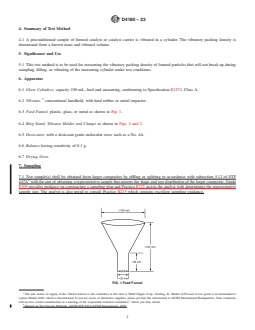
6.3 Feed Funnel, plastic, glass, or metal as shown in Fig. 1.
6.4 Ring Stand, Vibrator Holder and Clamps as shown in Figs. 2 and 3.
6.5 Desiccator, with a desiccant grade molecular sieve such as a No. 4A.
6.6 Balance having sensitivity of 0.1 g.
6.7 Drying Oven.
7. Sampling
7.1 Test sample(s) shall be obtained from larger composites by riffling or splitting in accordance with subsection 5.12 of STP
447A with the aim of obtaining a representative sample that mirrors the shape and size distribution of the larger composite. Guide
E105 provides guidance on constructing a sampling plan and Practice E122 assists the analyst with determining the representative
sample size. The analyst is also urged to consult Practice B215 which contains excellent sampling guidance.
FIG. 1 Feed Funnel
The sole source of supply of the vibrator known to the committee at this time is Wahl Clipper Corp., Sterling, IL. Model 4120 used at low speed is recommended to
replace Model 4180
...