

ASTM D6761-22a
(Test Method)Standard Test Method for Determination of the Total Pore Volume of Catalysts and Catalyst Carriers
General Information
- Abstract
SIGNIFICANCE AND USE
5.1 This test method provides for the measurement of volume of pores that are in the range of catalytic importance and possibly for adsorption processes. This test method requires the use of mercury in order to perform the measurements.
SCOPE
1.1 This test method covers the determination of the total pore volume of catalysts and catalyst carriers, that is, the volume of pores having pore diameter between approximately 14 µm and 0.4 nm (4 Å).
1.2 Units—The values stated in SI units are to be regarded as standard. No other units of measurement are included in this standard.
1.3 Warning—Mercury has been designated by many regulatory agencies as a hazardous material that can cause central nervous system, kidney, and liver damage. Mercury, or its vapor, may be hazardous to health and corrosive to materials. Caution should be taken when handling mercury and mercury containing products. See the applicable product Material Safety Data Sheet (MSDS) for details and EPA’s website—http://www.epa.gov/mercury/faq.htm—for additional information. Users should be aware that selling mercury or mercury containing products, or both, into your state or country may be prohibited by law.
1.4 This standard does not purport to address all of the safety concerns, if any, associated with its use. It is the responsibility of the user of this standard to establish appropriate safety, health, and environmental practices and determine the applicability of regulatory limitations prior to use. Specific hazard statements are given in Section 8. Warning statements are given in 10.1.4, 10.1.7, and 10.1.11.
1.5 This international standard was developed in accordance with internationally recognized principles on standardization established in the Decision on Principles for the Development of International Standards, Guides and Recommendations issued by the World Trade Organization Technical Barriers to Trade (TBT) Committee.
- Status
- Published
- Publication Date
- 31-Jul-2022
- Technical Committee
- D32 - Catalysts
- Drafting Committee
- D32.02 - Physical-Mechanical Properties
Buy Documents
ASTM D6761-22a - Standard Test Method for Determination of the Total Pore Volume of Catalysts and Catalyst Carriers
REDLINE ASTM D6761-22a - Standard Test Method for Determination of the Total Pore Volume of Catalysts and Catalyst Carriers
Overview
ASTM D6761-22a is the internationally recognized standard test method for the determination of the total pore volume of catalysts and catalyst carriers. Developed by ASTM International, this standard specifies procedures for measuring pores with diameters ranging from approximately 14 micrometers down to 0.4 nanometers (4 angstroms). This pore volume determination is crucial for evaluating the performance of materials used in catalytic and adsorption processes.
The method relies on mercury intrusion and helium pycnometry to quantify both particle and true volume, thus allowing the calculation of total pore volume. Adherence to this standardized practice enables consistent, reproducible results across laboratories and supports regulatory compliance in chemical, petrochemical, and environmental industries.
Key Topics
- Measurement Range: The standard defines total pore volume as the volume of pores between about 14 µm and 0.4 nm in diameter, which is especially important for catalyst performance.
- Technique Overview:
- Mercury Intrusion: Measures the particle volume, including accessible pores, using a specialized penetrometer and vacuum system.
- Helium Pycnometry: Determines the true volume, accounting for imprenetrable pores, via helium gas displacement.
- Sample Preparation and Apparatus: Details on sample handling, ensuring representative sampling, and required apparatus for both mercury intrusion and pycnometry techniques.
- Safety and Hazard Considerations: Emphasizes strict safety protocols for handling mercury, a hazardous and regulated substance, including necessary precautions, personal protective equipment, proper ventilation, spill management, and disposal per local regulations.
- Precision and Reproducibility: Outlines interlaboratory study data, underlining the method’s reliability and consistent outcomes.
- Regulatory Alignment: Developed following internationally recognized standards principles and relevant WTO guidelines.
Applications
The ASTM D6761-22a standard is widely employed in industries where catalyst efficiency and performance are paramount. Key applications include:
- Catalyst Quality Control: Ensures catalysts and supports possess optimal pore structures for specific chemical reactions, influencing activity, selectivity, and lifetime.
- R&D for Catalyst Design: Provides essential data for developing novel catalyst materials by enabling accurate comparison of pore characteristics.
- Adsorption Process Evaluation: Facilitates assessment of materials used in gas or liquid adsorption applications, helping evaluate efficacy for environmental controls or purification processes.
- Process Optimization: Supporting information for process engineers to select or modify catalyst carriers for improved operational efficiency.
- Regulatory Compliance: Provides verified, standardized test data for reporting and certification purposes.
Related Standards
To support comprehensive material characterization or to complement the pore volume determination, the following ASTM standards are commonly referenced:
- ASTM D3766 – Terminology Relating to Catalysts and Catalysis
- ASTM E105 – Guide for Probability Sampling of Materials
- ASTM E122 – Practice for Calculating Sample Size to Estimate, With Specified Precision, the Average for a Characteristic of a Lot or Process
- ASTM E177 – Practice for Use of the Terms Precision and Bias in ASTM Test Methods
- ASTM E456 – Terminology Relating to Quality and Statistics
- ASTM E691 – Practice for Conducting an Interlaboratory Study to Determine the Precision of a Test Method
Summary
ASTM D6761-22a is a critical standard for laboratories and technical teams working in catalyst development and quality assurance. By providing clear test methods for total pore volume determination, it ensures greater consistency, accuracy, and international acceptance in pore structure analysis. This enables informed decision-making in catalyst selection, process improvement, and product development, while also supporting environmental and safety regulations for hazardous material testing.
Relations
- Effective Date
- 01-Feb-2024
- Effective Date
- 01-Jan-2024
- Effective Date
- 01-Apr-2022
- Effective Date
- 01-Nov-2018
- Effective Date
- 01-Oct-2017
- Effective Date
- 01-Oct-2017
- Effective Date
- 01-May-2014
- Effective Date
- 15-Nov-2013
- Effective Date
- 15-Nov-2013
- Effective Date
- 15-Nov-2013
- Effective Date
- 15-Nov-2013
- Effective Date
- 15-Aug-2013
- Effective Date
- 01-May-2013
- Effective Date
- 01-May-2013
- Effective Date
- 01-Mar-2013
Buy Documents
ASTM D6761-22a - Standard Test Method for Determination of the Total Pore Volume of Catalysts and Catalyst Carriers
REDLINE ASTM D6761-22a - Standard Test Method for Determination of the Total Pore Volume of Catalysts and Catalyst Carriers
Get Certified
Connect with accredited certification bodies for this standard

ECOCERT
Organic and sustainability certification.

Eurofins Food Testing Global
Global leader in food, environment, and pharmaceutical product testing.

Intertek Bangladesh
Intertek certification and testing services in Bangladesh.
Sponsored listings
Frequently Asked Questions
ASTM D6761-22a is a standard published by ASTM International. Its full title is "Standard Test Method for Determination of the Total Pore Volume of Catalysts and Catalyst Carriers". This standard covers: SIGNIFICANCE AND USE 5.1 This test method provides for the measurement of volume of pores that are in the range of catalytic importance and possibly for adsorption processes. This test method requires the use of mercury in order to perform the measurements. SCOPE 1.1 This test method covers the determination of the total pore volume of catalysts and catalyst carriers, that is, the volume of pores having pore diameter between approximately 14 µm and 0.4 nm (4 Å). 1.2 Units—The values stated in SI units are to be regarded as standard. No other units of measurement are included in this standard. 1.3 Warning—Mercury has been designated by many regulatory agencies as a hazardous material that can cause central nervous system, kidney, and liver damage. Mercury, or its vapor, may be hazardous to health and corrosive to materials. Caution should be taken when handling mercury and mercury containing products. See the applicable product Material Safety Data Sheet (MSDS) for details and EPA’s website—http://www.epa.gov/mercury/faq.htm—for additional information. Users should be aware that selling mercury or mercury containing products, or both, into your state or country may be prohibited by law. 1.4 This standard does not purport to address all of the safety concerns, if any, associated with its use. It is the responsibility of the user of this standard to establish appropriate safety, health, and environmental practices and determine the applicability of regulatory limitations prior to use. Specific hazard statements are given in Section 8. Warning statements are given in 10.1.4, 10.1.7, and 10.1.11. 1.5 This international standard was developed in accordance with internationally recognized principles on standardization established in the Decision on Principles for the Development of International Standards, Guides and Recommendations issued by the World Trade Organization Technical Barriers to Trade (TBT) Committee.
SIGNIFICANCE AND USE 5.1 This test method provides for the measurement of volume of pores that are in the range of catalytic importance and possibly for adsorption processes. This test method requires the use of mercury in order to perform the measurements. SCOPE 1.1 This test method covers the determination of the total pore volume of catalysts and catalyst carriers, that is, the volume of pores having pore diameter between approximately 14 µm and 0.4 nm (4 Å). 1.2 Units—The values stated in SI units are to be regarded as standard. No other units of measurement are included in this standard. 1.3 Warning—Mercury has been designated by many regulatory agencies as a hazardous material that can cause central nervous system, kidney, and liver damage. Mercury, or its vapor, may be hazardous to health and corrosive to materials. Caution should be taken when handling mercury and mercury containing products. See the applicable product Material Safety Data Sheet (MSDS) for details and EPA’s website—http://www.epa.gov/mercury/faq.htm—for additional information. Users should be aware that selling mercury or mercury containing products, or both, into your state or country may be prohibited by law. 1.4 This standard does not purport to address all of the safety concerns, if any, associated with its use. It is the responsibility of the user of this standard to establish appropriate safety, health, and environmental practices and determine the applicability of regulatory limitations prior to use. Specific hazard statements are given in Section 8. Warning statements are given in 10.1.4, 10.1.7, and 10.1.11. 1.5 This international standard was developed in accordance with internationally recognized principles on standardization established in the Decision on Principles for the Development of International Standards, Guides and Recommendations issued by the World Trade Organization Technical Barriers to Trade (TBT) Committee.
ASTM D6761-22a is classified under the following ICS (International Classification for Standards) categories: 71.040.30 - Chemical reagents. The ICS classification helps identify the subject area and facilitates finding related standards.
ASTM D6761-22a has the following relationships with other standards: It is inter standard links to ASTM D3766-24a, ASTM D3766-24, ASTM E456-13a(2022)e1, ASTM D3766-08(2018), ASTM E456-13A(2017)e1, ASTM E456-13A(2017)e3, ASTM E177-14, ASTM E456-13ae1, ASTM E456-13ae2, ASTM E456-13a, ASTM E456-13ae3, ASTM E456-13, ASTM E177-13, ASTM E691-13, ASTM D3766-08(2013). Understanding these relationships helps ensure you are using the most current and applicable version of the standard.
ASTM D6761-22a is available in PDF format for immediate download after purchase. The document can be added to your cart and obtained through the secure checkout process. Digital delivery ensures instant access to the complete standard document.
Standards Content (Sample)
This international standard was developed in accordance with internationally recognized principles on standardization established in the Decision on Principles for the
Development of International Standards, Guides and Recommendations issued by the World Trade Organization Technical Barriers to Trade (TBT) Committee.
Designation: D6761 − 22a
Standard Test Method for
Determination of the Total Pore Volume of Catalysts and
Catalyst Carriers
This standard is issued under the fixed designation D6761; the number immediately following the designation indicates the year of
original adoption or, in the case of revision, the year of last revision. A number in parentheses indicates the year of last reapproval. A
superscript epsilon (´) indicates an editorial change since the last revision or reapproval.
1. Scope 2. Referenced Documents
2.1 ASTM Standards:
1.1 This test method covers the determination of the total
D3766 Terminology Relating to Catalysts and Catalysis
pore volume of catalysts and catalyst carriers, that is, the
E105 Guide for Probability Sampling of Materials
volume of pores having pore diameter between approximately
E122 Practice for Calculating Sample Size to Estimate,With
14 µm and 0.4 nm (4 Å).
Specified Precision, the Average for a Characteristic of a
1.2 Units—The values stated in SI units are to be regarded
Lot or Process
as standard. No other units of measurement are included in this E177 Practice for Use of the Terms Precision and Bias in
standard. ASTM Test Methods
E456 Terminology Relating to Quality and Statistics
1.3 Warning—Mercury has been designated by many regu-
E691 Practice for Conducting an Interlaboratory Study to
latory agencies as a hazardous material that can cause central
Determine the Precision of a Test Method
nervous system, kidney, and liver damage. Mercury, or its
vapor, may be hazardous to health and corrosive to materials. 3. Terminology
Caution should be taken when handling mercury and mercury
3.1 Definitions:
containing products. See the applicable product Material
3.1.1 particle volume, n—the volume of a particle including
Safety Data Sheet (MSDS) for details and EPA’s website—
pores into which mercury cannot penetrate at ambient pressure
http://www.epa.gov/mercury/faq.htm—for additional informa-
(smaller than approximately 14 µm diameter pore mouth).
tion. Users should be aware that selling mercury or mercury
3.1.2 true volume, n—the volume of a particle, including
containing products, or both, into your state or country may be
pores, into which helium cannot penetrate (smaller than about
prohibited by law.
approximately 0.4 nm (4 Å) diameter pore mouth).
1.4 This standard does not purport to address all of the
3.1.3 Other definitions and terms used in this test method
safety concerns, if any, associated with its use. It is the
are defined in Terminology D3766.
responsibility of the user of this standard to establish appro-
3.2 Symbols for Mercury Intrusion:
priate safety, health, and environmental practices and deter-
mine the applicability of regulatory limitations prior to use.
W = mass of sample
Specific hazard statements are given in Section 8. Warning
W = mass of sealed empty sample cell
c
statements are given in 10.1.4, 10.1.7, and 10.1.11.
W' = mass of sealed sample cell filled with mercury
C
1.5 This international standard was developed in accor-
W = mass of sealed sample cell with sample
s
dance with internationally recognized principles on standard-
W' = mass of sealed sample cell with sample filled with
S
ization established in the Decision on Principles for the
mercury
C
Development of International Standards, Guides and Recom- V = volume of mercury in empty sample cell (volume of
Hg
mendations issued by the World Trade Organization Technical sample cell)
S
V = volume of mercury in cell with sample
Barriers to Trade (TBT) Committee.
Hg
Hg
V = sample volume, cm
S
V = specific sample volume
Hg
This test method is under the jurisdiction of ASTM Committee D32 on
Catalysts and is the direct responsibility of Subcommittee D32.02 on Physical-
Mechanical Properties. For referenced ASTM standards, visit the ASTM website, www.astm.org, or
Current edition approved Aug. 1, 2022. Published August 2022. Originally contact ASTM Customer Service at service@astm.org. For Annual Book of ASTM
approved in 2002. Last previous edition approved in 2022 as D6761 – 22. DOI: Standards volume information, refer to the standard’s Document Summary page on
10.1520/D6761-22A. the ASTM website.
Copyright © ASTM International, 100 Barr Harbor Drive, PO Box C700, West Conshohocken, PA 19428-2959. United States
D6761 − 22a
V = particle volume
P
W = weight mercury reservoir after filling burette with
b
sample
W = massofmercuryreservoirafterfillingburettewithout
b'
sample
3.3 Symbols for Helium Pycnometry:
V = volume of sample cell and associated tubing, cm
C
V = reference volume, cm
R
He
V = sample volume, cm
S
V = volume of calibration cylinder, cm
Cyl
V = volume of calibration standard, cm
STD
V = specific sample volume
He
P' = pressure in empty sample cell, psig or pascals
P' = pressure in empty sample cell, after the reference
volume has been included in the system, psig or
pascals
P = pressure in sample cell with sample or calibration
standard before the reference volume has been
included in the system, psig or pascals
P = pressure with sample or calibration standard in the
sample cell, after the reference volume has been
included in the system, psig or pascals
W = tare weight of sample cup, g
W = mass of sample + tare weight of sample cup, g
FIG. 1 Schematic Diagram of Burette
W = mass of sample, g
P.V. = pore volume
4. Summary of Test Method
6.1.4 Valve, for choosing vacuum and vent, for evacuation
of the sample cell and filling the sample cell, respectively.
4.1 The total pore volume of a catalyst or catalyst carrier is
6.1.5 Valve, for rapid evacuation or venting of the system.
determined as the difference between the particle volume and
6.1.6 Valve, for controlled evacuation or venting.
the true volume, measured by mercury intrusion and helium
6.1.7 Cold Trap, or other method or device to prevent
pycnometry, respectively. The particle volume is determined
mercury vapor from being vented into the laboratory through
by mercury intrusion at ambient pressure and the true volume
the vacuum pump and to prevent contaminants from entering
is determined by helium displacement at pressures above
the vacuum pump.
ambient.
6.1.8 Pressure-Measuring Device, capable of reading in the
range 0 to 1000 torr or higher.
5. Significance and Use
6.1.9 Balance, measuring to the nearest 1 mg (60.001 g).
5.1 This test method provides for the measurement of
6.2 For Mercury Intrusion with a Burette—A schematic
volume of pores that are in the range of catalytic importance
diagram of the burette is shown in Fig. 1. It has the following
and possibly for adsorption processes. This test method re-
features:
quires the use of mercury in order to perform the measure-
6.2.1 Glass Sample Cell, with a needle valve suitable for
ments.
handling mercury. The tip, which is submerged in the mercury
reservoir, should be narrow enough so as to prevent drops of
6. Apparatus
mercury from becoming lost if the reservoir is removed for
6.1 For Mercury Intrusion:
weighing.
6.1.1 Chamber, capable of holding the sample cell (com-
6.2.2 Burette, a calibrated narrow bore tube ending in a
monly referred to as a penetrometer), which contains the
curved tip in the sample cell to prevent fine particles from
sample. This chamber must be capable of being evacuated and
passing into the burette. There is a clear mark on the burette at
contain enough mercury to fill the penetrometer.
23 cm above the curved tip.
6.1.2 Glass Sample Cell (Penetrometer),havingawidebase
6.2.3 Manifold, with a splash bulb and appropriate needle
and narrow bore stem. If the sample is powder, the penetrom-
valves for choosing either vacuum or vent.
etershouldhaveaprovisioninthebasetopreventfineparticles
6.2.4 Mercury Reservoir with Lid, capable of containing the
from passing into the stem when the cell is evacuated. The
amount of mercury necessary to fill the sample cell and burette
penetrometer must have the capability of being sealed.
while the tip of the sample cell valve is still submerged in
6.1.3 Vacuum Pump, capable of attaining pressures of less mercury. A weighing bottle of 5 cm diameter and 3 cm height
than 0.05 torr. is suitable.
D6761 − 22a
8.1.3 Washhandsimmediatelyafteranyoperationinvolving
mercury.
8.1.4 Exerciseextremecaretoavoidspillingmercury.Clean
up spills immediately using procedures recommended explic-
itly for mercury.
8.1.5 Recyclingofwastemercuryisrecommendedandtobe
conducted in accordance with local government hazardous
waste regulations. Disposal of waste mercury and mercury
FIG. 2 Pycnometer Apparatus
contaminated materials should be performed as mandated by
local government hazardous waste regulations.
6.2.5 Vacuum Pump, capable of attaining pressures of 0.05
9. Sampling
torr.
9.1 A test sample shall be obtained from larger composites
6.2.6 Cold Trap, or other method or device to prevent
by riffling or splitting in accordance with subsection 5.12 of
mercury vapor from being vented into the laboratory through
STP 447A, with the aim of obtaining a representative sample
the vacuum pump and to prevent contaminants from entering
that represents shape and size distribution of the larger com-
the vacuum pump.
posite. Guide E105 can provide guidance on constructing a
6.3 For Helium Pycnometry—A schematic diagram of the
sampling plan with the representative sample can be deter-
pycnometer apparatus is shown in Fig. 2. It should be con-
mined by Practice E122.
structed from metal and have the following features:
6.3.1 Sample Cell, having a volume suitable for the desired
10. Procedure
sample size and calibrated to the nearest 0.1 cm . This volume
10.1 For Mercury Intrusion Instruments:
is indicated in Fig. 2.
10.1.1 Weightheemptypenetrometerwithsealingdevicein
6.3.2 Reference Volume (V ), a precisely calibrated volume
R
place (W ).
C
known to the nearest 0.02 cm .
10.1.2 Place the empty penetrometer in the low pressure
6.3.3 Pressure Transducer, (0 to 25 psig or 0 to 172.3 kPa)
port of the instrument, seal it, and follow the manufacturer’s
with minimum volume displacement and linear within 0.1 %.
recommendations for evacuating the penetrometer and subse-
6.3.4 Pressure Relief Valve, set to 25 psig (172.3 kPa), to
quently filling it with mercury.
avoid overpressurization of the transducer.
10.1.3 When the penetrometer is completely filled with
6.3.5 Filter, to prevent powder from contaminating the
mercury, follow the manufacturer’s recommendations for
pressure transducer.
bringing the low pressure port to atmospheric pressure.
6.3.6 Input Flow Control Valves, to control pressurization.
10.1.4 When the low pressure port is again at atmospheric
6.3.7 Output Flow Control Valves, to vent the gas.
pressu
...
This document is not an ASTM standard and is intended only to provide the user of an ASTM standard an indication of what changes have been made to the previous version. Because
it may not be technically possible to adequately depict all changes accurately, ASTM recommends that users consult prior editions as appropriate. In all cases only the current version
of the standard as published by ASTM is to be considered the official document.
Designation: D6761 − 22 D6761 − 22a
Standard Test Method for
Determination of the Total Pore Volume of Catalysts and
Catalyst Carriers
This standard is issued under the fixed designation D6761; the number immediately following the designation indicates the year of
original adoption or, in the case of revision, the year of last revision. A number in parentheses indicates the year of last reapproval. A
superscript epsilon (´) indicates an editorial change since the last revision or reapproval.
1. Scope
1.1 This test method covers the determination of the total pore volume of catalysts and catalyst carriers, that is, the volume of pores
having pore diameter between approximately 14 μm and 0.4 nm (4 ).
1.2 Units—The values stated in SI units are to be regarded as standard. No other units of measurement are included in this
standard.
1.3 Warning—Mercury has been designated by many regulatory agencies as a hazardous material that can cause central nervous
system, kidney, and liver damage. Mercury, or its vapor, may be hazardous to health and corrosive to materials. Caution should
be taken when handling mercury and mercury containing products. See the applicable product Material Safety Data Sheet (MSDS)
for details and EPA’s website—http://www.epa.gov/mercury/faq.htm—for additional information. Users should be aware that
selling mercury or mercury containing products, or both, into your state or country may be prohibited by law.
1.4 This standard does not purport to address all of the safety concerns, if any, associated with its use. It is the responsibility
of the user of this standard to establish appropriate safety, health, and environmental practices and determine the applicability of
regulatory limitations prior to use. Specific hazard statements are given in Section 8. Warning statements are given in 10.1.4,
10.1.7, and 10.1.11.
1.5 This international standard was developed in accordance with internationally recognized principles on standardization
established in the Decision on Principles for the Development of International Standards, Guides and Recommendations issued
by the World Trade Organization Technical Barriers to Trade (TBT) Committee.
2. Referenced Documents
2.1 ASTM Standards:
D3766 Terminology Relating to Catalysts and Catalysis
E105 Guide for Probability Sampling of Materials
E122 Practice for Calculating Sample Size to Estimate, With Specified Precision, the Average for a Characteristic of a Lot or
Process
E177 Practice for Use of the Terms Precision and Bias in ASTM Test Methods
E456 Terminology Relating to Quality and Statistics
E691 Practice for Conducting an Interlaboratory Study to Determine the Precision of a Test Method
This test method is under the jurisdiction of ASTM Committee D32 on Catalysts and is the direct responsibility of Subcommittee D32.02 on Physical-Mechanical
Properties.
Current edition approved April 1, 2022Aug. 1, 2022. Published April 2022August 2022. Originally approved in 2002. Last previous edition approved in 20172022 as
D6761 – 17.D6761 – 22. DOI: 10.1520/D6761-22.10.1520/D6761-22A.
For referenced ASTM standards, visit the ASTM website, www.astm.org, or contact ASTM Customer Service at service@astm.org. For Annual Book of ASTM Standards
volume information, refer to the standard’s Document Summary page on the ASTM website.
Copyright © ASTM International, 100 Barr Harbor Drive, PO Box C700, West Conshohocken, PA 19428-2959. United States
D6761 − 22a
3. Terminology
3.1 Definitions:
3.1.1 particle volume—volume, n—the volume of a particle including pores into which mercury cannot penetrate at ambient
pressure (smaller than approximately 14 μm diameter pore mouth).
3.1.2 true volume—volume, n—the volume of a particle, including pores, into which helium cannot penetrate (smaller than about
approximately 0.4 nm (4 ) diameter pore mouth).
3.1.3 Other definitions and terms used in this test method are defined in Terminology D3766.
3.2 Symbols for Mercury Intrusion:
W = mass of sample
W = mass of sealed empty sample cell
c
W' = mass of sealed sample cell filled with mercury
C
W = mass of sealed sample cell with sample
s
W' = mass of sealed sample cell with sample filled with mercury
S
C
V = volume of mercury in empty sample cell (volume of sample cell)
Hg
S
V = volume of mercury in cell with sample
Hg
Hg
V = sample volume, cm
S
V = specific sample volume
Hg
V = particle volume
P
W = weight mercury reservoir after filling burette with sample
b
W = mass of mercury reservoir after filling burette without sample
b'
3.3 Symbols for Helium Pycnometry:
V = volume of sample cell and associated tubing, cm
C
V = reference volume, cm
R
He
V = sample volume, cm
S
V = volume of calibration cylinder, cm
Cyl
V = volume of calibration standard, cm
STD
V = specific sample volume
He
P' = pressure in empty sample cell, psig or pascals
P' = pressure in empty sample cell, after the reference volume has been included in the system, psig or pascals
P = pressure in sample cell with sample or calibration standard before the reference volume has been included in the system,
psig or pascals
P = pressure with sample or calibration standard in the sample cell, after the reference volume has been included in the
system, psig or pascals
W = tare weight of sample cup, g
W = mass of sample + tare weight of sample cup, g
W = mass of sample, g
P.V. = pore volume
4. Summary of Test Method
4.1 The total pore volume of a catalyst or catalyst carrier is determined as the difference between the particle volume and the true
volume, measured by mercury intrusion and helium pycnometry, respectively. The particle volume is determined by mercury
intrusion at ambient pressure and the true volume is determined by helium displacement at pressures above ambient.
5. Significance and Use
5.1 This test method provides for the measurement of volume of pores that are in the range of catalytic importance and possibly
for adsorption processes. This test method requires the use of mercury in order to perform the measurements.
D6761 − 22a
FIG. 1 Schematic Diagram of Burette
6. Apparatus
6.1 For Mercury Intrusion:
6.1.1 Chamber, capable of holding the sample cell (commonly referred to as a penetrometer), which contains the sample. This
chamber must be capable of being evacuated and contain enough mercury to fill the penetrometer.
6.1.2 Glass Sample Cell (Penetrometer), having a wide base and narrow bore stem. If the sample is powder, the penetrometer
should have a provision in the base to prevent fine particles from passing into the stem when the cell is evacuated. The
penetrometer must have the capability of being sealed.
6.1.3 Vacuum Pump, capable of attaining pressures of less than 0.05 torr.
6.1.4 Valve, for choosing vacuum and vent, for evacuation of the sample cell and filling the sample cell, respectively.
6.1.5 Valve, for rapid evacuation or venting of the system.
6.1.6 Valve, for controlled evacuation or venting.
6.1.7 Cold Trap, or other method or device to prevent mercury vapor from being vented into the laboratory through the vacuum
pump and to prevent contaminants from entering the vacuum pump.
6.1.8 Pressure-Measuring Device, capable of reading in the range 0 to 1000 torr or higher.
6.1.9 Balance, measuring to the nearest 1 mg (60.001 g).
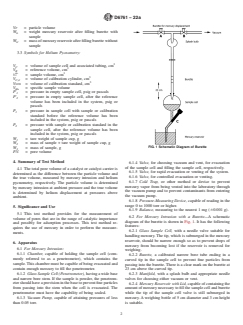
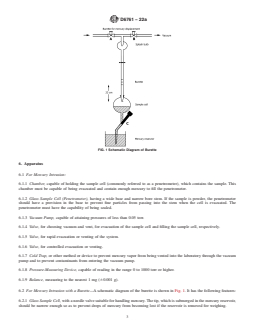
6.2 For Mercury Intrusion with a Burette—A schematic diagram of the burette is shown in Fig. 1. It has the following features:
6.2.1 Glass Sample Cell, with a needle valve suitable for handling mercury. The tip, which is submerged in the mercury reservoir,
should be narrow enough so as to prevent drops of mercury from becoming lost if the reservoir is removed for weighing.
D6761 − 22a
FIG. 2 Pycnometer Apparatus
6.2.2 Burette, a calibrated narrow bore tube ending in a curved tip in the sample cell to prevent fine particles from passing into
the burette. There is a clear mark on the burette at 23 cm above the curved tip.
6.2.3 Manifold, with a splash bulb and appropriate needle valves for choosing either vacuum or vent.
6.2.4 Mercury Reservoir with Lid, capable of containing the amount of mercury necessary to fill the sample cell and burette while
the tip of the sample cell valve is still submerged in mercury. A weighing bottle of 5 cm diameter and 3 cm height is suitable.
6.2.5 Vacuum Pump, capable of attaining pressures of 0.05 torr.
6.2.6 Cold Trap, or other method or device to prevent mercury vapor from being vented into the laboratory through the vacuum
pump and to prevent contaminants from entering the vacuum pump.
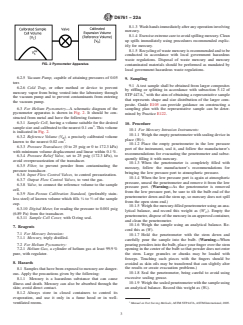
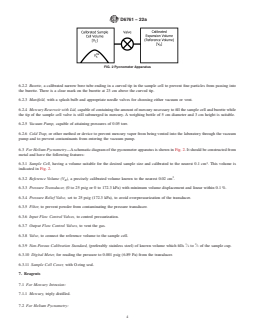
6.3 For Helium Pycnometry—A schematic diagram of the pycnometer apparatus is shown in Fig. 2. It should be constructed from
metal and have the following features:
6.3.1 Sample Cell, having a volume suitable for the desired sample size and calibrated to the nearest 0.1 cm . This volume is
indicated in Fig. 2.
6.3.2 Reference Volume (V ), a precisely calibrated volume known to the nearest 0.02 cm .
R
6.3.3 Pressure Transducer, (0 to 25 psig or 0 to 172.3 kPa) with minimum volume displacement and linear within 0.1 %.
6.3.4 Pressure Relief Valve, set to 25 psig (172.3 kPa), to avoid overpressurization of the transducer.
6.3.5 Filter, to prevent powder from contaminating the pressure transducer.
6.3.6 Input Flow Control Valves, to control pressurization.
6.3.7 Output Flow Control Valves, to vent the gas.
6.3.8 Valve, to connect the reference volume to the sample cell.
1 2
6.3.9 Non-Porous Calibration Standard, (preferably stainless steel) of known volume which fills ⁄4 to ⁄3 of the sample cup.
6.3.10 Digital Meter, for reading the pressure to 0.001 psig (6.89 Pa) from the transducer.
6.3.11 Sample Cell Cover, with O-ring seal.
7. Reagents
7.1 For Mercury Intrusion:
7.1.1 Mercury, triply distilled.
7.2 For Helium Pycnometry:
D6761 − 22a
7.2.1 Helium Gas, a cylinder of helium gas at least 99.9 % pure, with regulator.
8. Hazards
8.1 Samples that have been exposed to mercury are dangerous. Apply the precautions given by the following:
8.1.1 Mercury is a hazardous substance that can cause illness and death. Mercury can also be absorbed through the skin; avoid
direct contact.
8.1.2 Always store in closed containers to control its evaporation, and use it only in a fume hood or in well-ventilated rooms.
8.1.3 Wash hands immediately after any operation involving mercury.
8.1.4 Exercise extreme care to avoid spilling mercury. Clean up spills immediately using procedures recommended explicitly for
mercury.
8.1.5 Recycling of waste mercury is recommended and to be conducted in accordance with local government hazardous waste
regulations. Disposal of waste mercury and mercury contaminated materials should be performed as mandated by local government
hazardous waste regulat
...