

ASTM D4512-22
(Test Method)Standard Test Method for Vibrated Apparent Packing Density of Fine Catalyst and Catalyst Carrier Particles and Powder
General Information
- Abstract
SIGNIFICANCE AND USE
4.1 This test method is for measuring the apparent packing density of catalyst or catalyst carrier powders that are smaller than 0.8 mm in diameter.
SCOPE
1.1 This test method covers the determination of the apparent packing density of fine catalyst and catalyst carrier powders smaller than 0.8 mm in diameter.
1.2 Units—The values stated in SI units are to be regarded as standard. No other units of measurement are included in this standard.
1.3 This standard does not purport to address all of the safety concerns, if any, associated with its use. It is the responsibility of the user of this standard to establish appropriate safety, health, and environmental practices and determine the applicability of regulatory limitations prior to use.
1.4 This international standard was developed in accordance with internationally recognized principles on standardization established in the Decision on Principles for the Development of International Standards, Guides and Recommendations issued by the World Trade Organization Technical Barriers to Trade (TBT) Committee.
- Status
- Published
- Publication Date
- 31-Jul-2022
- Technical Committee
- D32 - Catalysts
- Drafting Committee
- D32.02 - Physical-Mechanical Properties
Buy Documents

ASTM D4512-22 - Standard Test Method for Vibrated Apparent Packing Density of Fine Catalyst and Catalyst Carrier Particles and Powder
REDLINE ASTM D4512-22 - Standard Test Method for Vibrated Apparent Packing Density of Fine Catalyst and Catalyst Carrier Particles and Powder
Overview
ASTM D4512-22: Standard Test Method for Vibrated Apparent Packing Density of Fine Catalyst and Catalyst Carrier Particles and Powder provides a recognized procedure for determining the vibrated apparent packing density of catalyst and catalyst carrier powders with particle sizes smaller than 0.8 mm in diameter. Developed by ASTM International, this test method ensures consistent, reproducible measurement of packing density, a key physical property influencing catalyst behavior and performance in a wide range of industrial applications. The standard supports both quality assurance and research activities for manufacturers and users within the chemical process industries.
Key Topics
Scope
- Applies to fine catalyst and catalyst carrier powders under 0.8 mm in diameter
- Utilizes SI units exclusively for all measurements
Significance
- Helps assess material handling, transport, and storage characteristics
- Aids in process design and optimization due to its effect on catalyst bed packing, porosity, and reactivity
Measurement Approach
- Relies on standardized apparatus: graduated cylinders, vibrators, feed funnels, ring stands, desiccators, balances, and drying ovens
- Involves controlled drying, sampling, vibration, and volume measurement procedures for accurate density calculation
Result Reporting
- Vibrated apparent packing density is calculated and reported in grams per milliliter (g/mL) to three significant figures
- Specifies precision and repeatability requirements for laboratory consistency
Safety Responsibility
- The standard highlights the need for users to establish relevant safety, health, and environmental practices
Applications
Catalyst Manufacturing:
Enables catalyst producers to analyze and control the apparent packing density of fine powders, supporting improvements in product consistency and reactor loading.Process Development:
Used by process engineers to optimize catalyst bed design-improving reactant flow dynamics, minimizing channeling, and maximizing conversion efficiency.Quality Assurance:
Provides laboratories with a reference test for batch acceptance and comparative analysis, aiding compliance with customer and regulatory requirements.Research and Development:
Supports product innovation by enabling scientists to understand how formulation changes impact density and, by extension, catalytic effectiveness.Logistics and Handling:
Informs the design of material handling, storage, and transport systems, as the bulk packing density influences container sizing, shipping costs, and safety precautions.
Related Standards
- ASTM D3766 - Terminology Relating to Catalysts and Catalysis
- ASTM E105 - Guide for Probability Sampling of Materials
- ASTM E122 - Practice for Calculating Sample Size to Estimate, With Specified Precision, the Average for a Characteristic of a Lot or Process
- ASTM E177 - Practice for Use of the Terms Precision and Bias in ASTM Test Methods
- ASTM E456 - Terminology Relating to Quality and Statistics
- ASTM E691 - Practice for Conducting an Interlaboratory Study to Determine the Precision of a Test Method
- ASTM E1272 - Specification for Laboratory Glass Graduated Cylinders
By utilizing ASTM D4512-22, organizations can ensure robust, repeatable determination of vibrated apparent packing density, contributing to better catalyst performance, safer processes, and enhanced product quality across the chemical and process industries. For more information or to obtain the official standard, consult ASTM International.
Relations
- Effective Date
- 01-Feb-2024
- Effective Date
- 01-Jan-2024
- Effective Date
- 01-Apr-2022
- Effective Date
- 01-Jan-2019
- Effective Date
- 01-Nov-2018
- Effective Date
- 01-Oct-2017
- Effective Date
- 01-Oct-2017
- Effective Date
- 01-May-2014
- Effective Date
- 15-Nov-2013
- Effective Date
- 15-Nov-2013
- Effective Date
- 15-Nov-2013
- Effective Date
- 15-Nov-2013
- Effective Date
- 15-Aug-2013
- Effective Date
- 01-May-2013
- Effective Date
- 01-May-2013
Buy Documents
ASTM D4512-22 - Standard Test Method for Vibrated Apparent Packing Density of Fine Catalyst and Catalyst Carrier Particles and Powder
REDLINE ASTM D4512-22 - Standard Test Method for Vibrated Apparent Packing Density of Fine Catalyst and Catalyst Carrier Particles and Powder
Get Certified
Connect with accredited certification bodies for this standard

ECOCERT
Organic and sustainability certification.

Eurofins Food Testing Global
Global leader in food, environment, and pharmaceutical product testing.

Intertek Bangladesh
Intertek certification and testing services in Bangladesh.
Sponsored listings
Frequently Asked Questions
ASTM D4512-22 is a standard published by ASTM International. Its full title is "Standard Test Method for Vibrated Apparent Packing Density of Fine Catalyst and Catalyst Carrier Particles and Powder". This standard covers: SIGNIFICANCE AND USE 4.1 This test method is for measuring the apparent packing density of catalyst or catalyst carrier powders that are smaller than 0.8 mm in diameter. SCOPE 1.1 This test method covers the determination of the apparent packing density of fine catalyst and catalyst carrier powders smaller than 0.8 mm in diameter. 1.2 Units—The values stated in SI units are to be regarded as standard. No other units of measurement are included in this standard. 1.3 This standard does not purport to address all of the safety concerns, if any, associated with its use. It is the responsibility of the user of this standard to establish appropriate safety, health, and environmental practices and determine the applicability of regulatory limitations prior to use. 1.4 This international standard was developed in accordance with internationally recognized principles on standardization established in the Decision on Principles for the Development of International Standards, Guides and Recommendations issued by the World Trade Organization Technical Barriers to Trade (TBT) Committee.
SIGNIFICANCE AND USE 4.1 This test method is for measuring the apparent packing density of catalyst or catalyst carrier powders that are smaller than 0.8 mm in diameter. SCOPE 1.1 This test method covers the determination of the apparent packing density of fine catalyst and catalyst carrier powders smaller than 0.8 mm in diameter. 1.2 Units—The values stated in SI units are to be regarded as standard. No other units of measurement are included in this standard. 1.3 This standard does not purport to address all of the safety concerns, if any, associated with its use. It is the responsibility of the user of this standard to establish appropriate safety, health, and environmental practices and determine the applicability of regulatory limitations prior to use. 1.4 This international standard was developed in accordance with internationally recognized principles on standardization established in the Decision on Principles for the Development of International Standards, Guides and Recommendations issued by the World Trade Organization Technical Barriers to Trade (TBT) Committee.
ASTM D4512-22 is classified under the following ICS (International Classification for Standards) categories: 71.040.30 - Chemical reagents. The ICS classification helps identify the subject area and facilitates finding related standards.
ASTM D4512-22 has the following relationships with other standards: It is inter standard links to ASTM D3766-24a, ASTM D3766-24, ASTM E456-13a(2022)e1, ASTM E1272-02(2019), ASTM D3766-08(2018), ASTM E456-13A(2017)e1, ASTM E456-13A(2017)e3, ASTM E177-14, ASTM E456-13ae1, ASTM E456-13ae2, ASTM E456-13ae3, ASTM E456-13a, ASTM E456-13, ASTM E177-13, ASTM E691-13. Understanding these relationships helps ensure you are using the most current and applicable version of the standard.
ASTM D4512-22 is available in PDF format for immediate download after purchase. The document can be added to your cart and obtained through the secure checkout process. Digital delivery ensures instant access to the complete standard document.
Standards Content (Sample)
This international standard was developed in accordance with internationally recognized principles on standardization established in the Decision on Principles for the
Development of International Standards, Guides and Recommendations issued by the World Trade Organization Technical Barriers to Trade (TBT) Committee.
Designation: D4512 − 22
Standard Test Method for
Vibrated Apparent Packing Density of Fine Catalyst and
Catalyst Carrier Particles and Powder
This standard is issued under the fixed designation D4512; the number immediately following the designation indicates the year of
original adoption or, in the case of revision, the year of last revision. A number in parentheses indicates the year of last reapproval. A
superscript epsilon (´) indicates an editorial change since the last revision or reapproval.
1. Scope 3. Terminology
1.1 This test method covers the determination of the appar- 3.1 Definitions—See Terminology D3766.
entpackingdensityoffinecatalystandcatalystcarrierpowders
4. Significance and Use
smaller than 0.8 mm in diameter.
4.1 This test method is for measuring the apparent packing
1.2 Units—The values stated in SI units are to be regarded
density of catalyst or catalyst carrier powders that are smaller
as standard. No other units of measurement are included in this
than 0.8 mm in diameter.
standard.
1.3 This standard does not purport to address all of the 5. Apparatus
safety concerns, if any, associated with its use. It is the
5.1 Graduated Glass or Plastic Cylinders,capacity100mL,
responsibility of the user of this standard to establish appro-
feed and measuring, Class A or B per Specification E1272.
priate safety, health, and environmental practices and deter-
5.2 Vibrator, conventional hand-held, with hard rubber or
mine the applicability of regulatory limitations prior to use.
metal impactor.
1.4 This international standard was developed in accor-
dance with internationally recognized principles on standard- 5.3 Feed Funnel, plastic, glass, or metal as shown in Fig. 1.
ization established in the Decision on Principles for the
5.4 Ring Stand, vibrator holder and clamps as shown in
Development of International Standards, Guides and Recom-
Figs. 2 and 3.
mendations issued by the World Trade Organization Technical
5.5 Desiccator, with a desiccant grade molecular sieve such
Barriers to Trade (TBT) Committee.
as 4A.
2. Referenced Documents
5.6 Balance, having sensitivity of 0.1 g.
2.1 ASTM Standards:
5.7 Drying Oven.
D3766 Terminology Relating to Catalysts and Catalysis
E105 Guide for Probability Sampling of Materials
6. Sample
E122 Practice for Calculating Sample Size to Estimate,With
6.1 Test sample shall be obtained from larger composites by
Specified Precision, the Average for a Characteristic of a
riffling or splitting in accordance with subsection 5.12 of STP
Lot or Process
447A with the aim of obtaining a sample that represents the
E177 Practice for Use of the Terms Precision and Bias in
particle size distribution of the larger composite. Guide E105
ASTM Test Methods
can provide guidance on constructing a sampling plan with the
E456 Terminology Relating to Quality and Statistics
representative sample size can be determined per Practice
E691 Practice for Conducting an Interlaboratory Study to
E122.
Determine the Precision of a Test Method
E1272 Specification for Laboratory Glass Graduated Cylin-
7. Procedure
ders
7.1 Heat an adequate amount of sample(s) at 400 6 15 °C
for not less than 3 h. Normally, this treatment can take place in
This test method is under the jurisdiction of ASTM Committee D32 on
Catalysts and is the direct responsibility of Subcommittee D32.02 on Physical-
Mechanical Properties. The sole source of supply of the vibrator known to the committee at this time
Current edition approved Aug. 1, 2022. Published August 2022. Originally is Wahl Clipper Corp., Sterling, IL. They recommend their Model 4120 used at low
ε1
approved in 1985. Last previous edition approved in 2018 as D4512 – 03(2018) . speed to replace their Model 4180, which is discontinued. If you are aware of
DOI: 10.1520/D4512-22. alternative suppliers, please provide this information to ASTM International
For referenced ASTM standards, visit the ASTM website, www.astm.org, or Headquarters.Your comments will receive careful consideration at a meeting of the
contact ASTM Customer Service at service@astm.org. For Annual Book of ASTM responsible technical committee, which you may attend.
Standards volume information, refer to the standard’s Document Summary page on STP 447A, Manual on Test Sieving Methods, ASTM International, West
the ASTM website. Conshohocken, PA 19428.
Copyright © ASTM International, 100 Barr Harbor Drive
...
This document is not an ASTM standard and is intended only to provide the user of an ASTM standard an indication of what changes have been made to the previous version. Because
it may not be technically possible to adequately depict all changes accurately, ASTM recommends that users consult prior editions as appropriate. In all cases only the current version
of the standard as published by ASTM is to be considered the official document.
´1
Designation: D4512 − 03 (Reapproved 2018) D4512 − 22
Standard Test Method for
Vibrated Apparent Packing Density of Fine Catalyst and
Catalyst Carrier Particles and Powder
This standard is issued under the fixed designation D4512; the number immediately following the designation indicates the year of
original adoption or, in the case of revision, the year of last revision. A number in parentheses indicates the year of last reapproval. A
superscript epsilon (´) indicates an editorial change since the last revision or reapproval.
ε NOTE—Section 6.5 was updated editorially in May 2018.
1. Scope
1.1 This test method covers the determination of the apparent packing density of fine catalyst and catalyst carrier powders smaller
than 0.8 mm in diameter.
1.2 Units—The values stated in SI units are to be regarded as standard. No other units of measurement are included in this
standard.
1.3 This standard does not purport to address all of the safety concerns, if any, associated with its use. It is the responsibility
of the user of this standard to establish appropriate safety, health, and environmental practices and determine the applicability of
regulatory limitations prior to use.
1.4 This international standard was developed in accordance with internationally recognized principles on standardization
established in the Decision on Principles for the Development of International Standards, Guides and Recommendations issued
by the World Trade Organization Technical Barriers to Trade (TBT) Committee.
2. Referenced Documents
2.1 ASTM Standards:
D3766 Terminology Relating to Catalysts and Catalysis
E105 Guide for Probability Sampling of Materials
E122 Practice for Calculating Sample Size to Estimate, With Specified Precision, the Average for a Characteristic of a Lot or
Process
E177 Practice for Use of the Terms Precision and Bias in ASTM Test Methods
E456 Terminology Relating to Quality and Statistics
E691 Practice for Conducting an Interlaboratory Study to Determine the Precision of a Test Method
E1272 Specification for Laboratory Glass Graduated Cylinders
3. Terminology
3.1 Definitions—See Terminology D3766.
This test method is under the jurisdiction of ASTM Committee D32 on Catalysts and is the direct responsibility of Subcommittee D32.02 on Physical-Mechanical
Properties.
Current edition approved May 1, 2018Aug. 1, 2022. Published June 2018August 2022. Originally approved in 1985. Last previous edition approved in 20132018 as
ε1
D4512–03(2013).D4512 – 03(2018) . DOI: 10.1520/D4512-03R18E01.10.1520/D4512-22.
For referenced ASTM standards, visit the ASTM website, www.astm.org, or contact ASTM Customer Service at service@astm.org. For Annual Book of ASTM Standards
volume information, refer to the standard’s Document Summary page on the ASTM website.
Copyright © ASTM International, 100 Barr Harbor Drive, PO Box C700, West Conshohocken, PA 19428-2959. United States
D4512 − 22
FIG. 1 Feed Funnel
4. Significance and Use
4.1 This test method is for measuring the apparent packing density of catalyst or catalyst carrier powders that are smaller than 0.8
mm in diameter.
5. Apparatus
5.1 Graduated Glass or Plastic Cylinders, capacity 100 mL, feed and measuring.measuring, Class A or B per Specification E1272.
5.2 Vibrator, conventional hand-held, with hard rubber or metal impactor.
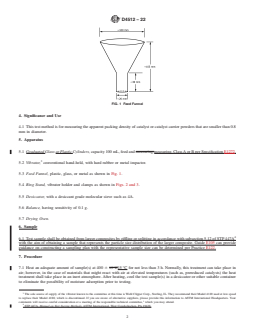
5.3 Feed Funnel, plastic, glass, or metal as shown in Fig. 1.
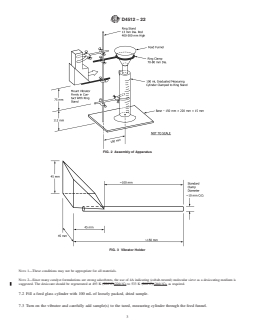
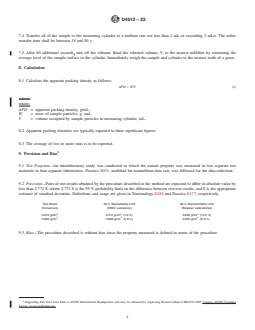
5.4 Ring Stand, vibrator holder and clamps as shown in Figs. 2 and 3.
5.5 Desiccator, with a desiccant grade molecular sieve such as 4A.
5.6 Balance, having sensitivity of 0.1 g.
5.7 Drying Oven.
6. Sample
6.1 Test sample shall be obtained from larger composites by riffling or splitting in accordance with subsection 5.12 of STP 447A
with the aim of obtaining a sample that represents the particle size distribution of the larger composite. Guide E105 can provide
guidance on constructing a sampling plan with the representative sample size can be determined per Practice E122.
7. Procedure
7.1 Heat an adequate amount of sample(s) at 400 6 15°C15 °C for not less than 3 h. Normally, this treatment can take place in
air; however, in the case of materials that might react with air at elevated temperatures (such as, prereduced catalysts) the heat
treatment shall take place in an inert atmosphere. After heating, cool the test sample(s) in a desiccator or other suitable container
to eliminate the possibility of moisture adsorption prior to te
...