

ASTM D3908-20
(Test Method)Standard Test Method for Hydrogen Chemisorption on Supported Platinum Catalysts by Volumetric Vacuum Method
General Information
- Abstract
SIGNIFICANCE AND USE
4.1 This test method sets forth a procedure by which duplicate catalyst samples can be compared either on an interlaboratory or intralaboratory basis. It is anticipated that catalyst producers and users will find this test method of value.
4.2 Discrimination of the samples for which this procedure is recommended must be exercised when considering carrier (support) materials that sorb appreciable quantities of hydrogen or could cause an alteration of the state of the catalyst during pretreatment, or both, (that is, sintering or metal occlusion). These materials must be identified by the user and experimented with to determine the most significant conditions of measurement.
4.3 This test method provides a measure of the total hydrogen uptake (volume of hydrogen at STP, cm3/g of catalyst) without specifying the nature of the hydrogen-platinum interaction. Persons interested in using hydrogen uptake data to calculate percent platinum dispersion in a specific catalyst should be aware of carrier (support) interactions, spillover effects, and other phenomena related to the hydrogen uptake capabilities of the catalyst in question.
SCOPE
1.1 This test method covers the determination of the chemisorption of hydrogen at 298 K (25 °C) on supported platinum catalysts that have been reduced in flowing hydrogen at 723 K (450 °C). It incorporates a static volumetric vacuum technique at constant volume.
1.2 The test method is intended for use on unused supported platinum on alumina catalysts of loadings greater than 0.3 weight %. Data on other supports and lower platinum loadings were not tested.
1.3 This standard does not purport to address all of the safety concerns, if any, associated with its use. It is the responsibility of the user of this standard to establish appropriate safety, health, and environmental practices and determine the applicability of regulatory limitations prior to use.
1.4 This international standard was developed in accordance with internationally recognized principles on standardization established in the Decision on Principles for the Development of International Standards, Guides and Recommendations issued by the World Trade Organization Technical Barriers to Trade (TBT) Committee.
- Status
- Published
- Publication Date
- 30-Sep-2020
- Technical Committee
- D32 - Catalysts
- Drafting Committee
- D32.01 - Physical-Chemical Properties
Buy Documents
ASTM D3908-20 - Standard Test Method for Hydrogen Chemisorption on Supported Platinum Catalysts by Volumetric Vacuum Method
REDLINE ASTM D3908-20 - Standard Test Method for Hydrogen Chemisorption on Supported Platinum Catalysts by Volumetric Vacuum Method
Overview
ASTM D3908-20: Standard Test Method for Hydrogen Chemisorption on Supported Platinum Catalysts by Volumetric Vacuum Method is a crucial international standard developed by ASTM for the chemical and petroleum industries. It establishes a consistent method for determining hydrogen chemisorption on supported platinum catalysts-especially for platinum on alumina with loading greater than 0.3 weight percent-using a volumetric vacuum technique at constant volume. This method is especially valuable for the comparative analysis of catalyst samples between and within laboratories, supporting both catalyst producers and users in quality assurance and research.
Key Topics
Hydrogen Chemisorption Analysis
This method quantifies the total hydrogen uptake (measured as volume at standard temperature and pressure per gram of catalyst) on platinum catalysts, providing insights into the surface characteristics and activity of the catalyst material.Supported Platinum Catalysts
The standard is specifically optimized for unused, reduced, platinum catalysts supported on alumina. Considerations are highlighted for carrier materials that can adsorb hydrogen or alter catalyst state during pretreatment.Volumetric Vacuum Technique
The procedure uses a static volumetric vacuum method, incorporating careful calibration, vacuum control, and precise temperature measurement for accurate data on hydrogen uptake.Interlaboratory and Intralaboratory Comparisons
ASTM D3908-20 is designed for reliable comparative studies, allowing different labs or teams to benchmark catalyst performance under standardized conditions.Precision and Bias
The standard includes guidelines for achieving reproducible results and outlines statistical approaches for handling data variation, fostering confidence in reported measurements.
Applications
Catalyst Quality Control
Producers of supported platinum catalysts use this standard to verify batch-to-batch consistency, ensuring catalysts meet performance specifications based on hydrogen chemisorption properties.Research and Development
R&D teams in chemical, petrochemical, and energy sectors apply this method to characterize new catalyst formulations, study catalyst aging, or optimize catalyst design for processes such as hydrogenation and reforming.Interlaboratory Comparison Programs
Laboratories use ASTM D3908-20 to participate in proficiency testing or collaborative studies, supporting accreditation and continuous improvement programs.Operational Troubleshooting
Plant engineers and process chemists may apply this method to diagnose catalyst deactivation or fouling by comparing hydrogen uptake data before and after service.Regulatory and Compliance Documentation
The method provides a defensible and standardized protocol for documenting catalyst performance to meet regulatory, contractual, or quality assurance requirements.
Related Standards
For broader understanding and integration into workflows, the following standards are directly referenced or commonly used alongside ASTM D3908-20:
ASTM D3766 – Terminology Relating to Catalysts and Catalysis
Defines terms essential for uniform interpretation of catalysts and chemisorption data.ASTM E177 – Practice for Use of the Terms Precision and Bias in ASTM Test Methods
Provides guidance on reporting repeatability and reproducibility in test results.ASTM E456 – Terminology Relating to Quality and Statistics
Supports the statistical treatment of chemisorption data.ASTM E691 – Practice for Conducting an Interlaboratory Study to Determine the Precision of a Test Method
Used for designing and analyzing precision testing between labs.
Keywords: hydrogen chemisorption, supported platinum catalysts, volumetric vacuum method, catalyst testing, ASTM D3908-20, catalyst quality control, hydrogen uptake, catalyst R&D.
Relations
- Effective Date
- 01-Feb-2024
- Effective Date
- 01-Jan-2024
- Effective Date
- 01-Apr-2022
- Effective Date
- 01-Nov-2018
- Effective Date
- 01-Oct-2017
- Effective Date
- 01-Oct-2017
- Effective Date
- 01-May-2014
- Effective Date
- 15-Nov-2013
- Effective Date
- 15-Nov-2013
- Effective Date
- 15-Nov-2013
- Effective Date
- 15-Nov-2013
- Effective Date
- 15-Aug-2013
- Effective Date
- 01-May-2013
- Effective Date
- 01-May-2013
- Effective Date
- 01-Mar-2013
Buy Documents
ASTM D3908-20 - Standard Test Method for Hydrogen Chemisorption on Supported Platinum Catalysts by Volumetric Vacuum Method
REDLINE ASTM D3908-20 - Standard Test Method for Hydrogen Chemisorption on Supported Platinum Catalysts by Volumetric Vacuum Method
Get Certified
Connect with accredited certification bodies for this standard

ECOCERT
Organic and sustainability certification.

Eurofins Food Testing Global
Global leader in food, environment, and pharmaceutical product testing.

Intertek Bangladesh
Intertek certification and testing services in Bangladesh.
Sponsored listings
Frequently Asked Questions
ASTM D3908-20 is a standard published by ASTM International. Its full title is "Standard Test Method for Hydrogen Chemisorption on Supported Platinum Catalysts by Volumetric Vacuum Method". This standard covers: SIGNIFICANCE AND USE 4.1 This test method sets forth a procedure by which duplicate catalyst samples can be compared either on an interlaboratory or intralaboratory basis. It is anticipated that catalyst producers and users will find this test method of value. 4.2 Discrimination of the samples for which this procedure is recommended must be exercised when considering carrier (support) materials that sorb appreciable quantities of hydrogen or could cause an alteration of the state of the catalyst during pretreatment, or both, (that is, sintering or metal occlusion). These materials must be identified by the user and experimented with to determine the most significant conditions of measurement. 4.3 This test method provides a measure of the total hydrogen uptake (volume of hydrogen at STP, cm3/g of catalyst) without specifying the nature of the hydrogen-platinum interaction. Persons interested in using hydrogen uptake data to calculate percent platinum dispersion in a specific catalyst should be aware of carrier (support) interactions, spillover effects, and other phenomena related to the hydrogen uptake capabilities of the catalyst in question. SCOPE 1.1 This test method covers the determination of the chemisorption of hydrogen at 298 K (25 °C) on supported platinum catalysts that have been reduced in flowing hydrogen at 723 K (450 °C). It incorporates a static volumetric vacuum technique at constant volume. 1.2 The test method is intended for use on unused supported platinum on alumina catalysts of loadings greater than 0.3 weight %. Data on other supports and lower platinum loadings were not tested. 1.3 This standard does not purport to address all of the safety concerns, if any, associated with its use. It is the responsibility of the user of this standard to establish appropriate safety, health, and environmental practices and determine the applicability of regulatory limitations prior to use. 1.4 This international standard was developed in accordance with internationally recognized principles on standardization established in the Decision on Principles for the Development of International Standards, Guides and Recommendations issued by the World Trade Organization Technical Barriers to Trade (TBT) Committee.
SIGNIFICANCE AND USE 4.1 This test method sets forth a procedure by which duplicate catalyst samples can be compared either on an interlaboratory or intralaboratory basis. It is anticipated that catalyst producers and users will find this test method of value. 4.2 Discrimination of the samples for which this procedure is recommended must be exercised when considering carrier (support) materials that sorb appreciable quantities of hydrogen or could cause an alteration of the state of the catalyst during pretreatment, or both, (that is, sintering or metal occlusion). These materials must be identified by the user and experimented with to determine the most significant conditions of measurement. 4.3 This test method provides a measure of the total hydrogen uptake (volume of hydrogen at STP, cm3/g of catalyst) without specifying the nature of the hydrogen-platinum interaction. Persons interested in using hydrogen uptake data to calculate percent platinum dispersion in a specific catalyst should be aware of carrier (support) interactions, spillover effects, and other phenomena related to the hydrogen uptake capabilities of the catalyst in question. SCOPE 1.1 This test method covers the determination of the chemisorption of hydrogen at 298 K (25 °C) on supported platinum catalysts that have been reduced in flowing hydrogen at 723 K (450 °C). It incorporates a static volumetric vacuum technique at constant volume. 1.2 The test method is intended for use on unused supported platinum on alumina catalysts of loadings greater than 0.3 weight %. Data on other supports and lower platinum loadings were not tested. 1.3 This standard does not purport to address all of the safety concerns, if any, associated with its use. It is the responsibility of the user of this standard to establish appropriate safety, health, and environmental practices and determine the applicability of regulatory limitations prior to use. 1.4 This international standard was developed in accordance with internationally recognized principles on standardization established in the Decision on Principles for the Development of International Standards, Guides and Recommendations issued by the World Trade Organization Technical Barriers to Trade (TBT) Committee.
ASTM D3908-20 is classified under the following ICS (International Classification for Standards) categories: 71.040.30 - Chemical reagents. The ICS classification helps identify the subject area and facilitates finding related standards.
ASTM D3908-20 has the following relationships with other standards: It is inter standard links to ASTM D3766-24a, ASTM D3766-24, ASTM E456-13a(2022)e1, ASTM D3766-08(2018), ASTM E456-13A(2017)e3, ASTM E456-13A(2017)e1, ASTM E177-14, ASTM E456-13ae3, ASTM E456-13a, ASTM E456-13ae1, ASTM E456-13ae2, ASTM E456-13, ASTM E177-13, ASTM E691-13, ASTM D3766-08(2013). Understanding these relationships helps ensure you are using the most current and applicable version of the standard.
ASTM D3908-20 is available in PDF format for immediate download after purchase. The document can be added to your cart and obtained through the secure checkout process. Digital delivery ensures instant access to the complete standard document.
Standards Content (Sample)
This international standard was developed in accordance with internationally recognized principles on standardization established in the Decision on Principles for the
Development of International Standards, Guides and Recommendations issued by the World Trade Organization Technical Barriers to Trade (TBT) Committee.
Designation: D3908 − 20
Standard Test Method for
Hydrogen Chemisorption on Supported Platinum Catalysts
by Volumetric Vacuum Method
This standard is issued under the fixed designation D3908; the number immediately following the designation indicates the year of
original adoption or, in the case of revision, the year of last revision.Anumber in parentheses indicates the year of last reapproval.A
superscript epsilon (´) indicates an editorial change since the last revision or reapproval.
1. Scope 3. Terminology
3.1 Definitions—See Terminology D3766.
1.1 This test method covers the determination of the
chemisorption of hydrogen at 298 K (25°C) on supported
3.2 Quality and Statistics—See Terminology E456.
platinum catalysts that have been reduced in flowing hydrogen
3.3 Precision and Bias—See Practice E177.
at 723K (450°C). It incorporates a static volumetric vacuum
technique at constant volume.
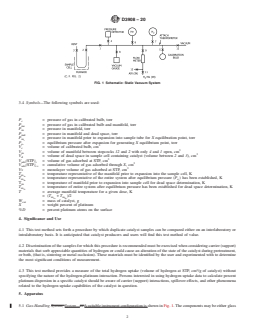
3.4 Symbols—The following symbols are used:
1.2 Thetestmethodisintendedforuseonunusedsupported
platinum on alumina catalysts of loadings greater than 0.3
P = pressure of gas in calibrated bulb, torr
c
weight %. Data on other supports and lower platinum loadings
P = pressure of gas in calibrated bulb and
mc
were not tested.
manifold, torr
1.3 This standard does not purport to address all of the P = pressure in manifold, torr
m
P = pressure in manifold and dead space, torr
safety concerns, if any, associated with its use. It is the
md
P = pressure in manifold prior to expansion into
responsibility of the user of this standard to establish appro-
m
x
sample tube for X equilibration point, torr
priate safety, health, and environmental practices and deter-
P = equilibrium pressure after expansion for gen-
e
mine the applicability of regulatory limitations prior to use.
x
erating X equilibrium point, torr
1.4 This international standard was developed in accor-
V = volume of calibrated bulb, cm
c
dance with internationally recognized principles on standard-
V = volume of manifold between stopcocks 12
m
ization established in the Decision on Principles for the
and 2 with only 4 and 1 open, cm
Development of International Standards, Guides and Recom-
V = volume of dead space in sample cell contain-
d
mendations issued by the World Trade Organization Technical 3
ing catalyst (volume between 2 and 3), cm
Barriers to Trade (TBT) Committee.
V (STP) = volume of gas adsorbed at STP, cm
ads x
V (STP) = cumulative volume of gas adsorbed through
ads cx
2. Referenced Documents
X,cm
V = monolayer volume of gas adsorbed at STP,
S
2.1 ASTM Standards:
cm
D3766Terminology Relating to Catalysts and Catalysis
T = temperature representative of the manifold
m
Ax
E177Practice for Use of the Terms Precision and Bias in
prior to expansion into the sample cell, K
ASTM Test Methods
T = temperature representative of the entire sys-
m
Bx
E456Terminology Relating to Quality and Statistics
tem after equilibrium pressure (P ) has been
e
x
E691Practice for Conducting an Interlaboratory Study to
established, K
Determine the Precision of a Test Method
T = temperature of manifold prior to expansion
m
intosamplecellfordeadspacedetermination,
K
T = temperatureofentiresystemafterequilibrium
This test method is under the jurisdiction of ASTM Committee D32 on
m
D
Catalysts and is the direct responsibility of Subcommittee D32.01 on Physical-
pressure has been established for dead space
Chemical Properties.
determination, K
Current edition approved Oct. 1, 2020. Published November 2020. Originally
T = average manifold temperature for a given
approved in 1980. Last previous edition approved in 2015 as D3908–03(2015).
dose, K
DOI: 10.1520/D3908-20.
For referenced ASTM standards, visit the ASTM website, www.astm.org, or
=(T + T )/2
m m
Ax Bx
contact ASTM Customer Service at service@astm.org. For Annual Book of ASTM
W = mass of catalyst, g
cat
Standards volume information, refer to the standard’s Document Summary page on
X = weight percent of platinum
the ASTM website.
Copyright © ASTM International, 100 Barr Harbor Drive, PO Box C700, West Conshohocken, PA 19428-2959. United States
D3908 − 20
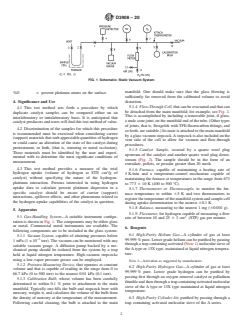
FIG. 1 Schematic: Static Vacuum System
manifold. One should make sure that the glass blowing is
%D = percent platinum atoms on the surface
sufficiently far removed from the calibrated volume to avoid
4. Significance and Use
distortion.
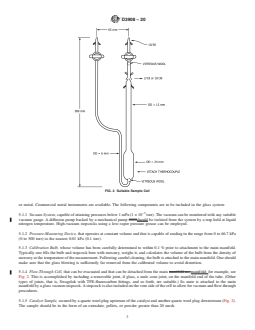
5.1.4 Flow-Through Cell,thatcanbeevacuatedandthatcan
4.1 This test method sets forth a procedure by which
be detached from the main manifold; for example, see Fig. 2.
duplicate catalyst samples can be compared either on an
This is accomplished by including a removable joint, if glass,
interlaboratory or intralaboratory basis. It is anticipated that
amaleconejoint,onthemanifoldendofthetube.(Othertypes
catalystproducersanduserswillfindthistestmethodofvalue.
ofjoints,thatis,SwagelokwithTFE-fluorocarbonfittings,and
4.2 Discrimination of the samples for which this procedure
soforth,aresuitable.)Itsmateisattachedtothemainmanifold
is recommended must be exercised when considering carrier
byaglassvacuumstopcock.Astopcockisalsoincludedonthe
(support)materialsthatsorbappreciablequantitiesofhydrogen
vent side of the cell to allow for vacuum and flow-through
or could cause an alteration of the state of the catalyst during
procedures.
pretreatment, or both, (that is, sintering or metal occlusion).
5.1.5 Catalyst Sample, secured by a quartz wool plug
These materials must be identified by the user and experi-
upstream of the catalyst and another quartz wool plug down-
mented with to determine the most significant conditions of
stream (Fig. 2). The sample should be in the form of an
measurement.
extrudate, pellets, or powder greater than 20 mesh.
4.3 This test method provides a measure of the total
5.1.6 Furnace, capable of maintaining a heating rate of
hydrogen uptake (volume of hydrogen at STP, cm /g of
5K⁄min and a temperature-control mechanism capable of
catalyst) without specifying the nature of the hydrogen-
maintaining the furnace at temperatures in the range from 673
platinum interaction. Persons interested in using hydrogen
to 773 6 10 K (400 to 500°C).
uptake data to calculate percent platinum dispersion in a
5.1.7 Thermometer or Thermocouple, to monitor the fur-
specific catalyst should be aware of carrier (support)
nace temperature to within 65 K and two thermometers to
interactions, spillover effects, and other phenomena related to
registerthetemperatureofthemanifoldsystemandsamplecell
the hydrogen uptake capabilities of the catalyst in question.
during uptake determination to the nearest 60.1 K.
5.1.8 Balance, measuring to the nearest 1 mg (60.001 g).
5. Apparatus
5.1.9 Flowmeter, for hydrogen capable of measuring a flow
5.1 Gas-Handling System—A suitable instrument configu-
rate of between 10 and 25 63cm (STP) gas per minute.
ration is shown in Fig. 1. The components may be either glass
or metal. Commercial metal instruments are available. The
6. Reagents
following components are to be included in the glass system:
6.1 High-Purity Helium Gas—A cylinder of gas at least
5.1.1 Vacuum System, capable of attaining pressures below
−5
99.999%pure.Lowergradeheliumcanbepurifiedbypassing
1 mPa (1×10 torr). The vacuum can be monitored with any
throughatrapcontainingactivated(Note1)molecularsieveof
suitable vacuum gauge. A diffusion pump backed by a me-
theAtype or 13X type, maintained at liquid nitrogen tempera-
chanical pump should be isolated from the system by a trap
ture.
held at liquid nitrogen temperature. High-vacuum stopcocks
using a low-vapor pressure grease can be employed.
NOTE 1—Activation as suggested by manufacturer.
5.1.2 Pressure-Measuring Device, that operates at constant
6.2 High-Purity Hydrogen Gas—A cylinder of gas at least
volume and that is capable of reading in the range from 0 to
99.999% pure. Lower grade hydrogen can be purified by
66.7 kPa (0 to 500 torr) to the nearest 0.01 kPa (0.1 torr).
passing first through an oxygen removal catalyst or palladium
5.1.3 Calibration Bulb, whose volume has been carefully
thimbleandthenthroughatrapcontainingactivatedmolecular
determined to within 0.1 % prior to attachment to the main
sieve of the A type or 13X type maintained at liquid nitrogen
manifold. Typically one fills the bulb and stopcock bore with
temperature.
mercury, weighs it, and calculates the volume of the bulb from
the density of mercury at the temperature of the measurement. 6.3 High-Purity Cylinder Air, purified by passing through a
Following careful cleaning, the bulb is attached to the main trap containing activated molecular sieve of the A series.
D3908 − 20
knownwithhighaccuracytoensureaccuratehydrogenuptake.
Recalibrate the system if any changes are made to the system.
The volume of the standard bulb shown in the diagram was
previously measured (see 5.1.3). Expansion of a known pres-
sure of gas into the evacuated system will allow a determina-
tion of system volume. The following steps are recommended
forsystemcalibration.RefertoFig.1forlocationofnumbered
stopcocks.
NOTE 2—Commercial instruments may differ slightly in the procedure
for calibrating their manifold or have automated calibration procedures.
Follow the instrument manufacturer’s guidelines for the procedure and
frequency of manifold calibrations.
8.1.1 Evacuatemainmanifoldbyopeningstopcocks 1, 4, 5,
8, and 12 with all others closed.
8.1.2 Close stopcocks 12 and 8 and introduce helium to the
system by opening 6.After establishment of a pressure of less
than one atmosphere, close 6. Record the pressure (P ).
c
8.1.3
...
This document is not an ASTM standard and is intended only to provide the user of an ASTM standard an indication of what changes have been made to the previous version. Because
it may not be technically possible to adequately depict all changes accurately, ASTM recommends that users consult prior editions as appropriate. In all cases only the current version
of the standard as published by ASTM is to be considered the official document.
Designation: D3908 − 03 (Reapproved 2015) D3908 − 20
Standard Test Method for
Hydrogen Chemisorption on Supported Platinum Catalysts
by Volumetric Vacuum Method
This standard is issued under the fixed designation D3908; the number immediately following the designation indicates the year of
original adoption or, in the case of revision, the year of last revision. A number in parentheses indicates the year of last reapproval. A
superscript epsilon (´) indicates an editorial change since the last revision or reapproval.
1. Scope
1.1 This test method covers the determination of the chemisorption of hydrogen at 298 K (25°C)(25 °C) on supported platinum
catalysts that have been reduced in flowing hydrogen at 723 K (450°C).(450 °C). It incorporates a static volumetric vacuum
technique at constant volume.
1.2 The test method is intended for use on unused supported platinum on alumina catalysts of loadings greater than 0.3 weight
%. Data on other supports and lower platinum loadings were not tested.
1.3 This standard does not purport to address all of the safety concerns, if any, associated with its use. It is the responsibility
of the user of this standard to establish appropriate safety safety, health, and healthenvironmental practices and determine the
applicability of regulatory limitations prior to use.
1.4 This international standard was developed in accordance with internationally recognized principles on standardization
established in the Decision on Principles for the Development of International Standards, Guides and Recommendations issued
by the World Trade Organization Technical Barriers to Trade (TBT) Committee.
2. Referenced Documents
2.1 ASTM Standards:
D3766 Terminology Relating to Catalysts and Catalysis
E177 Practice for Use of the Terms Precision and Bias in ASTM Test Methods
E456 Terminology Relating to Quality and Statistics
E691 Practice for Conducting an Interlaboratory Study to Determine the Precision of a Test Method
3. Terminology
3.1 Definitions—See Terminology D3766.
3.2 Quality and Statistics—See Terminology E456.
3.3 Precision and Bias—See Practice E177.
This test method is under the jurisdiction of ASTM Committee D32 on Catalysts and is the direct responsibility of Subcommittee D32.01 on Physical-Chemical
Properties.
Current edition approved April 1, 2015Oct. 1, 2020. Published June 2015November 2020. Originally approved in 1980. Last previous edition approved in 20082015 as
D3908 – 03 (2008).(2015). DOI: 10.1520/D3908-03R15.10.1520/D3908-20.
For referenced ASTM standards, visit the ASTM website, www.astm.org, or contact ASTM Customer Service at service@astm.org. For Annual Book of ASTM Standards
volume information, refer to the standard’s Document Summary page on the ASTM website.
Copyright © ASTM International, 100 Barr Harbor Drive, PO Box C700, West Conshohocken, PA 19428-2959. United States
D3908 − 20
FIG. 1 Schematic: Static Vacuum System
3.4 Symbols—The following symbols are used:
P = pressure of gas in calibrated bulb, torr
c
P = pressure of gas in calibrated bulb and manifold, torr
mc
P = pressure in manifold, torr
m
P = pressure in manifold and dead space, torr
md
P = pressure in manifold prior to expansion into sample tube for X equilibration point, torr
m
x
P = equilibrium pressure after expansion for generating X equilibrium point, torr
e
x
V = volume of calibrated bulb, cm
c
V = volume of manifold between stopcocks 12 and 2 with only 4 and 1 open, cm
m
V = volume of dead space in sample cell containing catalyst (volume between 2 and 3), cm
d
V (STP) = volume of gas adsorbed at STP, cm
ads x
V (STP) = cumulative volume of gas adsorbed through X, cm
ads cx
V = monolayer volume of gas adsorbed at STP, cm
S
T = temperature representative of the manifold prior to expansion into the sample cell, K
m
Ax
T = temperature representative of the entire system after equilibrium pressure (P ) has been established, K
m e
Bx x
T = temperature of manifold prior to expansion into sample cell for dead space determination, K
m
T = temperature of entire system after equilibrium pressure has been established for dead space determination, K
m
D
T = average manifold temperature for a given dose, K
= (T + T )/2
m m
Ax Bx
W = mass of catalyst, g
cat
X = weight percent of platinum
%D = percent platinum atoms on the surface
4. Significance and Use
4.1 This test method sets forth a procedure by which duplicate catalyst samples can be compared either on an interlaboratory or
intralaboratory basis. It is anticipated that catalyst producers and users will find this test method of value.
4.2 Discrimination of the samples for which this procedure is recommended must be exercised when considering carrier (support)
materials that sorb appreciable quantities of hydrogen or could cause an alteration of the state of the catalyst during pretreatment,
or both, (that is, sintering or metal occlusion). These materials must be identified by the user and experimented with to determine
the most significant conditions of measurement.
4.3 This test method provides a measure of the total hydrogen uptake (volume of hydrogen at STP, cm /g of catalyst) without
specifying the nature of the hydrogen-platinum interaction. Persons interested in using hydrogen uptake data to calculate percent
platinum dispersion in a specific catalyst should be aware of carrier (support) interactions, spillover effects, and other phenomena
related to the hydrogen uptake capabilities of the catalyst in question.
5. Apparatus
5.1 Gas-Handling System, System—as A suitable instrument configuration is shown in Fig. 1. The components may be either glass
D3908 − 20
FIG. 2 Suitable Sample Cell
or metal. Commercial metal instruments are available. The following components are to be included in the glass system:
−5
5.1.1 Vacuum System, capable of attaining pressures below 1 mPa (1 × 10 torr). The vacuum can be monitored with any suitable
vacuum gauge. A diffusion pump backed by a mechanical pump mustshould be isolated from the system by a trap held at liquid
nitrogen temperature. High-vacuum stopcocks using a low-vapor pressure grease can be employed.
5.1.2 Pressure-Measuring Device, that operates at constant volume and that is capable of reading in the range from 0 to 66.7 kPa
(0 to 500 torr) to the nearest 0.01 kPa (0.1 torr).
5.1.3 Calibration Bulb, whose volume has been carefully determined to within 0.1 % prior to attachment to the main manifold.
Typically one fills the bulb and stopcock bore with mercury, weighs it, and calculates the volume of the bulb from the density of
mercury at the temperature of the measurement. Following careful cleaning, the bulb is attached to the main manifold. One should
make sure that the glass blowing is sufficiently far removed from the calibrated volume to avoid distortion.
5.1.4 Flow-Through Cell, that can be evacuated and that can be detached from the main manifold as, manifold; for example, see
Fig. 2. This is accomplished by including a removable joint, if glass, a male cone joint, on the manifold end of the tube. (Other
types of joints, that is, Swagelok with TFE-fluorocarbon fittings, and so forth, are suitable.) Its mate is attached to the main
manifold by a glass vacuum stopcock. A stopcock is also included on the vent side of the cell to allow for vacuum and flow-through
procedures.
5.1.5 Catalyst Sample, secured by a quartz wool plug upstream of the catalyst and another quartz wool plug downstream (Fig. 2).
The sample should be in the form of an extrudate, pellets, or powder greater than 20 mesh.
D3908 − 20
5.1.6 Furnace, capable of maintaining a heating rate of 5 K ⁄min and a temperature-control mechanism capable of maintaining the
furnace at temperatures in the range from 673 to 773 6 10 K (400 to 500°C).500 °C).
5.1.7 Thermometer or Thermocouple, to monitor the furnace temperature to within 65 K and two thermometers to register the
temperature of the manifold system and sample cell during uptake determination to the nearest 60.1 K.
5.1.8 Balance, measuring to the nearest 1 mg (60.001 g).
5.1.9 Flowmeter, for hydrogen capable of measuring a flow rate of between 10 and 25 6 3 cm (STP) gas per minute.
5.2 Gas Purification Facilities , for helium and hydrogen.
6. Reagents
6.1 High-Purity Helium, Helium Gas—A cylinder of gas at least 99.999 % pure. Lower grade helium can be purified by passing
through a trap containing activated (Note 1) molecular sieve of the A type or 13X type, maintained at liquid nitrogen temperature.
NOTE 1—Activation as suggested by manufacturer.
6.2 High-Purity Hydrogen, Hydrogen Gas—A cylinder of gas at least 99.999 % pure. Lower grade hydrogen can be purified by
passing first through an oxygen removal catalyst or palladium thimble and then through a trap containing activated molecular sieve
of the A type or 13X type maintained at liquid nitrogen temperature.
6.3 High-Purity Cylinder Air, purified by passing through a trap containing activated molecular sieve of the A series.
7. Safety Hazards
7.1 Follow the usual precautions associated with handling hydrogen gas. Keep any gas cylinders separated from any oxidizing
reagents. Adequately vent the hydrogen flow at the roughing pump discharge and vent the sample (stopcock 3). A flash arresting
check valve and pressure relief valves or safety manometers should be incorporated into the design of the apparatus.
7.2 Adequately tape or otherwise shield glass reservoirs to avoid unrestricted explosion in the event of an over-fill and to avoid
flying glass in the event of an implosion during evacuation.
7.3 Eye protection is essential when operating the vacuum system.
7.4 Avoid accidental formation of mixtures of hydrogen and air at all times.
8. Volume Calibrations
8.1 The reliability of any gas adsorption measurement is naturally dependent on the accuracy with which the system volume is
known. It is therefore essential that the manifold volume be frequently determined very car
...