

ASTM E3206-19
(Guide)Standard Guide for Reporting the Physical and Chemical Characteristics of a Collection of Nano-Objects
General Information
- Abstract
SIGNIFICANCE AND USE
5.1 A nano-object is an individual, well-defined, and separable piece of a nanomaterial; in practice, nanomaterials used in research, products, testing, and other uses are almost always collections of nano-objects. Individual nano-objects and collections of nano-objects are the two major types of nanomaterials in use. The description of a collection of nano-objects is covered in this guide. The description of an individual nano-object is covered in Guide E3144. Nano-objects, individually or as a collection, are often embedded in other materials for commercial, research, and other uses. These embedded nanomaterials can be described using the information categories and descriptors included in these guides.
5.2 Nanomaterials are of growing importance in research and commerce, and data on their physical and chemical characteristics are critical to predict performance, to transact commercial activities, to assess their potential for harm to human and animal health and the environment in general, and to support regulations that affect their use. A collection of nano-objects is the predominant type of nanomaterial tested and used in commerce.
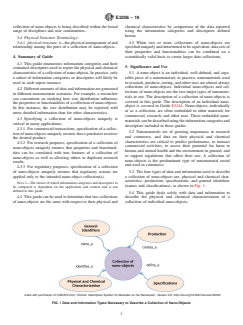
5.3 The four types of data and information used to describe a collection of nano-objects are: physical and chemical characteristics; production; specifications; and general identifiers (names and classifications), as shown in Fig. 1.
FIG. 1 Data and Information Types Necessary to Describe a Collection of Nano-Objects
Used with permission of CODATA from “Uniform Description System for Materials on the Nanoscale,” Version 2.0, http://doi.org/10.5281/zenodo.56720.
5.4 This guide deals solely with data and information to describe the physical and chemical characterization of a collection of individual nano-objects.
Note 2: Other guides and documents (see Section 2, Referenced Documents) deal with the data and information for production, specifications, and general identifiers (names and classifications).
Note 3: Specifi...
SCOPE
1.1 This guide provides guidelines for a description system to report the physical and chemical characteristics of collections of nano-objects. It establishes information categories and descriptors useful in describing collections of nano-objects uniquely and such that the equivalency of two or more collections of nano-objects can be determined according to specific criteria.
1.2 This guide is designed to be directly applicable to reporting the physical and chemical characteristics of collections of nano-objects in most circumstances, including, but not limited to, reporting original research results in the archival literature, developing ontologies, database schemas, data repositories, and data reporting formats, specifying regulations, and enabling commercial activity.
1.3 This guide is applicable to collections of naturally occurring, engineered, and manufactured nano-objects.
1.4 One goal of the guide is to help ensure that when measurement results are reported, they are reported uniformly.
1.5 A second goal of the guide is to encourage reports on the properties and functionalities of a collection of nano-objects to include as much detail as possible about the physical and chemical characteristics of that collection so it is uniquely specified.
1.6 This guide does not cover the chemical reactions or reactivity of a collection of nano-objects.
1.7 The values stated in SI units are to be regarded as standard. No other units of measurement are included in this standard.
1.8 This standard does not purport to address all of the safety concerns, if any, associated with its use. It is the responsibility of the user of this standard to establish appropriate safety, health, and environmental practices and determine the applicability of regulatory limitations prior to use.
1.9 This international standard was developed in accordance with internationally recognized principles on standardization establishe...
- Status
- Published
- Publication Date
- 14-Nov-2019
- Technical Committee
- E56 - Nanotechnology
- Drafting Committee
- E56.01 - Informatics and Terminology
Overview
ASTM E3206-19 is the Standard Guide for Reporting the Physical and Chemical Characteristics of a Collection of Nano-Objects. Established by ASTM International, this guide provides a systematic framework for consistently reporting the intrinsic properties of collections of nano-objects, such as nanoparticles, nanotubes, or other material fragments within the nanoscale. As nanomaterials are predominantly utilized and studied as collections rather than isolated entities, the need for uniform and comprehensive characterization has become critical for research, commerce, regulation, and data management.
This standard aims to ensure that collections of nano-objects are described in a way that allows for meaningful comparison, reproducibility, and regulatory compliance. It provides guidelines on the categories of information and descriptors needed to uniquely specify and compare such collections, helping stakeholders in academia, industry, and government to communicate nano-object characteristics effectively.
Key Topics
- Definition of Collection of Nano-Objects: Two or more nano-objects grouped or associated by physical, chemical, or processing conditions.
- Information Categories: The guide specifies eight primary categories for describing collections:
- General information (origin, size, homogeneity)
- Composition (identification and amounts of constituents)
- Size distribution (range, mean, median, measurement methods)
- Physical structure (arrangement and regularity of nano-objects)
- Association (aggregation, agglomeration, attachment)
- Interfaces (boundaries, preparation, residues)
- Surface (composition, charge, preparation)
- Topology (connectivity, spatial relations)
- Descriptors: Each information category uses quantitative and qualitative descriptors to capture essential characteristics and properties.
- Uniqueness and Equivalency: The guide addresses how to uniquely specify a collection and determine if different collections are equivalent based on their reported characteristics.
- Applicability: The guide applies to collections of naturally occurring, engineered, and manufactured nano-objects.
Applications
ASTM E3206-19 serves as a critical tool in various real-world applications, including:
- Research and Development: Facilitates uniform reporting of nano-object collection characteristics in scientific literature and data repositories, enhancing reproducibility and meta-analysis.
- Product Development and Commercialization: Ensures clear and comparable material specifications for procurement, quality assurance, and supply chain management.
- Regulatory Compliance: Supports the submission of comprehensive data for safety assessments, environmental impact, and compliance with governmental or international regulation on nanomaterials.
- Data Integration and Ontologies: Underpins the development of ontologies, database schemas, and data sharing platforms, supporting FAIR (Findable, Accessible, Interoperable, Reusable) data principles in nanotechnology.
- Risk Assessment and Safety: Provides a basis for assessing the equivalency of nano-object collections and aggregating datasets for hazard or exposure evaluations.
Related Standards
To achieve comprehensive reporting and support interoperability, ASTM E3206-19 references and complements the following standards:
- ASTM E3144 - Guide for Reporting the Physical and Chemical Characteristics of Individual Nano-Objects
- ASTM E3172 - Guide for Reporting Production Information and Data for Nano-Objects
- ASTM E2456 - Terminology Relating to Nanotechnology
- ISO/TS 80004-1 - Nanotechnologies - Vocabulary - Part 1: Core Terms
- ISO/TS 12805 - Nanotechnologies - Materials Specifications - Guidance on Specifying Nano-Objects
- CODATA Uniform Description System for Materials on the Nanoscale
By aligning with these related standards, ASTM E3206-19 fosters consistency and clarity in the field of nanomaterial characterization.
Keywords: ASTM E3206-19, nano-objects characterization, nanomaterial collections, nanotechnology, physical and chemical properties, reporting guidelines, standardized descriptors, size distribution, aggregation, agglomeration, interfaces, nanotechnology regulations, nanoparticle testing, surface characterization.
Relations
- Effective Date
- 01-Jan-2024
- Effective Date
- 01-Sep-2019
- Effective Date
- 01-Jun-2018
- Effective Date
- 01-Jul-2016
- Effective Date
- 01-Dec-2014
- Effective Date
- 01-Aug-2012
- Effective Date
- 01-Jun-2011
- Effective Date
- 01-Jan-2011
- Effective Date
- 01-Feb-2010
- Effective Date
- 01-Jul-2008
- Effective Date
- 01-Jul-2007
- Effective Date
- 01-Oct-2006
- Effective Date
- 10-Jul-2003
- Effective Date
- 10-Aug-2000
- Effective Date
- 15-Nov-2019
Frequently Asked Questions
ASTM E3206-19 is a guide published by ASTM International. Its full title is "Standard Guide for Reporting the Physical and Chemical Characteristics of a Collection of Nano-Objects". This standard covers: SIGNIFICANCE AND USE 5.1 A nano-object is an individual, well-defined, and separable piece of a nanomaterial; in practice, nanomaterials used in research, products, testing, and other uses are almost always collections of nano-objects. Individual nano-objects and collections of nano-objects are the two major types of nanomaterials in use. The description of a collection of nano-objects is covered in this guide. The description of an individual nano-object is covered in Guide E3144. Nano-objects, individually or as a collection, are often embedded in other materials for commercial, research, and other uses. These embedded nanomaterials can be described using the information categories and descriptors included in these guides. 5.2 Nanomaterials are of growing importance in research and commerce, and data on their physical and chemical characteristics are critical to predict performance, to transact commercial activities, to assess their potential for harm to human and animal health and the environment in general, and to support regulations that affect their use. A collection of nano-objects is the predominant type of nanomaterial tested and used in commerce. 5.3 The four types of data and information used to describe a collection of nano-objects are: physical and chemical characteristics; production; specifications; and general identifiers (names and classifications), as shown in Fig. 1. FIG. 1 Data and Information Types Necessary to Describe a Collection of Nano-Objects Used with permission of CODATA from “Uniform Description System for Materials on the Nanoscale,” Version 2.0, http://doi.org/10.5281/zenodo.56720. 5.4 This guide deals solely with data and information to describe the physical and chemical characterization of a collection of individual nano-objects. Note 2: Other guides and documents (see Section 2, Referenced Documents) deal with the data and information for production, specifications, and general identifiers (names and classifications). Note 3: Specifi... SCOPE 1.1 This guide provides guidelines for a description system to report the physical and chemical characteristics of collections of nano-objects. It establishes information categories and descriptors useful in describing collections of nano-objects uniquely and such that the equivalency of two or more collections of nano-objects can be determined according to specific criteria. 1.2 This guide is designed to be directly applicable to reporting the physical and chemical characteristics of collections of nano-objects in most circumstances, including, but not limited to, reporting original research results in the archival literature, developing ontologies, database schemas, data repositories, and data reporting formats, specifying regulations, and enabling commercial activity. 1.3 This guide is applicable to collections of naturally occurring, engineered, and manufactured nano-objects. 1.4 One goal of the guide is to help ensure that when measurement results are reported, they are reported uniformly. 1.5 A second goal of the guide is to encourage reports on the properties and functionalities of a collection of nano-objects to include as much detail as possible about the physical and chemical characteristics of that collection so it is uniquely specified. 1.6 This guide does not cover the chemical reactions or reactivity of a collection of nano-objects. 1.7 The values stated in SI units are to be regarded as standard. No other units of measurement are included in this standard. 1.8 This standard does not purport to address all of the safety concerns, if any, associated with its use. It is the responsibility of the user of this standard to establish appropriate safety, health, and environmental practices and determine the applicability of regulatory limitations prior to use. 1.9 This international standard was developed in accordance with internationally recognized principles on standardization establishe...
SIGNIFICANCE AND USE 5.1 A nano-object is an individual, well-defined, and separable piece of a nanomaterial; in practice, nanomaterials used in research, products, testing, and other uses are almost always collections of nano-objects. Individual nano-objects and collections of nano-objects are the two major types of nanomaterials in use. The description of a collection of nano-objects is covered in this guide. The description of an individual nano-object is covered in Guide E3144. Nano-objects, individually or as a collection, are often embedded in other materials for commercial, research, and other uses. These embedded nanomaterials can be described using the information categories and descriptors included in these guides. 5.2 Nanomaterials are of growing importance in research and commerce, and data on their physical and chemical characteristics are critical to predict performance, to transact commercial activities, to assess their potential for harm to human and animal health and the environment in general, and to support regulations that affect their use. A collection of nano-objects is the predominant type of nanomaterial tested and used in commerce. 5.3 The four types of data and information used to describe a collection of nano-objects are: physical and chemical characteristics; production; specifications; and general identifiers (names and classifications), as shown in Fig. 1. FIG. 1 Data and Information Types Necessary to Describe a Collection of Nano-Objects Used with permission of CODATA from “Uniform Description System for Materials on the Nanoscale,” Version 2.0, http://doi.org/10.5281/zenodo.56720. 5.4 This guide deals solely with data and information to describe the physical and chemical characterization of a collection of individual nano-objects. Note 2: Other guides and documents (see Section 2, Referenced Documents) deal with the data and information for production, specifications, and general identifiers (names and classifications). Note 3: Specifi... SCOPE 1.1 This guide provides guidelines for a description system to report the physical and chemical characteristics of collections of nano-objects. It establishes information categories and descriptors useful in describing collections of nano-objects uniquely and such that the equivalency of two or more collections of nano-objects can be determined according to specific criteria. 1.2 This guide is designed to be directly applicable to reporting the physical and chemical characteristics of collections of nano-objects in most circumstances, including, but not limited to, reporting original research results in the archival literature, developing ontologies, database schemas, data repositories, and data reporting formats, specifying regulations, and enabling commercial activity. 1.3 This guide is applicable to collections of naturally occurring, engineered, and manufactured nano-objects. 1.4 One goal of the guide is to help ensure that when measurement results are reported, they are reported uniformly. 1.5 A second goal of the guide is to encourage reports on the properties and functionalities of a collection of nano-objects to include as much detail as possible about the physical and chemical characteristics of that collection so it is uniquely specified. 1.6 This guide does not cover the chemical reactions or reactivity of a collection of nano-objects. 1.7 The values stated in SI units are to be regarded as standard. No other units of measurement are included in this standard. 1.8 This standard does not purport to address all of the safety concerns, if any, associated with its use. It is the responsibility of the user of this standard to establish appropriate safety, health, and environmental practices and determine the applicability of regulatory limitations prior to use. 1.9 This international standard was developed in accordance with internationally recognized principles on standardization establishe...
ASTM E3206-19 is classified under the following ICS (International Classification for Standards) categories: 07.120 - Nanotechnologies. The ICS classification helps identify the subject area and facilitates finding related standards.
ASTM E3206-19 has the following relationships with other standards: It is inter standard links to ASTM D16-24, ASTM E3144-19, ASTM E3172-18, ASTM D16-16, ASTM D16-14, ASTM D16-12, ASTM D16-11a, ASTM D16-11, ASTM D16-10, ASTM D16-08, ASTM D16-07, ASTM E2456-06, ASTM D16-03, ASTM D16-00, ASTM E3247-20. Understanding these relationships helps ensure you are using the most current and applicable version of the standard.
ASTM E3206-19 is available in PDF format for immediate download after purchase. The document can be added to your cart and obtained through the secure checkout process. Digital delivery ensures instant access to the complete standard document.
Standards Content (Sample)
This international standard was developed in accordance with internationally recognized principles on standardization established in the Decision on Principles for the
Development of International Standards, Guides and Recommendations issued by the World Trade Organization Technical Barriers to Trade (TBT) Committee.
Designation: E3206 − 19
Standard Guide for
Reporting the Physical and Chemical Characteristics of a
Collection of Nano-Objects
This standard is issued under the fixed designation E3206; the number immediately following the designation indicates the year of
original adoption or, in the case of revision, the year of last revision. A number in parentheses indicates the year of last reapproval. A
superscript epsilon (´) indicates an editorial change since the last revision or reapproval.
1. Scope responsibility of the user of this standard to establish appro-
priate safety, health, and environmental practices and deter-
1.1 This guide provides guidelines for a description system
mine the applicability of regulatory limitations prior to use.
to report the physical and chemical characteristics of collec-
1.9 This international standard was developed in accor-
tions of nano-objects. It establishes information categories and
dance with internationally recognized principles on standard-
descriptors useful in describing collections of nano-objects
ization established in the Decision on Principles for the
uniquely and such that the equivalency of two or more
Development of International Standards, Guides and Recom-
collections of nano-objects can be determined according to
mendations issued by the World Trade Organization Technical
specific criteria.
Barriers to Trade (TBT) Committee.
1.2 This guide is designed to be directly applicable to
reporting the physical and chemical characteristics of collec-
2. Referenced Documents
tions of nano-objects in most circumstances, including, but not
2.1 ASTM Standards:
limited to, reporting original research results in the archival
D16 TerminologyforPaint,RelatedCoatings,Materials,and
literature, developing ontologies, database schemas, data
Applications
repositories,anddatareportingformats,specifyingregulations,
E2456 Terminology Relating to Nanotechnology
and enabling commercial activity.
E3172 Guide for Reporting Production Information and
1.3 This guide is applicable to collections of naturally
Data for Nano-Objects
occurring, engineered, and manufactured nano-objects.
E3144 Guide for Reporting the Physical and Chemical
Characteristics of Nano-Objects
1.4 One goal of the guide is to help ensure that when
2.2 ISO Standards:
measurement results are reported, they are reported uniformly.
ISO 26824:2013(en) Particle Characterization of Particulate
1.5 Asecondgoaloftheguideistoencouragereportsonthe
Systems – Vocabulary
properties and functionalities of a collection of nano-objects to
ISO/TS 12805:2011(en) Nanotechnologies – Materials
include as much detail as possible about the physical and
Specifications – Guidance on Specifying Nano-Objects
chemical characteristics of that collection so it is uniquely
ISO/TS 80004-1:2015(en) Nanotechnologies –Vocabulary –
specified.
Part 1: Core Terms
1.6 This guide does not cover the chemical reactions or
2.3 Other Documents:
reactivity of a collection of nano-objects.
The Uniform Description System for Materials on the
Nanoscale CODATA-VAMAS Working Group on the De-
1.7 The values stated in SI units are to be regarded as
scription of Nanomaterials, as released on 25 May 2016
standard. No other units of measurement are included in this
standard.
1.8 This standard does not purport to address all of the
For referenced ASTM standards, visit the ASTM website, www.astm.org, or
safety concerns, if any, associated with its use. It is the
contact ASTM Customer Service at service@astm.org. For Annual Book of ASTM
Standards volume information, refer to the standard’s Document Summary page on
the ASTM website.
Available from International Organization for Standardization (ISO), ISO
This guide is under the jurisdiction of ASTM Committee E56 on Nanotech- Central Secretariat, BIBC II, Chemin de Blandonnet 8, CP 401, 1214 Vernier,
nology and is the direct responsibility of Subcommittee E56.01 on Informatics and Geneva, Switzerland, http://www.iso.org.
Terminology. Available from Committee on Data (CODATA) International Science Council,
Current edition approved Nov. 15, 2019. Published December 2019. DOI: 5 rue Auguste Vacquerie, 75016 Paris, France, https://www.codata.org/
10.1520/E3206-19. nanomaterials.
Copyright © ASTM International, 100 Barr Harbor Drive, PO Box C700, West Conshohocken, PA 19428-2959. United States
E3206 − 19
3. Terminology 3.3.3 collection of nano-objects, n—two or more nano-
objects that are associated in some way.
3.1 Definitions—Fordefinitionsofgeneraltermsusedinthis
3.3.3.1 Discussion—The nano-objects in a collection can be
standard, see ASTM Online Terminology Dictionary of Engi-
5 physically associated, such as in an aggregate or agglomerate,
neering Science and Technology.
or a simple grouping, such as a commercial batch of nano-
3.2 Data Description Definitions:
objects, or some combination thereof.
3.2.1 descriptor, n—numericaldataortextthatexpressesthe
3.3.3.2 Discussion—A collection of nano-objects and indi-
measurement, observation, or calculational result of some
vidual nano-objects are the two major types of nanomaterials.
aspect of an object.
3.3.4 engineered nanomaterial, n—nanomaterial designed
3.2.1.1 Discussion—A descriptor conveys both the seman-
for specific purpose or function.
tics of the results as well as the result itself.
ISO/TS 80004-1:2015(en), 2.8
3.2.2 information category, n—a set or group of related
3.3.5 equivalency, n—the ability of a description system to
descriptors that represent a property, characteristic, interaction,
establish that two objects as assessed by different disciplines or
performance, or other feature of an object.
user communities are the same according to specified criteria.
3.2.2.1 Discussion—Information categories may be hierar-
3.3.5.1 Discussion—In this guide, equivalency is the ability
chical and contain subcategories (referred to as such), each
to establish that two nano-objects are the same according to
containing a set of descriptors.
specified criteria.
3.2.2.2 Discussion—Information categories and their sub-
categories are constructed to convey understanding of the 3.3.6 manufactured nanomaterial, n—nanomaterial inten-
tionally produced to have selected properties or composition.
structure, properties, features, and performance of an object.
3.2.2.3 Discussion—A descriptor can occur in more than ISO/TS 80004-1:2015(en), 2.9
one information category.
3.3.7 nanomaterial, n—material with any external dimen-
3.2.2.4 Discussion—It is the responsibility of the owner of
sion in the nanoscale or having internal structure or surface
data or information resources using an information category to
structure in the nanoscale. ISO/TS 80004-1:2015(en), 2.4
ensure that data and information redundancy is adequately
3.3.8 nano-object, n—discrete piece of material with one,
addressed.
two or three external dimensions in the nanoscale.
3.3 Nanomaterials Terminology:
ISO/TS 80004-1:2015(en), 2.10
3.3.1 agglomerate, n—collection of weakly or medium-
3.3.8.1 Discussion—The second and third external dimen-
strongly bounded nano-objects where the resulting external
sions are orthogonal to the first dimension and to each other.
surface area is similar to the sum of the surface areas of the
ISO/TS 80004-1:2015(en), 2.5
individual components.
3.3.8.2 Discussion—A nano-object is the smallest unit of
3.3.1.1 Discussion—The forces holding an agglomerate to-
nanomaterial that exists as a separate functional entity.
gether are weak forces, for example, van der Waals forces, or
3.3.8.3 Discussion—Amultilayer structure that is the small-
simple physical entanglement.
est unit of nanomaterial with a specific functionality is defined
3.3.1.2 Discussion—Agglomerates are also termed second-
herein to be a nano-object (see 3.3.7).
ary nano-objects and the original sources of nano-objects are
3.3.9 nano-object feature, n—a distinctive aspect of a nano-
termed primary nano-objects.
object.
3.3.1.3 Discussion—Adapted from ISO 26824:2013(en),
3.3.9.1 Discussion—A nano-object feature can occur any-
1.2, with the substitution of “nano-objects” for “particles” in
where within or upon the nano-object.
the definition and the Discussions.
3.3.9.2 Discussion—Within this guide, the term nano-object
3.3.2 aggregate, n—comprising strongly bonded or fused
feature is sometimes referred to simply as a feature.
nano-objects where the resulting external surface area is
3.3.10 naturally-occurring nanomaterial, n—a nanomate-
significantly smaller than the sum of surface areas of the
rial made exclusively by natural processes.
individual components.
3.3.10.1 Discussion—A naturally occurring nanomaterial,
3.3.2.1 Discussion—The forces holding an aggregate to-
when altered in any way by a process planned or controlled by
gether are strong forces, for example, covalent or ionic bonds,
humans, is, by definition, an engineered or manufactured
or those resulting from sintering or complex physical
nanomaterial.
entanglement, or otherwise combined former primary nano-
3.3.10.2 Discussion—Ananomaterial produced by a natural
objects.
process not planned or controlled by humans, for example,
3.3.2.2 Discussion—Aggregates are also termed secondary
digestion or weathering of a rock, is naturally occurring.
nano-objects and the original sources of nano-objects are
3.3.10.3 Discussion—There are instances when it is am-
termed primary nano-objects.
biguous or difficult to say whether a nanomaterial is naturally
3.3.2.3 Discussion—Adapted from ISO 26824:2013(en),
occurring, engineered, or manufactured.
1.2, with the substitution of “nano-objects” for “particles” in
the definition and the Discussions. 3.3.11 uniquely, adv—the quality of having uniqueness.
3.3.12 uniqueness, n—the ability of a description system to
differentiate one collection of nano-objects from every other
ASTM Online Terminology Dictionary of Engineering Science and Technology,
available from ASTM International, ASTM Stock Number: DEFONLINE. collection of nano-objects and to establish which specific
E3206 − 19
collection of nano-objects is being described within the broad chemical characteristics by comparison of the data reported
range of disciplines and user communities. using the information categories and descriptors defined
herein.
3.4 Physical Structure Terminology:
3.4.1 physical structure, n—thephysicalarrangementofand 4.5 When two or more collections of nano-objects are
relationship among the parts of a collection of nano-objects. specifieduniquelyanddeterminedtobeequivalent,datasetsof
their properties and functionalities can be combined on a
4. Summary of Guide scientifically valid basis to create larger data collections.
4.1 This guide enumerates information categories and their
5. Significance and Use
contained descriptors used to report the physical and chemical
characteristics of a collection of nano-objects. In practice, only 5.1 A nano-object is an individual, well-defined, and sepa-
a subset of information categories or descriptors will likely be rable piece of a nanomaterial; in practice, nanomaterials used
used in each report instance. in research, products, testing, and other uses are almost always
collections of nano-objects. Individual nano-objects and col-
4.2 Different amounts of data and information are generated
lections of nano-objects are the two major types of nanomate-
in different measurement scenarios. For example, a researcher
rials in use. The description of a collection of nano-objects is
can concentrate on studying how size distribution influences
covered in this guide. The description of an individual nano-
the properties or functionalities of a collection of nano-objects.
object is covered in Guide E3144. Nano-objects, individually
In this instance, the size distribution may be reported with
or as a collection, are often embedded in other materials for
more detailed information than for other characteristics.
commercial, research, and other uses. These embedded nano-
4.3 Specifying a collection of nano-objects uniquely is
materialscanbedescribedusingtheinformationcategoriesand
critical in many applications.
descriptors included in these guides.
4.3.1 For commercial transactions, specification of a collec-
5.2 Nanomaterials are of growing importance in research
tion of nano-objects uniquely ensures that a purchaser receives
and commerce, and data on their physical and chemical
the desired product.
characteristics are critical to predict performance, to transact
4.3.2 For research purposes, specification of a collection of
commercial activities, to assess their potential for harm to
nano-objects uniquely ensures that properties and functional-
human and animal health and the environment in general, and
ities can be correlated with true features of a collection of
to support regulations that affect their use. A collection of
nano-objects as well as allowing others to duplicate research
nano-objects is the predominant type of nanomaterial tested
results.
and used in commerce.
4.3.3 For regulatory purposes, specification of a collection
of nano-objects uniquely ensures that regulatory actions are 5.3 The four types of data and information used to describe
applied only to the intended nano-object collection(s). a collection of nano-objects are: physical and chemical char-
acteristics; production; specifications; and general identifiers
NOTE 1—The choice of which information categories and descriptors to
(names and classifications), as shown in Fig. 1.
be compared is dependent on the application and context and is not
defined in this guide.
5.4 This guide deals solely with data and information to
4.4 This guide can be used to determine that two collections describe the physical and chemical characterization of a
of nano-objects are the same with respect to their physical and collection of individual nano-objects.
Used with permission of CODATA from “Uniform Description System for Materials on the Nanoscale,” Version 2.0, http://doi.org/10.5281/zenodo.56720.
FIG. 1 Data and Information Types Necessary to Describe a Collection of Nano-Objects
E3206 − 19
NOTE 2—Other guides and documents (see Section 2, Referenced
instruments used to measure these properties can greatly
Documents) deal with the data and information for production,
influence the property value, when available, the measurement
specifications, and general identifiers (names and classifications).
result being used should include as much information as
NOTE 3—Specifications are formal or informal documents that provide
possible about the measurement conditions.
guidance on specifying the composition, structure, or any other aspect of
a nano-object or a collection of nano-objects.
5.10 This guide is designed for use whenever the data and
5.5 In a practical sense, the amount of data and information information on the physical and chemical characteristics of a
collection of nano-objects are reported.
reported to describe the physical and chemical characteristics
of a collection of nano-objects differs widely depending on
6. Collections of Nano-Objects
who is reporting and the reason they are reporting. Researchers
6.1 The production and use of nanomaterials can be done on
examining specific aspects of a collection of nano-objects can
a “bottoms-up” basis resulting in a single individual nano-
choose to report a limited subset of characteristics. For
object,orona“top-down”approachresultinginacollectionof
example,atestreportonthepotentialtoxicityofacollectionof
identical, similar, or dissimilar nano-objects. Collections of
nano-objects can choose to report numerous characteristics.
nano-objects are the subject of this guide.
This guide supports both limited and complete reporting of
characteristics enumerated herein.
6.2 A collection of nano-objects is created either deliber-
ately or through natural interactions and occurs during
5.6 The science of characterizing collections of nano-
production, shipment, testing, and use. In most cases, the
objects is still evolving. Some information categories will
reactivity of individual nano-objects means that on a practical
require additional descriptors as new knowledge is developed.
scale, it is difficult to produce, manipulate, or use an individual
Some descriptors can become obsolete. Users should consult
nano-object in isolation of all other nano-objects.
the latest guide for the most complete recommendations.
NOTE 4—There are exceptions when one considers applications such as
5.7 The technology for collecting, storing, analyzing, and
are being explored in the manipulation of quantum dots for creating qubits
disseminating scientific and technical data continues to evolve,
for quantum computing applications, or the delivery of a drug via an
and tools such as ontologies, database schemas, data repository
individual nano-object.
reporting requirements, and data recoding formats are evolving
6.3 A collection is differentiated from bulk materials with
similarly. This guide provides a clear, English language defi-
nano-objects in that a collection only contains nano-objects.
nition of information categories and descriptors used to de-
NOTE 5—There remains the ambiguity of an individual nano-object that
scribeacollectionofnano-objectsthatcanbeusedintheseand
has acquired adherents such as a full corona or partial coverage. In these
other similar tools.
cases, using the information categories for an individual nano-object is
preferred.
5.8 A collection of nano-objects has properties and func-
tionalities that are measured under specific measurement con- 6.4 A collection of nano-objects can be homogeneous,
ditions.Thedescriptionofacollectionofnano-objectsrequires
composed of one type of nano-object, or heterogeneous,
data and information on its properties as well as on the composed of two or more different types of nano-objects.
conditions under which those properties were measured, as
Because of the wide diversity of possible collections, consid-
shown in Fig. 2.
erable thought must be given to the details of accurately
describing a collection.
5.9 The characteristics of a collection of nano-objects de-
fined in this guide address the important physical and chemical 6.5 Agglomerates and aggregates of nano-objects are con-
properties of that collection. Because the techniques and sidered collections.
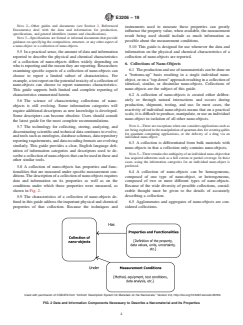
Used with permission of CODATA from “Uniform Description System for Materials on the Nanoscale,” Version 2.0, http://doi.org/10.5281/zenodo.56720.
FIG. 2 Data and Information Components Necessary to Describe a Nanomaterial and Its Properties
E3206 − 19
6.6 Nano-objects rarely are produced one at a time, though 7.1.5 Sampling of a collection itself might change charac-
“bottoms-up” construction of a nano-object does happen. teristics of the collection, adding to or reducing, for example,
Therefore, the initial production or manufacturing of nano- the amount of association through a change of conditions.
objects routinely produces collections. As a collection of 7.1.6 Simple activities such as storage and transportation
nano-objects proceeds from initial manufacture to testing or can create conditions that also alter the characteristics of a
use in a product, the collection undergoes a life cycle that collection.
includes additional processing steps. Each step along the way 7.1.7 Collections can be characterized using the eight cat-
is likely to produce or change the nature and characteristics of egories of information listed in Table 1 and shown in Fig. 3.
the collection. This guide is applicable to describing a collec-
7.2 General Information:
tion at e
...