

ASTM E3144-19
(Guide)Standard Guide for Reporting the Physical and Chemical Characteristics of Nano-Objects
General Information
- Abstract
SIGNIFICANCE AND USE
5.1 A nano-object is an individual, well-defined, and separable piece of a nanomaterial; in practice, nanomaterials used in research, products, testing, and other uses are usually collections of nano-objects. Individual nano-objects and collections of nano-objects are the two major types of nanomaterials in use. The description of an individual nano-object is covered in this guide; the description of collections of nano-objects (for example, two or more individual nano-objects) is not covered in this guide.
5.2 Nanomaterials are of growing importance in research and commerce, and data on their physical and chemical characteristics are critical to predict performance, to transact commercial activities, to assess their potential for harm to human and animal health and the environment in general, and to support regulations that affect their use. To describe nanomaterials, whether for research or commerce, it is important to be able to describe an individual nano-object.
5.3 When in a liquid environment, a nano-object may attract a non-permanent “halo” of water or other solvent molecules; such a non-permanent halo is not described by the present guide.
5.4 In contrast, coatings and coronas are semi-permanent or permanent adherents on time scales commensurate with testing procedures; coatings and coronas can fundamentally transform one nano-object to another in terms of its characteristics and can be described using this guide.
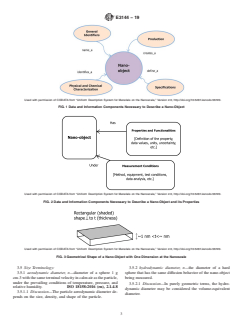
5.5 The four types of data and information used to describe a nano-object are: physical and chemical characteristics; production; specifications; and general identifiers (names and classifications), as shown in Fig. 1.
5.6 This guide deals solely with data and information to describe the physical and chemical characterization of an individual nano-object.
Note 2: Other guides and documents (see Section 2, Referenced Documents) deal with the data and information for production, specifications, and general identifiers (names and cla...
SCOPE
1.1 This guide provides guidelines for a description system for reporting the physical and chemical characteristics of individual nano-objects. It establishes information categories and descriptors useful in describing individual nano-objects uniquely and such that the equivalency of two or more individual nano-objects can be determined according to specific criteria.
1.2 This guide is designed to be directly applicable to reporting the physical and chemical characteristics of nano-objects in every circumstance, including but not limited to reporting original research results in the archival literature, developing ontologies, database schemas, data repositories, and data reporting formats, specifying regulations, and enabling commercial activity.
1.3 This guide is applicable to naturally-occurring, engineered, and manufactured nano-objects.
1.4 One goal of the guide is to help ensure that when measurement results are reported, they are reported uniformly.
1.5 A second goal of the guide is to encourage reports on the properties and functionalities of a nano-object to include as much detail as possible about the physical and chemical characteristics of that nano-object so it is uniquely specified.
1.6 This guide does not cover the chemical reactions or reactivity of a nano-object.
1.7 The values stated in SI units are to be regarded as standard. No other units of measurement are included in this standard.
1.8 This standard does not purport to address all of the safety concerns, if any, associated with its use. It is the responsibility of the user of this standard to establish appropriate safety, health, and environmental practices and determine the applicability of regulatory limitations prior to use.
1.9 This international standard was developed in accordance with internationally recognized principles on standardization established in the Decision on Principles for the Development of International ...
- Status
- Published
- Publication Date
- 31-Aug-2019
- Technical Committee
- E56 - Nanotechnology
- Drafting Committee
- E56.01 - Informatics and Terminology
Overview
ASTM E3144-19: Standard Guide for Reporting the Physical and Chemical Characteristics of Nano-Objects provides a comprehensive framework for the systematic description and reporting of individual nano-objects. Developed by ASTM International, this guide establishes information categories and descriptors that enable scientists, regulators, and industry professionals to uniquely specify the physical and chemical characteristics of nano-objects, regardless of their origin-naturally occurring, engineered, or manufactured. Consistent reporting facilitates data comparison, replication of research, regulatory compliance, and successful commercialization in the rapidly growing field of nanotechnology.
Key Topics
- Individual Nano-Object Focus: The guide specifically addresses the characterization and reporting of individual nano-objects, not collections or aggregates.
- Information Categories: It identifies six primary information categories essential for comprehensive reporting:
- Shape
- Size
- Physical structure
- Chemical composition
- Crystallographic structure
- Surface description
- Descriptors: Each category includes quantitative and qualitative descriptors to capture detailed nano-object features, including dimensions, shape types (e.g., plate, fiber, tube), structural uniformity, and atomic or molecular makeup.
- Uniform Reporting: The guide emphasizes the importance of standardized data reporting using SI units and clear, unambiguous descriptors.
- Scope Limitations: It does not address chemical reactivity, production, general identifiers, or safety/regulatory requirements, which are covered in related standards.
- Dynamic Field: Recognizes the evolving nature of nanomaterial science, encouraging users to consult the latest guidance and update practices as methodologies advance.
Applications
The ASTM E3144-19 standard is valuable in multiple fields and sectors aiming for robust and reliable data management of nano-objects:
- Scientific Research: Enables researchers to document and share nano-object characteristics consistently, supporting reproducibility and cross-study data integration.
- Data Repositories and Ontologies: Guides the development of database schemas and ontologies for nanomaterial data storage and retrieval, facilitating interoperability and data sharing among scientific communities.
- Regulatory Compliance: Assists regulatory agencies and manufacturers in specifying nano-object features for safe use, risk assessment, and compliance with national or international standards.
- Commercial Transactions: Provides buyers and sellers with clear specifications to ensure material equivalency and performance, reducing ambiguity during trade and procurement.
- Innovation and Product Development: Enhances the ability to compare, improve, and design nano-enabled products and materials by providing detailed, standardized descriptions.
Related Standards
When implementing ASTM E3144-19 for nanomaterial characterization, consider these relevant and referenced standards for broader coverage:
- ASTM E3172 - Guide for Reporting Production Information and Data for Nano-Objects
- ISO/TS 12805 - Nanotechnologies-Materials specifications-Guidance on specifying nano-objects
- ISO/TS 80004-1 & ISO/TS 80004-3 - Nanotechnologies-Vocabulary for nano-objects and carbon nano-objects
- ISO/TS 27687 - Nanotechnologies-Terminology and definitions for nano-objects
- ISO/TS 18158 - Workplace air-Terminology for nano-object exposure
- CODATA Uniform Description System for Materials on the Nanoscale
Practical Value
Applying ASTM E3144-19 ensures high-quality, uniform reporting of nano-object characteristics, supporting:
- Accurate scientific communication
- Regulatory transparency
- Improved material traceability
- Enhanced collaboration across academia, industry, and government
For organizations developing or using nano-objects, this standard is a critical tool in supporting responsible innovation and global harmonization in nanotechnology data reporting.
Relations
- Effective Date
- 01-Jan-2024
- Effective Date
- 01-Jun-2018
- Effective Date
- 01-Jul-2016
- Effective Date
- 01-Dec-2014
- Effective Date
- 01-Aug-2012
- Effective Date
- 01-Jun-2011
- Effective Date
- 01-Jan-2011
- Effective Date
- 01-Feb-2010
- Effective Date
- 01-Jul-2008
- Effective Date
- 01-Jul-2007
- Effective Date
- 10-Jul-2003
- Effective Date
- 10-Aug-2000
- Effective Date
- 01-Sep-2019
- Effective Date
- 01-Sep-2019
Frequently Asked Questions
ASTM E3144-19 is a guide published by ASTM International. Its full title is "Standard Guide for Reporting the Physical and Chemical Characteristics of Nano-Objects". This standard covers: SIGNIFICANCE AND USE 5.1 A nano-object is an individual, well-defined, and separable piece of a nanomaterial; in practice, nanomaterials used in research, products, testing, and other uses are usually collections of nano-objects. Individual nano-objects and collections of nano-objects are the two major types of nanomaterials in use. The description of an individual nano-object is covered in this guide; the description of collections of nano-objects (for example, two or more individual nano-objects) is not covered in this guide. 5.2 Nanomaterials are of growing importance in research and commerce, and data on their physical and chemical characteristics are critical to predict performance, to transact commercial activities, to assess their potential for harm to human and animal health and the environment in general, and to support regulations that affect their use. To describe nanomaterials, whether for research or commerce, it is important to be able to describe an individual nano-object. 5.3 When in a liquid environment, a nano-object may attract a non-permanent “halo” of water or other solvent molecules; such a non-permanent halo is not described by the present guide. 5.4 In contrast, coatings and coronas are semi-permanent or permanent adherents on time scales commensurate with testing procedures; coatings and coronas can fundamentally transform one nano-object to another in terms of its characteristics and can be described using this guide. 5.5 The four types of data and information used to describe a nano-object are: physical and chemical characteristics; production; specifications; and general identifiers (names and classifications), as shown in Fig. 1. 5.6 This guide deals solely with data and information to describe the physical and chemical characterization of an individual nano-object. Note 2: Other guides and documents (see Section 2, Referenced Documents) deal with the data and information for production, specifications, and general identifiers (names and cla... SCOPE 1.1 This guide provides guidelines for a description system for reporting the physical and chemical characteristics of individual nano-objects. It establishes information categories and descriptors useful in describing individual nano-objects uniquely and such that the equivalency of two or more individual nano-objects can be determined according to specific criteria. 1.2 This guide is designed to be directly applicable to reporting the physical and chemical characteristics of nano-objects in every circumstance, including but not limited to reporting original research results in the archival literature, developing ontologies, database schemas, data repositories, and data reporting formats, specifying regulations, and enabling commercial activity. 1.3 This guide is applicable to naturally-occurring, engineered, and manufactured nano-objects. 1.4 One goal of the guide is to help ensure that when measurement results are reported, they are reported uniformly. 1.5 A second goal of the guide is to encourage reports on the properties and functionalities of a nano-object to include as much detail as possible about the physical and chemical characteristics of that nano-object so it is uniquely specified. 1.6 This guide does not cover the chemical reactions or reactivity of a nano-object. 1.7 The values stated in SI units are to be regarded as standard. No other units of measurement are included in this standard. 1.8 This standard does not purport to address all of the safety concerns, if any, associated with its use. It is the responsibility of the user of this standard to establish appropriate safety, health, and environmental practices and determine the applicability of regulatory limitations prior to use. 1.9 This international standard was developed in accordance with internationally recognized principles on standardization established in the Decision on Principles for the Development of International ...
SIGNIFICANCE AND USE 5.1 A nano-object is an individual, well-defined, and separable piece of a nanomaterial; in practice, nanomaterials used in research, products, testing, and other uses are usually collections of nano-objects. Individual nano-objects and collections of nano-objects are the two major types of nanomaterials in use. The description of an individual nano-object is covered in this guide; the description of collections of nano-objects (for example, two or more individual nano-objects) is not covered in this guide. 5.2 Nanomaterials are of growing importance in research and commerce, and data on their physical and chemical characteristics are critical to predict performance, to transact commercial activities, to assess their potential for harm to human and animal health and the environment in general, and to support regulations that affect their use. To describe nanomaterials, whether for research or commerce, it is important to be able to describe an individual nano-object. 5.3 When in a liquid environment, a nano-object may attract a non-permanent “halo” of water or other solvent molecules; such a non-permanent halo is not described by the present guide. 5.4 In contrast, coatings and coronas are semi-permanent or permanent adherents on time scales commensurate with testing procedures; coatings and coronas can fundamentally transform one nano-object to another in terms of its characteristics and can be described using this guide. 5.5 The four types of data and information used to describe a nano-object are: physical and chemical characteristics; production; specifications; and general identifiers (names and classifications), as shown in Fig. 1. 5.6 This guide deals solely with data and information to describe the physical and chemical characterization of an individual nano-object. Note 2: Other guides and documents (see Section 2, Referenced Documents) deal with the data and information for production, specifications, and general identifiers (names and cla... SCOPE 1.1 This guide provides guidelines for a description system for reporting the physical and chemical characteristics of individual nano-objects. It establishes information categories and descriptors useful in describing individual nano-objects uniquely and such that the equivalency of two or more individual nano-objects can be determined according to specific criteria. 1.2 This guide is designed to be directly applicable to reporting the physical and chemical characteristics of nano-objects in every circumstance, including but not limited to reporting original research results in the archival literature, developing ontologies, database schemas, data repositories, and data reporting formats, specifying regulations, and enabling commercial activity. 1.3 This guide is applicable to naturally-occurring, engineered, and manufactured nano-objects. 1.4 One goal of the guide is to help ensure that when measurement results are reported, they are reported uniformly. 1.5 A second goal of the guide is to encourage reports on the properties and functionalities of a nano-object to include as much detail as possible about the physical and chemical characteristics of that nano-object so it is uniquely specified. 1.6 This guide does not cover the chemical reactions or reactivity of a nano-object. 1.7 The values stated in SI units are to be regarded as standard. No other units of measurement are included in this standard. 1.8 This standard does not purport to address all of the safety concerns, if any, associated with its use. It is the responsibility of the user of this standard to establish appropriate safety, health, and environmental practices and determine the applicability of regulatory limitations prior to use. 1.9 This international standard was developed in accordance with internationally recognized principles on standardization established in the Decision on Principles for the Development of International ...
ASTM E3144-19 is classified under the following ICS (International Classification for Standards) categories: 07.120 - Nanotechnologies. The ICS classification helps identify the subject area and facilitates finding related standards.
ASTM E3144-19 has the following relationships with other standards: It is inter standard links to ASTM D16-24, ASTM E3172-18, ASTM D16-16, ASTM D16-14, ASTM D16-12, ASTM D16-11a, ASTM D16-11, ASTM D16-10, ASTM D16-08, ASTM D16-07, ASTM D16-03, ASTM D16-00, ASTM E3247-20, ASTM E3206-19. Understanding these relationships helps ensure you are using the most current and applicable version of the standard.
ASTM E3144-19 is available in PDF format for immediate download after purchase. The document can be added to your cart and obtained through the secure checkout process. Digital delivery ensures instant access to the complete standard document.
Standards Content (Sample)
This international standard was developed in accordance with internationally recognized principles on standardization established in the Decision on Principles for the
Development of International Standards, Guides and Recommendations issued by the World Trade Organization Technical Barriers to Trade (TBT) Committee.
Designation: E3144 − 19
Standard Guide for
Reporting the Physical and Chemical Characteristics of
Nano-Objects
This standard is issued under the fixed designation E3144; the number immediately following the designation indicates the year of
original adoption or, in the case of revision, the year of last revision. A number in parentheses indicates the year of last reapproval. A
superscript epsilon (´) indicates an editorial change since the last revision or reapproval.
1. Scope 1.9 This international standard was developed in accor-
dance with internationally recognized principles on standard-
1.1 This guide provides guidelines for a description system
ization established in the Decision on Principles for the
for reporting the physical and chemical characteristics of
Development of International Standards, Guides and Recom-
individual nano-objects. It establishes information categories
mendations issued by the World Trade Organization Technical
and descriptors useful in describing individual nano-objects
Barriers to Trade (TBT) Committee.
uniquely and such that the equivalency of two or more
individual nano-objects can be determined according to spe-
2. Referenced Documents
cific criteria.
2.1 ASTM Standards:
1.2 This guide is designed to be directly applicable to
D16 TerminologyforPaint,RelatedCoatings,Materials,and
reporting the physical and chemical characteristics of nano-
Applications
objects in every circumstance, including but not limited to
E3172 Guide for Reporting Production Information and
reporting original research results in the archival literature,
Data for Nano-Objects
developing ontologies, database schemas, data repositories,
2.2 ISO Standards:
and data reporting formats, specifying regulations, and en-
ISO/TS 12805:2011(en) Nanotechnologies – Materials
abling commercial activity.
Specifications – Guidance on Specifying Nano-Objects
1.3 This guide is applicable to naturally-occurring,
ISO/TS 18158:2016(en) Workplace Air – Terminology
engineered, and manufactured nano-objects.
ISO/TS 20787:2017(en) Nanotechnologies –Aquatic Toxic-
ityAssessment of Manufactured Nanomaterials in Saltwa-
1.4 One goal of the guide is to help ensure that when
ter Lakes using Artemia sp. Nauplii
measurement results are reported, they are reported uniformly.
ISO/TS 27687:2008(en) Nanotechnologies – Terminology
1.5 Asecondgoaloftheguideistoencouragereportsonthe
and Definitions for Nano-Objects – Nanoparticle, Nano-
properties and functionalities of a nano-object to include as
fibre and Nanoplate
much detail as possible about the physical and chemical
ISO/TS 80004-1:2015(en) Nanotechnologies –Vocabulary –
characteristics of that nano-object so it is uniquely specified.
Part 1: Core Terms
1.6 This guide does not cover the chemical reactions or
ISO/TS 80004-3:2015(en) Nanotechnologies –Vocabulary –
reactivity of a nano-object.
Part 3: Carbon Nano-Objects
2.3 Other Documents:
1.7 The values stated in SI units are to be regarded as
standard. No other units of measurement are included in this The Uniform Description System for Materials on the
Nanoscale CODATA-VAMAS Working Group on the De-
standard.
scription of Nanomaterials, as released on 25 May 2016
1.8 This standard does not purport to address all of the
safety concerns, if any, associated with its use. It is the
responsibility of the user of this standard to establish appro-
For referenced ASTM standards, visit the ASTM website, www.astm.org, or
priate safety, health, and environmental practices and deter-
contact ASTM Customer Service at service@astm.org. For Annual Book of ASTM
mine the applicability of regulatory limitations prior to use. Standards volume information, refer to the standard’s Document Summary page on
the ASTM website.
Available from International Organization for Standardization (ISO), ISO
This guide is under the jurisdiction of ASTM Committee E56 on Nanotech- Central Secretariat, BIBC II, Chemin de Blandonnet 8, CP 401, 1214 Vernier,
nology and is the direct responsibility of Subcommittee E56.01 on Informatics and Geneva, Switzerland, http://www.iso.org.
Terminology. Available from Committee on Data (CODATA) International Science Council,
Current edition approved Sept. 1, 2019. Published September 2019. DOI: 5 rue Auguste Vacquerie, 75016 Paris, France, https://www.codata.org/
10.1520/E3144-19. nanomaterials.
Copyright © ASTM International, 100 Barr Harbor Drive, PO Box C700, West Conshohocken, PA 19428-2959. United States
E3144 − 19
3. Terminology 3.3.6 nano-object, n—discrete piece of material with one,
two or three external dimensions in the nanoscale.
3.1 Definitions—Fordefinitionsofgeneraltermsusedinthis
ISO/TS 80004-1:2015(en), 2.10
document, see ASTM Online Terminology Dictionary of Engi-
5 3.3.6.1 Discussion—The second and third external dimen-
neering Science and Technology.
sions are orthogonal to the first dimension and to each other.
3.2 Data Description Definitions:
ISO/TS 80004-1:2015(en), 2.5
3.2.1 descriptor, n—numericaldataortextthatexpressesthe
3.3.6.2 Discussion—A nano-object is the smallest unit of
measurement, observation, or calculational result of some
nanomaterial that exists as a separate functional entity.
aspect of an object.
3.3.6.3 Discussion—Amultilayer structure that is the small-
3.2.1.1 Discussion—A descriptor conveys both the seman-
est unit of nanomaterial with a specific functionality is defined
tics of the results as well as the result itself.
herein to be a nano-object (see 3.3.5).
3.2.2 information category, n—a set or group of related
3.3.7 nano-object feature, n—a distinctive aspect of a nano-
descriptors that represent a property, characteristic, interaction,
object.
performance, or other feature of an object.
3.3.7.1 Discussion—A nano-object feature can occur any-
3.2.2.1 Discussion—Information categories may be hierar-
where within or upon the nano-object.
chical and contain subcategories (referred to as such), each
3.3.7.2 Discussion—Within this guide, the term nano-object
containing a set of descriptors.
feature is sometimes referred to simply as a feature.
3.2.2.2 Discussion—Information categories and their sub-
3.3.8 naturally-occurring nanomaterial, n—a nanomaterial
categories are constructed to convey understanding of the
made exclusively by natural processes.
structure, properties, features, and performance of an object.
3.3.8.1 Discussion—A naturally-occurring nanomaterial,
3.2.2.3 Discussion—A descriptor may occur in more than
when altered in any way by a process planned or controlled by
one information category.
humans, is, by definition, an engineered or manufactured
3.2.2.4 Discussion—It is the responsibility of the owner of
nanomaterial.
data or information resources using an information category to
3.3.8.2 Discussion—A nanomaterial produced by a natural
ensure that data and information redundancy is adequately
process not planned or controlled by humans, for example,
addressed.
digestion or weathering of a rock, is naturally-occurring.
3.3 Nanomaterials Terminology:
3.3.8.3 Discussion—There are instances when it is ambigu-
3.3.1 chemical moiety, n—an identifiable part of a molecule
ous or difficult to say whether a nanomaterial is naturally-
that can act as a unit in chemical reactions.
occurring, engineered, or manufactured.
3.3.1.1 Discussion—A moiety does not have to be able to
3.3.9 uniquely, adv—the quality of having uniqueness.
exist separate from its inclusion in a molecule.
3.3.10 uniqueness, n—the ability of a description system to
3.3.1.2 Discussion—A functional group is an example of a
differentiate one nano-object from every other nano-object and
moiety, for example, the –COOH organic acid functional
to establish which specific nano-object is being described
group.
within the broad range of disciplines and user communities.
3.3.2 engineered nanomaterial, n—nanomaterial designed
3.4 Shape Terminology:
for specific purpose or function.
3.4.1 aspect ratio, n—ratio of the extremal orthogonal
ISO/TS 80004-1:2015(en), 2.8
dimensions of a nano-object.
3.3.3 equivalency, n—the ability of a description system to
3.4.1.1 Discussion—The aspect ratio reflects the fiber- or
establish that two objects as assessed by different disciplines or
rod-like nature of a nano-object.
user communities are the same according to specified criteria.
3.4.1.2 Discussion—The aspect ratio is sometimes called
3.3.3.1 Discussion—In this guide, equivalency is the ability
the sharpness of a nano-object.
to establish that two nano-objects are the same according to
3.4.1.3 Discussion—Aspect ratio applies to both two-
specified criteria.
dimensional and three-dimensional nano-objects.
3.3.4 manufactured nanomaterial, n—nanomaterial inten-
3.4.2 flatness, n—ratio of the largest to smallest thickness
tionally produced to have selected properties or composition.
for a two-dimensional-shaped nano-object.
ISO/TS 80004-1:2015(en), 2.9
3.4.2.1 Discussion—Flatness is sometimes referred to as
3.3.4.1 Discussion—Intentionally produced includes
thickness uniformity.
chemical, mechanical, electrical, nuclear, and other activities
3.4.2.2 Discussion—This concept applies to both planar and
planned or controlled by humans.
non-planar shapes.
3.4.2.3 Discussion—See Fig. 3 and Fig. 4.
3.3.5 nanomaterial, n—material with any external dimen-
sion in the nanoscale or having internal structure or surface
3.4.3 sphericity, n—ratio of the radii drawn from the geo-
structure in the nanoscale. ISO/TS 80004-1:2015(en), 2.4
metric center of a nano-object to the closest and furthest
surface features.
3.4.3.1 Discussion—Sphericity reflects how close a nano-
object is to an ideal sphere; the closer the value is to 1, the
ASTM Online Terminology Dictionary of Engineering Science and Technology,
available from ASTM International, ASTM Stock Number: DEFONLINE. more spherical is the nano-object.
E3144 − 19
Used with permission of CODATA from “Uniform Description System for Materials on the Nanoscale,” Version 2.0, http://doi.org/10.5281/zenodo.56720.
FIG. 1 Data and Information Components Necessary to Describe a Nano-Object
Used with permission of CODATA from “Uniform Description System for Materials on the Nanoscale,” Version 2.0, http://doi.org/10.5281/zenodo.56720.
FIG. 2 Data and Information Components Necessary to Describe a Nano-Object and its Properties
Used with permission of CODATA from “Uniform Description System for Materials on the Nanoscale,” Version 2.0, http://doi.org/10.5281/zenodo.56720.
FIG. 3 Geometrical Shape of a Nano-Object with One Dimension at the Nanoscale
3.5 Size Terminology: 3.5.2 hydrodynamic diameter, n—the diameter of a hard
3.5.1 aerodynamic diameter, n—diameter of a sphere 1 g
sphere that has the same diffusion behavior of the nano-object
cm-3withthesameterminalvelocityincalmairastheparticle,
being measured.
under the prevailing conditions of temperature, pressure, and
3.5.2.1 Discussion—In purely geometric terms, the hydro-
relative humidity. ISO 18158:2016 (en), 2.1.4.8
dynamic diameter may be considered the volume-equivalent
3.5.1.1 Discussion—The particle aerodynamic diameter de-
diameter.
pends on the size, density, and shape of the particle.
E3144 − 19
Used with permission of CODATA from “Uniform Description System for Materials on the Nanoscale,” Version 2.0, http://doi.org/10.5281/zenodo.56720.
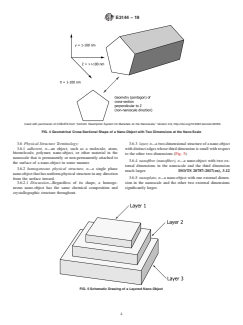
FIG. 4 Geometrical Cross-Sectional Shape of a Nano-Object with Two Dimensions at the Nano-Scale
3.6 Physical Structure Terminology: 3.6.3 layer, n—a two-dimensional structure of a nano-object
3.6.1 adherent, n—an object, such as a molecule, atom, with distinct edges whose third dimension is small with respect
biomolecule, polymer, nano-object, or other material in the
to the other two dimensions (Fig. 5).
nanoscale that is permanently or non-permanently attached to
3.6.4 nanofibre (nanofiber), n—a nano-object with two ex-
the surface of a nano-object in some manner.
ternal dimensions in the nanoscale and the third dimension
3.6.2 homogeneous physical structure, n—a single phase
much larger. ISO/TS 20787:2017(en), 3.12
nano-objectthathasuniformphysicalstructureinanydirection
3.6.5 nanoplate, n—a nano-object with one external dimen-
from the surface inward.
sion in the nanoscale and the other two external dimensions
3.6.2.1 Discussion—Regardless of its shape, a homoge-
neous nano-object has the same chemical composition and significantly larger.
crystallographic structure throughout.
FIG. 5 Schematic Drawing of a Layered Nano-Object
E3144 − 19
3.6.5.1 Discussion—The larger external dimensions are not characteristics by comparison of the data reported using the
necessarily in the nanoscale. information categories and descriptors defined herein.
3.6.6 phase, n—a bounded region of a nano-object with
NOTE 1—The choice of which information categories and descriptors to
uniform chemical composition and crystallographic structure
be compared is dependent on the application and context and is not
that can be mechanically separated from other regions of a
defined in this guide.
nano-object.
4.5 When two or more nano-objects are specified uniquely
3.6.7 physical structure, n—thephysicalarrangementofand
and determined to be equivalent, data sets of their properties
relationship among the parts of a nano-object.
and functionalities may be combined on a scientifically valid
3.6.8 shell, n—a three-dimensional structure in a nano- basis to create larger data collections.
object without distinct edges with one dimension (shell thick-
ness) small with respect to the other two dimensions (Fig. 6). 5. Significance and Use
5.1 A nano-object is an individual, well-defined, and sepa-
4. Summary of Guide
rable piece of a nanomaterial; in practice, nanomaterials used
4.1 This guide enumerates information categories and their
in research, products, testing, and other uses are usually
contained descriptors used to report the physical and chemical
collections of nano-objects. Individual nano-objects and col-
characteristics of a nano-object. In practice, only a subset of
lections of nano-objects are the two major types of nanomate-
informationcategoriesordescriptorswilllikelybeusedineach
rials in use. The description of an individual nano-object is
report instance.
covered in this guide; the description of collections of nano-
4.2 Different amounts of data and information are generated
objects (for example, two or more individual nano-objects) is
in different measurement scenarios. For example, a researcher
not covered in this guide.
may concentrate on studying how shape influences the prop-
5.2 Nanomaterials are of growing importance in research
erties or functionalities of a nano-object. In this instance, the
and commerce, and data on their physical and chemical
shape characteristics may be reported with more detailed
characteristics are critical to predict performance, to transact
information than for other characteristics.
commercial activities, to assess their potential for harm to
4.3 Specification of a nano-object uniquely is critical in
human and animal health and the environment in general, and
many applications.
to support regulations that affect their use. To describe
4.3.1 For commercial transactions, specification of a nano-
nanomaterials, whether for research or commerce, it is impor-
object uniquely ensures that a purchaser receives the desired
tant to be able to describe an individual nano-object.
product.
5.3 Wheninaliquidenvironment,anano-objectmayattract
4.3.2 For research purposes, specification of a nano-object
a non-permanent “halo” of water or other solvent molecules;
uniquely ensures that properties and functionalities can be
such a non-permanent halo is not described by the present
correlated with true features of a nano-object as well as
guide.
allowing others to duplicate research results.
4.3.3 Forregulatorypurposes,specificationofanano-object
5.4 In contrast, coatings and coronas are semi-permanent or
uniquely ensures that regulatory actions are applied only to the
permanent adherents on time scales commensurate with testing
intended nano-object(s).
procedures; coatings and coronas can fundamentally transform
4.4 This guide can be used to determine that two nano- one nano-object to another in terms of its characteristics and
objectsarethesamewithrespecttotheirphysicalandchemical can be described using this guide.
FIG. 6 Schematic Drawing of the Cross-Sectional View of a Nano-Object with a Shell-Like Structure
E3144 − 19
TABLE 1 Information Categories for Describing the Physical and
5.5 The four types of data and information used to describe
Chemical Characteristics (Intrinsic Properties) of a Nano-Object
a nano-object are: physical and chemical characteristics; pro-
Shape
duction; specifications; and general identifiers (names and
Size
classifications), as shown in Fig. 1.
Physical structure
Chemical composition
5.6 This guide deals solely with data and information to
Crystallographic structure
describe the physical and chemical characterization of an
Surface description
individual nano-object.
NOTE 2—Other guides and documents (see Section 2, Referenced
Documents) deal with the data and information for production,
specifications, and general identifiers (names and classifications).
NOTE 4—Other characteristics, not covered herein, may be useful in
NOTE 3—Specifications are formal or informal documents that provide
some circumstances.
guidance on specifying the composition, structure, or any other aspect of
a nano-object.
6.1.1 Each of these information categories has several
descriptorsthatprovidequantitativeandqualitativedataforthe
5.7 In a practical sense, the amount of data and information
reported to describe the physical and chemical characteristics characteristics of a nano-object.
differs widely depending on who is reporting and the reason 6.1.2 While most descriptors to characterize a nano-object
they are reporting. Researchers examining specific aspects of a use data from measurement results using well-defined
nano-object may choose to report a limited subset of charac- methods, other descriptors are more qualitative. As new
teristics.Atest report on the potential toxicity of a nano-object methods for measuring the characteristics of nano-objects
may choose to report numerous characteristics. This guide evolve, these qualitative descriptors will be replaced by quan-
supports both limited and complete reporting of the character- titative ones.
istics enumerated herein.
6.2 Shape:
5.8 The science of characterizing nano-objects is still evolv- 6.2.1 Characterization of the geometrical shape of a nano-
ing. Some information categories will require additional de- object is critical as its properties and reactivity are strongly
scriptors as new knowledge is developed. Some descriptors dependent on this factor. The descriptors required to describe
may become obsolete. Users should consult the latest guide for quantitatively the shape of a nano-object are given in Table 2.
the most complete recommendations. 6.2.2 Standard definitions have been established for many
forms. The most common criterion for defining the shape of a
5.9 The technology for collecting, storing, analyzing, and
nano-objectisitsgeneralthree-dimensionalgeometry,orshape
disseminating scientific and technical data continues to evolve,
type.
and tools such as ontologies, database schemas, data repository
6.2.3 For shapes with external features, descriptors enumer-
reporting requirements, and data recoding formats are evolving
ate and describe those features.
similarly. This guide provides a clear, English language defi-
6.2.4 Quantitative measures of shape include aspect ratio,
nition of information categories and descriptors used to de-
or sharpness, that reflects the fiber- or rod-like nature of a
scribe an individual nano-object that can be used in these and
nano-object, flatness, or the lack of unevenness of a plate-like
other similar tools.
nano-object, and sphericity that provides an indication of how
5.10 A nano-object has properties and functionalities that
close a nano-object approaches the shape of a perfect sphere.
are measured under specific measurement conditions. The
6.3 Size:
description of a nano-object requires data and information on
6.3.1 The modifier “nano” illustrates the importance of size
its properties as well as on the conditions under which those
in describing a nano-object, yet size even in the nanoscale can
properties were measured, as shown in Fig. 2. The description
vary greatly. For example, the volume of a cube-shaped
of the data and information necessary to describe properties
nano-object with all three dimensions on the nano-scale can
and functionalities as well as the procedure, which specify the
3 6 3
range from 1 nm to 10 nm . Similarly the surface area of a
measurement conditions under which the properties and func-
100 nm-sided cube is 10 larger than the surface area of a 1
tionalities are measured, are described in other guides and
nm-sided cube.As many properties of nano-objects are surface
standards.
area dependent, clearly size is important.
5.11 The characteristics of an individual nano-object de-
6.3.2 The size of features of a nano-object is also important
fined in this guide address the important physical and chemical
and can also be reported. These features can be large-scale
properties of that nano-object. Because the techniques and
features that define the shape, such as the points of a star, or
instruments used to measure these properties can greatly
small-scale features, such as irregularities of a surface or
influence the property value, when available, the measurement
large-scale feature.
result being used should include as much information as
6.3.3 In addition to overall size and the size of features,
possible about the measurement conditions.
derived dimensions such as aerodynamic and hydrodynamic
diameters can be reported.
6. Information Categories and Descriptors
6.1 The six information categories, as given in Table 1,
comprise characteristics of an individual nano-object relevant
The boldface numbers in parentheses refer to a list of references at the end of
for its description that are covered in this guide. this standard.
E3144 − 19
TABLE 2 Descriptors for the Shape of a Nano-Object
Descriptor Definition Notes or Examples
Subcategory: Shape Type
Number of dimensions on nanoscale Number of dimensions of the nano-object in the For example, 1, 2, or 3 dimensions
nanoscale (about 1 to 100 nm)
General shape Common name of shape For example, plate; nanotube; star; etc.
Specific shape Qualified common shape name For example, multi-walled nanotube; five-pointed star;
etc.
ISO TC 229 shape name Shape name as defined by ISO TC 229 (see next For example, nanoplate; nanofiber; nanotube;
column) nanorod; nanowire; as defined in ISO/TS
27687:2008(en) and ISO/TS 80004-3:2011(en)
Geometrical shape of a nano-object with one dimen- Geometrical name of the shape taken perpendicular For example, rectangle; circle; etc. (see Fig. 3)
sion at the nanoscale to the nanoscale dimension (thickness)
Geometrical cross-section shape of a nano-object For a nano-object with two dimensions at the For example, hexagon; circle; square; pentagon; etc.
with two dimensions at the nanoscale nanoscale, the geometrical name of the cross- (see Fig. 4)
section taken perpendicular to the non-nanoscale
dimension
Shape symmetry Overall symmetry of the shape For example, planar; rotational; inversion; screw over-
all symmetry
Symmetry components Number of and type of symmetry components For example, an enumeration and identification of all
relevant symmetry components
Subcategory: Shape Features (recurring)
Type of feature A feature that occurs in the shape For example, points of a star
Regularity of feature The description of the regularity of the feature For example, are all points equivalent? If not, can
they be grouped into logical categories?
Number of features Number of occurrences of the feature
Arrangement of feature Arrangement of the feature on the surface For example, how the features are arranged? If
symmetrically, how?
Subcategory: Quantitative Shape
Aspect ratio Ratio of the extremal orthogonal dimensions of the A measure of the sharpness of a nano-object; the
nano-object greater the value, the sharper the nano-object; can
be used for the World Health Organization (WHO)
fibre dimension determination (3:1) (1)
Flatness (sometimes called uniform thickness) Ratio of the largest to smallest thickness dimension A measure of the smoothness of a nano-object; the
for a two-dimensional shape; may be planar (for closer to a value of one (1.0), the flatter the surface
example, a nanoplate) or non-planar
Sphericity Ratio of the radii drawn from the geometric center of A measure of how spherical a nano-object is; the
a nano-object to closest and furthest surface fea- closer to a value of one (1.0), the more spherical a
tures nano-object
6.3.4 The dimensions needed to specify the size (internal 6.4.2 These structural components need to be described in
andexternaldimensions)ofdifferentnano-objectsvaryaccord- terms of the composition of each component, its place in the
ing to the shape. overall structure, and other details. For example, some nano-
6.3.5 Some shapes have ambiguity in their definition, for objectsaresynthesizedtohavespecificporesizes,forexample,
example\, which ratio of diameter to length of a particle should for catalytic purposes.The description of structural defects and
be considered a rod. Similar ambiguity applies to other shap
...