


ASTM E2859-11(2023)
(Guide)Standard Guide for Size Measurement of Nanoparticles Using Atomic Force Microscopy
Standard Guide for Size Measurement of Nanoparticles Using Atomic Force Microscopy
SIGNIFICANCE AND USE
5.1 As AFM measurement technology has matured and proliferated, the technique has been widely adopted by the nanotechnology research and development community to the extent that it is now considered an indispensible tool for visualizing and quantifying structures on the nanoscale. Whether used as a stand-alone method or to complement other dimensional measurement methods, AFM is now a firmly established component of the nanoparticle measurement tool box. International standards for AFM-based determination of nanoparticle size are nonexistent as of the drafting of this guide. Therefore, this standard aims to provide practical and metrological guidance for the application of AFM to measure the size of substrate-supported nanoparticles based on maximum displacement as the probe is rastered across the particle surface to create a line profile.
SCOPE
1.1 The purpose of this document is to provide guidance on the quantitative application of atomic force microscopy (AFM) to determine the size of nanoparticles2 deposited in dry form on flat substrates using height (z-displacement) measurement. Unlike electron microscopy, which provides a two-dimensional projection or a two-dimensional image of a sample, AFM provides a three-dimensional surface profile. While the lateral dimensions are influenced by the shape of the probe, displacement measurements can provide the height of nanoparticles with a high degree of accuracy and precision. If the particles are assumed to be spherical, the height measurement corresponds to the diameter of the particle. In this guide, procedures are described for dispersing gold nanoparticles on various surfaces such that they are suitable for imaging and height measurement via intermittent contact mode AFM. Generic procedures for AFM calibration and operation to make such measurements are then discussed. Finally, procedures for data analysis and reporting are addressed. The nanoparticles used to exemplify these procedures are National Institute of Standards and Technology (NIST) reference materials containing citrate-stabilized negatively charged gold nanoparticles in an aqueous solution.
1.2 The values stated in SI units are to be regarded as standard. No other units of measurement are included in this standard.
1.3 This standard does not purport to address all of the safety concerns, if any, associated with its use. It is the responsibility of the user of this standard to establish appropriate safety, health, and environmental practices and determine the applicability of regulatory limitations prior to use.
1.4 This international standard was developed in accordance with internationally recognized principles on standardization established in the Decision on Principles for the Development of International Standards, Guides and Recommendations issued by the World Trade Organization Technical Barriers to Trade (TBT) Committee.
General Information
- Status
- Published
- Publication Date
- 31-Aug-2023
- Technical Committee
- E56 - Nanotechnology
- Drafting Committee
- E56.02 - Physical and Chemical Characterization
Relations
- Effective Date
- 01-Feb-2024
- Effective Date
- 01-Apr-2019
- Effective Date
- 01-Apr-2015
- Effective Date
- 01-Oct-2014
- Effective Date
- 01-Oct-2014
- Effective Date
- 01-Apr-2014
- Effective Date
- 01-Dec-2012
- Effective Date
- 01-Mar-2009
- Effective Date
- 01-Apr-2007
- Effective Date
- 01-Nov-2006
- Effective Date
- 01-Oct-2006
- Effective Date
- 01-Aug-2004
- Effective Date
- 10-Apr-1997
- Effective Date
- 10-Apr-1997
Overview
ASTM E2859-11(2023): Standard Guide for Size Measurement of Nanoparticles Using Atomic Force Microscopy (AFM) provides essential guidance for the quantitative measurement of nanoparticle size using AFM technology. This international standard, developed by ASTM Committee E56 on Nanotechnology, is particularly significant for researchers and laboratories engaged in nanotechnology and materials science. With the growing reliance on AFM for nanoscale characterization, the standard serves as a critical resource for ensuring accuracy, consistency, and quality in nanoparticle size measurement processes.
Key Topics
AFM-Based Nanoparticle Measurement: The guide details using atomic force microscopy for measuring the size of nanoparticles deposited in dry form on flat substrates by capturing height (z-displacement) data. Unlike electron microscopy, AFM provides accurate three-dimensional surface profiles.
Sample Preparation and Substrate Selection: Procedures for dispersing nanoparticles, including citrate-stabilized gold nanoparticles, on various substrates such as mica, silicon, and gold (111) are described, ensuring optimal surface flatness and minimal artifacts for imaging and measurement.
Instrument Calibration and Data Quality: The standard underscores the importance of AFM calibration using traceable standards (such as step height gratings) to secure reliable height measurements, and it provides general guidance for procedure optimization.
Image Acquisition and Analysis: Recommendations for imaging settings, cantilever choice, image flattening, baseline correction, and manual or automated particle analysis are included to support consistent, high-quality data collection.
Reporting Practices: It offers guidance for calculating and reporting mean nanoparticle size, uncertainty, and statistical distribution of measurement results, aligning with ISO/IEC Guide 98-3 and other international best practices.
Applications
Nanotechnology Research & Development: Essential in academic and industrial research where accurate nanoparticle characterization is crucial for understanding material properties and behavior at the nanoscale.
Quality Assurance in Material Manufacturing: Enables manufacturers of nanomaterials and nanoparticle-based products to implement standardized measurement procedures, thereby enhancing product quality and comparability.
Reference Material Validation: Suitable for laboratories evaluating reference materials-such as NIST citrate-stabilized gold nanoparticles-to ensure consistency in nanoparticle sizing.
Cross-Method Calibration: The guide supports laboratories that use AFM in tandem with other analytical techniques (e.g., electron microscopy), providing a reliable means to validate and complement other dimensional measurement data.
Regulatory and Safety Compliance: The standard aligns with international principles and is instrumental in meeting requirements for traceable and reproducible nanoparticle measurements, supporting safety assessments and regulatory submissions.
Related Standards
- ASTM E1617: Practice for Reporting Particle Size Characterization Data
- ASTM E2382: Guide to Scanner and Tip Related Artifacts in Scanning Tunneling Microscopy and Atomic Force Microscopy
- ASTM E2456: Terminology Relating to Nanotechnology
- ISO 18115-2: Surface Chemical Analysis-Vocabulary-Part 2: Terms Used in Scanning-Probe Microscopy
- ISO/IEC Guide 98-3:2008: Uncertainty of Measurement-Part 3: Guide to the Expression of Uncertainty in Measurement
Practical Value
ASTM E2859-11(2023) stands as a vital reference for establishments tasked with nanoparticle analysis, supporting the rigor and repeatability required in nanotechnology. By following these standardized AFM measurement procedures, organizations can enhance the reliability of their data, facilitate international collaboration, and contribute to the advancement of nanoparticle science.
Keywords: AFM nanoparticle measurement, atomic force microscopy, nanoparticle size, AFM calibration, nanotechnology standards, substrate preparation, nanoscale measurement, gold nanoparticles, particle size reporting, ASTM E2859-11, laboratory best practices, metrological guidance.
Frequently Asked Questions
ASTM E2859-11(2023) is a guide published by ASTM International. Its full title is "Standard Guide for Size Measurement of Nanoparticles Using Atomic Force Microscopy". This standard covers: SIGNIFICANCE AND USE 5.1 As AFM measurement technology has matured and proliferated, the technique has been widely adopted by the nanotechnology research and development community to the extent that it is now considered an indispensible tool for visualizing and quantifying structures on the nanoscale. Whether used as a stand-alone method or to complement other dimensional measurement methods, AFM is now a firmly established component of the nanoparticle measurement tool box. International standards for AFM-based determination of nanoparticle size are nonexistent as of the drafting of this guide. Therefore, this standard aims to provide practical and metrological guidance for the application of AFM to measure the size of substrate-supported nanoparticles based on maximum displacement as the probe is rastered across the particle surface to create a line profile. SCOPE 1.1 The purpose of this document is to provide guidance on the quantitative application of atomic force microscopy (AFM) to determine the size of nanoparticles2 deposited in dry form on flat substrates using height (z-displacement) measurement. Unlike electron microscopy, which provides a two-dimensional projection or a two-dimensional image of a sample, AFM provides a three-dimensional surface profile. While the lateral dimensions are influenced by the shape of the probe, displacement measurements can provide the height of nanoparticles with a high degree of accuracy and precision. If the particles are assumed to be spherical, the height measurement corresponds to the diameter of the particle. In this guide, procedures are described for dispersing gold nanoparticles on various surfaces such that they are suitable for imaging and height measurement via intermittent contact mode AFM. Generic procedures for AFM calibration and operation to make such measurements are then discussed. Finally, procedures for data analysis and reporting are addressed. The nanoparticles used to exemplify these procedures are National Institute of Standards and Technology (NIST) reference materials containing citrate-stabilized negatively charged gold nanoparticles in an aqueous solution. 1.2 The values stated in SI units are to be regarded as standard. No other units of measurement are included in this standard. 1.3 This standard does not purport to address all of the safety concerns, if any, associated with its use. It is the responsibility of the user of this standard to establish appropriate safety, health, and environmental practices and determine the applicability of regulatory limitations prior to use. 1.4 This international standard was developed in accordance with internationally recognized principles on standardization established in the Decision on Principles for the Development of International Standards, Guides and Recommendations issued by the World Trade Organization Technical Barriers to Trade (TBT) Committee.
SIGNIFICANCE AND USE 5.1 As AFM measurement technology has matured and proliferated, the technique has been widely adopted by the nanotechnology research and development community to the extent that it is now considered an indispensible tool for visualizing and quantifying structures on the nanoscale. Whether used as a stand-alone method or to complement other dimensional measurement methods, AFM is now a firmly established component of the nanoparticle measurement tool box. International standards for AFM-based determination of nanoparticle size are nonexistent as of the drafting of this guide. Therefore, this standard aims to provide practical and metrological guidance for the application of AFM to measure the size of substrate-supported nanoparticles based on maximum displacement as the probe is rastered across the particle surface to create a line profile. SCOPE 1.1 The purpose of this document is to provide guidance on the quantitative application of atomic force microscopy (AFM) to determine the size of nanoparticles2 deposited in dry form on flat substrates using height (z-displacement) measurement. Unlike electron microscopy, which provides a two-dimensional projection or a two-dimensional image of a sample, AFM provides a three-dimensional surface profile. While the lateral dimensions are influenced by the shape of the probe, displacement measurements can provide the height of nanoparticles with a high degree of accuracy and precision. If the particles are assumed to be spherical, the height measurement corresponds to the diameter of the particle. In this guide, procedures are described for dispersing gold nanoparticles on various surfaces such that they are suitable for imaging and height measurement via intermittent contact mode AFM. Generic procedures for AFM calibration and operation to make such measurements are then discussed. Finally, procedures for data analysis and reporting are addressed. The nanoparticles used to exemplify these procedures are National Institute of Standards and Technology (NIST) reference materials containing citrate-stabilized negatively charged gold nanoparticles in an aqueous solution. 1.2 The values stated in SI units are to be regarded as standard. No other units of measurement are included in this standard. 1.3 This standard does not purport to address all of the safety concerns, if any, associated with its use. It is the responsibility of the user of this standard to establish appropriate safety, health, and environmental practices and determine the applicability of regulatory limitations prior to use. 1.4 This international standard was developed in accordance with internationally recognized principles on standardization established in the Decision on Principles for the Development of International Standards, Guides and Recommendations issued by the World Trade Organization Technical Barriers to Trade (TBT) Committee.
ASTM E2859-11(2023) is classified under the following ICS (International Classification for Standards) categories: 07.120 - Nanotechnologies. The ICS classification helps identify the subject area and facilitates finding related standards.
ASTM E2859-11(2023) has the following relationships with other standards: It is inter standard links to ASTM E1617-09(2024), ASTM E1617-09(2019), ASTM E2587-15, ASTM E2587-14e1, ASTM E2587-14, ASTM E1617-09(2014)e1, ASTM E2587-12, ASTM E1617-09, ASTM E1617-97(2007), ASTM E2530-06, ASTM E2456-06, ASTM E2382-04, ASTM E1617-97, ASTM E1617-97(2002). Understanding these relationships helps ensure you are using the most current and applicable version of the standard.
ASTM E2859-11(2023) is available in PDF format for immediate download after purchase. The document can be added to your cart and obtained through the secure checkout process. Digital delivery ensures instant access to the complete standard document.
Standards Content (Sample)
This international standard was developed in accordance with internationally recognized principles on standardization established in the Decision on Principles for the
Development of International Standards, Guides and Recommendations issued by the World Trade Organization Technical Barriers to Trade (TBT) Committee.
Designation: E2859 − 11 (Reapproved 2023)
Standard Guide for
Size Measurement of Nanoparticles Using Atomic Force
Microscopy
This standard is issued under the fixed designation E2859; the number immediately following the designation indicates the year of
original adoption or, in the case of revision, the year of last revision. A number in parentheses indicates the year of last reapproval. A
superscript epsilon (´) indicates an editorial change since the last revision or reapproval.
1. Scope ization established in the Decision on Principles for the
Development of International Standards, Guides and Recom-
1.1 The purpose of this document is to provide guidance on
mendations issued by the World Trade Organization Technical
the quantitative application of atomic force microscopy (AFM)
Barriers to Trade (TBT) Committee.
to determine the size of nanoparticles deposited in dry form on
flat substrates using height (z-displacement) measurement.
2. Referenced Documents
Unlike electron microscopy, which provides a two-dimensional
2.1 ASTM Standards:
projection or a two-dimensional image of a sample, AFM
E1617 Practice for Reporting Particle Size Characterization
provides a three-dimensional surface profile. While the lateral
Data
dimensions are influenced by the shape of the probe, displace-
E2382 Guide to Scanner and Tip Related Artifacts in Scan-
ment measurements can provide the height of nanoparticles
ning Tunneling Microscopy and Atomic Force Micros-
with a high degree of accuracy and precision. If the particles
copy
are assumed to be spherical, the height measurement corre-
E2456 Terminology Relating to Nanotechnology
sponds to the diameter of the particle. In this guide, procedures
E2530 Practice for Calibrating the Z-Magnification of an
are described for dispersing gold nanoparticles on various
surfaces such that they are suitable for imaging and height Atomic Force Microscope at Subnanometer Displacement
Levels Using Si(111) Monatomic Steps (Withdrawn
measurement via intermittent contact mode AFM. Generic
2015)
procedures for AFM calibration and operation to make such
E2587 Practice for Use of Control Charts in Statistical
measurements are then discussed. Finally, procedures for data
Process Control
analysis and reporting are addressed. The nanoparticles used to
exemplify these procedures are National Institute of Standards
2.2 ISO Standards:
and Technology (NIST) reference materials containing citrate-
ISO 18115–2 Surface Chemical Analysis—Vocabulary—
stabilized negatively charged gold nanoparticles in an aqueous
Part 2: Terms Used in Scanning-Probe Microscopy
solution.
ISO/IEC Guide 98–3:2008 Uncertainty of Measurement—
Part 3: Guide to the Expression of Uncertainty in Mea-
1.2 The values stated in SI units are to be regarded as
surement (GUM:1995)
standard. No other units of measurement are included in this
standard.
3. Terminology
1.3 This standard does not purport to address all of the
3.1 Definitions:
safety concerns, if any, associated with its use. It is the
3.1.1 For definitions pertaining to nanotechnology terms,
responsibility of the user of this standard to establish appro-
refer to Terminology E2456.
priate safety, health, and environmental practices and deter-
3.1.2 For definitions pertaining to terms associated with
mine the applicability of regulatory limitations prior to use.
scanning-probe microscopy, including AFM, refer to ISO
1.4 This international standard was developed in accor-
18115–2.
dance with internationally recognized principles on standard-
This guide is under the jurisdiction of ASTM Committee E56 on Nanotech-
nology and is the direct responsibility of Subcommittee E56.02 on Physical and For referenced ASTM standards, visit the ASTM website, www.astm.org, or
Chemical Characterization. contact ASTM Customer Service at service@astm.org. For Annual Book of ASTM
Current edition approved Sept. 1, 2023. Published September 2023. Originally Standards volume information, refer to the standard’s Document Summary page on
approved in 2011. Last previous edition approved in 2017 as E2859 – 11 (2017). the ASTM website.
DOI: 10.1520/E2859-11R23. The last approved version of this historical standard is referenced on
Having two or three dimensions in the size scale from approximately 1 nm to www.astm.org.
100 nm as in accordance with Terminology E2456; this definition does not consider Available from International Organization for Standardization (ISO), ISO
functionality, which may impact regulatory aspects of nanotechnology, but which Central Secretariat, BIBC II, Chemin de Blandonnet 8, CP 401, 1214 Vernier,
are beyond the scope of this guide. Geneva, Switzerland, http://www.iso.org.
Copyright © ASTM International, 100 Barr Harbor Drive, PO Box C700, West Conshohocken, PA 19428-2959. United States
E2859 − 11 (2023)
3.2 Definitions of Terms Specific to This Standard: moment on the cantilever. In response to this moment, the
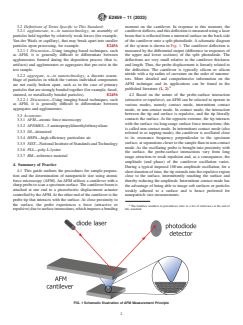
3.2.1 agglomerate, n—in nanotechnology, an assembly of cantilever deflects, and this deflection is measured using a laser
particles held together by relatively weak forces (for example, beam that is reflected from a mirrored surface on the back side
Van der Waals or capillary), that may break apart into smaller of the cantilever onto a split photodiode. A schematic diagram
particles upon processing, for example. E2456 of the system is shown in Fig. 1. The cantilever deflection is
3.2.1.1 Discussion—Using imaging based techniques, such measured by the differential output (difference in responses of
as AFM, it is generally difficult to differentiate between the upper and lower sections) of the split photodiode. The
agglomerates formed during the deposition process (that is, deflections are very small relative to the cantilever thickness
artifacts) and agglomerates or aggregates that pre-exist in the and length. Thus, the probe displacement is linearly related to
test sample. the deflection. The cantilever is typically silicon or silicon
nitride with a tip radius of curvature on the order of nanome-
3.2.2 aggregate, n—in nanotechnology, a discrete assem-
ters. More detailed and comprehensive information on the
blage of particles in which the various individual components
AFM technique and its applications can be found in the
are not easily broken apart, such as in the case of primary
published literature (1, 2).
particles that are strongly bonded together (for example, fused,
sintered, or metallically bonded particles). E2456
4.2 Based on the nature of the probe-surface interaction
3.2.2.1 Discussion—Using imaging based techniques, such
(attractive or repulsive), an AFM can be selected to operate in
as AFM, it is generally difficult to differentiate between
various modes, namely contact mode, intermittent contact
aggregates and agglomerates.
mode, or non-contact mode. In contact mode, the interaction
between the tip and surface is repulsive, and the tip literally
3.3 Acronyms:
contacts the surface. At the opposite extreme, the tip interacts
3.3.1 AFM—atomic force microscopy
with the surface via long-range surface force interactions; this
3.3.2 APDMES—3-aminopropyldimethylethoxysilane
is called non-contact mode. In intermittent contact mode (also
3.3.3 DI—deionized
referred to as tapping mode), the cantilever is oscillated close
to its resonance frequency perpendicular to the specimen
3.3.4 HEPA—high efficiency particulate air
surface, at separations closer to the sample than in non-contact
3.3.5 NIST—National Institute of Standards and Technology
mode. As the oscillating probe is brought into proximity with
3.3.6 PLL—poly-L-lysine
the surface, the probe-surface interactions vary from long
3.3.7 RM—reference material
range attraction to weak repulsion and, as a consequence, the
amplitude (and phase) of the cantilever oscillation varies.
4. Summary of Practice
During a typical imposed 100 nm amplitude oscillation, for a
4.1 This guide outlines the procedures for sample prepara-
short duration of time, the tip extends into the repulsive region
tion and the determination of nanoparticle size using atomic
close to the surface, intermittently touching the surface and
force microscopy (AFM). An AFM utilizes a cantilever with a
thereby reducing the amplitude. Intermittent contact mode has
sharp probe to scan a specimen surface. The cantilever beam is
the advantage of being able to image soft surfaces or particles
attached at one end to a piezoelectric displacement actuator
weakly adhered to a surface and is hence preferred for
controlled by the AFM. At the other end of the cantilever is the
nanoparticle size measurements.
probe tip that interacts with the surface. At close proximity to
the surface, the probe experiences a force (attractive or 6
The boldface numbers in parentheses refer to a list of references at the end of
repulsive) due to surface interactions, which imposes a bending this standard.
FIG. 1 Schematic Illustration of AFM Measurement Principle
E2859 − 11 (2023)
4.3 A microscope feedback mechanism can be employed to 6.3 Atomically flat gold (111) on mica, if needed as a
maintain a user defined AFM set point amplitude, in the case of substrate material.
intermittent contact mode. When such feedback is operational,
6.4 Colloidal gold, citrate-stabilized in aqueous solution, if
constant vibration amplitude can be maintained by displacing
needed to test or validate sample preparation and measurement
the built-in end of the cantilever up and down by means of the
procedures.
piezo-actuator.
6.5 Deionized water, filtered to 0.1 μm, as needed for sample
NOTE 1—Operation of an AFM with feedback off enables the interac-
preparation or to rinse substrates.
tions to be measured and this is known as force spectroscopy.
6.6 Ethanol, reagent or chromatographic grade, as needed
This displacement directly corresponds to the height of the
to rinse substrates.
sample. A topographic image of the surface can be generated
by rastering the probe over the specimen surface and recording 6.7 HCl, concentrated (37 %), if needed to clean silicon (Si)
substrates.
the displacement of the piezo-actuator as a function of position.
Although the lateral dimensions are influenced by the shape of
6.8 H O , 30 % solution, if needed to clean Si substrates.
2 2
the probe (see Guide E2382 for guidance on tip related
6.9 Inert compressed gas source (for example, nitrogen,
artifacts), the height measurements can provide the height of
argon, or air), filtered to remove particles.
nanoparticles deposited onto a substrate with a high degree of
accuracy and precision. If the particles are assumed to be 6.10 Mica disc, if needed as a substrate material.
spherical, the height measurement corresponds to the diameter
6.11 Poly-l-lysine, solution (0.1 %), if needed for prepara-
or “size” of the particle.
tion of functionalized substrates.
4.4 Procedures for dispersing nanoparticles on various sur-
6.12 Single crystal Si wafers, diced to appropriate size, if
faces such that they are suitable for imaging and height
needed as a substrate material.
measurement via intermittent contact mode AFM are first
described. The nanoparticles used to exemplify these proce-
7. Apparatus
dures were National Institute of Standards and Technology
7.1 Atomic Force Microscope, capable of making
(NIST) gold nanoparticle reference materials, RM 8011 (nomi-
z-displacement measurements at sub-nanoscale dimensions.
nally 10 nm), RM 8012 (nominally 30 nm), and RM 8013
(nominally 60 nm), all of which contained citrate-stabilized 7.2 Bath Ultrasonicator, as needed to clean substrates.
negatively charged gold nanoparticles in an aqueous solution.
7.3 Microcentrifuge (“Microfuge”), as needed for sample
4.5 Generic procedures for AFM calibration and operation preparation.
to perform size measurements in intermittent contact mode are
7.4 RF Plasma Cleaner with O , as needed to clean Si
discussed, and procedures for data analysis and reporting are
substrates.
outlined.
8. Procedure
5. Significance and Use
8.1 Nanoparticle Deposition—For AFM measurements,
5.1 As AFM measurement technology has matured and
nanoparticle samples must be deposited on flat surfaces. The
proliferated, the technique has been widely adopted by the
roughness of the surface should be much less than the nominal
nanotechnology research and development community to the
size of the nanoparticles (preferably less than 5 %) in order to
extent that it is now considered an indispensible tool for
provide a consistent baseline for height measurements. High-
visualizing and quantifying structures on the nanoscale.
quality mica, atomically flat gold (111) (deposited on mica), or
Whether used as a stand-alone method or to complement other
single crystal silicon can all be used as substrates to minimize
dimensional measurement methods, AFM is now a firmly
the effect of surface roughness on nanoparticle measurements.
established component of the nanoparticle measurement tool
Example procedures are provided for depositing nanoparticles
box. International standards for AFM-based determination of
on these three substrates. The sample deposition procedures
nanoparticle size are nonexistent as of the drafting of this
outlined below were developed for use with negatively charged
guide. Therefore, this standard aims to provide practical and
citrate-stabilized gold nanoparticles suspended in an aqueous
metrological guidance for the application of AFM to measure
solution at a mass concentration nominally 50 μg/g (as exem-
the size of substrate-supported nanoparticles based on maxi-
plified by NIST RMs 8011, 8012, and 8013). The procedures
mum displacement as the probe is rastered across the particle
should work with other nanoparticles that carry a negative
surface to create a line profile.
surface charge or zeta potential, including, but not limited to,
commercially available citrate-stabilized colloidal gold. As
6. Reagents
suggested below, these procedures can also be applied to
6.1 Certain chemicals and materials may be necessary in
positively charged or neutral nanoparticles with some modifi-
order to perform one or more of the steps discussed in this
cation. Each procedure may require optimization by the user in
guide, but the specific reagents used are at the discretion of the
order to obtain satisfactory deposition density and to minimize
tester and may depend on which specific alternative procedures
artifacts such as agglomerate formation on the substrate or
are chosen or relevant for a particular application.
build-up of organic films resulting from additives that might be
6.2 Adhesive tape, if needed to cleave mica substrates. present in the solution phase.
E2859 − 11 (2023)
NOTE 2—Substrate preparation and sample deposition should be con-
plasma cleaner, treat for 10 min in a clean glass beaker with
ducted in a manner that minimizes the potential for contamination and
acetone placed in a low intensity ultrasonic bath followed by
artifacts. For instance, to the extent possible, these operations should be
10 min sonication in a clean glass beaker with ethanol. Blow
conducted in a HEPA filtered clean bench or work area. Similarly,
substrate dry with inert gas stream.
prepared samples should be stored in a manner that maintains their
8.1.2.1 If a plasma cleaner is not available, the following
integrity and precludes contamination.
alternative cleaning procedure can be used. Place silicon
8.1.1 Mica Substrate—Mica is a layered mineral that can be
substrate in a solution containing a 6:1:1 volumetric ratio of DI
readily cleaved along alkali-rich basal planes to form clean,
water: concentrated HCl (37 %): 30 % H O solution, and treat
2 2
atomically flat surfaces extending over large areas. To prepare
in a low intensity ultrasonic bath for 2 min to 10 min. Solution
the substrate, a mica disc must be cleaved to produce a clean
is a strong oxidizer and very acidic, and thus should be
surface. Place the disc on a clean, lint-free cloth or directly on
prepared and handled with due caution; always dilute acid into
an AFM puck. Press a piece of adhesive tape against the
water. Follow treatment with a DI water rinse to remove any
surface of the disc and then smoothly remove the tape from the
residual acid or peroxide.
mica. The top layer of the mica should appear on the tape.
NOTE 3—Pre-made cleaning solutions for silicon wafers are commer-
Continue to cleave the mica until a full layer is removed and
cially available. Other cleaning procedures can be found in the literature.
the exposed surface is visually smooth. Typically, this step
If using an alternative procedure, avoid treatments that tend to remove the
needs to be repeated several times, and requires visual inspec-
native oxide layer (for example, basic solutions, such as those containing
tion of the cleaved surface. ammonium hydroxide). Be advised that some commonly used cleaning
solutions for removing organics from glass surfaces (for example,
8.1.1.1 After cleaving, the mica disc is ready to be activated
acidified peroxide or piranha) are extremely aggressive and appropriate
so as to promote adhesion between the substrate and the gold
care should be taken if using such solutions.
nanoparticles. The NIST gold nanoparticle RMs are dispersed
8.1.2.2 The cleaned wafer supports a thin, native oxide
in solution and stabilized by adsorbed citrate ions that give the
layer. The substrate can then be treated to produce a positive
particles a negative charge. The mica substrate can be activated
surface using an amino-silane coupling agent, such as
to have a positive charge that readily binds negatively charged
3-aminopropyldimethylethoxysilane (APDMES). Place a drop
particles to the surface. The substrate is activated using diluted
of APDMES on the Si surface. Allow the APDMES to react
0.1 % poly-l-lysine (PLL) solution to provide a positively
with the underlying substrate for 2 h inside a sealed glass vial.
charged surface. To create the solution, dilute 0.1 % PLL
Remove the excess APDMES by rinsing with ethanol followed
solution 1:10 with filtered deionized (DI) water (for example,
by DI water.
add 0.5 mL PLL to 4.5 mL DI water). Use clean glassware for
8.1.2.3 After drying, apply '25 µL of undiluted gold nan-
dilution and coating. Store the diluted PLL solution in a
oparticle solution onto the APDMES-modified silicon substrate
refrigerator between 2 °C and 8 °C until needed. Fully immerse
using a micropipette. The gold solution should spread evenly
the mica disc in the diluted PLL solution for 30 min at room
across the surface. Incubate at room temperature using the
temperature. To minimize evaporation, cover the solution with
following schedule as a guide:
a glass dish. After the time has elapsed, remove the mica from
(1) 60 nm particles: 60 min.
the solution and blow dry with a filtered inert gas stream (for
(2) 30 nm particles: 30 min.
example, air, nitrogen, argon).
(3) 10 nm particles: 15 min.
8.1.1.2 After drying, apply '25 µL of undiluted gold nan-
The incubation times are approximate and should be verified
oparticle solution onto the PLL-modified mica substrate using
or optimized for each application. To prevent evaporation, the
a micropipette. The gold solution should spread evenly across
substrate with gold solution droplet should be sealed inside a
the surface. Incubate at room temperature using the following
humidified chamber (for example, under an inverted glass
schedule as a guide:
beaker with DI water reservoir). Following incubation, rinse
(1) 60 nm particles: 10 min.
the sample first with ethanol, followed by DI water, and gently
(2) 30 nm particles: 5 min.
dry with a filtered inert gas stream prior to analysis.
(3) 10 nm particles: 30 sec.
8.1.3 Gold Substrate—An atomically flat gold (111) surface
The incubation times are appropriate for 50 μg/g colloidal
(deposited on mica) can be obtained commercially and used as
gold suspensions, but can be varied to modify the particle
a substrate for nanoparticle sizing. If necessary, clean the gold
density on the surface as required for particles of different size,
surface using ethanol and dry using a filtered stream of inert
composition or concentration; incubation times should be
gas. It is recommended that ultrasonic cleaning not be used, as
verified or optimized for each application. Rinse the substrate
this may delaminate the gold layer from the underlying mica.
with filtered DI water and gently dry with a filtered inert gas
8.1.3.1 The gold substrate can be functionalized in a manner
stream. The sample is now ready to image.
similar to that described for mica and silicon above, but using
thiolated compounds that react chemically with the gold
8.1.2 Silicon Substrate—An electrostatic deposition proce-
dure such as that described for negatively charged nanopar- surface. For instance, an amino-thio
...
Questions, Comments and Discussion
Ask us and Technical Secretary will try to provide an answer. You can facilitate discussion about the standard in here.
Loading comments...