

ASTM E3089-22
(Guide)Standard Guide for Nanotechnology Workforce Education in Material Properties and Effects of Size
General Information
- Abstract
SIGNIFICANCE AND USE
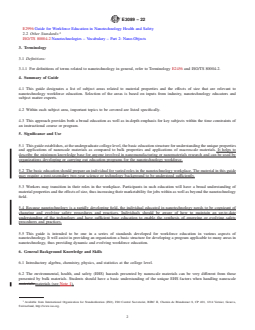
5.1 This guide establishes, at the undergraduate college level, the basic education structure for understanding the unique properties and applications of nanoscale materials as compared to bulk properties and applications of macroscale materials. It helps to describe the minimum knowledge base for anyone involved in nanomanufacturing or nanomaterials research and can be used by organizations developing or carrying out education programs for the nanotechnology workforce.
5.2 The basic education should prepare an individual for varied roles in the nanotechnology workplace. The material in this guide may require a post-secondary two-year science or technology background to be understood sufficiently.
5.3 Workers may transition in their roles in the workplace. Participants in such education will have a broad understanding of material properties and the effects of size, thus increasing their marketability for jobs within as well as beyond the nanotechnology field.
5.4 Because nanotechnology is a rapidly developing field, the individual educated in nanotechnology needs to be cognizant of changing and evolving safety procedures and practices. Individuals should be aware of how to maintain an up-to-date understanding of the technology and have sufficient base education to enable the synthesis of emerging or evolving safety procedures and practices.
5.5 This guide is intended to be one in a series of standards developed for workforce education in various aspects of nanotechnology. It will assist in providing an organization a basic structure for developing a program applicable to many areas in nanotechnology, thus providing dynamic and evolving workforce education.
SCOPE
1.1 This guide provides a framework for a basic workforce education in material properties at the nanoscale, to be taught at an undergraduate college level. This education should be broad to prepare an individual to serve within one of the many areas in nanotechnology research, development, or manufacturing.
1.2 This guide may be used to develop or evaluate an education program for unique material properties and their applications in the nanotechnology field. This guide provides listings of key topics that should be covered in a nanotechnology education program on this subject, but it does not provide specific course material to be used in such a program. This approach is taken in order to allow workforce education entities to ensure their programs cover the required material while also enabling these institutions to tailor their programs to meet the needs of their local employers.
1.3 While no units of measurements are used in this guide, values stated in SI units are to be regarded as standard.
1.4 This standard does not purport to address all of the techniques, materials, and concepts needed for material properties and applications. It is the responsibility of the user of this standard to utilize other knowledge and skill objectives as applicable to local conditions or required by local regulations.
1.5 This standard does not purport to address all of the safety concerns, if any, associated with its use. It is the responsibility of the user of this standard to establish appropriate safety, health, and environmental practices and determine the applicability of regulatory limitations prior to use.
1.6 This international standard was developed in accordance with internationally recognized principles on standardization established in the Decision on Principles for the Development of International Standards, Guides and Recommendations issued by the World Trade Organization Technical Barriers to Trade (TBT) Committee.
- Status
- Published
- Publication Date
- 31-Jan-2022
- Technical Committee
- E56 - Nanotechnology
- Drafting Committee
- E56.07 - Education and Workforce Development
Buy Documents

ASTM E3089-22 - Standard Guide for Nanotechnology Workforce Education in Material Properties and Effects of Size
REDLINE ASTM E3089-22 - Standard Guide for Nanotechnology Workforce Education in Material Properties and Effects of Size
Overview
ASTM E3089-22: Standard Guide for Nanotechnology Workforce Education in Material Properties and Effects of Size is a key framework developed by ASTM International. This guide establishes the foundational educational structure needed for understanding the distinctive properties and applications of nanoscale materials, as compared to their macroscale (bulk) counterparts. Designed for undergraduate-level, post-secondary education, the guide is intended for use in developing or evaluating educational programs geared toward the nanotechnology workforce, including those involved in nanomanufacturing, nanomaterials research, and related industries.
This standard highlights the importance of understanding both the scientific and practical aspects of nanomaterials, including the environmental, health, and safety considerations unique to nanoscale substances.
Key Topics
The guide outlines essential subject areas and concepts necessary for effective workforce education in nanotechnology material properties:
Material Characteristics
- Structure: crystalline, non-crystalline, allotropes, polymorphism
- Bonding and defects
- Phase diagrams
Physical Properties
- Surface energy
- Melting temperature changes
- Diffusion behavior
Mechanical Properties
- Stress and strain
- Tensile and compressive strength
- Elastic/plastic behavior; Young's, shear, and bulk modulus
- Hardness
Optical Properties
- Reflection, refraction, absorption, transmittance, emission
Electrical Properties
- Fermi level, conductivity, electronic transport, dielectric constant
Magnetic Properties
- Ferromagnetism, diamagnetism
Nanoscale Effects
- Changes in melting temperature and chemical reactivity at the nanoscale
- Ballistic conduction and quantum effects
- Tunable optical wavelengths due to reduced size
Safety Considerations
- Evolving safety, health, and environmental practices for handling nanomaterials
- Integration of up-to-date risk management procedures in educational programs
Applications
Nanoscale materials display unique properties that enable a wide range of innovative applications across multiple sectors. Examples highlighted in ASTM E3089-22 include:
Mechanical Applications
- Use of carbon nanotubes in aerospace composites
- Nanoparticles to reduce wear in tires and coatings
- Nanostructured additives for improved paint durability
Optical Applications
- Quantum well lasers with tunable emission wavelengths
- Enhanced UV protection using nanoscale titanium dioxide
- Anti-reflective coatings designed with nanopatterned surfaces
Electronics
- Advanced transistors and interconnects using nanomaterials
- Incorporation of nanoparticles and nanowires in solar cells for higher efficiency
- Development of nanoelectromechanical systems (NEMS) for highly sensitive sensors
Biomedical and Health
- Fluorescent nanoparticles for bioimaging and diagnostics
- Magnetic nanoparticles for protein detection and purification
- Enhanced therapies and drug delivery using nanoscale carriers and coatings
Food and Surface Technology
- Nanocellulose as a low-calorie additive
- Nanosilica as flow mediators and anti-caking agents
- Superhydrophobic and self-cleaning coatings for improved surface function
- Antimicrobial coatings for medical prosthetic devices
Related Standards
For a more comprehensive approach to nanotechnology workforce education, ASTM E3089-22 references and aligns with several other international standards:
- ASTM E2456: Terminology Relating to Nanotechnology
- ASTM E2996: Guide for Workforce Education in Nanotechnology Health and Safety
- ISO/TS 80004-2: Nanotechnologies – Vocabulary – Part 2: Nano-Objects
- ASTM E3001: Practice for Workforce Education in Nanotechnology Characterization
- ASTM E3034: Guide for Workforce Education in Nanotechnology Pattern Generation
- ASTM E3059: Guide for Workforce Education in Nanotechnology Infrastructure
- ASTM E3071: Guide for Nano-Technology Workforce Education in Materials Synthesis and Processing
Practical Value
ASTM E3089-22 supports institutions in creating programs that meet industry needs while addressing rapid technological advances and regulatory requirements. This standard ensures a broad and up-to-date understanding of material properties at the nanoscale, empowering individuals for successful and adaptable careers in the dynamic nanotechnology sector. Its framework and topic listings are designed to prepare students, educators, and professionals for evolving roles in research, development, manufacturing, and safety management within the nanotechnology workforce.
Relations
- Effective Date
- 01-Oct-2006
Buy Documents
ASTM E3089-22 - Standard Guide for Nanotechnology Workforce Education in Material Properties and Effects of Size
REDLINE ASTM E3089-22 - Standard Guide for Nanotechnology Workforce Education in Material Properties and Effects of Size
Get Certified
Connect with accredited certification bodies for this standard

Great Wall Tianjin Quality Assurance Center
Established 1993, first batch to receive national accreditation with IAF recognition.
Hong Kong Quality Assurance Agency (HKQAA)
Hong Kong's leading certification body.

Innovative Quality Certifications Pvt. Ltd. (IQCPL)
Known for integrity, providing ethical & impartial Assessment & Certification. CMMI Institute Partner.
Sponsored listings
Frequently Asked Questions
ASTM E3089-22 is a guide published by ASTM International. Its full title is "Standard Guide for Nanotechnology Workforce Education in Material Properties and Effects of Size". This standard covers: SIGNIFICANCE AND USE 5.1 This guide establishes, at the undergraduate college level, the basic education structure for understanding the unique properties and applications of nanoscale materials as compared to bulk properties and applications of macroscale materials. It helps to describe the minimum knowledge base for anyone involved in nanomanufacturing or nanomaterials research and can be used by organizations developing or carrying out education programs for the nanotechnology workforce. 5.2 The basic education should prepare an individual for varied roles in the nanotechnology workplace. The material in this guide may require a post-secondary two-year science or technology background to be understood sufficiently. 5.3 Workers may transition in their roles in the workplace. Participants in such education will have a broad understanding of material properties and the effects of size, thus increasing their marketability for jobs within as well as beyond the nanotechnology field. 5.4 Because nanotechnology is a rapidly developing field, the individual educated in nanotechnology needs to be cognizant of changing and evolving safety procedures and practices. Individuals should be aware of how to maintain an up-to-date understanding of the technology and have sufficient base education to enable the synthesis of emerging or evolving safety procedures and practices. 5.5 This guide is intended to be one in a series of standards developed for workforce education in various aspects of nanotechnology. It will assist in providing an organization a basic structure for developing a program applicable to many areas in nanotechnology, thus providing dynamic and evolving workforce education. SCOPE 1.1 This guide provides a framework for a basic workforce education in material properties at the nanoscale, to be taught at an undergraduate college level. This education should be broad to prepare an individual to serve within one of the many areas in nanotechnology research, development, or manufacturing. 1.2 This guide may be used to develop or evaluate an education program for unique material properties and their applications in the nanotechnology field. This guide provides listings of key topics that should be covered in a nanotechnology education program on this subject, but it does not provide specific course material to be used in such a program. This approach is taken in order to allow workforce education entities to ensure their programs cover the required material while also enabling these institutions to tailor their programs to meet the needs of their local employers. 1.3 While no units of measurements are used in this guide, values stated in SI units are to be regarded as standard. 1.4 This standard does not purport to address all of the techniques, materials, and concepts needed for material properties and applications. It is the responsibility of the user of this standard to utilize other knowledge and skill objectives as applicable to local conditions or required by local regulations. 1.5 This standard does not purport to address all of the safety concerns, if any, associated with its use. It is the responsibility of the user of this standard to establish appropriate safety, health, and environmental practices and determine the applicability of regulatory limitations prior to use. 1.6 This international standard was developed in accordance with internationally recognized principles on standardization established in the Decision on Principles for the Development of International Standards, Guides and Recommendations issued by the World Trade Organization Technical Barriers to Trade (TBT) Committee.
SIGNIFICANCE AND USE 5.1 This guide establishes, at the undergraduate college level, the basic education structure for understanding the unique properties and applications of nanoscale materials as compared to bulk properties and applications of macroscale materials. It helps to describe the minimum knowledge base for anyone involved in nanomanufacturing or nanomaterials research and can be used by organizations developing or carrying out education programs for the nanotechnology workforce. 5.2 The basic education should prepare an individual for varied roles in the nanotechnology workplace. The material in this guide may require a post-secondary two-year science or technology background to be understood sufficiently. 5.3 Workers may transition in their roles in the workplace. Participants in such education will have a broad understanding of material properties and the effects of size, thus increasing their marketability for jobs within as well as beyond the nanotechnology field. 5.4 Because nanotechnology is a rapidly developing field, the individual educated in nanotechnology needs to be cognizant of changing and evolving safety procedures and practices. Individuals should be aware of how to maintain an up-to-date understanding of the technology and have sufficient base education to enable the synthesis of emerging or evolving safety procedures and practices. 5.5 This guide is intended to be one in a series of standards developed for workforce education in various aspects of nanotechnology. It will assist in providing an organization a basic structure for developing a program applicable to many areas in nanotechnology, thus providing dynamic and evolving workforce education. SCOPE 1.1 This guide provides a framework for a basic workforce education in material properties at the nanoscale, to be taught at an undergraduate college level. This education should be broad to prepare an individual to serve within one of the many areas in nanotechnology research, development, or manufacturing. 1.2 This guide may be used to develop or evaluate an education program for unique material properties and their applications in the nanotechnology field. This guide provides listings of key topics that should be covered in a nanotechnology education program on this subject, but it does not provide specific course material to be used in such a program. This approach is taken in order to allow workforce education entities to ensure their programs cover the required material while also enabling these institutions to tailor their programs to meet the needs of their local employers. 1.3 While no units of measurements are used in this guide, values stated in SI units are to be regarded as standard. 1.4 This standard does not purport to address all of the techniques, materials, and concepts needed for material properties and applications. It is the responsibility of the user of this standard to utilize other knowledge and skill objectives as applicable to local conditions or required by local regulations. 1.5 This standard does not purport to address all of the safety concerns, if any, associated with its use. It is the responsibility of the user of this standard to establish appropriate safety, health, and environmental practices and determine the applicability of regulatory limitations prior to use. 1.6 This international standard was developed in accordance with internationally recognized principles on standardization established in the Decision on Principles for the Development of International Standards, Guides and Recommendations issued by the World Trade Organization Technical Barriers to Trade (TBT) Committee.
ASTM E3089-22 is classified under the following ICS (International Classification for Standards) categories: 03.180 - Education; 07.120 - Nanotechnologies. The ICS classification helps identify the subject area and facilitates finding related standards.
ASTM E3089-22 has the following relationships with other standards: It is inter standard links to ASTM E2456-06. Understanding these relationships helps ensure you are using the most current and applicable version of the standard.
ASTM E3089-22 is available in PDF format for immediate download after purchase. The document can be added to your cart and obtained through the secure checkout process. Digital delivery ensures instant access to the complete standard document.
Standards Content (Sample)
This international standard was developed in accordance with internationally recognized principles on standardization established in the Decision on Principles for the
Development of International Standards, Guides and Recommendations issued by the World Trade Organization Technical Barriers to Trade (TBT) Committee.
Designation: E3089 − 22
Standard Guide for
Nanotechnology Workforce Education in Material Properties
and Effects of Size
This standard is issued under the fixed designation E3089; the number immediately following the designation indicates the year of
original adoption or, in the case of revision, the year of last revision. A number in parentheses indicates the year of last reapproval. A
superscript epsilon (´) indicates an editorial change since the last revision or reapproval.
1. Scope 2. Referenced Documents
1.1 This guide provides a framework for a basic workforce 2.1 ASTM Standards:
education in material properties at the nanoscale, to be taught E2456 Terminology Relating to Nanotechnology
at an undergraduate college level. This education should be E2996 Guide for Workforce Education in Nanotechnology
broad to prepare an individual to serve within one of the many Health and Safety
areas in nanotechnology research, development, or manufac- 2.2 Other Standards:
turing. ISO/TS 80004-2 Nanotechnologies – Vocabulary – Part 2:
Nano-Objects
1.2 This guide may be used to develop or evaluate an
education program for unique material properties and their
3. Terminology
applications in the nanotechnology field. This guide provides
3.1 Definitions:
listings of key topics that should be covered in a nanotechnol-
3.1.1 For definitions of terms related to nanotechnology in
ogy education program on this subject, but it does not provide
general, refer to Terminology E2456 and ISO/TS 80004-2.
specific course material to be used in such a program. This
approach is taken in order to allow workforce education
4. Summary of Guide
entities to ensure their programs cover the required material
4.1 This guide designates a list of subject areas related to
while also enabling these institutions to tailor their programs to
material properties and the effects of size that are relevant to
meet the needs of their local employers.
nanotechnology workforce education. Selection of the areas is
1.3 While no units of measurements are used in this guide,
based on inputs from industry, nanotechnology educators and
values stated in SI units are to be regarded as standard.
subject matter experts.
1.4 This standard does not purport to address all of the
4.2 Within each subject area, important topics to be covered
techniques, materials, and concepts needed for material prop-
are listed specifically.
erties and applications. It is the responsibility of the user of this
4.3 This approach provides both a broad education as well
standard to utilize other knowledge and skill objectives as
as in-depth emphasis for key subjects within the time con-
applicable to local conditions or required by local regulations.
straints of an instructional course or program.
1.5 This standard does not purport to address all of the
safety concerns, if any, associated with its use. It is the 5. Significance and Use
responsibility of the user of this standard to establish appro-
5.1 This guide establishes, at the undergraduate college
priate safety, health, and environmental practices and deter-
level, the basic education structure for understanding the
mine the applicability of regulatory limitations prior to use.
unique properties and applications of nanoscale materials as
1.6 This international standard was developed in accor-
compared to bulk properties and applications of macroscale
dance with internationally recognized principles on standard-
materials.Ithelpstodescribetheminimumknowledgebasefor
ization established in the Decision on Principles for the
anyone involved in nanomanufacturing or nanomaterials re-
Development of International Standards, Guides and Recom-
searchandcanbeusedbyorganizationsdevelopingorcarrying
mendations issued by the World Trade Organization Technical
out education programs for the nanotechnology workforce.
Barriers to Trade (TBT) Committee.
For referenced ASTM standards, visit the ASTM website, www.astm.org, or
This guide is under the jurisdiction of ASTM Committee E56 on Nanotech- contact ASTM Customer Service at service@astm.org. For Annual Book of ASTM
nology and is the direct responsibility of Subcommittee E56.07 on Education and Standards volume information, refer to the standard’s Document Summary page on
Workforce Development. the ASTM website.
Current edition approved Feb. 1, 2022. Published April 2022. Originally Available from International Organization for Standardization (ISO), ISO
approved in 2017. Last previous edition approved in 2017 as E3089 – 17. DOI: Central Secretariat, BIBC II, Chemin de Blandonnet 8, CP 401, 1214 Vernier,
10.1520/E3089-22. Geneva, Switzerland, http://www.iso.org.
Copyright © ASTM International, 100 Barr Harbor Drive, PO Box C700, West Conshohocken, PA 19428-2959. United States
E3089 − 22
5.2 The basic education should prepare an individual for are affected when material or structure dimensions change
varied roles in the nanotechnology workplace. The material in from the macroscale to the nanoscale.
this guide may require a post-secondary two-year science or
8.2 Material Characteristics:
technology background to be understood sufficiently.
8.2.1 Structure:
5.3 Workers may transition in their roles in the workplace. 8.2.1.1 Crystalline material.
Participants in such education will have a broad understanding
NOTE 2—Include discussion of Miller indices.
of material properties and the effects of size, thus increasing
8.2.1.2 Non-crystalline material.
their marketability for jobs within as well as beyond the
8.2.1.3 Allotropes and polymorphism.
nanotechnology field.
8.2.2 Bonding.
5.4 Because nanotechnology is a rapidly developing field,
8.2.3 Defects.
the individual educated in nanotechnology needs to be cogni-
8.2.4 Phase diagrams.
zant of changing and evolving safety procedures and practices.
8.3 Physical Properties:
Individuals should be aware of how to maintain an up-to-date
8.3.1 Surface energy.
understanding of the technology and have sufficient base
8.3.2 Melting temperature.
education to enable the synthesis of emerging or evolving
8.3.3 Diffusion.
safety procedures and practices.
8.4 Mechanical Properties:
5.5 This guide is intended to be one in a series of standards
8.4.1 Stress and strain.
developed for workforce education in various aspects of
8.4.2 Tensile and compressive strength.
nanotechnology. It will assist in providing an organization a
8.4.3 Elastic and plastic responses.
basic structure for developing a program applicable to many
8.4.4 Moduli.
areas in nanotechnology, thus providing dynamic and evolving
workforce education.
NOTE 3—Include introduction to Young’s, shear, and bulk modulus.
8.4.5 Hardness.
6. General Background Knowledge and Skills
8.5 Optical Properties:
6.1 Introductoryalgebra,chemistry,physics,andstatisticsat
8.5.1 Reflection.
the college level.
8.5.2 Refraction.
6.2 The environmental, health, and safety (EHS) hazards
8.5.3 Absorption.
presented by nanoscale materials can be very different from
8.5.4 Transmittance.
thosepresentedbybulkmaterials.Studentsshouldhaveabasic
8.5.5 Emission.
understanding of the unique EHS factors when handling
8.6 Electrical Properties:
nanoscale materials (see Note 1).
8.6.1 Fermi level.
NOTE 1—See Guide E2996 and the National Nanotechnology Initia-
NOTE 4—This is to provide an overview for insight into electronic
tive’s webpage on recent EHS research for more information.
devices, corrosion, and batteries.
7. Concepts and Skills to be Covered
8.6.2 Conductivity.
8.6.3 Electronic transport.
7.1 The subject areas and topics relevant for workforce
8.6.4 Dielectric constant.
education in nanotechnology regarding material properties are
given in Section 8, and select examples of how a reduction of
8.7 Magnetic Properties:
material or structure size to the nanoscale affect material
8.7.1 Ferromagnetism.
properties are shown in Section 9. These should be covered in
8.7.2 Diamagnetism.
a manner wherein bulk and nanoscale properties are compared
and contrasted.
9. Effects of Scale on Properties
7.2 Select examples of how nanoscale materials are utilized
9.1 While the subject of nanotechnology is generally asso-
in a variety of applications are given in Section 10.
ciated with materials or structures having at least one dimen-
7.3 Additional subject areas, topics, and examples may be sion with a size approximately within the 1 to 100 nanometres
(nm)range,itshouldbenotedthatthesmallsizealonedoesnot
added on an as-needed basis.
necessarily distinguish the technology. The uniqueness of
8. Fundamental Material Properties
nanotechnologyariseswhenthenanoscalematerialorstructure
provides properties or phenomena different from those ob-
8.1 This section consists of topics that pertain to the basic
served at the bulk or macroscale in the same material or
properties of materials.These are considered to be essential for
structure, and these properties or phenomena can be utilized to
introduction in an undergraduate-level class to facilitate the
achieve new or improved performances in a variety of appli-
subsequent understanding of how and why certain properties
cations.
9.2 Some of the different properties of nanoscale materials
Available from U.S. National Nanotechnology Coordination Office (NNCO),
can be attributed to their significantly larger surface areas
2415 Eisenhower Ave., Alexandria, VA 22314, https://www.nano.gov/Highligh
...
This document is not an ASTM standard and is intended only to provide the user of an ASTM standard an indication of what changes have been made to the previous version. Because
it may not be technically possible to adequately depict all changes accurately, ASTM recommends that users consult prior editions as appropriate. In all cases only the current version
of the standard as published by ASTM is to be considered the official document.
Designation: E3089 − 17 E3089 − 22
Standard Guide for
Nanotechnology Workforce Education in Material Properties
and Effects of Size
This standard is issued under the fixed designation E3089; the number immediately following the designation indicates the year of
original adoption or, in the case of revision, the year of last revision. A number in parentheses indicates the year of last reapproval. A
superscript epsilon (´) indicates an editorial change since the last revision or reapproval.
1. Scope
1.1 This guide provides a framework for a basic workforce education in material properties at the nanoscale, to be taught at an
undergraduate college level. This education should be broad to prepare an individual to serve within one of the many areas in
nanotechnology research, development, or manufacturing.
1.2 This guide may be used to develop or evaluate an education program for unique material properties and their applications in
the nanotechnology field. This guide provides listings of key topics that should be covered in a nanotechnology education program
on this subject, but it does not provide specific course material to be used in such a program. This approach is taken in order to
allow workforce education entities to ensure their programs cover the required material while also enabling these institutions to
tailor their programs to meet the needs of their local employers.
1.3 While no units of measurements are used in this guide, values stated in SI units are to be regarded as standard.
1.4 This standard does not purport to address all of the safety concerns, if any, associated with its use. It is the responsibility
of the user of this standard to establish appropriate safety, health, and environmental practices and determine the applicability of
regulatory limitations prior to use.
1.4 This standard does not purport to address all of the techniques, materials, and concepts needed for material properties and
applications. It is the responsibility of the user of this standard to utilize other knowledge and skill objectives as applicable to local
conditions or required by local regulations.
1.5 This standard does not purport to address all of the safety concerns, if any, associated with its use. It is the responsibility
of the user of this standard to establish appropriate safety, health, and environmental practices and determine the applicability of
regulatory limitations prior to use.
1.6 This international standard was developed in accordance with internationally recognized principles on standardization
established in the Decision on Principles for the Development of International Standards, Guides and Recommendations issued
by the World Trade Organization Technical Barriers to Trade (TBT) Committee.
2. Referenced Documents
2.1 ASTM Standards:
E2456 Terminology Relating to Nanotechnology
This guide is under the jurisdiction of ASTM Committee E56 on Nanotechnology and is the direct responsibility of Subcommittee E56.07 on Education and Workforce
Development.
Current edition approved Sept. 1, 2017Feb. 1, 2022. Published September 2017April 2022. Originally approved in 2017. Last previous edition approved in 2017 as
E3089 – 17. DOI: 10.1520/E3089-17.10.1520/E3089-22.
For referenced ASTM standards, visit the ASTM website, www.astm.org, or contact ASTM Customer Service at service@astm.org. For Annual Book of ASTM Standards
volume information, refer to the standard’s Document Summary page on the ASTM website.
Copyright © ASTM International, 100 Barr Harbor Drive, PO Box C700, West Conshohocken, PA 19428-2959. United States
E3089 − 22
E2996 Guide for Workforce Education in Nanotechnology Health and Safety
2.2 Other Standards:
ISO/TS 80004-2 Nanotechnologies – Vocabulary – Part 2: Nano-Objects
3. Terminology
3.1 Definitions:
3.1.1 For definitions of terms related to nanotechnology in general, refer to Terminology E2456 and ISO/TS 80004-2.
4. Summary of Guide
4.1 This guide designates a list of subject areas related to material properties and the effects of size that are relevant to
nanotechnology workforce education. Selection of the areas is based on inputs from industry, nanotechnology educators and
subject matter experts.
4.2 Within each subject area, important topics to be covered are listed specifically.
4.3 This approach provides both a broad education as well as in-depth emphasis for key subjects within the time constraints of
an instructional course or program.
5. Significance and Use
5.1 This guide establishes, at the undergraduate college level, the basic education structure for understanding the unique properties
and applications of nanoscale materials as compared to bulk properties and applications of macroscale materials. It helps to
describe the minimum knowledge base for anyone involved in nanomanufacturing or nanomaterials research and can be used by
organizations developing or carrying out education programs for the nanotechnology workforce.
5.2 The basic education should prepare an individual for varied roles in the nanotechnology workplace. The material in this guide
may require a post-secondary two-year science or technology background to be understood sufficiently.
5.3 Workers may transition in their roles in the workplace. Participants in such education will have a broad understanding of
material properties and the effects of size, thus increasing their marketability for jobs within as well as beyond the nanotechnology
field.
5.4 Because nanotechnology is a rapidly developing field, the individual educated in nanotechnology needs to be cognizant of
changing and evolving safety procedures and practices. Individuals should be aware of how to maintain an up-to-date
understanding of the technology and have sufficient base education to enable the synthesis of emerging or evolving safety
procedures and practices.
5.5 This guide is intended to be one in a series of standards developed for workforce education in various aspects of
nanotechnology. It will assist in providing an organization a basic structure for developing a program applicable to many areas in
nanotechnology, thus providing dynamic and evolving workforce education.
6. General Background Knowledge and Skills
6.1 Introductory algebra, chemistry, physics, and statistics at the college level.
6.2 The environmental, health, and safety (EHS) hazards presented by nanoscale materials can be very different from those
presented by bulk materials. Students should have a basic understanding of the unique EHS factors when handling nanoscale
materials.materials (see Note 1).
Available from International Organization for Standardization (ISO), ISO Central Secretariat, BIBC II, Chemin de Blandonnet 8, CP 401, 1214 Vernier, Geneva,
Switzerland, http://www.iso.org.
E3089 − 22
NOTE 1—See Guide E2996 and the National Nanotechnology Initiative’s website on Environmental, Health, and Safety Issueswebpage on recent EHS
research for more information.
7. Concepts and Skills to be Covered
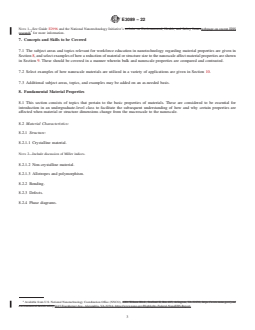
7.1 The subject areas and topics relevant for workforce education in nanotechnology regarding material properties are given in
Section 8, and select examples of how a reduction of material or structure size to the nanoscale affect material properties are shown
in Section 9. These should be covered in a manner wherein bulk and nanoscale properties are compared and contrasted.
7.2 Select examples of how nanoscale materials are utilized in a variety of applications are given in Section 10.
7.3 Additional subject areas, topics, and examples may be added on an as-needed basis.
8. Fundamental Material Properties
8.1 This section consists of topics that pertain to the basic properties of materials. These are considered to be essential for
introduction in an undergraduate-level class to facilitate the subsequent understanding of how and why certain properties are
affected when material or structure dimensions change from the macroscale to the nanoscale.
8.2 Material Characteristics:
8.2.1 Structure:
8.2.1.1 Crystalline material.
NOTE 2—Include discussion of Miller indices.
8.2.1.2 Non-crystalline material.
8.2.1.3 Allotropes and polymorphism.
8.2.2 Bonding.
8.2.3 Defects.
8.2.4 Phase diagrams.
Available from U.S. National Nanotechnology Coordination Office (NNCO), 4201 Wilson Blvd., Stafford II, Rm 405, Arlington, VA 22230, https://www.nano.gov/you/
environmental-health-safety.2415 Eisenhower Ave., Alexandria, VA 22314, https://www.nano.gov/Highlights-Federal-NanoEHS-Report.
E3089 − 22
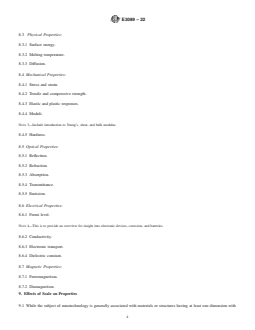
8.3 Physical Properties:
8.3.1 Surface energy.
8.3.2 Melting temperature.
8.3.3 Diffusion.
8.4 Mechanical Properties:
8.4.1 Stress and strain.
8.4.2 Tensile and compressive strength.
8.4.3 Elastic and plastic responses.
8.4.4 Moduli.
NOTE 3—Include introduction to Young’s, shear, and bulk modulus.
8.4.5 Hardness.
8.5 Optical Properties:
8.5.1 Reflection.
8.5.2 Refraction.
8.5.3 Absorption.
8.5.4 Transmittance.
8.5.5 Emission.
8.6 Electrical Properties:
8.6.1 Fermi level.
NOTE 4—This is to provide an overview for insight into electronic devices, corrosion, and batteries.
8.6.2 Conductivity.
8.6.3 Electronic transport.
8.6.4 Dielectric constant.
8.7 Magnetic Properties:
8.7.1 Ferromagnetism.
8.7.2 Diamagnetism.
9. Effects of Scale on Properties
9.1 While the subject of nanotechnology is generally associated with materials or structures having at least one dimension with
E3089 − 22
a size approximately within the 1 to 100 nanometres (nm) range, it should be noted that the small size alone does not necessarily
distinguish the technology. The uniqueness of nanotechnology arises when the
...