


ASTM E3001-20
(Practice)Standard Practice for Workforce Education in Nanotechnology Characterization
Standard Practice for Workforce Education in Nanotechnology Characterization
SIGNIFICANCE AND USE
5.1 This practice establishes the basic structure for education in the characterization of nanoscale materials at the undergraduate college level. The approach taken is to classify specific characterization methods into two tiers, with a minimum number of methods to be selected from each tier and taught at an in-depth or introductory level. This offers the flexibility of tailoring to regional industry needs while still retaining a high degree of equivalency in educational depth and breadth across geographical boundaries.
5.2 Workers may transition in their roles in the workplace. Participants in such education will have a broad understanding of a complement of characterization methods, thus increasing their marketability for jobs within as well as beyond the nanotechnology field.
5.3 This practice is intended to be one in a series of standards developed for workforce education in various aspects of nanotechnology. It will assist in providing an organization a basic structure for developing a program applicable to many areas in nanotechnology, thus providing dynamic and evolving workforce education.
SCOPE
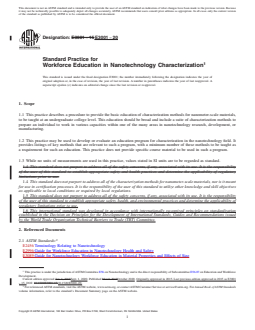
1.1 This practice describes a procedure to provide the basic education of characterization methods for nanometer-scale materials, to be taught at an undergraduate college level. This education should be broad and include a suite of characterization methods to prepare an individual to work in various capacities within one of the many areas in nanotechnology research, development, or manufacturing.
1.2 This practice may be used to develop or evaluate an education program for characterization in the nanotechnology field. It provides listings of key methods that are relevant to such a program, with a minimum number of these methods to be taught as a requirement for such an education. This practice does not provide specific course material to be used in such a program.
1.3 While no units of measurements are used in this practice, values stated in SI units are to be regarded as standard.
1.4 This standard does not purport to address all of the characterization methods for nanometer-scale materials, nor is it meant for use in certification processes. It is the responsibility of the user of this standard to utilize other knowledge and skill objectives as applicable to local conditions or required by local regulations.
1.5 This standard does not purport to address all of the safety concerns, if any, associated with its use. It is the responsibility of the user of this standard to establish appropriate safety, health, and environmental practices and determine the applicability of regulatory limitations prior to use.
1.6 This international standard was developed in accordance with internationally recognized principles on standardization established in the Decision on Principles for the Development of International Standards, Guides and Recommendations issued by the World Trade Organization Technical Barriers to Trade (TBT) Committee.
General Information
- Status
- Published
- Publication Date
- 31-Aug-2020
- Technical Committee
- E56 - Nanotechnology
- Drafting Committee
- E56.07 - Education and Workforce Development
Relations
- Effective Date
- 01-Oct-2006
Overview
ASTM E3001-20 is the Standard Practice for Workforce Education in Nanotechnology Characterization, established by ASTM International. This standard provides a structured approach to teaching the fundamentals of nanoscale material characterization at the undergraduate college level. By organizing key characterization methods into two tiers and requiring a minimum number from each tier to be taught at either a detailed or introductory level, the standard offers critical flexibility. Educational institutions can tailor their programs to align with specific regional industry needs while ensuring consistency in educational depth and breadth across different locations. The standard is not meant for use in certification, but rather as a framework for developing robust and relevant workforce education in nanotechnology.
Key Topics
- Two-Tiered Characterization Methods: The standard organizes 19 relevant nanotechnology characterization techniques into Tier 1 and Tier 2 groups, with a focus on both breadth and depth of understanding.
- Tier 1: Scanning Electron Microscopy (SEM), Scanning Probe Microscopy, Optical Microscopy, Energy Dispersive X-ray Spectroscopy (EDS), and Ellipsometry.
- Tier 2: Fourteen additional methods such as Transmission Electron Microscopy (TEM), Raman Spectroscopy, Fourier Transform Infrared Spectroscopy (FTIR), X-ray Photoelectron Spectroscopy (XPS), and more.
- Core Competencies: Emphasis on basic knowledge in algebra, chemistry, physics, and statistics, along with awareness of environmental, health, and safety (EHS) hazards unique to nanoscale materials.
- Industry Alignment: Methods and skill focus are informed by feedback from employers, educators, and subject matter experts to ensure that education matches the evolving requirements of nanotechnology-related industries.
- Flexible Curriculum Design: Programs must provide detailed instruction in at least three Tier 1 methods and introductory coverage for the remaining Tier 1 and selected Tier 2 methods, ensuring adaptability while maintaining a solid technical foundation.
- Practical Training Goals: Graduates gain exposure to sample preparation, equipment operation, data analysis, and key measurement techniques, making them better prepared for diverse technical roles.
Applications
The ASTM E3001-20 standard is instrumental in:
- Academic Curriculum Development: Assists educational institutions in designing and evaluating undergraduate programs focused on nanotechnology characterization. It promotes both comprehensive and specialized instruction, depending on industry needs.
- Workforce Preparation: Provides students with a broad, versatile skillset, increasing their employability in research, development, and manufacturing roles within nanotechnology and related fields.
- Industry-Education Collaboration: Encourages institutions to consult with local and regional technology companies to refine curricula, ensuring produced skillsets are immediately applicable and valuable in the job market.
- Standardized Skill Assessment: Facilitates comparability and uniformity in graduate qualifications across institutions, thereby supporting academic mobility and industry confidence.
Related Standards
For a comprehensive approach to nanotechnology workforce education and nanoscale material handling, ASTM E3001-20 is best used in conjunction with the following standards:
- ASTM E2456: Terminology Relating to Nanotechnology
- ASTM E2996: Guide for Workforce Education in Nanotechnology Health and Safety
- ASTM E3089: Guide for Nanotechnology Workforce Education in Material Properties and Effects of Size
- ASTM E2535: Guide for Handling Unbound Engineered Nanoscale Particles in Occupational Settings
- ISO/TS 80004-1 & ISO/TS 80004-6: Nanotechnologies - Vocabulary and Nano-object Characterization
- ISO/TR 12885: Health and Safety Practices in Occupational Settings Relevant to Nanotechnologies
- ISO/TS 17200: Nanoparticles in Powder Form - Characteristics and Measurements
- ISO/TS 10797 & 10798: Characterization of Single-Wall Carbon Nanotubes (via TEM and SEM/EDS)
Keywords: nanotechnology workforce education, nanoscale materials characterization, ASTM E3001, undergraduate curriculum, nano characterization methods, nanomaterials, standard practice, laboratory skills, industry-responsive education.
Buy Documents
ASTM E3001-20 - Standard Practice for Workforce Education in Nanotechnology Characterization
REDLINE ASTM E3001-20 - Standard Practice for Workforce Education in Nanotechnology Characterization
Get Certified
Connect with accredited certification bodies for this standard

Great Wall Tianjin Quality Assurance Center
Established 1993, first batch to receive national accreditation with IAF recognition.
Hong Kong Quality Assurance Agency (HKQAA)
Hong Kong's leading certification body.

Innovative Quality Certifications Pvt. Ltd. (IQCPL)
Known for integrity, providing ethical & impartial Assessment & Certification. CMMI Institute Partner.
Sponsored listings
Frequently Asked Questions
ASTM E3001-20 is a standard published by ASTM International. Its full title is "Standard Practice for Workforce Education in Nanotechnology Characterization". This standard covers: SIGNIFICANCE AND USE 5.1 This practice establishes the basic structure for education in the characterization of nanoscale materials at the undergraduate college level. The approach taken is to classify specific characterization methods into two tiers, with a minimum number of methods to be selected from each tier and taught at an in-depth or introductory level. This offers the flexibility of tailoring to regional industry needs while still retaining a high degree of equivalency in educational depth and breadth across geographical boundaries. 5.2 Workers may transition in their roles in the workplace. Participants in such education will have a broad understanding of a complement of characterization methods, thus increasing their marketability for jobs within as well as beyond the nanotechnology field. 5.3 This practice is intended to be one in a series of standards developed for workforce education in various aspects of nanotechnology. It will assist in providing an organization a basic structure for developing a program applicable to many areas in nanotechnology, thus providing dynamic and evolving workforce education. SCOPE 1.1 This practice describes a procedure to provide the basic education of characterization methods for nanometer-scale materials, to be taught at an undergraduate college level. This education should be broad and include a suite of characterization methods to prepare an individual to work in various capacities within one of the many areas in nanotechnology research, development, or manufacturing. 1.2 This practice may be used to develop or evaluate an education program for characterization in the nanotechnology field. It provides listings of key methods that are relevant to such a program, with a minimum number of these methods to be taught as a requirement for such an education. This practice does not provide specific course material to be used in such a program. 1.3 While no units of measurements are used in this practice, values stated in SI units are to be regarded as standard. 1.4 This standard does not purport to address all of the characterization methods for nanometer-scale materials, nor is it meant for use in certification processes. It is the responsibility of the user of this standard to utilize other knowledge and skill objectives as applicable to local conditions or required by local regulations. 1.5 This standard does not purport to address all of the safety concerns, if any, associated with its use. It is the responsibility of the user of this standard to establish appropriate safety, health, and environmental practices and determine the applicability of regulatory limitations prior to use. 1.6 This international standard was developed in accordance with internationally recognized principles on standardization established in the Decision on Principles for the Development of International Standards, Guides and Recommendations issued by the World Trade Organization Technical Barriers to Trade (TBT) Committee.
SIGNIFICANCE AND USE 5.1 This practice establishes the basic structure for education in the characterization of nanoscale materials at the undergraduate college level. The approach taken is to classify specific characterization methods into two tiers, with a minimum number of methods to be selected from each tier and taught at an in-depth or introductory level. This offers the flexibility of tailoring to regional industry needs while still retaining a high degree of equivalency in educational depth and breadth across geographical boundaries. 5.2 Workers may transition in their roles in the workplace. Participants in such education will have a broad understanding of a complement of characterization methods, thus increasing their marketability for jobs within as well as beyond the nanotechnology field. 5.3 This practice is intended to be one in a series of standards developed for workforce education in various aspects of nanotechnology. It will assist in providing an organization a basic structure for developing a program applicable to many areas in nanotechnology, thus providing dynamic and evolving workforce education. SCOPE 1.1 This practice describes a procedure to provide the basic education of characterization methods for nanometer-scale materials, to be taught at an undergraduate college level. This education should be broad and include a suite of characterization methods to prepare an individual to work in various capacities within one of the many areas in nanotechnology research, development, or manufacturing. 1.2 This practice may be used to develop or evaluate an education program for characterization in the nanotechnology field. It provides listings of key methods that are relevant to such a program, with a minimum number of these methods to be taught as a requirement for such an education. This practice does not provide specific course material to be used in such a program. 1.3 While no units of measurements are used in this practice, values stated in SI units are to be regarded as standard. 1.4 This standard does not purport to address all of the characterization methods for nanometer-scale materials, nor is it meant for use in certification processes. It is the responsibility of the user of this standard to utilize other knowledge and skill objectives as applicable to local conditions or required by local regulations. 1.5 This standard does not purport to address all of the safety concerns, if any, associated with its use. It is the responsibility of the user of this standard to establish appropriate safety, health, and environmental practices and determine the applicability of regulatory limitations prior to use. 1.6 This international standard was developed in accordance with internationally recognized principles on standardization established in the Decision on Principles for the Development of International Standards, Guides and Recommendations issued by the World Trade Organization Technical Barriers to Trade (TBT) Committee.
ASTM E3001-20 is classified under the following ICS (International Classification for Standards) categories: 03.180 - Education; 07.120 - Nanotechnologies. The ICS classification helps identify the subject area and facilitates finding related standards.
ASTM E3001-20 has the following relationships with other standards: It is inter standard links to ASTM E2456-06. Understanding these relationships helps ensure you are using the most current and applicable version of the standard.
ASTM E3001-20 is available in PDF format for immediate download after purchase. The document can be added to your cart and obtained through the secure checkout process. Digital delivery ensures instant access to the complete standard document.
Standards Content (Sample)
This international standard was developed in accordance with internationally recognized principles on standardization established in the Decision on Principles for the
Development of International Standards, Guides and Recommendations issued by the World Trade Organization Technical Barriers to Trade (TBT) Committee.
Designation: E3001 − 20
Standard Practice for
Workforce Education in Nanotechnology Characterization
This standard is issued under the fixed designation E3001; the number immediately following the designation indicates the year of
original adoption or, in the case of revision, the year of last revision. A number in parentheses indicates the year of last reapproval. A
superscript epsilon (´) indicates an editorial change since the last revision or reapproval.
1. Scope 2. Referenced Documents
2.1 ASTM Standards:
1.1 This practice describes a procedure to provide the basic
E2456 Terminology Relating to Nanotechnology
education of characterization methods for nanometer-scale
E2996 Guide for Workforce Education in Nanotechnology
materials, to be taught at an undergraduate college level. This
Health and Safety
education should be broad and include a suite of characteriza-
E3089 Guide for Nanotechnology Workforce Education in
tion methods to prepare an individual to work in various
Material Properties and Effects of Size
capacities within one of the many areas in nanotechnology
2.2 ISO Standards:
research, development, or manufacturing.
ISO/TS 80004-1 Nanotechnologies – Vocabulary – Part 1:
1.2 This practice may be used to develop or evaluate an
Core terms
education program for characterization in the nanotechnology
ISO/TS 80004-6 Nanotechnologies – Vocabulary – Part 6:
field. It provides listings of key methods that are relevant to
Nano-object characterization
such a program, with a minimum number of these methods to
be taught as a requirement for such an education. This practice
3. Terminology
does not provide specific course material to be used in such a
3.1 Definitions:
program.
3.1.1 For definitions of terms related to nanotechnology in
1.3 While no units of measurements are used in this
general, refer to Terminology E2456 and ISO/TS 80004-1.
practice, values stated in SI units are to be regarded as 3.1.2 For definitions of terms related to measurement meth-
standard.
ods and instrumentation used, refer to ISO/TS 80004-6.
3.2 Definitions of Terms Specific to This Standard:
1.4 This standard does not purport to address all of the
3.2.1 characterization, n—measurement(s), using one or
characterization methods for nanometer-scale materials, nor is
more methods, to determine the structure and composition of a
it meant for use in certification processes. It is the responsi-
material as well as its physical or chemical properties.
bility of the user of this standard to utilize other knowledge and
skill objectives as applicable to local conditions or required by
4. Summary of Practice
local regulations.
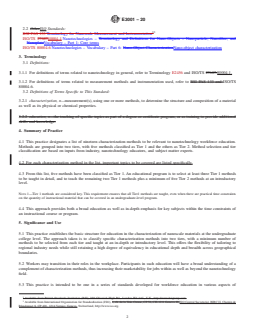
4.1 This practice designates a list of nineteen characteriza-
1.5 This standard does not purport to address all of the
tion methods to be relevant to nanotechnology workforce
safety concerns, if any, associated with its use. It is the
education. Methods are grouped into two tiers, with five
responsibility of the user of this standard to establish appro-
methods classified as Tier 1 and the others as Tier 2. Method
priate safety, health, and environmental practices and deter-
selection and tier classification are based on inputs from
mine the applicability of regulatory limitations prior to use.
industry, nanotechnology educators, and subject matter ex-
1.6 This international standard was developed in accor-
perts.
dance with internationally recognized principles on standard-
4.2 For each characterization method in the list, important
ization established in the Decision on Principles for the
topics to be covered are listed specifically.
Development of International Standards, Guides and Recom-
mendations issued by the World Trade Organization Technical
4.3 From this list, five methods have been classified as Tier
Barriers to Trade (TBT) Committee.
1. An educational program is to select at least three Tier 1
For referenced ASTM standards, visit the ASTM website, www.astm.org, or
This practice is under the jurisdiction of ASTM Committee E56 on Nanotech- contact ASTM Customer Service at service@astm.org. For Annual Book of ASTM
nology and is the direct responsibility of Subcommittee E56.07 on Education and Standards volume information, refer to the standard’s Document Summary page on
Workforce Development. the ASTM website.
Current edition approved Sept. 1, 2020. Published October 2020. Originally Available from International Organization for Standardization (ISO), ISO
approved in 2015. Last previous edition approved in 2015 as E3001 – 15. DOI: Central Secretariat, BIBC II, Chemin de Blandonnet 8, CP 401, 1214 Vernier,
10.1520/E3001-20. Geneva, Switzerland, http://www.iso.org.
Copyright © ASTM International, 100 Barr Harbor Drive, PO Box C700, West Conshohocken, PA 19428-2959. United States
E3001 − 20
methods to be taught in detail, and to teach the remaining two 7.3 The methods relevant for workforce education in nano-
Tier 1 methods plus a minimum of five Tier 2 methods at an technology characterization are given in Section 8, with
introductory level. important topics to be covered for each method listed specifi-
cally. Additional methods or topics, or both, may be added on
NOTE 1—Tier 1 methods are considered key. This requirement ensures
an as-needed basis.
that all Tier1 methods are taught, even when there are practical time
constraints on the quantity of instructional material that can be covered in
an undergraduate-level program.
8. Characterization Methods Relevant to Nanotechnology
Workforce Education
4.4 This approach provides both a broad education as well
as in-depth emphasis for key subjects within the time con-
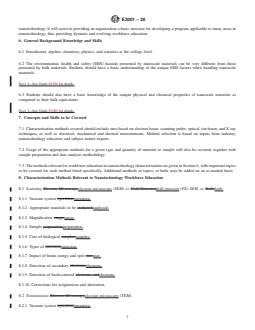
8.1 Scanning electron microscopy (SEM) or field emission
straints of an instructional course or program.
(FE) SEM, or both:
8.1.1 Vacuum system operation.
5. Significance and Use
8.1.2 Appropriate materials to be analyzed.
5.1 This practice establishes the basic structure for educa-
8.1.3 Magnification range.
tion in the characterization of nanoscale materials at the
8.1.4 Sample preparation.
undergraduate college level. The approach taken is to classify
8.1.5 Care of biological samples.
specific characterization methods into two tiers, with a mini-
8.1.6 Types of emission.
mum number of methods to be selected from each tier and
8.1.7 Impact of beam energy and spot size.
taught at an in-depth or introductory level. This offers the
8.1.8 Detection of secondary electrons.
flexibility of tailoring to regional industry needs while still
8.1.9 Detection of backscattered electrons.
retainingahighdegreeofequivalencyineducationaldepthand
8.1.10 Corrections for astigmatism and aberration.
breadth across geographical boundaries.
8.2 Transmission electron microscopy (TEM):
5.2 Workers may transition in their roles in the workplace.
8.2.1 Vacuum system operation.
Participants in such education will have a broad understanding
8.2.2 Appropriate materials to be analyzed.
of a complement of characterization methods, thus increasing
8.2.3 Magnification range.
their marketability for jobs within as well as beyond the
8.2.4 Sample preparation and sample thinning methods.
nanotechnology field.
8.2.5 Care of biological samples.
5.3 This practice is intended to be one in a series of
8.2.6 Bright field mode.
standardsdevelopedforworkforceeducationinvariousaspects
8.2.7 Diffraction contrast.
of nanotechnology. It will assist in providing an organization a
8.2.8 Impact of beam energy.
basic structure for developing a program applicable to many
8.2.9 Corrections for astigmatism and aberration.
areas in nanotechnology, thus providing dynamic and evolving
8.3 Energy dispersive X-ray spectroscopy (EDS):
workforce education.
8.3.1 Vacuum system operation.
6. General Background Knowledge and Skills 8.3.2 Appropriate materials to be analyzed.
8.3.3 Electron beam source.
6.1 Introductoryalgebra,chemistry,physics,andstatisticsat
8.3.4 X-ray detector.
the college level.
8.3.5 Spectrum and data analysis., and
6.2 The environmental, health and safety (EHS) hazards
8.3.6 Detection limit.
presented by nanoscale materials can be very different from
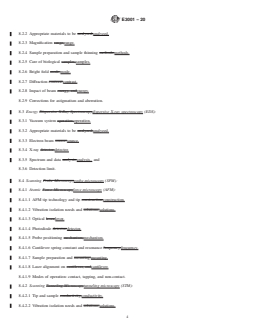
8.4 Scanning probe microscopy (SPM):
thosepresentedbybulkmaterials.Studentsshouldhaveabasic
8.4.1 Atomic force microscopy (AFM):
understanding of the unique EHS factors when handling
nanoscale materials. 8.4.1.1 AFM tip technology and tip construction.
8.4.1.2 Vibration isolation needs and solutions.
NOTE 2—See Guide E2996 for details.
8.4.1.3 Optical lever.
6.3 Students should also have a basic knowledge of the
8.4.1.4 Photodiode detector.
uniquephysicalandchemicalpropertiesofnanoscalematerials
8.4.1.5 Probe positioning mechanism.
as compared to their bulk equivalents.
8.4.1.6 Cantilever spring constant and resonance frequency.
NOTE 3—See Guide E3089 for details.
8.4.1.7 Sample preparation and mounting.
8.4.1.8 Laser alignment on cantilever.
7. Concepts and Skills to be Covered
8.4.1.9 Modes of operation: contact, tapping, and non-
7.1 Characterization methods covered should include ones
contact.
basedonelectronbeam,scanningprobe,optical,ionbeam,and
8.4.2 Scanning tunneling microscopy (STM):
X-ray techniques, as well as electrical, mechanical and thermal
8.4.2.1 Tip and sample conductivity.
measurements. Method selection is based on inputs from
8.4.2.2 Vibration isolation needs and solutions.
industry, nanotechnology educators and subject matter experts.
8.4.2.3 Sample flatness.
8.4.2.4 Probe positioning mechanism.
7.2 Usage of the appropriate methods for a given type and
8.4.2.5 Probe tip construction.
quantity of material or sample will also be covered, together
with sample preparation and data analysis methodology. 8.4.2.6 Piezoelectric tube scanner.
E3001 − 20
8.4.2.7 Feedback loop proportional-integral-derivative 8.13.2 Appropriate materials to be analyzed.
(PID) control.
8.13.3 Element sensitivity range.
8.4.2.8 Cases needing ultra high vacuum measurements.
8.13.4 Ion source:
8.4.2.9 Range of operation.
8.13.4.1 Ion beam selection and interaction with surface.
8.13.4.2 Gaseous ionization by electron ionization.
8.5 Stylus profilometry:
8.5.1 Appropriate materials to be analyzed. 8.13.4.3 Surface ionization of Cs ions.
8.5.2 Range of operation. 8.13.4.4 Liquid metal ionization.
8.5.3 Calibration.
8.13.5 Static versus dynamic measurement methods:
8.5.4 Stylus designs and stylus force.
8.13.5.1 Sputter rates.
8.13.6 Types of emission.
8.6 Raman spectroscopy:
8.13.7 Impact of beam energy.
8.6.1 Concept of operation.
8.13.8 Sample charging and reduction of negative charge.
8.6.2 Appropriate materials to be analyzed.
8.6.3 Chemical bonds and Doppler interactions.
8.14 X-ray photoelectron spectroscopy (XPS):
8.7 Fourier transform infrared spectroscopy (FTIR):
8.14.1 Vacuum system operation.
8.7.1 Appropriate materials to be analyzed.
8.14.2 Appropriate materials to be analyzed.
8.7.2 Sample preparation.
8.14.3 X-ray source.
8.7.3 Infrared emitter.
8.14.4 Electron detector.
8.7.4 Michelson interferometer operation.
8.14.5 Spectrum and data analysis.
8.7.5 Overview of the theory of Fourier transforms.
8.14.6 Detection limit.
8.7.6 Interferogram analysis.
8.15 X-ray diffraction (XRD):
8.8 Spectrophotometry:
8.15.1 X-ray generation and characteristics.
8.8.1 Appropriate materials to be analyzed.
8.15.2 Lattice planes and Bragg’s law.
8.8.2 Transmittance and reflectance mode.
8.15.3 Sample preparation:
8.8.3 Sample preparation and cuvettes.
8.15.3.1 Diffraction of powder samples.
8.9 Optical microscopy:
8.15.3.2 Diffraction of thin film samples.
8.9.1 Light microscopy:
8.15.4 Comparison with reference spectra:
8.9.1.1 Appropriate materials to be analyzed.
8.15.4.1 Elemental composition.
8.9.1.2 Magnification range and resolution limits.
8.15.4.2 Lattice parameter.
8.9.1.3 Brightfield and darkfield illumination.
8.16 Electrical measurements:
8.9.2 Fluorescence mi
...
This document is not an ASTM standard and is intended only to provide the user of an ASTM standard an indication of what changes have been made to the previous version. Because
it may not be technically possible to adequately depict all changes accurately, ASTM recommends that users consult prior editions as appropriate. In all cases only the current version
of the standard as published by ASTM is to be considered the official document.
Designation: E3001 − 15 E3001 − 20
Standard Practice for
Workforce Education in Nanotechnology Characterization
This standard is issued under the fixed designation E3001; the number immediately following the designation indicates the year of
original adoption or, in the case of revision, the year of last revision. A number in parentheses indicates the year of last reapproval. A
superscript epsilon (´) indicates an editorial change since the last revision or reapproval.
1. Scope
1.1 This practice describes a procedure to provide the basic education of characterization methods for nanometer-scale materials,
to be taught at an undergraduate college level. This education should be broad and include a suite of characterization methods to
prepare an individual to work in various capacities within one of the many areas in nanotechnology research, development, or
manufacturing.
1.2 This practice may be used to develop or evaluate an education program for characterization in the nanotechnology field. It
provides listings of key methods that are relevant to such a program, with a minimum number of these methods to be taught as
a requirement for such an education. This practice does not provide specific course material to be used in such a program.
1.3 While no units of measurements are used in this practice, values stated in SI units are to be regarded as standard.
1.4 This standard does not purport to address all of the safety concerns, if any, associated with its use. It is the responsibility
of the user of this standard to establish appropriate safety and health practices and determine the applicability of regulatory
limitations prior to use.
1.4 This standard does not purport to address all of the characterization methods for nanometer-scale materials, nor is it meant
for use in certification processes. It is the responsibility of the user of this standard to utilize other knowledge and skill objectives
as applicable to local conditions or required by local regulations.
1.5 This standard does not purport to address all of the safety concerns, if any, associated with its use. It is the responsibility
of the user of this standard to establish appropriate safety, health, and environmental practices and determine the applicability of
regulatory limitations prior to use.
1.6 This international standard was developed in accordance with internationally recognized principles on standardization
established in the Decision on Principles for the Development of International Standards, Guides and Recommendations issued
by the World Trade Organization Technical Barriers to Trade (TBT) Committee.
2. Referenced Documents
2.1 ASTM Standards:
E2456 Terminology Relating to Nanotechnology
E2996 Guide for Workforce Education in Nanotechnology Health and Safety
E3089 Guide for Nanotechnology Workforce Education in Material Properties and Effects of Size
This practice is under the jurisdiction of ASTM Committee E56 on Nanotechnology and is the direct responsibility of Subcommittee E56.07 on Education and Workforce
Development.
Current edition approved Jan. 1, 2015Sept. 1, 2020. Published March 2015October 2020. Originally approved in 2015. Last previous edition approved in 2015 as E3001
– 15. DOI: 10.1520/E3001-15.10.1520/E3001-20.
For referenced ASTM standards, visit the ASTM website, www.astm.org, or contact ASTM Customer Service at service@astm.org. For Annual Book of ASTM Standards
volume information, refer to the standard’s Document Summary page on the ASTM website.
Copyright © ASTM International, 100 Barr Harbor Drive, PO Box C700, West Conshohocken, PA 19428-2959. United States
E3001 − 20
2.2 OtherISO Standards:
BSI PAS 133 Terminology for Nanoscale Measurement and Instrumentation
ISO/TS 2768780004-1 Nanotechnologies – Terminology and Definitions for Nano-Objects – Nanoparticle, Nanofibre, and
NanoplateVocabulary – Part 1: Core terms
ISO/TS 80004-6 Nanotechnologies – Vocabulary – Part 6: Nano-Object CharacterizationNano-object characterization
3. Terminology
3.1 Definitions:
3.1.1 For definitions of terms related to nanotechnology in general, refer to Terminology E2456 and ISO/TS 27687.80004-1.
3.1.2 For definitions of terms related to measurement methods and instrumentation used, refer to BSI PAS 133 and ISO/TS
80004-6.
3.2 Definitions of Terms Specific to This Standard:
3.2.1 characterization, n—measurement(s), using one or more methods, to determine the structure and composition of a material
as well as its physical or chemical properties.
3.2.2 education, n—the teaching of specific topics as part of a degree or certificate program, or as training to provide additional
skills and knowledge.
4. Summary of Practice
4.1 This practice designates a list of nineteen characterization methods to be relevant to nanotechnology workforce education.
Methods are grouped into two tiers, with five methods classified as Tier 1 and the others as Tier 2. Method selection and tier
classification are based on inputs from industry, nanotechnology educators, and subject matter experts.
4.2 For each characterization method in the list, important topics to be covered are listed specifically.
4.3 From this list, five methods have been classified as Tier 1. An educational program is to select at least three Tier 1 methods
to be taught in detail, and to teach the remaining two Tier 1 methods plus a minimum of five Tier 2 methods at an introductory
level.
NOTE 1—Tier 1 methods are considered key. This requirement ensures that all Tier1 methods are taught, even when there are practical time constraints
on the quantity of instructional material that can be covered in an undergraduate-level program.
4.4 This approach provides both a broad education as well as in-depth emphasis for key subjects within the time constraints of
an instructional course or program.
5. Significance and Use
5.1 This practice establishes the basic structure for education in the characterization of nanoscale materials at the undergraduate
college level. The approach taken is to classify specific characterization methods into two tiers, with a minimum number of
methods to be selected from each tier and taught at an in-depth or introductory level. This offers the flexibility of tailoring to
regional industry needs while still retaining a high degree of equivalency in educational depth and breadth across geographical
boundaries.
5.2 Workers may transition in their roles in the workplace. Participants in such education will have a broad understanding of a
complement of characterization methods, thus increasing their marketability for jobs within as well as beyond the nanotechnology
field.
5.3 This practice is intended to be one in a series of standards developed for workforce education in various aspects of
Available from British Standards Institution (BSI), 389 Chiswick High Rd., London W4 4AL, U.K., http://www.bsigroup.com.
Available from International Organization for Standardization (ISO), 1, ch. de la Voie-Creuse, CP 56, CH-1211 Geneva 20,ISO Central Secretariat, BIBC II, Chemin de
Blandonnet 8, CP 401, 1214 Vernier, Geneva, Switzerland, http://www.iso.org.
E3001 − 20
nanotechnology. It will assist in providing an organization a basic structure for developing a program applicable to many areas in
nanotechnology, thus providing dynamic and evolving workforce education.
6. General Background Knowledge and Skills
6.1 Introductory algebra, chemistry, physics, and statistics at the college level.
6.2 The environmental, health and safety (EHS) hazards presented by nanoscale materials can be very different from those
presented by bulk materials. Students should have a basic understanding of the unique EHS factors when handling nanoscale
materials.
NOTE 2—See Guide E2996 for details.
6.3 Students should also have a basic knowledge of the unique physical and chemical properties of nanoscale materials as
compared to their bulk equivalents.
NOTE 3—See Guide E3089 for details.
7. Concepts and Skills to be Covered
7.1 Characterization methods covered should include ones based on electron beam, scanning probe, optical, ion beam, and X-ray
techniques, as well as electrical, mechanical and thermal measurements. Method selection is based on inputs from industry,
nanotechnology educators and subject matter experts.
7.2 Usage of the appropriate methods for a given type and quantity of material or sample will also be covered, together with
sample preparation and data analysis methodology.
7.3 The methods relevant for workforce education in nanotechnology characterization are given in Section 8, with important topics
to be covered for each method listed specifically. Additional methods or topics, or both, may be added on an as-needed basis.
8. Characterization Methods Relevant to Nanotechnology Workforce Education
8.1 Scanning Electron Microscopyelectron microscopy (SEM) or Field Emissionfield emission (FE) SEM, or Both:both:
8.1.1 Vacuum system operation,operation.
8.1.2 Appropriate materials to be analyzed,analyzed.
8.1.3 Magnification range,range.
8.1.4 Sample preparation,preparation.
8.1.5 Care of biological samples,samples.
8.1.6 Types of emission,emission.
8.1.7 Impact of beam energy and spot size,size.
8.1.8 Detection of secondary electrons,electrons.
8.1.9 Detection of backscattered electrons, andelectrons.
8.1.10 Corrections for astigmatism and aberration.
8.2 Transmission Electron Microscopyelectron microscopy (TEM):
8.2.1 Vacuum system operation,operation.
E3001 − 20
8.2.2 Appropriate materials to be analyzed,analyzed.
8.2.3 Magnification range,range.
8.2.4 Sample preparation and sample thinning methods,methods.
8.2.5 Care of biological samples,samples.
8.2.6 Bright field mode,mode.
8.2.7 Diffraction contrast,contrast.
8.2.8 Impact of beam energy, andenergy.
8.2.9 Corrections for astigmatism and aberration.
8.3 Energy Dispersive X-Ray Spectroscopydispersive X-ray spectroscopy (EDS):
8.3.1 Vacuum system operation,operation.
8.3.2 Appropriate materials to be analyzed,analyzed.
8.3.3 Electron beam source,source.
8.3.4 X-ray detector,detector.
8.3.5 Spectrum and data analysis,analysis., and
8.3.6 Detection limit.
8.4 Scanning Probe Microscopyprobe microscopy (SPM):
8.4.1 Atomic Force Microscopyforce microscopy (AFM):
8.4.1.1 AFM tip technology and tip construction,construction.
8.4.1.2 Vibration isolation needs and solutions,solutions.
8.4.1.3 Optical lever,lever.
8.4.1.4 Photodiode detector,detector.
8.4.1.5 Probe positioning mechanism,mechanism.
8.4.1.6 Cantilever spring constant and resonance frequency,frequency.
8.4.1.7 Sample preparation and mounting,mounting.
8.4.1.8 Laser alignment on cantilever, andcantilever.
8.4.1.9 Modes of operation: contact, tapping, and non-contact.
8.4.2 Scanning Tunneling Microscopytunneling microscopy (STM):
8.4.2.1 Tip and sample conductivity,conductivity.
8.4.2.2 Vibration isolation needs and solutions,solutions.
E3001 − 20
8.4.2.3 Sample flatness,flatness.
8.4.2.4 Probe positioning mechanism,mechanism.
8.4.2.5 Probe tip construction,construction.
8.4.2.6 Piezoelectric tube scanner,scanner.
8.4.2.7 Feedback loop proportional-integral-derivative (PID) control,control.
8.4.2.8 Cases needing ultra high vacuum measurements, andmeasurements.
8.4.2.9 Range of operation.
8.5 Profilometry:Stylus profilometry:
8.5.1 Appropriate materials to be analyzed,analyzed.
8.5.2 Range of operation,operation.
8.5.3 Calibration, andCalibration.
8.5.4 Stylus designs and stylus force.
8.6 Raman Spectroscopy:spectroscopy:
8.6.1 Concept of operation,operation.
8.6.2 Appropriate materials to be analyzed, andanalyzed.
8.6.3 Chemical bonds and Doppler interactions.
8.7 Fourier Transform Infrared Spectroscopytransform infrared spectroscopy (FTIR):
8.7.1 Appropriate materials to be analyzed,analyzed.
8.7.2 Sample preparation,preparation.
8.7.3 Infrared emitter,emitter.
8.7.4 Michelson interferometer operation,operation.
8.7.5 Overview of the theory of Fourier transforms, andtransforms.
8.7.6 Interferogram analysis.
8.8 Spectrophotometry:
8.8.1 Appropriate materials to be analyzed,analyzed.
8.8.2 Transmittance and reflectance mode, andmode.
8.8.3 Sample preparation and cuvettes.
8.9 Optical Microscopy:microscopy:
E3001 − 20
8.9.1 Light Microscopy:microscopy:
8.9.1.1 Appropriate materials to be analyzed,analyzed.
8.9.1.2 Magnification range and resolution limits, andlimits.
8.9.1.3 Brightfield and darkfield illumination.
8.9.2 Fluorescence Microscopy:microscopy:
8.9.2.1 Light sources,sources.
8.9.2.2 Application to biological samples, andsamples.
8.9.2.3 Limitations.
8.9.3 Scanning Confocal Microscopy:confocal microscopy:
8.9.3.1 Scanning modes: laser scanning and spinning disc, anddisc.
8.9.3.2 3-dimensional image reconstruction and multi-channel image overlay.
8.10 Ellipsometry:
8.10.1 Appropriate materials to be analyzed,analyzed.
8.10.2 One-angle verses two-angle measurements, andmeasurements.
8.10.3 Stoichiometric information.
8.11 Contact Angle Measurement:angle measurement:
8.11.1 Appropriate materials to be analyzed,analyzed.
8.11.2 Surface energy, andenergy.
8.11.3 Relationship of surface energy for water and protein adhesion and implications for biocompatibility.
8.12 Auger Electron Spectroscopyelectron spectroscopy (AES):
8.12.1 Vacuum system operation,operation.
8.12.2 Electron transitions and the Auger Effect,effect.
8.12.3 Spectrum and data analysis,analysis.
8.12.4 Instrumentation,Instrumentation.
8.12.5 Quantitative analysis, andanalysis.
8.12.6 Depth profile.
8.13 Secondary-Ion Mass SpectroscopySecondary-ion mass spectroscopy (SIMS):
8.13.1 Vacuum system operation,operation.
E3001 − 20
8.13.2 Appropriate materials to be analyzed,analyzed.
8.13.3 Element sensitivity range,range.
8.13.4 Ion source:
8.13.4.1 Ion beam selection and interaction with surface,surface.
8.13.4.2 Gaseous ionization by electron ionization,ionization.
8.13.4.3 Surface ionization of Cs ions, andions.
8.13.4.4 Liquid metal ionization.
8.13.5 Static versus dynamic measurement methods:
8.13.5.1 Sputter rates.
8.13.6 Types of emission,emission.
8.13.7 Impact of beam energy, andenergy.
8.13.8 Sample charging and reduction o
...
Questions, Comments and Discussion
Ask us and Technical Secretary will try to provide an answer. You can facilitate discussion about the standard in here.
Loading comments...