

ASTM D7722-22
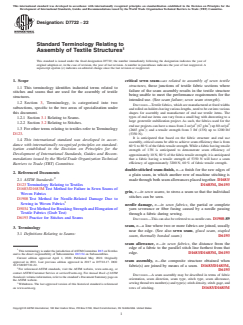
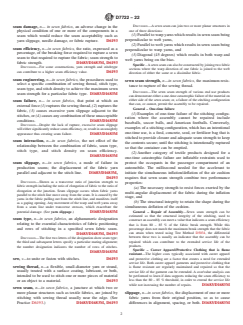
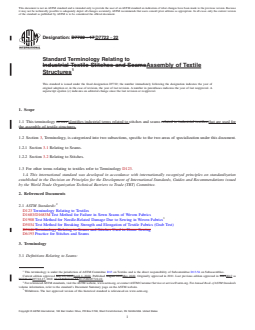
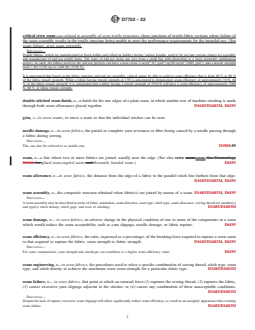
(Terminology)Standard Terminology Relating to Assembly of Textile Structures
General Information
- Abstract
SCOPE
1.1 This terminology identifies industrial terms related to stitches and seams that are used for the assembly of textile structures.
1.2 Section 3, Terminology, is categorized into two subsections, specific to the two areas of specialization under this document.
1.2.1 Section 3.1 Relating to Seams.
1.2.2 Section 3.2 Relating to Stitches.
1.3 For other terms relating to textiles refer to Terminology D123.
1.4 This international standard was developed in accordance with internationally recognized principles on standardization established in the Decision on Principles for the Development of International Standards, Guides and Recommendations issued by the World Trade Organization Technical Barriers to Trade (TBT) Committee.
- Status
- Published
- Publication Date
- 31-Mar-2022
- Technical Committee
- D13 - Textiles
- Drafting Committee
- D13.54 - Subassemblies


Overview
ASTM D7722-22: Standard Terminology Relating to Assembly of Textile Structures provides a comprehensive set of industrial terms and definitions relevant to the assembly of textile structures, with a particular focus on stitches and seams. Established by ASTM International, this standard facilitates clear communication and understanding across the textile and apparel industries by categorizing terminology related to both seams and stitches. Adhering to ASTM D7722-22 ensures that professionals use consistent language when specifying, testing, and comparing sewn textile products, supporting quality, safety, and global trade compliance.
Key Topics
- Terminology for Seams and Stitches: Defines critical terms used in the design, production, and testing of sewn textile structures, such as critical sewn seam, double-stitched seam-finish, seam efficiency, stitch density, and various classes and types of stitches.
- Classification System: Categorizes definitions into two main areas:
- Terms relating to seams (e.g., seam allowance, seam assembly, seam failure, seam slippage)
- Terms relating to stitches (e.g., lockstitch, chainstitch, overedge chainstitch, stitch type)
- Performance Metrics: Details key seam and stitch performance concepts like seam strength, seam efficiency, and seam engineering - essential for evaluating and optimizing the durability of textile assemblies.
- Failure Modes: Describes common issues such as needle damage, yarn severance, seam slippage, seam damage, and how these impact finished products.
Applications
The standardized terminology established in ASTM D7722-22 is critical in a wide range of textile industry applications, including:
- Industrial and Technical Textiles: Applied in the design and production of geotextiles, filtration media, protective clothing, and other engineered textile products where seam and stitch performance is crucial to product safety and function.
- Apparel and Garment Manufacturing: Used by designers, manufacturers, and quality assurance professionals to communicate requirements, assess sewn seam strength, and maintain compliance with performance and safety specifications.
- Textile Product Testing: Facilitates consistent reporting and evaluation when testing for seam efficiency, stitch density, and sewn seam strength, supporting product development and quality control processes.
- Product Repair and Maintenance: Provides guidance on seam efficiency and reparability, important for evaluating lifetime value and repair strategies for high-value and protective textile products (e.g., career apparel, flame-resistant garments).
- Global Trade and Compliance: Supports international business by harmonizing terminology, aiding in compliance with the World Trade Organization Technical Barriers to Trade (TBT) principles.
Related Standards
ASTM D7722-22 references and operates alongside several important industry standards to offer a complete framework for sewn textile structures:
- ASTM D123 – Terminology Relating to Textiles: Broader textile terminology beyond seams and stitches.
- ASTM D1683/D1683M – Test Method for Failure in Sewn Seams of Woven Fabrics: For seam failure analysis.
- ASTM D1908 – Test Method for Needle-Related Damage Due to Sewing in Woven Fabrics: Evaluates needle damage.
- ASTM D5034 – Test Method for Breaking Strength and Elongation of Textile Fabrics (Grab Test): Measures fabric strength.
- ASTM D5646 – Terminology Relating to Seams and Stitches Used in Home Sewing.
- ASTM D6193 – Practice for Stitches and Seams: Details stitch types and seam constructions.
By utilizing ASTM D7722-22, companies in textiles and apparel benefit from unified, industry-accepted language supporting process efficiency, product integrity, and international collaboration in textile assembly and sewn product manufacturing.
Relations
- Effective Date
- 01-Jul-2020
- Effective Date
- 01-Mar-2017
- Effective Date
- 01-Mar-2017
- Effective Date
- 01-Mar-2017
- Effective Date
- 01-Nov-2016
- Effective Date
- 01-Jan-2016
- Effective Date
- 15-Sep-2015
- Effective Date
- 01-Sep-2015
- Effective Date
- 01-Apr-2015
- Effective Date
- 15-Jun-2013
- Effective Date
- 15-Jun-2013
- Effective Date
- 15-May-2013
- Effective Date
- 01-Feb-2012
- Effective Date
- 01-Feb-2012
- Refers
ASTM D1683/D1683M-11a - Standard Test Method for Failure in Sewn Seams of Woven Apparel Fabrics - Effective Date
- 01-Jul-2011
Get Certified
Connect with accredited certification bodies for this standard

Control Union Certifications
Global certification for agriculture and sustainability.

Hohenstein Institut
Textile testing and certification.

Bureau Veritas Bangladesh
Bureau Veritas certification services in Bangladesh.
Sponsored listings
Frequently Asked Questions
ASTM D7722-22 is a standard published by ASTM International. Its full title is "Standard Terminology Relating to Assembly of Textile Structures". This standard covers: SCOPE 1.1 This terminology identifies industrial terms related to stitches and seams that are used for the assembly of textile structures. 1.2 Section 3, Terminology, is categorized into two subsections, specific to the two areas of specialization under this document. 1.2.1 Section 3.1 Relating to Seams. 1.2.2 Section 3.2 Relating to Stitches. 1.3 For other terms relating to textiles refer to Terminology D123. 1.4 This international standard was developed in accordance with internationally recognized principles on standardization established in the Decision on Principles for the Development of International Standards, Guides and Recommendations issued by the World Trade Organization Technical Barriers to Trade (TBT) Committee.
SCOPE 1.1 This terminology identifies industrial terms related to stitches and seams that are used for the assembly of textile structures. 1.2 Section 3, Terminology, is categorized into two subsections, specific to the two areas of specialization under this document. 1.2.1 Section 3.1 Relating to Seams. 1.2.2 Section 3.2 Relating to Stitches. 1.3 For other terms relating to textiles refer to Terminology D123. 1.4 This international standard was developed in accordance with internationally recognized principles on standardization established in the Decision on Principles for the Development of International Standards, Guides and Recommendations issued by the World Trade Organization Technical Barriers to Trade (TBT) Committee.
ASTM D7722-22 is classified under the following ICS (International Classification for Standards) categories: 01.040.59 - Textile and leather technology (Vocabularies); 59.080.30 - Textile fabrics. The ICS classification helps identify the subject area and facilitates finding related standards.
ASTM D7722-22 has the following relationships with other standards: It is inter standard links to ASTM D6193-16(2020), ASTM D1683/D1683M-17, ASTM D1683/D1683M-17e1, ASTM D123-17, ASTM D1683/D1683M-16, ASTM D6193-16, ASTM D123-15b, ASTM D123-15a, ASTM D123-15, ASTM D123-13ae1, ASTM D123-13a, ASTM D123-13, ASTM D123-12e1, ASTM D123-12, ASTM D1683/D1683M-11a. Understanding these relationships helps ensure you are using the most current and applicable version of the standard.
ASTM D7722-22 is available in PDF format for immediate download after purchase. The document can be added to your cart and obtained through the secure checkout process. Digital delivery ensures instant access to the complete standard document.
Standards Content (Sample)
This international standard was developed in accordance with internationally recognized principles on standardization established in the Decision on Principles for the
Development of International Standards, Guides and Recommendations issued by the World Trade Organization Technical Barriers to Trade (TBT) Committee.
Designation: D7722 − 22
Standard Terminology Relating to
Assembly of Textile Structures
This standard is issued under the fixed designation D7722; the number immediately following the designation indicates the year of
original adoption or, in the case of revision, the year of last revision. A number in parentheses indicates the year of last reapproval. A
superscript epsilon (´) indicates an editorial change since the last revision or reapproval.
1. Scope critical sewn seam—as related to assembly of sewn textile
structures, those junctions of textile fabric sections where
1.1 This terminology identifies industrial terms related to
failure of the seam assembly results in the textile structure
stitches and seams that are used for the assembly of textile
being unable to meet the performance requirements for the
structures.
intended use. (See seam failure; sewn seam strength).
1.2 Section 3, Terminology, is categorized into two
DISCUSSION—Textile fabrics, which are manufactured at fixed widths
subsections, specific to the two areas of specialization under
androlledonholdershavingvariouslengths,needtobecutintovarious
this document. shapes for assembly and manufacture of end use textile items. The
types of end use items can vary from a small bag with drawstring to a
1.2.1 Section 3.1 Relating to Seams.
large geotextile stabilization project. As such, the fabrics used for the
1.2.2 Section 3.2 Relating to Stitches.
2 2 2
end use projects can have a mass from 2 oz/yd (67 g/m ) up 80 oz/yd
1.3 For other terms relating to textiles refer to Terminology
(2665 g/m ); and a tensile strength from 3 lbf (13N) up to 1200 lbf
D123. (5350 N).
It is anticipated that based on the fabric structure and end use
1.4 This international standard was developed in accor-
assembly, critical seams be able to achieve seam efficiency that is from
dance with internationally recognized principles on standard-
60%to80%ofthefabrictensilestrength.Whileafabrichavingtensile
ization established in the Decision on Principles for the
strength of 13N is anticipated to demonstrate seam efficiency of
Development of International Standards, Guides and Recom-
approximately 10 N, 80 % of the fabric tensile strength; it is anticipated
mendations issued by the World Trade Organization Technical that a fabric having a tensile strength of 5350 N will have a seam
efficiency of approximately 3200 N, 60 % of fabric tensile strength.
Barriers to Trade (TBT) Committee.
double-stitched seam-finish, n—a finish for the raw edges of
2. Referenced Documents
a plain seam, in which another row of machine stitching is
madethroughbothseamallowancesplacedtogether. D1683/
2.1 ASTM Standards:
D123 Terminology Relating to Textiles D1683M, D6193
D1683/D1683M Test Method for Failure in Sewn Seams of
grin, v—in sewn seams, to stress a seam so that the individual
Woven Fabrics
stitches can be seen.
D1908 Test Method for Needle-Related Damage Due to
Sewing in Woven Fabrics
needle damage, n—in sewn fabrics, the partial or complete
D5034 TestMethodforBreakingStrengthandElongationof
yarn severance or fiber fusing caused by a needle passing
Textile Fabrics (Grab Test)
through a fabric during sewing.
D6193 Practice for Stitches and Seams
DISCUSSION—This can also be referred to as needle cuts. D1908-89
seam, n—a line where two or more fabrics are joined, usually
3. Terminology
near the edge. (See also sewn seam, glued seam, stapled
3.1 Definitions Relating to Seams:
seam, thermally bonded seam.) D6193
seam allowance, n—in sewn fabrics, the distance from the
edge of a fabric to the parallel stitch line furthest from that
ThisterminologyisunderthejurisdictionofASTMCommitteeD13onTextiles
edge. D1683/D1683M, D6193
and is the direct responsibility of Subcommittee D13.54 on Subassemblies.
Current edition approved April 1, 2022. Published May 2022. Originally
seam assembly, n—the composite structure obtained when
approved in 2011. Last previous edition approved in 2017 as D7722-17. DOI:
10.1520/D7722-22. fabric(s) are joined by means of a seam. D1683/D1683M,
For referenced ASTM standards, visit the ASTM website, www.astm.org, or
D6193
contact ASTM Customer Service at service@astm.org. For Annual Book of ASTM
DISCUSSION—A seam assembly may be described in terms of fabric
Standards volume information, refer to the standard’s Document Summary page on
orientation, seam direction, seam type, stitch type, seam allowance,
the ASTM website.
sewing thread tex number(s) and type(s) stitch density, stitch gage, and
Withdrawn. The last approved version of this historical standard is referenced
on www.astm.org. rows of stitching. D1683/D1683M
Copyright © ASTM International, 100 Barr Harbor Drive, PO Box C700, West Conshohocken, PA 19428-2959. United States
D7722 − 22
DISCUSSION—A sewn seam can join two or more planar structures in
seam damage, n— in sewn fabrics, an adverse change in the
one of three directions:
physical condition of one or more of the components in a
(1) Paralleltowarpyarnswhichresultsinsewnseambeing
seam which would reduce the seam acceptability such as
perpendicular to weft yarns,
yarn slippage, needle damage, or fabric rupture. D6193
(2) Parallel to weft yarns which results in sewn seam being
seam efficiency, n—in sewn fabrics, the ratio, expressed as a
perpendicular to warp yarns, and
percentage, of the breaking force required to rupture a sewn
(3) Diagonal (45 degrees) which results in both warp and
seam to that required to rupture the fabric; seam strength to
weft yarns being on the bias.
fabric strength. D1683/D1683M, D6193
Specific–Asewnseamcanalsobeconstructedbyjoiningtwofabric
DISCUSSION—For some constructions, yarn strength and stitchtype
sections where the warp direction of one fabric is joined to the weft
can contribute to a higher seam efficiency value. D6193
direction of either the same or a dissimilar fabric.
seam engineering, n—in sewn fabrics, the procedures used to
sewn seam strength, n—in sewn fabrics, the maximum resis-
select a specific combination of sewing thread, stitch type,
tance to rupture of the sewing thread.
seam type, and stitch density to achieve the maximum sewn
DISCUSSION—The sewn seam strength of various end use products
seam strength for a particular fabric type. D1683/D1683M
candemonstrateeitheraone-timecatastrophicfailureofthematerialon
either side of the sewn seam; or, a failure of the stitching configuration
seam failure, n— in sewn fabrics, that point at which an
that can, or cannot, permit the assembly to be repaired.
externalforce (1)rupturesthesewingthread, (2)rupturesthe
General – One-time failure
fabric, (3) causes excessive yarn slippage adjacent to the
(1) Examples of one-time failure of the stitching configu-
stitches,or (4)causesanycombinationoftheseunacceptable
ration where the assembly cannot be repaired include
conditions. D1683/D1683M
baseballs, soccer balls, and American footballs. Conversely,
DISCUSSION—Despite the lack of rupture, excessive seam slippage
examples of a stitching configuration, which has an intentional
willeithersignificantlyreduceseamefficiency,or,resultinanunsightly
one-time use, is a feed, concrete, seed, or fertilizer bag that is
appearance thus creating seam failure. D1683/D1683M
stitched to provide closure and adequate seam strength to keep
seam interaction, n—in sewn fabrics, the net effect of the
the contents secure; until the stitching is intentionally ruptured
relationship between the combination of fabric, seam type,
so that the container can be emptied.
stitch type, and stitch density on seam efficiency.
(2) Another category of textile products de
...
This document is not an ASTM standard and is intended only to provide the user of an ASTM standard an indication of what changes have been made to the previous version. Because
it may not be technically possible to adequately depict all changes accurately, ASTM recommends that users consult prior editions as appropriate. In all cases only the current version
of the standard as published by ASTM is to be considered the official document.
Designation: D7722 − 17 D7722 − 22
Standard Terminology Relating to
Industrial Textile Stitches and SeamsAssembly of Textile
Structures
This standard is issued under the fixed designation D7722; the number immediately following the designation indicates the year of
original adoption or, in the case of revision, the year of last revision. A number in parentheses indicates the year of last reapproval. A
superscript epsilon (´) indicates an editorial change since the last revision or reapproval.
1. Scope
1.1 This terminology covers identifies industrial terms related to stitches and seams related to industrial textiles.that are used for
the assembly of textile structures.
1.2 Section 3, Terminology, is categorized into two subsections, specific to the two areas of specialization under this document.
1.2.1 Section 3.1 Relating to Seams.
1.2.2 Section 3.2 Relating to Stitches.
1.3 For other terms relating to textiles refer to Terminology D123.
1.4 This international standard was developed in accordance with internationally recognized principles on standardization
established in the Decision on Principles for the Development of International Standards, Guides and Recommendations issued
by the World Trade Organization Technical Barriers to Trade (TBT) Committee.
2. Referenced Documents
2.1 ASTM Standards:
D123 Terminology Relating to Textiles
D1683/D1683M Test Method for Failure in Sewn Seams of Woven Fabrics
D1908 Test Method for Needle-Related Damage Due to Sewing in Woven Fabrics
D5034 Test Method for Breaking Strength and Elongation of Textile Fabrics (Grab Test)
D5646 Terminology Relating to Seams and Stitches Used in Home Sewing
D6193 Practice for Stitches and Seams
3. Terminology
3.1 Definitions Relating to Seams:
This terminology is under the jurisdiction of ASTM Committee D13 on Textiles and is the direct responsibility of Subcommittee D13.54 on Subassemblies.
Current edition approved July 15, 2017April 1, 2022. Published August 2017May 2022. Originally approved in 2011. Last previous edition approved in 20132017 as
D7722-13.D7722-17. DOI: 10.1520/D7722-17.10.1520/D7722-22.
For referenced ASTM standards, visit the ASTM website, www.astm.org, or contact ASTM Customer Service at service@astm.org. For Annual Book of ASTM Standards
volume information, refer to the standard’s Document Summary page on the ASTM website.
Withdrawn. The last approved version of this historical standard is referenced on www.astm.org.
Copyright © ASTM International, 100 Barr Harbor Drive, PO Box C700, West Conshohocken, PA 19428-2959. United States
D7722 − 22
critical sewn seam—as related to assembly of sewn textile structures, those junctions of textile fabric sections where failure of
the seam assembly results in the textile structure being unable to meet the performance requirements for the intended use. (See
seam failure; sewn seam strength).
DISCUSSION—
Textile fabrics, which are manufactured at fixed widths and rolled on holders having various lengths, need to be cut into various shapes for assembly
and manufacture of end use textile items. The types of end use items can vary from a small bag with drawstring to a large geotextile stabilization
2 2 2 2
project. As such, the fabrics used for the end use projects can have a mass from 2 oz/yd (67 g/m ) up 80 oz/yd (2665 g/m ); and a tensile strength
from 3 lbf (13N) up to 1200 lbf (5350 N).
It is anticipated that based on the fabric structure and end use assembly, critical seams be able to achieve seam efficiency that is from 60 % to 80 %
of the fabric tensile strength. While a fabric having tensile strength of 13N is anticipated to demonstrate seam efficiency of approximately 10 N, 80
% of the fabric tensile strength; it is anticipated that a fabric having a tensile strength of 5350 N will have a seam efficiency of approximately 3200
N, 60 % of fabric tensile strength.
double-stitched seam-finish, n—a finish for the raw edges of a plain seam, in which another row of machine stitching is made
through both seam allowances placed together. D1683/D1683M, D6193
grin, v—in sewn seams, to stress a seam so that the individual stitches can be seen.
needle damage, n—in sewn fabrics, the partial or complete yarn severance or fiber fusing caused by a needle passing through
a fabric during sewing.
DISCUSSION—
This can also be referred to as needle cuts. D1908-89
seam, n—a line where two or more fabrics are joined, usually near the edge. (See also sewn seam.seam, See Terminology
D5646 for glued seam,stapled seam, and thermally bonded seam.) D6193
seam allowance, n—in sewn fabrics, the distance from the edge of a fabric to the parallel stitch line furthest from that edge.
D1683/D1683M, D6193
seam assembly, n—the composite structure obtained when fabric(s) are joined by means of a seam. D1683/D1683M, D6193
DISCUSSION—
A seam assembly may be described in terms of fabric orientation, seam direction, seam type, stitch type, seam allowance, sewing thread tex number(s)
and type(s) stitch density, stitch gage, and rows of stitching. D1683/D1683M
seam damage, n— in sewn fabrics, an adverse change in the physical condition of one or more of the components in a seam
which would reduce the seam acceptability such as yarn slippage, needle damage, or fabric rupture. D6193
seam efficiency, n—in sewn fabrics, the ratio, expressed as a percentage, of the breaking force required to rupture a sewn seam
to that required to rupture the fabric; seam strength to fabric strength. D1683/D1683M, D6193
DISCUSSION—
For some constructions, yarn strength and stitchtype can contribute to a higher seam efficiency value. D6193
seam engineering, n—in sewn fabrics, the procedures used to select a specific combination of sewing thread, stitch type, seam
type, and stitch density to achieve the maximum sewn seam strength for a particular fabric type. D1683/D1683M
seam failure, n— in sewn fabrics, that point at which an external force (1) ruptures the sewing thread, (2) ruptures the fabric,
(3) causes excessive yarn slippage adjacent to the stitches, or (4) causes any combination of these unacceptable conditions.
D1683/D1683M
DISCUSSION—
Despite the lack of rupture, excessive seam slippage will either significantly reduce seam efficiency, or, result in an unsightly appearance thus creating
seam failure. D1683/D1683M
D7722 − 22
seam interaction, n—in sewn fabrics, the net effect of the relationship between the combination of fabric, seam type, stitch type,
and stitch density on seam efficiency. D1683/D1683M
seam slippage, n—in sewn fabrics, a mode of failure in production seams; the displacement of the fabric yarn parallel and
adjacent to the stitch line. D1683/D1683M, D6193
DISCUSSION—
Shown as a transverse ratio of junction strength to fabric strength including the ratio of elongation of fabric to the ratio of elongation at the junction.
Seam slippage occurs when fabric yarns parallel to the stitch line move away from the seam. It is caused by the yarns in the fabric pulling out from
the stitch line, and manifests itself as a gaping opening. Any movement of the warp and weft yarns away from a seam line under transverse stresses,
which exacerbate the potential damage. (See yarn slippage.) D1683/D1683M
seam type, n—in sewn fabrics, an alphanumeric designation relating to the essential characteristics of fabric positioning and
rows of stitching in a specified sewn fabric seam. D1683/D1683M, D6193
DISCUSSION—
The first two letters of the designation show seam type; the third and subsequent letters specify a particular mating alignment; the number designation
indicates the number of rows of stitches. D1683/D1683M
sew, v—to unite or fasten with stitches. D6193
sewing thread, n—a flexible, small-diameter yarn or strand, usually treated with a surface coating, lubricant, or both, intended
to b
...