

ASTM D7973-19
(Guide)Standard Guide for Monitoring Failure Mode Progression in Plain Bearings
General Information
- Abstract
SIGNIFICANCE AND USE
5.1 This standard is intended as a guideline for the justification of oil test selection for monitoring plain bearing conditions. One should employ a continuous benchmarking against similar applications to ensure lessons learned are continuously being implemented.
5.2 Selection of oil tests for the purpose of detecting plain bearing failure modes requires good understanding of equipment design, operating requirements, and surrounding conditions. Specifically, detailed knowledge is required of bearing design configuration, dimensional tolerances, load directions, design limitations, lubrication mechanisms, lubricant characteristics, and metallurgy of lubricated surfaces. Equipment criticality and accessibility as well as application of other monitoring techniques (for example, vibration, ultrasound, or thermal images) are also critical information in this analysis process. In addition, detailed knowledge of the lubricating oil is paramount.
5.3 To properly apply the FMEA methodology, users must understand the changes encountered in the system during all operating modes, their impact on design functions, and available monitoring techniques capable of detecting these changes. To demonstrate this approach, Section 6 will provide extensive descriptions of the plain bearing failure modes, their causes, and effects.
SCOPE
1.1 This guide covers an oil test selection process for plain bearing applications by applying the principles of Failure Mode and Effect Analysis (FMEA) as described in Guide D7874.
1.2 This guide approaches oil analysis from a failure standpoint and includes both the bearing wear and fluid deterioration.
1.3 This guide pertains to improving equipment reliability, reducing maintenance costs, and enhancing the condition-based maintenance program primarily for industrial machinery by applying analytical methodology to an oil analysis program for the purpose of determining the detection capability of specific failure modes.
1.4 This guide reinforces the requirements for appropriate assembly and operation within the original design envelope, as well as the need for condition-based and time-based maintenance.
1.5 The values stated in SI units are to be regarded as standard. No other units of measurement are included in this standard.
1.6 This standard does not purport to address all of the safety concerns, if any, associated with its use. It is the responsibility of the user of this standard to establish appropriate safety, health, and environmental practices and determine the applicability of regulatory limitations prior to use.
1.7 This international standard was developed in accordance with internationally recognized principles on standardization established in the Decision on Principles for the Development of International Standards, Guides and Recommendations issued by the World Trade Organization Technical Barriers to Trade (TBT) Committee.
- Status
- Published
- Publication Date
- 30-Apr-2019
- Technical Committee
- D02 - Petroleum Products, Liquid Fuels, and Lubricants
- Drafting Committee
- D02.96.04 - Guidelines for In-Services Lubricants Analysis
Overview
ASTM D7973-19: Standard Guide for Monitoring Failure Mode Progression in Plain Bearings provides a structured approach for selecting oil analysis tests to monitor and manage the condition of plain bearings, supporting effective condition-based maintenance in industrial machinery. Leveraging the principles of Failure Mode and Effect Analysis (FMEA), this guide emphasizes the importance of systematic oil test selection to detect both bearing wear and lubricant deterioration. By aligning oil analysis practices with specific failure modes, organizations can increase equipment reliability and reduce maintenance costs.
Key Topics
- Oil Test Selection and Justification: The guide outlines criteria for choosing appropriate oil tests based on equipment design, lubrication mechanisms, operating conditions, and criticality of components.
- Application of FMEA: Users are encouraged to apply FMEA methodology to identify potential failure modes, their causes, and effects, prioritizing those most critical for monitoring.
- Failure Modes in Plain Bearings: The document details common failure modes such as changes in oil viscosity, lubrication chemistry deterioration, contamination (gaseous, liquid, solid), and various forms of wear including abrasive, adhesive, fatigue, and corrosion.
- Monitoring Techniques: Recommendations cover both traditional off-line oil sample analysis and modern in-line sensors and monitoring equipment. Other condition monitoring methods, such as vibration and temperature analysis, complement oil testing.
- Sampling and Maintenance: Guidance is provided for sampling locations and frequency, considering performance-to-failure intervals (P-F intervals) and industry best practices to ensure early detection of potential issues.
Applications
ASTM D7973-19 is chiefly applicable in the following areas:
- Industrial Machinery Maintenance: Used by maintenance teams to establish oil analysis programs tailored for plain bearing systems in pumps, motors, turbines, and other heavy machinery.
- Reliability Engineering: Serves as a resource for reliability professionals implementing condition-based maintenance strategies to minimize unexpected failures and maximize asset uptime.
- Lubrication Management: Essential for specialists tasked with selecting and managing lubricants and monitoring lubricant health in critical rotating equipment.
- Failure Analysis and Prevention: Aids engineers and analysts in understanding typical failures in plain bearings, improving diagnosis and proactive intervention.
By integrating this guide into maintenance operations, organizations can benchmark performance against similar applications and ensure lessons learned are embedded into ongoing practices.
Related Standards
Several standards are referenced within ASTM D7973-19, providing complementary testing methods and best practices, including:
- ASTM D7874: Guide for Applying FMEA to In-Service Lubricant Testing
- ASTM D445: Test Method for Kinematic Viscosity of Transparent and Opaque Liquids
- ASTM D6304: Test Method for Determination of Water in Petroleum Products, Lubricating Oils, and Additives
- ASTM D5185: Multielement Determination in Lubricating Oils by ICP-AES
- ASTM D664: Acid Number of Petroleum Products by Potentiometric Titration
- ASTM D7685: In-line Wear Debris Determination Practice
- ASTM D8112: Guide for Obtaining In-Service Samples of Turbine Operation Related Lubricating Fluid
- ISO 4407 and ISO 11500: Standards for determination and measurement of fluid contamination
Using ASTM D7973-19 in conjunction with these related standards ensures comprehensive monitoring of plain bearing condition, enhances fault detection, and drives industry best practices in oil analysis and maintenance management.
Keywords: ASTM D7973-19, plain bearings, oil analysis, failure mode, FMEA, condition-based maintenance, industrial machinery reliability, lubricant testing, bearing wear, oil contamination, equipment monitoring.
Relations
- Effective Date
- 01-May-2019
- Effective Date
- 01-Apr-2024
- Effective Date
- 01-Mar-2024
- Effective Date
- 01-Mar-2024
- Effective Date
- 01-Dec-2023
- Effective Date
- 01-Nov-2023
- Effective Date
- 01-Dec-2019
- Effective Date
- 01-Apr-2018
- Effective Date
- 01-May-2017
- Effective Date
- 15-Dec-2016
- Effective Date
- 01-Oct-2014
- Effective Date
- 01-Jul-2014
- Effective Date
- 01-Jul-2014
- Effective Date
- 01-May-2014
- Effective Date
- 01-Oct-2013
Frequently Asked Questions
ASTM D7973-19 is a guide published by ASTM International. Its full title is "Standard Guide for Monitoring Failure Mode Progression in Plain Bearings". This standard covers: SIGNIFICANCE AND USE 5.1 This standard is intended as a guideline for the justification of oil test selection for monitoring plain bearing conditions. One should employ a continuous benchmarking against similar applications to ensure lessons learned are continuously being implemented. 5.2 Selection of oil tests for the purpose of detecting plain bearing failure modes requires good understanding of equipment design, operating requirements, and surrounding conditions. Specifically, detailed knowledge is required of bearing design configuration, dimensional tolerances, load directions, design limitations, lubrication mechanisms, lubricant characteristics, and metallurgy of lubricated surfaces. Equipment criticality and accessibility as well as application of other monitoring techniques (for example, vibration, ultrasound, or thermal images) are also critical information in this analysis process. In addition, detailed knowledge of the lubricating oil is paramount. 5.3 To properly apply the FMEA methodology, users must understand the changes encountered in the system during all operating modes, their impact on design functions, and available monitoring techniques capable of detecting these changes. To demonstrate this approach, Section 6 will provide extensive descriptions of the plain bearing failure modes, their causes, and effects. SCOPE 1.1 This guide covers an oil test selection process for plain bearing applications by applying the principles of Failure Mode and Effect Analysis (FMEA) as described in Guide D7874. 1.2 This guide approaches oil analysis from a failure standpoint and includes both the bearing wear and fluid deterioration. 1.3 This guide pertains to improving equipment reliability, reducing maintenance costs, and enhancing the condition-based maintenance program primarily for industrial machinery by applying analytical methodology to an oil analysis program for the purpose of determining the detection capability of specific failure modes. 1.4 This guide reinforces the requirements for appropriate assembly and operation within the original design envelope, as well as the need for condition-based and time-based maintenance. 1.5 The values stated in SI units are to be regarded as standard. No other units of measurement are included in this standard. 1.6 This standard does not purport to address all of the safety concerns, if any, associated with its use. It is the responsibility of the user of this standard to establish appropriate safety, health, and environmental practices and determine the applicability of regulatory limitations prior to use. 1.7 This international standard was developed in accordance with internationally recognized principles on standardization established in the Decision on Principles for the Development of International Standards, Guides and Recommendations issued by the World Trade Organization Technical Barriers to Trade (TBT) Committee.
SIGNIFICANCE AND USE 5.1 This standard is intended as a guideline for the justification of oil test selection for monitoring plain bearing conditions. One should employ a continuous benchmarking against similar applications to ensure lessons learned are continuously being implemented. 5.2 Selection of oil tests for the purpose of detecting plain bearing failure modes requires good understanding of equipment design, operating requirements, and surrounding conditions. Specifically, detailed knowledge is required of bearing design configuration, dimensional tolerances, load directions, design limitations, lubrication mechanisms, lubricant characteristics, and metallurgy of lubricated surfaces. Equipment criticality and accessibility as well as application of other monitoring techniques (for example, vibration, ultrasound, or thermal images) are also critical information in this analysis process. In addition, detailed knowledge of the lubricating oil is paramount. 5.3 To properly apply the FMEA methodology, users must understand the changes encountered in the system during all operating modes, their impact on design functions, and available monitoring techniques capable of detecting these changes. To demonstrate this approach, Section 6 will provide extensive descriptions of the plain bearing failure modes, their causes, and effects. SCOPE 1.1 This guide covers an oil test selection process for plain bearing applications by applying the principles of Failure Mode and Effect Analysis (FMEA) as described in Guide D7874. 1.2 This guide approaches oil analysis from a failure standpoint and includes both the bearing wear and fluid deterioration. 1.3 This guide pertains to improving equipment reliability, reducing maintenance costs, and enhancing the condition-based maintenance program primarily for industrial machinery by applying analytical methodology to an oil analysis program for the purpose of determining the detection capability of specific failure modes. 1.4 This guide reinforces the requirements for appropriate assembly and operation within the original design envelope, as well as the need for condition-based and time-based maintenance. 1.5 The values stated in SI units are to be regarded as standard. No other units of measurement are included in this standard. 1.6 This standard does not purport to address all of the safety concerns, if any, associated with its use. It is the responsibility of the user of this standard to establish appropriate safety, health, and environmental practices and determine the applicability of regulatory limitations prior to use. 1.7 This international standard was developed in accordance with internationally recognized principles on standardization established in the Decision on Principles for the Development of International Standards, Guides and Recommendations issued by the World Trade Organization Technical Barriers to Trade (TBT) Committee.
ASTM D7973-19 is classified under the following ICS (International Classification for Standards) categories: 21.100.10 - Plain bearings. The ICS classification helps identify the subject area and facilitates finding related standards.
ASTM D7973-19 has the following relationships with other standards: It is inter standard links to ASTM D7973-14, ASTM D445-24, ASTM D8112-24, ASTM D1500-24, ASTM D665-23, ASTM D445-23, ASTM D665-19, ASTM D5185-18, ASTM D664-11a(2017), ASTM D445-16, ASTM D665-14, ASTM D445-14e1, ASTM D445-14, ASTM D7042-14, ASTM D7874-13. Understanding these relationships helps ensure you are using the most current and applicable version of the standard.
ASTM D7973-19 is available in PDF format for immediate download after purchase. The document can be added to your cart and obtained through the secure checkout process. Digital delivery ensures instant access to the complete standard document.
Standards Content (Sample)
This international standard was developed in accordance with internationally recognized principles on standardization established in the Decision on Principles for the
Development of International Standards, Guides and Recommendations issued by the World Trade Organization Technical Barriers to Trade (TBT) Committee.
Designation: D7973 − 19
Standard Guide for
Monitoring Failure Mode Progression in Plain Bearings
This standard is issued under the fixed designation D7973; the number immediately following the designation indicates the year of
original adoption or, in the case of revision, the year of last revision. A number in parentheses indicates the year of last reapproval. A
superscript epsilon (´) indicates an editorial change since the last revision or reapproval.
INTRODUCTION
Oil analysis is a part of condition-based maintenance programs. Despite the wide use for several
decades, there is no systematic approach to selecting oil tests based on failure mode analysis. Most
users select tests primarily based on oil degradation criteria, minimizing the potential for detecting
surface damage and limiting the potential benefits of the oil analysis program. This guide provides an
example of justification for oil analysis from a failure standpoint to include both component wear and
fluid deterioration.
1. Scope* 1.7 This international standard was developed in accor-
dance with internationally recognized principles on standard-
1.1 This guide covers an oil test selection process for plain
ization established in the Decision on Principles for the
bearing applications by applying the principles of Failure
Development of International Standards, Guides and Recom-
Mode and Effect Analysis (FMEA) as described in Guide
mendations issued by the World Trade Organization Technical
D7874.
Barriers to Trade (TBT) Committee.
1.2 This guide approaches oil analysis from a failure stand-
point and includes both the bearing wear and fluid deteriora-
2. Referenced Documents
tion.
2.1 ASTM Standards:
1.3 This guide pertains to improving equipment reliability,
D130 Test Method for Corrosiveness to Copper from Petro-
reducing maintenance costs, and enhancing the condition-
leum Products by Copper Strip Test
based maintenance program primarily for industrial machinery
D445 Test Method for Kinematic Viscosity of Transparent
by applying analytical methodology to an oil analysis program
and Opaque Liquids (and Calculation of Dynamic Viscos-
for the purpose of determining the detection capability of
ity)
specific failure modes.
D664 Test Method for Acid Number of Petroleum Products
by Potentiometric Titration
1.4 This guide reinforces the requirements for appropriate
D665 Test Method for Rust-Preventing Characteristics of
assembly and operation within the original design envelope, as
Inhibited Mineral Oil in the Presence of Water
well as the need for condition-based and time-based mainte-
D1500 Test Method forASTM Color of Petroleum Products
nance.
(ASTM Color Scale)
1.5 The values stated in SI units are to be regarded as
D5185 Test Method for Multielement Determination of
standard. No other units of measurement are included in this
Used and Unused Lubricating Oils and Base Oils by
standard.
Inductively Coupled Plasma Atomic Emission Spectrom-
1.6 This standard does not purport to address all of the
etry (ICP-AES)
safety concerns, if any, associated with its use. It is the
D6304 Test Method for Determination of Water in Petro-
responsibility of the user of this standard to establish appro-
leum Products, Lubricating Oils, and Additives by Cou-
priate safety, health, and environmental practices and deter-
lometric Karl Fischer Titration
mine the applicability of regulatory limitations prior to use.
D7042 Test Method for Dynamic Viscosity and Density of
Liquids by Stabinger Viscometer (and the Calculation of
Kinematic Viscosity)
This guide is under the jurisdiction of ASTM Committee D02 on Petroleum
Products, Liquid Fuels, and Lubricants and is the direct responsibility of Subcom-
mittee D02.96.04 on Guidelines for In-Services Lubricants Analysis. For referenced ASTM standards, visit the ASTM website, www.astm.org, or
CurrenteditionapprovedMay1,2019.PublishedJuly2019.Originallyapproved contact ASTM Customer Service at service@astm.org. For Annual Book of ASTM
in 2014. Last previous edition approved in 2014 as D7973 – 14. DOI: 10.1520/ Standards volume information, refer to the standard’s Document Summary page on
D7973-19. the ASTM website.
*A Summary of Changes section appears at the end of this standard
Copyright © ASTM International, 100 Barr Harbor Drive, PO Box C700, West Conshohocken, PA 19428-2959. United States
D7973 − 19
D7685 Practice for In-Line, Full Flow, Inductive Sensor for all possible system or component failure modes and their
Ferromagnetic and Non-ferromagnetic Wear Debris De- associated causes and effects on system performance.
termination and Diagnostics for Aero-Derivative and Air-
3.1.11 hydrodynamic lubrication (HD), n—lubrication re-
craft Gas Turbine Engine Bearings
gime where the load carrying surfaces are separated by a
D7690 Practice for Microscopic Characterization of Par-
relatively thick film of lubricant formed by a combination of
ticles from In-Service Lubricants by Analytical Ferrogra-
surface geometry, surface relative motion, and fluid viscosity.
phy
3.1.12 kinematic viscosity (ν), n—the ratio of the dynamic
D7874 Guide for Applying Failure Mode and Effect Analy-
viscosity (η) to the density (ρ) of a fluid.
sis (FMEA) to In-Service Lubricant Testing
D8112 Guide for Obtaining In-Service Samples of Turbine
3.1.12.1 Discussion—In SI, the unit of kinematic viscosity
2 2
Operation Related Lubricating Fluid
is m /s, often conveniently expressed as mm /s, which has the
2.2 Other Documents:
English system equivalent of the centistoke (cSt).
ISO 4407 Hydraulic Fluid Power—Fluid Contamination—
3.1.13 occurrence number, O, n—ranking number that de-
Determination of Particulate
scribes the probability of occurrence of a failure mode’s causes
ISO 11500 Hydraulic Fluid Power—Determination of the
and effects over a predetermined period of time based on past
Particulate Contamination Level of a Liquid Sample by
operating experience in similar applications.
Automatic Particle Counting Using the Light-extinction
3.1.14 P-F interval, n—period from the point in time in
Principle
which a change in performance characteristics or condition can
first be detected (P) to the point in time in which functional
3. Terminology
failure (F) will occur.
3.1 Definitions:
3.1.15 risk priority number, RPN, n—a numeric assessment
3.1.1 bearing failure, n—the termination of the bearing’s
of risk assigned to FMEA process quantifying failure
ability to perform its design function.
occurrence, severity of impact, and likelihood detection.
3.1.2 bearing failure initiation, n—the moment a bearing
3.1.16 severity number, S, n—ranking number that describes
starts to perform outside of its design function measured by
the seriousness of the consequences of each failure’s modes,
performance characteristics.
causes and effects on potential injury, component or equipment
3.1.3 cause(s) of failure, n—underlying source(s) for each
damage, and system availability.
potential failure mode that can be identified and described by
3.1.17 white metal bearing alloys, n—Metal alloys typically
analytical testing.
consisting of lead (Pb), tin (Sn) or zinc (Zn) with antimony
3.1.4 design function, n—function or task that the system or
(Sb) (some known as Babbitt) that are applied as a relatively
components should perform.
thin surface to hydrodynamic bearings.
3.1.5 detection ability number, D, n—ranking number that
3.1.17.1 Discussion—These relatively soft materials are
describes the ability of a specific fluid test to successfully
used to ensure embeddability of hard particle contaminants
detect a failure mode’s cause or effects.
entrained in the lubricant and to ensure journal protection
3.1.5.1 Discussion—A scale is used to grade detection
should oil supply be interrupted.
ability numbers.
3.1.6 dynamic viscosity (η), n—the ratio of applied shear
4. Summary of Guide
stress and the resulting rate of shear of a liquid.
4.1 This guide assists users in the condition assessment of
3.1.6.1 Discussion—It is also sometimes called absolute
plain bearing applications by selecting oil tests associated with
viscosity. Dynamic viscosity is a measure of the resistance to
specific failure modes, causes, or effects for the purpose of
flow of the liquid at a given temperature. In SI, the unit of
detecting the earliest stage of failure development.
dynamic viscosity is the Pascal·second (Pa·s), often conve-
4.2 There are a number of different industrial systems with
niently expressed as milliPascal·second (mPa·s), which has the
plain bearings. For the purpose of demonstrating the applica-
cgs system equivalent of the centipoise (cP).
tions of this methodology, a simple horizontal bearing housing
3.1.7 effect(s) of failure, n—potential outcome(s) of each
utilizing a journal type plain bearing lubricated by an oil ring
failure mode on the system or components.
will be discussed. This example is a typical application for
3.1.8 failure-developing period (FDP), n—period from
many industrial pumps and motors (1).
component’s incipient failure to functional failure.
4.3 The focus of this example is to select oil tests capable of
3.1.9 failure mode, n—physical description of the manner in
detecting and monitoring the progression of specific plain
which a failure occurs.
bearing failure modes, their causes and effects, as well as
3.1.10 failure mode and effect analysis (FMEA),
lubricating oil deterioration.
n—analytical approach to determine and address methodically
3 4
Available fromAmerican National Standards Institute (ANSI), 25 W. 43rd St., The boldface numbers in parentheses refer to the list of references at the end of
4th Floor, New York, NY 10036, http://www.ansi.org. this standard.
D7973 − 19
4.4 The expectation is that similar approaches will be corrected, it will cause bearing failure. In opposite conditions
applied to other system components lubricated under hydrody- whenthedynamicviscosityistoohigh,anincreaseindragand
namic condition to detect their specific failure modes.
friction will result in local heat generation, which may increase
the rate of chemical reaction within the oil film. In condition-
5. Significance and Use
based maintenance programs, kinematic viscosity at 40 °C (or
occasionally at 100 °C) is used to measure this property. The
5.1 This standard is intended as a guideline for the justifi-
assumption is that in most industrial applications, lubricant
cation of oil test selection for monitoring plain bearing
density is not significantly changed in the measured tempera-
conditions. One should employ a continuous benchmarking
against similar applications to ensure lessons learned are ture of interest (for example, 40 °C or 100 °C) and trending
continuously being implemented. kinematic viscosity can provide adequate prediction of the
lubricant’s ability to form a reliable and sustainable HD oil
5.2 Selection of oil tests for the purpose of detecting plain
film. Newer methods exist or are being developed that will
bearing failure modes requires good understanding of equip-
measure dynamic viscosity directly (for example, Test Method
ment design, operating requirements, and surrounding condi-
D7042). These methods may in time become commonly used
tions. Specifically, detailed knowledge is required of bearing
in this application.
design configuration, dimensional tolerances, load directions,
design limitations, lubrication mechanisms, lubricant 6.5.2 Deterioration of Lubricating Oil Chemistry—The HD
characteristics, and metallurgy of lubricated surfaces. Equip-
lubrication will also depend on the complex relationship
ment criticality and accessibility as well as application of other
between properties of oil-to-metal adhesion and oil-to-oil
monitoring techniques (for example, vibration, ultrasound, or
cohesion. Applying a constant shear stress on the lubricating
thermal images) are also critical information in this analysis
oil film may lead to physical damage to the lubricant mol-
process. In addition, detailed knowledge of the lubricating oil
ecules. The presence of atmospheric oxygen may initiate
is paramount.
chemical reactions such as oxidation. High temperature and
pressurewillacceleratethesereactionsandlubricantmolecules
5.3 To properly apply the FMEA methodology, users must
thermalbreakdown.Finally,lubricatingoilwillalsodeteriorate
understand the changes encountered in the system during all
operating modes, their impact on design functions, and avail- bytheadditivedepletionprocess(forexample,duetoexpected
able monitoring techniques capable of detecting these changes.
performance).The depletion rate would depend on the additive
To demonstrate this approach, Section 6 will provide extensive
type, applications, and operating conditions.The consequences
descriptions of the plain bearing failure modes, their causes,
of these chemical changes will influence several critical
and effects.
properties such as cohesion, adhesion, surface tension, etc.
Some visible changes will include an increase in foaming
6. Failure Modes and their Effects for Plain Bearing
characteristics, air release, sludge and varnish formation, or
Applications
reduce oil solubility characteristics.
6.1 During steady state operation, plain bearings operate
6.5.3 Increase in Gaseous, Liquid, and Solid Particle
primarily under the hydrodynamic (HD) lubrication regime.
Contamination—All three contaminants types will affect the
HD oil film but in different mechanisms.
6.2 The main failure modes of plain bearings include rapid
breakdown or slow deterioration of the HD oil film. 6.5.3.1 An excessive amount of undissolved gas bubbles in
the oil weakens the load carrying capacity of the lubricating
6.3 The rapid breakdown of HD oil film can be caused by a
film. If the gas is reactive, it can promote chemical degradation
sudden loss of lubricating oil, rapid change in bearing operat-
of the lubricant which may change the physical characteristics
ing conditions being outside the original design basis, or
of the oil.
accidental bearing material disintegration. Wear sensors and
other monitoring techniques (for example, bearing surface 6.5.3.2 A large amount of liquid contaminants, particularly
temperature or vibration sensors) would provide better moni-
those having significantly different viscosity or density, may
toring capability for this failure mode.
influence the dynamic viscosity. If this liquid has chemical
reactivity with the lubricant, it could affect its performance
6.4 The slow deterioration of HD oil film can be monitored
characteristics. An example is free water which may not
by in-line oil sensors or off-line oil sample analysis. Based on
support the external load acting on the bearing. It could also
operating experience, several causes are linked to this failure
hydrolyze some of the additives, affecting their performance.
mode.
6.5.3.3 The presence of a moderate concentration of small
6.5 Causes of Plain Bearing Failures:
solid particle contamination is of less concern in HD
6.5.1 Change in Dynamic Viscosity of the Lubricating
lubrication, assuming the particle sizes are smaller than the oil
Oil—Dynamic viscosity at operating temperature is the only
filmthickness.However,thepresenceofsolidparticlesismore
property representing the lubricant in the HD oil film thickness
harmful in boundary and mixed lubrication conditions. The
calculation. In general, reduction in dynamic viscosity will
presence of solid particles may increase the risk of some
reduce the oil film thickness. Under severe transient conditions
particles being imbedded in soft bearing surfaces and generate
reduction of the oil film thickness may change the HD
abrasive wear to the mating hard surfaces. In applications with
lubrication condition to a mixed lubrication regime and in-
crease the risk of bearing surface contact and wear. If not a hydrostatic lift system, large solid particles may scratch
D7973 − 19
surfaces around oil grooves, reducing bearing capability to bearing indicates that the bearing surface layers melt and wipe
generate the required hydrostatic lift during start up or shut in order to accept a particular configuration. Severe wipes lead
down operations.
to a new film thickness profile. Some associated problems with
6.5.4 Change in Bearing Surface Profile or Material
tighter clearances may occur during rapid start up of a cold
Properties—Changes in the relative speed of bearing surfaces
machine, where the heat generated within the oil film may
or to the wedge profile will also influence the HD oil film.
cause the shaft temperature to rise more rapidly than the
During start up or shut down operations, plain bearings most
bearing housing. Differential expansion of the shaft can cause
likely will operate for a short period under mixed or even
a temporary reduction in bearing clearance, which in severe
boundary lubrication.At these conditions there is an increased
cases may cause metal-to-metal contact in the zone of mini-
risk of bearing surface contact resulting in surface wear, which
mum clearance. (2)
may temper the profile of the lubricating oil wedge, thus
6.7.4 Bearing Surface Damage Due to Cracking—Cracking
affecting the oil film formation.
occurs when dynamic loads exceed temperature dependent
6.6 Typical corrective actions related to oil contamination
whitemetalbearingalloystrengthandisgenerallyattributedto
include a total or partial replacement of the existing lubricating
fatigue. A characteristic of fatigue damage is that the cracks
oil.
may reach areas near the bond but they will then propagate
through the white metal bearing alloy, leaving a portion of this
6.7 Effects of Plain Bearing Failures (2):
alloy still adhering to the backing. The remaining white metal
6.7.1 In general, five major types of wear are identified:
bearing alloy is often polished by the loose particles over a
adhesive, abrasive, fatigue, fretting and erosion. For the
period of time. The fatigue strength of white metal bearing
purpose of this guide, an extended version of the wear
classification is proposed in Table 1. alloys decreases with increased temperature. Partial loss of oil
6.7.2 Bearing Surface Damage Due to Scoring and Wire supply may result in overheating and produce fatigue damage.
Wool—The term scoring is used to describe parallel or circum-
Intergranular cracking is another form of fatigue mechanism
ferentialgroovesonthebearingsurfacecausedbydirtordebris and may be caused by a short period of overheating. The high
presence between the bearing and mating surfaces. These
temperature zone extends deeper than the surface layer of a
particles can originate from wear of journal, bearing surfaces,
single wipe so that more of the white metal bearing alloy is
system components, or from the surrounding environment.
weakened. Frictional forces on the surface from contact with
Smallparticlesmayalsocausepolishingofbearingsurfacethat
the shaft may cause partial shearing of the white metal bearing
willhavelittleeffectonthebearingperformance,providingthe
all
...
This document is not an ASTM standard and is intended only to provide the user of an ASTM standard an indication of what changes have been made to the previous version. Because
it may not be technically possible to adequately depict all changes accurately, ASTM recommends that users consult prior editions as appropriate. In all cases only the current version
of the standard as published by ASTM is to be considered the official document.
Designation: D7973 − 14 D7973 − 19
Standard Guide for
Monitoring Failure Mode Progression in Plain Bearings
This standard is issued under the fixed designation D7973; the number immediately following the designation indicates the year of
original adoption or, in the case of revision, the year of last revision. A number in parentheses indicates the year of last reapproval. A
superscript epsilon (´) indicates an editorial change since the last revision or reapproval.
INTRODUCTION
Oil analysis is a part of condition-based maintenance programs. Despite the wide use for several
decades, there is no systematic approach to selecting oil tests based on failure mode analysis. Most
users select tests primarily based on oil degradation criteria, minimizing the potential for detecting
surface damage and limiting the potential benefits of the oil analysis program. This guide provides an
example of justification for oil analysis from a failure standpoint to include both component wear and
fluid deterioration.
1. Scope Scope*
1.1 This guide covers an oil test selection process for plain bearing applications by applying the principles of Failure Mode and
Effect Analysis (FMEA) as described in Guide D7874.
1.2 This guide approaches oil analysis from a failure standpoint and includes both the bearing wear and fluid deterioration.
1.3 This guide pertains to improving equipment reliability, reducing maintenance costs, and enhancing the condition-based
maintenance program primarily for industrial machinery by applying analytical methodology to an oil analysis program for the
purpose of determining the detection capability of specific failure modes.
1.4 This guide reinforces the requirements for appropriate assembly and operation within the original design envelope, as well
as the need for condition-based and time-based maintenance.
1.5 The values stated in SI units are to be regarded as standard. No other units of measurement are included in this standard.
1.6 This standard does not purport to address all of the safety concerns, if any, associated with its use. It is the responsibility
of the user of this standard to establish appropriate safety safety, health, and healthenvironmental practices and determine the
applicability of regulatory limitations prior to use.
1.7 This international standard was developed in accordance with internationally recognized principles on standardization
established in the Decision on Principles for the Development of International Standards, Guides and Recommendations issued
by the World Trade Organization Technical Barriers to Trade (TBT) Committee.
2. Referenced Documents
2.1 ASTM Standards:
D130 Test Method for Corrosiveness to Copper from Petroleum Products by Copper Strip Test
D445 Test Method for Kinematic Viscosity of Transparent and Opaque Liquids (and Calculation of Dynamic Viscosity)
D664 Test Method for Acid Number of Petroleum Products by Potentiometric Titration
D665 Test Method for Rust-Preventing Characteristics of Inhibited Mineral Oil in the Presence of Water
D1500 Test Method for ASTM Color of Petroleum Products (ASTM Color Scale)
D5185 Test Method for Multielement Determination of Used and Unused Lubricating Oils and Base Oils by Inductively
Coupled Plasma Atomic Emission Spectrometry (ICP-AES)
D6304 Test Method for Determination of Water in Petroleum Products, Lubricating Oils, and Additives by Coulometric Karl
Fischer Titration
This guide is under the jurisdiction of ASTM Committee D02 on Petroleum Products, Liquid Fuels, and Lubricants and is the direct responsibility of Subcommittee
D02.96.04 on Guidelines for In-Services Lubricants Analysis.
Current edition approved Dec. 1, 2014May 1, 2019. Published February 2015July 2019. Originally approved in 2014. Last previous edition approved in 2014 as
D7973 – 14. DOI: 10.1520/D7973-14.10.1520/D7973-19.
For referenced ASTM standards, visit the ASTM website, www.astm.org, or contact ASTM Customer Service at service@astm.org. For Annual Book of ASTM Standards
volume information, refer to the standard’s Document Summary page on the ASTM website.
*A Summary of Changes section appears at the end of this standard
Copyright © ASTM International, 100 Barr Harbor Drive, PO Box C700, West Conshohocken, PA 19428-2959. United States
D7973 − 19
D7042 Test Method for Dynamic Viscosity and Density of Liquids by Stabinger Viscometer (and the Calculation of Kinematic
Viscosity)
D7685 Practice for In-Line, Full Flow, Inductive Sensor for Ferromagnetic and Non-ferromagnetic Wear Debris Determination
and Diagnostics for Aero-Derivative and Aircraft Gas Turbine Engine Bearings
D7690 Practice for Microscopic Characterization of Particles from In-Service Lubricants by Analytical Ferrography
D7874 Guide for Applying Failure Mode and Effect Analysis (FMEA) to In-Service Lubricant Testing
D8112 Guide for Obtaining In-Service Samples of Turbine Operation Related Lubricating Fluid
2.2 Other Documents:
ISO 4407 Hydraulic Fluid Power—Fluid Contamination—Determination of Particulate
ISO 11500 Hydraulic Fluid Power—Determination of the Particulate Contamination Level of a Liquid Sample by Automatic
Particle Counting Using the Light-extinction Principle
3. Terminology
3.1 Definitions:
3.1.1 bearing failure, n—the termination of the bearing’s ability to perform its design function.
3.1.2 bearing failure initiation, n—the moment a bearing starts to perform outside of its design function measured by
performance characteristics.
3.1.3 cause(s) of failure, n—underlying source(s) for each potential failure mode that can be identified and described by
analytical testing.
3.1.4 design function, n—function or task that the system or components should perform.
3.1.5 detection ability number, D, n—ranking number that describes the ability of a specific fluid test to successfully detect a
failure mode’s cause or effects. A scale is used to grade detection ability numbers.
3.1.5.1 Discussion—
A scale is used to grade detection ability numbers.
3.1.6 dynamic viscosity (η), n—the ratio between the of applied shear stress and the resulting rate of shear of a liquid; commonly
known as a fluid resistance to flow.liquid.
3.1.6.1 Discussion—
It is also sometimes called absolute viscosity. Dynamic viscosity is a measure of the resistance to flow of the liquid at a given
temperature. In SI, the unit of dynamic viscosity is the Pascal·second (Pa·s), often conveniently expressed as milliPascal·second
(mPa·s), which has the cgs system equivalent of the centipoise (cP).
3.1.7 effect(s) of failure, n—potential outcome(s) of each failure mode on the system or components.
3.1.8 failure-developing period (FDP), n—period from component’s incipient failure to functional failure.
3.1.9 failure mode, n—physical description of the manner in which a failure occurs.
3.1.10 failure mode and effect analysis (FMEA), n—analytical approach to determine and address methodically all possible
system or component failure modes and their associated causes and effects on system performance.
3.1.11 hydrodynamic lubrication (HD), n—lubrication regime where the load carrying surfaces are separated by a relatively
thick film of lubricant formed by a combination of surface geometry, surface relative motion, and fluid viscosity.
3.1.12 kinematic viscosity (ν), n—the ratio of the dynamic viscosity (η) to the density (ρ) of a fluid.
3.1.12.1 Discussion—
2 2
In SI, the unit of kinematic viscosity is m /s, often conveniently expressed as mm /s, which has the English system equivalent of
the centistoke (cSt).
3.1.13 occurrence number, O, n—ranking number that describes the probability of occurrence of a failure mode’s causes and
effects over a predetermined period of time based on past operating experience in similar applications.
3.1.14 P-F interval, n—period from the point in time in which a change in performance characteristics or condition can first be
detected (P) to the point in time in which functional failure (F) will occur.
3.1.15 risk priority number, RPN, n—a numeric assessment of risk assigned to FMEA process quantifying failure occurrence,
severity of impact, and likelihood detection.
Available from American National Standards Institute (ANSI), 25 W. 43rd St., 4th Floor, New York, NY 10036, http://www.ansi.org.
D7973 − 19
3.1.16 severity number, S, n—ranking number that describes the seriousness of the consequences of each failure’s modes, causes
and effects on potential injury, component or equipment damage, and system availability.
3.1.17 white metal bearing alloys, n—Metal alloys typically consisting of lead (Pb), tin (Sn) or zinc (Zn) with antimony (Sb)
(some known as Babbitt) that are applied as a relatively thin surface to hydrodynamic bearings. These relatively soft materials are
used to ensure embeddability of hard particle contaminants entrained in the lubricant and to ensure journal protection should oil
supply be interrupted.
3.1.17.1 Discussion—
These relatively soft materials are used to ensure embeddability of hard particle contaminants entrained in the lubricant and to
ensure journal protection should oil supply be interrupted.
4. Summary of Guide
4.1 This guide assists users in the condition assessment of plain bearing applications by selecting oil tests associated with
specific failure modes, causes, or effects for the purpose of detecting the earliest stage of failure development.
4.2 There are a number of different industrial systems with plain bearings. For the purpose of demonstrating the applications
of this methodology, a simple horizontal bearing housing utilizing a journal type plain bearing lubricated by an oil ring will be
discussed. This example is a typical application for many industrial pumps and motors (1).
4.3 The focus of this example is to select oil tests capable of detecting and monitoring the progression of specific plain bearing
failure modes, their causes and effects, as well as lubricating oil deterioration.
4.4 The expectation is that similar approaches will be applied to other system components lubricated under hydrodynamic
condition to detect their specific failure modes.
5. Significance and Use
5.1 This standard is intended as a guideline for the justification of oil test selection for monitoring plain bearing conditions. One
should employ a continuous benchmarking against similar applications to ensure lessons learned are continuously being
implemented.
5.2 Selection of oil tests for the purpose of detecting plain bearing failure modes requires good understanding of equipment
design, operating requirements, and surrounding conditions. Specifically, detailed knowledge is required of bearing design
configuration, dimensional tolerances, load directions, design limitations, lubrication mechanisms, lubricant characteristics, and
metallurgy of lubricated surfaces. Equipment criticality and accessibility as well as application of other monitoring techniques (for
example, vibration, ultrasound, or thermal images) are also critical information in this analysis process. In addition, detailed
knowledge of the lubricating oil is paramount.
5.3 To properly apply the FMEA methodology, users must understand the changes encountered in the system during all
operating modes, their impact on design functions, and available monitoring techniques capable of detecting these changes. To
demonstrate this approach, Section 6 will provide extensive descriptions of the plain bearing failure modes, their causes, and
effects.
6. Failure Modes and their Effects for Plain Bearing Applications
6.1 During steady state operation, plain bearings operate primarily under the hydrodynamic (HD) lubrication regime.
6.2 The main failure modes of plain bearings include rapid breakdown or slow deterioration of the HD oil film.
6.3 The rapid breakdown of HD oil film can be caused by a sudden loss of lubricating oil, rapid change in bearing operating
conditions being outside the original design basis, or accidental bearing material disintegration. Wear sensors and other monitoring
techniques (for example, bearing surface temperature or vibration sensors) would provide better monitoring capability for this
failure mode.
6.4 The slow deterioration of HD oil film can be monitored by in-line oil sensors or off-line oil sample analysis. Based on
operating experience, several causes are linked to this failure mode.
6.5 Causes of Plain Bearing Failures:
6.5.1 Change in Dynamic Viscosity of the Lubricating Oil—Dynamic viscosity at operating temperature is the only property
representing the lubricant in the HD oil film thickness calculation. In general, reduction in dynamic viscosity will reduce the oil
film thickness. Under severe transient conditions reduction of the oil film thickness may change the HD lubrication condition to
a mixed lubrication regime and increase the risk of bearing surface contact and wear. If not corrected, it will cause bearing failure.
The boldface numbers in parentheses refer to the list of references at the end of this standard.
D7973 − 19
In opposite conditions when the dynamic viscosity is too high, an increase in drag and friction will result in local heat generation,
which may increase the rate of chemical reaction within the oil film. In condition-based maintenance programs, kinematic viscosity
at 40 °C (or occasionally at 100 °C) is used to measure this property. The assumption is that in most industrial applications,
lubricant density is not significantly changed in the measured temperature of interest (for example, 40 °C or 100 °C) and trending
kinematic viscosity can provide adequate prediction of the lubricant’s ability to form a reliable and sustainable HD oil film. Newer
methods exist or are being developed that will measure dynamic viscosity directly. directly (for example, Test Method D7042).
These methods may in time become commonly used in this application.
6.5.2 Deterioration of Lubricating Oil Chemistry—The HD lubrication will also depend on the complex relationship between
properties of oil-to-metal adhesion and oil-to-oil cohesion. Applying a constant shear stress on the lubricating oil film may lead
to physical damage to the lubricant molecules. The presence of atmospheric oxygen may initiate chemical reactions such as
oxidation. High temperature and pressure will accelerate these reactions and lubricant molecules thermal breakdown. Finally,
lubricating oil will also deteriorate by the additive depletion process (for example, due to expected performance). The depletion
rate would depend on the additive type, applications, and operating conditions. The consequences of these chemical changes will
influence several critical properties such as cohesion, adhesion, surface tension, etc. Some visible changes will include an increase
in foaming characteristics, air release, sludge and varnish formation, or reduce oil solubility characteristics.
6.5.3 Increase in Gaseous, Liquid, and Solid Particle Contamination—All three contaminants types will affect the HD oil film
but in different mechanisms.
6.5.3.1 An excessive amount of undissolved gas bubbles in the oil weakens the load carrying capacity of the lubricating film.
If the gas is reactive, it can promote chemical degradation of the lubricant which may change the physical characteristics of the
oil.
6.5.3.2 A large amount of liquid contaminants, particularly those having significantly different viscosity or density, may
influence the dynamic viscosity. If this liquid has chemical reactivity with the lubricant, it could affect its performance
characteristics. An example is free water which may not support the external load acting on the bearing. It could also hydrolyze
some of the additives, affecting their performance.
6.5.3.3 The presence of a moderate concentration of small solid particle contamination is of less concern in HD lubrication,
assuming the particle sizes are smaller than the oil film thickness. However, the presence of solid particles is more harmful in
boundary and mixed lubrication conditions. The presence of solid particles may increase the risk of some particles being imbedded
in soft bearing surfaces and generate abrasive wear to the mating hard surfaces. In applications with a hydrostatic lift system, large
solid particles may scratch surfaces around oil grooves, reducing bearing capability to generate the required hydrostatic lift during
start up or shut down operations.
6.5.4 Change in Bearing Surface Profile or Material Properties—Changes in the relative speed of bearing surfaces or to the
wedge profile will also influence the HD oil film. During start up or shut down operations, plain bearings most likely will operate
for a short period under mixed or even boundary lubrication. At these conditions there is an increased risk of bearing surface
contact resulting in surface wear, which may temper the profile of the lubricating oil wedge, thus affecting the oil film formation.
6.6 Typical corrective actions related to oil contamination include a total or partial replacement of the existing lubricating oil.
6.7 Effects of Plain Bearing Failures (2):
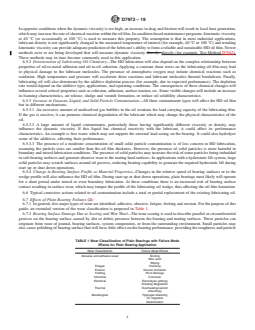
6.7.1 In general, five major types of wear are identified: adhesive, abrasive, fatigue, fretting and erosion. For the purpose of this
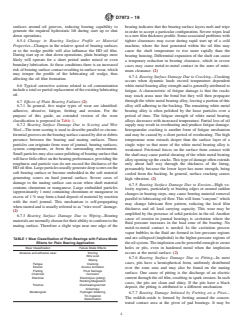
guide, an extended version of the wear classification is proposed in Table 1.
6.7.2 Bearing Surface Damage Due to Scoring and Wire Wool—The term scoring is used to describe parallel or circumferential
grooves on the bearing surface caused by dirt or debris presence between the bearing and mating surfaces. These particles can
originate from wear of journal, bearing surfaces, system components, or from the surrounding environment. Small particles may
also cause polishing of bearing surface that will have little effect on the bearing performance, providing the roughness and particle
TABLE 1 Wear Classification of Plain Bearings with Failure Mode
Effects for Plain Bearing Application
Wear Classification Failure Mode Effects
Abrasive and adhesive wear Scoring
Wire wool
Wiping
Fatigue Cracking
Erosion Groove formation
Fretting Pivot Damage
Chemical Corrosion
Electrical Electrolysis (pitting)
Rotating Magnetism
Thermal Overheating/varnish
Anisotropy
Metallurgical Hydrogen blistering
Tin migration
Delamination
D7973 − 19
size do not exceed the thickness of the HD oil film. Large particles usually generate deep scores on the soft bearing surface or
become embedded in the soft material generating scores on hard journal surface. Severe cases of damage to the mating surface
can occur when shaft material contains chromium or manganese. Large embedded particles (approximately 1 mm) containing
chromium or manganese in excess of 1 % may form a hard deposit of material by reaction with the steel journal. This mechanism
is self-propagating when started and is usually referred to as “wire wool” damage. (2)
6.7.3 Bearing Surface Damage Due to Wiping—Bearing materials are normally chosen for their ability to conform to the mating
surface. Therefore a slight wipe near one edge of the bearing indicates that the bearing surface layers melt and wipe in order to
accept a particular configuration. Severe wipes lead to a new film thickness profile. Some associated pro
...