

ASTM D4308-21
(Test Method)Standard Test Method for Electrical Conductivity of Liquid Hydrocarbons by Precision Meter
General Information
- Abstract
SIGNIFICANCE AND USE
5.1 The generation and dissipation of electrostatic charge in fuel due to handling depend largely on the ionic species present which may be characterized by the rest or equilibrium electrical conductivity. The time for static charge to dissipate is inversely related to conductivity. This test method can supplement Test Method D2624 which is limited to fuels containing static dissipator additive.
Note 1: For low-conductivity fluids below 1 pS/m in conductivity, an ac measurement technique is preferable to a dc test method for sensing the electrical conductivity of bulk fluid.
SCOPE
1.1 This test method covers and applies to the determination of the “rest” electrical conductivity of aviation fuels and other similar low-conductivity hydrocarbon liquids in the range from 1 pS/m to 2000 pS/m (see 3.1.2). This test method can be used in the laboratory or in the field.
1.2 The values stated in SI units are to be regarded as standard. No other units of measurement are included in this standard.
1.3 WARNING—Mercury has been designated by many regulatory agencies as a hazardous substance that can cause serious medical issues. Mercury, or its vapor, has been demonstrated to be hazardous to health and corrosive to materials. Use Caution when handling mercury and mercury-containing products. See the applicable product Safety Data Sheet (SDS) for additional information. The potential exists that selling mercury or mercury-containing products, or both, is prohibited by local or national law. Users must determine legality of sales in their location.
1.4 This standard does not purport to address all of the safety concerns, if any, associated with its use. It is the responsibility of the user of this standard to establish appropriate safety, health, and environmental practices and determine the applicability of regulatory limitations prior to use. For specific warning statements, see 8.3 and Annex A1.
1.5 This international standard was developed in accordance with internationally recognized principles on standardization established in the Decision on Principles for the Development of International Standards, Guides and Recommendations issued by the World Trade Organization Technical Barriers to Trade (TBT) Committee.
- Status
- Published
- Publication Date
- 31-Dec-2020
- Technical Committee
- D02 - Petroleum Products, Liquid Fuels, and Lubricants
- Drafting Committee
- D02.J0.04 - Additives and Electrical Properties
Buy Documents
ASTM D4308-21 - Standard Test Method for Electrical Conductivity of Liquid Hydrocarbons by Precision Meter
REDLINE ASTM D4308-21 - Standard Test Method for Electrical Conductivity of Liquid Hydrocarbons by Precision Meter
Overview
ASTM D4308-21 is the Standard Test Method for Electrical Conductivity of Liquid Hydrocarbons by Precision Meter. Developed by ASTM International, this method provides an effective means of determining the “rest” electrical conductivity of low-conductivity hydrocarbon liquids, such as aviation fuels, in the range of 1 picosiemens per meter (pS/m) to 2000 pS/m. Measuring electrical conductivity is essential for evaluating how hydrocarbon fuels generate and dissipate electrostatic charges during handling and storage, which is critical for ensuring safety and operational reliability in fuel systems.
The standard is widely applicable in both laboratory and field settings and supports compliance with international principles on standardization as outlined by the World Trade Organization Technical Barriers to Trade (TBT) Committee.
Key Topics
- Scope of Measurement: The method covers the determination of equilibrium (rest) electrical conductivity in aviation fuels and similar hydrocarbons using SI units (pS/m).
- Safety Considerations: Special caution is required for handling hazardous substances like mercury and flammable solvents (e.g., toluene and n-heptane). Users must adhere to regulatory guidelines and safety data sheets.
- Sampling and Sampling Containers: Detailed procedures ensure the integrity of test samples, including guidelines for the use of clean, non-contaminating containers and immediate testing to prevent sample alteration.
- Apparatus and Equipment: Use of a precision conductivity meter and cell, including calibration procedures, is described to ensure accurate and reliable results.
- Cleaning and Preparation: Rigorous cleaning protocols for cells and auxiliary equipment are emphasized, particularly to avoid cross-contamination and maintain measurement precision.
- Methodology: The test involves filling a clean cell with the sample, using a sensitive ammeter and battery voltage source, and employing a digital readout for conductivity. A waiting period is recommended for very low conductivity samples to ensure static charge dissipation.
- Data Reporting and Repeatability: Clear requirements for reporting results, including temperature and mode of measurement, and specifications for repeatability and reproducibility are provided.
Applications
The practical value of ASTM D4308-21 rests in its ability to:
- Enhance Fuel Safety: Mitigate the risk of static discharge in the handling, transportation, and storage of fuels, especially aviation fuels prone to low conductivity.
- Quality Control: Provide a reliable metric for fuel cleanliness and contaminant control for refineries, airports, and fuel supply chains.
- Compliance and Risk Management: Support regulatory and safety compliance by ensuring fuels meet specified conductivity thresholds critical for safe operations.
- Supplement Other Standards: Serve as a complementary method to ASTM D2624, especially where static dissipator additives are not present.
Typical users include fuel terminals, refineries, airports, regulatory agencies, and laboratories focusing on petroleum product quality assurance and safety management.
Related Standards
- ASTM D2624: Standard Test Methods for Electrical Conductivity of Aviation and Distillate Fuels (particularly for fuels containing static dissipator additives)
- ASTM D150: Test Methods for AC Loss Characteristics and Permittivity of Solid Electrical Insulation (provides background for AC conductivity techniques)
- ASTM D4306: Practice for Aviation Fuel Sample Containers for Tests Affected by Trace Contamination
- ASTM E1: Specification for ASTM Liquid-in-Glass Thermometers
ASTM D4308-21 is an essential reference for professionals managing fuel quality and safety, supporting best practices in the assessment of electrical conductivity in liquid hydrocarbons under a range of operational conditions. For full compliance and testing protocols, users should consult the latest official ASTM standard documentation.
Relations
- Effective Date
- 01-Oct-2015
- Effective Date
- 01-May-2013
- Effective Date
- 01-Dec-2012
- Effective Date
- 01-Jun-2012
- Effective Date
- 15-Apr-2012
- Effective Date
- 01-Feb-2012
- Refers
ASTM D2624-09 - Standard Test Methods for Electrical Conductivity of Aviation and Distillate Fuels - Effective Date
- 01-Dec-2009
- Effective Date
- 01-Nov-2007
- Effective Date
- 01-Jul-2007
- Refers
ASTM D2624-07 - Standard Test Methods for Electrical Conductivity of Aviation and Distillate Fuels - Effective Date
- 01-Jul-2007
- Refers
ASTM D2624-06a - Standard Test Methods for Electrical Conductivity of Aviation and Distillate Fuels - Effective Date
- 01-Dec-2006
- Refers
ASTM D2624-06 - Standard Test Methods for Electrical Conductivity of Aviation and Distillate Fuels - Effective Date
- 01-Jan-2006
- Effective Date
- 01-Nov-2005
- Effective Date
- 01-Mar-2004
- Effective Date
- 01-Nov-2003
Buy Documents
ASTM D4308-21 - Standard Test Method for Electrical Conductivity of Liquid Hydrocarbons by Precision Meter
REDLINE ASTM D4308-21 - Standard Test Method for Electrical Conductivity of Liquid Hydrocarbons by Precision Meter
Get Certified
Connect with accredited certification bodies for this standard

ECOCERT
Organic and sustainability certification.

Eurofins Food Testing Global
Global leader in food, environment, and pharmaceutical product testing.

Intertek Bangladesh
Intertek certification and testing services in Bangladesh.
Sponsored listings
Frequently Asked Questions
ASTM D4308-21 is a standard published by ASTM International. Its full title is "Standard Test Method for Electrical Conductivity of Liquid Hydrocarbons by Precision Meter". This standard covers: SIGNIFICANCE AND USE 5.1 The generation and dissipation of electrostatic charge in fuel due to handling depend largely on the ionic species present which may be characterized by the rest or equilibrium electrical conductivity. The time for static charge to dissipate is inversely related to conductivity. This test method can supplement Test Method D2624 which is limited to fuels containing static dissipator additive. Note 1: For low-conductivity fluids below 1 pS/m in conductivity, an ac measurement technique is preferable to a dc test method for sensing the electrical conductivity of bulk fluid. SCOPE 1.1 This test method covers and applies to the determination of the “rest” electrical conductivity of aviation fuels and other similar low-conductivity hydrocarbon liquids in the range from 1 pS/m to 2000 pS/m (see 3.1.2). This test method can be used in the laboratory or in the field. 1.2 The values stated in SI units are to be regarded as standard. No other units of measurement are included in this standard. 1.3 WARNING—Mercury has been designated by many regulatory agencies as a hazardous substance that can cause serious medical issues. Mercury, or its vapor, has been demonstrated to be hazardous to health and corrosive to materials. Use Caution when handling mercury and mercury-containing products. See the applicable product Safety Data Sheet (SDS) for additional information. The potential exists that selling mercury or mercury-containing products, or both, is prohibited by local or national law. Users must determine legality of sales in their location. 1.4 This standard does not purport to address all of the safety concerns, if any, associated with its use. It is the responsibility of the user of this standard to establish appropriate safety, health, and environmental practices and determine the applicability of regulatory limitations prior to use. For specific warning statements, see 8.3 and Annex A1. 1.5 This international standard was developed in accordance with internationally recognized principles on standardization established in the Decision on Principles for the Development of International Standards, Guides and Recommendations issued by the World Trade Organization Technical Barriers to Trade (TBT) Committee.
SIGNIFICANCE AND USE 5.1 The generation and dissipation of electrostatic charge in fuel due to handling depend largely on the ionic species present which may be characterized by the rest or equilibrium electrical conductivity. The time for static charge to dissipate is inversely related to conductivity. This test method can supplement Test Method D2624 which is limited to fuels containing static dissipator additive. Note 1: For low-conductivity fluids below 1 pS/m in conductivity, an ac measurement technique is preferable to a dc test method for sensing the electrical conductivity of bulk fluid. SCOPE 1.1 This test method covers and applies to the determination of the “rest” electrical conductivity of aviation fuels and other similar low-conductivity hydrocarbon liquids in the range from 1 pS/m to 2000 pS/m (see 3.1.2). This test method can be used in the laboratory or in the field. 1.2 The values stated in SI units are to be regarded as standard. No other units of measurement are included in this standard. 1.3 WARNING—Mercury has been designated by many regulatory agencies as a hazardous substance that can cause serious medical issues. Mercury, or its vapor, has been demonstrated to be hazardous to health and corrosive to materials. Use Caution when handling mercury and mercury-containing products. See the applicable product Safety Data Sheet (SDS) for additional information. The potential exists that selling mercury or mercury-containing products, or both, is prohibited by local or national law. Users must determine legality of sales in their location. 1.4 This standard does not purport to address all of the safety concerns, if any, associated with its use. It is the responsibility of the user of this standard to establish appropriate safety, health, and environmental practices and determine the applicability of regulatory limitations prior to use. For specific warning statements, see 8.3 and Annex A1. 1.5 This international standard was developed in accordance with internationally recognized principles on standardization established in the Decision on Principles for the Development of International Standards, Guides and Recommendations issued by the World Trade Organization Technical Barriers to Trade (TBT) Committee.
ASTM D4308-21 is classified under the following ICS (International Classification for Standards) categories: 71.080.01 - Organic chemicals in general. The ICS classification helps identify the subject area and facilitates finding related standards.
ASTM D4308-21 has the following relationships with other standards: It is inter standard links to ASTM D4306-15, ASTM E1-13, ASTM D4306-12c, ASTM D4306-12b, ASTM D4306-12a, ASTM D4306-12, ASTM D2624-09, ASTM E1-07, ASTM D4306-07, ASTM D2624-07, ASTM D2624-06a, ASTM D2624-06, ASTM E1-05, ASTM D150-98(2004), ASTM E1-03a. Understanding these relationships helps ensure you are using the most current and applicable version of the standard.
ASTM D4308-21 is available in PDF format for immediate download after purchase. The document can be added to your cart and obtained through the secure checkout process. Digital delivery ensures instant access to the complete standard document.
Standards Content (Sample)
This international standard was developed in accordance with internationally recognized principles on standardization established in the Decision on Principles for the
Development of International Standards, Guides and Recommendations issued by the World Trade Organization Technical Barriers to Trade (TBT) Committee.
Designation: D4308 − 21
Standard Test Method for
Electrical Conductivity of Liquid Hydrocarbons by Precision
Meter
This standard is issued under the fixed designation D4308; the number immediately following the designation indicates the year of
original adoption or, in the case of revision, the year of last revision. A number in parentheses indicates the year of last reapproval. A
superscript epsilon (´) indicates an editorial change since the last revision or reapproval.
This standard has been approved for use by agencies of the U.S. Department of Defense.
1. Scope* 2. Referenced Documents
2.1 ASTM Standards:
1.1 Thistestmethodcoversandappliestothedetermination
D150 Test Methods forAC Loss Characteristics and Permit-
of the “rest” electrical conductivity of aviation fuels and other
tivity (Dielectric Constant) of Solid Electrical Insulation
similarlow-conductivityhydrocarbonliquidsintherangefrom
D2624 Test Methods for Electrical Conductivity ofAviation
1 pS⁄m to 2000 pS⁄m (see 3.1.2).This test method can be used
and Distillate Fuels
in the laboratory or in the field.
D4306 Practice for Aviation Fuel Sample Containers for
1.2 The values stated in SI units are to be regarded as Tests Affected by Trace Contamination
standard. No other units of measurement are included in this E1 Specification for ASTM Liquid-in-Glass Thermometers
standard.
3. Terminology
1.3 WARNING—Mercury has been designated by many
3.1 Definitions:
regulatory agencies as a hazardous substance that can cause
3.1.1 picosiemens per metre, n—the unit of electrical con-
serious medical issues. Mercury, or its vapor, has been dem-
ductivity is also called a conductivity unit (CU). A siemen is
onstrated to be hazardous to health and corrosive to materials.
the SI definition of reciprocal ohm sometimes called mho.
Use Caution when handling mercury and mercury-containing
212 21 21
1 pS/m 5 1 310 Ω m 51cu 5 1 picomho/m (1)
products. See the applicable product Safety Data Sheet (SDS)
for additional information. The potential exists that selling
3.1.2 rest conductivity, n—the reciprocal of the resistance of
mercury or mercury-containing products, or both, is prohibited uncharged fuel in the absence of ionic depletion or polariza-
by local or national law. Users must determine legality of sales tion. It is the electrical conductivity at the initial instant of
current measurement after a dc voltage is impressed between
in their location.
electrodes.
1.4 This standard does not purport to address all of the
safety concerns, if any, associated with its use. It is the
4. Summary of Test Method
responsibility of the user of this standard to establish appro-
4.1 A sample of liquid hydrocarbon is introduced into a
priate safety, health, and environmental practices and deter-
clean conductivity cell which is connected in series to a battery
mine the applicability of regulatory limitations prior to use.
voltage source and a sensitive dc ammeter. The conductivity,
For specific warning statements, see 8.3 and Annex A1.
automatically calculated from the observed peak current read-
1.5 This international standard was developed in accor-
ing dc voltage and cell constant using Ohm’s law, appears as a
dance with internationally recognized principles on standard-
digital value in either a manual or automatic mode of meter
ization established in the Decision on Principles for the
operation.
Development of International Standards, Guides and Recom-
mendations issued by the World Trade Organization Technical
5. Significance and Use
Barriers to Trade (TBT) Committee.
5.1 The generation and dissipation of electrostatic charge in
fuelduetohandlingdependlargelyontheionicspeciespresent
This test method is under the jurisdiction of ASTM Committee D02 on
Petroleum Products, Liquid Fuels, and Lubricants and is the direct responsibility of
Subcommittee D02.J0.04 on Additives and Electrical Properties. For referenced ASTM standards, visit the ASTM website, www.astm.org, or
Current edition approved Jan. 1, 2021. Published March 2021. Originally contact ASTM Customer Service at service@astm.org. For Annual Book of ASTM
approved in 1983. Last previous edition approved in 2013 as D4308 – 13. DOI: Standards volume information, refer to the standard’s Document Summary page on
10.1520/D4308-21. the ASTM website.
*A Summary of Changes section appears at the end of this standard
Copyright © ASTM International, 100 Barr Harbor Drive, PO Box C700, West Conshohocken, PA 19428-2959. United States
D4308 − 21
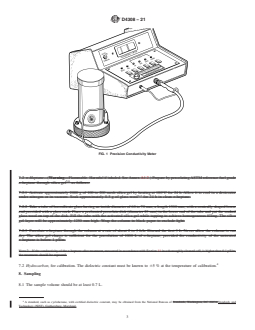
FIG. 1 Precision Conductivity Meter
which may be characterized by the rest or equilibrium electri- 6.2 Thermometer, general purpose type, having a range of
cal conductivity. The time for static charge to dissipate is 0 °C to 60 °C (see Specification E1). Temperature measuring
inversely related to conductivity. This test method can supple- devices that cover the temperature range of interest, such as an
ment Test Method D2624 which is limited to fuels containing ASTM 1C thermometer, or liquid-in-glass thermometers,
static dissipator additive. thermocouples, or platinum resistance thermometers that pro-
vide equivalent or better accuracy and precision than ASTM
NOTE 1—For low-conductivity fluids below 1 pS/m in conductivity, an
1C thermometers may be used.
ac measurement technique is preferable to a dc test method for sensing the
electrical conductivity of bulk fluid.
7. Reagents
6. Apparatus
7.1 Cleaning Solvent, isopropyl alcohol.
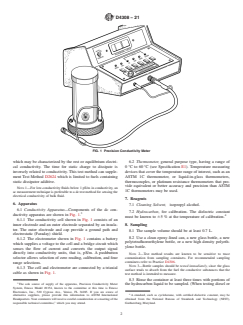
6.1 Conductivity Apparatus—Components of the dc con-
7.2 Hydrocarbon, for calibration. The dielectric constant
ductivity apparatus are shown in Fig. 1.
must be known to 65 % at the temperature of calibration.
6.1.1 The conductivity cell shown in Fig. 1 consists of an
8. Sampling
inner electrode and an outer electrode separated by an insula-
tor. The outer electrode and cap provide a ground path and
8.1 The sample volume should be at least 0.7 L.
electrostatic (Faraday) shield.
8.2 Use a clean epoxy-lined can, a new glass bottle, a new
6.1.2 The electrometer shown in Fig. 1 contains a battery
polytetrafluoroethylene bottle, or a new high density polyeth-
which supplies a voltage to the cell and a bridge circuit which
ylene bottle.
senses the flow of current and converts the output signal
directly into conductivity units, that is, pS/m. A pushbutton
NOTE 2—Test method results are known to be sensitive to trace
contamination from sampling containers. For recommended sampling
selector allows selection of zero reading, calibration, and four
containers refer to Practice D4306.
range selections.
NOTE 3—Bottle samples should be tested immediately, since the glass
6.1.3 The cell and electrometer are connected by a triaxial
surface tends to absorb from the fuel the conductive substances that the
cable as shown in Fig. 1.
test method is intended to measure.
8.3 Rinse the container at least three times with portions of
The sole source of supply of the apparatus, Precision Conductivity Meter
the hydrocarbon liquid to be sampled. (When testing diesel or
System, Emcee Model #1154, known to the committee at this time is Emcee
Electronics, Inc., 520 Cypress Ave., Venice, FL 34285. If you are aware of
alternative suppliers, please provide this information to ASTM International A standard, such as cyclohexane, with certified dielectric constant, may be
Headquarters.Your comments will receive careful consideration at a meeting of the obtained from the National Bureau of Standards and Technology (NIST),
responsible technical committee, which you may attend. Gaithersburg,Maryland.
D4308 − 21
FIG. 2 Cleaned Cell Attached to Meter
aviation turbine fuels Jet A or A-1, Warning—Combustible. 10.1.3 Depress the calibrate switch. The digital reading
Vapor harmful. See Annex A1.1.) (When testing gasoline, should indicate 1000 pS⁄m 6 3 pS⁄m.
aviation gasoline, or aviation turbine fuel Jet B, Warning—
10.1.4 If low battery indicator is displayed during measure
Extremely flammable. Harmful if inhaled. Vapors can cause
or calibration, the internal batteries should be replaced.
flash fire. See Annex A1.2.) If possible, fill the container, let
10.2 Checking the Cell Constant:
stand,thenemptyandrefill.Avoidtakingthesamplefortestby
10.2.1 A check on the cell constant is necessary only if the
pouring from the container; pipet instead. The sample should
cell has been damaged. Two capacitance measurements are
be clean and bright when tested.
required with a precision ac bridge. Make a rigid two-terminal
connection betwee
...
This document is not an ASTM standard and is intended only to provide the user of an ASTM standard an indication of what changes have been made to the previous version. Because
it may not be technically possible to adequately depict all changes accurately, ASTM recommends that users consult prior editions as appropriate. In all cases only the current version
of the standard as published by ASTM is to be considered the official document.
Designation: D4308 − 13 D4308 − 21 An American National Standard
Standard Test Method for
Electrical Conductivity of Liquid Hydrocarbons by Precision
Meter
This standard is issued under the fixed designation D4308; the number immediately following the designation indicates the year of
original adoption or, in the case of revision, the year of last revision. A number in parentheses indicates the year of last reapproval. A
superscript epsilon (´) indicates an editorial change since the last revision or reapproval.
This standard has been approved for use by agencies of the U.S. Department of Defense.
1. Scope*
1.1 This test method covers and applies to the determination of the “rest” electrical conductivity of aviation fuels and other similar
low-conductivity hydrocarbon liquids in the range from 0.11 pS ⁄m to 20002000 pS pS/m ⁄m (see 3.1.2). This test method can be
used in the laboratory or in the field.
1.2 The values stated in SI units are to be regarded as standard. No other units of measurement are included in this standard.
1.3 WARNING—Mercury has been designated by many regulatory agencies as a hazardous materialsubstance that can cause
central nervous system, kidney and liver damage. serious medical issues. Mercury, or its vapor, may has been demonstrated to be
hazardous to health and corrosive to materials. Caution should be taken Use Caution when handling mercury and mercury
containing mercury-containing products. See the applicable product Material Safety Data Sheet (MSDS) for details and EPA’s
website—http://www.epa.gov/mercury/faq.htm—for additional information. Users should be aware (SDS) for additional informa-
tion. The potential exists that selling mercury and/or mercury containing products into your state or country may be prohibited by
law.or mercury-containing products, or both, is prohibited by local or national law. Users must determine legality of sales in their
location.
1.4 This standard does not purport to address all of the safety concerns, if any, associated with its use. It is the responsibility
of the user of this standard to establish appropriate safety safety, health, and healthenvironmental practices and determine the
applicability of regulatory limitations prior to use. For specific warning statements, see 7.1.1, 7.2, 8.3, and Annex A1.
1.5 This international standard was developed in accordance with internationally recognized principles on standardization
established in the Decision on Principles for the Development of International Standards, Guides and Recommendations issued
by the World Trade Organization Technical Barriers to Trade (TBT) Committee.
2. Referenced Documents
2.1 ASTM Standards:
D150 Test Methods for AC Loss Characteristics and Permittivity (Dielectric Constant) of Solid Electrical Insulation
D2624 Test Methods for Electrical Conductivity of Aviation and Distillate Fuels
D4306 Practice for Aviation Fuel Sample Containers for Tests Affected by Trace Contamination
E1 Specification for ASTM Liquid-in-Glass Thermometers
This test method is under the jurisdiction of ASTM Committee D02 on Petroleum Products, Liquid Fuels, and Lubricants and is the direct responsibility of Subcommittee
D02.J0.04 on Additives and Electrical Properties.
Current edition approved June 15, 2013Jan. 1, 2021. Published July 2013March 2021. Originally approved in 1983. Last previous edition approved in 20122013 as
D4308 – 12.D4308 – 13. DOI: 10.1520/D4308-13.10.1520/D4308-21.
For referenced ASTM standards, visit the ASTM website, www.astm.org, or contact ASTM Customer Service at service@astm.org. For Annual Book of ASTM Standards
volume information, refer to the standard’s Document Summary page on the ASTM website.
*A Summary of Changes section appears at the end of this standard
Copyright © ASTM International, 100 Barr Harbor Drive, PO Box C700, West Conshohocken, PA 19428-2959. United States
D4308 − 21
3. Terminology
3.1 Definitions:
3.1.1 picosiemens per metre, n—the unit of electrical conductivity is also called a conductivity unit (CU). A siemen is the SI
definition of reciprocal ohm sometimes called mho.
212 21 21
1 pS/m5 1310 Ω m 5 1 cu 5 1 picomho/m (1)
3.1.2 rest conductivity, n—the reciprocal of the resistance of uncharged fuel in the absence of ionic depletion or polarization. It
is the electrical conductivity at the initial instant of current measurement after a dc voltage is impressed between electrodes.
4. Summary of Test Method
4.1 A sample of liquid hydrocarbon is introduced into a clean conductivity cell which is connected in series to a battery voltage
source and a sensitive dc ammeter. The conductivity, automatically calculated from the observed peak current reading dc voltage
and cell constant using Ohm’s law, appears as a digital value in either a manual or automatic mode of meter operation.
5. Significance and Use
5.1 The generation and dissipation of electrostatic charge in fuel due to handling depend largely on the ionic species present which
may be characterized by the rest or equilibrium electrical conductivity. The time for static charge to dissipate is inversely related
to conductivity. This test method can supplement Test Method D2624 which is limited to fuels containing static dissipator additive.
NOTE 1—For low-conductivity fluids below 1 pS/m in conductivity, an ac measurement technique is preferable to a dc test method for sensing the
electrical conductivity of bulk fluid. This dc test method can be used at conductivities from 0.1 to 1 pS/m if precautions are observed in cell cleaning
and sample handling. A waiting period of 15 min is required after filling the cell before measuring dc conductivities below 1 pS/m. A single-laboratory
program was conducted comparing this test method with ac Test Methods D150.
6. Apparatus
3,
6.1 Conductivity Apparatus—Components of the dc conductivity apparatus are shown in Fig. 1.
6.1.1 The conductivity cell shown in Fig. 1 consists of an inner electrode and an outer electrode separated by an insulator. The
outer electrode and cap provide a ground path and electrostatic (Faraday) shield.
6.1.2 The electrometer shown in Fig. 1 contains a battery which supplies a voltage to the cell and a bridge circuit which senses
the flow of current and converts the output signal directly into conductivity units, that is, pS/m. A pushbutton selector allows
selection of zero reading, calibration, and four range selections.
6.1.3 The cell and electrometer are connected by a triaxial cable as shown in Fig. 1.
6.2 Thermometer, general purpose type, having a range of 00 °C to 60°C60 °C (see Specification E1). Temperature measuring
devices that cover the temperature range of interest, such as an ASTM 1C thermometer, or liquid-in-glass thermometers,
thermocouples, or platinum resistance thermometers that provide equivalent or better accuracy and precision than ASTM 1C
thermometers may be used.
7. Reagents
7.1 Cleaning Solvent, The following may be used: isopropyl alcohol.
7.1.1 Toluene-Isopropyl Alcohol Mixture—(Warning—Flammable. Vapor harmful. See Annex A1.1. ) Mix two volumes of
toluene and three volumes of isopropyl alcohol both of reagent grade and distill. Discard the first 20 % and last 5 % fractions.
Supporting data have been filed at ASTM International Headquarters and may be obtained by requesting Research Report RR:D02-1241.
The sole source of supply of the apparatus, the KSLA Cell and Precision Conductivity Meter System, Emcee Model #1154, known to the committee at this time is Emcee
Electronics, Inc., 520 Cypress Ave., Venice, FL 34285.
The sole source of supply of the apparatus, Precision Conductivity Meter System, Emcee Model #1154, known to the committee at this time is Emcee Electronics, Inc.,
520 Cypress Ave., Venice, FL 34285. If you are aware of alternative suppliers, please provide this information to ASTM International Headquarters. Your comments will
receive careful consideration at a meeting of the responsible technical committee, which you may attend.
D4308 − 21
FIG. 1 Precision Conductivity Meter
7.2 n-Heptane—(Warning—Flammable. Harmful if inhaled. See Annex A1.2.) Prepare by percolating ASTM reference fuel grade
5,6
n-heptane through silica gel as follows:
7.2.1 Activate approximately 2000 g of 100 to 200 mesh silica gel by heating at 180°C for 24 h. Allow it to cool in a desiccator
5,7
under nitrogen or in vacuum. Soak approximately 0.5 g of glass wool for 24 h in clean n-heptane.
7.2.2 Take a tube of borosilicate glass having an inside diameter of 60 to 70 mm, a length 1500 mm, with a conically shaped lower
end provided with a glass cock. Place a perforated porcelain disk (diameter 25 mm) in the lower end of the tube and put the soaked
glass wool on top of the disk. Fill the tube with the activated silica gel while tapping to achieve homogeneous filling. The silica
gel layer will be approximately 1250 mm high. Wrap the column in black paper to exclude light.
7.2.3 Percolate n-heptane through the column at a rate of about 2 to 3 L/h. Discard the first 3 L. Never allow the column to run
dry. The silica gel charge is sufficient for the percolation of 1000 L of n-heptane, provided the conductivity of the untreated
n-heptane is below 1 pS/m.
NOTE 2—If the conductivity of the n-heptane after treatment, measured in accordance with Section 11 in a thoroughly cleaned cell, is higher than 0.1 pS/m,
the treatment should be repeated.
7.2 Hydrocarbon, for calibration. The dielectric constant must be known to 65 % at the temperature of calibration.
8. Sampling
8.1 The sample volume should be at least 0.7 L.
A standard, such as cyclohexane, with certified dielectric constant, may be obtained from the National Bureau of Standards, Washington, DC 20234.Standards and
Technology (NIST), Gaithersburg, Maryland.
D4308 − 21
8.2 Use a clean epoxy-lined can, or a new glass bottle that has been rinsed successively with hot water, distilled water, acetone,
and cleaning solvent then flush with dry nitrogen. Use only non-contaminating caps.bottle, a new polytetrafluoroethylene bottle,
or a new high density polyethylene bottle.
NOTE 2—Test method results are known to be sensitive to trace contamination from sampling containers. For recommended sampling containers refer
to Practice D4306.
NOTE 3—Bottle samples should be tested immediately, since the glass surface tends to absorb from the fuel the conductive substances that the test method
is intended to measure.
8.3 Rinse the container at least three times with portions of the hydrocarbon liquid to be sampled. (When testing diesel or aviation
turbine fuels Jet A or A-1, Warning—Combustible. Vapor harmful. See Annex A1.3A1.1.) (When testing gasoline, aviation
gasoline, or aviation turbine fuel Jet B, Warning—Extremely flammable. Harmful if inhaled. Vapors can cause flash fire. See
Annex A1.4A1.2.) If possible, fill the container, let stand, then empty and refill. Avoid taking the sample for test by pouring from
the container; pipet instead. The sample should be clean and bright when tested.
9. Preparation of Apparatus
9.1 Cleaning the Cell—The cleaning procedure to be used depends on the estimated conductivity of the sample to be tested.
9.1.1 For samples that are expected to exhibit conductivities below 1 pS/m, the KSLA cell should be completely disassembled,
the parts cleaned and the cell reassembled using protective gloves.
9.1.1.1 Dismantle the cell by removing the loose battery cap, the outer electrode electrical connector and the bottom screw-on cap.
Press the inner electrode towards the bottom of the outer electrode and remove the inner electrode TFE-fluorocarbon insulator
assembly.
9.1.1.2 Each part of the cell should be rinsed thoroughly five times with cleaning solvent followed by rinsing with treated
n-heptane. The parts should be dried with a stream of nitrogen gas.
9.1.1.3 After reassembly, the cell should be rinsed with treated n-heptane.
9.1.1.4 After cleaning, check the cleanliness of the cell by measuring the conductivity of treated n-heptane in accordance with
Section 11. The corrected value should be lower than 0.05 pS/m.
9.1.1 For samples that are expected to exhibit conductivities above 1 pS/m, the KSLAconductivity cell still assembled should be
rinsed fivethree times with cleaning solvent, followed by rinsingdrying with treatedcompressed nair.-heptane. The cell should be
dried with a stream of nitrogen gas.
9.1.1.1 After cleaning, check the cleanliness of the cell by measuring the conductivity
...