

ASTM D5451-21
(Practice)Standard Practice for Sampling Using a Trier Sampler
General Information
- Abstract
SIGNIFICANCE AND USE
5.1 This practice is applicable to sampling soils and similar fine-grained cohesive materials. This practice is to be used by personnel who are to acquire the samples.
5.2 This practice should be used in conjunction with Guide D4687, which covers sampling plans, safety, quality assurance, preservation, decontamination, labeling, and chain-of-custody procedures; Practice D5088, which covers the decontamination of field equipment used at waste sites; and Practice D5283, which covers project specifications and practices for environmental field operations.
SCOPE
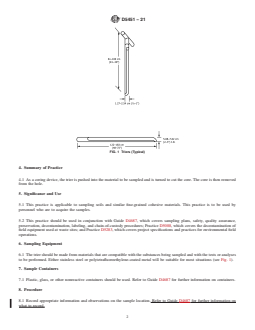
1.1 This practice covers sampling using a trier. A trier resembles an elongated scoop as shown in Fig. 1. The trier is used to collect samples of granular or powdered materials that are moist or sticky and have a particle diameter less than one half the diameter of the trier.
FIG. 1 Triers (Typical)
1.2 The trier can be used as a vertical coring device only when it is certain that a relatively complete and cylindrical sample can be extracted.
1.3 Units—The values stated in SI units are to be regarded as standard. No other units of measurement are included in this standard. All observed and calculated values shall conform to the guidelines for significant digits and rounding established in Practice D6026. Reporting of test results in units other than SI shall not be regarded as nonconformance with this standard.
1.4 This standard does not purport to address all of the safety concerns, if any, associated with its use. It is the responsibility of the user of this standard to establish appropriate safety, health, and environmental practices and determine the applicability of regulatory limitations prior to use.
1.5 This international standard was developed in accordance with internationally recognized principles on standardization established in the Decision on Principles for the Development of International Standards, Guides and Recommendations issued by the World Trade Organization Technical Barriers to Trade (TBT) Committee.
- Status
- Published
- Publication Date
- 30-Apr-2021
- Technical Committee
- D34 - Waste Management
- Drafting Committee
- D34.01.03 - Sampling Equipment




Overview
ASTM D5451-21: Standard Practice for Sampling Using a Trier Sampler provides a consistent method for obtaining soil samples and other fine-grained, cohesive materials by means of a trier sampler. The trier, resembling an elongated scoop, is specifically designed for collecting samples of granular or powdered materials that are moist or sticky and have particle diameters smaller than half the diameter of the trier. This standard supports quality assurance in environmental, geotechnical, and waste management activities that require reliable sampling techniques.
ASTM D5451-21 ensures that personnel performing sampling adhere to uniform procedures, improving data consistency and supporting compliance with regulatory or project-specific requirements. It is especially relevant for activities involving environmental site assessments, waste characterization, remediation, and quality control in soil studies.
Key Topics
Purpose of Trier Samplers: Trier samplers are inserted into soils or similar materials to extract cylindrical cores, which are then analyzed for various properties, such as contamination levels, composition, or physical characteristics.
Sampling Procedure:
- Insert the trier perpendicularly and rotate to cut a core.
- Carefully remove the sample to prevent contamination or sample loss.
- Transfer samples using non-reactive tools and containers.
Sample Handling:
- Use containers made from plastic, glass, or other non-reactive materials.
- Label, seal, and document each sample to ensure traceability and maintain chain-of-custody.
Equipment and Decontamination:
- Select triers made from compatible materials, such as stainless steel or polytetrafluoroethylene-coated metals.
- Clean and decontaminate equipment according to relevant standards after each use to prevent cross-contamination.
Safety and Regulatory Compliance: Users are responsible for maintaining safety, health, and environmental standards and ensuring adherence to regulatory requirements during sampling.
Applications
This ASTM standard is widely implemented in several industries and use cases:
- Environmental Sampling: Collecting subsurface soils and waste materials for contamination assessment and site characterization.
- Waste Management: Supporting waste profiling activities for hazardous and non-hazardous sites, providing data for regulatory compliance and disposal planning.
- Geotechnical Engineering: Gathering soil samples for physical and chemical analysis to inform construction, remediation, and site development.
- Quality Assurance: Establishing consistency in laboratory and field sampling as part of larger environmental monitoring or remediation projects.
Proper use of a trier sampler according to ASTM D5451-21 improves the reliability of environmental and geotechnical data and supports successful project outcomes by ensuring chain-of-custody and sample integrity.
Related Standards
ASTM D5451-21 is best used alongside the following ASTM standards to ensure a comprehensive approach to environmental field operations and sampling quality:
- ASTM D4687: Guide for General Planning of Waste Sampling - covers overall sampling plans, safety, labeling, and chain-of-custody.
- ASTM D5088: Practice for Decontamination of Field Equipment Used at Waste Sites.
- ASTM D5283: Practice for Generation of Environmental Data Related to Waste Management Activities: Quality Assurance and Quality Control Planning and Implementation.
- ASTM D5681: Terminology for Waste and Waste Management - provides definitions relevant to sampling and waste assessment.
- ASTM D6026: Practice for Using Significant Digits in Geotechnical Data - standardizes reporting precision and rounding.
For those conducting soil sampling, waste sampling, or similar environmental field operations, referencing ASTM D5451-21 alongside these supporting documents ensures that all relevant quality, safety, and data integrity requirements are fulfilled.
Keywords: ASTM D5451, trier sampler, soil sampling, environmental sampling, waste sampling, field equipment, sample integrity, decontamination, chain-of-custody, quality assurance.
Relations
- Effective Date
- 01-Nov-2023
- Effective Date
- 01-May-2020
- Effective Date
- 01-Nov-2018
- Effective Date
- 01-May-2018
- Effective Date
- 01-Sep-2017
- Effective Date
- 01-Nov-2016
- Effective Date
- 01-Feb-2016
- Effective Date
- 01-Aug-2015
- Effective Date
- 15-Jan-2015
- Effective Date
- 01-Feb-2013
- Effective Date
- 01-Jul-2009
- Effective Date
- 01-Feb-2009
- Refers
ASTM D5088-02(2008) - Standard Practice for Decontamination of Field Equipment Used at Waste Sites - Effective Date
- 15-Sep-2008
- Effective Date
- 01-Sep-2008
- Effective Date
- 01-Nov-2006
Get Certified
Connect with accredited certification bodies for this standard

CIS Institut d.o.o.
Personal Protective Equipment (PPE) certification body. Notified Body NB-2890 for EU Regulation 2016/425 PPE.

Kiwa BDA Testing
Building and construction product certification.
Kmetijski inštitut Slovenije
Agricultural Institute of Slovenia. Soil testing, plant health, agricultural product analysis.
Sponsored listings
Frequently Asked Questions
ASTM D5451-21 is a standard published by ASTM International. Its full title is "Standard Practice for Sampling Using a Trier Sampler". This standard covers: SIGNIFICANCE AND USE 5.1 This practice is applicable to sampling soils and similar fine-grained cohesive materials. This practice is to be used by personnel who are to acquire the samples. 5.2 This practice should be used in conjunction with Guide D4687, which covers sampling plans, safety, quality assurance, preservation, decontamination, labeling, and chain-of-custody procedures; Practice D5088, which covers the decontamination of field equipment used at waste sites; and Practice D5283, which covers project specifications and practices for environmental field operations. SCOPE 1.1 This practice covers sampling using a trier. A trier resembles an elongated scoop as shown in Fig. 1. The trier is used to collect samples of granular or powdered materials that are moist or sticky and have a particle diameter less than one half the diameter of the trier. FIG. 1 Triers (Typical) 1.2 The trier can be used as a vertical coring device only when it is certain that a relatively complete and cylindrical sample can be extracted. 1.3 Units—The values stated in SI units are to be regarded as standard. No other units of measurement are included in this standard. All observed and calculated values shall conform to the guidelines for significant digits and rounding established in Practice D6026. Reporting of test results in units other than SI shall not be regarded as nonconformance with this standard. 1.4 This standard does not purport to address all of the safety concerns, if any, associated with its use. It is the responsibility of the user of this standard to establish appropriate safety, health, and environmental practices and determine the applicability of regulatory limitations prior to use. 1.5 This international standard was developed in accordance with internationally recognized principles on standardization established in the Decision on Principles for the Development of International Standards, Guides and Recommendations issued by the World Trade Organization Technical Barriers to Trade (TBT) Committee.
SIGNIFICANCE AND USE 5.1 This practice is applicable to sampling soils and similar fine-grained cohesive materials. This practice is to be used by personnel who are to acquire the samples. 5.2 This practice should be used in conjunction with Guide D4687, which covers sampling plans, safety, quality assurance, preservation, decontamination, labeling, and chain-of-custody procedures; Practice D5088, which covers the decontamination of field equipment used at waste sites; and Practice D5283, which covers project specifications and practices for environmental field operations. SCOPE 1.1 This practice covers sampling using a trier. A trier resembles an elongated scoop as shown in Fig. 1. The trier is used to collect samples of granular or powdered materials that are moist or sticky and have a particle diameter less than one half the diameter of the trier. FIG. 1 Triers (Typical) 1.2 The trier can be used as a vertical coring device only when it is certain that a relatively complete and cylindrical sample can be extracted. 1.3 Units—The values stated in SI units are to be regarded as standard. No other units of measurement are included in this standard. All observed and calculated values shall conform to the guidelines for significant digits and rounding established in Practice D6026. Reporting of test results in units other than SI shall not be regarded as nonconformance with this standard. 1.4 This standard does not purport to address all of the safety concerns, if any, associated with its use. It is the responsibility of the user of this standard to establish appropriate safety, health, and environmental practices and determine the applicability of regulatory limitations prior to use. 1.5 This international standard was developed in accordance with internationally recognized principles on standardization established in the Decision on Principles for the Development of International Standards, Guides and Recommendations issued by the World Trade Organization Technical Barriers to Trade (TBT) Committee.
ASTM D5451-21 is classified under the following ICS (International Classification for Standards) categories: 13.080.01 - Soil quality and pedology in general. The ICS classification helps identify the subject area and facilitates finding related standards.
ASTM D5451-21 has the following relationships with other standards: It is inter standard links to ASTM D5681-23, ASTM D5088-20, ASTM D5681-18, ASTM D5283-18, ASTM D5681-17, ASTM D5681-16a, ASTM D5681-16, ASTM D5088-15a, ASTM D5088-15, ASTM D5681-13, ASTM D5681-09, ASTM D5283-92(2009), ASTM D5088-02(2008), ASTM D5681-08, ASTM D6026-06. Understanding these relationships helps ensure you are using the most current and applicable version of the standard.
ASTM D5451-21 is available in PDF format for immediate download after purchase. The document can be added to your cart and obtained through the secure checkout process. Digital delivery ensures instant access to the complete standard document.
Standards Content (Sample)
This international standard was developed in accordance with internationally recognized principles on standardization established in the Decision on Principles for the
Development of International Standards, Guides and Recommendations issued by the World Trade Organization Technical Barriers to Trade (TBT) Committee.
Designation: D5451 − 21
Standard Practice for
Sampling Using a Trier Sampler
This standard is issued under the fixed designation D5451; the number immediately following the designation indicates the year of
original adoption or, in the case of revision, the year of last revision. A number in parentheses indicates the year of last reapproval. A
superscript epsilon (´) indicates an editorial change since the last revision or reapproval.
1. Scope lated to Waste Management Activities: Quality Assurance
and Quality Control Planning and Implementation
1.1 This practice covers sampling using a trier. A trier
D5681 Terminology for Waste and Waste Management
resembles an elongated scoop as shown in Fig. 1. The trier is
D6026 Practice for Using Significant Digits in Geotechnical
used to collect samples of granular or powdered materials that
Data
are moist or sticky and have a particle diameter less than one
half the diameter of the trier.
3. Terminology
1.2 The trier can be used as a vertical coring device only
3.1 Definitions—For definitions of terms used in this
when it is certain that a relatively complete and cylindrical
standard, see Terminology D5681.
sample can be extracted.
4. Summary of Practice
1.3 Units—The values stated in SI units are to be regarded
as standard. No other units of measurement are included in this
4.1 As a coring device, the trier is pushed into the material
standard. All observed and calculated values shall conform to
to be sampled and is turned to cut the core. The core is then
the guidelines for significant digits and rounding established in
removed from the hole.
Practice D6026. Reporting of test results in units other than SI
shall not be regarded as nonconformance with this standard.
5. Significance and Use
1.4 This standard does not purport to address all of the
5.1 This practice is applicable to sampling soils and similar
safety concerns, if any, associated with its use. It is the
fine-grained cohesive materials. This practice is to be used by
responsibility of the user of this standard to establish appro-
personnel who are to acquire the samples.
priate safety, health, and environmental practices and deter-
5.2 This practice should be used in conjunction with Guide
mine the applicability of regulatory limitations prior to use.
D4687, which covers sampling plans, safety, quality assurance,
1.5 This international standard was developed in accor-
preservation, decontamination, labeling, and chain-of-custody
dance with internationally recognized principles on standard-
procedures; Practice D5088, which covers the decontamination
ization established in the Decision on Principles for the
of field equipment used at waste sites; and Practice D5283,
Development of International Standards, Guides and Recom-
which covers project specifications and practices for environ-
mendations issued by the World Trade Organization Technical
mental field operations.
Barriers to Trade (TBT) Committee.
6. Sampling Equipment
2. Referenced Documents
6.1 The trier should be made from materials that are
2.1 ASTM Standards:
compatible with the substances being sampled and with the
D4687 Guide for General Planning of Waste Sampling
tests or analyses to be performed. Either stainless steel or
D5088 Practice for Decontamination of Field Equipment
polytetrafluoroethylene-coated metal will be suitable for most
Used at Waste Sites
situations (see Fig.
...
This document is not an ASTM standard and is intended only to provide the user of an ASTM standard an indication of what changes have been made to the previous version. Because
it may not be technically possible to adequately depict all changes accurately, ASTM recommends that users consult prior editions as appropriate. In all cases only the current version
of the standard as published by ASTM is to be considered the official document.
Designation: D5451 − 93 (Reapproved 2016) D5451 − 21
Standard Practice for
Sampling Using a Trier Sampler
This standard is issued under the fixed designation D5451; the number immediately following the designation indicates the year of
original adoption or, in the case of revision, the year of last revision. A number in parentheses indicates the year of last reapproval. A
superscript epsilon (´) indicates an editorial change since the last revision or reapproval.
1. Scope
1.1 This practice covers sampling using a trier. A trier resembles an elongated scoop as shown in Fig. 1. The trier is used to collect
samples of granular or powdered materials that are moist or sticky and have a particle diameter less than one-half one half the
diameter of the trier.
1.2 The trier can be used as a vertical coring device only when it is certain that a relatively complete and cylindrical sample can
be extracted.
1.3 Units—The values stated in SI units are to be regarded as standard. No other units of measurement are included in this
standard. All observed and calculated values shall conform to the guidelines for significant digits and rounding established in
Practice D6026. Reporting of test results in units other than SI shall not be regarded as nonconformance with this standard.
1.4 This standard does not purport to address all of the safety problems,concerns, if any, associated with its use. It is the
responsibility of the user of this standard to establish appropriate safety safety, health, and healthenvironmental practices and
determine the applicability of regulatory limitations prior to use.
1.5 This international standard was developed in accordance with internationally recognized principles on standardization
established in the Decision on Principles for the Development of International Standards, Guides and Recommendations issued
by the World Trade Organization Technical Barriers to Trade (TBT) Committee.
2. Referenced Documents
2.1 ASTM Standards:
D4687 Guide for General Planning of Waste Sampling
D5088 Practice for Decontamination of Field Equipment Used at Waste Sites
D5283 Practice for Generation of Environmental Data Related to Waste Management Activities: Quality Assurance and Quality
Control Planning and Implementation
D5681 Terminology for Waste and Waste Management
D6026 Practice for Using Significant Digits in Geotechnical Data
3. Terminology
3.1 Definitions—For definitions of terms used in this standard, see Terminology D5681.
This practice is under the jurisdiction of ASTM Committee D34 on Waste Management and is the direct responsibility of Subcommittee D34.01.03 on Sampling
Equipment.
Current edition approved Sept. 1, 2016May 1, 2021. Published September 2016May 2021. Originally approved in 1993. Last previous edition approved in 20122016 as
D5451 – 93 (2012).(2016). DOI: 10.1520/D5451-93R16.10.1520/D5451-21.
For referenced ASTM standards, visit the ASTM website, www.astm.org, or contact ASTM Customer Service at service@astm.org. For Annual Book of ASTM Standards
volume information, refer to the standard’s Document Summary page on the ASTM website.
Copyright © ASTM International, 100 Barr Harbor Drive, PO Box C700, West Conshohocken, PA 19428-2959. United States
D5451 − 21
FIG. 1 Triers (Typical)
4. Summary of Practice
4.1 As a coring device, the trier is pushed into the material to be sampled and is
...