

ASTM D6519/D6519M-23
(Practice)Standard Practice for Sampling of Soil Using the Hydraulically Operated Stationary Piston Sampler
General Information
- Abstract
SIGNIFICANCE AND USE
5.1 Hydraulically operated stationary piston samplers are used to gather soil samples for laboratory or field testing and analysis for geologic investigations, soil chemical composition studies, and water quality investigations. The sampler is sometimes used when attempts to recover unstable soils with thin-walled tubes, Practice D1587/D1587M, are unsuccessful. Examples of a few types of investigations in which hydraulic stationary piston samplers may be used include building site foundation studies containing soft sediments, highway and dam foundation investigations where softer soil formation need evaluation, wetland crossings utilizing floating structures, and hazardous waste site investigations. Hydraulically operated stationary piston samplers provide specimens necessary to determine the physical and chemical composition of soils and, in certain circumstances, contained pore fluids (see Guide D6169/D6169M).
5.2 Hydraulically operated stationary piston samplers can provide relatively intact soil samples of soft or loose formation materials for testing to determine accurate information on the physical characteristics of that soil. Samples of soft formation materials can be tested to determine numerous soil characteristics such as; soil stratigraphy, particle size, water content, permeability, shear strength, compressibility, and so forth. The chemical composition of soft formation soils can also be determined from the sample if provisions are made to ensure that clean, decontaminated tools are used in the sample gathering procedure. Field-extruded samples can be field-screened or laboratory-analyzed to determine the chemical composition of soil and contained pore fluids. Using sealed or protected sampling tools, cased boreholes, and proper advancement techniques can help in the acquisition of good representative samples. A general knowledge of subsurface conditions at the site is beneficial.
5.3 The use of this practice may not be the correct method for inv...
SCOPE
1.1 This practice covers a procedure for sampling of cohesive, organic, or fine-grained soils, or combination thereof, using a thin-walled metal tube that is inserted into the soil formation by means of a hydraulically operated piston. It is used to collect relatively intact soil samples suitable for laboratory tests to determine structural and chemical properties for geotechnical and environmental site characterizations.
1.1.1 Guidance on preservation and transport of samples in accordance with Practice D4220/D4220M may apply. Samples for classification may be preserved using procedures similar to Class A. In most cases, a thin-walled tube sample can be considered as Class B, C, or D. Refer to Guide D6169/D6169M for use of the hydraulically operated stationary piston soil sampler for environmental site characterization. This sampling method is often used in conjunction with rotary drilling methods such as fluid rotary; Guide D5783; and hollow stem augers, Practice D6151/D6151M. Sampling data shall be reported in the field log in accordance with Guide D5434.
1.2 The hydraulically operated stationary piston sampler is limited to soils and unconsolidated materials that can be penetrated with the available hydraulic pressure that can be applied without exceeding the structural strength of the thin-walled tube. This standard addresses typical hydraulic piston samplers used on land or shallow water in drill holes. The standard does not address specialized offshore samplers for deep marine applications that may or may not be hydraulically operated. This standard does not address operation of other types of mechanically advanced piston samplers. For information on other soil samplers, refer to Guide D6169/D6169M.
1.3 Units—The values stated in either inch-pound units or SI units [presented in brackets] are to be regarded separately as standard. The values stated in each system may not be exact equivalents; therefore, e...
- Status
- Published
- Publication Date
- 31-Oct-2023
- Technical Committee
- D18 - Soil and Rock
- Drafting Committee
- D18.02 - Sampling and Related Field Testing for Soil Evaluations
Buy Documents
ASTM D6519/D6519M-23 - Standard Practice for Sampling of Soil Using the Hydraulically Operated Stationary Piston Sampler
REDLINE ASTM D6519/D6519M-23 - Standard Practice for Sampling of Soil Using the Hydraulically Operated Stationary Piston Sampler
Overview
ASTM D6519/D6519M-23 details the standard practice for sampling cohesive, organic, or fine-grained soils using a hydraulically operated stationary piston sampler. This practice is crucial for geotechnical and environmental site characterization, enabling the collection of relatively intact soil samples for laboratory or field analysis. The methodology is especially valuable where other thin-walled tube sampling approaches are unsuccessful, such as in loose or unstable sediments often encountered at building sites, dams, highways, wetlands, and hazardous waste investigations.
This standard, published by ASTM International, ensures consistent and reliable procedures for obtaining soil samples, minimizing disturbance and preserving the physical and chemical properties essential for accurate testing and assessment.
Key Topics
Purpose of Hydraulic Stationary Piston Samplers
- Designed to obtain soil samples that closely represent in-situ conditions.
- Used to assess soil stratigraphy, particle size, moisture content, permeability, shear strength, compressibility, and chemical composition.
Applications in Site Investigation
- Geologic and geotechnical investigations for building and infrastructure foundations.
- Environmental studies, including soil chemical analysis and water quality.
- Useful when standard tube sampling is ineffective, particularly in soft or loose formations.
Sampling Processes and Requirements
- Utilizes a thin-walled metal tube driven into the soil by hydraulic pressure over a stationary piston.
- Capable of gathering samples from predrilled boreholes on land or in shallow water environments.
- Requires the use of clean, decontaminated equipment to avoid sample contamination.
- Guidance on sample preservation and transport is provided to maintain the integrity of the collected material.
Limitations
- Not intended for highly cohesive formations with high undrained shear strength, coarser soils (sand, gravel), or solid rock.
- Not suitable for specialized offshore or deep marine applications.
- Site conditions, such as groundwater presence, may affect sampling quality and method suitability.
Reporting and Safety
- Emphasizes comprehensive field logging, including depth, recovery, classification, and observation of equipment performance.
- Outlines the need to comply with applicable safety and health regulations, such as OSHA standards.
Applications
The standard’s procedures are applied in a variety of professional contexts, including:
- Foundation Analysis: Collects quality soil cores for assessment of building, dam, and highway foundation design, especially where soils are unconsolidated or sensitive.
- Environmental Site Assessments: Enables accurate chemical and physical analysis of soil and pore fluids, vital for contamination studies and regulatory compliance at hazardous waste sites.
- Wetland and Waterway Projects: Facilitates sampling in challenging environments, such as crossings involving floating structures or areas with soft sediment.
- Sampling in Difficult Formations: Offers an alternative when typical thin-walled tube sampling methods are inadequate, improving recovery rates and sample integrity.
Related Standards
For comprehensive site assessment and effective implementation of ASTM D6519/D6519M-23, familiarity with related ASTM standards is important:
- ASTM D1587/D1587M: Standard Practice for Thin-Walled Tube Sampling of Fine-Grained Soils.
- ASTM D6169/D6169M: Guide for Selection of Subsurface Soil and Rock Sampling Devices.
- ASTM D6151/D6151M: Practice for Using Hollow-Stem Augers for Geotechnical Exploration and Soil Sampling.
- ASTM D4220/D4220M: Practices for Preserving and Transporting Soil Samples.
- ASTM D5434: Guide for Field Logging of Subsurface Explorations of Soil and Rock.
- ASTM D653: Terminology Relating to Soil, Rock, and Contained Fluids.
Practical Value
Adhering to ASTM D6519/D6519M-23 ensures:
- Consistent, high-quality soil sample recovery in diverse and challenging site conditions.
- Reliable data for geotechnical design, environmental risk assessment, and regulatory compliance.
- Reduced risk of sample disturbance, loss, or contamination, supporting accurate analysis and decision-making.
By following this standard and integrating it with associated ASTM practices, professionals can achieve precise and reproducible results across a range of soil sampling and site investigation projects.
Relations
- Effective Date
- 01-Nov-2023
- Effective Date
- 01-Nov-2023
- Effective Date
- 01-Oct-2019
- Effective Date
- 15-Nov-2015
- Effective Date
- 01-Jul-2015
Buy Documents
ASTM D6519/D6519M-23 - Standard Practice for Sampling of Soil Using the Hydraulically Operated Stationary Piston Sampler
REDLINE ASTM D6519/D6519M-23 - Standard Practice for Sampling of Soil Using the Hydraulically Operated Stationary Piston Sampler
Get Certified
Connect with accredited certification bodies for this standard

CIS Institut d.o.o.
Personal Protective Equipment (PPE) certification body. Notified Body NB-2890 for EU Regulation 2016/425 PPE.

Kiwa BDA Testing
Building and construction product certification.
Kmetijski inštitut Slovenije
Agricultural Institute of Slovenia. Soil testing, plant health, agricultural product analysis.
Sponsored listings
Frequently Asked Questions
ASTM D6519/D6519M-23 is a standard published by ASTM International. Its full title is "Standard Practice for Sampling of Soil Using the Hydraulically Operated Stationary Piston Sampler". This standard covers: SIGNIFICANCE AND USE 5.1 Hydraulically operated stationary piston samplers are used to gather soil samples for laboratory or field testing and analysis for geologic investigations, soil chemical composition studies, and water quality investigations. The sampler is sometimes used when attempts to recover unstable soils with thin-walled tubes, Practice D1587/D1587M, are unsuccessful. Examples of a few types of investigations in which hydraulic stationary piston samplers may be used include building site foundation studies containing soft sediments, highway and dam foundation investigations where softer soil formation need evaluation, wetland crossings utilizing floating structures, and hazardous waste site investigations. Hydraulically operated stationary piston samplers provide specimens necessary to determine the physical and chemical composition of soils and, in certain circumstances, contained pore fluids (see Guide D6169/D6169M). 5.2 Hydraulically operated stationary piston samplers can provide relatively intact soil samples of soft or loose formation materials for testing to determine accurate information on the physical characteristics of that soil. Samples of soft formation materials can be tested to determine numerous soil characteristics such as; soil stratigraphy, particle size, water content, permeability, shear strength, compressibility, and so forth. The chemical composition of soft formation soils can also be determined from the sample if provisions are made to ensure that clean, decontaminated tools are used in the sample gathering procedure. Field-extruded samples can be field-screened or laboratory-analyzed to determine the chemical composition of soil and contained pore fluids. Using sealed or protected sampling tools, cased boreholes, and proper advancement techniques can help in the acquisition of good representative samples. A general knowledge of subsurface conditions at the site is beneficial. 5.3 The use of this practice may not be the correct method for inv... SCOPE 1.1 This practice covers a procedure for sampling of cohesive, organic, or fine-grained soils, or combination thereof, using a thin-walled metal tube that is inserted into the soil formation by means of a hydraulically operated piston. It is used to collect relatively intact soil samples suitable for laboratory tests to determine structural and chemical properties for geotechnical and environmental site characterizations. 1.1.1 Guidance on preservation and transport of samples in accordance with Practice D4220/D4220M may apply. Samples for classification may be preserved using procedures similar to Class A. In most cases, a thin-walled tube sample can be considered as Class B, C, or D. Refer to Guide D6169/D6169M for use of the hydraulically operated stationary piston soil sampler for environmental site characterization. This sampling method is often used in conjunction with rotary drilling methods such as fluid rotary; Guide D5783; and hollow stem augers, Practice D6151/D6151M. Sampling data shall be reported in the field log in accordance with Guide D5434. 1.2 The hydraulically operated stationary piston sampler is limited to soils and unconsolidated materials that can be penetrated with the available hydraulic pressure that can be applied without exceeding the structural strength of the thin-walled tube. This standard addresses typical hydraulic piston samplers used on land or shallow water in drill holes. The standard does not address specialized offshore samplers for deep marine applications that may or may not be hydraulically operated. This standard does not address operation of other types of mechanically advanced piston samplers. For information on other soil samplers, refer to Guide D6169/D6169M. 1.3 Units—The values stated in either inch-pound units or SI units [presented in brackets] are to be regarded separately as standard. The values stated in each system may not be exact equivalents; therefore, e...
SIGNIFICANCE AND USE 5.1 Hydraulically operated stationary piston samplers are used to gather soil samples for laboratory or field testing and analysis for geologic investigations, soil chemical composition studies, and water quality investigations. The sampler is sometimes used when attempts to recover unstable soils with thin-walled tubes, Practice D1587/D1587M, are unsuccessful. Examples of a few types of investigations in which hydraulic stationary piston samplers may be used include building site foundation studies containing soft sediments, highway and dam foundation investigations where softer soil formation need evaluation, wetland crossings utilizing floating structures, and hazardous waste site investigations. Hydraulically operated stationary piston samplers provide specimens necessary to determine the physical and chemical composition of soils and, in certain circumstances, contained pore fluids (see Guide D6169/D6169M). 5.2 Hydraulically operated stationary piston samplers can provide relatively intact soil samples of soft or loose formation materials for testing to determine accurate information on the physical characteristics of that soil. Samples of soft formation materials can be tested to determine numerous soil characteristics such as; soil stratigraphy, particle size, water content, permeability, shear strength, compressibility, and so forth. The chemical composition of soft formation soils can also be determined from the sample if provisions are made to ensure that clean, decontaminated tools are used in the sample gathering procedure. Field-extruded samples can be field-screened or laboratory-analyzed to determine the chemical composition of soil and contained pore fluids. Using sealed or protected sampling tools, cased boreholes, and proper advancement techniques can help in the acquisition of good representative samples. A general knowledge of subsurface conditions at the site is beneficial. 5.3 The use of this practice may not be the correct method for inv... SCOPE 1.1 This practice covers a procedure for sampling of cohesive, organic, or fine-grained soils, or combination thereof, using a thin-walled metal tube that is inserted into the soil formation by means of a hydraulically operated piston. It is used to collect relatively intact soil samples suitable for laboratory tests to determine structural and chemical properties for geotechnical and environmental site characterizations. 1.1.1 Guidance on preservation and transport of samples in accordance with Practice D4220/D4220M may apply. Samples for classification may be preserved using procedures similar to Class A. In most cases, a thin-walled tube sample can be considered as Class B, C, or D. Refer to Guide D6169/D6169M for use of the hydraulically operated stationary piston soil sampler for environmental site characterization. This sampling method is often used in conjunction with rotary drilling methods such as fluid rotary; Guide D5783; and hollow stem augers, Practice D6151/D6151M. Sampling data shall be reported in the field log in accordance with Guide D5434. 1.2 The hydraulically operated stationary piston sampler is limited to soils and unconsolidated materials that can be penetrated with the available hydraulic pressure that can be applied without exceeding the structural strength of the thin-walled tube. This standard addresses typical hydraulic piston samplers used on land or shallow water in drill holes. The standard does not address specialized offshore samplers for deep marine applications that may or may not be hydraulically operated. This standard does not address operation of other types of mechanically advanced piston samplers. For information on other soil samplers, refer to Guide D6169/D6169M. 1.3 Units—The values stated in either inch-pound units or SI units [presented in brackets] are to be regarded separately as standard. The values stated in each system may not be exact equivalents; therefore, e...
ASTM D6519/D6519M-23 is classified under the following ICS (International Classification for Standards) categories: 13.080.01 - Soil quality and pedology in general. The ICS classification helps identify the subject area and facilitates finding related standards.
ASTM D6519/D6519M-23 has the following relationships with other standards: It is inter standard links to ASTM D6519-15, ASTM D3740-23, ASTM D3740-19, ASTM D1587/D1587M-15, ASTM D6151/D6151M-15. Understanding these relationships helps ensure you are using the most current and applicable version of the standard.
ASTM D6519/D6519M-23 is available in PDF format for immediate download after purchase. The document can be added to your cart and obtained through the secure checkout process. Digital delivery ensures instant access to the complete standard document.
Standards Content (Sample)
This international standard was developed in accordance with internationally recognized principles on standardization established in the Decision on Principles for the
Development of International Standards, Guides and Recommendations issued by the World Trade Organization Technical Barriers to Trade (TBT) Committee.
Designation: D6519/D6519M − 23
Standard Practice for
Sampling of Soil Using the Hydraulically Operated
Stationary Piston Sampler
This standard is issued under the fixed designation D6519/D6519M; the number immediately following the designation indicates the
year of original adoption or, in the case of revision, the year of last revision. A number in parentheses indicates the year of last
reapproval. A superscript epsilon (´) indicates an editorial change since the last revision or reapproval.
1. Scope* result in non-conformance with the standard. Reporting of
results in units other than shall not be regarded as nonconfor-
1.1 This practice covers a procedure for sampling of
mance with this standard.
cohesive, organic, or fine-grained soils, or combination thereof,
using a thin-walled metal tube that is inserted into the soil 1.4 All observed and calculated values shall conform to the
formation by means of a hydraulically operated piston. It is guidelines for significant digits and rounding established in
used to collect relatively intact soil samples suitable for Practice D6026, unless superseded by this standard.
laboratory tests to determine structural and chemical properties
1.5 This practice does not purport to address all the safety
for geotechnical and environmental site characterizations.
concerns, if any, associated with its use and may involve use of
1.1.1 Guidance on preservation and transport of samples in
hazardous materials, equipment, and operations. It is the
accordance with Practice D4220/D4220M may apply. Samples
responsibility of the user of this practice to establish appro-
for classification may be preserved using procedures similar to
priate safety, health, and environmental practices and deter-
Class A. In most cases, a thin-walled tube sample can be
mine the applicability of regulatory limitations prior to use.
considered as Class B, C, or D. Refer to Guide D6169/
Also, the user must comply with prevalent regulatory codes,
D6169M for use of the hydraulically operated stationary piston
such as OSHA (Occupational Health and Safety Administra-
soil sampler for environmental site characterization. This
tion) guidelines, while using this practice. For good safety
sampling method is often used in conjunction with rotary
practice, consult applicable OSHA regulations and other safety
drilling methods such as fluid rotary; Guide D5783; and hollow
guides on drilling.
stem augers, Practice D6151/D6151M. Sampling data shall be
1.6 This practice offers a set of instructions for performing
reported in the field log in accordance with Guide D5434.
one or more specific operations. This practice cannot replace
education or experience and should be used in conjunction
1.2 The hydraulically operated stationary piston sampler is
with professional judgement. Not all aspects of this practice
limited to soils and unconsolidated materials that can be
may be applicable in all circumstances. This practice is not
penetrated with the available hydraulic pressure that can be
intended to represent or replace the standard of care by which
applied without exceeding the structural strength of the thin-
the adequacy of a given professional service must be judged,
walled tube. This standard addresses typical hydraulic piston
nor should this document be applied without consideration of
samplers used on land or shallow water in drill holes. The
a project’s many unique aspects. The word “Standard” in the
standard does not address specialized offshore samplers for
title means only that the document has been approved through
deep marine applications that may or may not be hydraulically
the ASTM consensus process. This practice does not purport to
operated. This standard does not address operation of other
comprehensively address all of the methods and potential
types of mechanically advanced piston samplers. For informa-
issues associated with sampling of soil. Users should seek
tion on other soil samplers, refer to Guide D6169/D6169M.
qualified professionals for decisions as to the proper equipment
1.3 Units—The values stated in either inch-pound units or
and methods that would be most successful for their site
SI units [presented in brackets] are to be regarded separately as
exploration. Other methods may be available for drilling and
standard. The values stated in each system may not be exact
sampling of soil, and qualified professionals should have
equivalents; therefore, each system shall be used independently
flexibility to exercise judgment as to possible alternatives not
of the other. Combining values from the two systems may
covered in this practice. The practice is current at the time of
issue, but new alternative methods may become available prior
to revisions, therefore, users should consult with manufacturers
This practice is under the jurisdiction of ASTM Committee D18 on Soil and
or producers prior to specifying program requirements.
Rock and is the direct responsibility of Subcommittee D18.02 on Sampling and
Related Field Testing for Soil Evaluations
Current edition approved Nov. 1, 2023. Published November 2023. Originally
approved in 2000. Last previous edition approved in 2015 as D6519 – 15. DOI: Drilling Safety Guide, National Drilling Assn., 3008 Millwood Ave., Columbia,
10.1520/D6519_D6519M-23. SC 29205.
*A Summary of Changes section appears at the end of this standard
Copyright © ASTM International, 100 Barr Harbor Drive, PO Box C700, West Conshohocken, PA 19428-2959. United States
D6519/D6519M − 23
1.7 This international standard was developed in accor- 3. Terminology
dance with internationally recognized principles on standard-
3.1 Definitions:
ization established in the Decision on Principles for the
3.1.1 For definitions of common technical terms in this
Development of International Standards, Guides and Recom-
standard, refer to Terminology D653.
mendations issued by the World Trade Organization Technical
3.2 Definitions of Terms Specific to This Standard:
Barriers to Trade (TBT) Committee.
3.2.1 friction clutch, n—a device to lock the thin-walled
tube head to the outer barrel of the stationary piston sampler to
2. Referenced Documents
prevent uncontrolled thin-walled tube rotation.
2.1 ASTM Standards—Testing and Soil Classification:
3.2.2 hydraulically operated stationary piston sampler, n—a
D653 Terminology Relating to Soil, Rock, and Contained
stationary piston sampler in which the thin-walled tube is
Fluids
advanced over a fixed piston into the soil strata by hydraulic
D2488 Practice for Description and Identification of Soils
fluid pressure or pneumatic pressure. It is also known as an
(Visual-Manual Procedures)
“Osterberg” piston sampler, which was developed by Professor
D3740 Practice for Minimum Requirements for Agencies
Jori Osterberg of Northwestern University.
Engaged in Testing and/or Inspection of Soil and Rock as
3.2.3 incremental drilling and sampling, n—insertion
Used in Engineering Design and Construction
method where rotary drilling and sampling events are alter-
D5434 Guide for Field Logging of Subsurface Explorations
nated for incremental sampling, incremental drilling is often
of Soil and Rock (Withdrawn 2021)
needed to penetrate stiffer or deeper formations.
D6026 Practice for Using Significant Digits and Data Re-
cords in Geotechnical Data
3.2.4 sample interval, n—defined zone within a subsurface
2.2 ASTM Standards—Drilling Methods: strata from which a sample is gathered.
D5782 Guide for Use of Direct Air-Rotary Drilling for
3.2.5 sample recovery, n—the length of material recovered
Geoenvironmental Exploration and the Installation of
divided by the length of sampler advancement and stated as a
Subsurface Water-Quality Monitoring Devices
percentage.
D5783 Guide for Use of Direct Rotary Drilling with Water-
3.2.6 soil core, n—cylindrically shaped soil specimen recov-
Based Drilling Fluid for Geoenvironmental Exploration
ered from a sampler.
and the Installation of Subsurface Water-Quality Monitor-
ing Devices
4. Summary of Practice
D5784/D5784M Guide for Use of Hollow-Stem Augers for
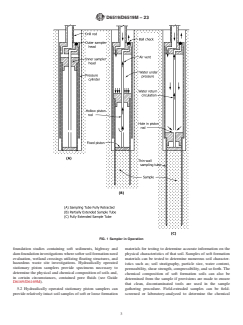
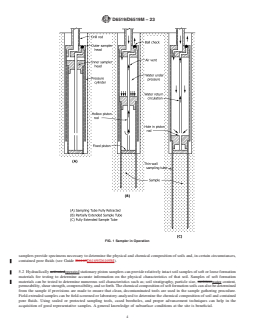
4.1 Hydraulically operated stationary piston sampling of
Geoenvironmental Exploration and the Installation of
soils consists of advancing a thin-walled sampling tube into
Subsurface Water Quality Monitoring Devices
subsurface soils generally through a predrilled bore hole to the
D6151/D6151M Practice for Using Hollow-Stem Augers for
desired sampling depth. See Fig. 1 for a schematic drawing of
Geotechnical Exploration and Soil Sampling
the sampling process. The sampler is sealed by the stationary
D6286/D6286M Guide for Selection of Drilling and Direct
piston to prevent any intrusion of formation material. At the
Push Methods for Geotechnical and Environmental Sub-
desired depth, fluid or air is forced into the sampling barrel,
surface Site Characterization
above the inner sampler head, forcing the thin-walled tube
2.3 ASTM Standards—Soil Sampling:
sampler over the piston into the soil formation. The hydrauli-
D1587/D1587M Practice for Thin-Walled Tube Sampling of
cally operated stationary piston sampler has a prescribed length
Fine-Grained Soils for Geotechnical Purposes
of travel. At the termination of the sampler travel length the
D4220/D4220M Practices for Preserving and Transporting
fluid flow is terminated. The sample is allowed to stabilize in
Soil Samples (Withdrawn 2023)
the thin-walled tube. The sampler is retrieved from the
D5088 Practice for Decontamination of Field Equipment
borehole, and the thin-walled tube with the sample is removed
Used at Waste Sites
from the sampler. The sample tube is then sealed properly or
D5299/D5299M Guide for Decommissioning of Groundwa-
field-extruded as desired. The stationary piston sampler is
ter Wells, Vadose Zone Monitoring Devices, Boreholes,
cleaned and a clean thin-walled tube installed. The procedure is
and Other Devices for Environmental Activities
repeated for the next desired sampling interval. Sampling can
D6169/D6169M Guide for Selection of Subsurface Soil and
be continuous for full-depth borehole logging or incremental
Rock Sampling Devices for Environmental and Geotech-
for specific interval sampling.
nical Investigations
5. Significance and Use
D6282/D6282M Guide for Direct Push Soil Sampling for
Environmental Site Characterizations (Withdrawn 2023)
5.1 Hydraulically operated stationary piston samplers are
used to gather soil samples for laboratory or field testing and
analysis for geologic investigations, soil chemical composition
studies, and water quality investigations. The sampler is
For referenced ASTM standards, visit the ASTM website, www.astm.org, or
contact ASTM Customer Service at service@astm.org. For Annual Book of ASTM
sometimes used when attempts to recover unstable soils with
Standards volume information, refer to the standard’s Document Summary page on
thin-walled tubes, Practice D1587/D1587M, are unsuccessful.
the ASTM website.
Examples of a few types of investigations in which hydraulic
The last approved version of this historical standard is referenced on
www.astm.org. stationary piston samplers may be used include building site
D6519/D6519M − 23
FIG. 1 Sampler in Operation
foundation studies containing soft sediments, highway and materials for testing to determine accurate information on the
dam foundation investigations where softer soil formation need
physical characteristics of that soil. Samples of soft formation
evaluation, wetland crossings utilizing floating structures, and
materials can be tested to determine numerous soil character-
hazardous waste site investigations. Hydraulically operated
istics such as; soil stratigraphy, particle size, water content,
stationary piston samplers provide specimens necessary to
permeability, shear strength, compressibility, and so forth. The
determine the physical and chemical composition of soils and,
chemical composition of soft formation soils can also be
in certain circumstances, contained pore fluids (see Guide
determined from the sample if provisions are made to ensure
D6169/D6169M).
that clean, decontaminated tools are used in the sample
gathering procedure. Field-extruded samples can be field-
5.2 Hydraulically operated stationary piston samplers can
provide relatively intact soil samples of soft or loose formation screened or laboratory-analyzed to determine the chemical
D6519/D6519M − 23
testing and/or inspection of soil and rock. As such, it is not totally
composition of soil and contained pore fluids. Using sealed or
applicable to agencies performing this practice. However, user of this
protected sampling tools, cased boreholes, and proper advance-
practice must recognize that the framework of Practice D3740 is appro-
ment techniques can help in the acquisition of good represen-
priate for evaluating the quality of an agency performing this practice.
tative samples. A general knowledge of subsurface conditions
Currently, there is no known qualifying national authority that inspects
at the site is beneficial.
agencies that perform this practice.
5.3 The use of this practice may not be the correct method
6. Criteria for Selection
for investigations of softer formations in all cases. As with all
sampling methods, subsurface conditions affect the perfor- 6.1 Important criteria to consider when selecting the hy-
mance of the sample gathering equipment and methods used.
draulically operated stationary piston sampler include the
For example, research indicates that clean sands may undergo following:
volume changes in the sampling process, due to drainage. The
6.1.1 Size of sample.
hydraulically operated stationary piston sampler is generally
6.1.2 Sample quality (Class A, B, C, or D) for physical
not effective for cohesive formations with unconfined, und-
testing. Refer to Practices D4220/D4220M.
rained shear strength in excess of 2.0 tons per square foot,
6.1.3 Sample handling requirements such as containers and
coarse sands, compact gravelly tills containing boulders and
preservation requirements.
cobbles, compacted gravel, cemented soil, or solid rock. These
6.1.4 Soil conditions anticipated (cohesiveness and particle
formations may damage the sample or cause refusal to pen-
size).
etration. A small percentage of gravel or gravel cuttings in the
6.1.5 Groundwater depth anticipated.
base of the borehole can cause the tube to bend and deform,
6.1.6 Boring depth required.
resulting in sample disturbance. Certain cohesive soils, de-
6.1.7 Chemical composition of soil and contained pore
pending on their water content, can create friction on the
fluids.
thin-walled tube which can exceed the hydraulic delivery
6.1.8 Available funds.
force. Some rock formations can weather into soft or loose
6.1.9 Estimated cost.
deposits where the hydraulically operated stationary piston
6.1.10 Time constraints.
sampler may be functional. The absence of groundwater can
6.1.11 History of tool performance under anticipated condi-
affect the performance of this sampling tool, and since this
tions (consult experienced users and manufacturers).
sampling method can introduce water to the borehole, it may
6.1.12 Site accessibility.
not be suitable for sampling above the groundwater table when
6.1.13 Decontamination requirements.
water is utilized as the activation fluid. As with all sampling
and borehole advancement methods, precautions must be taken
7. Apparatus
to prevent cross-contamination of aquifers through migration
of contaminates up or down the borehole. Refer to Guide
7.1 The hydraulically operated stationary piston sampler
D6286/D6286M on selecting drilling methods for environmen-
consists of an outer barrel, an outer barrel head with threaded
tal site characterization for additional information about work
connection for drill rod with a fluid-injection port leading into
at hazardous waste sites.
the inner barrel, a fluid-exit port fitted with a check valve, a
friction clutch assembly to control rotation, a piston rod that
NOTE 1—The quality of the result produced by this standard is
attaches to the sampler head and serves as a conduit from the
dependent on the competence of the personnel performing it, and the
suitability of the equipment and facilities used. Agencies that meet the
base of the piston for the discharge of fluid, an inner sampler
criteria of Practice D3740 are generally considered capable of competent
head which slides over the piston rod to which the thin-walled
and objective testing/sampling/inspection/etc. Users of this practice are
tube is attached, a piston that attaches to the lower end of the
cautioned that compliance with Practice D3740 does not in itself assure
piston rod, a thin-walled tube, and in some cases a removable
reliable results. Reliable results depend on many factors; Practice D3740
provides a means of evaluating some of those factors. outer barrel shoe. Necessary expendable supplies are thin-
Practice D3740 was developed for agencies engaged in the laboratory
walled tubes, tube sealing material, sample containers for use
in field extrusion, and O-ring seals.
7.1.1 Thin-walled Tube—The hydraulically operated sta-
Marcosion and Bieganovsky, “Liquefaction Potential of Dams & Foundations, tionary piston sampler is designed to accommodate standard
Report 4, Determination of In situ Density of Sands,” Research Report S-76-2, U.S.
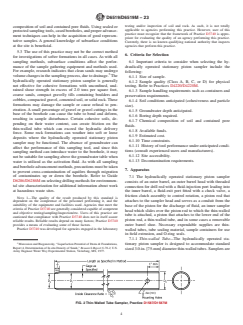
sized 3.0-in. [75-mm] diameter thin-walled tubes. Samplers are
Army Engineer Water Way Experimental Station, Vicksburg, MS, 1977.
FIG. 2 Thin-Walled Tube Sampler, Practice D1587/D1587M
D6519/D6519M − 23
also available to utilize 5.0-in. [125.0-mm] diameter thin- extended masts for long tool pulls, and sampler holding
walled tubes as well (Fig. 2). The thin-walled tubes are devices. Drill units are commonly fitted with fluid pumps that
generally manufactured in accordance with Practice D1587/ will provide the activation fluid. The unit must have a working
D1587M. Thin-walled tube retaining fastener patterns may pressure measurement gage in the fluid discharge line posi-
vary (Fig. 2). The most desirable pattern is the on
...
This document is not an ASTM standard and is intended only to provide the user of an ASTM standard an indication of what changes have been made to the previous version. Because
it may not be technically possible to adequately depict all changes accurately, ASTM recommends that users consult prior editions as appropriate. In all cases only the current version
of the standard as published by ASTM is to be considered the official document.
Designation: D6519 − 15 D6519/D6519M − 23
Standard Practice for
Sampling of Soil Using the Hydraulically Operated
Stationary Piston Sampler
This standard is issued under the fixed designation D6519;D6519/D6519M; the number immediately following the designation indicates
the year of original adoption or, in the case of revision, the year of last revision. A number in parentheses indicates the year of last
reapproval. A superscript epsilon (´) indicates an editorial change since the last revision or reapproval.
1. Scope*
1.1 This practice covers a procedure for sampling of cohesive, organic, or fine-grained soils, or combination thereof, using a
thin-walled metal tube that is inserted into the soil formation by means of a hydraulically operated piston. It is used to collect
relatively intact soil samples suitable for laboratory tests to determine structural and chemical properties for geotechnical and
environmental site characterizations.
1.1.1 Guidance on preservation and transport of samples in accordance with Practice D4220D4220/D4220M may apply. Samples
for classification may be preserved using procedures similar to Class A. In most cases, a thin-walled tube sample can be considered
as Class B, C, or D. Refer to Guide D6169D6169/D6169M for use of the hydraulically operated stationary piston soil sampler for
environmental site characterization. This sampling method is often used in conjunction with rotary drilling methods such as fluid
rotary; Guide D5783; and hollow stem augers, Practice D6151D6151/D6151M. Sampling data shouldshall be reported in the field
log in accordance with Guide D5434.
1.2 The hydraulically operated stationary piston sampler is limited to soils and unconsolidated materials that can be penetrated
with the available hydraulic pressure that can be applied without exceeding the structural strength of the thin-walled tube. This
standard addresses typical hydraulic piston samplers used on land or shallow water in drill holes. The standard does not address
specialized offshore samplers for deep marine applications that may or may not be hydraulically operated. This standard does not
address operation of other types of mechanically advanced piston samplers. For information on other soil samplers, refer to Guide
D6169D6169/D6169M.
1.3 Units—All observed and calculated values shall conform to the guidelines for significant digits and rounding established in
PracticeThe values stated in either inch-pound units or SI units [presented in brackets] are to be regarded separately as standard.
The values stated in each D6026, unless superseded by system may not be exact equivalents; therefore, each system shall be used
independently of the other. Combining values from the two systems may result in non-conformance with the standard. Reporting
of results in units other than shall not be regarded as nonconformance with this standard.
1.3.1 The values stated in either inch-pound units or SI units [presented in brackets] are to be regarded separately as standard. The
values stated in each system may not be exact equivalents; therefore, each system shall be used independently of the other.
Combining values from the two systems may result in non-conformance with the standard.
1.4 All observed and calculated values shall conform to the guidelines for significant digits and rounding established in Practice
D6026, unless superseded by this standard.
This practice is under the jurisdiction of ASTM Committee D18 on Soil and Rock and is the direct responsibility of Subcommittee D18.02 on Sampling and Related
Field Testing for Soil Evaluations
Current edition approved July 1, 2015Nov. 1, 2023. Published July 2015November 2023. Originally approved in 2000. Last previous edition approved in 20082015 as
D6519 – 08.D6519 – 15. DOI: 10.1520/D6519-15.10.1520/D6519_D6519M-23.
*A Summary of Changes section appears at the end of this standard
Copyright © ASTM International, 100 Barr Harbor Drive, PO Box C700, West Conshohocken, PA 19428-2959. United States
D6519/D6519M − 23
1.5 This practice does not purport to address all the safety concerns, if any, associated with its use and may involve use of
hazardous materials, equipment, and operations. It is the responsibility of the user of this practice to establish and adopt
appropriate safety and health practices. appropriate safety, health, and environmental practices and determine the applicability
of regulatory limitations prior to use. Also, the user must comply with prevalent regulatory codes, such as OSHA (Occupational
Health and Safety Administration) guidelines, while using this practice. For good safety practice, consult applicable OSHA
regulations and other safety guides on drilling.
1.6 This practice offers a set of instructions for performing one or more specific operations. This documentpractice cannot
replace education or experience and should be used in conjunction with professional judgement. Not all aspects of this practice
may be applicable in all circumstances. This ASTM standard practice is not intended to represent or replace the standard of care
by which the adequacy of a given professional service must be judged, nor should this document be applied without consideration
of a project’s many unique aspects. The word “Standard” in the title means only that the document has been approved through
the ASTM consensus process. This practice does not purport to comprehensively address all of the methods and thepotential issues
associated with sampling of soil. Users should seek qualified professionals for decisions as to the proper equipment and methods
that would be most successful for their site exploration. Other methods may be available for drilling and sampling of soil, and
qualified professionals should have flexibility to exercise judgment as to possible alternatives not covered in this practice. The
practice is current at the time of issue, but new alternative methods may become available prior to revisions, therefore, users
should consult with manufacturers or producers prior to specifying program requirements.
1.7 This international standard was developed in accordance with internationally recognized principles on standardization
established in the Decision on Principles for the Development of International Standards, Guides and Recommendations issued
by the World Trade Organization Technical Barriers to Trade (TBT) Committee.
2. Referenced Documents
2.1 ASTM Standards—Testing and Soil Classification:
D653 Terminology Relating to Soil, Rock, and Contained Fluids
D2488 Practice for Description and Identification of Soils (Visual-Manual Procedures)
D3740 Practice for Minimum Requirements for Agencies Engaged in Testing and/or Inspection of Soil and Rock as Used in
Engineering Design and Construction
D5434 Guide for Field Logging of Subsurface Explorations of Soil and Rock (Withdrawn 2021)
D6026 Practice for Using Significant Digits and Data Records in Geotechnical Data
2.2 ASTM Standards—Drilling Methods:
D5782 Guide for Use of Direct Air-Rotary Drilling for Geoenvironmental Exploration and the Installation of Subsurface
Water-Quality Monitoring Devices
D5783 Guide for Use of Direct Rotary Drilling with Water-Based Drilling Fluid for Geoenvironmental Exploration and the
Installation of Subsurface Water-Quality Monitoring Devices
D5784D5784/D5784M Guide for Use of Hollow-Stem Augers for Geoenvironmental Exploration and the Installation of
Subsurface Water Quality Monitoring Devices
D6151D6151/D6151M Practice for Using Hollow-Stem Augers for Geotechnical Exploration and Soil Sampling
D6286D6286/D6286M Guide for Selection of Drilling and Direct Push Methods for Geotechnical and Environmental
Subsurface Site Characterization
2.3 ASTM Standards—Soil Sampling:
D1587D1587/D1587M Practice for Thin-Walled Tube Sampling of Fine-Grained Soils for Geotechnical Purposes
D4220D4220/D4220M Practices for Preserving and Transporting Soil Samples (Withdrawn 2023)
D5088 Practice for Decontamination of Field Equipment Used at Waste Sites
D5299D5299/D5299M Guide for Decommissioning of Groundwater Wells, Vadose Zone Monitoring Devices, Boreholes, and
Other Devices for Environmental Activities
D6169D6169/D6169M Guide for Selection of Subsurface Soil and Rock Sampling Devices for Environmental and Geotechnical
Investigations
D6282D6282/D6282M Guide for Direct Push Soil Sampling for Environmental Site Characterizations (Withdrawn 2023)
3. Terminology
3.1 Definitions:
Drilling Safety Guide, National Drilling Assn., 3008 Millwood Ave., Columbia, SC 29205.
For referenced ASTM standards, visit the ASTM website, www.astm.org, or contact ASTM Customer Service at service@astm.org. For Annual Book of ASTM Standards
volume information, refer to the standard’s Document Summary page on the ASTM website.
The last approved version of this historical standard is referenced on www.astm.org.
D6519/D6519M − 23
3.1.1 For definitions of technical terms in this standard, refer to Terminology D653.
3.1.2 incremental drilling and sampling—insertion method where rotary drilling and sampling events are alternated for
incremental sampling, incremental drilling is often needed to penetrate harder or deeper formations.
3.1.3 sample recovery—the length of material recovered divided by the length of sampler advancement and stated as a percentage.
3.1.4 sample interval—defined zone within a subsurface strata from which a sample is gathered.
3.1.5 soil core—cylindrically shaped soil specimen recovered from a sampler.
3.1 Definitions:
3.1.1 For definitions of common technical terms in this standard, refer to Terminology D653.
3.2 Definitions of Terms Specific to This Standard:
3.2.1 friction clutch—clutch, n—a device to lock the thin-walled tube head to the outer barrel of the stationary piston sampler to
prevent uncontrolled thin-walled tube rotation.
3.2.2 hydraulically activatedoperated stationary piston sampler—sampler, n—a stationary piston sampler in which the thin-walled
tube is forcedadvanced over a fixed piston into the soil strata by hydraulic fluid pressure or pneumatic pressure. It is also known
as an “Osterberg” piston sampler, which was developed by Professor Jori Osterberg of Northwestern University.
3.2.3 incremental drilling and sampling, n—insertion method where rotary drilling and sampling events are alternated for
incremental sampling, incremental drilling is often needed to penetrate stiffer or deeper formations.
3.2.4 sample interval, n—defined zone within a subsurface strata from which a sample is gathered.
3.2.5 sample recovery, n—the length of material recovered divided by the length of sampler advancement and stated as a
percentage.
3.2.6 soil core, n—cylindrically shaped soil specimen recovered from a sampler.
4. Summary of Practice
4.1 Hydraulic Hydraulically operated stationary piston sampling of soils consists of advancing a thin-walled sampling devicetube
into subsurface soils generally through a predrilled bore hole to the desired sampling depth. See Fig. 1 for a schematic drawing
of the sampling process. The sampler is sealed by the stationary piston to prevent any intrusion of formation material. At the desired
depth, fluid or air is forced into the sampling barrel, above the inner sampler head, forcing the thin-walled tube sampler over the
piston into the soil formation. The hydraulically operated stationary piston sampler has a prescribed length of travel. At the
termination of the sampler travel length the fluid flow is terminated. The sample is allowed to stabilize in the thin-walled tube. The
sample is then sheared by rotating the sampler. The sampler is retrieved from the borehole, and the thin-walled tube with the sample
is removed from the sampler. The sample tube is then sealed properly or field-extruded as desired. The stationary piston sampler
is cleaned and a clean thin-walled tube installed. The procedure is repeated for the next desired sampling interval. Sampling can
be continuous for full-depth borehole logging or incremental for specific interval sampling.
5. Significance and Use
5.1 Hydraulically activatedoperated stationary piston samplers are used to gather soil samples for laboratory or field testing and
analysis for geologic investigations, soil chemical composition studies, and water quality investigations. The sampler is sometimes
used when attempts to recover unstable soils with thin-walled tubes, Practice D1587D1587/D1587M, are unsuccessful. Examples
of a few types of investigations in which hydraulic stationary piston samplers may be used include building site foundation studies
containing soft sediments, highway and dam foundation investigations where softer soil formation need evaluation, wetland
crossings utilizing floating structures, and hazardous waste site investigations. Hydraulically activatedoperated stationary piston
D6519/D6519M − 23
FIG. 1 Sampler in Operation
samplers provide specimens necessary to determine the physical and chemical composition of soils and, in certain circumstances,
contained pore fluids (see Guide D6169D6169/D6169M).
5.2 Hydraulically activatedoperated stationary piston samplers can provide relatively intact soil samples of soft or loose formation
materials for testing to determine accurate information on the physical characteristics of that soil. Samples of soft formation
materials can be tested to determine numerous soil characteristics such as; soil stratigraphy, particle size, moisturewater content,
permeability, shear strength, compressibility, and so forth. The chemical composition of soft formation soils can also be determined
from the sample if provisions are made to ensure that clean, decontaminated tools are used in the sample gathering procedure.
Field-extruded samples can be field-screened or laboratory-analyzed to determine the chemical composition of soil and contained
pore fluids. Using sealed or protected sampling tools, cased boreholes, and proper advancement techniques can help in the
acquisition of good representative samples. A general knowledge of subsurface conditions at the site is beneficial.
D6519/D6519M − 23
5.3 The use of this practice may not be the correct method for investigations of softer formations in all cases. As with all sampling
methods, subsurface conditions affect the performance of the sample gathering equipment and methods used. For example,
research indicates that clean sands may undergo volume changes in the sampling process, due to drainage. The hydraulically
activatedoperated stationary piston sampler is generally not effective for cohesive formations with unconfined, undrained shear
strength in excess of 2.0 tons per square foot, coarse sands, compact gravelly tills containing boulders and cobbles, compacted
gravel, cemented soil, or solid rock. These formations may damage the sample or cause refusal to penetration. A small percentage
of gravel or gravel cuttings in the base of the borehole can cause the tube to bend and deform, resulting in sample disturbance.
Certain cohesive soils, depending on their water content, can create friction on the thin-walled tube which can exceed the hydraulic
delivery force. Some rock formations can weather into soft or loose deposits where the hydraulically activatedoperated stationary
piston sampler may be functional. The absence of groundwater can affect the performance of this sampling tool. tool, and since
this sampling method can introduce water to the borehole, it may not be suitable for sampling above the groundwater table when
water is utilized as the activation fluid. As with all sampling and borehole advancement methods, precautions must be taken to
prevent cross-contamination of aquifers through migration of contaminates up or down the borehole. Refer to Guide
D6286D6286/D6286M on selecting drilling methods for environmental site characterization for additional information about work
at hazardous waste sites.
NOTE 1—The quality of the result produced by this standard is dependent on the competence of the personnel performing it, and the suitability of the
equipment and facilities used. Agencies that meet the criteria of Practice D3740 are generally considered capable of competent and objective
sampling.testing/sampling/inspection/etc. Users of this practice are cautioned that compliance with Practice D3740 does not in itself ensureassure reliable
results. Reliable results depend on many factors; Practice D3740 provides a means of evaluating some of those factors.
Practice D3740 was developed for agencies engaged in the laboratory testing and/or inspection of soil and rock. As such, it is not totally applicable
to agencies performing this practice. However, user of this practice shouldmust recognize that the framework of Practice D3740 is appropriate for
evaluating the quality of an agency performing this practice. Currently, there is no known qualifying national authority that inspects agencies that perform
this practice.
6. Criteria for Selection
6.1 Important criteria to consider when selecting the hydraulically activatedoperated stationary piston sampler include the
following:
6.1.1 Size of sample.
6.1.2 Sample quality (Class A, B, C, or D) for physical testing. Refer to Practices D4220D4220/D4220M.
6.1.3 Sample handling requirements such as containers and preservation requirements.
6.1.4 Soil conditions anticipated (cohesiveness).(cohesiveness and particle size).
6.1.5 Groundwater depth anticipated.
6.1.6 Boring depth required.
6.1.7 Chemical composition of soil and contained pore fluids.
6.1.8 Available funds.
6.1.9 Estimated cost.
6.1.10 Time constraints.
6.1.11 History of tool performance under anticipated conditions (consult experienced users and manufacturers).
6.1.12 Site accessibility.
6.1.13 Decontamination requirements.
Marcosion and Bieganovsky, “Liquefaction Potential of Dams & Foundations, Report 4, Determination of In situ Density of Sands,” Research Report S-76-2, U.S. Army
Engineer Water Way Experimental Station, Vicksburg, MS, 1977.
D6519/D6519M − 23
7. Apparatus
7.1 The hydraulically activatedoperated stationary piston sampler consists of an outer barrel, an outer barrel head with threaded
connection for drill rod with a fluid-injection port leading into the inner barrel, a fluid-exit port fitted with a check valve, a friction
clutch assembly to control rotation, a piston rod that attaches to the sampler head and serves as a conduit from the base of the piston
for the discharge of fluid, an inner sampler head which slides over the piston rod to which the thin-walled tube is attached, a piston
that attaches to the lower end of the piston rod, a thin-walled tube, and in some cases a removable outer barrel shoe. Necessary
expendable supplies are thin-walled tubes, tube sealing material, sample containers for use in field extrusion, and O-ring seals.
7.1.1 Thin-walled Tube—The hydraulically activatedoperated stationary piston sampler is designed to accommodate standard
sized 3.0-in. [75-mm] diameter thin-walled tubes. Samplers are also available to utilize 5.0-in. [125.0-mm] diameter thin-walled
tubes as well (Fig. 2). The thin-walled tubes are generally manufactured in accordance with Practice D1587D1587/D1587M.
Thin-walled tube retaining fastener patterns may vary (Fig. 2). The most desirable pattern
...