

ASTM D6460-24
(Test Method)Standard Test Method for Determination of Rolled Erosion Control Product (RECP) Performance in Protecting Earthen Channels from Stormwater-Induced Erosion
General Information
- Abstract
SIGNIFICANCE AND USE
5.1 This test method evaluates RECPs and their means of installation to:
5.1.1 Reduce soil loss and sediment concentrations in stormwater runoff under conditions of varying channel conditions and soil type;
5.1.2 Function within a composite system acting as vegetative reinforcement; and
5.1.3 Improve water quality exiting the area disturbed by earthwork activity by minimizing mobilization of in-situ particles within the streambed.
5.2 This test method models and examines conditions typically found on construction sites involving earthwork activities, including: highways and roads; airports; residential, commercial and industrial developments; pipelines, mines, and landfills; golf courses; etc.
5.3 This test method is a performance test, but can be used for quality control to determine product conformance to project specifications. Caution is advised since information regarding laboratory specific precision is incomplete. For project specific conformance, unique project-specific conditions should be taken into consideration.
SCOPE
1.1 This test method covers the guidelines, requirements and procedures for evaluating the ability of Rolled Erosion Control Products (RECPs) to protect earthen channels from stormwater-induced erosion. Critical elements of this protection are the ability of the RECP to:
1.1.1 Neutralize and absorb the hydraulic force of stormwater, thereby reducing soil particle loosening through “scour” mechanisms;
1.1.2 Slow runoff and encourage sedimentation, thereby reducing soil particle transport downstream;
1.1.3 Absorb shear forces of overland flow;
1.1.4 Trap soil particles beneath; and
1.1.5 Promote the establishment of vegetation.
1.2 This test method utilizes full-scale testing procedures, rather than reduced-scale (bench-scale) simulation, and is patterned after conditions typically found on construction sites prior to and after revegetation work. Further, procedures for evaluation of baseline conditions are provided. Thus, test preparation, test execution, data collection, data analysis and reporting procedures herein are intended to be suitable for testing of bare soil, unvegetated RECP, vegetated soil and vegetated RECP conditions.
1.3 This test method provides a comparative evaluation of an unvegetated RECP to baseline bare soil conditions and a vegetated RECP to a baseline, vegetated condition under controlled and documented conditions.
1.4 The values stated in SI units are to be regarded as standard. The inch-pound units given in parentheses are provided for information purposes only.
1.5 This standard does not purport to address all of the safety concerns, if any, associated with its use. It is the responsibility of the user of this standard to establish appropriate safety, health, and environmental practices and determine the applicability of regulatory limitations prior to use. Also, the user must comply with prevalent regulatory codes, such as OSHA (Occupational Health and Safety Administration) guidelines, while using the test method.
1.6 This international standard was developed in accordance with internationally recognized principles on standardization established in the Decision on Principles for the Development of International Standards, Guides and Recommendations issued by the World Trade Organization Technical Barriers to Trade (TBT) Committee.
- Status
- Published
- Publication Date
- 31-Jan-2024
- Technical Committee
- D18 - Soil and Rock
- Drafting Committee
- D18.25 - Erosion and Sediment Control Technology
Buy Documents
ASTM D6460-24 - Standard Test Method for Determination of Rolled Erosion Control Product (RECP) Performance in Protecting Earthen Channels from Stormwater-Induced Erosion
REDLINE ASTM D6460-24 - Standard Test Method for Determination of Rolled Erosion Control Product (RECP) Performance in Protecting Earthen Channels from Stormwater-Induced Erosion
Overview
ASTM D6460-24: Standard Test Method for Determination of Rolled Erosion Control Product (RECP) Performance in Protecting Earthen Channels from Stormwater-Induced Erosion provides comprehensive guidelines for evaluating how effectively RECPs protect soil surfaces in channels subjected to stormwater runoff. The standard ensures consistent, comparative testing of these products under conditions that closely simulate real construction site environments, aiding in erosion prevention and sediment control.
With a focus on full-scale testing, rather than small-scale simulations, ASTM D6460-24 helps engineers, contractors, and regulators assess RECP performance for soil loss reduction, sediment control, and water quality improvement, aligning with international principles for standards development.
Key Topics
- Erosion Control Efficacy: The test method assesses the ability of RECPs to absorb hydraulic forces, slow runoff, trap soil, and encourage vegetation establishment.
- Comparative Evaluation: Tests compare unvegetated and vegetated RECPs to baseline bare soil and vegetated conditions.
- Full-Scale Testing Approach: Procedures are designed to replicate field conditions observed on construction projects, including bare soil, seeded, unvegetated RECP, and vegetated RECP scenarios.
- Data Collection and Analysis: The standard outlines detailed protocols for preparing test channels, installing products, running controlled stormwater flows, collecting hydraulic/topographic data, and reporting results.
- Quality Control and Conformance: While primarily a performance test method, it is also appropriate for quality control by comparing product results to project requirements.
Applications
ASTM D6460-24 is widely acknowledged in geotechnical engineering, environmental compliance, and infrastructure construction for its practical applications:
- Construction Site Management: Evaluate RECP suitability and compliance for soils exposed during earthworks, mitigating stormwater-induced erosion on highways, roads, airports, pipelines, mines, landfills, and new developments.
- Product Selection and Specification: Facilitate the comparison and specification of different RECPs, ensuring that selected products meet regulatory and project performance criteria.
- Stormwater Management: Improve water quality leaving construction sites by minimizing sediment mobilization and controlling soil loss within temporary channels and drainage ways.
- Vegetative System Support: Support the use of RECPs for promoting rapid establishment of vegetation, offering a composite system for channel stabilization and long-term erosion control.
- Quality Assurance: Provide an objective, standardized method for documenting RECP performance on-site or in laboratory settings to demonstrate conformance to contract specifications.
Related Standards
ASTM D6460-24 references several related soil and geosynthetic test methods to ensure reliable and comprehensive evaluation, including:
- ASTM D698 - Standard Proctor compaction test for soil density
- ASTM D4318 - Determining liquid limit, plastic limit, and plasticity index of soils
- ASTM D6475 - Measuring mass per unit area of erosion control blankets
- ASTM D6566 - Mass per unit area of turf reinforcement mats
- ASTM D6818 - Tensile properties of RECPs
- ASTM D4595 - Tensile properties of geotextiles
- ASTM C136 - Sieve analysis of aggregates
- ASTM E177 and ASTM E691 - Precision and bias in test methods and interlaboratory studies
By referencing these standards, ASTM D6460-24 ensures high accuracy in characterization, installation, and assessment of RECPS and associated materials.
Keywords: ASTM D6460-24, rolled erosion control product, RECP, stormwater erosion, channel protection, soil loss, sediment control, vegetation establishment, construction site stormwater management, erosion control standards.
Relations
- Effective Date
- 01-Feb-2024
- Effective Date
- 01-Feb-2024
Buy Documents
ASTM D6460-24 - Standard Test Method for Determination of Rolled Erosion Control Product (RECP) Performance in Protecting Earthen Channels from Stormwater-Induced Erosion
REDLINE ASTM D6460-24 - Standard Test Method for Determination of Rolled Erosion Control Product (RECP) Performance in Protecting Earthen Channels from Stormwater-Induced Erosion
Get Certified
Connect with accredited certification bodies for this standard

CIS Institut d.o.o.
Personal Protective Equipment (PPE) certification body. Notified Body NB-2890 for EU Regulation 2016/425 PPE.

Kiwa BDA Testing
Building and construction product certification.
Kmetijski inštitut Slovenije
Agricultural Institute of Slovenia. Soil testing, plant health, agricultural product analysis.
Sponsored listings
Frequently Asked Questions
ASTM D6460-24 is a standard published by ASTM International. Its full title is "Standard Test Method for Determination of Rolled Erosion Control Product (RECP) Performance in Protecting Earthen Channels from Stormwater-Induced Erosion". This standard covers: SIGNIFICANCE AND USE 5.1 This test method evaluates RECPs and their means of installation to: 5.1.1 Reduce soil loss and sediment concentrations in stormwater runoff under conditions of varying channel conditions and soil type; 5.1.2 Function within a composite system acting as vegetative reinforcement; and 5.1.3 Improve water quality exiting the area disturbed by earthwork activity by minimizing mobilization of in-situ particles within the streambed. 5.2 This test method models and examines conditions typically found on construction sites involving earthwork activities, including: highways and roads; airports; residential, commercial and industrial developments; pipelines, mines, and landfills; golf courses; etc. 5.3 This test method is a performance test, but can be used for quality control to determine product conformance to project specifications. Caution is advised since information regarding laboratory specific precision is incomplete. For project specific conformance, unique project-specific conditions should be taken into consideration. SCOPE 1.1 This test method covers the guidelines, requirements and procedures for evaluating the ability of Rolled Erosion Control Products (RECPs) to protect earthen channels from stormwater-induced erosion. Critical elements of this protection are the ability of the RECP to: 1.1.1 Neutralize and absorb the hydraulic force of stormwater, thereby reducing soil particle loosening through “scour” mechanisms; 1.1.2 Slow runoff and encourage sedimentation, thereby reducing soil particle transport downstream; 1.1.3 Absorb shear forces of overland flow; 1.1.4 Trap soil particles beneath; and 1.1.5 Promote the establishment of vegetation. 1.2 This test method utilizes full-scale testing procedures, rather than reduced-scale (bench-scale) simulation, and is patterned after conditions typically found on construction sites prior to and after revegetation work. Further, procedures for evaluation of baseline conditions are provided. Thus, test preparation, test execution, data collection, data analysis and reporting procedures herein are intended to be suitable for testing of bare soil, unvegetated RECP, vegetated soil and vegetated RECP conditions. 1.3 This test method provides a comparative evaluation of an unvegetated RECP to baseline bare soil conditions and a vegetated RECP to a baseline, vegetated condition under controlled and documented conditions. 1.4 The values stated in SI units are to be regarded as standard. The inch-pound units given in parentheses are provided for information purposes only. 1.5 This standard does not purport to address all of the safety concerns, if any, associated with its use. It is the responsibility of the user of this standard to establish appropriate safety, health, and environmental practices and determine the applicability of regulatory limitations prior to use. Also, the user must comply with prevalent regulatory codes, such as OSHA (Occupational Health and Safety Administration) guidelines, while using the test method. 1.6 This international standard was developed in accordance with internationally recognized principles on standardization established in the Decision on Principles for the Development of International Standards, Guides and Recommendations issued by the World Trade Organization Technical Barriers to Trade (TBT) Committee.
SIGNIFICANCE AND USE 5.1 This test method evaluates RECPs and their means of installation to: 5.1.1 Reduce soil loss and sediment concentrations in stormwater runoff under conditions of varying channel conditions and soil type; 5.1.2 Function within a composite system acting as vegetative reinforcement; and 5.1.3 Improve water quality exiting the area disturbed by earthwork activity by minimizing mobilization of in-situ particles within the streambed. 5.2 This test method models and examines conditions typically found on construction sites involving earthwork activities, including: highways and roads; airports; residential, commercial and industrial developments; pipelines, mines, and landfills; golf courses; etc. 5.3 This test method is a performance test, but can be used for quality control to determine product conformance to project specifications. Caution is advised since information regarding laboratory specific precision is incomplete. For project specific conformance, unique project-specific conditions should be taken into consideration. SCOPE 1.1 This test method covers the guidelines, requirements and procedures for evaluating the ability of Rolled Erosion Control Products (RECPs) to protect earthen channels from stormwater-induced erosion. Critical elements of this protection are the ability of the RECP to: 1.1.1 Neutralize and absorb the hydraulic force of stormwater, thereby reducing soil particle loosening through “scour” mechanisms; 1.1.2 Slow runoff and encourage sedimentation, thereby reducing soil particle transport downstream; 1.1.3 Absorb shear forces of overland flow; 1.1.4 Trap soil particles beneath; and 1.1.5 Promote the establishment of vegetation. 1.2 This test method utilizes full-scale testing procedures, rather than reduced-scale (bench-scale) simulation, and is patterned after conditions typically found on construction sites prior to and after revegetation work. Further, procedures for evaluation of baseline conditions are provided. Thus, test preparation, test execution, data collection, data analysis and reporting procedures herein are intended to be suitable for testing of bare soil, unvegetated RECP, vegetated soil and vegetated RECP conditions. 1.3 This test method provides a comparative evaluation of an unvegetated RECP to baseline bare soil conditions and a vegetated RECP to a baseline, vegetated condition under controlled and documented conditions. 1.4 The values stated in SI units are to be regarded as standard. The inch-pound units given in parentheses are provided for information purposes only. 1.5 This standard does not purport to address all of the safety concerns, if any, associated with its use. It is the responsibility of the user of this standard to establish appropriate safety, health, and environmental practices and determine the applicability of regulatory limitations prior to use. Also, the user must comply with prevalent regulatory codes, such as OSHA (Occupational Health and Safety Administration) guidelines, while using the test method. 1.6 This international standard was developed in accordance with internationally recognized principles on standardization established in the Decision on Principles for the Development of International Standards, Guides and Recommendations issued by the World Trade Organization Technical Barriers to Trade (TBT) Committee.
ASTM D6460-24 is classified under the following ICS (International Classification for Standards) categories: 13.080.01 - Soil quality and pedology in general. The ICS classification helps identify the subject area and facilitates finding related standards.
ASTM D6460-24 has the following relationships with other standards: It is inter standard links to ASTM D6460-19, ASTM D7208-23. Understanding these relationships helps ensure you are using the most current and applicable version of the standard.
ASTM D6460-24 is available in PDF format for immediate download after purchase. The document can be added to your cart and obtained through the secure checkout process. Digital delivery ensures instant access to the complete standard document.
Standards Content (Sample)
This international standard was developed in accordance with internationally recognized principles on standardization established in the Decision on Principles for the
Development of International Standards, Guides and Recommendations issued by the World Trade Organization Technical Barriers to Trade (TBT) Committee.
Designation: D6460 − 24
Standard Test Method for
Determination of Rolled Erosion Control Product (RECP)
Performance in Protecting Earthen Channels from
Stormwater-Induced Erosion
This standard is issued under the fixed designation D6460; the number immediately following the designation indicates the year of
original adoption or, in the case of revision, the year of last revision. A number in parentheses indicates the year of last reapproval. A
superscript epsilon (´) indicates an editorial change since the last revision or reapproval.
1. Scope* priate safety, health, and environmental practices and deter-
mine the applicability of regulatory limitations prior to use.
1.1 This test method covers the guidelines, requirements
Also, the user must comply with prevalent regulatory codes,
and procedures for evaluating the ability of Rolled Erosion
such as OSHA (Occupational Health and Safety Administra-
Control Products (RECPs) to protect earthen channels from
tion) guidelines, while using the test method.
stormwater-induced erosion. Critical elements of this protec-
1.6 This international standard was developed in accor-
tion are the ability of the RECP to:
dance with internationally recognized principles on standard-
1.1.1 Neutralize and absorb the hydraulic force of
ization established in the Decision on Principles for the
stormwater, thereby reducing soil particle loosening through
Development of International Standards, Guides and Recom-
“scour” mechanisms;
mendations issued by the World Trade Organization Technical
1.1.2 Slow runoff and encourage sedimentation, thereby
Barriers to Trade (TBT) Committee.
reducing soil particle transport downstream;
1.1.3 Absorb shear forces of overland flow;
2. Referenced Documents
1.1.4 Trap soil particles beneath; and
2.1 ASTM Standards:
1.1.5 Promote the establishment of vegetation.
C136/C136M Test Method for Sieve Analysis of Fine and
1.2 This test method utilizes full-scale testing procedures,
Coarse Aggregates
rather than reduced-scale (bench-scale) simulation, and is
D422 Test Method for Particle-Size Analysis of Soils (With-
patterned after conditions typically found on construction sites 3
drawn 2016)
prior to and after revegetation work. Further, procedures for
D698 Test Methods for Laboratory Compaction Character-
evaluation of baseline conditions are provided. Thus, test 3
istics of Soil Using Standard Effort (12,400 ft-lbf/ft (600
preparation, test execution, data collection, data analysis and 3
kN-m/m ))
reporting procedures herein are intended to be suitable for
D1556/D1556M Test Method for Density and Unit Weight
testing of bare soil, unvegetated RECP, vegetated soil and 3
of Soil in Place by Sand-Cone Method (Withdrawn 2024)
vegetated RECP conditions.
D2922 Test Methods for Density of Soil and Soil-Aggregate
1.3 This test method provides a comparative evaluation of in Place by Nuclear Methods (Shallow Depth) (With-
an unvegetated RECP to baseline bare soil conditions and a
drawn 2007)
vegetated RECP to a baseline, vegetated condition under D4318 Test Methods for Liquid Limit, Plastic Limit, and
controlled and documented conditions.
Plasticity Index of Soils
D4595/D4595M Test Method for Tensile Properties of Geo-
1.4 The values stated in SI units are to be regarded as
textiles by the Wide-Width Method
standard. The inch-pound units given in parentheses are
D6475 Test Method for Measuring Mass per Unit Area of
provided for information purposes only.
Erosion Control Blankets
1.5 This standard does not purport to address all of the
D6525/D6525M Test Method for Measuring Nominal
safety concerns, if any, associated with its use. It is the
Thickness of Rolled Erosion Control Products (With-
responsibility of the user of this standard to establish appro-
drawn 2014)
1 2
This test method is under the jurisdiction of ASTM Committee D18 on Soil and For referenced ASTM standards, visit the ASTM website, www.astm.org, or
Rock; Subcommittee D18.25 on Erosion and Sediment Control Technology; and is contact ASTM Customer Service at service@astm.org. For Annual Book of ASTM
the direct responsibility of Section .02 on Erosion Control Blankets (ECBs). Standards volume information, refer to the standard’s Document Summary page on
Current edition approved Feb. 1, 2024. Published March 2024. Originally the ASTM website.
approved in 1999. Last previous edition approved in 2019 as D6460–19. DOI: The last approved version of this historical standard is referenced on
10.1520/D6460-24. www.astm.org.
*A Summary of Changes section appears at the end of this standard
Copyright © ASTM International, 100 Barr Harbor Drive, PO Box C700, West Conshohocken, PA 19428-2959. United States
D6460 − 24
D6526 Test Method for Analysis of Toluene by Capillary 3.1.11 shear stress, n—the force of flowing water applied to
Column Gas Chromatography (Withdrawn 2018) the surface of a channel in Newtons per square meter (pounds
D6566 Test Method for Measuring Mass Per Unit Area of per square foot); also, commonly referred to as “tractive force.”
Turf Reinforcement Mats
3.1.12 temporary degradable, adj—composed of
D6567 Test Method for Measuring the Light Penetration of
biologically, photochemically or otherwise degradable materi-
a Rolled Erosion Control Product (RECP)
als that temporarily reduces soil erosion and enhances the
D6818 Test Method for Tensile Properties of Rolled Erosion
establishment of vegetation.
Control Products
3.1.13 turf reinforcement mat (TRM), n—in erosion control,
E177 Practice for Use of the Terms Precision and Bias in
a non-degradable geosynthetic or geocomposite processed into
ASTM Test Methods
a matrix sufficient to increase the stability threshold of other-
E691 Practice for Conducting an Interlaboratory Study to
wise unreinforced established vegetation.
Determine the Precision of a Test Method
3.1.13.1 Discussion—Products in this category may incor-
porate ancillary degradable components to enhance the germi-
3. Terminology
nation and establishment of vegetation.
3.1 Definitions of Terms Specific to This Standard:
4. Summary of Test Method
3.1.1 erosion control blanket (ECB), n—a degradable
material, composed primarily of processed natural organic
4.1 The performance of an RECP in reducing stormwater-
materials, manufactured or fabricated into rolls designed to
induced erosion is determined by subjecting the material to
reduce soil erosion and assist in the growth, establishment and
simulated stormwater flow in a controlled and documented
protection of vegetation.
environment in reference to identical testing on baseline
3.1.2 erosion control net (ECN), n—a planar woven natural conditions.
fiber or extruded synthetic mesh used as a component in the
4.2 Key elements of the testing process include:
manufacture of ECBs.
4.2.1 Calibration of the stormwater simulation and measure-
3.1.3 index test, n—a test procedure which may contain a
ment equipment;
known bias, but which may be used to establish an order for a
4.2.2 Preparation of the test channel;
set of specimens with respect to the property of interest.
4.2.3 Documentation of the RECP to be tested (if appli-
cable);
3.1.4 lot, n—a unit of production, or a group of other units
4.2.4 Installation of the RECP (if applicable);
or packages, taken for sampling or statistical examination,
4.2.5 Establishment of vegetative stand (if applicable);
having one or more common properties and being readily
4.2.6 Execution of the test;
separable from other similar units.
4.2.7 Collection of hydraulic, topographical, and associated
3.1.5 natural, n—a class name of various fibers of animal,
data;
mineral or vegetable origin.
4.2.8 Analysis of the resultant data; and
3.1.6 open weave textile (OWT), n—a temporary degradable
4.2.9 Reporting.
ECB composed of natural or polymer yarns woven into a
matrix used to provide erosion control and facilitate vegetation 5. Significance and Use
establishment.
5.1 This test method evaluates RECPs and their means of
3.1.7 point gauge assembly, n—an adjustable, calibrated
installation to:
rack assembly mounted to a manually controlled pinion used to
5.1.1 Reduce soil loss and sediment concentrations in
determine the distance from a surface to a plane of reference.
stormwater runoff under conditions of varying channel condi-
Typically, a point gauge assembly is mounted to a data
tions and soil type;
acquisition cart traversing a hydraulic testing flume and mea-
5.1.2 Function within a composite system acting as vegeta-
sures the relative distance from a surface within the flume to
tive reinforcement; and
the zero mark of the pinion housing. The rack is graduated and
5.1.3 Improve water quality exiting the area disturbed by
adjustable to accommodate variable offsets. Distance can be
earthwork activity by minimizing mobilization of in-situ par-
recorded manually or electronically.
ticles within the streambed.
3.1.8 polymer, n—a chemical compound or mixture of
5.2 This test method models and examines conditions typi-
compounds formed by polymerization and consisting essen-
cally found on construction sites involving earthwork
tially of repeating molecular structural units.
activities, including: highways and roads; airports; residential,
commercial and industrial developments; pipelines, mines, and
3.1.9 rolled erosion control product (RECP), n—a tempo-
landfills; golf courses; etc.
rary degradable or long-term non-degradable material manu-
factured or fabricated into rolls designed to reduce soil erosion
5.3 This test method is a performance test, but can be used
and assist in the growth, establishment and protection of
for quality control to determine product conformance to project
vegetation.
specifications. Caution is advised since information regarding
3.1.10 sample, n—a portion of material which is taken for laboratory specific precision is incomplete. For project specific
testing or documentation and used in the laboratory as a source conformance, unique project-specific conditions should be
of individual specimens. taken into consideration.
D6460 − 24
6. Apparatus 6.4 Velocity Probe—A propeller-type probe shall be used to
identify flow conditions during test operation. In lieu of a
6.1 Water Delivery System—The water delivery system shall
propeller-type probe, other velocity measurement devices in-
include pump(s), piping, channels, water control structures,
cluding electromagnetic or sonic type flow meters may be
and water measurement instrumentation as necessary to
used, provided that equivalent accuracy (65 %) is achievable.
achieve the desired hydraulic conditions. The water control
Periodic calibration and certification of this equipment shall be
structures shall regulate and direct the flow into the desired test
performed.
channel. Fig. 1 presents a schematic showing an example of a
series of test channels and water delivery system. The water 6.5 Earthwork Equipment—Typical equipment utilized in
delivery system shall be constructed such that turbulence at the construction of test channels includes: skid loader, wheel
entrance to the test channel is minimized. Use of flow barrow, hand tamper, shovels, rakes, vibratory plate compactor
straighteners (for example, tube racks or vanes) are recom- and excavation template.
mended to reduce turbulence and achieve uniform flow condi-
6.6 Geotechnical Testing Equipment—Equipment sufficient
tions. A direct flow system (that is, controlled flow diverted
to conduct testing described in Test Methods D422, C136/
from a natural waterway) may also be employed for this
C136M, D698, D4318, D1556/D1556M, and D2922. Geotech-
purpose. Testing of bare soil conditions requires minimal
nical evaluation may be outsourced to a laboratory with
channel gradient and minimal water flow. Testing of vegetated,
sufficient equipment and expertise to conduct sediment char-
reinforced conditions typically requires steep gradient channels
acteristic evaluation.
and a maximum discharge in excess of 2.8 cubic meters per
6.7 Vegetative Stand Quantification Equipment—A cali-
second (cms) (98.9 cubic feet per second (cfs)).
brated template used to ensure height of vegetation and
6.2 Water Source—Water derived for testing may be gravity
counting box are necessary for vegetated testing. Vegetation is
fed or pump supplied to the testing facility in a closed loop or
cut to a specific, uniform stand height by placing a template on
pass through system. Water delivered should be regulated to
the soil surface and trimming blades/stems at the top of the
ensure consistent discharge and be free of debris with little or
template. An open, square box is used to count vegetation
no turbidity. Discharge must be measured by hydraulic control
stems and blades to determine stand density. The box may be
structure, calibrated hydraulic structure, or calibrated flow
constructed of metal or wood with an internal opening mea-
meter.
suring 76.2 mm (3 in.) square and 25.4 to 50.8 mm (1 to 2 in.)
6.3 Survey Apparatus—Channel gradient must be measured in height.
in a three-dimensional coordinate system with respect to a
6.8 Photographic Equipment—At a minimum, still and
fixed benchmark. A total station apparatus or survey level is
video footage must be recorded throughout the preparation and
required to determine elevations within the test reach. The total
testing process to document the testing. 35 mm still and 8 mm
station system is a standard surveying instrument capable of
video formats or digital equivalents are acceptable.
measuring distance simultaneously with vertical and horizontal
6.9 Miscellaneous—Other miscellaneous equipment in-
angles to determine the coordinates of a location (that is, X, Y
cludes: meteorological equipment (wind speed, temperature,
and Z axis) within a defined coordinate system and store the
precipitation).
data electronically in a data logger. In lieu of a total station
system, manual surveying equipment may be used. Precision
7. Procedure
and bias of either instrument must be known. Soil loss may be
recorded using survey apparatus referenced to a known bench 7.1 Test Channel Preparation:
mark or by calibrated point gauge assembly referenced to 7.1.1 Construct earthen test channels using conventional
relative locations within the facility. earthwork placement techniques. A rectangular or trapezoidal
FIG. 1 Typical Closed Looped Water Delivery System
D6460 − 24
cross section channel may be used; however, a rectangular vegetated testing should be identical to soil preparation meth-
channel is recommended for consistency of construction and ods for the protected scenario.
explicit computation of shear stress. Perform compaction of
7.1.6 Optional—If results are to be specific to RECP unveg-
channel bed material to create a geotechnically (structurally) etated performance, install RECP by manufacturer’s guidelines
stable subgrade. General soil types to be used for testing shall
or by specifications for testing required. Sample product to be
be loam, clay and sand. Target grain sizes and plasticity indices tested (one per installation) and determine mass per unit area
are included in Table 1. Fig. 2 presents a schematic showing a
(Test Method D6475), tensile strength and elongation (Test
typical test channel profile. Record geotechnical characteristics Method D4595/D4595M for ECBs, Test Method D6818 for
in file to include: visual description and classification, grain
TRMs), thickness (Test Method D6526), and light penetration
size distribution (course and sub 200 fraction), plasticity (Test Method D6567). Record staple size, staple locations,
indices, moisture-density relationship, USDA, ASTM or USCS
product description, seam details (that is, checkslots or over-
classification and in-situ compaction. laps used) and any other pertinent information. If the depth of
flow will exceed the boundaries of the installation (that is, a
NOTE 1—Construction of steep slope and shallow soil layer plots may
rectangular channel or trapezoidal channel with insufficient
lead to geotechnical instability. Evaluation of test facility prior to
operation is advised. freeboard), secure the edges by placing mechanical seal along
edges of installation to prohibit flow from circumventing the
7.1.2 Plate the channel surface with a minimum 30.5-cm
RECP. Typically a mechanical seal is achieved by securing
(12-in.) thick veneer of test soil. Place soil in a minimum of
dimensional lumber or angle iron along walls of testing facility,
two lifts and compact to 90 6 3 % of standard Proctor density
placed in contact with the RECP. Sufficient downward pressure
in accordance with Test Method D698. In the case previous
must be applied in placing the longitudinal, mechanical seal to
testing was completed in channel, remove top layer of soil to a
ensure intimate contact with the RECP over the length of the
depth of 25.4 mm (1 in.) deeper than deepest erosion and
installation; however, the seal should not act as ancillary
replace veneer. In-situ density of soil must be measured for
stabilization to the RECP. The angle iron or lumber is sealed
each lift utilizing Test Methods D1556/D1556M or D2922.
with a silicone sealant to ensure flow does not circumvent the
7.1.3 Excavate and fill the soil surface to the design cross
mechanical seal. Mechanical seal should be installed to mini-
section and grade and ensure a smooth surface throughout the
mize disturbance of the flow. Proceed to 7.2.
test reach. The test channel may be comprised of a trapezoidal
7.1.7 Optional—If results are to be specific to an unrein-
cross section or rectangular cross section. Trapezoidal cross
forced stand of vegetation, prepare seed bed and seed as
section should incorporate a 0.61-m (2-ft) bottom width and
desired. Provide water and fertilizer or other additives as
2H:1V side slopes. A rectangular cross section must be 0.61 m
required to establish vegetation. Record seed type, preparation
(2 ft) minimum in width. The test channels shall be a minimum
methodology, watering schedule, fertilizer and additives used,
of 12.2 m (40 ft) in length.
and climatic variables over the entirety of the maturation
7.1.4 Locate test section sufficiently downstream of inlet
period. Photograph test reach weekly. Include photographs and
structure or transitions of flow to ensure straight and parallel
notes regarding vegetation establishment in log with seed type,
stream lines. Flow should enter test section as uniform flow, or
seed source and date of planting. Allow vegetation to mature to
as close to uniform flow as possible. Maintenance or modifi-
reflect desired conditions. If a uniform vegetation height is
cation of the reach of channel upstream from the test section
desired, trim vegetation using hand shears and height template,
may be required to provide similar roughness to the test section
or by other suitable means, immediately prior to testing.
to attain near uniform flow conditions entering the test section.
7.1.8 Optional—If results are to be specific to a stand of
7.1.5 Prepare soil surface to mimic field conditions to be
vegetation reinforced with an RECP, prepare and document
tested. In the case of bare soil testing, prepare a smooth or
seed bed as described in 7.1.7, install the RECP as described in
roughened surface as necessary. If soil surface differs from
7.1.6 and allow vegetation to mature as required, documenting
final, compacted surface (that is, hand roughened), measure
maturation of vegetation as described in 7.1.7. Prepare vegeta-
in-situ density of surface by Test Methods D1556/D1556M or
tion for testing as described in 7.1.7.
D2922. If results are to be representative of bare soil conditions
proceed to 7.2. Otherwise, soil preparation methods for bare
7.2 Pre-Test Documentation:
soil testing utilized as a baseline, control plot for product or
7.2.1 Maintain a test folder for each test cycle, including
information on:
7.2.1.1 Site conditions;
7.2.1.2 Geotechnical and soil conditions including grain
TABLE 1 Target Grain Sizes and Plasticity Indices
size distribution, liquid limit, plastic limit, plasticity index,
Particle size
Sand Loam Clay
USDA, USCS or ASTM classification, K factor and in-situ
(mm)
compaction results;
D (mm) 25 > D > 3.0 10 > D > 0.3 3.0 > D > 0.02
100 100 100 100
D (mm) 4.0 > D > 0.8 0.8 > D > 0.08 0.08 > D > 0.003
85 85 85 85 7.2.1.3 Meteorological data from on-site weather station at
D (mm) 0.9 > D > 0.2 0.15 > D > 0.015 0.015 > D >
50 50 50 50
time of testing (if testing outdoors);
0.0008
D (mm) 0.3 > D > 0.03 > D > 0.001 D < 0.002 7.2.1.4 RECP product type/description including product
15 15 15 15
0.01
data sheet and the following index test results from subsamples
Plasticity N/A (nonplastic) 2 < PI < 8 10 < PI
of the products tested (if product test): Thickness (Test Method
Index
D6525/D6525M), Mass per Unit Area (Test Method D6475 for
D6460 − 24
FIG. 2 Typical Channel Profile
ECBs; Test Method D6566 for TRMs), Tensile Strength (Test are to be performed; one located within the upstream, middle
Method D4595/D4595M for ECBs; Test Method D6818 for and downstream third of the test section. Minimize damage to
TRMs), and Light Penetration (Test Method D6567); vegetated system by limiting foot traffic and stepping carefully
7.2.1.5 Vegetative component variables including seed type, around vegetation stem/blade density count location. Subse-
seed source, stand density and maturity at time of testing, stand quent counts during testing are to be performed in the same
height, visual classification of vegetation, and photo and note location as the initial count. Document condition of vegetation
log from vegetation (if vegetative element incorporated in immediately prior to testing, recording stand height as obtained
testing); by trimming to template height, density obtained from box
7.2.1.6 Installation procedure including dates of installation counts, photographs and video footage and visual classification
and descriptions of RECP and vegetative component incorpo- of vegetative stand. Classify and record condition of vegetation
rated. Include all documentation listed in 7.1.6 and 7.1.7; as described in USDA Agricultural Handbook #667 (USDA
7.2.1.7 Photo documentation of installation immediately 1987). If variable vegetation height is used, record description
prior to testing; and of vegetation and a range of heights and USDA classification.
7.2.1.8 Document any conditions not specifically mentioned 7.3.3 Determine initial, target discharge. Initial discharge
herein that could potentially influence the results of testing. determination must consider conditions to be tested (bare soil,
unvegetated RECP, bare vegetation or reinforced vegetation),
7.3 Initial Data Collection and Test Preparation:
slope of test channel, and cross section size and shape of
7.3.1 Immediately prior to testing, delineate cross sections
channel. The objective of the performance test is to subject the
for data acquisition. At a minimum, eight cross sections should
installation incrementally increasing hydraulic forces, thus, the
be included through the test reach, with a maximum spacing
initial discharge should cause little migration of soil from the
between sections of one channel width in the direction of flow.
test channel. Each subsequent target discharge will be deter-
Locate data acquisition locations within each cross section to
mined from the computation of hydraulic forces of the previous
record water surface elevation and bed elevation. At a
test.
minimum, three data acquisition locations along the bed of the
7.3.4 Prepare facility for testing. Provide access to each data
channel and two data acquisition locations on each bank of the
acquisition cross section to permit measurement of bed eleva-
channel (if using a trapezoidal section) must be identified and
tion without walking on channel surface. Provide access to
monitored at each cross section. Record the elevation of each
each data acquisition cross section to permit measurement of
data acquisition location by survey apparatus or point gauge
water surface elevation by means of survey apparatus or point
assembly. If using a point gauge assembly in a relative frame
gauge assembly.
of reference, determine the longitudinal slope of the installa-
tion by survey apparatus. Elevation readings can be sensitive to 7.4 Test Operation and Data Collection:
the diameter of the probe (rod or point gauge assembly) in 7.4.1 Include the following test data: operator name and
contact with the ground surface. Thus, the point gauge assem- title; actual discharge recorded during testing, time flow began;
bly or survey rod should include an extension rod between 6.4 time flow stopped; time runoff stopped; flow depths; and
mm (0.25 in.) and 9.5 mm (0.375 in.) in diameter to make measured velocities. Also record accuracy of all instruments
contact with the ground surface. involved. If using hydraulic control structure or calibrated
7.3.2 If vegetative component is incorporated in testing, hydraulic structure flow control into test channel, include
quantify vegetative stand density using count box described in summary of accuracy determination and st
...
This document is not an ASTM standard and is intended only to provide the user of an ASTM standard an indication of what changes have been made to the previous version. Because
it may not be technically possible to adequately depict all changes accurately, ASTM recommends that users consult prior editions as appropriate. In all cases only the current version
of the standard as published by ASTM is to be considered the official document.
Designation: D6460 − 19 D6460 − 24
Standard Test Method for
Determination of Rolled Erosion Control Product (RECP)
Performance in Protecting Earthen Channels from
Stormwater-Induced Erosion
This standard is issued under the fixed designation D6460; the number immediately following the designation indicates the year of
original adoption or, in the case of revision, the year of last revision. A number in parentheses indicates the year of last reapproval. A
superscript epsilon (´) indicates an editorial change since the last revision or reapproval.
1. Scope*
1.1 This test method covers the guidelines, requirements and procedures for evaluating the ability of Rolled Erosion Control
Products (RECPs) to protect earthen channels from stormwater-induced erosion. Critical elements of this protection are the ability
of the RECP to:
1.1.1 Neutralize and absorb the hydraulic force of stormwater, thereby reducing soil particle loosening through “scour”
mechanisms;
1.1.2 Slow runoff and encourage sedimentation, thereby reducing soil particle transport downstream;
1.1.3 Absorb shear forces of overland flow;
1.1.4 Trap soil particles beneath; and
1.1.5 Promote the establishment of vegetation.
1.2 This test method utilizes full-scale testing procedures, rather than reduced-scale (bench-scale) simulation, and is patterned after
conditions typically found on construction sites prior to and after revegetation work. Further, procedures for evaluation of baseline
conditions are provided. Thus, test preparation, test execution, data collection, data analysis and reporting procedures herein are
intended to be suitable for testing of bare soil, unvegetated RECP, vegetated soil and vegetated RECP conditions.
1.3 This test method provides a comparative evaluation of an unvegetated RECP to baseline bare soil conditions and a vegetated
RECP to a baseline, vegetated condition under controlled and documented conditions.
1.4 The values stated in SI units are to be regarded as standard. The inch-pound units given in parentheses are provided for
information purposes only.
1.5 This standard does not purport to address all of the safety concerns, if any, associated with its use. It is the responsibility
of the user of this standard to establish appropriate safety, health, and environmental practices and determine the applicability of
regulatory limitations prior to use. Also, the user must comply with prevalent regulatory codes, such as OSHA (Occupational
Health and Safety Administration) guidelines, while using the test method.
This test method is under the jurisdiction of ASTM Committee D18 on Soil and Rock; Subcommittee D18.25 on Erosion and Sediment Control Technology; and is the
direct responsibility of Section .02 on Erosion Control Blankets (ECBs).
Current edition approved July 15, 2019Feb. 1, 2024. Published August 2019March 2024. Originally approved in 1999. Last previous edition approved in 20122019 as
D6460–12. DOI: 10.1520/D6460-19.–19. DOI: 10.1520/D6460-24.
*A Summary of Changes section appears at the end of this standard
Copyright © ASTM International, 100 Barr Harbor Drive, PO Box C700, West Conshohocken, PA 19428-2959. United States
D6460 − 24
1.6 This international standard was developed in accordance with internationally recognized principles on standardization
established in the Decision on Principles for the Development of International Standards, Guides and Recommendations issued
by the World Trade Organization Technical Barriers to Trade (TBT) Committee.
2. Referenced Documents
2.1 ASTM Standards:
C136C136/C136M Test Method for Sieve Analysis of Fine and Coarse Aggregates
D422 Test Method for Particle-Size Analysis of Soils (Withdrawn 2016)
3 3
D698 Test Methods for Laboratory Compaction Characteristics of Soil Using Standard Effort (12,400 ft-lbf/ft (600 kN-m/m ))
D1556D1556/D1556M Test Method for Density and Unit Weight of Soil in Place by Sand-Cone Method (Withdrawn 2024)
D2922 Test Methods for Density of Soil and Soil-Aggregate in Place by Nuclear Methods (Shallow Depth) (Withdrawn 2007)
D4318 Test Methods for Liquid Limit, Plastic Limit, and Plasticity Index of Soils
D4595D4595/D4595M Test Method for Tensile Properties of Geotextiles by the Wide-Width Method
D6475 Test Method for Measuring Mass per Unit Area of Erosion Control Blankets
D6525D6525/D6525M Test Method for Measuring Nominal Thickness of Rolled Erosion Control Products (Withdrawn 2014)
D6526 Test Method for Analysis of Toluene by Capillary Column Gas Chromatography (Withdrawn 2018)
D6566 Test Method for Measuring Mass Per Unit Area of Turf Reinforcement Mats
D6567 Test Method for Measuring the Light Penetration of a Rolled Erosion Control Product (RECP)
D6818 Test Method for Tensile Properties of Rolled Erosion Control Products
E177 Practice for Use of the Terms Precision and Bias in ASTM Test Methods
E691 Practice for Conducting an Interlaboratory Study to Determine the Precision of a Test Method
3. Terminology
3.1 Definitions of Terms Specific to This Standard:
3.1.1 erosion control blanket (ECB), n—a degradable material, composed primarily of processed natural organic materials,
manufactured or fabricated into rolls designed to reduce soil erosion and assist in the growth, establishment and protection of
vegetation.
3.1.2 erosion control net (ECN), n—a planar woven natural fiber or extruded synthetic mesh used as a component in the
manufacture of ECBs.
3.1.3 index test, n—a test procedure which may contain a known bias, but which may be used to establish an order for a set of
specimens with respect to the property of interest.
3.1.4 lot, n—a unit of production, or a group of other units or packages, taken for sampling or statistical examination, having one
or more common properties and being readily separable from other similar units.
3.1.5 natural, n—a class name of various fibers of animal, mineral or vegetable origin.
3.1.6 open weave textile (OWT), n—a temporary degradable ECB composed of natural or polymer yarns woven into a matrix used
to provide erosion control and facilitate vegetation establishment.
3.1.7 point gauge assembly, n—an adjustable, calibrated rack assembly mounted to a manually controlled pinion used to determine
the distance from a surface to a plane of reference. Typically, a point gauge assembly is mounted to a data acquisition cart
traversing a hydraulic testing flume and measures the relative distance from a surface within the flume to the zero mark of the
pinion housing. The rack is graduated and adjustable to accommodate variable offsets. Distance can be recorded manually or
electronically.
3.1.8 polymer, n—a chemical compound or mixture of compounds formed by polymerization and consisting essentially of
repeating molecular structural units.
For referenced ASTM standards, visit the ASTM website, www.astm.org, or contact ASTM Customer Service at service@astm.org. For Annual Book of ASTM Standards
volume information, refer to the standard’s Document Summary page on the ASTM website.
The last approved version of this historical standard is referenced on www.astm.org.
D6460 − 24
3.1.9 rolled erosion control product (RECP), n—a temporary degradable or long-term non-degradable material manufactured or
fabricated into rolls designed to reduce soil erosion and assist in the growth, establishment and protection of vegetation.
3.1.10 sample, n—a portion of material which is taken for testing or documentation and used in the laboratory as a source of
individual specimens.
3.1.11 shear stress, n—the force of flowing water applied to the surface of a channel in Newtons per square meter (pounds per
square foot); also, commonly referred to as “tractive force.”
3.1.12 temporary degradable, adj—composed of biologically, photochemically or otherwise degradable materials that temporarily
reduces soil erosion and enhances the establishment of vegetation.
3.1.13 turf reinforcement mat (TRM), n—in erosion control, a non-degradable geosynthetic or geocomposite processed into a
matrix sufficient to increase the stability threshold of otherwise unreinforced established vegetation.
3.1.13.1 Discussion—
Products in this category may incorporate ancillary degradable components to enhance the germination and establishment of
vegetation.
4. Summary of Test Method
4.1 The performance of an RECP in reducing stormwater-induced erosion is determined by subjecting the material to simulated
stormwater flow in a controlled and documented environment in reference to identical testing on baseline conditions.
4.2 Key elements of the testing process include:
4.2.1 Calibration of the stormwater simulation and measurement equipment;
4.2.2 Preparation of the test channel;
4.2.3 Documentation of the RECP to be tested (if applicable);
4.2.4 Installation of the RECP (if applicable);
4.2.5 Establishment of vegetative stand (if applicable);
4.2.6 Execution of the test;
4.2.7 Collection of hydraulic, topographical, and associated data;
4.2.8 Analysis of the resultant data; and
4.2.9 Reporting.
5. Significance and Use
5.1 This test method evaluates RECPs and their means of installation to:
5.1.1 Reduce soil loss and sediment concentrations in stormwater runoff under conditions of varying channel conditions and soil
type;
5.1.2 Function within a composite system acting as vegetative reinforcement; and
5.1.3 Improve water quality exiting the area disturbed by earthwork activity by minimizing mobilization of in-situ particles within
the streambed.
D6460 − 24
5.2 This test method models and examines conditions typically found on construction sites involving earthwork activities,
including: highways and roads; airports; residential, commercial and industrial developments; pipelines, mines, and landfills; golf
courses; etc.
5.3 This test method is a performance test, but can be used for quality control to determine product conformance to project
specifications. Caution is advised since information regarding laboratory specific precision is incomplete. For project specific
conformance, unique project-specific conditions should be taken into consideration.
6. Apparatus
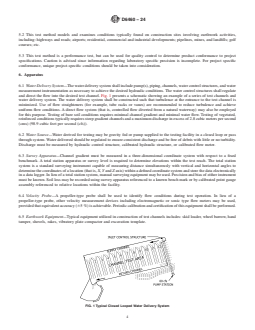
6.1 Water Delivery System—The water delivery system shall include pump(s), piping, channels, water control structures, and water
measurement instrumentation as necessary to achieve the desired hydraulic conditions. The water control structures shall regulate
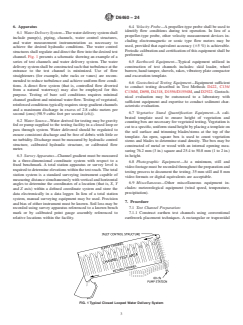
and direct the flow into the desired test channel. Fig. 1 presents a schematic showing an example of a series of test channels and
water delivery system. The water delivery system shall be constructed such that turbulence at the entrance to the test channel is
minimized. Use of flow straighteners (for example, tube racks or vanes) are recommended to reduce turbulence and achieve
uniform flow conditions. A direct flow system (that is, controlled flow diverted from a natural waterway) may also be employed
for this purpose. Testing of bare soil conditions requires minimal channel gradient and minimal water flow. Testing of vegetated,
reinforced conditions typically requires steep gradient channels and a maximum discharge in excess of 2.8 cubic meters per second
(cms) (98.9 cubic feet per second (cfs)).
6.2 Water Source—Water derived for testing may be gravity fed or pump supplied to the testing facility in a closed loop or pass
through system. Water delivered should be regulated to ensure consistent discharge and be free of debris with little or no turbidity.
Discharge must be measured by hydraulic control structure, calibrated hydraulic structure, or calibrated flow meter.
6.3 Survey Apparatus—Channel gradient must be measured in a three-dimensional coordinate system with respect to a fixed
benchmark. A total station apparatus or survey level is required to determine elevations within the test reach. The total station
system is a standard surveying instrument capable of measuring distance simultaneously with vertical and horizontal angles to
determine the coordinates of a location (that is, X, Y and Z axis) within a defined coordinate system and store the data electronically
in a data logger. In lieu of a total station system, manual surveying equipment may be used. Precision and bias of either instrument
must be known. Soil loss may be recorded using survey apparatus referenced to a known bench mark or by calibrated point gauge
assembly referenced to relative locations within the facility.
6.4 Velocity Probe—A propeller-type probe shall be used to identify flow conditions during test operation. In lieu of a
propeller-type probe, other velocity measurement devices including electromagnetic or sonic type flow meters may be used,
provided that equivalent accuracy (65 %) is achievable. Periodic calibration and certification of this equipment shall be performed.
6.5 Earthwork Equipment—Typical equipment utilized in construction of test channels includes: skid loader, wheel barrow, hand
tamper, shovels, rakes, vibratory plate compactor and excavation template.
FIG. 1 Typical Closed Looped Water Delivery System
D6460 − 24
6.6 Geotechnical Testing Equipment—Equipment sufficient to conduct testing described in Test Methods D422, C136C136/
C136M, D698, D4318, D1556D1556/D1556M, and D2922. Geotechnical evaluation may be outsourced to a laboratory with
sufficient equipment and expertise to conduct sediment characteristic evaluation.
6.7 Vegetative Stand Quantification Equipment—A calibrated template used to ensure height of vegetation and counting box are
necessary for vegetated testing. Vegetation is cut to a specific, uniform stand height by placing a template on the soil surface and
trimming blades/stems at the top of the template. An open, square box is used to count vegetation stems and blades to determine
stand density. The box may be constructed of metal or wood with an internal opening measuring 76.2 mm (3 in.) square and 25.4
to 50.8 mm (1 to 2 in.) in height.
6.8 Photographic Equipment—At a minimum, still and video footage must be recorded throughout the preparation and testing
process to document the testing. 35 mm still and 8 mm video formats or digital equivalents are acceptable.
6.9 Miscellaneous—Other miscellaneous equipment includes: meteorological equipment (wind speed, temperature, precipitation).
7. Procedure
7.1 Test Channel Preparation:
7.1.1 Construct earthen test channels using conventional earthwork placement techniques. A rectangular or trapezoidal cross
section channel may be used; however, a rectangular channel is recommended for consistency of construction and explicit
computation of shear stress. Perform compaction of channel bed material to create a geotechnically (structurally) stable subgrade.
General soil types to be used for testing shall be loam, clay and sand. Target grain sizes and plasticity indices are included in Table
1. Fig. 2 presents a schematic showing a typical test channel profile. Record geotechnical characteristics in file to include: visual
description and classification, grain size distribution (course and sub 200 fraction), plasticity indices, moisture-density relationship,
USDA, ASTM or USCS classification and in-situ compaction.
NOTE 1—Construction of steep slope and shallow soil layer plots may lead to geotechnical instability. Evaluation of test facility prior to operation is
advised.
7.1.2 Plate the channel surface with a minimum 30.5-cm (12-in.) thick veneer of test soil. Place soil in a minimum of two lifts
and compact to 90 6 3 % of standard Proctor density in accordance with Test Method D698. In the case previous testing was
completed in channel, remove top layer of soil to a depth of 25.4 mm (1 in.) deeper than deepest erosion and replace veneer. In-situ
density of soil must be measured for each lift utilizing Test Methods D1556D1556/D1556M or D2922.
7.1.3 Excavate and fill the soil surface to the design cross section and grade and ensure a smooth surface throughout the test reach.
The test channel may be comprised of a trapezoidal cross section or rectangular cross section. Trapezoidal cross section should
incorporate a 0.61-m (2-ft) bottom width and 2H:1V side slopes. A rectangular cross section must be 0.61 m (2 ft) minimum in
width. The test channels shall be a minimum of 12.2 m (40 ft) in length.
7.1.4 Locate test section sufficiently downstream of inlet structure or transitions of flow to ensure straight and parallel stream lines.
Flow should enter test section as uniform flow, or as close to uniform flow as possible. Maintenance or modification of the reach
of channel upstream from the test section may be required to provide similar roughness to the test section to attain near uniform
flow conditions entering the test section.
TABLE 1 Target Grain Sizes and Plasticity Indices
Particle size
Sand Loam Clay
(mm)
D (mm) 25 > D > 3.0 10 > D > 0.3 3.0 > D > 0.02
100 100 100 100
D (mm) 4.0 > D > 0.8 0.8 > D > 0.08 0.08 > D > 0.003
85 85 85 85
D (mm) 0.9 > D > 0.2 0.15 > D > 0.015 0.015 > D >
50 50 50 50
0.0008
D (mm) 0.3 > D > 0.03 > D > 0.001 D < 0.002
15 15 15 15
0.01
Plasticity N/A (nonplastic) 2 < PI < 8 10 < PI
Index
D6460 − 24
FIG. 2 Typical Channel Profile
7.1.5 Prepare soil surface to mimic field conditions to be tested. In the case of bare soil testing, prepare a smooth or roughened
surface as necessary. If soil surface differs from final, compacted surface (that is, hand roughened), measure in-situ density of
surface by Test Methods D1556D1556/D1556M or D2922. If results are to be representative of bare soil conditions proceed to 7.2.
Otherwise, soil preparation methods for bare soil testing utilized as a baseline, control plot for product or vegetated testing should
be identical to soil preparation methods for the protected scenario.
7.1.6 Optional—If results are to be specific to RECP unvegetated performance, install RECP by manufacturer’s guidelines or by
specifications for testing required. Sample product to be tested (one per installation) and determine mass per unit area (Test Method
D6475), tensile strength and elongation (Test Method D4595D4595/D4595M for ECBs, Test Method D6818 for TRMs), thickness
(Test Method D6526), and light penetration (Test Method D6567). Record staple size, staple locations, product description, seam
details (that is, checkslots or overlaps used) and any other pertinent information. If the depth of flow will exceed the boundaries
of the installation (that is, a rectangular channel or trapezoidal channel with insufficient freeboard), secure the edges by placing
mechanical seal along edges of installation to prohibit flow from circumventing the RECP. Typically a mechanical seal is achieved
by securing dimensional lumber or angle iron along walls of testing facility, placed in contact with the RECP. Sufficient downward
pressure must be applied in placing the longitudinal, mechanical seal to ensure intimate contact with the RECP over the length of
the installation; however, the seal should not act as ancillary stabilization to the RECP. The angle iron or lumber is sealed with
a silicone sealant to ensure flow does not circumvent the mechanical seal. Mechanical seal should be installed to minimize
disturbance of the flow. Proceed to 7.2.
7.1.7 Optional—If results are to be specific to an unreinforced stand of vegetation, prepare seed bed and seed as desired. Provide
water and fertilizer or other additives as required to establish vegetation. Record seed type, preparation methodology, watering
schedule, fertilizer and additives used, and climatic variables over the entirety of the maturation period. Photograph test reach
weekly. Include photographs and notes regarding vegetation establishment in log with seed type, seed source and date of planting.
Allow vegetation to mature to reflect desired conditions. If a uniform vegetation height is desired, trim vegetation using hand
shears and height template, or by other suitable means, immediately prior to testing.
7.1.8 Optional—If results are to be specific to a stand of vegetation reinforced with an RECP, prepare and document seed bed as
described in 7.1.7, install the RECP as described in 7.1.6 and allow vegetation to mature as required, documenting maturation of
vegetation as described in 7.1.7. Prepare vegetation for testing as described in 7.1.7.
7.2 Pre-Test Documentation:
7.2.1 Maintain a test folder for each test cycle, including information on:
7.2.1.1 Site conditions;
7.2.1.2 Geotechnical and soil conditions including grain size distribution, liquid limit, plastic limit, plasticity index, USDA, USCS
or ASTM classification, K factor and in-situ compaction results;
7.2.1.3 Meteorological data from on-site weather station at time of testing (if testing outdoors);
D6460 − 24
7.2.1.4 RECP product type/description including product data sheet and the following index test results from subsamples of the
products tested (if product test): Thickness (Test Method D6525D6525/D6525M), Mass per Unit Area (Test Method D6475 for
ECBs; Test Method D6566 for TRMs), Tensile Strength (Test Method D4595D4595/D4595M for ECBs; Test Method D6818 for
TRMs), and Light Penetration (Test Method D6567);
7.2.1.5 Vegetative component variables including seed type, seed source, stand density and maturity at time of testing, stand
height, visual classification of vegetation, and photo and note log from vegetation (if vegetative element incorporated in testing);
7.2.1.6 Installation procedure including dates of installation and descriptions of RECP and vegetative component incorporated.
Include all documentation listed in 7.1.6 and 7.1.7;
7.2.1.7 Photo documentation of installation immediately prior to testing; and
7.2.1.8 Document any conditions not specifically mentioned herein that could potentially influence the results of testing.
7.3 Initial Data Collection and Test Preparation:
7.3.1 Immediately prior to testing, delineate cross sections for data acquisition. At a minimum, eight cross sections should be
included through the test reach, with a maximum spacing between sections of one channel width in the direction of flow. Locate
data acquisition locations within each cross section to record water surface elevation and bed elevation. At a minimum, three data
acquisition locations along the bed of the channel and two data acquisition locations on each bank of the channel (if using a
trapezoidal section) must be identified and monitored at each cross section. Record the elevation of each data acquisition location
by survey apparatus or point gauge assembly. If using a point gauge assembly in a relative frame of reference, determine the
longitudinal slope of the installation by survey apparatus. Elevation readings can be sensitive to the diameter of the probe (rod or
point gauge assembly) in contact with the ground surface. Thus, the point gauge assembly or survey rod should include an
extension rod between 6.4 mm (0.25 in.) and 9.5 mm (0.375 in.) in diameter to make contact with the ground surface.
7.3.2 If vegetative component is incorporated in testing, quantify vegetative stand density using count box described in 6.7. A
minimum of three vegetation stem density counts are to be performed. Place count box on ground surface; count and record the
number of stems and the number of blades within the opening of the box. Three vegetation stem density counts are to be performed;
one located within the upstream, middle and downstream third of the test section. Minimize damage to vegetated system by
limiting foot traffic and stepping carefully around vegetation stem/blade density count location. Subsequent counts during testing
are to be performed in the same location as the initial count. Document condition of vegetation immediately prior to testing,
recording stand height as obtained by trimming to template height, density obtained from box counts, photographs and video
footage and visual classification of vegetative stand. Classify and record condition of vegetation as described in USDAAgricultural
Handbook #667 (USDA 1987). If variable vegetation height is used, record description of vegetation and a range of heights and
USDA classification.
7.3.3 Determine initial, target discharge. Initial discharge determination must consider conditions to be tested (bare soil,
unvegetated RECP, bare vegetation or reinforced vegetation), slope of test channel, and cross section size and shape of channel.
The objective of the performance test is to subject the installation incrementally increasing hydraulic forces, thus, the initial
discharge should cause little migration of soil from the test channel. Each subsequent target discharge will be determined from the
computation of hydraulic forces of the previous test.
7.3.4 Prepare facility for testing. Provide access to each data acquisition cross section to permit measurement of bed elevation
without walking on channel surface. Provide access to each data acquisition cross section to permit measurement of water surface
elevation by means of survey apparatus or point gauge assembly.
7.4 Test Operation and Data Collection:
7.4.1 Include the following test data: operator name and title; actual discharge recorded during testing, time flow began; time flow
stopped; time runoff stopped; flow depths; and measured velocities. Also record accuracy of all instruments
...