

ASTM D6640-21
(Practice)Standard Practice for Collection and Handling of Soils Obtained in Core Barrel Samplers for Environmental Investigations
General Information
- Abstract
SIGNIFICANCE AND USE
5.1 Often during environmental investigations, soils are analyzed after being collected from the surface, the vadose zone (Terminology D653), and sometimes from below the groundwater table to identify and quantify the presence of a chemical contaminant. A contaminant is a substance that is typically hazardous and either is not normally present or that occurs naturally but is of an uncharacteristically high concentration (Guide D4687). A three-dimensional spatial array of samples can often provide information as to the source and route(s) of migration of the contaminant. The resultant information is used to direct remedial and corrective actions or can be used for monitoring purposes. Obtaining a soil sample with a core barrel sampler involves driving this device into the ground and then retrieving it for sample processing. Several methods for advancing a core barrel are generally acceptable (for example, Test Method D1586; Practices D1587, D3550, and D6151; Guides D5784, D5875, D5876, D6169, and D6282). Drilling methods that use drilling fluids (liquids or air) should be avoided because they are more susceptible to cross-contamination (Guide D6286) (see 6.1.6).
5.2 If samples are to be collected for the determination of per- and poly-fluorinated alkyl substances (PFAS), all sampling equipment should be made of fluorine-free materials. Other considerations for PFAS sampling may exist but are beyond the scope of this standard.
SCOPE
1.1 This practice covers procedures for obtaining soils from core barrel samplers for chemical and physical analysis, with an emphasis on the collection and handling procedures that maintain the representativeness of the chemical contaminants of concern. Core barrel samplers are initially empty (hollow) until they are pushed into the ground to collect and retrieve a cylindrical soil sample with minimal disturbance. The selection of equipment and the sample handling procedures are dependent on the soil properties, the depth of sampling, and the general properties of the chemical contaminants of concern, that is, volatile organic compounds, semi-volatile organic compounds, and inorganic constituents. The sampling procedures described are designed to maintain representative concentrations of the contaminants regardless of their physical state(s), that is, solid, liquid, or gas.
1.2 This practice covers soil samplers used in Guide D6169 on soils and rock sampling and included in Guide D6232 for waste sampling. Guide D6169 provides additional information on samplers and procedures that will preserve representative contaminate concentrations. Guide D6282 is on direct-push soil samplers that are most frequently used for environmental work. Guide D4547 addresses special sampling of soils for volatile compounds. This standard does not include sediment samplers in Guide D4823, but the same principles may apply to handling of those cores. Guide D4700 includes information on shallow manual push soil samplers.
1.3 Five general types of core barrel samplers are discussed in this practice: split-barrel, soil corer, ring-lined barrel, thin-walled tube, and solid-barrel samplers.
1.4 This document does not cover all the core barrel devices that are available for the collection of soil samples.
1.5 The procedures described may or may not be applicable to handling of samples for assessing certain geotechnical properties, for example, soil porosity.
Note 1: Prior to commencement of any intrusive exploration, the site should be checked for underground utilities.
1.6 Units—The values stated in SI units are to be regarded as standard. No other units of measurement are included in this standard. All observed and calculated values shall conform to the guidelines for significant digits and rounding established in Practice D6026. Reporting of test results in units other than SI shall not be regarded as nonconformance with this standard.
1.7 This standard does not purpo...
- Status
- Published
- Publication Date
- 30-Sep-2021
- Technical Committee
- D34 - Waste Management
- Drafting Committee
- D34.01.03 - Sampling Equipment
Buy Documents
ASTM D6640-21 - Standard Practice for Collection and Handling of Soils Obtained in Core Barrel Samplers for Environmental Investigations
REDLINE ASTM D6640-21 - Standard Practice for Collection and Handling of Soils Obtained in Core Barrel Samplers for Environmental Investigations
Overview
ASTM D6640-21 is the internationally recognized standard practice for the collection and handling of soils obtained in core barrel samplers for environmental investigations. Published by ASTM International, this standard details procedures to collect undisturbed soil samples from the subsurface using core barrel samplers, ensuring the representativeness of chemical contaminants such as volatile organic compounds, semi-volatile organic compounds, and inorganic constituents. Adherence to these methods is critical for reliable environmental site characterization, pollution assessment, and compliance with environmental regulations.
Key Topics
Representativeness and Contaminant Integrity: Guidance is provided to maintain accurate contaminant concentrations when collecting, handling, and preserving soil samples. The practice stresses minimizing physical and chemical changes to volatile and semi-volatile organic compounds.
Types of Core Barrel Samplers:
- Split-barrel samplers
- Ring-lined barrel samplers
- Thin-walled tube samplers
- Solid-barrel samplers (including sealed and unsealed types)
- Manual push variants for surface and shallow sampling
Equipment Selection Criteria:
- Compatibility of sample-contacting materials (e.g., stainless steel, plastic) with target contaminants
- Suitability for soil types, moisture content, and sampling depth
- Sample volume requirements based on analytical needs
- Minimization of cross-contamination, especially in multi-depth sampling
Handling Procedures:
- Strategies for immediate and proper subsampling to limit contaminant loss, particularly for volatile organics
- Pre-sampling and post-sampling cleaning and decontamination of equipment, as per Practice D5088
- Recommendations for safe sample transfer, storage, and preservation
PFAS Considerations: When sampling for per- and polyfluorinated alkyl substances (PFAS), only fluorine-free materials must contact the soil samples to prevent false positives.
Applications
ASTM D6640-21 is essential for:
Environmental Site Assessments: Accurate collection and analysis of soil samples to identify contamination and define the extent of pollution migration, informing remedial action and ongoing monitoring.
Regulatory Compliance: Meeting requirements for environmental investigations under national and local regulations, particularly for hazardous waste sites and contaminated land.
Groundwater and Vadose Zone Studies: Enabling three-dimensional sampling arrays that provide crucial data on contaminant sources, pathways, and behavior below the surface.
PFAS and Emerging Contaminant Sampling: Implementing best practices to prevent cross-contamination during sampling for challenging analytes.
Waste Management and Geotechnical Engineering: Supplementary use in waste characterization and, where appropriate, in limited geotechnical parameter assessment.
Practitioners working in environmental consulting, laboratory analysis, remediation planning, and regulatory enforcement rely on these standardized practices to ensure high-quality, legally defensible data.
Related Standards
ASTM D6640-21 references several related ASTM standards and guides that support best practices for soil sampling and environmental data quality, including:
- ASTM D1586: Standard Penetration Test (SPT) and Split-Barrel Sampling
- ASTM D1587: Thin-Walled Tube Sampling of Fine-Grained Soils
- ASTM D3550: Thick Wall, Ring-Lined, Split Barrel Sampling
- ASTM D4547: Sampling Waste and Soils for Volatile Organic Compounds
- ASTM D5088: Decontamination of Field Equipment
- ASTM D6169: Selection of Soil and Rock Sampling Devices
- ASTM D6232: Selection of Sampling Equipment for Waste and Contaminated Media Data Collection
- ASTM D6282: Direct Push Soil Sampling for Environmental Site Characterizations
- ASTM D6026: Significant Digits and Data Records in Geotechnical Data
Utilizing these interconnected standards ensures completeness, consistency, and data integrity in environmental soil sampling and analysis projects.
Keywords: ASTM D6640, soil core sampling, environmental investigations, core barrel sampler, soil contaminants, PFAS sampling, cross-contamination prevention, soil sample handling, volatile organic compounds, environmental site assessment.
Relations
- Effective Date
- 01-Apr-2024
- Effective Date
- 01-Nov-2023
- Effective Date
- 01-Nov-2023
- Effective Date
- 01-May-2020
- Effective Date
- 01-Nov-2019
- Effective Date
- 01-Oct-2019
- Effective Date
- 01-Nov-2018
- Effective Date
- 01-Sep-2017
- Effective Date
- 01-Nov-2016
- Effective Date
- 01-Feb-2016
- Effective Date
- 01-Sep-2015
- Effective Date
- 01-Sep-2015
- Effective Date
- 01-Aug-2015
- Effective Date
- 01-Feb-2015
- Effective Date
- 15-Jan-2015
Buy Documents
ASTM D6640-21 - Standard Practice for Collection and Handling of Soils Obtained in Core Barrel Samplers for Environmental Investigations
REDLINE ASTM D6640-21 - Standard Practice for Collection and Handling of Soils Obtained in Core Barrel Samplers for Environmental Investigations
Get Certified
Connect with accredited certification bodies for this standard

CIS Institut d.o.o.
Personal Protective Equipment (PPE) certification body. Notified Body NB-2890 for EU Regulation 2016/425 PPE.

Kiwa BDA Testing
Building and construction product certification.
Kmetijski inštitut Slovenije
Agricultural Institute of Slovenia. Soil testing, plant health, agricultural product analysis.
Sponsored listings
Frequently Asked Questions
ASTM D6640-21 is a standard published by ASTM International. Its full title is "Standard Practice for Collection and Handling of Soils Obtained in Core Barrel Samplers for Environmental Investigations". This standard covers: SIGNIFICANCE AND USE 5.1 Often during environmental investigations, soils are analyzed after being collected from the surface, the vadose zone (Terminology D653), and sometimes from below the groundwater table to identify and quantify the presence of a chemical contaminant. A contaminant is a substance that is typically hazardous and either is not normally present or that occurs naturally but is of an uncharacteristically high concentration (Guide D4687). A three-dimensional spatial array of samples can often provide information as to the source and route(s) of migration of the contaminant. The resultant information is used to direct remedial and corrective actions or can be used for monitoring purposes. Obtaining a soil sample with a core barrel sampler involves driving this device into the ground and then retrieving it for sample processing. Several methods for advancing a core barrel are generally acceptable (for example, Test Method D1586; Practices D1587, D3550, and D6151; Guides D5784, D5875, D5876, D6169, and D6282). Drilling methods that use drilling fluids (liquids or air) should be avoided because they are more susceptible to cross-contamination (Guide D6286) (see 6.1.6). 5.2 If samples are to be collected for the determination of per- and poly-fluorinated alkyl substances (PFAS), all sampling equipment should be made of fluorine-free materials. Other considerations for PFAS sampling may exist but are beyond the scope of this standard. SCOPE 1.1 This practice covers procedures for obtaining soils from core barrel samplers for chemical and physical analysis, with an emphasis on the collection and handling procedures that maintain the representativeness of the chemical contaminants of concern. Core barrel samplers are initially empty (hollow) until they are pushed into the ground to collect and retrieve a cylindrical soil sample with minimal disturbance. The selection of equipment and the sample handling procedures are dependent on the soil properties, the depth of sampling, and the general properties of the chemical contaminants of concern, that is, volatile organic compounds, semi-volatile organic compounds, and inorganic constituents. The sampling procedures described are designed to maintain representative concentrations of the contaminants regardless of their physical state(s), that is, solid, liquid, or gas. 1.2 This practice covers soil samplers used in Guide D6169 on soils and rock sampling and included in Guide D6232 for waste sampling. Guide D6169 provides additional information on samplers and procedures that will preserve representative contaminate concentrations. Guide D6282 is on direct-push soil samplers that are most frequently used for environmental work. Guide D4547 addresses special sampling of soils for volatile compounds. This standard does not include sediment samplers in Guide D4823, but the same principles may apply to handling of those cores. Guide D4700 includes information on shallow manual push soil samplers. 1.3 Five general types of core barrel samplers are discussed in this practice: split-barrel, soil corer, ring-lined barrel, thin-walled tube, and solid-barrel samplers. 1.4 This document does not cover all the core barrel devices that are available for the collection of soil samples. 1.5 The procedures described may or may not be applicable to handling of samples for assessing certain geotechnical properties, for example, soil porosity. Note 1: Prior to commencement of any intrusive exploration, the site should be checked for underground utilities. 1.6 Units—The values stated in SI units are to be regarded as standard. No other units of measurement are included in this standard. All observed and calculated values shall conform to the guidelines for significant digits and rounding established in Practice D6026. Reporting of test results in units other than SI shall not be regarded as nonconformance with this standard. 1.7 This standard does not purpo...
SIGNIFICANCE AND USE 5.1 Often during environmental investigations, soils are analyzed after being collected from the surface, the vadose zone (Terminology D653), and sometimes from below the groundwater table to identify and quantify the presence of a chemical contaminant. A contaminant is a substance that is typically hazardous and either is not normally present or that occurs naturally but is of an uncharacteristically high concentration (Guide D4687). A three-dimensional spatial array of samples can often provide information as to the source and route(s) of migration of the contaminant. The resultant information is used to direct remedial and corrective actions or can be used for monitoring purposes. Obtaining a soil sample with a core barrel sampler involves driving this device into the ground and then retrieving it for sample processing. Several methods for advancing a core barrel are generally acceptable (for example, Test Method D1586; Practices D1587, D3550, and D6151; Guides D5784, D5875, D5876, D6169, and D6282). Drilling methods that use drilling fluids (liquids or air) should be avoided because they are more susceptible to cross-contamination (Guide D6286) (see 6.1.6). 5.2 If samples are to be collected for the determination of per- and poly-fluorinated alkyl substances (PFAS), all sampling equipment should be made of fluorine-free materials. Other considerations for PFAS sampling may exist but are beyond the scope of this standard. SCOPE 1.1 This practice covers procedures for obtaining soils from core barrel samplers for chemical and physical analysis, with an emphasis on the collection and handling procedures that maintain the representativeness of the chemical contaminants of concern. Core barrel samplers are initially empty (hollow) until they are pushed into the ground to collect and retrieve a cylindrical soil sample with minimal disturbance. The selection of equipment and the sample handling procedures are dependent on the soil properties, the depth of sampling, and the general properties of the chemical contaminants of concern, that is, volatile organic compounds, semi-volatile organic compounds, and inorganic constituents. The sampling procedures described are designed to maintain representative concentrations of the contaminants regardless of their physical state(s), that is, solid, liquid, or gas. 1.2 This practice covers soil samplers used in Guide D6169 on soils and rock sampling and included in Guide D6232 for waste sampling. Guide D6169 provides additional information on samplers and procedures that will preserve representative contaminate concentrations. Guide D6282 is on direct-push soil samplers that are most frequently used for environmental work. Guide D4547 addresses special sampling of soils for volatile compounds. This standard does not include sediment samplers in Guide D4823, but the same principles may apply to handling of those cores. Guide D4700 includes information on shallow manual push soil samplers. 1.3 Five general types of core barrel samplers are discussed in this practice: split-barrel, soil corer, ring-lined barrel, thin-walled tube, and solid-barrel samplers. 1.4 This document does not cover all the core barrel devices that are available for the collection of soil samples. 1.5 The procedures described may or may not be applicable to handling of samples for assessing certain geotechnical properties, for example, soil porosity. Note 1: Prior to commencement of any intrusive exploration, the site should be checked for underground utilities. 1.6 Units—The values stated in SI units are to be regarded as standard. No other units of measurement are included in this standard. All observed and calculated values shall conform to the guidelines for significant digits and rounding established in Practice D6026. Reporting of test results in units other than SI shall not be regarded as nonconformance with this standard. 1.7 This standard does not purpo...
ASTM D6640-21 is classified under the following ICS (International Classification for Standards) categories: 13.080.01 - Soil quality and pedology in general. The ICS classification helps identify the subject area and facilitates finding related standards.
ASTM D6640-21 has the following relationships with other standards: It is inter standard links to ASTM D3694-96(2024), ASTM D5681-23, ASTM D5792-10(2023), ASTM D5088-20, ASTM D4823-95(2019), ASTM D6286-19, ASTM D5681-18, ASTM D5681-17, ASTM D5681-16a, ASTM D5681-16, ASTM D5792-10(2015), ASTM D4547-15, ASTM D5088-15a, ASTM D4700-15, ASTM D5088-15. Understanding these relationships helps ensure you are using the most current and applicable version of the standard.
ASTM D6640-21 is available in PDF format for immediate download after purchase. The document can be added to your cart and obtained through the secure checkout process. Digital delivery ensures instant access to the complete standard document.
Standards Content (Sample)
This international standard was developed in accordance with internationally recognized principles on standardization established in the Decision on Principles for the
Development of International Standards, Guides and Recommendations issued by the World Trade Organization Technical Barriers to Trade (TBT) Committee.
Designation: D6640 − 21
Standard Practice for
Collection and Handling of Soils Obtained in Core Barrel
Samplers for Environmental Investigations
This standard is issued under the fixed designation D6640; the number immediately following the designation indicates the year of
original adoption or, in the case of revision, the year of last revision. A number in parentheses indicates the year of last reapproval. A
superscript epsilon (´) indicates an editorial change since the last revision or reapproval.
NOTE 1—Prior to commencement of any intrusive exploration, the site
1. Scope
should be checked for underground utilities.
1.1 This practice covers procedures for obtaining soils from
1.6 Units—The values stated in SI units are to be regarded
core barrel samplers for chemical and physical analysis, with
as standard. No other units of measurement are included in this
an emphasis on the collection and handling procedures that
standard. All observed and calculated values shall conform to
maintain the representativeness of the chemical contaminants
the guidelines for significant digits and rounding established in
of concern. Core barrel samplers are initially empty (hollow)
Practice D6026. Reporting of test results in units other than SI
until they are pushed into the ground to collect and retrieve a
shall not be regarded as nonconformance with this standard.
cylindricalsoilsamplewithminimaldisturbance.Theselection
1.7 This standard does not purport to address all of the
of equipment and the sample handling procedures are depen-
safety concerns, if any, associated with its use. It is the
dent on the soil properties, the depth of sampling, and the
responsibility of the user of this standard to establish appro-
general properties of the chemical contaminants of concern,
priate safety, health, and environmental practices and deter-
that is, volatile organic compounds, semi-volatile organic
mine the applicability of regulatory limitations prior to use.
compounds, and inorganic constituents. The sampling proce-
1.8 This international standard was developed in accor-
dures described are designed to maintain representative con-
dance with internationally recognized principles on standard-
centrations of the contaminants regardless of their physical
ization established in the Decision on Principles for the
state(s), that is, solid, liquid, or gas.
Development of International Standards, Guides and Recom-
1.2 This practice covers soil samplers used in Guide D6169
mendations issued by the World Trade Organization Technical
on soils and rock sampling and included in Guide D6232 for
Barriers to Trade (TBT) Committee.
waste sampling. Guide D6169 provides additional information
on samplers and procedures that will preserve representative
2. Referenced Documents
contaminate concentrations. Guide D6282 is on direct-push
2.1 ASTM Standards:
soil samplers that are most frequently used for environmental
D653 Terminology Relating to Soil, Rock, and Contained
work. Guide D4547 addresses special sampling of soils for
Fluids
volatile compounds. This standard does not include sediment
D1586 Test Method for Standard PenetrationTest (SPT) and
samplersinGuideD4823,butthesameprinciplesmayapplyto
Split-Barrel Sampling of Soils
handling of those cores. Guide D4700 includes information on
D1587 Practice for Thin-Walled Tube Sampling of Fine-
shallow manual push soil samplers.
Grained Soils for Geotechnical Purposes
1.3 Five general types of core barrel samplers are discussed
D3550 Practice for Thick Wall, Ring-Lined, Split Barrel,
in this practice: split-barrel, soil corer, ring-lined barrel, thin-
Drive Sampling of Soils
walled tube, and solid-barrel samplers.
D3694 Practices for Preparation of Sample Containers and
for Preservation of Organic Constituents
1.4 This document does not cover all the core barrel devices
D4547 Guide for Sampling Waste and Soils for Volatile
that are available for the collection of soil samples.
Organic Compounds
1.5 The procedures described may or may not be applicable
D4687 Guide for General Planning of Waste Sampling
to handling of samples for assessing certain geotechnical
D4700 Guide for Soil Sampling from the Vadose Zone
properties, for example, soil porosity.
D4823 Guide for Core Sampling Submerged, Unconsoli-
dated Sediments
This practice is under the jurisdiction of ASTM Committee D34 on Waste
Management and is the direct responsibility of Subcommittee D34.01.03 on
Sampling Equipment. For referenced ASTM standards, visit the ASTM website, www.astm.org, or
Current edition approved Oct. 1, 2021. Published October 2021. Originally contact ASTM Customer Service at service@astm.org. For Annual Book of ASTM
approved in 2001. Last previous edition approved in 2015 as D6640 – 01 (2015). Standards volume information, refer to the standard’s Document Summary page on
DOI: 10.1520/D6640-21. the ASTM website.
Copyright © ASTM International, 100 Barr Harbor Drive, PO Box C700, West Conshohocken, PA 19428-2959. United States
D6640 − 21
D5088 Practice for Decontamination of Field Equipment 4. Summary of Practice
Used at Waste Sites
4.1 Obtaining soil samples from the surface and subsurface
D5681 Terminology for Waste and Waste Management
for chemical and physical analysis often involves the advance-
D5784 Guide for Use of Hollow-Stem Augers for Geoenvi-
ment of a core barrel sampler into the ground. A core barrel
ronmental Exploration and the Installation of Subsurface
sampler can be operated by hand or mechanically, and it may
Water Quality Monitoring Devices
be of a closed or open design (Guides D6169 and D6282).
D5792 Practice for Generation of Environmental Data Re-
Once the core barrel has been filled, the sampler is recovered
lated to Waste Management Activities: Development of
from the bore hole and the soil sample is handled appropriately
Data Quality Objectives for the chemical constituents of concern.
D5875 Guide for Use of Cable-Tool Drilling and Sampling
4.2 This practice describes collection and handling proce-
Methods for Geoenvironmental Exploration and Installa-
dures used with four types of core barrel samplers. The
tion of Subsurface Water Quality Monitoring Devices
standards related to data quality objectives (Practice D5792),
D5876 Guide for Use of Direct Rotary Wireline Casing
equipment specifications (Guides D6286, D6232, D6169,
Advancement Drilling Methods for Geoenvironmental
D4700, and D4823), their limitations and advantages (Guides
Exploration and Installation of Subsurface Water-Quality
D6282 and D6232), and the site-specific geological and hydro-
Monitoring Devices
logical data should be reviewed to determine the soil coring
D6026 Practice for Using Significant Digits and Data Re-
equipment that is best suited for a specific project.
cords in Geotechnical Data
D6051 Guide for Composite Sampling and Field Subsam- 5. Significance and Use
pling for Environmental Waste Management Activities
5.1 Often during environmental investigations, soils are
D6151 Practice for Using Hollow-StemAugers for Geotech-
analyzed after being collected from the surface, the vadose
nical Exploration and Soil Sampling
zone (Terminology D653), and sometimes from below the
D6169 Guide for Selection of Soil and Rock Sampling
groundwater table to identify and quantify the presence of a
Devices Used With Drill Rigs for Environmental Investi-
chemical contaminant. A contaminant is a substance that is
gations
typically hazardous and either is not normally present or that
D6232 Guide for Selection of Sampling Equipment for
occurs naturally but is of an uncharacteristically high concen-
WasteandContaminatedMediaDataCollectionActivities
tration (Guide D4687). A three-dimensional spatial array of
D6282 Guide for Direct Push Soil Sampling for Environ-
samples can often provide information as to the source and
mental Site Characterizations route(s) of migration of the contaminant. The resultant infor-
D6286 Guide for Selection of Drilling and Direct Push
mation is used to direct remedial and corrective actions or can
Methods for Geotechnical and Environmental Subsurface be used for monitoring purposes. Obtaining a soil sample with
Site Characterization a core barrel sampler involves driving this device into the
ground and then retrieving it for sample processing. Several
D8170 Guide for Using Disposable Handheld Soil Core
methods for advancing a core barrel are generally acceptable
Samplers for the Collection and Storage of Soil for
(for example, Test Method D1586; Practices D1587, D3550,
Volatile Organic Analysis
and D6151; Guides D5784, D5875, D5876, D6169, and
D6282).Drillingmethodsthatusedrillingfluids(liquidsorair)
3. Terminology
should be avoided because they are more susceptible to
3.1 Definitions:
cross-contamination (Guide D6286) (see 6.1.6).
3.1.1 For definitions of terms used in this standard, see
5.2 If samples are to be collected for the determination of
Terminology D5681.
per-andpoly-fluorinatedalkylsubstances(PFAS),allsampling
3.1.2 PFAS, n—per- and polyfluorinated akyl substances: a
equipment should be made of fluorine-free materials. Other
group of man-made chemicals that includes PFOA (perfluo-
considerationsforPFASsamplingmayexistbutarebeyondthe
rooctanoate acid), PFOS (perfluorooctane sulfonate), GenX,
scope of this standard.
and many other chemicals.
3.1.2.1 Discussion—PFAS include thousands of fluorinated 6. Equipment Selection Criteria
compounds that have been manufactured and used in a variety
6.1 Important criteria to consider when selecting a core
of industries around the globe, including in the United States,
barrel sampler for soil sampling are:
since the 1940s. PFAS are bioaccumulative and very persistent
6.1.1 The materials that come into direct contact with the
in the environment under natural conditions due to their strong
soil sample (barrel or barrel liner) should be compatible with
carbon-fluorine bonds. PFAS can be found in consumer prod-
the chemical or physical properties of the contaminant(s) of
ucts (for example, stain and water repellants and nonstick
concern and the chemical properties of the soil. As a general
cookware) and non-consumer products, including aqueous
rule, samples obtained for semi-volatile organic compound
fire-fighting foams (AFFF) previously used at military and
analysiscanbeobtainedwithinacorebarrelorcorebarrelliner
commercial airports. A common PFAS is polytetrafluorethyl-
that is composed of stainless steel, steel, or brass. When only
ene (PTFE), which should be excluded from use when PFAS
inorganic constituents are of concern, a plastic core barrel liner
sampling is conducted. would be more appropriate than the previously cited materials.
D6640 − 21
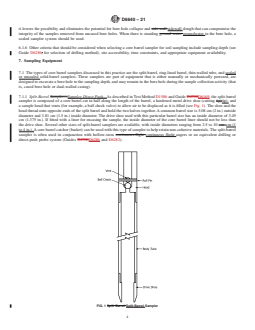
All of these materials are suitable for volatile organic com- barrel, a hardened metal drive shoe (cutting tip), and a sample
pounds as long as the contact time is minimized. Often all of head that vents (for example, a ball check valve) to allow air to
the above samples (semi-volatile organic, inorganic, and vola- be displaced as it is filled (see Fig. 1). The shoe and the head
tileorganiccompounds)areobtainedfromasinglesoilcore.In thread onto opposite ends of the split barrel and hold the two
this situation, soils should be taken from the interior of the soil halvestogether.Acommonbarrelsizeis5.08cm(2in.)outside
core to avoid potential interferences between the contaminants diameter and 3.81 cm (1.5 in.) inside diameter. The drive shoe
of concern and the surface of the core barrel that is in direct used with this particular barrel size has an inside diameter of
contact with the sample. 3.49 cm (1.375 in.). If fitted with a liner for encasing the
sample, the inside diameter of the core barrel liner should not
6.1.2 The design of the core barrel sampler should allow for
easy access to the sampled substrate for all subsequent han- be less than the drive shoe. Several other sizes of split-barrel
samplers are available, with inside diameters ranging from 2.5
dling procedures.
to 10 cm (1 to 4 in.).Acore barrel catcher (basket) can be used
6.1.3 Core barrel size requirements depend on the type and
with this type of sampler to help retain non-cohesive materials.
number of chemical constituents of concern. For example,
The split-barrel sampler is often used in conjunction with
more soil is needed for the collection of samples intended for
hollow-stem continuous flight augers or an equivalent drilling
semi-volatile organic compound analysis than for the analysis
or direct-push probe system (Guides D6286 and D6282).
of volatile organic compounds or inorganic constituents, or
7.1.2 Split-Barrel Soil Corer, Manual Push—A variant of
both.Typically, a 250-mL(8-oz) bottle is filled for the analysis
thesplit-barrelsampleristhesplit-barrelsoilcorer(seeFig.2).
ofsemi-volatileorganiccompounds,a125-mL(4-oz)bottlefor
This sampler is a short version of the split-barrel sampler that
inorganic constituents, and only 5-g subsamples are taken for
is manually pushed into the soil to collect soil surface or
volatile organic compounds.
near-surface samples (Guide D4700). Typical split-barrel soil
6.1.4 Suitability for soil type, that is, grain size, cohesion
corers are between 15.2 cm (6 in.) and 30.5 cm (12 in.) in
properties, and moisture content. For example, when sampling
length and between 2.5 cm (1 in.) and 7.6 cm (3 in.) in
non-cohesive materials or when sampling below the water
diameter. Liners may be available for the split-barrel soil corer.
table, a core catcher (basket) should be used to limit the loss of
sample and groundwater during retrieval (Guides D6169 and
D6282).
6.1.5 The spreading of contamination between sampling
depths should be minimized. Sealed hollow-barrel samplers
(7.1.5) or cased bore holes (7.1.7) and proper advancement
techniques should be used to limit cross-contamination be-
tween sampling depths in the vadose zone. To avoid cross-
contamination, open-barrel samplers (7.1.1 – 7.1.3) should not
beusedinuncasedboreholes.Althoughacasedboreholedoes
not guarantee that contamination will not be spread from one
sampling depth to another, it lowers the possibility and
eliminates the potential for bore hole collapse and sidewall
slough that can compromise the integrity of the samples
removed from uncased bore holes. When there is standing
groundwater in the bore hole, a sealed sampler system should
be used.
6.1.6 Other criteria that should be considered when select-
ing a core barrel sampler for soil sampling include sampling
depth (see Guide D6286 for selection of drilling method), site
accessibility, time constraints, and appropriate equipment
availability.
7. Sampling Equipment
7.1 The types of core barrel samplers discussed in this
practice are the split-barrel, ring-lined barrel, thin-walled tube,
and sealed or unsealed solid-barrel samplers. These samplers
are part of equipment that is either manually or mechanically
powered, are designed to excavate a bore hole to the sampling
depth, and may remain in the bore hole during the sample
collection activity (that is, cased bore hole or dual-walled
casing).
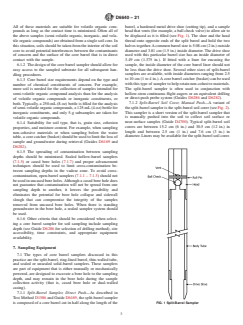
7.1.1 Split-Barrel Sampler, Direct Push—As described in
Test Method D1586 and Guide D6169, the split-barrel sampler
is composed of a core barrel cut in half along the length of the FIG. 1 Split-Barrel Sampler
D6640 − 21
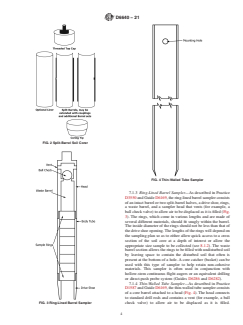
FIG. 2 Split-Barrel Soil Corer
FIG. 4 Thin-Walled Tube Sampler
7.1.3 Ring-Lined Barrel Sampler—As described in Practice
D3550andGuideD6169,thering-linedbarrelsamplerconsists
ofanintactbarrelortwosplit-barrelhalves,adriveshoe,rings,
a waste barrel, and a sampler head that vents (for example, a
ball check valve) to allow air to be displaced as it is filled (Fig.
3). The rings, which come in various lengths and are made of
several different materials, should fit snugly within the barrel.
The inside diameter of the rings should not be less than that of
the drive shoe opening.The lengths of the rings will depend on
the sampling plan so as to either allow quick access to a cross
section of the soil core at a depth of interest or allow the
appropriate size sample to be collected (see 8.1.2). The waste
barrel section allows the rings to be filled with undisturbed soil
by leaving space to contain the disturbed soil that often is
present at the bottom of a hole.Acore catcher (basket) can be
used with this type of sampler to help retain non-cohesive
materials. This sampler is often used in conjun
...
This document is not an ASTM standard and is intended only to provide the user of an ASTM standard an indication of what changes have been made to the previous version. Because
it may not be technically possible to adequately depict all changes accurately, ASTM recommends that users consult prior editions as appropriate. In all cases only the current version
of the standard as published by ASTM is to be considered the official document.
Designation: D6640 − 01 (Reapproved 2015) D6640 − 21
Standard Practice for
Collection and Handling of Soils Obtained in Core Barrel
Samplers for Environmental Investigations
This standard is issued under the fixed designation D6640; the number immediately following the designation indicates the year of
original adoption or, in the case of revision, the year of last revision. A number in parentheses indicates the year of last reapproval. A
superscript epsilon (´) indicates an editorial change since the last revision or reapproval.
1. Scope
1.1 This practice covers procedures for obtaining soils from core barrel samplers for chemical and physical analysis, with an
emphasis on the collection and handling procedures that maintain the representativeness of the chemical contaminants of concern.
Core barrel samplers are initially empty (hollow) until they are pushed into the ground to collect and retrieve a cylindrical soil
sample with minimal disturbance. The selection of equipment and the sample handling procedures are dependent on the soil
properties, the depth of sampling, and the general properties of the chemical contaminants of concern, that is, volatile organic
compounds, semi-volatile organic compounds, and inorganic constituents. The sampling procedures described are designed to
maintain representative concentrations of the contaminants regardless of their physical state(s), that is, solid, liquid, or gas.
1.2 This practice covers soil samplers used in Guide D6169 on soils and rock sampling and included in Guide D6232 for waste
sampling. Guide D6169 provides additional information on samplers and procedures that will preserve representative contaminate
concentrations. Guide D6282 is on direct-push soil samplers that are most frequently used for environmental work. Guide D4547
addresses special sampling of soils for volatile compounds. This standard does not include sediment samplers in Guide D4823, but
the same principles may apply to handling of those cores. Guide D4700 includes information on shallow manual push soil
samplers.
1.3 FourFive general types of core barrel samplers are discussed in this practice: split-barrel, soil corer, ring-lined barrel,
thin-walled tube, and solid-barrel samplers.
1.4 This document does not cover all the core barrel devices that are available for the collection of soil samples.
1.5 The procedures described may or may not be applicable to handling of samples for assessing certain geotechnical properties,
for example, soil porosity.
NOTE 1—Prior to commencement of any intrusive exploration, the site should be checked for underground utilities.
1.6 Units—The values stated in SI units are to be regarded as standard. No other units of measurement are included in this
standard. All observed and calculated values shall conform to the guidelines for significant digits and rounding established in
Practice D6026. Reporting of test results in units other than SI shall not be regarded as nonconformance with this standard.
1.7 This standard does not purport to address all of the safety concerns, if any, associated with its use. It is the responsibility
of the user of this standard to establish appropriate safety safety, health, and healthenvironmental practices and determine the
applicability of regulatory limitations prior to use.
This practice is under the jurisdiction of ASTM Committee D34 on Waste Management and is the direct responsibility of Subcommittee D34.01.03 on Sampling
Equipment.
Current edition approved Sept. 1, 2015Oct. 1, 2021. Published September 2015October 2021. Originally approved in 2001. Last previous edition approved in 20102015
as D6640 – 01 (2010).(2015). DOI: 10.1520/D6640-01R15.10.1520/D6640-21.
Copyright © ASTM International, 100 Barr Harbor Drive, PO Box C700, West Conshohocken, PA 19428-2959. United States
D6640 − 21
1.8 This international standard was developed in accordance with internationally recognized principles on standardization
established in the Decision on Principles for the Development of International Standards, Guides and Recommendations issued
by the World Trade Organization Technical Barriers to Trade (TBT) Committee.
2. Referenced Documents
2.1 ASTM Standards:
D653 Terminology Relating to Soil, Rock, and Contained Fluids
D1586 Test Method for Standard Penetration Test (SPT) and Split-Barrel Sampling of Soils
D1587 Practice for Thin-Walled Tube Sampling of Fine-Grained Soils for Geotechnical Purposes
D3550 Practice for Thick Wall, Ring-Lined, Split Barrel, Drive Sampling of Soils
D3694 Practices for Preparation of Sample Containers and for Preservation of Organic Constituents
D4547 Guide for Sampling Waste and Soils for Volatile Organic Compounds
D4687 Guide for General Planning of Waste Sampling
D4700 Guide for Soil Sampling from the Vadose Zone
D4823 Guide for Core Sampling Submerged, Unconsolidated Sediments
D5088 Practice for Decontamination of Field Equipment Used at Waste Sites
D5681 Terminology for Waste and Waste Management
D5784 Guide for Use of Hollow-Stem Augers for Geoenvironmental Exploration and the Installation of Subsurface Water
Quality Monitoring Devices
D5792 Practice for Generation of Environmental Data Related to Waste Management Activities: Development of Data Quality
Objectives
D5875 Guide for Use of Cable-Tool Drilling and Sampling Methods for Geoenvironmental Exploration and Installation of
Subsurface Water Quality Monitoring Devices
D5876 Guide for Use of Direct Rotary Wireline Casing Advancement Drilling Methods for Geoenvironmental Exploration and
Installation of Subsurface Water-Quality Monitoring Devices
D6026 Practice for Using Significant Digits and Data Records in Geotechnical Data
D6051 Guide for Composite Sampling and Field Subsampling for Environmental Waste Management Activities
D6151 Practice for Using Hollow-Stem Augers for Geotechnical Exploration and Soil Sampling
D6169 Guide for Selection of Soil and Rock Sampling Devices Used With Drill Rigs for Environmental Investigations
D6232 Guide for Selection of Sampling Equipment for Waste and Contaminated Media Data Collection Activities
D6282 Guide for Direct Push Soil Sampling for Environmental Site Characterizations
D6286 Guide for Selection of Drilling and Direct Push Methods for Geotechnical and Environmental Subsurface Site
Characterization
D8170 Guide for Using Disposable Handheld Soil Core Samplers for the Collection and Storage of Soil for Volatile Organic
Analysis
3. Terminology
3.1 Definitions:
3.1.1 For definitions of terms used in this standard, see Terminology D5681.
3.1.2 PFAS, n—per- and polyfluorinated akyl substances: a group of man-made chemicals that includes PFOA (perfluorooctanoate
acid), PFOS (perfluorooctane sulfonate), GenX, and many other chemicals.
3.1.2.1 Discussion—
PFAS include thousands of fluorinated compounds that have been manufactured and used in a variety of industries around the
globe, including in the United States, since the 1940s. PFAS are bioaccumulative and very persistent in the environment under
natural conditions due to their strong carbon-fluorine bonds. PFAS can be found in consumer products (for example, stain and
water repellants and nonstick cookware) and non-consumer products, including aqueous fire-fighting foams (AFFF) previously
used at military and commercial airports. A common PFAS is polytetrafluorethylene (PTFE), which should be excluded from use
when PFAS sampling is conducted.
4. Summary of Practice
4.1 Obtaining soil samples from the surface and subsurface for chemical and physical analysis often involves the advancement
For referenced ASTM standards, visit the ASTM website, www.astm.org, or contact ASTM Customer Service at service@astm.org. For Annual Book of ASTM Standards
volume information, refer to the standard’s Document Summary page on the ASTM website.
D6640 − 21
of a core barrel sampler into the ground. A core barrel sampler can be operated by hand or mechanically, and it may be of a closed
or open design (Guide(Guides D6169 and D6282). Once the core barrel has been filled, the sampler is recovered from the bore
hole and the soil sample is handled appropriately for the chemical constituents of concern.
4.2 This practice describes collection and handling procedures used with four types of core barrel samplers. The standards related
to data quality objectives (Practice D5792), equipment specifications (Guides D6286, D6232, D6169, D4700and , and
D4700D4823), their limitations and advantages (Guide(Guides D6282 and D6232), and the site-specific geological and
hydrological data should be reviewed to determine the soil coring equipment that is best suited for a specific project.
5. Significance and Use
5.1 Often during environmental investigations, soils are analyzed after being collected from the surface, the vadose zone
(Terminology D653)), and sometimes from below the ground water groundwater table to identify and quantify the presence of a
chemical contaminant. A contaminant is a substance that is typically hazardous and either is not normally present or that occurs
naturally but is of an uncharacteristically high concentration (Guide D4687). A three-dimensional spatial array of samples can often
provide information as to the source and route(s) of migration of the contaminant. The resultant information is used to direct
remedial and corrective actions or can be used for monitoring purposes. Obtaining a soil sample with a core barrel sampler involves
driving this device into the ground and then retrieving it for sample processing. Several methods for advancing a core barrel are
generally acceptable (for example, Test Method D1586, Practice; Practices D1587, Practice D3550, Guideand D4700D6151,
Guide; Guides D5784, Guide D5875, Guide D5876, Practice D6151D6169, Guideand D6282, and Guide D6286). Drilling methods
that use drilling fluids (liquids or air) should be avoided because they are more susceptible to cross-contamination (See(Guide
D6286) (see 5.1.66.1.6).
5.2 If samples are to be collected for the determination of per- and poly-fluorinated alkyl substances (PFAS), all sampling
equipment should be made of fluorine-free materials. Other considerations for PFAS sampling may exist but are beyond the scope
of this standard.
6. Equipment Selection Criteria
6.1 Important criteria to consider when selecting a core barrel sampler for soil sampling are:
6.1.1 The materials that come into direct contact with the soil sample (barrel or barrel liner) should be compatible with the
chemical or physical properties of the contaminant(s) of concern and the chemical properties of the soil. As a general rule, samples
obtained for semi-volatile organic compound analysis can be obtained within a core barrel or core barrel liner that is composed
of stainless steel, steel, or brass. When only inorganic constituents are of concern, a plastic core barrel liner would be more
appropriate than the previously cited materials. All of these materials are suitable for volatile organic compounds as long as the
contact time is minimized. Often all of the above samples (semi-volatile organic, inorganic, and volatile organic compounds) are
obtained from a single soil core. In this situation, soils should be taken from the interior of the soil core to avoid potential
interferences between the contaminants of concern and the surface of the core barrel that is in direct contact with the sample.
6.1.2 The design of the core barrel sampler should allow for easy access to the sampled substrate for all subsequent handling
procedures.
6.1.3 Core barrel size requirements depend on the type and number of chemical constituents of concern. For example, more soil
is needed for the collection of samples intended for semi-volatile organic compound analysis than for the analysis of volatile
organic compounds or inorganic constituents, or both. Typically, a 250-mL (8-oz) bottle is filled for the analysis of semi-volatile
organic compounds, a 125-mL (4-oz) bottle for inorganic constituents, and only 5-g subsamples are taken for volatile organic
compounds.
6.1.4 Suitability for soil type, that is, grain size, cohesion properties, and moisture content. For example, when sampling
non-cohesive materials or when sampling below the water table, a core catcher (basket) should be used to limit the loss of sample
and ground water groundwater during retrieval (Guides D4700D6169 and D6282).
6.1.5 The spreading of contamination between sampling depths should be minimized. Sealed hollow-barrel samplers (6.1.47.1.5)
or cased bore holes (7.1.7) and proper advancement techniques should be used to limit cross-contamination between sampling
depths in the vadose zone. To avoid cross-contamination, open-barrel samplers (7.1.1 – 7.1.3) should not be used in uncased bore
holes. Although a cased bore hole does not guarantee that contamination will not be spread from one sampling depth to another,
D6640 − 21
it lowers the possibility and eliminates the potential for bore hole collapse and side wall sidewall slough that can compromise the
integrity of the samples removed from uncased bore holes. When there is standing ground water groundwater in the bore hole, a
sealed sampler system should be used.
6.1.6 Other criteria that should be considered when selecting a core barrel sampler for soil sampling include sampling depth (see
Guide D6286, for selection of drilling method), site accessibility, time constraints, and appropriate equipment availability.
7. Sampling Equipment
7.1 The types of core barrel samplers discussed in this practice are the split-barrel, ring-lined barrel, thin-walled tube, and sealed
or unsealed solid-barrel samplers. These samplers are part of equipment that is either manually or mechanically powered, are
designed to excavate a bore hole to the sampling depth, and may remain in the bore hole during the sample collection activity (that
is, cased bore hole or dual-walled casing).
7.1.1 Split-Barrel Sampler—Sampler, Direct Push—As described in Test Method D1586 and Guide D4700D6169, the split-barrel
sampler is composed of a core barrel cut in half along the length of the barrel, a hardened metal drive shoe (cutting tip)tip), and
a sample head that vents (for example, a ball check valve) to allow air to be displaced as it is filled (see Fig. 1). The shoe and the
head thread onto opposite ends of the split barrel and hold the two halves together. A common barrel size is 5.08 cm (2 in.) outside
diameter and 3.81 cm (1.5 in.) inside diameter. The drive shoe used with this particular barrel size has an inside diameter of 3.49
cm (1.375 in.). If fitted with a liner for encasing the sample, the inside diameter of the core barrel liner should not be less than
the drive shoe. Several other sizes of split-barrel samplers are available, with inside diameters ranging from 2.5 to 10 cm. cm (1
to 4 in.). A core barrel catcher (basket) can be used with this type of sampler to help retain non-cohesive materials. The split-barrel
sampler is often used in conjunction with hollow-stem continuous-flight continuous flight augers or an equivalent drilling or
direct-push probe system (Guides D4700D6286 and D6282).
FIG. 1 Split Barrel Split-Barrel Sampler
D6640 − 21
7.1.2 Split-Barrel Soil Corer, Manual Push—A variant of the split-barrel sampler is the split-barrel soil corer (see Fig. 2). This
sampler is a short version of the split-barrel sampler that is manually pushed into the soil to collect soil surface or near-surface
samples (Guide D4700). Typical split-barrel soil corers are between 15.2 cm (6 in.) and 30.5 cm (12 in.) in length and between
2.5 cm (1 in.) and 7.6 cm (3 in.) in diameter. Liners may be available for the split-barrel soil corer.
7.1.3 Ring-Lined Barrel Sampler—As described in Practice D3550 and Guide D4700D6169, the ring-lined barrel sampler consists
of an intact barrel or two split-barrel halves, a drive shoe, rings, a waste barrel, and a sampler head that vents (for example, a ball
check valve) to allow air to be displaced as it is filled (Fig. 23). The rings, which come in various lengths and are made of several
different materials, should fit snugly within the barrel. The inside diameter of the rings should not be less than that of the drive
shoe opening. The lengths of the rings will depend on the sampling plan so as to either allow quick access to a cross section of
the soil core at a depth of interest or allow the appropriate size sample to be collected (see 8.1.2). The waste barrel section allows
the rings to be filled with undisturbed soil by leaving space to contain the disturbed soil that often is present at the bottom of a
hole. A core catcher (basket) can be used with this type of sampler to help retain non-cohesive materials. This sampler is often used
in conjunction with hollow-stem continuous flight augers,augers or an equivalent drilling or direct-push probe system (Guides
D4700D6286 and D6282).
7.1.4 Thin-Walled Tube Sampler—As desc
...