

ASTM C1471/C1471M-22
(Guide)Standard Guide for the Use of High Solids Content Cold Liquid-Applied Elastomeric Waterproofing Membrane on Vertical Surfaces
General Information
- Abstract
ABSTRACT
This guide describes the use of a high solids content, cold liquid-applied elastomeric waterproofing membrane subject to intermittent hydrostatic pressure in a waterproofing system intended for installation on cast-in-place concrete vertical surfaces. Typical uses for these systems include planters and foundation walls with drainage system and others. The major components to be considered for a below grade building wall waterproofing system are the structural wall or substrate to be waterproofed, waterproofing membrane, membrane protection, and drainage system. The following considerations are detailed: (1) compatibility; (2) continuity; (3) substrate: strength, density and moisture content, admixtures, release and curing agents, finish, dryness, and joints; (4) waterproofing membrane: adhesion to substrate, terminations, and penetrations; (5) treatment and design of reinforced, unreinforced, and expansion joints; (6) protection course: impact resistance, compatibility, ancillary provisions, thermal insulation, and drainage composites; and (7) drainage system: drainage course, backfill, and drainage pipes. Illustrations of footing, treatment of vertical corners, and pipe penetration for the waterproofing system and treatment of reinforced and unreinforced joints are given.
SCOPE
1.1 This guide describes the use of a high solids content, cold liquid-applied elastomeric waterproofing membrane that meets the performance criteria specified in Specification C836/C836M, subject to intermittent hydrostatic pressure in a waterproofing system intended for installation on vertical cast-in-place concrete surfaces.
1.2 The values stated in either SI units or inch-pound units are to be regarded separately as standard. The values stated in each system may not be exact equivalents; therefore, each system shall be used independently of the other. Combining values from the two systems may result in nonconformance with the standard.
1.3 This standard does not purport to address all of the safety concerns, if any, associated with its use. It is the responsibility of the user of this standard to establish appropriate safety, health, and environmental practices and determine the applicability of regulatory limitations prior to use.
1.4 This international standard was developed in accordance with internationally recognized principles on standardization established in the Decision on Principles for the Development of International Standards, Guides and Recommendations issued by the World Trade Organization Technical Barriers to Trade (TBT) Committee.
- Status
- Published
- Publication Date
- 30-Apr-2022
- Technical Committee
- D08 - Roofing and Waterproofing
- Drafting Committee
- D08.22 - Waterproofing and Dampproofing Systems
Buy Documents
ASTM C1471/C1471M-22 - Standard Guide for the Use of High Solids Content Cold Liquid-Applied Elastomeric Waterproofing Membrane on Vertical Surfaces
REDLINE ASTM C1471/C1471M-22 - Standard Guide for the Use of High Solids Content Cold Liquid-Applied Elastomeric Waterproofing Membrane on Vertical Surfaces
Overview
ASTM C1471/C1471M-22 is the Standard Guide for the Use of High Solids Content Cold Liquid-Applied Elastomeric Waterproofing Membrane on Vertical Surfaces. Developed by ASTM International, this guide outlines best practices for the design and installation of high solids, cold liquid-applied elastomeric waterproofing membranes-specifically for vertical, cast-in-place concrete surfaces subjected to intermittent hydrostatic pressure. Typical applications include foundation walls, planters, and other below-grade building elements that require durable, continuous waterproofing coupled with effective drainage.
Utilizing high solids elastomeric membranes delivers reliable waterproofing performance, providing flexibility, strong adhesion, and continuous coverage over complex geometries and building details. This guide emphasizes key system elements including the substrate, membrane, protection course, and drainage system, ensuring waterproofing integrity and long-term durability.
Key Topics
- System Compatibility and Continuity: The guide stresses compatibility among all components-membrane, protection layer, and drainage-forming an integrated, continuous waterproofing solution. Special care is directed at terminations, corners, transitions, and interfaces with other waterproofing systems to prevent water ingress.
- Substrate Requirements: Offers guidelines for substrate strength, density, moisture content, finish, and preparation. Proper substrate preparation is vital for membrane adhesion and to avoid defects such as voids or thin spots.
- Waterproofing Membrane Application: Describes best practices for application, including recommended methods (brush, roller, spray), mixing procedures, and the importance of achieving minimum dry film thickness. Use of primers, coverage rates, and inspection for defects are highlighted.
- Treatment of Joints and Penetrations: Details approaches for reinforced, unreinforced, and expansion joints, as well as managing penetrations like utility pipes. These are crucial to maintaining membrane continuity and accommodating structural movement.
- Protection Course: Guidance on selecting impact-resistant, compatible materials to shield the membrane during backfilling and from construction stresses. Insulation and drainage composite options are discussed.
- Drainage System Design: Recommends installation of a drainage course and perimeter drainage pipes to minimize hydrostatic pressure and channel water away from the foundation. Emphasis is placed on proper backfill material and filter fabric to prevent silt clogging.
Applications
ASTM C1471/C1471M-22 is primarily intended for waterproofing vertical concrete surfaces in construction projects where below-grade moisture protection is essential. Practical applications include:
- Foundation walls in residential and commercial buildings
- Basement walls where water ingress must be prevented
- Exterior planters built of cast-in-place concrete
- Retaining walls and other below-grade concrete structures
Industries using this standard benefit from enhanced durability, improved building envelope performance, and reduced risk of water damage or structural deterioration. When installed according to this guide, liquid-applied elastomeric membranes create resilient barriers against water penetration and hydrostatic pressure, contributing to the longevity of the structure.
Related Standards
This standard should be used in conjunction with other ASTM standards for a comprehensive approach to waterproofing. Key related standards include:
- ASTM C836/C836M: Specification for High Solids Content, Cold Liquid-Applied Elastomeric Waterproofing Membrane
- ASTM C898/C898M: Guide for Use of High Solids Content Cold Liquid-Applied Elastomeric Waterproofing Membrane with Separate Wearing Course
- ASTM D6451/D6451M: Guide for Application of Asphalt-Based Protection Board
- ASTM D6506/D6506M: Specification for Asphalt Based Protection Board for Below-Grade Waterproofing
- ASTM D7492/D7492M: Guide for Use of Drainage System Media with Waterproofing Systems
- ASTM C117: Test Method for Materials Finer than 75-μm (No. 200) Sieve in Mineral Aggregates by Washing
- ASTM D4263: Test Method for Indicating Moisture in Concrete by the Plastic Sheet Method
- ASTM C717: Terminology of Building Seals and Sealants
Adherence to ASTM C1471/C1471M-22 ensures effective, long-lasting waterproofing for vertical concrete surfaces, optimizing building performance and mitigating moisture-related risks.
Relations
- Effective Date
- 01-Apr-2024
- Effective Date
- 01-Jan-2024
- Effective Date
- 15-Nov-2023
- Effective Date
- 01-Mar-2019
- Effective Date
- 01-Aug-2018
- Effective Date
- 01-Mar-2018
- Effective Date
- 01-Jan-2018
- Effective Date
- 01-Dec-2017
- Effective Date
- 01-Nov-2017
- Effective Date
- 01-Jan-2017
- Effective Date
- 15-Nov-2016
- Effective Date
- 01-Sep-2016
- Refers
ASTM D7492/D7492M-16 - Standard Guide for Use of Drainage System Media with Waterproofing Systems - Effective Date
- 01-Feb-2016
- Effective Date
- 01-Jun-2015
- Effective Date
- 01-May-2014
Buy Documents
ASTM C1471/C1471M-22 - Standard Guide for the Use of High Solids Content Cold Liquid-Applied Elastomeric Waterproofing Membrane on Vertical Surfaces
REDLINE ASTM C1471/C1471M-22 - Standard Guide for the Use of High Solids Content Cold Liquid-Applied Elastomeric Waterproofing Membrane on Vertical Surfaces
Get Certified
Connect with accredited certification bodies for this standard

DIBt (Deutsches Institut für Bautechnik)
German Institute for Building Technology.
DIN CERTCO
DIN Group product certification.

Aboma Certification B.V.
Specialized in construction, metal, and transport sectors.
Sponsored listings
Frequently Asked Questions
ASTM C1471/C1471M-22 is a guide published by ASTM International. Its full title is "Standard Guide for the Use of High Solids Content Cold Liquid-Applied Elastomeric Waterproofing Membrane on Vertical Surfaces". This standard covers: ABSTRACT This guide describes the use of a high solids content, cold liquid-applied elastomeric waterproofing membrane subject to intermittent hydrostatic pressure in a waterproofing system intended for installation on cast-in-place concrete vertical surfaces. Typical uses for these systems include planters and foundation walls with drainage system and others. The major components to be considered for a below grade building wall waterproofing system are the structural wall or substrate to be waterproofed, waterproofing membrane, membrane protection, and drainage system. The following considerations are detailed: (1) compatibility; (2) continuity; (3) substrate: strength, density and moisture content, admixtures, release and curing agents, finish, dryness, and joints; (4) waterproofing membrane: adhesion to substrate, terminations, and penetrations; (5) treatment and design of reinforced, unreinforced, and expansion joints; (6) protection course: impact resistance, compatibility, ancillary provisions, thermal insulation, and drainage composites; and (7) drainage system: drainage course, backfill, and drainage pipes. Illustrations of footing, treatment of vertical corners, and pipe penetration for the waterproofing system and treatment of reinforced and unreinforced joints are given. SCOPE 1.1 This guide describes the use of a high solids content, cold liquid-applied elastomeric waterproofing membrane that meets the performance criteria specified in Specification C836/C836M, subject to intermittent hydrostatic pressure in a waterproofing system intended for installation on vertical cast-in-place concrete surfaces. 1.2 The values stated in either SI units or inch-pound units are to be regarded separately as standard. The values stated in each system may not be exact equivalents; therefore, each system shall be used independently of the other. Combining values from the two systems may result in nonconformance with the standard. 1.3 This standard does not purport to address all of the safety concerns, if any, associated with its use. It is the responsibility of the user of this standard to establish appropriate safety, health, and environmental practices and determine the applicability of regulatory limitations prior to use. 1.4 This international standard was developed in accordance with internationally recognized principles on standardization established in the Decision on Principles for the Development of International Standards, Guides and Recommendations issued by the World Trade Organization Technical Barriers to Trade (TBT) Committee.
ABSTRACT This guide describes the use of a high solids content, cold liquid-applied elastomeric waterproofing membrane subject to intermittent hydrostatic pressure in a waterproofing system intended for installation on cast-in-place concrete vertical surfaces. Typical uses for these systems include planters and foundation walls with drainage system and others. The major components to be considered for a below grade building wall waterproofing system are the structural wall or substrate to be waterproofed, waterproofing membrane, membrane protection, and drainage system. The following considerations are detailed: (1) compatibility; (2) continuity; (3) substrate: strength, density and moisture content, admixtures, release and curing agents, finish, dryness, and joints; (4) waterproofing membrane: adhesion to substrate, terminations, and penetrations; (5) treatment and design of reinforced, unreinforced, and expansion joints; (6) protection course: impact resistance, compatibility, ancillary provisions, thermal insulation, and drainage composites; and (7) drainage system: drainage course, backfill, and drainage pipes. Illustrations of footing, treatment of vertical corners, and pipe penetration for the waterproofing system and treatment of reinforced and unreinforced joints are given. SCOPE 1.1 This guide describes the use of a high solids content, cold liquid-applied elastomeric waterproofing membrane that meets the performance criteria specified in Specification C836/C836M, subject to intermittent hydrostatic pressure in a waterproofing system intended for installation on vertical cast-in-place concrete surfaces. 1.2 The values stated in either SI units or inch-pound units are to be regarded separately as standard. The values stated in each system may not be exact equivalents; therefore, each system shall be used independently of the other. Combining values from the two systems may result in nonconformance with the standard. 1.3 This standard does not purport to address all of the safety concerns, if any, associated with its use. It is the responsibility of the user of this standard to establish appropriate safety, health, and environmental practices and determine the applicability of regulatory limitations prior to use. 1.4 This international standard was developed in accordance with internationally recognized principles on standardization established in the Decision on Principles for the Development of International Standards, Guides and Recommendations issued by the World Trade Organization Technical Barriers to Trade (TBT) Committee.
ASTM C1471/C1471M-22 is classified under the following ICS (International Classification for Standards) categories: 91.120.30 - Waterproofing. The ICS classification helps identify the subject area and facilitates finding related standards.
ASTM C1471/C1471M-22 has the following relationships with other standards: It is inter standard links to ASTM C898/C898M-09(2024), ASTM D7492/D7492M-16a(2024), ASTM C117-23, ASTM C717-19, ASTM D4263-83(2018), ASTM C717-18, ASTM D6506/D6506M-01(2018)e1, ASTM C898/C898M-09(2017), ASTM C717-17a, ASTM C717-17, ASTM C717-16a, ASTM C717-16, ASTM D7492/D7492M-16, ASTM C836/C836M-15, ASTM C717-14a. Understanding these relationships helps ensure you are using the most current and applicable version of the standard.
ASTM C1471/C1471M-22 is available in PDF format for immediate download after purchase. The document can be added to your cart and obtained through the secure checkout process. Digital delivery ensures instant access to the complete standard document.
Standards Content (Sample)
This international standard was developed in accordance with internationally recognized principles on standardization established in the Decision on Principles for the
Development of International Standards, Guides and Recommendations issued by the World Trade Organization Technical Barriers to Trade (TBT) Committee.
Designation:C1471/C1471M −22
Standard Guide for the
Use of High Solids Content Cold Liquid-Applied Elastomeric
Waterproofing Membrane on Vertical Surfaces
This standard is issued under the fixed designation C1471/C1471M; the number immediately following the designation indicates the
year of original adoption or, in the case of revision, the year of last revision. A number in parentheses indicates the year of last
reapproval. A superscript epsilon (´) indicates an editorial change since the last revision or reapproval.
1. Scope Use with Separate Wearing Course
C898/C898M Guide for Use of High Solids Content, Cold
1.1 This guide describes the use of a high solids content,
Liquid-Applied Elastomeric Waterproofing Membrane
cold liquid-applied elastomeric waterproofing membrane that
with Separate Wearing Course
meets the performance criteria specified in Specification C836/
D4263 Test Method for Indicating Moisture in Concrete by
C836M, subject to intermittent hydrostatic pressure in a
the Plastic Sheet Method
waterproofing system intended for installation on vertical
D6451/D6451M Guide for Application of Asphalt-Based
cast-in-place concrete surfaces.
Protection Board
1.2 The values stated in either SI units or inch-pound units
D6506/D6506M Specification for Asphalt Based Protection
are to be regarded separately as standard. The values stated in
Board for Below-Grade Waterproofing
each system may not be exact equivalents; therefore, each
D7492/D7492M Guide for Use of Drainage System Media
system shall be used independently of the other. Combining
with Waterproofing Systems
values from the two systems may result in nonconformance
with the standard.
3. Terminology
1.3 This standard does not purport to address all of the
3.1 Definitions—Refer to Terminology C717 for definitions
safety concerns, if any, associated with its use. It is the
of terms used in this standard.
responsibility of the user of this standard to establish appro-
3.2 Definitions of Terms Specific to This Standard:
priate safety, health, and environmental practices and deter-
mine the applicability of regulatory limitations prior to use. 3.2.1 drainage composite—geocomposite consisting of a
1.4 This international standard was developed in accor- geotextile filter fabric and a drainage core of various thick-
dance with internationally recognized principles on standard- nesses and shapes.
ization established in the Decision on Principles for the
Development of International Standards, Guides and Recom-
4. Significance and Use
mendations issued by the World Trade Organization Technical
4.1 This grade provides considerations for the design and
Barriers to Trade (TBT) Committee.
installation of liquid-applied waterproofing systems.The intent
is to provide information and guidelines for consideration by
2. Referenced Documents
designers. Typical uses for these systems include, among
2.1 ASTM Standards:
others, planters and foundation walls with drainage systems.
C117 Test Method for Materials Finer than 75-µm (No. 200)
4.2 This guide is intended to be considered in conjunction
Sieve in Mineral Aggregates by Washing
with Guide C898/C898M to provide total system guidelines.
C717 Terminology of Building Seals and Sealants
C836/C836M Specification for High Solids Content, Cold
5. General
Liquid-Applied Elastomeric Waterproofing Membrane for
5.1 General—The major components to be considered for a
below-grade building wall waterproofing system are the struc-
This guide is under the jurisdiction of ASTM Committee D08 on Roofing and
tural wall or substrate to be waterproofed, waterproofing
Waterproofing and is the direct responsibility of Subcommittee D08.22 on Water-
proofing and Dampproofing Systems. membrane, membrane protection, drainage, and backfill. Ad-
Current edition approved May 1, 2022. Published May 2022. Originally
ditional components to be considered are membrane
approved in 2000. Last previous edition approved in 2021 as C1471/C1471M – 05
terminations, penetrations, joints, and thermal insulation.
(2021). DOI: 10.1520/C1471_C1471M-22.
For referenced ASTM standards, visit the ASTM website, www.astm.org, or
5.2 Compatibility—It is essential that all components and
contact ASTM Customer Service at service@astm.org. For Annual Book of ASTM
contiguous elements be compatible, and that they be coordi-
Standards volume information, refer to the standard’s Document Summary page on
the ASTM website. nated to form an integrated waterproofing system.
Copyright © ASTM International, 100 Barr Harbor Drive, PO Box C700, West Conshohocken, PA 19428-2959. United States
C1471/C1471M−22
5.3 Continuity—It is essential that the waterproofing irregularities. A minimum width of 200 mm, with 300 mm
membrane, including all joints and transitions, is continuous. preferred, should be available on the footing to effectively
Special attention must be paid to changes in plane, transitions
terminate the waterproofing membrane. The top of the footing
from one substrate to another, terminations, and abutting should be sloped away from the wall.
waterproofing systems. Expansion and control joints in abut-
6.7 Dryness—Membrane manufacturers’ requirements for
ting vertical and horizontal surfaces must maintain the conti-
substrate dryness vary and can include being visibly dry,
nuity of the system. It is recommended that, during system
passing a 4-h glass test, passing Test Method D4263 with no
development and documentation, isometric drawings be made
condensate, or having a specific maximum moisture content as
of three-dimensional connections and transitions.
measured by a moisture meter. Refer to and meet the manu-
facturer’s requirements for the particular membrane being
6. Substrate
applied. It is recommended that the membrane not be applied
6.1 General—The building wall substrate referred to in this
sooner than 28 days after concrete placement.
guide is reinforced, cast-in-place concrete.
6.8 Joints—Joints in structural concrete walls are referred to
6.2 Strength—The strength of concrete is a factor to be
in this guide as reinforced joints, unreinforced joints, and
considered with respect to liquid-applied membranes so far as
expansion joints.
it relates to surface finish, bond strength, and continuing
integrity (absence of cracks and other concrete defects that 6.8.1 Reinforced Joints—Reinforced joints consist of hair-
line cracks, cold joints, construction joints, or control joints
could affect the integrity of the membrane).
held together with steel reinforcing bars or wire fabric. These
6.3 Density and Moisture Content—The density and mois-
are considered static joints with little or no anticipated move-
ture content of concrete when cured are interrelated. Exces-
ment because the reinforcement is continuous across the joint.
sively high moisture content can affect adhesion of the mem-
6.8.2 Unreinforced Joints—Unreinforced joints consist of
brane to a substrate, as moisture may condense at the
butted construction joints and isolation joints not held together
membrane-to-concrete interface and cause membrane delami-
with steel reinforcing bars or wire fabric. These joints are
nation. Lower moisture contents are achieved with the use of
generally considered as non-moving or static joints. However,
hard, dense stone aggregate. This type of coarse aggregate will
they should be considered as capable of some movement, the
generally provide structural concrete with moisture content
magnitude of which is difficult to predict.
from 3 to 5 % when cured. The concrete substrate should have
3 3
a minimum density of 2100 kg/m [130 lb/ft ] and a maximum
6.8.3 Expansion Joints—Expansion joints are designed to
moisture content of 8 % when cured.
accommodate a predetermined amount of movement. Such
movement can be due to thermal change, shrinkage, creep,
6.4 Admixtures—Polymeric, latex, or other organic chemi-
deflection, or other factors. In detailing watertight expansion
cal based admixtures or modifiers can coat the concrete
joints, the amount of movement must be determined using a
particles and reduce the adhesion of the membrane to the
reasonable factor of safety since accurate prediction of the
substrate. If the concrete substrate will contain any admixtures,
magnitude of movement is difficult. The size and configuration
the membrane manufacturer should be consulted and should
of the joint should then be related to the capability of the
approve the use of the membrane with the specific proposed
membrane and joint seal materials to accommodate the antici-
admixtures.
pated movement.
6.5 Release and Curing Agents—Form release agents and
formoilsareoftenusedtofacilitatetheremovaloftheconcrete
7. Waterproofing Membrane
form work, and curing agents are sometimes applied to the
green (uncured) concrete surface. These chemicals can reduce 7.1 General—Application of the membrane may be by
the adhesion of the membrane to the concrete, and their use
brush, trowel, roller, or spray equipment, or combinations
should be coordinated with and be accepted by the membrane thereof, depending on the manufacturer’s recommended or
manufacturer. Form oils should not be used on areas to receive
required procedures and the job site conditions. A two-coat
waterproofing. If form oils were used, sandblasting or other
application is preferable to a single-coat application, because it
approved methods must be used to remove the form oils prior
providessomeredundancyanditiseasiertomeetorexceedthe
to waterproofing application.
minimum required membrane thickness. It also reduces the
tendencyformembranematerialtoslideorsag,andpinholesin
6.6 Finish—The structural wall should have a smooth form
the first coat can be covered by the second coat.
finish. The surface should provide a mechanical bond for the
7.1.1 One-part membrane materials should be stirred thor-
membrane but not be so rough as to preclude achieving
oughly prior to application With two-part materials, stir each
continuity of the membrane and the specified membrane
thickness across its surface. All fins, projections, tie rod holes, component separately before combining. Thoroughly mix the
two components together so the curing agent is uniformly
and honeycomb must be repaired. The removal of fins and
similar projections is especially critical, because they cause dispersed in the base component, ensuring even curing of the
membrane. Mixing should be at a slow speed, 80 to 150 rpm,
thin spots in the membrane that are easily punctured. The
concrete surface at the top of the wall and at the footing should to avoid entrapping air in the material.The bottom and sides of
the container should be scraped with a square-edged spatula
be of the same quality as the face of the wall. The footing
should be troweled smooth and be free of fins, burrs, and large during mixing.
C1471/C1471M−22
7.1.2 Some materials require the use of a primer on some is applied. Excessive moisture in the substrate or moisture on
substrates. Review the manufacturer’s requirements and use the surface from frost, rain, or condensation may cause an
the recommended primer where necessary. improper cure, formation of gas pockets, or little or no
2 2
7.1.3 A coverage rate of 1.5 L/m [4 gal/100 ft ] of surface adhesion to the substrate. Should rain or snow interrupt the
area on a smooth substrate yields a dry-film thickness of 1.5 6 application after at least one coat of material has been applied,
0.1 mm [60 6 5 mils] using materials that are 100 % solids. the manufacturer’s instructions should be followed pertaining
Theproductsdescribedbythisguidearemarketedbyanumber to treatment of the cured material prior to continuing applica-
of manufacturers and may have different minimum required tion.
membrane thicknesses. This guide is predicated upon a mini-
7.3 Terminations—The waterproofing system should termi-
mum dry-film thickness of 1.5 6 0.1 mm. When the solids
nate a minimum of 150 mm [6 in.] above the finish grade or
content of the waterproofing membrane is less than 100 %, the
brick ledge. Where a concrete wall is to be exposed above
coverage rate required to achieve a 1.5 mm dry-film thickness
grade, the waterproofing may be terminated no more than
is calculated by the following formula:
50 mm [2 in.] below grade. It should be recognized that the
1.5 L/m
area above the termination is vulnerable to water penetration
5 L/m (1)
% solids by volume ~expressed as a decimal!
through cracks or joints and these areas must be addressed.
7.3.1 The waterproofing system should terminate a mini-
The manufacturer’s data sheets should be consulted for the
mum of 300 mm [12 in.] below the lower floor line or on top
yield of the proposed product.
of the footing a minimum of 150 mm [6 in.] out from the wall
7.1.4 The application thickness should be monitored closely
face. The system should never be terminated above the
to ensure that the membrane is applied at the specified wet-film
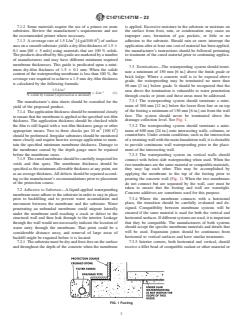
drainage collection level. See Fig. 1.
thickness. The application thickness should be checked while
7.3.2 The waterproofing system should terminate a mini-
the film is still liquid with a wet-film thickness gauge or other
2 2
mum of 600 mm [24 in.] onto intersecting walls, columns, or
appropriate means. Two to three checks per 10 m [100 ft ]
counterforts. Under ce
...
This document is not an ASTM standard and is intended only to provide the user of an ASTM standard an indication of what changes have been made to the previous version. Because
it may not be technically possible to adequately depict all changes accurately, ASTM recommends that users consult prior editions as appropriate. In all cases only the current version
of the standard as published by ASTM is to be considered the official document.
Designation: C1471/C1471M − 05 (Reapproved 2021) C1471/C1471M − 22
Standard Guide for the
Use of High Solids Content Cold Liquid-Applied Elastomeric
Waterproofing Membrane on Vertical Surfaces
This standard is issued under the fixed designation C1471/C1471M; the number immediately following the designation indicates the
year of original adoption or, in the case of revision, the year of last revision. A number in parentheses indicates the year of last
reapproval. A superscript epsilon (´) indicates an editorial change since the last revision or reapproval.
1. Scope
1.1 This guide describes the use of a high solids content, cold liquid-applied elastomeric waterproofing membrane that meets the
performance criteria specified in Specification C836/C836M, subject to intermittent hydrostatic pressure in a waterproofing system
intended for installation on vertical cast-in-place concrete surfaces.
1.2 The committee with jurisdiction over this standard is not aware of any comparable standards published by other organizations.
1.2 The values stated in either SI units or inch-pound units are to be regarded separately as standard. The values stated in each
system may not be exact equivalents; therefore, each system shall be used independently of the other. Combining values from the
two systems may result in nonconformance with the standard.
1.3 This standard does not purport to address all of the safety concerns, if any, associated with its use. It is the responsibility
of the user of this standard to establish appropriate safety, health, and environmental practices and determine the applicability of
regulatory limitations prior to use.
1.4 This international standard was developed in accordance with internationally recognized principles on standardization
established in the Decision on Principles for the Development of International Standards, Guides and Recommendations issued
by the World Trade Organization Technical Barriers to Trade (TBT) Committee.
2. Referenced Documents
2.1 ASTM Standards:
C117 Test Method for Materials Finer than 75-μm (No. 200) Sieve in Mineral Aggregates by Washing
C717 Terminology of Building Seals and Sealants
C836/C836M Specification for High Solids Content, Cold Liquid-Applied Elastomeric Waterproofing Membrane for Use with
Separate Wearing Course
C898/C898M Guide for Use of High Solids Content, Cold Liquid-Applied Elastomeric Waterproofing Membrane with Separate
Wearing Course
D4263 Test Method for Indicating Moisture in Concrete by the Plastic Sheet Method
D6451/D6451M Guide for Application of Asphalt-Based Protection Board
D6506/D6506M Specification for Asphalt Based Protection Board for Below-Grade Waterproofing
D7492/D7492M Guide for Use of Drainage System Media with Waterproofing Systems
This guide is under the jurisdiction of ASTM Committee D08 on Roofing and Waterproofing and is the direct responsibility of Subcommittee D08.22 on Waterproofing
and Dampproofing Systems.
Current edition approved Dec. 1, 2021May 1, 2022. Published December 2021May 2022. Originally approved in 2000. Last previous edition approved in 20142021 as
ɛ1
C1471/C1471M – 05 (2014)(2021). . DOI: 10.1520/C1471_C1471M-05R21.10.1520/C1471_C1471M-22.
For referenced ASTM standards, visit the ASTM website, www.astm.org, or contact ASTM Customer Service at service@astm.org. For Annual Book of ASTM Standards
volume information, refer to the standard’s Document Summary page on the ASTM website.
Copyright © ASTM International, 100 Barr Harbor Drive, PO Box C700, West Conshohocken, PA 19428-2959. United States
C1471/C1471M − 22
3. Terminology
3.1 Definitions—Refer to Terminology C717 for definitions of terms used in this standard.
3.2 Definitions of Terms Specific to This Standard:
3.2.1 drainage composite—geocomposite consisting of a geotextile filter fabric and a drainage core of various thicknesses and
shapes.
4. Significance and Use
4.1 This grade provides considerations for the design and installation of liquid-applied waterproofing systems. The intent is to
provide information and guidelines for consideration by designers. Typical uses for these systems include, among others, planters
and foundation walls with drainage systems.
4.2 This guide is intended to be considered in conjunction with Guide C898/C898M to provide total system guidelines.
5. Comparison to Other Standards
5.1 The committee with jurisdiction over this standard is not aware of any comparable standards published by other organizations.
5. General
5.1 General—The major components to be considered for a below-grade building wall waterproofing system are the structural wall
or substrate to be waterproofed, waterproofing membrane, membrane protection, drainage, and backfill. Additional components to
be considered are membrane terminations, penetrations, joints, and thermal insulation.
5.2 Compatibility—It is essential that all components and contiguous elements be compatible, and that they be coordinated to form
an integrated waterproofing system.
5.3 Continuity—It is essential that the waterproofing membrane, including all joints and transitions, is continuous. Special
attention must be paid to changes in plane, transitions from one substrate to another, terminations, and abutting waterproofing
systems. Expansion and control joints in abutting vertical and horizontal surfaces must maintain the continuity of the system. It
is recommended that, during system development and documentation, isometric drawings be made of three-dimensional
connections and transitions.
6. Substrate
6.1 General—The building wall substrate referred to in this guide is reinforced, cast-in-place concrete.
6.2 Strength—The strength of concrete is a factor to be considered with respect to liquid-applied membranes so far as it relates
to surface finish, bond strength, and continuing integrity (absence of cracks and other concrete defects that could affect the integrity
of the membrane).
6.3 Density and Moisture Content—The density and moisture content of concrete when cured are interrelated. Excessively high
moisture content can affect adhesion of the membrane to a substrate, as moisture may condense at the membrane-to-concrete
interface and cause membrane delamination. Lower moisture contents are achieved with the use of hard, dense stone aggregate.
This type of coarse aggregate will generally provide structural concrete with moisture content from 3 to 5 % when cured. The
3 3
concrete substrate should have a minimum density of 2100 kg/m [130 lb/ft ] and a maximum moisture content of 8 % when cured.
6.4 Admixtures—Polymeric, latex, or other organic chemical based admixtures or modifiers can coat the concrete particles and
reduce the adhesion of the membrane to the substrate. If the concrete substrate will contain any admixtures, the membrane
manufacturer should be consulted and should approve the use of the membrane with the specific proposed admixtures.
6.5 Release and Curing Agents—Form release agents and form oils are often used to facilitate the removal of the concrete form
work, and curing agents are sometimes applied to the green (uncured) concrete surface. These chemicals can reduce the adhesion
C1471/C1471M − 22
of the membrane to the concrete, and their use should be coordinated with and be accepted by the membrane manufacturer. Form
oils should not be used on areas to receive waterproofing. If form oils were used, sandblasting or other approved methods must
be used to remove the form oils prior to waterproofing application.
6.6 Finish—The structural wall should have a smooth form finish. The surface should provide a mechanical bond for the
membrane but not be so rough as to preclude achieving continuity of the membrane and the specified membrane thickness across
its surface. All fins, projections, tie rod holes, and honeycomb must be repaired. The removal of fins and similar projections is
especially critical, because they cause thin spots in the membrane that are easily punctured. The concrete surface at the top of the
wall and at the footing should be of the same quality as the face of the wall. The footing should be troweled smooth and be free
of fins, burrs, and large irregularities. A minimum width of 200 mm, with 300 mm preferred, should be available on the footing
to effectively terminate the waterproofing membrane. The top of the footing should be sloped away from the wall.
6.7 Dryness—Membrane manufacturers’ requirements for substrate dryness vary and can include being visibly dry, passing a 4-h
glass test, passing Test Method D4263 with no condensate, or having a specific maximum moisture content as measured by a
moisture meter. Refer to and meet the manufacturer’s requirements for the particular membrane being applied. It is recommended
that the membrane not be applied sooner than 28 days after concrete placement.
6.8 Joints—Joints in structural concrete walls are referred to in this guide as reinforced joints, unreinforced joints, and expansion
joints.
6.8.1 Reinforced Joints—Reinforced joints consist of hairline cracks, cold joints, construction joints, or control joints held together
with steel reinforcing bars or wire fabric. These are considered static joints with little or no anticipated movement because the
reinforcement is continuous across the joint.
6.8.2 Unreinforced Joints—Unreinforced joints consist of butted construction joints and isolation joints not held together with
steel reinforcing bars or wire fabric. These joints are generally considered as non-moving or static joints. However, they should
be considered as capable of some movement, the magnitude of which is difficult to predict.
6.8.3 Expansion Joints—Expansion joints are designed to accommodate a predetermined amount of movement. Such movement
can be due to thermal change, shrinkage, creep, deflection, or other factors. In detailing watertight expansion joints, the amount
of movement must be determined using a reasonable factor of safety since accurate prediction of the magnitude of movement is
difficult. The size and configuration of the joint should then be related to the capability of the membrane and joint seal materials
to accommodate the anticipated movement.
7. Waterproofing Membrane
7.1 General—Application of the membrane may be by brush, trowel, roller, or spray equipment, or combinations thereof,
depending on the manufacturer’s recommended or required procedures and the job site conditions. A two-coat application is
preferable to a single-coat application, because it provides some redundancy and it is easier to meet or exceed the minimum
required membrane thickness. It also reduces the tendency for membrane material to slide or sag, and pinholes in the first coat can
be covered by the second coat.
7.1.1 One-part membrane materials should be stirred thoroughly prior to application With two-part materials, stir each component
separately before combining. Thoroughly mix the two components together so the curing agent is uniformly dispersed in the base
component, ensuring even curing of the membrane. Mixing should be at a slow speed, 80 to 150 rpm, to avoid entrapping air in
the material. The bottom and sides of the container should be scraped with a square-edged spatula during mixing.
7.1.2 Some materials require the use of a primer on some substrates. Review the manufacturer’s requirements and use the
recommended primer where necessary.
2 2
7.1.3 A coverage rate of 1.5 L/m [4 gal/100 ft ] of surface area on a smooth substrate yields a dry-film thickness of 1.5 6 0.1
mm [60 6 5 mils] using materials that are 100 % solids. The products described by this guide are marketed by a number of
manufacturers and may have different minimum required membrane thicknesses. This guide is predicated upon a minimum
dry-film thickness of 1.5 6 0.1 mm. When the solids content of the waterproofing membrane is less than 100 %, the coverage rate
required to achieve a 1.5 mm dry-film thickness is calculated by the following formula:
1.5 L/m
5 L/m (1)
% solids by volume expressed as a decimal
~ !
C1471/C1471M − 22
The manufacturer’s data sheets should be consulted for the yield of the proposed product.
7.1.4 The application thickness should be monitored closely to ensure that the membrane is applied at the specified wet-film
thickness. The application thickness should be checked while the film is still liquid with a wet-film thickness gauge or other
2 2
appropriate means. Two to three checks per 10 m [100 ft ] should be performed. Irregular substrates should be monitored more
closely and require heavier average application to maintain the specified minimum membrane thickness. Damage to the membrane
caused by the depth gauge must be repaired before the membrane cures.
7.1.5 The cured membrane should be carefully inspected for voids and thin spots. The membrane thickness should be specified
as the minimum allowable thickness at any point, not as an average thickness. All defects should be repaired according to the
manufacturer’s recommendations prior to placement of the protection course.
7.2 Adhesion to Substrate—A liquid-applied waterproofing membrane must adhere to the substrate in order to stay in place prior
to backfilling and to prevent water accumulation and movement between the membrane and the substrate. Water penetrating an
unbonded membrane could migrate laterally under the membrane until reaching a crack or defect in the structural wall and then
leak through to the interior. Leakage through the w
...