

ASTM E3127-24
(Guide)Standard Guide for Specifying Water Vapor Transmission Material Properties of Water-Resistive Barriers and Air Barriers
General Information
- Abstract
SIGNIFICANCE AND USE
4.1 As the building industry shifts towards performance-based design, specification of material properties consistent with anticipated in-service conditions becomes paramount to the design process. When specifying water vapor transmission properties, it is important to identify water vapor transmission properties for WRB/AB products that are measured under test conditions relevant to anticipated in-service conditions. This guide provides a performance-based framework for characterizing the water vapor transmission properties of WRB/AB.
4.2 When specifying WRB/AB, water vapor permeance is an important attribute to consider for proper moisture management and functioning of wall and roof assemblies in service. In North America, water vapor transmission properties of water-resistive and air barrier materials are traditionally tested in accordance with Test Methods E96/E96M. This guide adopts the ASTM E96/E96M test methods as a primary source of information for water vapor transmission properties of WRB/AB unless otherwise instructed by the design professional.
4.3 Most standard test methods rely on a limited set of steady-state testing conditions for evaluating the water vapor transmission properties of materials. Test conditions used to measure and report water vapor transmission values of WRB/AB should represent the in-service conditions of the tested material as closely as possible (that is, should cover the range of temperature and relative humidity conditions the products will experience when installed in wall and roof assemblies). The water vapor permeance of many WRB/AB materials can vary by more than an order of magnitude when tested for ranges of temperatures and relative humidity expected in service. For this reason, WVT properties over the full range of environmental conditions that the material will most likely experience in service should be used or evaluated when specifying a material or assembly design for a specific project.
SCOPE
1.1 This document covers guidelines for specifying water vapor transmission (WVT) properties for above-grade water-resistive barriers and air barriers (WRB/AB), typically installed between building structural components and cladding that compose the exterior side of building envelopes in North America.
1.2 This guide applies to all types of water-resistive barrier and air barrier products, including multifunctional products, regardless of the manufacturing process, type of material, or installation technique.
1.3 This guide provides general provisions for specifying and reporting the water vapor transmission properties of WRB/AB determined by standardized test methods, in accordance with in-service conditions these products typically experience within building envelopes.
1.4 It is beyond the scope of this guide to optimize the water vapor transmission characteristics of WRB/AB for specific conditions of use. The specific conditions of use should account for variations in indoor and outdoor climates, cladding type, moisture storage capacity of cladding materials, thermal insulating measures for wall and roof assemblies, air movement, and vapor diffusion control strategies.
1.5 This guide does not address proper installation and integration of WRB/AB with other wall and roof components.
1.6 The values stated in inch-pound units are to be regarded separately as standard. Within the text, the SI units shown in parentheses are provided for information only. The values stated in each system are not exact equivalents; therefore, each system shall be used independently. Combining values from two systems may result in non-conformance with the standard. However, derived results can be converted between systems using appropriate conversion factors (see Table 1).
1.7 This standard does not purport to address all of the safety concerns, if any, associated with its use. It is the responsibility of the user of this standard to establish approp...
- Status
- Published
- Publication Date
- 29-Feb-2024
- Technical Committee
- E06 - Performance of Buildings
- Drafting Committee
- E06.41 - Air Leakage and Ventilation Performance
Buy Documents
ASTM E3127-24 - Standard Guide for Specifying Water Vapor Transmission Material Properties of Water-Resistive Barriers and Air Barriers
REDLINE ASTM E3127-24 - Standard Guide for Specifying Water Vapor Transmission Material Properties of Water-Resistive Barriers and Air Barriers
Overview
ASTM E3127-24, titled Standard Guide for Specifying Water Vapor Transmission Material Properties of Water-Resistive Barriers and Air Barriers, provides guidance for specifying the water vapor transmission (WVT) properties of above-grade water-resistive barriers (WRB) and air barriers (AB) typically installed between structural building components and exterior cladding. As building envelope design evolves towards performance-based metrics, ensuring that WRB/AB materials are appropriately specified for real-world service conditions is critical for effective moisture management and the overall durability of wall and roof assemblies.
This guide is applicable to all types of WRB/AB products, regardless of manufacturing process, composition, or installation technique. It outlines protocols for determining and reporting WVT properties under standardized test methods, primarily referencing ASTM E96/E96M, while emphasizing that test conditions should reflect actual in-service environments as closely as possible.
Key Topics
Water Vapor Permeance Considerations
- Water vapor permeance is a key factor in the selection of WRB/AB, impacting the ability of building envelope assemblies to manage moisture and prevent damage associated with water intrusion or accumulation.
- Proper specification supports both moisture protection and necessary drying potential.
Testing Procedures
- The guide identifies ASTM E96/E96M as the primary test method for determining WVT properties.
- Other acceptable ASTM test methods include ASTM D3833, D1653, E398, and F1249, provided test conditions correspond to real-world exposure.
- Manufacturers are encouraged to report permeance at multiple relative humidities (e.g., 25%, 75%, 95%) and at various temperatures (e.g., 40°F, 73.4°F, 90°F) to represent a range of environmental conditions.
- Reporting should include both procedure and actual test conditions, especially for multilayer or composite products.
Performance-Based Specification
- Recognizes that in-service WVT properties can be highly variable with changes in temperature and humidity.
- Recommends graphical representation of test data for clarity and comparison across products.
- Advocates for using comprehensive performance data to inform material selection for project-specific climates and wall/roof assemblies.
Applications
ASTM E3127-24’s guidance is valuable for stakeholders involved in building design, construction, and product manufacturing, particularly for:
- Design Professionals and Architects: Assisting in the selection and specification of WRB/AB materials suitable for the anticipated range of in-service temperature and humidity, considering local climate, wall and roof assembly composition, and required moisture control strategies.
- Manufacturers: Standardizing the way water vapor transmission data is collected, interpreted, and reported in product technical documentation, supporting transparency and comparability.
- Building Envelope Consultants: Using consistent and relevant WVT data to optimize wall and roof moisture management strategies, improving durability and energy efficiency.
- Code Compliance and Quality Assurance: Referencing consistent test data for compliance with IBC, IRC, and other building code requirements regarding vapor retarders, moisture control, and air barriers.
Practical scenarios addressed by this standard include:
- Assemblies with absorptive claddings, where drying potential is critical.
- Use of exterior continuous insulation, influencing vapor transmission dynamics.
- Managing accidental water intrusion and seasonal drying of building materials.
Related Standards
The following standards are referenced within ASTM E3127-24 and are pertinent for professionals working on moisture management and air barrier selection:
- ASTM E96/E96M: Test Methods for Water Vapor Transmission of Materials.
- ASTM D1653, D3833/D3833M, E398, F1249: Alternative standard test methods for water vapor transmission.
- ASTM C168, D1079, E631: Terminology standards relevant to building envelope and insulation.
- ASTM E2556/E2556M: Specification for vapor permeable flexible sheet water-resistive barriers.
- ANSI/ASHRAE 160: Criteria for Moisture-Control Design Analysis in Buildings.
- International Codes: IBC, IRC, and ICC-ES Acceptance Criteria (AC38, AC71, AC212, AC310).
Keywords
Water vapor transmission, water-resistive barriers, air barriers, building envelope, permeance, water vapor permeability, ASTM E96, moisture management, wall assembly, roof assembly, air leakage, vapor retarder classification
Relations
- Effective Date
- 01-Mar-2024
- Effective Date
- 15-Apr-2024
- Effective Date
- 01-Mar-2024
- Effective Date
- 15-Nov-2023
- Effective Date
- 01-May-2022
Buy Documents
ASTM E3127-24 - Standard Guide for Specifying Water Vapor Transmission Material Properties of Water-Resistive Barriers and Air Barriers
REDLINE ASTM E3127-24 - Standard Guide for Specifying Water Vapor Transmission Material Properties of Water-Resistive Barriers and Air Barriers
Get Certified
Connect with accredited certification bodies for this standard

DIBt (Deutsches Institut für Bautechnik)
German Institute for Building Technology.
DIN CERTCO
DIN Group product certification.

Aboma Certification B.V.
Specialized in construction, metal, and transport sectors.
Sponsored listings
Frequently Asked Questions
ASTM E3127-24 is a guide published by ASTM International. Its full title is "Standard Guide for Specifying Water Vapor Transmission Material Properties of Water-Resistive Barriers and Air Barriers". This standard covers: SIGNIFICANCE AND USE 4.1 As the building industry shifts towards performance-based design, specification of material properties consistent with anticipated in-service conditions becomes paramount to the design process. When specifying water vapor transmission properties, it is important to identify water vapor transmission properties for WRB/AB products that are measured under test conditions relevant to anticipated in-service conditions. This guide provides a performance-based framework for characterizing the water vapor transmission properties of WRB/AB. 4.2 When specifying WRB/AB, water vapor permeance is an important attribute to consider for proper moisture management and functioning of wall and roof assemblies in service. In North America, water vapor transmission properties of water-resistive and air barrier materials are traditionally tested in accordance with Test Methods E96/E96M. This guide adopts the ASTM E96/E96M test methods as a primary source of information for water vapor transmission properties of WRB/AB unless otherwise instructed by the design professional. 4.3 Most standard test methods rely on a limited set of steady-state testing conditions for evaluating the water vapor transmission properties of materials. Test conditions used to measure and report water vapor transmission values of WRB/AB should represent the in-service conditions of the tested material as closely as possible (that is, should cover the range of temperature and relative humidity conditions the products will experience when installed in wall and roof assemblies). The water vapor permeance of many WRB/AB materials can vary by more than an order of magnitude when tested for ranges of temperatures and relative humidity expected in service. For this reason, WVT properties over the full range of environmental conditions that the material will most likely experience in service should be used or evaluated when specifying a material or assembly design for a specific project. SCOPE 1.1 This document covers guidelines for specifying water vapor transmission (WVT) properties for above-grade water-resistive barriers and air barriers (WRB/AB), typically installed between building structural components and cladding that compose the exterior side of building envelopes in North America. 1.2 This guide applies to all types of water-resistive barrier and air barrier products, including multifunctional products, regardless of the manufacturing process, type of material, or installation technique. 1.3 This guide provides general provisions for specifying and reporting the water vapor transmission properties of WRB/AB determined by standardized test methods, in accordance with in-service conditions these products typically experience within building envelopes. 1.4 It is beyond the scope of this guide to optimize the water vapor transmission characteristics of WRB/AB for specific conditions of use. The specific conditions of use should account for variations in indoor and outdoor climates, cladding type, moisture storage capacity of cladding materials, thermal insulating measures for wall and roof assemblies, air movement, and vapor diffusion control strategies. 1.5 This guide does not address proper installation and integration of WRB/AB with other wall and roof components. 1.6 The values stated in inch-pound units are to be regarded separately as standard. Within the text, the SI units shown in parentheses are provided for information only. The values stated in each system are not exact equivalents; therefore, each system shall be used independently. Combining values from two systems may result in non-conformance with the standard. However, derived results can be converted between systems using appropriate conversion factors (see Table 1). 1.7 This standard does not purport to address all of the safety concerns, if any, associated with its use. It is the responsibility of the user of this standard to establish approp...
SIGNIFICANCE AND USE 4.1 As the building industry shifts towards performance-based design, specification of material properties consistent with anticipated in-service conditions becomes paramount to the design process. When specifying water vapor transmission properties, it is important to identify water vapor transmission properties for WRB/AB products that are measured under test conditions relevant to anticipated in-service conditions. This guide provides a performance-based framework for characterizing the water vapor transmission properties of WRB/AB. 4.2 When specifying WRB/AB, water vapor permeance is an important attribute to consider for proper moisture management and functioning of wall and roof assemblies in service. In North America, water vapor transmission properties of water-resistive and air barrier materials are traditionally tested in accordance with Test Methods E96/E96M. This guide adopts the ASTM E96/E96M test methods as a primary source of information for water vapor transmission properties of WRB/AB unless otherwise instructed by the design professional. 4.3 Most standard test methods rely on a limited set of steady-state testing conditions for evaluating the water vapor transmission properties of materials. Test conditions used to measure and report water vapor transmission values of WRB/AB should represent the in-service conditions of the tested material as closely as possible (that is, should cover the range of temperature and relative humidity conditions the products will experience when installed in wall and roof assemblies). The water vapor permeance of many WRB/AB materials can vary by more than an order of magnitude when tested for ranges of temperatures and relative humidity expected in service. For this reason, WVT properties over the full range of environmental conditions that the material will most likely experience in service should be used or evaluated when specifying a material or assembly design for a specific project. SCOPE 1.1 This document covers guidelines for specifying water vapor transmission (WVT) properties for above-grade water-resistive barriers and air barriers (WRB/AB), typically installed between building structural components and cladding that compose the exterior side of building envelopes in North America. 1.2 This guide applies to all types of water-resistive barrier and air barrier products, including multifunctional products, regardless of the manufacturing process, type of material, or installation technique. 1.3 This guide provides general provisions for specifying and reporting the water vapor transmission properties of WRB/AB determined by standardized test methods, in accordance with in-service conditions these products typically experience within building envelopes. 1.4 It is beyond the scope of this guide to optimize the water vapor transmission characteristics of WRB/AB for specific conditions of use. The specific conditions of use should account for variations in indoor and outdoor climates, cladding type, moisture storage capacity of cladding materials, thermal insulating measures for wall and roof assemblies, air movement, and vapor diffusion control strategies. 1.5 This guide does not address proper installation and integration of WRB/AB with other wall and roof components. 1.6 The values stated in inch-pound units are to be regarded separately as standard. Within the text, the SI units shown in parentheses are provided for information only. The values stated in each system are not exact equivalents; therefore, each system shall be used independently. Combining values from two systems may result in non-conformance with the standard. However, derived results can be converted between systems using appropriate conversion factors (see Table 1). 1.7 This standard does not purport to address all of the safety concerns, if any, associated with its use. It is the responsibility of the user of this standard to establish approp...
ASTM E3127-24 is classified under the following ICS (International Classification for Standards) categories: 91.120.30 - Waterproofing. The ICS classification helps identify the subject area and facilitates finding related standards.
ASTM E3127-24 has the following relationships with other standards: It is inter standard links to ASTM E3127-22, ASTM C168-24, ASTM E96/E96M-24, ASTM E96/E96M-23, ASTM C168-22. Understanding these relationships helps ensure you are using the most current and applicable version of the standard.
ASTM E3127-24 is available in PDF format for immediate download after purchase. The document can be added to your cart and obtained through the secure checkout process. Digital delivery ensures instant access to the complete standard document.
Standards Content (Sample)
This international standard was developed in accordance with internationally recognized principles on standardization established in the Decision on Principles for the
Development of International Standards, Guides and Recommendations issued by the World Trade Organization Technical Barriers to Trade (TBT) Committee.
Designation: E3127 − 24
Standard Guide for
Specifying Water Vapor Transmission Material Properties of
Water-Resistive Barriers and Air Barriers
This standard is issued under the fixed designation E3127; the number immediately following the designation indicates the year of
original adoption or, in the case of revision, the year of last revision. A number in parentheses indicates the year of last reapproval. A
superscript epsilon (´) indicates an editorial change since the last revision or reapproval.
1. Scope 1.7 This standard does not purport to address all of the
safety concerns, if any, associated with its use. It is the
1.1 This document covers guidelines for specifying water
responsibility of the user of this standard to establish appro-
vapor transmission (WVT) properties for above-grade water-
priate safety, health, and environmental practices and deter-
resistive barriers and air barriers (WRB/AB), typically in-
mine the applicability of regulatory limitations prior to use.
stalled between building structural components and cladding
1.8 This international standard was developed in accor-
that compose the exterior side of building envelopes in North
dance with internationally recognized principles on standard-
America.
ization established in the Decision on Principles for the
1.2 This guide applies to all types of water-resistive barrier
Development of International Standards, Guides and Recom-
and air barrier products, including multifunctional products,
mendations issued by the World Trade Organization Technical
regardless of the manufacturing process, type of material, or
Barriers to Trade (TBT) Committee.
installation technique.
2. Referenced Documents
1.3 This guide provides general provisions for specifying
2.1 ASTM Standards:
and reporting the water vapor transmission properties of
C168 Terminology Relating to Thermal Insulation
WRB/AB determined by standardized test methods, in accor-
C578 Specification for Rigid, Cellular Polystyrene Thermal
dance with in-service conditions these products typically
Insulation
experience within building envelopes.
C1289 Specification for Faced Rigid Cellular Polyisocyanu-
1.4 It is beyond the scope of this guide to optimize the water
rate Thermal Insulation Board
vapor transmission characteristics of WRB/AB for specific
D226/D226M Specification for Asphalt-Saturated Organic
conditions of use. The specific conditions of use should
Felt Used in Roofing and Waterproofing
account for variations in indoor and outdoor climates, cladding
D779 Test Method for Determining the Water Vapor Resis-
type, moisture storage capacity of cladding materials, thermal
tance of Sheet Materials in Contact with Liquid Water by
insulating measures for wall and roof assemblies, air
the Dry Indicator Method
movement, and vapor diffusion control strategies.
D1079 Terminology Relating to Roofing and Waterproofing
D1653 Test Methods for Water Vapor Transmission of Or-
1.5 This guide does not address proper installation and
ganic Coating Films
integration of WRB/AB with other wall and roof components.
D3833/D3833M Test Method for Water Vapor Transmission
1.6 The values stated in inch-pound units are to be regarded
of Pressure-Sensitive Tapes
separately as standard. Within the text, the SI units shown in
E96/E96M Test Methods for Gravimetric Determination of
parentheses are provided for information only. The values
Water Vapor Transmission Rate of Materials
stated in each system are not exact equivalents; therefore, each
E398 Test Method for Water Vapor Transmission Rate of
system shall be used independently. Combining values from
Sheet Materials Using Dynamic Relative Humidity Mea-
two systems may result in non-conformance with the standard.
surement
However, derived results can be converted between systems
E631 Terminology of Building Constructions
using appropriate conversion factors (see Table 1).
E2556/E2556M Specification for Vapor Permeable Flexible
Sheet Water-Resistive Barriers Intended for Mechanical
Attachment
This guide is under the jurisdiction of ASTM Committee E06 on Performance
of Buildings and is the direct responsibility of Subcommittee E06.41 on Air
Leakage and Ventilation Performance. For referenced ASTM standards, visit the ASTM website, www.astm.org, or
Current edition approved March 1, 2024. Published March 2024. Originally contact ASTM Customer Service at service@astm.org. For Annual Book of ASTM
approved in 2022. Last previous edition approved in 2022 as E3127 – 22. DOI: Standards volume information, refer to the standard’s Document Summary page on
10.1520/E3127-24. the ASTM website.
Copyright © ASTM International, 100 Barr Harbor Drive, PO Box C700, West Conshohocken, PA 19428-2959. United States
E3127 − 24
A, B
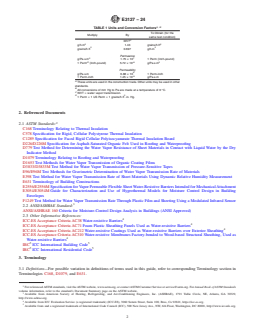
TABLE 1 Units and Conversion Factors
3.2.1.1 Discussion—A given material may serve multiple
To Obtain (for the
functions within a wall or roof assembly if it meets the
Multiply By
same test condition)
requirements for each function. For example, it is possible to
C
WVT
specify and install a single product that functions both as a
2 2
g/h·m 1.43 grains/h·ft
2 2
grains/h·ft 0.697 g/h·m water-resistive and air barrier on the exterior side of the
assembly. Some products can also provide additional structural
Permeance
2 7 support and thermal insulating capability.
g/Pa·s·m 1.75 × 10 1 Perm (Inch-pound)
D -8 2
1 Perm (Inch-pound) 5.72 × 10 g/Pa·s·m
3.2.2 air leakage, n—in buildings, the passage of uncon-
trolled air through cracks or openings in the building envelope
Permeability
g/Pa·s·m 6.88 × 10 1 Perm-inch
or its components, such as ducts, because of air pressure or
-9
1 Perm-inch 1.45 × 10 g/Pa·s·m
temperature difference.
A
These units are used in the construction trade. Other units may be used in other
standards.
3.2.3 building envelope, n—a boundary that encloses and
B
All conversions of mm Hg to Pa are made at a temperature of 0 °C.
separates conditioned space from the outdoor environment or
C
WVT = water vapor transmission.
D 2
other environments with different conditions (for example,
1 Perm = 1 US Perm = 1 grains/h·ft ·in. Hg.
semi-conditioned spaces, cold storage spaces, manufacturing
or industrial processing environments).
3.2.3.1 Discussion—A building’s interior is typically the
E3054/E3054M Guide for Characterization and Use of Hy-
enclosed conditioned space that, in general, does not include
grothermal Models for Moisture Control Design in Build-
vented attics, unconditioned basements, vented crawl spaces,
ing Envelopes
or attached spaces (for example, unconditioned garages or
F1249 Test Method for Water Vapor Transmission Rate
other utility spaces that are connected to the main structure but
Through Plastic Film and Sheeting Using a Modulated
are not conditioned). In commercial buildings, these interior
Infrared Sensor
environments may include designated spaces for storage,
2.2 ANSI/ASHRAE Standard:
manufacturing, or industrial processing.
ANSI/ASHRAE 160 Criteria for Moisture-Control Design
Analysis in Buildings (ANSI Approved)
3.2.4 responsive water vapor transmission properties,
2.3 Other Informative References:
n—water vapor transmission properties that vary as a function
ICC-ES Acceptance Criteria AC38 Water-resistive Barriers
of temperature and relative humidity.
ICC-ES Acceptance Criteria AC71 Foam Plastic Sheathing
3.2.4.1 Discussion—The water vapor permeance (WVP) of
Panels Used as Water-resistive Barriers
many WRB/AB materials increases with increasing tempera-
ICC-ES Acceptance Criteria AC212 Water-resistive Coat-
ture and relative humidity, often in a nonlinear fashion.
ings Used as Water-resistive Barriers over Exterior
3.2.5 water vapor diffusion, n—the process by which water
Sheathing
vapor moves through a vapor permeable material by molecular
ICC-ES Acceptance Criteria AC310 Water-resistive Mem-
branes Factory-bonded to Wood-based Structural diffusion due to a difference (gradient) in water vapor pressure
across the material.
Sheathing, Used as Water-resistive Barriers
5 5
IBC ICC International Building Code
3.2.6 water-resistive barrier (WRB), n—a protective mate-
5 5
IRC ICC International Residential Code
rial installed on the exterior surface or behind the exterior
building covering (for example, wall cladding or roof cover-
3. Terminology
ing) that is intended to resist further intrusion of liquid water
3.1 Definitions—For possible variation in definitions of
that has penetrated the exterior covering and prevent it from
terms used in this guide, refer to corresponding Terminology
reaching interior components of the building envelope.
section in Terminologies C168, D1079, and E631.
3.2.6.1 Discussion—Wall and roof assemblies designed to
3.2 Definitions of Terms Specific to This Standard:
function as a drainage system include two layers of resistance
3.2.1 air barrier (AB), n—a material or assembly installed
against rainwater penetration; the exterior covering provides
as a system in a building envelope and designed to resist
the initial resistance to rainwater penetration, and the WRB
uncontrolled air movement into or through the opaque wall or
provides the ultimate resistance against any water that bypasses
roof assembly. An air barrier can be specified as a control layer
the exterior covering or drains down from upper levels.
on the inside, outside, or middle sections of exterior wall and
3.2.7 water vapor permeability, n—a material property that
roof assemblies, or as an entire assembly.
represents the time rate of water vapor transmission by
diffusion through unit area of a flat material of unit thickness
Available from American Society of Heating, Refrigerating, and Air-
induced by a unit vapor pressure difference between two
Conditioning Engineers, Inc. (ASHRAE), 1791 Tullie Circle, NE, Atlanta, GA
specific surfaces, under specified temperature and relative
30329, http://www.ashrae.org.
4 humidity conditions.
Available from ICC Evaluation Service (a registered trademark) (ICC-ES),
3060 Saturn Street, Suite 100, Brea, Ca 92821, https://icc-es.org.
3.2.8 water vapor permeance, n—a material layer property
Available from and a registered trademark of International Code Council (ICC),
that represents the time rate of water vapor transmission by
500 New Jersey Ave., NW, 6th Floor, Washington, DC 20001, http://
www.iccsafe.org. diffusion through unit area of a flat material or assembly
E3127 − 24
induced by a unit vapor pressure difference between two information for water vapor transmission properties of
specific surfaces, under specified temperature and humidity WRB/AB unless otherwise instructed by the design profes-
conditions. sional.
3.2.8.1 Discussion—Permeance is an extrinsic material
4.3 Most standard test methods rely on a limited set of
property for the specific thickness of the material. Permeability
steady-state testing conditions for evaluating the water vapor
is an intrinsic material property that must be divided by the
transmission properties of materials. Test conditions used to
thickness to determine the permeance of the material. Water
measure and report water vapor transmission values of
vapor permeance has been traditionally reported in “perms,”
WRB/AB should represent the in-service conditions of the
and material classes are established based on this perm rating
tested material as closely as possible (that is, should cover the
for sheet- and fluid-applied materials.
range of temperature and relative humidity conditions the
3.2.9 water vapor transmission rate (WVTR), n—the steady
products will experience when installed in wall and roof
water vapor flow by diffusion in unit time through unit area of
assemblies). The water vapor permeance of many WRB/AB
a material, normal to specific parallel surface, under specific
materials can vary by more than an order of magnitude when
temperature and relative humidity conditions on each surface.
tested for ranges of temperatures and relative humidity ex-
3.2.9.1 Discussion—Water vapor transmission rate is some-
pected in service. For this reason, WVT properties over the full
times reported as the amount of water vapor flow over a 24 h
range of environmental conditions that the material will most
2 2
time interval, for example, g/24 h·m or grains/24 h·ft . It is
likely experience in service should be used or evaluated when
required that the units are reported with the numerical value
specifying a material or assembly design for a specific project.
when stating the WVTR or water vapor permeance of a
material.
5. Classification
3.2.9.2 Discussion—Although some technical documents
5.1 This guide addresses selection and reporting of water
report WVTR values as a measure of water vapor permeance of
vapor transmission properties for WRB/AB in accordance with
building materials instead of traditionally reported “perm”
their in-service conditions regardless of the manufacturing
rating, the WVTR is not a complete performance measure of
process and physical characteristics of the products.
water vapor transmission. If water vapor pressure differentials
across tested specimens are not reported, estimation of water
5.2 The International Building Code (IBC) and International
vapor transmission properties cannot be accomplished without
Residential Code (IRC) adopt the following vapor retarder
making assumptions about the water vapor pressures on each
classes for materials as defined using the Desiccant Method
side of tested specimens.
(“Procedure A”) of Test Methods E96/E96M:
(1) Class I: 0.1 perm or less,
3.3 Symbols:
(2) Class II: 0.1 < perm ≤ 1.0 perm, and
2 2
q = mass flux rate of vapor flow, grains/h·ft , (kg/s·m ) (3) Class III: 1.0 < perm ≤ 10 perm.
v
μ = water vapor permeability, grains/h·ft·in. Hg, (kg/
p
The vapor retarder classes listed above have been primarily
Pa·s·m)
developed for classification of vapor retarders installed typi-
M = water vapor permeance, grains/h·ft ·in. Hg, (kg/
cally on the interior side of frame walls to better characterize
Pa·s·m )
potential of vapor retarders to control the magnitude of water
P = water vapor pressure, in. Hg (Pa)
v
vapor diffusion from inside to outside in winter time. The vapor
P = saturation water vapor pressure, in. Hg, (Pa)
v,sat
retarder classes in 5.2 may not be sufficient to provide
WVTR = water vapor transmission rate, grains/h·ft ,
complete metrics needed to characterize the performance of
(g/h·m )
WRB/AB.
5.2.1 For proper characterization of water vapor retarding
4. Significance and Use
properties for WRB/AB in service, selected test methods and
4.1 As the building industry shifts towards performance-
test conditions should reproduce the full range of temperatures
based design, specification of material properties consistent
and relative humidity encountered in service. It is strongly
with anticipated in-service conditions becomes paramount to
recommended that technical data sheets for WRB/AB report
the design process. When specifying water vapor transmission
water vapor transmission properties for at least three mean
properties, it is important to identify water vapor transmission
relative humidity levels:
properties for WRB/AB products that are measured under test
(1) 25 % (matches the Desiccant Method or Procedure “A”
conditions relevant to anticipated in-service conditions. This
test conditions in accordance with Test Methods E96/E96M),
guide provides a performance-based framework for character-
(2) 75 % (matches the Water Method or Procedure “B” test
izing the water vapor transmission properties of WRB/AB.
conditions in accordance with Test Methods E96/E96M), and
(3) 95 % (evaluates performance in “wet” conditions and
4.2 When specifying WRB/AB, water vapor permeance is
assesses potential for drying after incidental water intrusion
an important attribute to consider for proper moisture manage-
events).
ment and functioning of wall and roof assemblies in service. In
North America, water vapor transmission properties of water- 5.2.1.1 The reported values for each recommended average
resistive and air barrier materials are traditionally tested in relative humidity level should be assessed at three different
accordance with Test Methods E96/E96M. This guide adopts temperatures covering the most typical range of temperatures
the ASTM E96/E96M test methods as a primary source of expected in service: 40 °F, 73.4 °F, and 90 °F.
E3127 − 24
5.2.1.2 It is recommended that test results be presented in 6.3 Test Methods E96/E96M provide a limited number of
graphical form by using a water vapor permeance performance recommended standard test conditions (temperature and rela-
chart as shown in Fig. 1, which provides a summary of test data
tive humidity). The test chamber conditions for the two most
for three different products “A,” “B,” and “C” represented by
widely reported test methods, Desiccant Method (“Procedure
green, blue, and red boxes, respectively. Numeric labels next to
A”) and Water Method (“Procedure B”), are 73.4 °F (23 °C)
the green boxes indicate mean relative humidity for each tested
and 50 % 6 2 % relative humidity. The test dishes are filled
temperature, and width of the boxes corresponds to tested
either with dried desiccant to maintain 0 % relative humidity
permeance values to be reported. For clarity, relative humidity
(“Procedure A”), or with distilled water (“Procedure B”) to
labels were omitted for products “B” and “C.” It is possible
maintain 100 % relative humidity on one side of the tested
that certain WRB/AB products demonstrate a wider range of
material. These standard conditions, however, provide only
water vapor permeance values at different humidity and tem-
limited information and may not reflect the actual conditions
perature conditions than others.
that tested barrier materials may experience in service.
5.2.2 The Desiccant Method (“Procedure A”) of ASTM
E96/E96M test methods is conducted at a single environmental
6.4 It is strongly recommended that, at a minimum, manu-
condition, 73 °F (23 °C) and average relative humidity (RH) of
facturers of WRB/AB materials report the results for at least
25 % and may be used as a baseline to characterize vapor
the two most common test methods used in industry; that is, to
retarding properties for WRB/AB.
test the material to both the Test Methods E96/E96M Desiccant
5.2.3 In addition to the Desiccant Method (“Procedure A”),
Method (“Procedure A”) and Water Method (“Procedure B”) to
Test Methods E96/E96M specify five other standard test
facilitate better the specification of water vapor transmission
conditions and permits the use of additional temperature and
properties based on project-specific conditions.
RH conditions with the requirement that test conditions shall
be stated in the test report. 6.5 Test Methods E96/E96M are a simple, straightforward,
and relatively inexpensive testing protocol commonly used in
6. Test Methods and Practices
the industry to evaluate water vapor transmission properties of
6.1 Regardless of the test method used for evaluation of building materials. Variations in test results typically occur due
water vapor transmission properties of WRB/AB, it is highly
to inhomogeneity of tested material, fluctuations in environ-
recommended that selected test conditions represent the antici-
mental conditions, a lack of detailed specifications for shape
pated range of in-service conditions.
and size of test dishes, absence of detailed instructions for
sealing methods, reliance on operator skill to adequately seal
6.2 Test Methods E96/E96M are recommended as a primary
the test specimen, and difficulties in test specimen preparation
test method for determining the WVT properties of both
for certain categories of WRB/AB products. Typically, these
WRB/AB, unless the nature of the tested material, test method
conditions, or the range and dynamics of in-service conditions test methods provide reliable and repeatable values for water
suggest an alternative test method would be more appropriate. vapor transmission properties of building materials by means
NOTE 1—Perm ratings on top of the chart expressed in US perms on logarithmic scale.
FIG. 1 Proposed WVP Performance Chart for WRB/AB
E3127 − 24
of simple apparatus; however, interlaboratory studies con- 7. In-Service Conditions and Water Vapor Permeance
ducted on several materials revealed that percent coefficient of Reporting Requirements for Water-Resistive Barriers
and Air Barriers
variation could be up to 20 % for some materials as reported in
Precision and Bias section of the ASTM E96/E96M test
7.1 In-service conditions impact the performance of
standard.
WRB/AB and should be carefully considered when selecting
conditions for measuring, reporting, and specifying water
6.6 Test reports should follow the Test Methods E96/E96M
vapor transmission properties of barrier products for project-
reporting requirements and include the test procedure or
specific in-service conditions. Factors governing the in-service
method, or both, along with test temperature and relative
conditions of WRB/AB as installed on the exterior side of
humidity in the test chamber. If non-standard test conditions
building envelopes include, but are not limited to:
are selected, report temperature and relative humidity on each
(1) Local climate (for example, temperature, relative
side of the tested specimen. When testing multilayered and
humidity, solar radiation, wind direction and wind speed,
composite materials, report the specimen side that was exposed
precipitation);
to the environment with higher water vapor pressure and higher
(2) Exposure to liquid water in service (for example,
relative humidity, keeping in mind that orientation may change
cladding type and installation method, local site and building
with selected procedure (Desiccant Method versus Water
exposure conditions such as wall orientation in relation to
Method).
predominant wind-driven rain direction, location relative to
protective features such as overhangs and porches, and flashing
6.7 Water vapor transmission properties obtained in accor-
practices employed for redirecting water);
dance with alternative test methods such as Test Methods
(3) Exposure to indirect and intermittent ultraviolet (UV)
E398, D1653, D3833/D3833M, or F1249 are also acceptable
radiation from sunlight in open joint rainscreen applications;
provided that reported water vapor transmission properties
(4) Interior ambient conditions (temperature and relative
reflect in-service conditions of the tested materials or condi-
humidity);
tions similar to “Procedure A” and “Procedure B” of ASTM
(5) Location of barrier material within the wall and roof
E96/E96M test methods. The test results generated using
assembly;
alternative test methods may not be equal to the test results
(6) Characteristics of other layers in the wall and roof
produced using Test Methods E96/E96M testing protocol for
assembly with regards to heat, air, and moisture transport (for
the same testing conditions. It is the design professional’s
example, water vapor transmission and air leakage properties,
responsibility to interpret and use the alternative test data
moisture absorption, moisture storage characteristics, and ther-
accordingly in the design process. Some alternative test meth-
mal insulating properties), as they all affect wetting and drying
ods for measuring water vapor transmission allow for material
potential of a particular assembly; and
property testing under dynamic conditions. Test data generated
(7) Properties of the substrate to which the barrier is
under such conditions may be preferable when tested materials
applied, and interaction between barrier, substrate material, and
will be subjected to similar conditions in service.
flashing for proper installation (for example, chemical compat-
6.7.1 The benefits of using alternative test methods over
ibility and use of adhesives, primers, and other means to adhere
Test Methods E96/E96M may include speed and ease in
the barrier material to the substrate and flashing).
specifying of variable test conditions. A limitation of some 7.1.1 Most severe wind-driven rain conditions, magnitude
alternative test methods is the allowable specimen thickness
of water vapor drive, and corresponding thermal gradients
that can be tested. As most alternative test methods are throughout the year in relation to moisture storage capacities
designed for sheet and membrane materials, they may not be and water vapor transmission properties of adjacent layers
should be carefully considered in selecting and reporting water
suitable for testing thick WRB/AB products or composite
vapor transmission characteristics of WRB (1). These factors
materials.
can impact product in-service performance due to variation in
6.8 Evaluation of interaction between barrier material and
water vapor transmission characteristics with change in relative
the exterior sheathing substrate and assessing the actual or
humidity and temperature. Therefore, using test conditions that
effective permeability is critical for performance assessment of
are consistent with the in-service environment of the barrier
barrier products that require full adhesion to the substrate (for
product is necessary when providing water vapor transmission
example, self-adhered membranes, fluid-applied, factory-
data to support the specification process.
laminated, or bonded products). Due to limitations imposed on
7.2 Some WRB/AB products rely on either mechanical
specimen thickness, use of certain test methods for evaluation
attachment or physical bonding (for example, fluid-applied and
of interaction between barrier material and exterior sheathing
self-adhered products) to the substrate for proper installation;
substrate may not be appropriate.
others are manufactured with the WRB/AB laminated directly
6.9 In general, most standard test methods specify a limited to the exterior sheathing. Physical interaction between the
barrier material and the substrate can affect the water vapor
set of conditions for evaluating the water vapor transmission
transmission characteristics of multilayered composites. To
characteristics of tested material, and selection of alternative
test methods, along with evaluation of reported test results
using alternative test methods, requires professional expertise 6
The boldface numbers in parentheses refer to the list of references at the end of
and assessment. this standard.
E3127 − 24
achieve a minimum required bond strength to a particular freeze-thaw damage), mold growth, occupant health and
substrate, some WRB/AB products specify the use of primers, comfort, and energy use. Properly designed wall and roof
which also may affect the water vapor transmission character- assemblies have WRB/AB selected with optimal material
istics of the composite product. Therefore, in addition to properties for the particular climate and indoor environments
evaluating the water vapor transmission characteristics of and are placed in appropriate location within the assembly.
individual layers in a multilayered system, evaluation of the Temperature gradients across the assembly and insulation
water vapor transmission properties of composite products that strategies (for example, use of exterior-applied insulation
include substrate, surface treatments, and coatings or facers is products having a wide range of water vapor transmission
recommended. properties) can alter the significance or importance of the water
vapor transmission characteristics of WRB/AB.
7.3 Water vapor permeability measured under test condi-
7.6 When continuous insulation on exterior was not re-
tions representative of the in-service conditions should be used
quired in codes, traditional wall assemblies in cold climates
when choosing a material for a particular building application
used a vapor permeable WRB coupled with interior vapor
(2).
retarder and AB to control condensation and to prevent
7.3.1 For WRB/AB materials with vapor transmission prop-
moisture accumulation in wall assemblies. Vapor permeable
erties not significantly impacted by changes in temperature and
WRB allowed for faster dissipation of excessive moisture
relative humidity, specifying testing conditions and reporting
outwards and controlled moisture accumulation in building
water vapor transmission properties in accordance with in-
envelopes. In general, vapor permeable WRB/AB products
service conditions is less relevant.
enable faster drying when accidental water infiltration into the
7.3.2 For WRB/AB materials with responsive water vapor
exterior wall or roof cavity occurs; however, assemblies with
transmission characteristics, that is, water vapor transmission
water absorptive claddings permit moisture to migrate through
properties that vary with temperature and relative humidity, it
and accumulate within a wall or roof assembly. Provision of
is essential to select and report the water vapor transmission
ventilation between cladding and WRB using exterior ambient
values measured under conditions that are similar to expected
air may mitigate this problem and reduce amount of moisture
in-service conditions. The specification and reporting docu-
migration inwards in those circumstances.
...
This document is not an ASTM standard and is intended only to provide the user of an ASTM standard an indication of what changes have been made to the previous version. Because
it may not be technically possible to adequately depict all changes accurately, ASTM recommends that users consult prior editions as appropriate. In all cases only the current version
of the standard as published by ASTM is to be considered the official document.
Designation: E3127 − 22 E3127 − 24
Standard Guide for
Specifying Water Vapor Transmission Material Properties of
Water-Resistive Barriers and Air Barriers
This standard is issued under the fixed designation E3127; the number immediately following the designation indicates the year of
original adoption or, in the case of revision, the year of last revision. A number in parentheses indicates the year of last reapproval. A
superscript epsilon (´) indicates an editorial change since the last revision or reapproval.
1. Scope
1.1 This document providescovers guidelines for specifying water vapor transmission (WVT) properties for above-grade
water-resistive barriers and air barriers (WRB/AB), typically installed between building structural components and cladding that
compose the exterior side of building envelopes in North America.
1.2 This guide applies to all types of water-resistive barrier and air barrier products, including multifunctional products, regardless
of the manufacturing process, type of material, or installation technique.
1.3 This guide provides general provisions for specifying and reporting the water vapor transmission properties of WRB/AB
determined by standardized test methods, in accordance with in-service conditions these products typically experience within
building envelopes.
1.4 It is beyond the scope of this guide to optimize the water vapor transmission characteristics of WRB/AB for specific conditions
of use. The specific conditions of use should account for variations in indoor and outdoor climates, cladding type, moisture storage
capacity of cladding materials, thermal insulating measures for wall and roof assemblies, air movement, and vapor diffusion control
strategies.
1.5 This guide does not address proper installation and integration of WRB/AB with other wall and roof components.
1.6 The values stated in inch-pound units are to be regarded separately as standard. Within the text, the SI units shown in
parentheses are provided for information only. The values stated in each system are not exact equivalents; therefore, each system
shall be used independently. Combining values from two systems may result in non-conformance with the standard. However,
derived results can be converted between systems using appropriate conversion factors (see Table 1).
1.7 This standard does not purport to address all of the safety concerns, if any, associated with its use. It is the responsibility
of the user of this standard to establish appropriate safety, health, and environmental practices and determine the applicability of
regulatory limitations prior to use.
1.8 This international standard was developed in accordance with internationally recognized principles on standardization
established in the Decision on Principles for the Development of International Standards, Guides and Recommendations issued
by the World Trade Organization Technical Barriers to Trade (TBT) Committee.
This guide is under the jurisdiction of ASTM Committee E06 on Performance of Buildings and is the direct responsibility of Subcommittee E06.41 on Air Leakage and
Ventilation Performance.
Current edition approved May 1, 2022March 1, 2024. Published July 2022March 2024. Originally approved in 2022. Last previous edition approved in 2022 as E3127 – 22.
DOI: 10.1520/E3127-22.10.1520/E3127-24.
Copyright © ASTM International, 100 Barr Harbor Drive, PO Box C700, West Conshohocken, PA 19428-2959. United States
E3127 − 24
A, B
TABLE 1 Units and Conversion Factors
To Obtain (for the
Multiply By
same test condition)
C
WVT
2 2
g/h·m 1.43 grains/h·ft
2 2
grains/h·ft 0.697 g/h·m
Permeance
2 7
g/Pa·s·m 1.75 × 10 1 Perm (Inch-pound)
D -8 2
1 Perm (Inch-pound) 5.72 × 10 g/Pa·s·m
Permeability
g/Pa·s·m 6.88 × 10 1 Perm-inch
-9
1 Perm-inch 1.45 × 10 g/Pa·s·m
A
These units are used in the construction trade. Other units may be used in other
standards.
B
All conversions of mm Hg to Pa are made at a temperature of 0 °C.
C
WVT = water vapor transmission.
D 2
1 Perm = 1 US Perm = 1 grains/h·ft ·in. Hg.
2. Referenced Documents
2.1 ASTM Standards:
C168 Terminology Relating to Thermal Insulation
C578 Specification for Rigid, Cellular Polystyrene Thermal Insulation
C1289 Specification for Faced Rigid Cellular Polyisocyanurate Thermal Insulation Board
D226/D226M Specification for Asphalt-Saturated Organic Felt Used in Roofing and Waterproofing
D779 Test Method for Determining the Water Vapor Resistance of Sheet Materials in Contact with Liquid Water by the Dry
Indicator Method
D1079 Terminology Relating to Roofing and Waterproofing
D1653 Test Methods for Water Vapor Transmission of Organic Coating Films
D3833/D3833M Test Method for Water Vapor Transmission of Pressure-Sensitive Tapes
E96/E96M Test Methods for Gravimetric Determination of Water Vapor Transmission Rate of Materials
E398 Test Method for Water Vapor Transmission Rate of Sheet Materials Using Dynamic Relative Humidity Measurement
E631 Terminology of Building Constructions
E2556/E2556M Specification for Vapor Permeable Flexible Sheet Water-Resistive Barriers Intended for Mechanical Attachment
E3054/E3054M Guide for Characterization and Use of Hygrothermal Models for Moisture Control Design in Building
Envelopes
F1249 Test Method for Water Vapor Transmission Rate Through Plastic Film and Sheeting Using a Modulated Infrared Sensor
2.2 ANSI/ASHRAE Standard:
ANSI/ASHRAE 160 Criteria for Moisture-Control Design Analysis in Buildings (ANSI Approved)
2.3 Other Informative References:
ICC-ES Acceptance Criteria AC38 Water-resistive Barriers
ICC-ES Acceptance Criteria AC71 Foam Plastic Sheathing Panels Used as Water-resistive Barriers
ICC-ES Acceptance Criteria AC212 Water-resistive Coatings Used as Water-resistive Barriers over Exterior Sheathing
ICC-ES Acceptance Criteria AC310 Water-resistive Membranes Factory-bonded to Wood-based Structural Sheathing, Used as
Water-resistive Barriers
5 5
IBC ICC International Building Code
5 5
IRC ICC International Residential Code
3. Terminology
3.1 Definitions—For possible variation in definitions of terms used in this guide, refer to corresponding Terminology section in
Terminologies C168, D1079, and E631.
For referenced ASTM standards, visit the ASTM website, www.astm.org, or contact ASTM Customer Service at service@astm.org. For Annual Book of ASTM Standards
volume information, refer to the standard’s Document Summary page on the ASTM website.
Available from American Society of Heating, Refrigerating, and Air-Conditioning Engineers, Inc. (ASHRAE), 1791 Tullie Circle, NE, Atlanta, GA 30329,
http://www.ashrae.org.
Available from ICC Evaluation Service (a registered trademark) (ICC-ES), 3060 Saturn Street, Suite 100, Brea, Ca 92821, https://icc-es.org.
Available from and a registered trademark of International Code Council (ICC), 500 New Jersey Ave., NW, 6th Floor, Washington, DC 20001, http://www.iccsafe.org.
E3127 − 24
3.2 Definitions of Terms Specific to This Standard:
3.2.1 air barrier (AB), n—a material or assembly installed as a system in a building envelope and designed to resist uncontrolled
air movement into or through the opaque wall or roof assembly. An air barrier can be specified as a control layer on the inside,
outside, or middle sections of exterior wall and roof assemblies, or as an entire assembly.
3.2.1.1 Discussion—
A given material may serve multiple functions within a wall or roof assembly if it meets the requirements for each function. For
example, it is possible to specify and install a single product that functions both as a water-resistive and air barrier on the exterior
side of the assembly. Some products can also provide additional structural support and thermal insulating capability.
3.2.2 air leakage, n—in buildings, the passage of uncontrolled air through cracks or openings in the building envelope or its
components, such as ducts, because of air pressure or temperature difference.
3.2.3 building envelope, n—a boundary that encloses and separates conditioned space from the outdoor environment or other
environments with different conditions (for example, semi-conditioned spaces, cold storage spaces, manufacturing or industrial
processing environments).
3.2.3.1 Discussion—
A building’s interior is typically the enclosed conditioned space that, in general, does not include vented attics, unconditioned
basements, vented crawl spaces, or attached spaces (for example, unconditioned garages or other utility spaces that are connected
to the main structure but are not conditioned). In commercial buildings, these interior environments may include designated spaces
for storage, manufacturing, or industrial processing.
3.2.4 responsive water vapor transmission properties, n—water vapor transmission properties that vary as a function of
temperature and relative humidity.
3.2.4.1 Discussion—
The water vapor permeance (WVP) of many WRB/AB materials increases with increasing temperature and relative humidity, often
in a nonlinear fashion.
3.2.5 water vapor diffusion, n—the process by which water vapor moves through a vapor permeable material by molecular
diffusion due to a difference (gradient) in water vapor pressure across the material.
3.2.6 water-resistive barrier (WRB), n—a protective material installed on the exterior surface or behind the exterior building
covering (for example, wall cladding or roof covering) that is intended to resist further intrusion of liquid water that has penetrated
the exterior covering and prevent it from reaching interior components of the building envelope.
3.2.6.1 Discussion—
Wall and roof assemblies designed to function as a drainage system include two layers of resistance against rainwater penetration;
the exterior covering provides the initial resistance to rainwater penetration, and the WRB provides the ultimate resistance against
any water that bypasses the exterior covering or drains down from upper levels.
3.2.7 water vapor permeability, n—a material property that represents the time rate of water vapor transmission by diffusion
through unit area of a flat material of unit thickness induced by a unit vapor pressure difference between two specific surfaces,
under specified temperature and relative humidity conditions.
3.2.8 water vapor permeance, n—a material layer property that represents the time rate of water vapor transmission by diffusion
through unit area of a flat material or assembly induced by a unit vapor pressure difference between two specific surfaces, under
specified temperature and humidity conditions.
3.2.8.1 Discussion—
Permeance is an extrinsic material property for the specific thickness of the material. Permeability is an intrinsic material property
that must be divided by the thickness to determine the permeance of the material. Water vapor permeance has been traditionally
reported in “perms,” and material classes are established based on this perm rating for sheet- and fluid-applied materials.
3.2.9 water vapor transmission rate (WVTR), n—the steady water vapor flow by diffusion in unit time through unit area of a
material, normal to specific parallel surface, under specific temperature and relative humidity conditions on each surface.
E3127 − 24
3.2.9.1 Discussion—
Water vapor transmission rate is sometimes reported as the amount of water vapor flow over a 24 h time interval, for example,
2 2
g/24 h·m or grains/24 h·ft . It is required that the units are reported with the numerical value when stating the WVTR or water
vapor permeance of a material.
3.2.9.2 Discussion—
Although some technical documents report WVTR values as a measure of water vapor permeance of building materials instead
of traditionally reported “perm” rating, the WVTR is not a complete performance measure of water vapor transmission. If water
vapor pressure differentials across tested specimens are not reported, estimation of water vapor transmission properties cannot be
accomplished without making assumptions about the water vapor pressures on each side of tested specimens.
3.3 Symbols:
2 2
q = mass flux rate of vapor flow, grains/h·ft , (kg/s·m )
v
μ = water vapor permeability, grains/h·ft·in. Hg, (kg/Pa·s·m)
p
2 2
M = water vapor permeance, grains/h·ft ·in. Hg, (kg/Pa·s·m )
P = water vapor pressure, in. Hg (Pa)
v
P = saturation water vapor pressure, in. Hg, (Pa)
v,sat
2 2
WVTR = water vapor transmission rate, grains/h·ft , (g/h·m )
4. Significance and Use
4.1 As the building industry shifts towards performance-based design, specification of material properties consistent with
anticipated in-service conditions becomes paramount to the design process. When specifying water vapor transmission properties,
it is important to identify water vapor transmission properties for WRB/AB products that are measured under test conditions
relevant to anticipated in-service conditions. This guide provides a performance-based framework for characterizing the water
vapor transmission properties of WRB/AB.
4.2 When specifying WRB/AB, water vapor permeance is an important attribute to consider for proper moisture management and
functioning of wall and roof assemblies in service. In North America, water vapor transmission properties of water-resistive and
air barrier materials are traditionally tested in accordance with Test Methods E96/E96M. This guide adopts the ASTM E96/E96M
test methods as a primary source of information for water vapor transmission properties of WRB/AB unless otherwise instructed
by the design professional.
4.3 Most standard test methods rely on a limited set of steady-state testing conditions for evaluating the water vapor transmission
properties of materials. Test conditions used to measure and report water vapor transmission values of WRB/AB should represent
the in-service conditions of the tested material as closely as possible (that is, should cover the range of temperature and relative
humidity conditions the products will experience when installed in wall and roof assemblies). The water vapor permeance of many
WRB/AB materials can vary by more than an order of magnitude when tested for ranges of temperatures and relative humidity
expected in service. For this reason, WVT properties over the full range of environmental conditions that the material will most
likely experience in service should be used or evaluated when specifying a material or assembly design for a specific project.
5. Classification
5.1 This guide addresses selection and reporting of water vapor transmission properties for WRB/AB in accordance with their
in-service conditions regardless of the manufacturing process and physical characteristics of the products.
5.2 The International Building Code (IBC) and International Residential Code (IRC) adopt the following vapor retarder classes
for materials as defined using the Desiccant Method (“Procedure A”) of Test Methods E96/E96M:
(1) Class I: 0.1 perm or less,
(2) Class II: 0.1 < perm ≤ 1.0 perm, and
(3) Class III: 1.0 < perm ≤ 10 perm.
The vapor retarder classes listed above have been primarily developed for classification of vapor retarders installed typically on
the interior side of frame walls to better characterize potential of vapor retarders to control the magnitude of water vapor diffusion
from inside to outside in winter time. The vapor retarder classes in 5.2 may not be sufficient to provide complete metrics needed
to characterize the performance of WRB/AB.
5.2.1 For proper characterization of water vapor retarding properties for WRB/AB in service, selected test methods and test
E3127 − 24
conditions should reproduce the full range of temperatures and relative humidity encountered in service. It is strongly
recommended that technical data sheets for WRB/AB report water vapor transmission properties for at least three mean relative
humidity levels:
(1) 25 % (matches the Desiccant Method or Procedure “A” test conditions in accordance with Test Methods E96/E96M),
(2) 75 % (matches the Water Method or Procedure “B” test conditions in accordance with Test Methods E96/E96M), and
(3) 95 % (evaluates performance in “wet” conditions and assesses potential for drying after incidental water intrusion events).
5.2.1.1 The reported values for each recommended average relative humidity level should be assessed at three different
temperatures covering the most typical range of temperatures expected in service: 40 °F, 73.4 °F, and 90 °F.
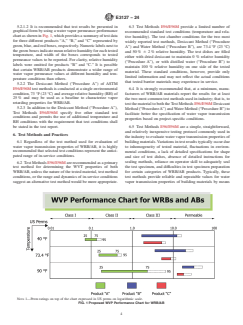
5.2.1.2 It is recommended that test results be presented in graphical form by using a water vapor permeance performance chart
as shown in Fig. 1, which provides a summary of test data for three different products “A,” “B,” and “C” represented by green,
blue, and red boxes, respectively. Numeric labels next to the green boxes indicate mean relative humidity for each tested
temperature, and width of the boxes corresponds to tested permeance values to be reported. For clarity, relative humidity labels
were omitted for products “B” and “C.” It is possible that certain WRB/AB products demonstrate a wider range of water vapor
permeance values at different humidity and temperature conditions than others.
5.2.2 The Desiccant Method (“Procedure A”) of ASTM E96/E96M test methods is conducted at a single environmental condition,
73 °F (23 °C) and average relative humidity (RH) of 25 % and may be used as a baseline to characterize vapor retarding properties
for WRB/AB.
5.2.3 In addition to the Desiccant Method (“Procedure A”), Test Methods E96/E96M specifiesspecify five other standard test
conditions and permits the use of additional temperature and RH conditions with the requirement that test conditions shall be stated
in the test report.
6. Test Methods and Practices
6.1 Regardless of the test method used for evaluation of water vapor transmission properties of WRB/AB, it is highly
recommended that selected test conditions represent the anticipated range of in-service conditions.
6.2 ASTM Test Methods E96/E96M isare recommended as a primary test method for determining the WVT properties of both
WRB/AB, unless the nature of the tested material, test method conditions, or the range and dynamics of in-service conditions
suggest an alternative test method would be more appropriate.
NOTE 1—Perm ratings on top of the chart expressed in US perms on logarithmic scale.
FIG. 1 Proposed WVP Performance Chart for WRB/AB
E3127 − 24
6.3 Test Methods E96/E96M provide a limited number of recommended standard test conditions (temperature and relative
humidity). The test chamber conditions for the two most widely reported test methods, Desiccant Method (“Procedure A”) and
Water Method (“Procedure B”), are 73.4 °F (23 °C) and 50 % 6 2 % relative humidity. The test dishes are filled either with dried
desiccant to maintain 0 % relative humidity (“Procedure A”), or with distilled water (“Procedure B”) to maintain 100 % relative
humidity on one side of the tested material. These standard conditions, however, provide only limited information and may not
reflect the actual conditions that tested barrier materials may experience in service.
6.4 It is strongly recommended that, at a minimum, manufacturers of WRB/AB materials report the results for at least the two most
common test methods used in industry; that is, to test the material to both the ASTM Test Methods E96/E96M Desiccant Method
(“Procedure A”) and Water Method (“Procedure B”) to facilitate better the specification of water vapor transmission properties
based on project-specific conditions.
6.5 Test Methods E96/E96M isare a simple, straightforward, and relatively inexpensive testing protocol commonly used in the
industry to evaluate water vapor transmission properties of building materials. Variations in test results typically occur due to
inhomogeneity of tested material, fluctuations in environmental conditions, a lack of detailed specifications for shape and size of
test dishes, absence of detailed instructions for sealing methods, reliance on operator skill to adequately seal the test specimen, and
difficulties in test specimen preparation for certain categories of WRB/AB products. Typically, these test methods provide reliable
and repeatable values for water vapor transmission properties of building materials by means of simple apparatus; however,
interlaboratory studies conducted on several materials revealed that percent coefficient of variation could be up to 20 % for some
materials as reported in Precision and Bias section of the ASTM E96/E96M test standard.
6.6 Test reports should follow the Test Methods E96/E96M reporting requirements and include the test procedure or method, or
both, along with test temperature and relative humidity in the test chamber. If non-standard test conditions are selected, report
temperature and relative humidity on each side of the tested specimen. When testing multilayered and composite materials, report
the specimen side that was exposed to the environment with higher water vapor pressure and higher relative humidity, keeping in
mind that orientation may change with selected procedure (Desiccant Method versus Water Method).
6.7 Water vapor transmission properties obtained in accordance with alternative test methods such as ASTM Test Methods E398,
D1653, D3833/D3833M, or F1249 are also acceptable provided that reported water vapor transmission properties reflect in-service
conditions of the tested materials or conditions similar to “Procedure A” and “Procedure B” of ASTM E96/E96M test methods.
The test results generated using alternative test methods may not be equal to the test results produced using Test Methods
E96/E96M testing protocol for the same testing conditions. It is the design professional’s responsibility to interpret and use the
alternative test data accordingly in the design process. Some alternative test methods for measuring water vapor transmission allow
for material property testing under dynamic conditions. Test data generated under such conditions may be preferable when tested
materials will be subjected to similar conditions in service.
6.7.1 The benefits of using alternative test methods over Test Methods E96/E96M may include speed and ease in specifying of
variable test conditions. A limitation of some alternative test methods is the allowable specimen thickness that can be tested. As
most alternative test methods are designed for sheet and membrane materials, they may not be suitable for testing thick WRB/AB
products or composite materials.
6.8 Evaluation of interaction between barrier material and the exterior sheathing substrate and assessing the actual or effective
permeability is critical for performance assessment of barrier products that require full adhesion to the substrate (for example,
self-adhered membranes, fluid-applied, factory-laminated, or bonded products). Due to limitations imposed on specimen thickness,
use of certain test methods for evaluation of interaction between barrier material and exterior sheathing substrate may not be
appropriate.
6.9 In general, most standard test methods specify a limited set of conditions for evaluating the water vapor transmission
characteristics of tested material, and selection of alternative test methods, along with evaluation of reported test results using
alternative test methods, requires professional expertise and assessment.
7. In-Service Conditions and Water Vapor Permeance Reporting Requirements for Water-Resistive Barriers and Air
Barriers
7.1 In-service conditions impact the performance of WRB/AB and should be carefully considered when selecting conditions for
E3127 − 24
measuring, reporting, and specifying water vapor transmission properties of barrier products for project-specific in-service
conditions. Factors governing the in-service conditions of WRB/AB as installed on the exterior side of building envelopes include,
but are not limited to:
(1) localLocal climate (for example, temperature, relative humidity, solar radiation, wind direction and wind speed,
precipitation);
(2) exposureExposure to liquid water in service (for example, cladding type and installation method, local site and building
exposure conditions such as wall orientation in relation to predominant wind-driven rain direction, location relative to protective
features such as overhangs and porches, and flashing practices employed for redirecting water);
(3) exposureExposure to indirect and intermittent ultraviolet (UV) radiation from sunlight in open joint rainscreen applications;
(4) interiorInterior ambient conditions (temperature and relative humidity);
(5) locationLocation of barrier material within the wall and roof assembly;
(6) characteristicsCharacteristics of other layers in the wall and roof assembly with regards to heat, air, and moisture transport
(for example, water vapor transmission and air leakage properties, moisture absorption, moisture storage characteristics, and
thermal insulating properties), as they all affect wetting and drying potential of a particular assembly; and
(7) propertiesProperties of the substrate to which the barrier is applied, and interaction between barrier, substrate material, and
flashing for proper installation (for example, chemical compatibility and use of adhesives, primers, and other means to adhere the
barrier material to the substrate and flashing).
7.1.1 Most severe wind-driven rain conditions, magnitude of water vapor drive, and corresponding thermal gradients throughout
the year in relation to moisture storage capacities and water vapor transmission properties of adjacent layers should be carefully
considered in selecting and reporting water vapor transmission characteristics of WRB (1). These factors can impact product
in-service performance due to variation in water vapor transmission characteristics with change in relative humidity and
temperature. Therefore, using test conditions that are consistent with the in-service environment of the barrier product is necessary
when providing water vapor transmission data to support the specification process.
7.2 Some WRB/AB products rely on either mechanical attachment or physical bonding (for example, fluid-applied and
self-adhered products) to the substrate for proper installation; others are manufactured with the WRB/AB laminated directly to the
exterior sheathing. Physical interaction between the barrier material and the substrate can affect the water vapor transmission
characteristics of multilayered composites. To achieve a minimum required bond strength to a particular substrate, some WRB/AB
products specify the use of primers, which also may affect the water vapor transmission characteristics of the composite product.
Therefore, in addition to evaluating the water vapor transmission characteristics of individual layers in a multilayered system,
evaluation of the water vapor transmission properties of composite products that include substrate, surface treatments, and coatings
or facers is recommended.
7.3 Water vapor permeability measured under test conditions representative of the in-service conditions should be used when
choosing a material for a particular building application (2).
7.3.1 For WRB/AB materials with vapor transmission properties not significantly impacted by changes in temperature and relative
humidity, specifying testing conditions and reporting water vapor transmission properties in accordance with in-service conditions
is less relevant.
7.3.2 For WRB/AB materials with responsive water vapor transmission characteristics, that is, water vapor transmission properties
that vary with temperature and relative humidity, it is essential to select and report the water vapor transmission values measured
under conditions that are similar to expected in-service conditions. The specification and reporting documents for these products
should acknowledge that variability can exist in water vapor transmission properties and take fluctuating in-service conditions into
consideration. It is recommended to report test results in graphic form that reflect a range of varying hygrothermal conditions
representative of in-service conditions (3), and reporting metrics as described in 5.2.1 should be used. Though the limited set of
testing conditions does not fully represent actual conditions these materials may encounter in service, testing to these standard test
conditions provides adequate performance metrics for comparison of water vapor transmission material properties of water-
resistive and air barriers.
7.4 It is the design professional’s responsibility to select and specify The selection and specification of the water vapor
permeability and water vapor permeance values transmission properties for WRB/AB appropriate for the given application.
application should be included in the design process. Ideally, the WVT characteristics should be defined across the whole range
of relative humidity and temperature values expected in service. Complete evaluation of water vapor transmission characteristics
The boldface numbers in parentheses refer to the list of references at the end of this standard.
E3127 − 24
for WRB/AB can be time consuming, and current industry standards do not prescribe such comprehensive test condition
requirements for these barrier products. The intent of the subsequent sections
...