

ASTM E2266-22
(Guide)Standard Guide for Design and Construction of Low-Rise Frame Building Wall Systems to Resist Water Intrusion
General Information
- Abstract
SIGNIFICANCE AND USE
5.1 This guide may be used by public agencies to set standards affecting the weather resistance, durability, and performance of new building wall systems, exterior deck and stair components, doors, windows, penetrations and sealant joints beyond those specifically defined in the building codes.
5.2 This guide may be used by building field inspectors as a resource for construction inspection during the construction phase of a project.
5.3 This guide may be used by private organizations or individuals to set standards affecting the weather resistance, durability, and performance of building walls.
5.4 This guide may be used by architects and engineers as a resource for making design decisions involving material selection, building wall detailing and specifications.
5.5 This guide may be used by architects and engineers as a resource for conducting submittal review and construction observation during the construction administration phase of a project.
5.6 This guide may be used by contractors as a resource and checklist for exercising field quality control.
SCOPE
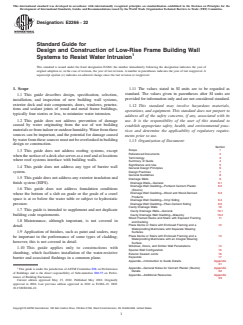
1.1 This guide describes design, specification, selection, installation, and inspection of new building wall systems, exterior deck and stair components, doors, windows, penetrations and sealant joints of wood and metal frame buildings, typically four stories or less, to minimize water intrusion.
1.2 This guide does not address prevention of damage caused by water originating from the use of wet building materials or from indoor or outdoor humidity. Water from these sources can be important, and the potential for damage caused by water from these sources must not be overlooked in building design or construction.
1.3 This guide does not address roofing systems, except when the surface of a deck also serves as a roof and at locations where roof systems interface with building walls.
1.4 This guide does not address any type of barrier wall system.
1.5 This guide does not address any exterior insulation and finish system (EIFS).
1.6 This guide does not address foundation conditions where the bottom of a slab on grade or the grade of a crawl space is at or below the water table or subject to hydrostatic pressure.
1.7 This guide is intended to supplement and not duplicate building code requirements.
1.8 Maintenance, although important, is not covered in detail.
1.9 Application of finishes, such as paint and sealers, may be important in the performance of some types of cladding; however, this is not covered in detail.
1.10 This guide applies only to constructions with sheathing, which facilitates installation of the water-resistive barrier and associated flashings in a common plane.
1.11 The values stated in SI units are to be regarded as standard. The values given in parentheses after SI units are provided for information only and are not considered standard.
1.12 This standard may involve hazardous materials, operations, and equipment. This standard does not purport to address all of the safety concerns, if any, associated with its use. It is the responsibility of the user of this standard to establish appropriate safety, health, and environmental practices and determine the applicability of regulatory requirements prior to use.
1.13 Organization of Document:
Section
Scope
1
Referenced Documents
2
Terminology
3
Summary of Guide
4
Significance and Use
5
General Design Principles
6
Design Practices
7
General Guidelines
8
Drainage Walls
9
Drainage Walls—General
9.1
Drainage Wall Cladding—Portland Cement Plaster (Stucco)
9.2
Drainage Wall Cladding—Wood and Wood-Derived Products
9.3
Drainage Wall Cladding—Vinyl Siding
9.4
Drainage Wall Cladding—Fiber-Cement Siding
9.5
Cavity Drainage Walls
10
Cavity Drainage Walls—General
10.1
Cavity Drainage Wall Cladding—Masonry...
- Status
- Published
- Publication Date
- 14-May-2022
- Technical Committee
- E06 - Performance of Buildings
- Drafting Committee
- E06.55 - Performance of Building Enclosures
Buy Documents
ASTM E2266-22 - Standard Guide for Design and Construction of Low-Rise Frame Building Wall Systems to Resist Water Intrusion
REDLINE ASTM E2266-22 - Standard Guide for Design and Construction of Low-Rise Frame Building Wall Systems to Resist Water Intrusion
Overview
ASTM E2266-22, "Standard Guide for Design and Construction of Low-Rise Frame Building Wall Systems to Resist Water Intrusion," provides comprehensive guidelines for designing, specifying, selecting, installing, and inspecting wall systems, exterior decks, stair components, doors, windows, and sealant joints in low-rise wood and metal frame buildings, typically up to four stories. Developed by ASTM International, this guide supplements, but does not replace, building code requirements and focuses specifically on minimizing water intrusion due to precipitation, thus promoting the long-term structural integrity and durability of building enclosures.
Key Topics
Design Principles for Weather Resistance
The standard emphasizes the incorporation of prudent factors of safety to ensure the building envelope can withstand local climate conditions, especially precipitation exposure. Guidance covers how to effectively integrate water-resistive barriers, flashings, and sealants to manage and direct water away from vulnerable areas.Wall and Cladding Systems
Instructions are provided for a variety of common cladding systems used on low-rise buildings, including cement plaster (stucco), wood products, vinyl siding, and fiber-cement siding. The guide differentiates between drainage wall designs (including cavity wall systems) and addresses detailed cladding integration.Material Selection and Installation
Recommendations assist in the selection and installation of materials that enhance water resistance and durability, including sheathing types compatible with water-resistive barriers and flashings. Compatibility between product types and appropriate installation procedures are stressed to ensure effective moisture management.Critical Junctions and Penetrations
Guidance covers the treatment of potential water entry points, such as doors, windows, deck-to-wall interfaces, and sealant joints. Proper detailing at these locations, particularly the use of appropriately designed flashings, is vital for reducing water intrusion risk.Inspection and Quality Control
The guide serves as a resource for field inspectors and contractors, providing checklists and best practices for verifying proper installation and adherence to the guide’s recommendations. It underlines the importance of inspections at key construction "hold points" before components are concealed.
Applications
ASTM E2266-22 is a valuable resource for a wide range of building professionals and stakeholders involved in low-rise construction projects:
Public Agencies:
Can use the guide to set or supplement performance standards for weather-resistant construction beyond what is mandated by local building codes.Design Professionals (Architects/Engineers):
The guide informs critical design decisions, material choices, detailing, and specification writing, as well as reviews and observations during construction administration phases.Contractors and Field Inspectors:
Offers practical checklists and serves as a reference for ensuring quality control, especially during installation or when evaluating work for compliance with weather-resistance goals.Private Developers and Owners:
Useful for establishing construction standards or evaluating proposed wall system assemblies to reduce long-term water damage risks.
Related Standards
ASTM E2266-22 references and is supplemented by several related standards, including but not limited to:
- ASTM E241: Guide for Limiting Water-Induced Damage to Buildings
- ASTM E1677: Specification for Air Barrier (AB) Material or Assemblies for Low-Rise Framed Building Walls
- ASTM C920: Specification for Elastomeric Joint Sealants
- ASTM E2112: Practice for Installation of Exterior Windows, Doors, and Skylights
- ICC-ES AC38: Acceptance Criteria for Weather-Resistive Barriers
- AAMA, ICBO, and APA references to deck, cladding, and window system integration
By following ASTM E2266-22, construction and design professionals can significantly improve the water resistance, durability, and long-term performance of low-rise frame building envelopes, minimizing risks associated with water intrusion and protecting building assets for years to come.
Keywords: ASTM E2266-22, water intrusion, low-rise building, frame construction, building envelope, weather resistance, drainage wall, cladding, flashing, inspection, building standards.
Relations
- Effective Date
- 15-Apr-2024
- Effective Date
- 15-Apr-2024
- Refers
ASTM D4477-24 - Standard Specification for Rigid (Unplasticized) Poly(Vinyl Chloride) (PVC) Soffit - Effective Date
- 01-Apr-2024
- Effective Date
- 01-Apr-2024
- Effective Date
- 01-Apr-2024
- Effective Date
- 01-Apr-2024
- Effective Date
- 15-Dec-2023
- Effective Date
- 01-Dec-2023
- Effective Date
- 01-Dec-2023
- Effective Date
- 01-Dec-2023
- Effective Date
- 15-Nov-2023
- Effective Date
- 01-Aug-2020
- Effective Date
- 01-Jul-2020
- Effective Date
- 01-May-2020
- Effective Date
- 01-May-2020
Buy Documents
ASTM E2266-22 - Standard Guide for Design and Construction of Low-Rise Frame Building Wall Systems to Resist Water Intrusion
REDLINE ASTM E2266-22 - Standard Guide for Design and Construction of Low-Rise Frame Building Wall Systems to Resist Water Intrusion
Get Certified
Connect with accredited certification bodies for this standard

DIBt (Deutsches Institut für Bautechnik)
German Institute for Building Technology.
DIN CERTCO
DIN Group product certification.

Aboma Certification B.V.
Specialized in construction, metal, and transport sectors.
Sponsored listings
Frequently Asked Questions
ASTM E2266-22 is a guide published by ASTM International. Its full title is "Standard Guide for Design and Construction of Low-Rise Frame Building Wall Systems to Resist Water Intrusion". This standard covers: SIGNIFICANCE AND USE 5.1 This guide may be used by public agencies to set standards affecting the weather resistance, durability, and performance of new building wall systems, exterior deck and stair components, doors, windows, penetrations and sealant joints beyond those specifically defined in the building codes. 5.2 This guide may be used by building field inspectors as a resource for construction inspection during the construction phase of a project. 5.3 This guide may be used by private organizations or individuals to set standards affecting the weather resistance, durability, and performance of building walls. 5.4 This guide may be used by architects and engineers as a resource for making design decisions involving material selection, building wall detailing and specifications. 5.5 This guide may be used by architects and engineers as a resource for conducting submittal review and construction observation during the construction administration phase of a project. 5.6 This guide may be used by contractors as a resource and checklist for exercising field quality control. SCOPE 1.1 This guide describes design, specification, selection, installation, and inspection of new building wall systems, exterior deck and stair components, doors, windows, penetrations and sealant joints of wood and metal frame buildings, typically four stories or less, to minimize water intrusion. 1.2 This guide does not address prevention of damage caused by water originating from the use of wet building materials or from indoor or outdoor humidity. Water from these sources can be important, and the potential for damage caused by water from these sources must not be overlooked in building design or construction. 1.3 This guide does not address roofing systems, except when the surface of a deck also serves as a roof and at locations where roof systems interface with building walls. 1.4 This guide does not address any type of barrier wall system. 1.5 This guide does not address any exterior insulation and finish system (EIFS). 1.6 This guide does not address foundation conditions where the bottom of a slab on grade or the grade of a crawl space is at or below the water table or subject to hydrostatic pressure. 1.7 This guide is intended to supplement and not duplicate building code requirements. 1.8 Maintenance, although important, is not covered in detail. 1.9 Application of finishes, such as paint and sealers, may be important in the performance of some types of cladding; however, this is not covered in detail. 1.10 This guide applies only to constructions with sheathing, which facilitates installation of the water-resistive barrier and associated flashings in a common plane. 1.11 The values stated in SI units are to be regarded as standard. The values given in parentheses after SI units are provided for information only and are not considered standard. 1.12 This standard may involve hazardous materials, operations, and equipment. This standard does not purport to address all of the safety concerns, if any, associated with its use. It is the responsibility of the user of this standard to establish appropriate safety, health, and environmental practices and determine the applicability of regulatory requirements prior to use. 1.13 Organization of Document: Section Scope 1 Referenced Documents 2 Terminology 3 Summary of Guide 4 Significance and Use 5 General Design Principles 6 Design Practices 7 General Guidelines 8 Drainage Walls 9 Drainage Walls—General 9.1 Drainage Wall Cladding—Portland Cement Plaster (Stucco) 9.2 Drainage Wall Cladding—Wood and Wood-Derived Products 9.3 Drainage Wall Cladding—Vinyl Siding 9.4 Drainage Wall Cladding—Fiber-Cement Siding 9.5 Cavity Drainage Walls 10 Cavity Drainage Walls—General 10.1 Cavity Drainage Wall Cladding—Masonry...
SIGNIFICANCE AND USE 5.1 This guide may be used by public agencies to set standards affecting the weather resistance, durability, and performance of new building wall systems, exterior deck and stair components, doors, windows, penetrations and sealant joints beyond those specifically defined in the building codes. 5.2 This guide may be used by building field inspectors as a resource for construction inspection during the construction phase of a project. 5.3 This guide may be used by private organizations or individuals to set standards affecting the weather resistance, durability, and performance of building walls. 5.4 This guide may be used by architects and engineers as a resource for making design decisions involving material selection, building wall detailing and specifications. 5.5 This guide may be used by architects and engineers as a resource for conducting submittal review and construction observation during the construction administration phase of a project. 5.6 This guide may be used by contractors as a resource and checklist for exercising field quality control. SCOPE 1.1 This guide describes design, specification, selection, installation, and inspection of new building wall systems, exterior deck and stair components, doors, windows, penetrations and sealant joints of wood and metal frame buildings, typically four stories or less, to minimize water intrusion. 1.2 This guide does not address prevention of damage caused by water originating from the use of wet building materials or from indoor or outdoor humidity. Water from these sources can be important, and the potential for damage caused by water from these sources must not be overlooked in building design or construction. 1.3 This guide does not address roofing systems, except when the surface of a deck also serves as a roof and at locations where roof systems interface with building walls. 1.4 This guide does not address any type of barrier wall system. 1.5 This guide does not address any exterior insulation and finish system (EIFS). 1.6 This guide does not address foundation conditions where the bottom of a slab on grade or the grade of a crawl space is at or below the water table or subject to hydrostatic pressure. 1.7 This guide is intended to supplement and not duplicate building code requirements. 1.8 Maintenance, although important, is not covered in detail. 1.9 Application of finishes, such as paint and sealers, may be important in the performance of some types of cladding; however, this is not covered in detail. 1.10 This guide applies only to constructions with sheathing, which facilitates installation of the water-resistive barrier and associated flashings in a common plane. 1.11 The values stated in SI units are to be regarded as standard. The values given in parentheses after SI units are provided for information only and are not considered standard. 1.12 This standard may involve hazardous materials, operations, and equipment. This standard does not purport to address all of the safety concerns, if any, associated with its use. It is the responsibility of the user of this standard to establish appropriate safety, health, and environmental practices and determine the applicability of regulatory requirements prior to use. 1.13 Organization of Document: Section Scope 1 Referenced Documents 2 Terminology 3 Summary of Guide 4 Significance and Use 5 General Design Principles 6 Design Practices 7 General Guidelines 8 Drainage Walls 9 Drainage Walls—General 9.1 Drainage Wall Cladding—Portland Cement Plaster (Stucco) 9.2 Drainage Wall Cladding—Wood and Wood-Derived Products 9.3 Drainage Wall Cladding—Vinyl Siding 9.4 Drainage Wall Cladding—Fiber-Cement Siding 9.5 Cavity Drainage Walls 10 Cavity Drainage Walls—General 10.1 Cavity Drainage Wall Cladding—Masonry...
ASTM E2266-22 is classified under the following ICS (International Classification for Standards) categories: 91.120.30 - Waterproofing. The ICS classification helps identify the subject area and facilitates finding related standards.
ASTM E2266-22 has the following relationships with other standards: It is inter standard links to ASTM C957/C957M-17(2024), ASTM C168-24, ASTM D4477-24, ASTM D3679-24, ASTM C898/C898M-09(2024), ASTM C896-24, ASTM C1232-23, ASTM C90-23, ASTM C1400-23, ASTM C55-23, ASTM C926-23a, ASTM D6622/D6622M-20, ASTM E241-20, ASTM D1079-20, ASTM C981-20. Understanding these relationships helps ensure you are using the most current and applicable version of the standard.
ASTM E2266-22 is available in PDF format for immediate download after purchase. The document can be added to your cart and obtained through the secure checkout process. Digital delivery ensures instant access to the complete standard document.
Standards Content (Sample)
This international standard was developed in accordance with internationally recognized principles on standardization established in the Decision on Principles for the
Development of International Standards, Guides and Recommendations issued by the World Trade Organization Technical Barriers to Trade (TBT) Committee.
Designation: E2266 − 22
Standard Guide for
Design and Construction of Low-Rise Frame Building Wall
Systems to Resist Water Intrusion
This standard is issued under the fixed designation E2266; the number immediately following the designation indicates the year of
original adoption or, in the case of revision, the year of last revision. A number in parentheses indicates the year of last reapproval. A
superscript epsilon (´) indicates an editorial change since the last revision or reapproval.
1. Scope 1.11 The values stated in SI units are to be regarded as
standard. The values given in parentheses after SI units are
1.1 This guide describes design, specification, selection,
provided for information only and are not considered standard.
installation, and inspection of new building wall systems,
exterior deck and stair components, doors, windows, penetra-
1.12 This standard may involve hazardous materials,
tions and sealant joints of wood and metal frame buildings,
operations, and equipment. This standard does not purport to
typically four stories or less, to minimize water intrusion.
address all of the safety concerns, if any, associated with its
1.2 This guide does not address prevention of damage use. It is the responsibility of the user of this standard to
caused by water originating from the use of wet building establish appropriate safety, health, and environmental prac-
materialsorfromindoororoutdoorhumidity.Waterfromthese
tices and determine the applicability of regulatory require-
sources can be important, and the potential for damage caused
ments prior to use.
bywaterfromthesesourcesmustnotbeoverlookedinbuilding
1.13 Organization of Document:
design or construction.
Section
Scope 1
1.3 This guide does not address roofing systems, except
Referenced Documents 2
whenthesurfaceofadeckalsoservesasaroofandatlocations
Terminology 3
where roof systems interface with building walls.
Summary of Guide 4
Significance and Use 5
1.4 This guide does not address any type of barrier wall
General Design Principles 6
system. Design Practices 7
General Guidelines 8
1.5 This guide does not address any exterior insulation and
Drainage Walls 9
Drainage Walls—General 9.1
finish system (EIFS).
Drainage Wall Cladding—Portland Cement Plaster 9.2
1.6 This guide does not address foundation conditions
(Stucco)
Drainage Wall Cladding—Wood and Wood-Derived 9.3
where the bottom of a slab on grade or the grade of a crawl
Products
space is at or below the water table or subject to hydrostatic
Drainage Wall Cladding—Vinyl Siding 9.4
pressure. Drainage Wall Cladding—Fiber-Cement Siding 9.5
Cavity Drainage Walls 10
1.7 This guide is intended to supplement and not duplicate
Cavity Drainage Walls—General 10.1
Cavity Drainage Wall Cladding—Masonry 10.2
building code requirements.
Wood Framed Decks and Stairs with Exposed Framing 11
1.8 Maintenance, although important, is not covered in
and Decking
Plaza Decks or Stairs with Enclosed Framing and a 12
detail.
Waterproofing Membrane with Separate Wearing
Surfaces
1.9 Application of finishes, such as paint and sealers, may
Plaza Decks or Stairs with Enclosed Framing and a 13
be important in the performance of some types of cladding;
Waterproofing Membrane with an Integral Wearing
however, this is not covered in detail.
Surface
Windows, Doors, and Similar Wall Penetrations 14
1.10 This guide applies only to constructions with
Special Wall Configuration 15
sheathing, which facilitates installation of the water-resistive
Exterior Sealant Joints 16
Keywords 17
barrier and associated flashings in a common plane.
Appendix—Introduction to Guide Details Appendix
X1
1 Appendix—General Notes for Cement Plaster (Stucco) Appendix
This guide is under the jurisdiction of ASTM Committee E06 on Performance
Details X2
of Buildings and is the direct responsibility of Subcommittee E06.55 on Perfor-
Appendix—Additional Resources Appendix
mance of Building Enclosures.
X3
Current edition approved May 15, 2022. Published May 2022. Originally
approved in 2004. Last previous edition approved in 2021 as E2266–21. DOI:
10.1520/E2266-22.
Copyright © ASTM International, 100 Barr Harbor Drive, PO Box C700, West Conshohocken, PA 19428-2959. United States
E2266 − 22
1.14 This international standard was developed in accor- C1127/C1127M Guide for Use of High Solids Content, Cold
dance with internationally recognized principles on standard- Liquid-Applied Elastomeric Waterproofing Membrane
ization established in the Decision on Principles for the
with an Integral Wearing Surface
Development of International Standards, Guides and Recom- C1180 Terminology of Mortar and Grout for Unit Masonry
mendations issued by the World Trade Organization Technical
C1186 Specification for Flat Fiber-Cement Sheets
Barriers to Trade (TBT) Committee.
C1193 Guide for Use of Joint Sealants
C1209 Terminology of Concrete Masonry Units and Related
2. Referenced Documents
Units (Withdrawn 2009)
2.1 ASTM Standards:
C1232 Terminology for Masonry
A153/A153M Specification for Zinc Coating (Hot-Dip) on
C1299 Guide for Use in Selection of Liquid-Applied Seal-
Iron and Steel Hardware
ants (Withdrawn 2012)
C11 Terminology Relating to Gypsum and Related Building
C1400 Guide for Reduction of Efflorescence Potential in
Materials and Systems
New Masonry Walls
C43 Terminology of Structural Clay Products (Withdrawn
C1405 Specification for Glazed Brick (Single Fired, Brick
2009)
Units)
C55 Specification for Concrete Building Brick
D226/D226M Specification for Asphalt-Saturated Organic
C62 Specification for Building Brick (Solid Masonry Units
Felt Used in Roofing and Waterproofing
Made From Clay or Shale)
D1079 Terminology Relating to Roofing and Waterproofing
C67/C67M Test Methods for Sampling and Testing Brick
D1970/D1970M Specification for Self-Adhering Polymer
and Structural Clay Tile
Modified Bituminous Sheet Materials Used as Steep
C90 Specification for Loadbearing Concrete Masonry Units
Roofing Underlayment for Ice Dam Protection
C126 Specification for Ceramic Glazed Structural Clay Fac-
D3679 Specification for Rigid Poly(Vinyl Chloride) (PVC)
ing Tile, Facing Brick, and Solid Masonry Units
Siding
C150/C150M Specification for Portland Cement
D4477 Specification for Rigid (Unplasticized) Poly(Vinyl
C168 Terminology Relating to Thermal Insulation
Chloride) (PVC) Soffit
C216 Specification for Facing Brick (Solid Masonry Units
D4756 Practice for Installation of Rigid Poly(Vinyl Chlo-
Made from Clay or Shale)
ride) (PVC) Siding and Soffit
C270 Specification for Mortar for Unit Masonry
D5843/D5843M Guide for Application of Fully Adhered
C652 Specification for Hollow Brick (Hollow Masonry
Vulcanized Rubber Sheets Used in Waterproofing
Units Made From Clay or Shale)
D5898 Guide for Standard Details forAdhered Sheet Water-
C717 Terminology of Building Seals and Sealants
proofing
C755 Practice for Selection of Water Vapor Retarders for
D5957 Guide for Flood Testing Horizontal Waterproofing
Thermal Insulation
Installations
C836/C836M Specification for High Solids Content, Cold
D6134/D6134M Specification forVulcanized Rubber Sheets
Liquid-Applied Elastomeric Waterproofing Membrane for
Used in Waterproofing Systems
Use with Separate Wearing Course
D6135 Practice for Application of Self-Adhering Modified
C896 Terminology Relating to Clay Products
Bituminous Waterproofing (Withdrawn 2014)
C898/C898M Guide for Use of High Solids Content, Cold
D6622/D6622M Guide for Application of Fully Adhered
Liquid-Applied Elastomeric Waterproofing Membrane
Hot-Applied Reinforced Waterproofing Systems
with Separate Wearing Course
D6864 Specification for Color andAppearance Retention of
C920 Specification for Elastomeric Joint Sealants
Solid Colored Plastic Siding Products (Withdrawn 2018)
C926 Specification for Application of Portland Cement-
E241 Guide for Limiting Water-Induced Damage to Build-
Based Plaster
ings
C957/C957M Specification for High-Solids Content, Cold
E331 Test Method for Water Penetration of Exterior
Liquid-Applied Elastomeric Waterproofing Membrane
Windows, Skylights, Doors, and Curtain Walls by Uni-
With Integral Wearing Surface
form Static Air Pressure Difference
C981 Guide for Design of Built-Up Bituminous Membrane
E547 Test Method for Water Penetration of Exterior
Waterproofing Systems for Building Decks
Windows, Skylights, Doors, and Curtain Walls by Cyclic
C1063 Specification for Installation of Lathing and Furring
Static Air Pressure Difference
to Receive Interior and Exterior Portland Cement-Based
E631 Terminology of Building Constructions
Plaster
E1105 Test Method for Field Determination of Water Pen-
C1088 Specification for Thin Veneer Brick Units Made
etration of Installed Exterior Windows, Skylights, Doors,
From Clay or Shale
and Curtain Walls, by Uniform or Cyclic Static Air
Pressure Difference
For referenced ASTM standards, visit the ASTM website, www.astm.org, or
contact ASTM Customer Service at service@astm.org. For Annual Book of ASTM
E1677 SpecificationforAirBarrier(AB)MaterialorAssem-
Standards volume information, refer to the standard’s Document Summary page on
blies for Low-Rise Framed Building Walls
the ASTM website.
E1825 Guide for Evaluation of Building Exterior Enclosure
The last approved version of this historical standard is referenced on
www.astm.org. Materials, Products, and Systems
E2266 − 22
E2112 Practice for Installation of Exterior Windows, Doors 2.8 CCMC Standard:
and Skylights NRCC-45-673 Technical Guide for Sheathing, Membrane,
F1667 Specification for Driven Fasteners: Nails, Spikes, and Breather-Type
Staples
2.9 CGSB Standard:
CAN/CGSB 51.32-M77 Sheathing, Membrane, Breather
2.2 AAMA Standards:
Type
AAMA 501 Methods of Test for Metal Curtain Walls
2.10 CMHC Standard:
AAMA501.2 Field Check of Metal Curtain Walls for Water
Wood-Frame Envelopes in the Coastal Climate of British
Leakage
Columbia
AAMA 502 Voluntary Specification for Field Testing of
2.11 CPA Standards:
Windows and Sliding Doors
ANSI/AHA 135.6 Hardboard Siding
AAMA 850 Fenestration Sealants Guide Manual
RecommendedBasicApplicationInstructionsforHardboard
AAMA IM-TM InstallationMasters Training Manual Win-
Siding
dow Selection Guide
Coatings Specification for Field-Applied Coatings on Hard-
2.3 ACI Standard:
board Siding
ACI 524 Guide to Portland Cement Plastering
Finishing Recommendations for New Construction Using
2.4 ANSI Standards: Unprimed and Primed Hardboard Siding
ANSI/ASCE 7 Building Code Requirements for Minimum
Maintenance Tips for Hardboard Siding
Design Loads in Buildings and Other Structures
2.12 CSSB Standards:
ANSI/AHA A135.6 American National Standard for Hard-
Wall Construction Manual
board Siding
Grading Rules for Certigrade Red Cedar Shingles
ANSI/AAMA/NWWDA 101/I.S. 2-97 Voluntary Specifica- Grading Rules for Certi-Split Red Cedar Shakes
tionsforAluminum,Vinyl(PVC)andWoodWindowsand
Grading Rules for Tapersawn Red Cedar Shakes
Glass Doors
2.13 Federal Specification:
ANSI/AAMA/WDMA 101/I.S. 2/NAFS-02 Voluntary Per-
UU B 790a Building Paper
formanceSpecificationforWindows,Skylights,andGlass
2.14 ICC-ES Standards:
Doors
AC38 Acceptance Criteria for Weather-Resistive Barriers
AC39 Acceptance Criteria for Walking Decks
2.5 APA Standards:
2.15 MLPB Standard:
APA 303 Siding Manufacturing Specifications
Stucco in Residential Construction
Avoiding Moisture Accumulation in Walls
2.16 NCMA Standard:
Buckling of Wood-Based Panel Siding
NCMA TEK Bulletins
Installation of Stucco Exterior Finish Over Wood Structural
2.17 NELMA Standard:
Panel Wall Sheathing
Standard Grading Rules for Northeastern Lumber
Product Guide Performance Rated Sidings
8 2.18 NRCA Standard:
2.6 AWPA Standards:
NRCA Roofing and Waterproofing Manual
AWPA C2 Lumber, Timbers, Bridge Ties and Mine Ties,
Pressure Treatment
AWPAC28 PreservativeTreatment by Pressure Processes of
Available from Canadian Construction Materials Centre (CCMC), Institute for
Research in Construction, National Research Council Canada, 1200 Montreal Road,
Structural Glue Laminated Members and Laminations
Building M-58, Ottawa, Ontario K1A 0R6, https://nrc-cnrc.canada.ca/.
Before Gluing
Available from Canadian General Standards Board (CGSB), 11 Laurier St.,
AWPA M4 Care of Pressure Treated Wood Products
Portage III, Place du Portage, Gatineau, Quebec K1A 0S5, Canada, http://
www.tpsgc-pwgsc.gc.ca/comm/cn-cu-eng.html.
2.7 BIA Standard:
Available from Canadian Mortgage and Housing Corporation (CMHC), 700
Technical Notes on Brick Construction
Montreal Road, Ottawa, Ontario, K1A 0P7, Canada, http://www.cmhc-schl.gc.ca.
Available from Composite PanelAssociation (CPA), 19465 DeerfieldAvenue,
Suite 306, Leesburg, VA 20176, https://www.compositepanel.org/.
Available from Cedar Shake and Shingle Bureau (CSSB), 300 – 34334 Forrest
Available from Fenestration & Glazing IndustryAlliance (FGIA), 1900 E Golf Terrace, Abbotsford, B.C. V2S 1G7, Canada, http://www.cedarbureau.org.
Rd, Suite 1250 Schaumburg, IL 60173, https://www.fgiaonline.org. On January 1, Available from U.S. General Services Administration (GSA), 1800 F Street,
2020, theAmericanArchitectural ManufacturersAssociation (AAMA) and Insulat- NW Washington, DC 20405, http://www.gsa.gov.
ing Glass Manufacturers Alliance (IGMA) merged to become Fenestration & The ICC Evaluation Service (ICC-ES) is reviewing Acceptance Criteria
Glazing Industry Alliance (FGIA). previously issued by the ICBO Evaluation Service. At the publication of this
Available from American Concrete Institute (ACI), 38800 Country Club Dr., standard,AC38 andAC39 are considered Interim Criteria. ICC Evaluation Service,
Farmington Hills, MI 48331-3439, http://www.concrete.org. 3060 Saturn Street, Suite 100, Brea, California 92821, http://www.icc-es.org.
6 17
Available fromAmerican National Standards Institute (ANSI), 25 W. 43rd St., Available from Minnesota Lath and Plaster Bureau (MLPB), 1270 Northland
4th Floor, New York, NY 10036, http://www.ansi.org. Dr, Ste 150, Mendota Hts, MN 55120, http://www.mnlath-plaster.com.
7 18
Available fromAPA– The Engineered WoodAssociation, 7011 S. 19th Street, Available from National Concrete Masonry Association (NCMA), 13750
Tacoma, WA 98466-5333, http://www.apawood.org. Sunrise Valley Drive, Herndon, VA 20171, http://www.ncma.org.
8 19
Available from American Wood Protection Association (AWPA), P.O. Box Available from Northeastern Lumber Manufacturers Association (NELMA),
361784, Birmingham, AL 35236-1784, http://www.awpa.com. 272 Tuttle Road, Cumberland Center, ME 04021, http://www.nelma.org.
9 20
Available from The Brick Industry Association (BIA), 12007 Sunrise Valley Available from National Roofing ContractorsAssociation (NRCA), 10255 W.
Drive, Suite 430, Reston, VA 20191, http://www.gobrick.com. Higgins Road, Suite 600, Rosemont, IL 60018-5607, http://www.nrca.net.
E2266 − 22
21 35
2.19 NWCB Standard: 2.33 WDMA Standard:
Stucco Resource Guide WDMA I.S. 4 Water-Repellent Preservative Non-Pressure
Treatment for Millwork
2.20 PCA Standard:
Portland Cement (Stucco) Manual
2.34 WRCLA Standard:
2.21 RIS Standard: Installing Siding
Standard Specifications for Grades of California Redwood 2.35 WSCPA Standard:
Lumber
Design Guide for Anchored Brick Veneer Over Steel Studs
2.22 SMACNA Standards:
2.36 WWPA Standards:
Architectural Sheet Metal Manual
Natural Wood Siding: Selection Installation and Finishing
Residential Sheet Metal Guidelines
Western Wood Grading Rules
2.23 SPC Standard:
3. Terminology
Guide to Southern Pine Siding
2.24 SPIB Standard:
3.1 Definitions—For terms used in this guide, refer to
Standard Grading Rules for Southern Pine Lumber
Terminology E631. For an explanation of terms that may be
2.25 SPRI Standard:
used in referenced documents refer to Terminologies C43,
Flexible Membrane Roofing: A Professional’s Guide to C168, C717, C896, C1180, C1209, C1232, and D1079.
Specifications
3.2 Definitions of Terms Specific to This Standard:
2.26 SWRI Standard:
3.2.1 air retarder (AR)—also commonly referred to as “air
Sealants The Professional’s Guide
barrier” and “house wrap;” a material or system in building
2.27 TCA Standard:
constructionthatisdesignedandinstalledtoreduceairleakage
Ceramic Tile Handbook
either into or through an opaque wall. Refer to Specification
2.28 TLPC Standard:
E1677.
Lath and Plaster Systems Manual
3.2.2 barrier wall—type of wall system that is intended to
2.29 USDC-FPL Standard:
manage all precipitation at the exterior surface of the cladding
Gen. Tech. Rep. FPL-GTR-113 Wood Handbook—Wood as
and associated sealants and flashings.These walls are designed
an Engineering Material
to prevent water intrusion by a combination of a water barrier
2.30 USDC-NIST Standard:
on the exterior surface and temporary absorption of water.
DOC PS 20 American Softwood Lumber Standard
3.2.2.1 Discussion—These wall systems consist of the ex-
2.31 VSI Standard:
terior surface of the wall and the exterior surface of fenestra-
Installation: A How To Guide
tionproducts,usuallyconnectedbyasealantjoint.Barrierwall
2.32 West Coast Lumber Inspection Bureau (WCLIB) Stan-
systemsmayincludefenestrationsystemsthatcollectanddrain
dard:
water to the exterior.
Standard No. 17 Grading Rules for West Coast Lumber
3.2.3 building wall components—materials that function as
or are designated as being essential to the effective weather-
AvailablefromNorthwestWallandCeilingBureau(NWCB),12437NE173rd proofing of the building.
PL, Suite 200, Woodinville, WA 98072, http://www.nwcb.org.
22 3.2.4 cladding—the outermost component of the wall sys-
Available from Portland CementAssociation (PCA), 5420 Old Orchard Road,
tem that provides resistance to intrusion of water originating as
Skokie, Illinois 60077-1083, http://www.cement.org.
Available from Western Wood Products Association, Redwood Inspection
precipitation into the wall. Examples of cladding are portland
Service, 1500 SWFirstAve., Ste 870, Portland, OR 97201, https://www.wwpa.org/.
cement plaster (stucco), wood and wood-based siding, wood
Available from Sheet Metal & Air Conditioning Contractors’ National Asso-
shingles, masonry veneer, and vinyl and aluminum siding.
ciation (SMACNA), 4201 Lafayette Center Dr., Chantilly, VA 20151-1219, http://
www.smacna.org.
3.2.5 deck—a horizontal surface intended for human occu-
Available from Southern Pine Council, 2900 IndianaAve. Kenner, LA70065,
pancy or use that is exposed to the weather.
http://www.southernpine.com.
Available from The Southern Pine Inspection Bureau (SPIB), P.O. Box 10915
3.2.6 drainage wall—a wall system in which the cladding
Pensacola, FL 32524-0915, http://www.spib.org.
provides a substantial barrier to water intrusion, but which also
AvailablefromSingle-PlyRoofingIndustry(SPRI),465WaverleyOaksRoad,
incorporates means for dissipating water that may circumvent
Suite 421, Waltham, MA 02452, http://www.spri.org.
Available from Sealant Waterproofing & Restoration Institute (SWRI), 400
the cladding. For purposes of this standard, a drainage wall is
Admiral Blvd, Kansas City, MO 64106, http://www.swrionline.org.
assumedtoincorporateaconcealedwater-resistivebarrierover
Available from The Tile Council of North America, Inc. (TCNA), 100
which drainage, away from water-sensitive components of the
Clemson Research Blvd., Anderson, SC 29625, https://www.tcnatile.com.
Available fromTexas Lathing & Plastering ContractorsAssociation (TLPCA),
P.O. Box 152282 Arlington, TX 76015, http://www.tlpca.org.
31 35
U.S. Department of Agriculture, Forest Service, Forest Products Laboratory Available from Window & Door ManufacturersAssociation (WDMA), 330 N
(USDC-FPL) documents are available from the U.S. Government Publishing Office Wabash Avenue, Suite 2000, Chicago, IL 60611, https://www.wdma.com.
(GPO), 732 N. Capitol St., NW, Washington, DC 20401, http://www.gpo.gov. Available from Western Red Cedar LumberAssociation (WRCLA), Suite 415
Available from National Institute of Standards and Technology (NIST), 100 4-32465 South Fraser Way, Abbotsford, BC Canada V2T 0C7, http://
Bureau Dr., Stop 1070, Gaithersburg, MD 20899-1070, http://www.nist.gov. www.realcedar.com.
33 37
Available from Vinyl Siding Institute (VSI), 1800 Diagonal Rd., Suite 545, Available from Western States Clay Products Association (WSCPA), 1315
Alexandria, VA 22314, http://www.vinylsiding.org. Storm Parkway Torrance, CA 90501-5041, http://www.brick-wscpa.org.
34 38
Available from Pacific Lumber Inspection Bureau (PLIB), 1010 South 336th Available from Western Wood ProductsAssociation (WWPA), 1500 SW First
Street #210, Federal Way, WA 98003-7394, http://www.plib.org. Ave, Ste 870, Portland, OR 97201, http://www.wwpa.org.
E2266 − 22
wall, may occur. In addition to drainage behind the cladding, 3.2.17 plaza deck—a deck, the components of which are
evaporation may play an important role in dissipating moisture covered with materials or systems intended to protect the
in some types of cladding. structure and/or enclosed areas below from precipitation or
irrigation water.
3.2.7 drainage wall, cavity—a type of drainage wall char-
acterized by a vertical air space, which is either wholly or 3.2.18 portland cement plaster (stucco) system—systems
include plaster, with portland cement and aggregate, and
substantially unobstructed, between the water-resistive barrier
and the back surface of the cladding system. The space typically on frame buildings, metallic lath. Portland cement
plaster(stucco)claddingmayalsoincludeadheredveneersuch
between the water-resistive barrier and the cladding may be
bridged, depending on the type of cladding, by masonry ties, as thin brick, ceramic and thin stone veneer.
vertical furring, or open-mesh synthetic polymer media. 3.2.18.1 Discussion—For portland cement refer to Specifi-
cation C150/C150M. For lathing and furring installation refer
3.2.8 exterior wall—a wall or wall component that defines
toSpecificationC1063.Forportlandcementplasterapplication
the exterior boundary of a building.
refer to Specification C926.
3.2.9 flashing—a component or system typically composed
3.2.19 protected membrane plaza deck—a plaza deck con-
of sheet material that is employed at interfaces between
structedwiththewaterproofmembraneplaceddirectlyoverthe
buildingcomponentsforthepurposeofdivertingwaterdirectly
structuraldecksurface(usuallyconcreteorwoodpanelsheath-
to the exterior or onto the water-resistive barrier.
ing) with a separate traffic-bearing surface, such as concrete,
3.2.10 frame building—a building in which the walls and
ceramic tile, or pedestal-supported pavers placed on top of the
roofs are supported structurally by wood or light steel framing.
membrane.
Exterior surfaces typically are finished with cladding systems.
3.2.20 saddle flashing—a type of flashing which covers the
3.2.11 hold points—times in the course of construction
intersecting joint between a vertical surface and horizontal
where specific components are to be inspected prior to appli-
penetration or appendage, such as the right-angle intersection
cation or installation of covering components.
of a beam penetrating a wall, or the intersection of a parapet to
a wall.
3.2.12 low-rise—a structure consisting of four or fewer
stories of frame construction.
3.2.21 self-adhering flashing—some materials comply with
Specification D1970/D1970M. This term applies to membrane
3.2.13 maintenance interval—the period of time a building
systems of several types in which modified asphalt or butyl
component will function successfully without requiring action
rubber adhesive is applied in the factory to sheets of
to achieve its service life.
polyethylene, polypropylene, or foil to a total thickness of
3.2.14 maintenance manual—a document organized by
0.5 mm to 1.5 mm (0.020 in. to 0.060 in.).
building components or systems in the CSI or other format
3.2.21.1 Discussion—This material, which is generally not
agreeable to the owner, which includes, at a minimum, the
intended for exposed use, can be used for areas requiring
following: original drawings and specification, as-built
additional durability or resistance to wind-driven rain, such as
changes, warranties and guarantees, vendor-provided mainte-
flashing, reinforcement of corners, and as a lap sealant. When
nance instructions, anticipated maintenance life, anticipated
self-adhering flashings are used in conjunction with a water-
service life, maintenance recommendations and requirements,
resistive barrier, the materials should be compatible. These
and names, addresses and phone numbers of subcontractors
types of membranes have very low vapor permeance, and as
and installers.
such, should be used with caution when applied over large
3.2.15 manufacturer’s recommendations—design, applica-
areas or entire wall surfaces.
tion, or construction recommendations provided by the manu-
3.2.22 service life—theperiodoftimeabuildingcomponent
facturer or vendor of a product or system by means of
or system will function successfully without replacement or
mass-distributed product literature, catalogs, internet web sites
excessive repair, assuming reasonable or expected periodic
or manuals. Manufacturers may also authorize individuals to
maintenance is performed.
issue project-specific recommendations.
3.2.23 sheathing—a rigid panel material fastened to the
3.2.16 pan flashing—a type of flashing used at the base of
exterior surfaces of wall framing members, which provides a
large openings or penetrations, such as doors or windows. Pan
continuous plane interrupted only by intentional wall openings
flashings are designed to collect water and drain water directly
(such as those for fenestration units) and by small panel
to the exterior or onto the water-resistive barrier. Pan flashings
spacing gaps.
have an upturned inner leg and upturned end legs, which form
3.2.24 soffıt—the underside of exposed horizontal surfaces,
a three-sided pan.
such as plaza decks, bay windows, roof overhangs, and heads
of recessed window and door openings.
3.2.25 water intrusion—water originating as precipitation
MasterFormat, 1995 Edition Master List of Numbers and Titles for the
Construction Industry, is available from Construction Specifications Institute (CSI),
that penetrates beyond the water-resistive barrier of the wall.
123 North Pitt St, Ste 450, Alexandria, VA 22314, http://www.csinet.org. This
3.2.25.1 Discussion—Water that penetrates past the outer-
revised guide is used to classify construction resources, including project
most surface of a drainage wall and beyond the water-resistive
information, products, and human effort.The five-digit numbering system organizes
construction specifications, project manuals, cost estimates, and data files. barrier that has the potential to cause deterioration of sheathing
E2266 − 22
or framing. If the water penetrates in sufficient quantities or low-rise frame buildings to make them resistant to water
occurs chronically, the deterioration may be significant. Larger intrusion from precipitation to minimize resulting damage.
amounts of water intrusion may also result in obvious leakage
4.2 This guide is based on the assumption that building wall
to the interior and damage to the interior wall finishes, interior
systems are supposed to maintain their structural integrity for
furnishings and equipment. Damage to framing and sheathing
a period in excess of a traditional 30-year mortgage, and by
can occur without obvious visible leakage to the interior.
extension, that water intrusion over that period is restricted to
3.2.26 water-resistive barrier—the concealed barrier in a
such a degree that water-induced structural damage is avoided.
drainage wall system installed in exterior building walls before
Inessencetheexpectationisthataframewall’swatershedding
the installation of cladding.
functionality will remain viable over a period in excess of a
3.2.26.1 Discussion—The water-resistive barrier is not ac-
traditional 30-year mortgage, given that the building is not
cessible and therefore is expected, along with associated
subject to abuse, and receives a reasonable level of mainte-
flashings, to remain functional for the service life of the
nance. This guide recognizes that not all components of a
building wall system.
building’s water-shedding system have the same life expectan-
3.2.26.2 Discussion—Specifications for water-resistive bar-
cies or maintenance requirements.
riers include ICC-ES AC38 and CAN/CGSB 51.32-M77.
4.3 Thisguideincludesbothgeneralandspecificguidelines.
Water-resistive barriers may also meet the requirements of
Practical experience indicates that the guidelines, if properly
Specification E1677 and function as air barriers.
implemented, will result in the assumption outlined in 4.2
3.2.27 water-resistive barrier, felt-based—asphalt-saturated
being attained.
felts meeting requirements of Specification D226/D226M,
5. Significance and Use
which defines Type I and II.
3.2.27.1 Discussion—Type I felt is commonly called #15
5.1 This guide may be used by public agencies to set
2 2
felt and has a minimum weight of 560 g/m (11.5 lb/100 ft )in
standards affecting the weather resistance, durability, and
accordance with Specification D226/D226M. Type II is com-
performance of new building wall systems, exterior deck and
monly called #30 felt and has a minimum weight of 1270
stair components, doors, windows, penetrations and sealant
2 2
g/m (26 lb/100 ft ) in accordance with Specification D226/
joints beyond those specifically defined in the building codes.
D226M. Note that some manufacturers market one “#15” felt
5.2 This guide may be used by building field inspectors as a
that meets Specification D226/D226M and another “#15” felt
resource for construction inspection during the construction
that does not meet Specification D226/D226M.
phase of a project.
3.2.27.2 Discussion—The 2003 International Residential
5.3 This guide may be used by private organizations or
Coderequiresthatfelthaveaminimumweightof683g/m (14
individuals to set standards affecting the weather resistance,
lb⁄100 ft ) and comply with Specification D226/D226M. The
durability, and performance of building walls.
2003 International Building Code and the 2003 NFPA5000
code require that felt comply with Specification D226/D226M,
5.4 This guide may be used by architects and engineers as a
Type I. The ICC-ES AC38 requires that felts comply with
resource for making design decisions involving material
“ASTM D226/D226M–97a.”
selection, building wall detailing and specifications.
3.2.28 water-resistive barrier, paper-based (building
5.5 This guide may be used by architects and engineers as a
paper)—asphalt-treated kraft paper conforming to ICC-ES
resource for conducting submittal review and construction
AC38 or CAN/CGSB 51.32-M77.
observation during the construction administration phase of a
3.2.28.1 Discussion—ICC-ESAC38definesfourgradesthat
project.
vary in water resistance from grade D (10 minutes) to gradeA
5.6 This guide may be used by contractors as a resource and
(24 hours). Grade D papers that exceed the minimum water
checklist for exercising field quality control.
resistance are available, for example, some manufacturers
make a “60-minute” Grade D paper, which would have 1 hour
6. General Design Principles
of water resistance. The vapor permeance of the grades
6.1 Guide E241 provides a comprehensive discussion of
decreases from Grade D to GradeA. ICC-ESAC38 is based on
means to avoid moisture damage in buildings. It addresses
Federal Specification UU B 790a.
water in liquid and vapor states and discusses water that enters
3.2.29 water-resistive barrier, polymer-based—polymer-
a building either during construction or after completion.
based barriers are proprietary polymeric sheet materials manu-
6.2 Building wall systems must accommodate the precipi-
factured for use as water-resistive barriers. Commonly referred
tation to which they will be exposed with provision for a
to as “house wraps,” they typically provide air barrier func-
prudent factor of safety. Climate, building siting and building
tionality in addition to being a water-resistive barrier.
design determine the exposure to precipitation.
3.2.29.1 Discussion—Standards include ICC Acceptance
6.2.1 Building designs and details that have a history of
Criteria AC38 and CAN/CGSB 51.32-M77. Air barrier func-
successful use in dry climates may not perform adequately in
tionality is defined by Specification E1677.
wetter climates.
4. Summary of Guide
6.2.2 Limiting exposure of exterior walls to precipitation by
4.1 This guide describes principles, materials and proce- using projecting elements, such as roof overhangs and flashing
dures for the design and construction of walls and decks of drip edges is effective.
E2266 − 22
6.2.3 Do not expose walls or decks to roof runoff. than others. Some constructions may tolerate imbalances of
limited magnitude for appreciable time periods. No
6.3 Wallsaremostsusceptibletowaterintrusionatjointsin,
construction, however, can be expected to tolerate cumulative
and penetrations of, the exterior cladding system and at
imbalances for long periods.
junctures of walls with roofs and decks.
6.5.1 When some intrusion of precipitation past the exterior
6.4 Precipitationintrudesintoexteriorwallsandplazadecks
cladding system occurs, a water-resistive barrier, if properly
primarily by three means: gravity, wind, and capillary suction.
manufactured and installed, has proven, within limits, to be
Limitation of intrusion by these primary transport mechanisms
effectiveatpreventingfurtherintrusionofprecipitationintothe
is a basic design principle. Limitation of water intrusion past
wall. Prevention of such further intrusion aids in dissipation of
the cladding system can be brought about by a variety of
the water from the system.
means. These include:
6.5.2 Moisturewithinexteriorwallsandplazadecksmaybe
6.4.1 Limiting the component’s exposure to precipitation.
dissipated by drainage or evaporation. Dissipation by drainage
is typically more rapid. Evaporation aided by air movement
6.4.2 Limiting inclusion of features in the design that are
difficult to successfully execute. For example, limit the size, (ventilation)istypicallymuchmorerapidthanevaporationthat
complexity, or number of penetrations. depends solely on vapor diffusion. For these reasons, cavity
drainage walls are typically effective at dissipating moisture
6.4.3 Designing and constructing the cladding system (in
that intrudes through the cladding system. With or without a
particular, the joints, interfaces, junctures and penetrations) so
cavity, drainage walls can generally be considered as robust
as to provide a reasonably effective barrier to water intrusion.
designs that can tolerate greater degrees of imperfection in
6.4.4 Designandconstructthecladdingsystemsoastolimit
construction and maintenance than can barrier walls.
water intrusion by gravity or wind. This usually involves the
6.5.3 Evaporationunaidedbyventilation,althoughtypically
use of sealants and flashings and relies on proper integration of
slower than evaporation aided by ventilation, may nonetheless
the sealants and flashings with each other and with the system
be important in dissipating moisture from building wall
components. The degree to which the cladding system must
systems, especially in wall systems with limited potential for
prevent water entry, given that precipitation exposure remains
drying by drainage or air movement. Therefore, actions or
constant, is inversely related to the degree to which the wall
practices with the potential to inhibit drying from the wall
system can dissipate water that may penetrate the cladding
assembly systems (for example, use of vapor retarders, see
system.
PracticeC755)shouldnotbeundertakenwithoutcognizanceof
6.4.4.1 ANSI/ASCE 7 can be used to calculate the design
this potential.
loads due to wind on exterior envelope components.
6.4.5 Flashing elements often need to be properly integrated
6.6 Maintenance can greatly influence durability of the
notonlywiththecladdingsystemandsometimeswithsealants,
exterior walls of frame buildings. Components directly ex-
but also with the water-resistive barrier. As implied in the
posed to exterior weather can be expected to require periodic
definitions of drainage wall, flashing elements may be an
maintenance on a schedule considerably shorter than the
integral part of the drainage system, and as such, must be
service life. This period is called the “maintenance interval.”
properlyintegratedwithboththewater-resistivebarrierandthe
Access for maintenance of such components should be consid-
cladding system to function properly.
ered in the design. Most notable are sealant joints (which can
6.4.6 Limiting water intrusion past wood-based cladding beexpectedtorequiremultiplereplacementsduringtheservice
systems may also be accomplished by limiting capillary lifeofthewall),andwoodorwood-basedcomponentsexposed
suction. This can, in turn, be accomplished by the use of to the weather, which can be expected to require refinishing
cladding materials with limited capillary suction, by configur-
with paint or stain or periodic application of water repellants.
ingelementsofthecladdingsystemtolimitcapillarysuctionat Seals integral with window units may likewise be expected to
joints, and by use of water repellants or coatings on elements
require maintenance or replacement within the duration of the
of the cladding system. service life.
6.5 Some intrusion of precipitation past the exterior clad-
7. Design Practices
ding system (generally at joints, penetrations and junctures)
can be expected in most climates. This moisture must be 7.1 Design practices for exterior cladding installation may
dissipated, for if it accumulates, damage can be expected. be categorized as follows: (1) Design based on practical
Wherethedegreeofintrusionpasttheexteriorcladdingsystem experience for the locality; or (2) Design based on understand-
islimited,therequiredcapacityfordissipationmaybereduced. ing of principles such as those described in Section 6.
A construction’s capacity for dissipation must be consistent 7.1.1 Designbasedonpracticalexperienceforthelocalityis
with the level of intrusion. Over sufficiently short time spans, the more traditional practice. In this approach, constructions
however,orwithincertainlimits,aconstructionmaybeableto are designed to emulate those that have, over the course of
store moisture without incurring damage. Therefore, under time, proven dependable in the locality. In practice, this
certain circumstances, moisture storage capacity may allow a approach usually involves cognizance of at least some of the
construction to tolerate a temporary imbalance between intru- principles outlined in Section 6. Designers using this approach
sion and dissipation. Some constructions may tolerate greater may not, however, have reference to an organized list of
magnitudes of temporary imbalance between intrusion and principles such as described in Section 6. Because materials,
dissipation,ormoreprolongedperiodsoftemporaryimbalance products and installation methods, tools and personnel may
E2266 − 22
change over time, this approach usually requires that design 8.4 Conform to referenced standards and industry associa-
principles such as those described in Section 6 be recognized tion recommendations for design and installation of non-
and addressed. This approach may also be aided by use of proprietary materials and generic products, except when such
numerical modeling, most likely to predict how moisture practice can be shown to violate a design principle in Section
conditions behind a secondary water-resistive barrier may be 6.
influenced by its vapor permeance.
8.5 Be aware that selecting a product that conforms to a
7.1.2 Design based on understanding of design principles is
standard does not assure that the product will perform ad-
practiced by evaluating whether a proposed construction takes
equately in all applications. Procedures for evaluating products
the principles into account, and if necessary, altering the
used in exterior walls are discussed in Guide E1825.
proposed construction so that they are followed.As implied in
8.6 In the case of conflict among the requirements of this
7.1.1, the proposed construction may be a variant on a design
guide, manufacturer’s recommendations, or referenced stan-
that is common practice in a local area. Like designs based on
dards and industry association recommendations, the most
practical experience, this approach may also be aided by use of
stringent should be followed, unless the most stringent can be
numerical modeling.
shown to violate a design principle in Section 6 or can be
7.2 Numerical modeling, using computer simulation
shown as unnecessary to meet the basic performance require-
models, can be used to predict moisture conditions within a
ments of this guide.
proposed construction under a given set of conditions and
8.7 Quality control during construction, specifically the use
assumptions. Most commonly, computer models are used to
of checklists and hold points, is recommended.
predict if a proposed construction, which may be resistant to
precipitation leakage, can be expected to experience moisture
8.8 Sealant joints should be designed and executed so as to
accumulation as a result of vapor diffusion. Computer models
permit anticipated maintenance or replacement without ex-
may also be used to predict drying rates of walls fabricated
traordinary or unusual effort.
with damp materials and enclosed before these materials dry
8.9 Before building commissioning, the designer or builder
thoroughly. Relatively simple one-dimensional hydrothermal
should communicate to the building owner the anticipated
models can be used for these purposes. Complex three-
maintenance life and requirements of the construction, if the
dimensional models may be used to predict moisture condi-
requirements deviate appreciatively from conventional expec-
tions in a given wall with assumed amounts and frequency of
tations. A maintenance manual is one way that these can be
water intrusion into the wall. The utility of such models,
communicated to an owner.
however, relies on having realistic inputs for them. The more
8.10 Field testing of water penetration may be done using
complex the model, the more inputs are required, all of which
must be realistic. Test Method E1105. When testing cavity drainage walls, water
penetration through the veneer of the masonry portion of a
7.2.1 Numerical modeling may be used to evaluate choice
of a water-resistive barrier material. Modeling can estimate if veneer wall would not necessarily indicate a failure of the wall
system. Windows may be field tested by AAMA 501, AAMA
a material has the appropriate vapor permeance and water
resistance for a chosen wall design and climate. 501.2, and AAMA 502.
8. General Guidelines
9. Drainage Walls
8.1 Design of installations should be by one or more of the
9.1 Drainage Walls—General:
approaches outlined in Section 7, but whichever approach is
9.1.1 Materials:
used as the primary approach, a review of the final design with
9.1.1.1 Water-Resistive Barrier—Generally, a desirable
regard to the principles in Section 6 should be made.
water-resistive barrier membrane will have high resistance to
8.2 Components that are not accessible without unreason-
water in a liquid form, moderate to low resistance to water in
able effort (or damage to other components that will be costly
a vapor form, resistance to degradation by air, water, and
to replace) should have a service life equal to that of the
ultraviolet radiation (prior to installation of cladding), resis-
cladding system.
tance to tearing, and compatibility with adjacent materials,
8.3 Conform to manufacturer’s most current recommenda- including sealants. There are several generic types of water-
resistive barriers commercially available, and within those
tions for design and installation of proprietary products, except
when such practice can be shown, with supporting rationale types, there is a variety of proprietary products. (Refer to 3.2,
Definitions.) Currently, each of these generic types is regulated
accepted by the designer or owner, to violate a design principle
in Section 6.(Warning—Deviation from manufa
...
This document is not an ASTM standard and is intended only to provide the user of an ASTM standard an indication of what changes have been made to the previous version. Because
it may not be technically possible to adequately depict all changes accurately, ASTM recommends that users consult prior editions as appropriate. In all cases only the current version
of the standard as published by ASTM is to be considered the official document.
Designation: E2266 − 21 E2266 − 22
Standard Guide for
Design and Construction of Low-Rise Frame Building Wall
Systems to Resist Water Intrusion
This standard is issued under the fixed designation E2266; the number immediately following the designation indicates the year of
original adoption or, in the case of revision, the year of last revision. A number in parentheses indicates the year of last reapproval. A
superscript epsilon (´) indicates an editorial change since the last revision or reapproval.
1. Scope
1.1 This guide describes design, specification, selection, installation, and inspection of new building wall systems, exterior deck
and stair components, doors, windows, penetrations and sealant joints of wood and metal frame buildings, typically four stories
or less, to minimize water intrusion.
1.2 This guide does not address prevention of damage caused by water originating from the use of wet building materials or from
indoor or outdoor humidity. Water from these sources can be important, and the potential for damage caused by water from these
sources must not be overlooked in building design or construction.
1.3 This guide does not address roofing systems, except when the surface of a deck also serves as a roof and at locations where
roof systems interface with building walls.
1.4 This guide does not address any type of barrier wall system.
1.5 This guide does not address any exterior insulation and finish system (EIFS).
1.6 This guide does not address foundation conditions where the bottom of a slab on grade or the grade of a crawl space is at or
below the water table or subject to hydrostatic pressure.
1.7 This guide is intended to supplement and not duplicate building code requirements.
1.8 Maintenance, although important, is not covered in detail.
1.9 Application of finishes, such as paint and sealers, may be important in the performance of some types of cladding; however,
this is not covered in detail.
1.10 This guide applies only to constructions with sheathing, which facilitates installation of the water-resistive barrier and
associated flashings in a common plane.
This guide is under the jurisdiction of ASTM Committee E06 on Performance of Buildings and is the direct responsibility of Subcommittee E06.55 on Performance of
Building Enclosures.
Current edition approved Oct. 1, 2021May 15, 2022. Published November 2021May 2022. Originally approved in 2004. Last previous edition approved in 20192021 as
E2266–11 (2019). –21. DOI: 10.1520/E2266-21.10.1520/E2266-22.
Copyright © ASTM International, 100 Barr Harbor Drive, PO Box C700, West Conshohocken, PA 19428-2959. United States
E2266 − 22
1.11 The values stated in SI units are to be regarded as standard. The values given in parentheses after SI units are provided for
information only and are not considered standard.
1.12 This standard may involve hazardous materials, operations, and equipment. This standard does not purport to address all
of the safety concerns, if any, associated with its use. It is the responsibility of the user of this standard to establish appropriate
safety, health, and environmental practices and determine the applicability of regulatory requirements prior to use.
1.13 Organization of Document:
Section
Scope 1
Referenced Documents 2
Terminology 3
Summary of Guide 4
Significance and Use 5
General Design Principles 6
Design Practices 7
General Guidelines 8
Drainage Walls 9
Drainage Walls—General 9.1
Drainage Wall Cladding—Portland Cement Plaster 9.2
(Stucco)
Drainage Wall Cladding—Wood and Wood-Derived 9.3
Products
Drainage Wall Cladding—Vinyl Siding 9.4
Drainage Wall Cladding—Fiber-Cement Siding 9.5
Cavity Drainage Walls 10
Cavity Drainage Walls—General 10.1
Cavity Drainage Wall Cladding—Masonry 10.2
Wood Framed Decks and Stairs with Exposed Framing 11
and Decking
Plaza Decks or Stairs with Enclosed Framing and a 12
Waterproofing Membrane with Separate Wearing
Surfaces
Plaza Decks or Stairs with Enclosed Framing and a 13
Waterproofing Membrane with an Integral Wearing
Surface
Windows, Doors, and Similar Wall Penetrations 14
Special Wall Configuration 15
Exterior Sealant Joints 16
Keywords 17
Appendix—Additional Resources Appendix
X1
Appendix—Introduction to Guide Details Appendix
X1
Appendix—General Notes for Cement Plaster (Stucco) Appendix
Details X2
Appendix—Additional Resources Appendix
X3
E2266 − 22
1.14 This international standard was developed in accordance with internationally recognized principles on standardization
established in the Decision on Principles for the Development of International Standards, Guides and Recommendations issued
by the World Trade Organization Technical Barriers to Trade (TBT) Committee.
2. Referenced Documents
2.1 ASTM Standards:
A153/A153M Specification for Zinc Coating (Hot-Dip) on Iron and Steel Hardware
C11 Terminology Relating to Gypsum and Related Building Materials and Systems
C43 Terminology of Structural Clay Products (Withdrawn 2009)
C55 Specification for Concrete Building Brick
C62 Specification for Building Brick (Solid Masonry Units Made From Clay or Shale)
C67/C67M Test Methods for Sampling and Testing Brick and Structural Clay Tile
C90 Specification for Loadbearing Concrete Masonry Units
C126 Specification for Ceramic Glazed Structural Clay Facing Tile, Facing Brick, and Solid Masonry Units
C150/C150M Specification for Portland Cement
C168 Terminology Relating to Thermal Insulation
C216 Specification for Facing Brick (Solid Masonry Units Made from Clay or Shale)
C270 Specification for Mortar for Unit Masonry
C652 Specification for Hollow Brick (Hollow Masonry Units Made From Clay or Shale)
C717 Terminology of Building Seals and Sealants
C755 Practice for Selection of Water Vapor Retarders for Thermal Insulation
C836/C836M Specification for High Solids Content, Cold Liquid-Applied Elastomeric Waterproofing Membrane for Use with
Separate Wearing Course
C896 Terminology Relating to Clay Products
C898/C898M Guide for Use of High Solids Content, Cold Liquid-Applied Elastomeric Waterproofing Membrane with Separate
Wearing Course
C920 Specification for Elastomeric Joint Sealants
C926 Specification for Application of Portland Cement-Based Plaster
C957/C957M Specification for High-Solids Content, Cold Liquid-Applied Elastomeric Waterproofing Membrane With Integral
Wearing Surface
C981 Guide for Design of Built-Up Bituminous Membrane Waterproofing Systems for Building Decks
C1063 Specification for Installation of Lathing and Furring to Receive Interior and Exterior Portland Cement-Based Plaster
C1088 Specification for Thin Veneer Brick Units Made From Clay or Shale
C1127/C1127M Guide for Use of High Solids Content, Cold Liquid-Applied Elastomeric Waterproofing Membrane with an
Integral Wearing Surface
C1180 Terminology of Mortar and Grout for Unit Masonry
C1186 Specification for Flat Fiber-Cement Sheets
C1193 Guide for Use of Joint Sealants
C1209 Terminology of Concrete Masonry Units and Related Units (Withdrawn 2009)
C1232 Terminology for Masonry
C1299 Guide for Use in Selection of Liquid-Applied Sealants (Withdrawn 2012)
C1400 Guide for Reduction of Efflorescence Potential in New Masonry Walls
C1405 Specification for Glazed Brick (Single Fired, Brick Units)
D226/D226M Specification for Asphalt-Saturated Organic Felt Used in Roofing and Waterproofing
D1079 Terminology Relating to Roofing and Waterproofing
D1970/D1970M Specification for Self-Adhering Polymer Modified Bituminous Sheet Materials Used as Steep Roofing
Underlayment for Ice Dam Protection
D3679 Specification for Rigid Poly(Vinyl Chloride) (PVC) Siding
D4477 Specification for Rigid (Unplasticized) Poly(Vinyl Chloride) (PVC) Soffit
D4756 Practice for Installation of Rigid Poly(Vinyl Chloride) (PVC) Siding and Soffit
D5843/D5843M Guide for Application of Fully Adhered Vulcanized Rubber Sheets Used in Waterproofing
D5898 Guide for Standard Details for Adhered Sheet Waterproofing
D5957 Guide for Flood Testing Horizontal Waterproofing Installations
For referenced ASTM standards, visit the ASTM website, www.astm.org, or contact ASTM Customer Service at service@astm.org. For Annual Book of ASTM Standards
volume information, refer to the standard’s Document Summary page on the ASTM website.
The last approved version of this historical standard is referenced on www.astm.org.
E2266 − 22
D6134/D6134M Specification for Vulcanized Rubber Sheets Used in Waterproofing Systems
D6135 Practice for Application of Self-Adhering Modified Bituminous Waterproofing (Withdrawn 2014)
D6622/D6622M Guide for Application of Fully Adhered Hot-Applied Reinforced Waterproofing Systems
D6864 Specification for Color and Appearance Retention of Solid Colored Plastic Siding Products (Withdrawn 2018)
E241 Guide for Limiting Water-Induced Damage to Buildings
E331 Test Method for Water Penetration of Exterior Windows, Skylights, Doors, and Curtain Walls by Uniform Static Air
Pressure Difference
E547 Test Method for Water Penetration of Exterior Windows, Skylights, Doors, and Curtain Walls by Cyclic Static Air Pressure
Difference
E631 Terminology of Building Constructions
E1105 Test Method for Field Determination of Water Penetration of Installed Exterior Windows, Skylights, Doors, and Curtain
Walls, by Uniform or Cyclic Static Air Pressure Difference
E1677 Specification for Air Barrier (AB) Material or Assemblies for Low-Rise Framed Building Walls
E1825 Guide for Evaluation of Building Exterior Enclosure Materials, Products, and Systems
E2112 Practice for Installation of Exterior Windows, Doors and Skylights
F1667 Specification for Driven Fasteners: Nails, Spikes, and Staples
2.2 AAMA Standards:
AAMA 501 Methods of Test for Metal Curtain Walls
AAMA 501.2 Field Check of Metal Curtain Walls for Water Leakage
AAMA 502 Voluntary Specification for Field Testing of Windows and Sliding Doors
AAMA 850 Fenestration Sealants Guide Manual
AAMA IM-TM InstallationMasters Training Manual Window Selection Guide
2.3 ACI Standard:
ACI 524 Guide to Portland Cement Plastering
2.4 ANSI Standards:
ANSI/ASCE 7 Building Code Requirements for Minimum Design Loads in Buildings and Other Structures
ANSI/AHA A135.6 American National Standard for Hardboard Siding
ANSI/AAMA/NWWDA 101/I.S. 2-97 Voluntary Specifications for Aluminum, Vinyl (PVC) and Wood Windows and Glass
Doors
ANSI/AAMA/WDMA 101/I.S. 2/NAFS-02 Voluntary Performance Specification for Windows, Skylights, and Glass Doors
2.5 APA Standards:
APA 303 Siding Manufacturing Specifications
Avoiding Moisture Accumulation in Walls
Buckling of Wood-Based Panel Siding
Installation of Stucco Exterior Finish Over Wood Structural Panel Wall Sheathing
Product Guide Performance Rated Sidings
2.6 AWPA Standards:
AWPA C2 Lumber, Timbers, Bridge Ties and Mine Ties, Pressure Treatment
AWPA C28 Preservative Treatment by Pressure Processes of Structural Glue Laminated Members and Laminations Before
Gluing
AWPA M4 Care of Pressure Treated Wood Products
2.7 BIA Standard:
Technical Notes on Brick Construction
2.8 CCMC Standard:
NRCC-45-673 Technical Guide for Sheathing, Membrane, Breather-Type
2.9 CGSB Standard:
CAN/CGSB 51.32-M77 Sheathing, Membrane, Breather Type
Available from Fenestration & Glazing Industry Alliance (FGIA), 1900 E Golf Rd, Suite 1250 Schaumburg, IL 60173, https://www.fgiaonline.org. On January 1, 2020,
the American Architectural Manufacturers Association (AAMA) and Insulating Glass Manufacturers Alliance (IGMA) merged to become Fenestration & Glazing Industry
Alliance (FGIA).
Available from American Concrete Institute (ACI), 38800 Country Club Dr., Farmington Hills, MI 48331-3439, http://www.concrete.org.
Available from American National Standards Institute (ANSI), 25 W. 43rd St., 4th Floor, New York, NY 10036, http://www.ansi.org.
Available from APA – The Engineered Wood Association, 7011 S. 19th Street, Tacoma, WA 98466-5333, http://www.apawood.org.
Available from American Wood Protection Association (AWPA), P.O. Box 361784, Birmingham, AL 35236-1784, http://www.awpa.com.
Available from The Brick Industry Association (BIA), 12007 Sunrise Valley Drive, Suite 430, Reston, VA 20191, http://www.gobrick.com.
Available from Canadian Construction Materials Centre (CCMC), Institute for Research in Construction, National Research Council Canada, 1200 Montreal Road,
Building M-58, Ottawa, Ontario K1A 0R6, https://nrc-cnrc.canada.ca/.
Available from Canadian General Standards Board (CGSB), 11 Laurier St., PhasePortage III, Place du Portage, Gatineau, Quebec K1A 0S5, Canada,
http://www.tpsgc-pwgsc.gc.ca/comm/cn-cu-eng.html.
E2266 − 22
2.10 CMHC Standard:
Wood-Frame Envelopes in the Coastal Climate of British Columbia
2.11 CPA Standards:
ANSI/AHA 135.6 Hardboard Siding
Recommended Basic Application Instructions for Hardboard Siding
Coatings Specification for Field-Applied Coatings on Hardboard Siding
Finishing Recommendations for New Construction Using Unprimed and Primed Hardboard Siding
Maintenance Tips for Hardboard Siding
2.12 CSSB Standards:
Wall Construction Manual
Grading Rules for Certigrade Red Cedar Shingles
Grading Rules for Certi-Split Red Cedar Shakes
Grading Rules for Tapersawn Red Cedar Shakes
2.13 Federal Specification:
UU B 790a Building Paper
2.14 ICC-ES Standards:
AC38 Acceptance Criteria for Weather-Resistive Barriers
AC39 Acceptance Criteria for Walking Decks
2.15 MLPB Standard:
Stucco in Residential Construction
2.16 NCMA Standard:
NCMA TEK Bulletins
2.17 NELMA Standard:
Standard Grading Rules for Northeastern Lumber
2.18 NRCA Standard:
NRCA Roofing and Waterproofing Manual
2.19 NWCB Standard:
Stucco Resource Guide
2.20 PCA Standard:
Portland Cement (Stucco) Manual
2.21 RIS Standard:
Standard Specifications for Grades of California Redwood Lumber
2.22 SMACNA Standards:
Architectural Sheet Metal Manual
Residential Sheet Metal Guidelines
2.23 SPC Standard:
Guide to Southern Pine Siding
2.24 SPIB Standard:
Standard Grading Rules for Southern Pine Lumber
2.25 SPRI Standard:
Flexible Membrane Roofing: A Professional’s Guide to Specifications
Available from Canadian Mortgage and Housing Corporation (CMHC), 700 Montreal Road, Ottawa, Ontario, K1A 0P7, Canada, http://www.cmhc-schl.gc.ca.
Available from Composite Panel Association (CPA), 19465 Deerfield Avenue, Suite 306, Leesburg, VA 20176, https://www.compositepanel.org/.
Available from Cedar Shake and Shingle Bureau (CSSB), 7101 Horne St #2, Mission, BC V2V 7A2, 300 – 34334 Forrest Terrace, Abbotsford, B.C. V2S 1G7, Canada,
http://www.cedarbureau.org.
Available from U.S. General Services Administration (GSA), 1800 F Street, NW Washington, DC 20405, http://www.gsa.gov.
The ICC Evaluation Service (ICC-ES) is reviewing Acceptance Criteria previously issued by the ICBO Evaluation Service. At the publication of this standard, AC38
and AC39 are considered Interim Criteria. ICC Evaluation Service, 3060 Saturn Street, Suite 100, Brea, California 92821, http://www.icc-es.org.
Available from Minnesota Lath and Plaster Bureau (MLPB), 1270 Northland Dr, Ste 150, Mendota Hts, MN 55120, http://www.mnlath-plaster.com.
Available from National Concrete Masonry Association (NCMA), 13750 Sunrise Valley Drive, Herndon, VA 20171, http://www.ncma.org.
Available from Northeastern Lumber Manufacturers Association (NELMA), 272 Tuttle Road, Cumberland Center, ME 04021, http://www.nelma.org.
Available from National Roofing Contractors Association (NRCA), 10255 W. Higgins Road, Suite 600, Rosemont, IL 600185607,60018-5607, http://www.nrca.net.
Available from Northwest Wall &and Ceiling Bureau (NWCB), 2825 Eastlake Ave E, Ste 350, Seattle, WA 98102,12437 NE 173rd PL, Suite 200, Woodinville, WA
98072, http://www.nwcb.org.
Available from Portland Cement Association (PCA), 5420 Old Orchard Road, Skokie, Illinois 60077-1083, http://www.cement.org.
Available from Western Wood Products Association, Redwood Inspection Service, 1500 SW First Ave., Ste 870, Portland, OR 97201, https://www.wwpa.org/.
Available from Sheet Metal & Air Conditioning Contractors’ National Association (SMACNA), 4201 Lafayette Center Dr., Chantilly, VA 20151-1219, http://
www.smacna.org.
Available from Southern Pine Council, 2900 Indiana Ave. Kenner, LA 70065, http://www.southernpine.com.
Available from The Southern Pine Inspection Bureau (SPIB), P.O. Box 10915 Pensacola, FL 32524-0915, http://www.spib.org.
Available from Single-Ply Roofing Industry (SPRI), 465 Waverley Oaks Road, Suite 421, Waltham, MA 02452, http://www.spri.org.
E2266 − 22
2.26 SWRI Standard:
Sealants The Professional’s Guide
2.27 TCA Standard:
Ceramic Tile Handbook
2.28 TLPC Standard:
Lath and Plaster Systems Manual
2.29 USDC-FPL Standard:
Gen. Tech. Rep. FPL-GTR-113 Wood Handbook—Wood as an Engineering Material
2.30 USDC-NIST Standard:
DOC PS 20 American Softwood Lumber Standard
2.31 VSI Standard:
Installation: A How To Guide
2.32 WCLIB West Coast Lumber Inspection Bureau (WCLIB) Standard:
Standard No. 17 Grading Rules for West Coast Lumber
2.33 WDMA Standard:
WDMA I.S. 4 Water-Repellent Preservative Non-Pressure Treatment for Millwork
2.34 WRCLA Standard:
Installing Siding
2.35 WSCPA Standard:
Design Guide for Anchored Brick Veneer Over Steel Studs
2.36 WWPA Standards:
Natural Wood Siding: Selection Installation and Finishing
Western Wood Grading Rules
3. Terminology
3.1 Definitions—For terms used in this guide, refer to Terminology E631. For an explanation of terms that may be used in
referenced documents refer to Terminologies C43, C168, C717, C896, C1180, C1209, C1232, and D1079.
3.2 Definitions of Terms Specific to This Standard:
3.2.1 air retarder (AR)—also commonly referred to as “air barrier” and “house wrap;” a material or system in building
construction that is designed and installed to reduce air leakage either into or through an opaque wall. Refer to Specification E1677.
3.2.2 barrier wall—type of wall system that is intended to manage all precipitation at the exterior surface of the cladding and
associated sealants and flashings. These walls are designed to prevent water intrusion by a combination of a water barrier on the
exterior surface and temporary absorption of water.
3.2.2.1 Discussion—
These wall systems consist of the exterior surface of the wall and the exterior surface of fenestration products, usually connected
by a sealant joint. Barrier wall systems may include fenestration systems that collect and drain water to the exterior.
3.2.3 building wall components—materials that function as or are designated as being essential to the effective weatherproofing
of the building.
Available from Sealant Waterproofing & Restoration Institute (SWRI), 400 Admiral Blvd, Kansas City, MO 64106, http://www.swrionline.org.
Available from The Tile Council of North America, Inc. (TCNA), 100 Clemson Research Blvd., Anderson, SC 29625, https://www.tcnatile.com.
Available from Texas Lathing & Plastering Contractors Association (TLPCA), P.O. Box 152282 Arlington, TX 76015, http://www.tlpca.org.
U.S. Department of Agriculture, Forest Service, Forest Products Laboratory (USDC-FPL) documents are available from the U.S. Government Publishing Office (GPO),
732 N. Capitol St., NW, Washington, DC 20401, http://www.gpo.gov.
Available from National Institute of Standards and Technology (NIST), 100 Bureau Dr., Stop 1070, Gaithersburg, MD 20899-1070, http://www.nist.gov.
Available from Vinyl Siding Institute (VSI), National Housing Center, 1201 15th Street NW, Suite 220, Washington, DC 20005,1800 Diagonal Rd., Suite 545,
Alexandria, VA 22314, http://www.vinylsiding.org.
Available from West Coast Pacific Lumber Inspection Bureau (WCLIB), P.O. Box 23145, Portland, OR 97281, http://www.wclib.org.(PLIB), 1010 South 336th Street
#210, Federal Way, WA 98003-7394, http://www.plib.org.
Available from Window & Door Manufacturers Association (WDMA), 330 N Wabash Avenue, Suite 2000, Chicago, IL 60611, https://www.wdma.com.
Available from Western Red Cedar Lumber Association (WRCLA), 1220-595 Howe Street, Vancouver, BC Canada, V6C 2T5,Suite 415 4-32465 South Fraser Way,
Abbotsford, BC Canada V2T 0C7, http://www.realcedar.com.
Available from Western States Clay Products Association (WSCPA), 1315 Storm Parkway Torrance, CA 90501-5041, http://www.brick-wscpa.org.
Available from Western Wood Products Association (WWPA), 1500 SW First Ave, Ste 870, Portland, OR 97201, http://www.wwpa.org.
E2266 − 22
3.2.4 cladding—the outermost component of the wall system that provides resistance to intrusion of water originating as
precipitation into the wall. Examples of cladding are portland cement plaster (stucco), wood and wood-based siding, wood
shingles, masonry veneer, and vinyl and aluminum siding.
3.2.5 deck—a horizontal surface intended for human occupancy or use that is exposed to the weather.
3.2.6 drainage wall—a wall system in which the cladding provides a substantial barrier to water intrusion, but which also
incorporates means for dissipating water that may circumvent the cladding. For purposes of this standard, a drainage wall is
assumed to incorporate a concealed water-resistive barrier over which drainage, away from water-sensitive components of the wall,
may occur. In addition to drainage behind the cladding, evaporation may play an important role in dissipating moisture in some
types of cladding.
3.2.7 drainage wall, cavity—a type of drainage wall characterized by a vertical air space, which is either wholly or substantially
unobstructed, between the water-resistive barrier and the back surface of the cladding system. The space between the
water-resistive barrier and the cladding may be bridged, depending on the type of cladding, by masonry ties, vertical furring, or
open-mesh synthetic polymer media.
3.2.8 exterior wall—a wall or wall component that defines the exterior boundary of a building.
3.2.9 flashing—a component or system typically composed of sheet material that is employed at interfaces between building
components for the purpose of diverting water directly to the exterior or onto the water-resistive barrier.
3.2.10 frame building—a building in which the walls and roofs are supported structurally by wood or light steel framing. Exterior
surfaces typically are finished with cladding systems.
3.2.11 hold points—times in the course of construction where specific components are to be inspected prior to application or
installation of covering components.
3.2.12 low-rise—a structure consisting of four or fewer stories of frame construction.
3.2.13 maintenance interval—the period of time a building component will function successfully without requiring action to
achieve its service life.
3.2.14 maintenance manual—a document organized by building components or systems in the CSI or other format agreeable to
the owner, which includes, at a minimum, the following: original drawings and specification, as-built changes, warranties and
guarantees, vendor-provided maintenance instructions, anticipated maintenance life, anticipated service life, maintenance
recommendations and requirements, and names, addresses and phone numbers of subcontractors and installers.
3.2.15 manufacturer’s recommendations—design, applica-
tion, or construction recommendations provided by the manufacturer or vendor of a product or system by means of
mass-distributed product literature, catalogs, internet web sites or manuals. Manufacturers may also authorize individuals to issue
project-specific recommendations.
3.2.16 pan flashing—a type of flashing used at the base of large openings or penetrations, such as doors or windows. Pan flashings
are designed to collect water and drain water directly to the exterior or onto the water-resistive barrier. Pan flashings have an
upturned inner leg and upturned end legs, which form a three-sided pan.
3.2.17 plaza deck—a deck, the components of which are covered with materials or systems intended to protect the structure and/or
enclosed areas below from precipitation or irrigation water.
MasterFormat, 1995 Edition Master List of Numbers and Titles for the Construction Industry, is available from Construction Specifications Institute (CSI), 123 North
Pitt St, Ste 450, Alexandria, VA 22314, http://www.csinet.org. This revised guide is used to classify construction resources, including project information, products, and human
effort. The five-digit numbering system organizes construction specifications, project manuals, cost estimates, and data files.
E2266 − 22
3.2.18 portland cement plaster (stucco) system—systems include plaster, with portland cement and aggregate, and typically on
frame buildings, metallic lath. Portland cement plaster (stucco) cladding may also include adhered veneer such as thin brick,
ceramic and thin stone veneer.
3.2.18.1 Discussion—
For portland cement refer to Specification C150/C150M. For lathing and furring installation refer to Specification C1063. For
portland cement plaster application refer to Specification C926.
3.2.19 protected membrane plaza deck—a plaza deck constructed with the waterproof membrane placed directly over the
structural deck surface (usually concrete or wood panel sheathing) with a separate traffic-bearing surface, such as concrete, ceramic
tile, or pedestal-supported pavers placed on top of the membrane.
3.2.20 saddle flashing—a type of flashing which covers the intersecting joint between a vertical surface and horizontal penetration
or appendage, such as the right-angle intersection of a beam penetrating a wall, or the intersection of a parapet to a wall.
3.2.21 self-adhering flashing—some materials comply with Specification D1970/D1970M. This term applies to membrane
systems of several types in which modified asphalt or butyl rubber adhesive is applied in the factory to sheets of polyethylene,
polypropylene, or foil to a total thickness of 0.50.5 mm to 1.5 mm (0.020(0.020 in. to 0.060 in.).
3.2.21.1 Discussion—
This material, which is generally not intended for exposed use, can be used for areas requiring additional durability or resistance
to wind-driven rain, such as flashing, reinforcement of corners, and as a lap sealant. When self-adhering flashings are used in
conjunction with a water-resistive barrier, the materials should be compatible. These types of membranes have very low vapor
permeance, and as such, should be used with caution when applied over large areas or entire wall surfaces.
3.2.22 service life—the period of time a building component or system will function successfully without replacement or excessive
repair, assuming reasonable or expected periodic maintenance is performed.
3.2.23 sheathing—a rigid panel material fastened to the exterior surfaces of wall framing members, which provides a continuous
plane interrupted only by intentional wall openings (such as those for fenestration units) and by small panel spacing gaps.
3.2.24 soffıt—the underside of exposed horizontal surfaces, such as plaza decks, bay windows, roof overhangs, and heads of
recessed window and door openings.
3.2.25 water intrusion—water originating as precipitation that penetrates beyond the water-resistive barrier of the wall.
3.2.25.1 Discussion—
Water that penetrates past the outermost surface of a drainage wall and beyond the water-resistive barrier that has the potential to
cause deterioration of sheathing or framing. If the water penetrates in sufficient quantities or occurs chronically, the deterioration
may be significant. Larger amounts of water intrusion may also result in obvious leakage to the interior and damage to the interior
wall finishes, interior furnishings and equipment. Damage to framing and sheathing can occur without obvious visible leakage to
the interior.
3.2.26 water-resistive barrier—the concealed barrier in a drainage wall system installed in exterior building walls before the
installation of cladding.
3.2.26.1 Discussion—
The water-resistive barrier is not accessible and therefore is expected, along with associated flashings, to remain functional for the
service life of the building wall system.
3.2.26.2 Discussion—
Specifications for water-resistive barriers include ICC-ES AC38 and CAN/CGSB 51.32-M77. Water-resistive barriers may also
meet the requirements of Specification E1677 and function as air barriers.
3.2.27 water-resistive barrier, felt-based—asphalt-saturated felts meeting requirements of Specification D226/D226M, which
defines Type I and II.
3.2.27.1 Discussion—
2 2
Type I felt is commonly called #15 felt and has a minimum weight of 560 g/m (11.5 lb/100 ft ) in accordance with Specification
2 2
D226/D226M. Type II is commonly called #30 felt and has a minimum weight of 1270 g/m (26 lb/100 ft ) in accordance with
E2266 − 22
Specification D226/D226M. Note that some manufacturers market one “#15” felt that meets Specification D226/D226M and
another “#15” felt that does not meet Specification D226/D226M.
3.2.27.2 Discussion—
2 2
The 2003 International Residential Code requires that felt have a minimum weight of 683 g/m (14 lb ⁄100 ft ) and comply with
Specification D226/D226M. The 2003 International Building Code and the 2003 NFPA5000 code require that felt comply with
Specification D226/D226M, Type I. The ICC-ES AC38 requires that felts comply with “ASTM D226/D226M–97a.”
3.2.28 water-resistive barrier, paper-based (building paper)—asphalt-treated kraft paper conforming to ICC-ES AC38 or
CAN/CGSB 51.32-M77.
3.2.28.1 Discussion—
ICC-ES AC38 defines four grades that vary in water resistance from grade D (10 minutes) to grade A (24 hours). Grade D papers
that exceed the minimum water resistance are available, for example, some manufacturers make a “60-minute” Grade D paper,
which would have 1 hour of water resistance. The vapor permeance of the grades decreases from Grade D to Grade A. ICC-ES
AC38 is based on Federal Specification UU B 790a.
3.2.29 water-resistive barrier, polymer-based—polymer-based barriers are proprietary polymeric sheet materials manufactured for
use as water-resistive barriers. Commonly referred to as “house wraps,” they typically provide air barrier functionality in addition
to being a water-resistive barrier.
3.2.29.1 Discussion—
Standards include ICC Acceptance Criteria AC38 and CAN/CGSB 51.32-M77. Air barrier functionality is defined by Specification
E1677.
4. Summary of Guide
4.1 This guide describes principles, materials and procedures for the design and construction of walls and decks of low-rise frame
buildings to make them resistant to water intrusion from precipitation to minimize resulting damage.
4.2 This guide is based on the assumption that building wall systems are supposed to maintain their structural integrity for a period
in excess of a traditional 30-year mortgage, and by extension, that water intrusion over that period is restricted to such a degree
that water-induced structural damage is avoided. In essence the expectation is that a frame wall’s water shedding functionality will
remain viable over a period in excess of a traditional 30-year mortgage, given that the building is not subject to abuse, and receives
a reasonable level of maintenance. This guide recognizes that not all components of a building’s water-shedding system have the
same life expectancies or maintenance requirements.
4.3 This guide includes both general and specific guidelines. Practical experience indicates that the guidelines, if properly
implemented, will result in the assumption outlined in 4.2 being attained.
5. Significance and Use
5.1 This guide may be used by public agencies to set standards affecting the weather resistance, durability, and performance of
new building wall systems, exterior deck and stair components, doors, windows, penetrations and sealant joints beyond those
specifically defined in the building codes.
5.2 This guide may be used by building field inspectors as a resource for construction inspection during the construction phase
of a project.
5.3 This guide may be used by private organizations or individuals to set standards affecting the weather resistance, durability, and
performance of building walls.
5.4 This guide may be used by architects and engineers as a resource for making design decisions involving material selection,
building wall detailing and specifications.
5.5 This guide may be used by architects and engineers as a resource for conducting submittal review and construction observation
during the construction administration phase of a project.
5.6 This guide may be used by contractors as a resource and checklist for exercising field quality control.
E2266 − 22
6. General Design Principles
6.1 Guide E241 provides a comprehensive discussion of means to avoid moisture damage in buildings. It addresses water in liquid
and vapor states and discusses water that enters a building either during construction or after completion.
6.2 Building wall systems must accommodate the precipitation to which they will be exposed with provision for a prudent factor
of safety. Climate, building siting and building design determine the exposure to precipitation.
6.2.1 Building designs and details that have a history of successful use in dry climates may not perform adequately in wetter
climates.
6.2.2 Limiting exposure of exterior walls to precipitation by using projecting elements, such as roof overhangs and flashing drip
edges is effective.
6.2.3 Do not expose walls or decks to roof runoff.
6.3 Walls are most susceptible to water intrusion at joints in, and penetrations of, the exterior cladding system and at junctures
of walls with roofs and decks.
6.4 Precipitation intrudes into exterior walls and plaza decks primarily by three means: gravity, wind, and capillary suction.
Limitation of intrusion by these primary transport mechanisms is a basic design principle. Limitation of water intrusion past the
cladding system can be brought about by a variety of means. These include:
6.4.1 Limiting the component’s exposure to precipitation.
6.4.2 Limiting inclusion of features in the design that are difficult to successfully execute. For example, limit the size, complexity,
or number of penetrations.
6.4.3 Designing and constructing the cladding system (in particular, the joints, interfaces, junctures and penetrations) so as to
provide a reasonably effective barrier to water intrusion.
6.4.4 Design and construct the cladding system so as to limit water intrusion by gravity or wind. This usually involves the use
of sealants and flashings and relies on proper integration of the sealants and flashings with each other and with the system
components. The degree to which the cladding system must prevent water entry, given that precipitation exposure remains
constant, is inversely related to the degree to which the wall system can dissipate water that may penetrate the cladding system.
6.4.4.1 ANSI/ASCE 7 can be used to calculate the design loads due to wind on exterior envelope components.
6.4.5 Flashing elements often need to be properly integrated not only with the cladding system and sometimes with sealants, but
also with the water-resistive barrier. As implied in the definitions of drainage wall, flashing elements may be an integral part of
the drainage system, and as such, must be properly integrated with both the water-resistive barrier and the cladding system to
function properly.
6.4.6 Limiting water intrusion past wood-based cladding systems may also be accomplished by limiting capillary suction. This
can, in turn, be accomplished by the use of cladding materials with limited capillary suction, by configuring elements of the
cladding system to limit capillary suction at joints, and by use of water repellants or coatings on elements of the cladding system.
6.5 Some intrusion of precipitation past the exterior cladding system (generally at joints, penetrations and junctures) can be
expected in most climates. This moisture must be dissipated, for if it accumulates, damage can be expected. Where the degree of
intrusion past the exterior cladding system is limited, the required capacity for dissipation may be reduced. A construction’s
capacity for dissipation must be consistent with the level of intrusion. Over sufficiently short time spans, however, or within certain
limits, a construction may be able to store moisture without incurring damage. Therefore, under certain circumstances, moisture
storage capacity may allow a construction to tolerate a temporary imbalance between intrusion and dissipation. Some constructions
may tolerate greater magnitudes of temporary imbalance between intrusion and dissipation, or more prolonged periods of
temporary imbalance than others. Some constructions may tolerate imbalances of limited magnitude for appreciable time periods.
No construction, however, can be expected to tolerate cumulative imbalances for long periods.
E2266 − 22
6.5.1 When some intrusion of precipitation past the exterior cladding system occurs, a water-resistive barrier, if properly
manufactured and installed, has proven, within limits, to be effective at preventing further intrusion of precipitation into the wall.
Prevention of such further intrusion aids in dissipation of the water from the system.
6.5.2 Moisture within exterior walls and plaza decks may be dissipated by drainage or evaporation. Dissipation by drainage is
typically more rapid. Evaporation aided by air movement (ventilation) is typically much more rapid than evaporation that depends
solely on vapor diffusion. For these reasons, cavity drainage walls are typically effective at dissipating moisture that intrudes
through the cladding system. With or without a cavity, drainage walls can generally be considered as robust designs that can
tolerate greater degrees of imperfection in construction and maintenance than can barrier walls.
6.5.3 Evaporation unaided by ventilation, although typically slower than evaporation aided by ventilation, may nonetheless be
important in dissipating moisture from building wall systems, especially in wall systems with limited potential for drying by
drainage or air movement. Therefore, actions or practices with the potential to inhibit drying from the wall assembly systems (for
example, use of vapor retarders, see Practice C755) should not be undertaken without cognizance of this potential.
6.6 Maintenance can greatly influence durability of the exterior walls of frame buildings. Components directly exposed to exterior
weather can be expected to require periodic maintenance on a schedule considerably shorter than the service life. This period is
called the “maintenance interval.” Access for maintenance of such components should be considered in the design. Most notable
are sealant joints (which can be expected to require multiple replacements during the service life of the wall), and wood or
wood-based components exposed to the weather, which can be expected to require refinishing with paint or stain or periodic
application of water repellants. Seals integral with window units may likewise be expected to require maintenance or replacement
within the duration of the service life.
7. Design Practices
7.1 Design practices for exterior cladding installation may be categorized as follows: (1) Design based on practical experience for
the locality; or (2) Design based on understanding of principles such as those described in Section 6.
7.1.1 Design based on practical experience for the locality is the more traditional practice. In this approach, constructions are
designed to emulate those that have, over the course of time, proven dependable in the locality. In practice, this approach usually
involves cognizance of at least some of the principles outlined in Section 6. Designers using this approach may not, however, have
reference to an organized list of principles such as described in Section 6. Because materials, products and installation methods,
tools and personnel may change over time, this approach usually requires that design principles such as those described in Section
6 be recognized and addressed. This approach may also be aided by use of numerical modeling, most likely to predict how moisture
conditions behind a secondary water-resistive barrier may be influenced by its vapor permeance.
7.1.2 Design based on understanding of design principles is practiced by evaluating whether a proposed construction takes the
principles into account, and if necessary, altering the proposed construction so that they are followed. As implied in 7.1.1, the
proposed construction may be a variant on a design that is common practice in a local area. Like designs based on practical
experience, this approach may also be aided by use of numerical modeling.
7.2 Numerical modeling, using computer simulation models, can be used to predict moisture conditions within a proposed
construction under a given set of conditions and assumptions. Most commonly, computer models are used to predict if a proposed
construction, which may be resistant to precipitation leakage, can be expected to experience moisture accumulation as a result of
vapor diffusion. Computer models may also be used to predict drying rates of walls fabricated with damp materials and enclosed
before these materials dry thoroughly. Relatively simple one-dimensional hydrothermal models can be used for these purposes.
Complex three-dimensional models may be used to predict moisture conditions in a given wall with assumed amounts and
frequency of water intrusion into the wall. The utility of such models, however, relies on having realistic inputs for them. The more
complex the model, the more inputs are required, all of which must be realistic.
7.2.1 Numerical modeling may be used to evaluate choice of a water-resistive barrier material. Modeling can estimate if a material
has the appropriate vapor permeance and water resistance for a chosen wall design and climate.
8. General Guidelines
8.1 Design of installations should be by one or more of the approaches outlined in Section 7, but whichever approach is used as
the primary approach, a review of the final design with regard to the principles in Section 6 should be made.
E2266 − 22
8.2 Components that are not accessible without unreasonable effort (or damage to other components that will be costly to replace)
should have a service life equal to that of the cladding system.
8.3 Conform to manufacturer’s most current recommendations for design and installation of proprietary products, except when
such practice can be shown, with supporting rationale accepted by the designer or owner, to violate a design principle in Section
6. (Warning—Deviation from manufacturer’s written installation instructions may void warranties. Consult manufacturer about
proposed changes.)
8.3.1 Particular attention should be paid to manufacturer’s recommendations that are published by building code related
organizations. For example, the ICC Evaulation Service publishes Evaluation Reports that contain specific manufacturer’s
instructions that are to be met for approval by building officials in applicable jurisdictions.
8.4 Conform to referenced standards and industry association recommendations for design and installation of non-proprietary
materials and generic products, except when such practice can be shown to violate a design principle in Section 6.
8.5 Be aware that selecting a product that conforms to a standard does not assure that the product will perform adequately in all
applications. Procedures for evaluating products used in exterior walls are discussed in Guide E1825.
8.6 In the case of conflict among the requirements of this guide, manufacturer’s recommendations, or referenced standards and
industry association recommendations, the most stringent should be followed, unless the most stringent can be shown to violate
a design principle in Section 6 or can be shown as unnecessary to meet the basic performance requirements of this guide.
8.7 Quality control during con
...