

ASTM C55-23
(Specification)Standard Specification for Concrete Building Brick
General Information
- Abstract
ABSTRACT
This specification covers solid, dry-cast, concrete building brick intended for interior and exterior use in constructing structural masonry, and are made from portland cement, water, and suitable mineral aggregates with or without the inclusion of other materials. Materials to be used in the manufacture of brick include Portland cement, limestone, hydraulic cement, pozzolan, blast furnace slag cement, aggregates, and other constituents like air-entraining agents, coloring pigments, integral water repellents, and finely ground silica. All units shall be sound and free of cracks or other defects that interfere with the proper placement of the units or significantly impair the strength or permanence of the construction.
SCOPE
1.1 This specification covers solid, dry-cast, concrete building brick intended for interior and exterior use in constructing structural masonry, and are made from portland cement, water, and suitable mineral aggregates with or without the inclusion of other materials.
Note 1: Specification C1634 addresses concrete facing brick used in facing applications and other exposures (previously referred to in earlier editions of this standard as Grade N—for use as architectural veneer and facing units in exterior walls and for use where high-strength and resistance to moisture penetration and severe frost action are desired). This specification differs from C1634 in that it addresses properties for concrete building brick used in non-facing, utilitarian applications (previously referred to in earlier editions of this specification as Grade S—for general use where moderate strength and resistance to frost action and moisture penetration are required).
1.2 The text of this specification references notes and footnotes which provide explanatory material. These notes and footnotes (excluding those in tables and figures) shall not be considered as requirements of the standard.
Note 2: Concrete building brick covered by this specification are made from lightweight or normal weight aggregates, or both.
Note 3: When particular features are desired, such as density classification, high compressive strength, surface textures for appearance or bond, finish, color, fire resistance, insulation, acoustical properties, or other special features, such properties should be specified separately by the purchaser. Suppliers should be consulted as to the availability of concrete building brick having the desired features.
1.3 The values stated in inch-pound units are to be regarded as standard. The values given in parentheses are mathematical conversions to SI units that are provided for information only and are not considered standard.
1.4 This international standard was developed in accordance with internationally recognized principles on standardization established in the Decision on Principles for the Development of International Standards, Guides and Recommendations issued by the World Trade Organization Technical Barriers to Trade (TBT) Committee.
- Status
- Published
- Publication Date
- 30-Nov-2023
- Technical Committee
- C15 - Masonry – Manufactured Masonry Units, Mortars and Grouts
- Drafting Committee
- C15.03 - Concrete Masonry Units and Related Units


Overview
ASTM C55-23: Standard Specification for Concrete Building Brick establishes requirements for solid, dry-cast concrete building bricks designed for both interior and exterior structural masonry applications. These concrete bricks are manufactured using portland cement, water, mineral aggregates, and may include additional materials such as air-entraining agents, pigments, and water repellents. The standard focuses on bricks intended for non-facing, utilitarian use, setting clear parameters for materials, dimensions, and physical characteristics to ensure consistent quality and performance in construction projects.
Key Topics
- Material Requirements: The specification details allowable materials including portland cement, hydraulic cement, limestone, pozzolans, blast furnace slag cement, various aggregates, and optional additives such as coloring pigments and integral water repellents. All materials must comply with relevant ASTM standards (C150/C150M, C1157/C1157M, C33/C33M, C331/C331M, and others).
- Physical Properties: To meet ASTM C55-23, concrete building bricks must conform to standards for compressive strength, water absorption, and density. Typical requirements include:
- Specific minimum compressive strengths
- Maximum allowable water absorption rates
- Classification by oven-dry density (lightweight, medium weight, normal weight)
- Manufacturing and Quality: Bricks must be sound, free from cracks or defects that impede placement or affect structural strength. Minor surface cracks or chips resulting from handling are generally acceptable but are limited to a small percentage of the shipment.
- Dimensional Tolerances: The bricks must adhere to precise dimensional standards, allowing minimal variation to ensure uniformity in construction.
- Compliance Testing: Sampling and testing methods (referencing ASTM C140/C140M and C426) are provided for evaluating compressive strength, absorption, density, and linear drying shrinkage.
Applications
ASTM C55-23 is crucial for stakeholders in the building and construction industry, including architects, engineers, contractors, and building material suppliers. Its applicability includes:
- Structural Masonry Construction: The standard supports the specification and quality control of concrete building brick used in load-bearing walls, partitions, and other structural components.
- General Building Projects: Useful for both interior and exterior masonry, particularly where brick is not exposed as a finished surface but forms part of the structural mass.
- Infrastructure Projects: Ensures consistent quality for public works and government projects requiring compliance with U.S. Department of Defense and other agency guidelines.
- Sustainability and Performance: Enables the selection of brick materials for durability, frost resistance, moderate compressive strength, and moisture control-key considerations in climate-resilient construction.
Related Standards
Professionals referencing ASTM C55-23 should also consider the following related standards for concrete masonry:
- ASTM C1634: Standard Specification for Concrete Facing Brick and Other Concrete Masonry Facing Units - for bricks used in facing or exposed applications.
- ASTM C140/C140M: Test Methods for Sampling and Testing Concrete Masonry Units and Related Units - for detailed testing procedures.
- ASTM C33/C33M: Specification for Concrete Aggregates - for aggregate requirements.
- ASTM C150/C150M: Specification for Portland Cement - for cement used in concrete bricks.
- ASTM C331/C331M: Specification for Lightweight Aggregates for Concrete Masonry Units.
Practical Value
Adhering to ASTM C55-23 ensures high-quality, durable concrete building bricks, delivering reliability and standardized performance in a wide range of masonry applications. Consistent use of this standard improves project outcomes by verifying material strength, durability, and suitability for non-decorative structural purposes, supporting safe and sustainable construction practices.
Keywords: concrete building brick, ASTM C55-23, masonry units, portland cement, non-facing brick, structural masonry, construction standards, compressive strength, water absorption, building materials.
Relations
- Effective Date
- 01-Dec-2023
- Effective Date
- 01-Feb-2024
- Effective Date
- 15-Dec-2023
- Effective Date
- 01-Jun-2023
- Effective Date
- 01-Jan-2023
- Effective Date
- 01-Jul-2022
- Effective Date
- 01-Dec-2021
- Referred By
ASTM C744-21 - Standard Specification for Prefaced Concrete and Calcium Silicate Masonry Units - Effective Date
- 01-Dec-2023
- Effective Date
- 01-Dec-2023
- Effective Date
- 01-Dec-2023
- Effective Date
- 01-Dec-2023
- Effective Date
- 01-Dec-2023
- Effective Date
- 01-Dec-2023
Get Certified
Connect with accredited certification bodies for this standard

DIBt (Deutsches Institut für Bautechnik)
German Institute for Building Technology.
DIN CERTCO
DIN Group product certification.

Aboma Certification B.V.
Specialized in construction, metal, and transport sectors.
Sponsored listings
Frequently Asked Questions
ASTM C55-23 is a technical specification published by ASTM International. Its full title is "Standard Specification for Concrete Building Brick". This standard covers: ABSTRACT This specification covers solid, dry-cast, concrete building brick intended for interior and exterior use in constructing structural masonry, and are made from portland cement, water, and suitable mineral aggregates with or without the inclusion of other materials. Materials to be used in the manufacture of brick include Portland cement, limestone, hydraulic cement, pozzolan, blast furnace slag cement, aggregates, and other constituents like air-entraining agents, coloring pigments, integral water repellents, and finely ground silica. All units shall be sound and free of cracks or other defects that interfere with the proper placement of the units or significantly impair the strength or permanence of the construction. SCOPE 1.1 This specification covers solid, dry-cast, concrete building brick intended for interior and exterior use in constructing structural masonry, and are made from portland cement, water, and suitable mineral aggregates with or without the inclusion of other materials. Note 1: Specification C1634 addresses concrete facing brick used in facing applications and other exposures (previously referred to in earlier editions of this standard as Grade N—for use as architectural veneer and facing units in exterior walls and for use where high-strength and resistance to moisture penetration and severe frost action are desired). This specification differs from C1634 in that it addresses properties for concrete building brick used in non-facing, utilitarian applications (previously referred to in earlier editions of this specification as Grade S—for general use where moderate strength and resistance to frost action and moisture penetration are required). 1.2 The text of this specification references notes and footnotes which provide explanatory material. These notes and footnotes (excluding those in tables and figures) shall not be considered as requirements of the standard. Note 2: Concrete building brick covered by this specification are made from lightweight or normal weight aggregates, or both. Note 3: When particular features are desired, such as density classification, high compressive strength, surface textures for appearance or bond, finish, color, fire resistance, insulation, acoustical properties, or other special features, such properties should be specified separately by the purchaser. Suppliers should be consulted as to the availability of concrete building brick having the desired features. 1.3 The values stated in inch-pound units are to be regarded as standard. The values given in parentheses are mathematical conversions to SI units that are provided for information only and are not considered standard. 1.4 This international standard was developed in accordance with internationally recognized principles on standardization established in the Decision on Principles for the Development of International Standards, Guides and Recommendations issued by the World Trade Organization Technical Barriers to Trade (TBT) Committee.
ABSTRACT This specification covers solid, dry-cast, concrete building brick intended for interior and exterior use in constructing structural masonry, and are made from portland cement, water, and suitable mineral aggregates with or without the inclusion of other materials. Materials to be used in the manufacture of brick include Portland cement, limestone, hydraulic cement, pozzolan, blast furnace slag cement, aggregates, and other constituents like air-entraining agents, coloring pigments, integral water repellents, and finely ground silica. All units shall be sound and free of cracks or other defects that interfere with the proper placement of the units or significantly impair the strength or permanence of the construction. SCOPE 1.1 This specification covers solid, dry-cast, concrete building brick intended for interior and exterior use in constructing structural masonry, and are made from portland cement, water, and suitable mineral aggregates with or without the inclusion of other materials. Note 1: Specification C1634 addresses concrete facing brick used in facing applications and other exposures (previously referred to in earlier editions of this standard as Grade N—for use as architectural veneer and facing units in exterior walls and for use where high-strength and resistance to moisture penetration and severe frost action are desired). This specification differs from C1634 in that it addresses properties for concrete building brick used in non-facing, utilitarian applications (previously referred to in earlier editions of this specification as Grade S—for general use where moderate strength and resistance to frost action and moisture penetration are required). 1.2 The text of this specification references notes and footnotes which provide explanatory material. These notes and footnotes (excluding those in tables and figures) shall not be considered as requirements of the standard. Note 2: Concrete building brick covered by this specification are made from lightweight or normal weight aggregates, or both. Note 3: When particular features are desired, such as density classification, high compressive strength, surface textures for appearance or bond, finish, color, fire resistance, insulation, acoustical properties, or other special features, such properties should be specified separately by the purchaser. Suppliers should be consulted as to the availability of concrete building brick having the desired features. 1.3 The values stated in inch-pound units are to be regarded as standard. The values given in parentheses are mathematical conversions to SI units that are provided for information only and are not considered standard. 1.4 This international standard was developed in accordance with internationally recognized principles on standardization established in the Decision on Principles for the Development of International Standards, Guides and Recommendations issued by the World Trade Organization Technical Barriers to Trade (TBT) Committee.
ASTM C55-23 is classified under the following ICS (International Classification for Standards) categories: 91.100.30 - Concrete and concrete products. The ICS classification helps identify the subject area and facilitates finding related standards.
ASTM C55-23 has the following relationships with other standards: It is inter standard links to ASTM C55-22, ASTM C989/C989M-24, ASTM C1232-23, ASTM C140/C140M-23, ASTM C1634-23, ASTM C989/C989M-22, ASTM C1232-21a, ASTM C744-21, ASTM E2266-22, ASTM C946-23, ASTM C140/C140M-23a, ASTM C1283-15(2021), ASTM C1634-23a. Understanding these relationships helps ensure you are using the most current and applicable version of the standard.
ASTM C55-23 is available in PDF format for immediate download after purchase. The document can be added to your cart and obtained through the secure checkout process. Digital delivery ensures instant access to the complete standard document.
Standards Content (Sample)
This international standard was developed in accordance with internationally recognized principles on standardization established in the Decision on Principles for the
Development of International Standards, Guides and Recommendations issued by the World Trade Organization Technical Barriers to Trade (TBT) Committee.
Designation: C55 − 23
Standard Specification for
Concrete Building Brick
This standard is issued under the fixed designation C55; the number immediately following the designation indicates the year of original
adoption or, in the case of revision, the year of last revision. A number in parentheses indicates the year of last reapproval. A superscript
epsilon (´) indicates an editorial change since the last revision or reapproval.
This standard has been approved for use by agencies of the U.S. Department of Defense.
1. Scope* mendations issued by the World Trade Organization Technical
Barriers to Trade (TBT) Committee.
1.1 This specification covers solid, dry-cast, concrete build-
ing brick intended for interior and exterior use in constructing
2. Referenced Documents
structural masonry, and are made from portland cement, water,
2.1 ASTM Standards:
and suitable mineral aggregates with or without the inclusion
C33/C33M Specification for Concrete Aggregates
of other materials.
C140/C140M Test Methods for Sampling and Testing Con-
NOTE 1—Specification C1634 addresses concrete facing brick used in
crete Masonry Units and Related Units
facing applications and other exposures (previously referred to in earlier
C150/C150M Specification for Portland Cement
editions of this standard as Grade N—for use as architectural veneer and
C331/C331M Specification for Lightweight Aggregates for
facing units in exterior walls and for use where high-strength and
resistance to moisture penetration and severe frost action are desired). This Concrete Masonry Units
specification differs from C1634 in that it addresses properties for concrete
C426 Test Method for Linear Drying Shrinkage of Concrete
building brick used in non-facing, utilitarian applications (previously
Masonry Units
referred to in earlier editions of this specification as Grade S—for general
C595/C595M Specification for Blended Hydraulic Cements
use where moderate strength and resistance to frost action and moisture
C618 Specification for Coal Ash and Raw or Calcined
penetration are required).
Natural Pozzolan for Use in Concrete
1.2 The text of this specification references notes and
C979/C979M Specification for Pigments for Integrally Col-
footnotes which provide explanatory material. These notes and
ored Concrete
footnotes (excluding those in tables and figures) shall not be
C989/C989M Specification for Slag Cement for Use in
considered as requirements of the standard.
Concrete and Mortars
NOTE 2—Concrete building brick covered by this specification are C1157/C1157M Performance Specification for Hydraulic
made from lightweight or normal weight aggregates, or both.
Cement
NOTE 3—When particular features are desired, such as density
C1232 Terminology for Masonry
classification, high compressive strength, surface textures for appearance
C1240 Specification for Silica Fume Used in Cementitious
or bond, finish, color, fire resistance, insulation, acoustical properties, or
Mixtures
other special features, such properties should be specified separately by
the purchaser. Suppliers should be consulted as to the availability of C1634 Specification for Concrete Facing Brick and Other
concrete building brick having the desired features.
Concrete Masonry Facing Units
1.3 The values stated in inch-pound units are to be regarded
3. Terminology
as standard. The values given in parentheses are mathematical
conversions to SI units that are provided for information only
3.1 Terminology defined in Terminology C1232 shall apply
and are not considered standard. for this specification.
1.4 This international standard was developed in accor-
3.2 Definitions of Terms Specific to This Standard:
dance with internationally recognized principles on standard-
3.2.1 concrete building brick, n—a concrete masonry unit,
ization established in the Decision on Principles for the
with a maximum width of four (4) inches and of a weight that
Development of International Standards, Guides and Recom-
will typically permit it to be lifted and placed with one hand,
that is manufactured for general use in non-facing, utilitarian
applications.
This specification is under the jurisdiction of ASTM Committee C15 on
Manufactured Masonry Units and is the direct responsibility of Subcommittee
C15.03 on Concrete Masonry Units and Related Units. For referenced ASTM standards, visit the ASTM website, www.astm.org, or
Current edition approved Dec. 1, 2023. Published December 2023. Originally contact ASTM Customer Service at service@astm.org. For Annual Book of ASTM
approved in 1924. Last previous edition approved in 2022 as C55 – 22. DOI: Standards volume information, refer to the standard’s Document Summary page on
10.1520/C0055-23. the ASTM website.
*A Summary of Changes section appears at the end of this standard
Copyright © ASTM International, 100 Barr Harbor Drive, PO Box C700, West Conshohocken, PA 19428-2959. United States
C55 − 23
3.2.2 concrete facing brick, n—a concrete masonry unit, 5.1.1 When higher compressive strengths than those listed
with a maximum width of four (4) inches and of a weight that in Table 1 are specified, the tested average net area compres-
will typically permit it to be lifted and placed with one hand, sive strength of three units shall equal or exceed the specified
that is manufactured to be typically used in an application compressive strength, and the following single unit strength
where one or more faces of the unit is intended to be exposed. requirements shall apply.
5.1.1.1 When the specified compressive strength is less than
4. Materials and Manufacture
5000 psi, no single unit net area compressive strength test
result shall be less than the specified compressive strength
4.1 Cementitious Materials—Cementitious materials shall
minus 500 psi. Compressive strength shall be tested in accor-
conform to the following applicable specifications:
dance with 7.2.
4.1.1 Portland Cement—Specification C150/C150M.
5.1.1.2 When the specified compressive strength is 5000 psi
4.1.2 Modified Portland Cement—Portland cement con-
or greater, no single unit net area compressive strength test
forming to Specification C150/C150M, modified as follows:
result shall be less than 90 % of the specified compressive
(1) Limestone—If calcium carbonate is added to the
strength. Compressive strength shall be tested in accordance
cement, the CaCO content shall not be less than 85 %.
with 7.2.
(2) Limitation on Insoluble Residue—1.5 %.
(3) Limitation on Air Content of Mortar—Volume percent,
5.2 At the time of delivery to the purchaser, the average
22 % max.
total linear drying shrinkage of the three units tested shall not
(4) Limitation on Loss on Ignition—7 %.
exceed 0.065 % when tested in accordance with 7.3.
4.1.3 Blended Hydraulic Cements—Specification C595/
NOTE 5—The purchaser is the public body or authority, association,
C595M.
corporation, partnership, or individual entering into a contract or agree-
4.1.4 Hydraulic Cement—Specification C1157/C1157M.
ment to purchase or install, or both, concrete building brick. The time of
4.1.5 Pozzolans—Specification C618. delivery to the purchaser is FOB plant when the purchaser or the
purchaser’s agent transports the concrete building brick, or at the time
4.1.6 Slag Cement—Specification C989/C989M.
unloaded at the worksite if the manufacturer or the manufacturer’s agent
4.1.7 Silica Fume—Specification C1240.
transports the concrete building brick.
4.2 Aggregates—Aggregates shall conform to the following
specifications, except for grading requirements:
6. Dimensio
...
This document is not an ASTM standard and is intended only to provide the user of an ASTM standard an indication of what changes have been made to the previous version. Because
it may not be technically possible to adequately depict all changes accurately, ASTM recommends that users consult prior editions as appropriate. In all cases only the current version
of the standard as published by ASTM is to be considered the official document.
Designation: C55 − 22 C55 − 23
Standard Specification for
Concrete Building Brick
This standard is issued under the fixed designation C55; the number immediately following the designation indicates the year of original
adoption or, in the case of revision, the year of last revision. A number in parentheses indicates the year of last reapproval. A superscript
epsilon (´) indicates an editorial change since the last revision or reapproval.
This standard has been approved for use by agencies of the U.S. Department of Defense.
1. Scope*
1.1 This specification covers solid, dry-cast, concrete building brick intended for interior and exterior use in constructing structural
masonry, and are made from portland cement, water, and suitable mineral aggregates with or without the inclusion of other
materials.
NOTE 1—Specification C1634 addresses concrete facing brick used in facing applications and other exposures (previously referred to in earlier editions
of this standard as Grade N—for use as architectural veneer and facing units in exterior walls and for use where high-strength and resistance to moisture
penetration and severe frost action are desired). This specification differs from C1634 in that it addresses properties for concrete building brick used in
non-facing, utilitarian applications (previously referred to in earlier editions of this specification as Grade S—for general use where moderate strength
and resistance to frost action and moisture penetration are required).
1.2 The text of this specification references notes and footnotes which provide explanatory material. These notes and footnotes
(excluding those in tables and figures) shall not be considered as requirements of the standard.
NOTE 2—Concrete building brick covered by this specification are made from lightweight or normal weight aggregates, or both.
NOTE 3—When particular features are desired, such as density classification, high compressive strength, surface textures for appearance or bond, finish,
color, fire resistance, insulation, acoustical properties, or other special features, such properties should be specified separately by the purchaser. Suppliers
should be consulted as to the availability of concrete building brick having the desired features.
1.3 The values stated in inch-pound units are to be regarded as standard. The values given in parentheses are mathematical
conversions to SI units that are provided for information only and are not considered standard.
1.4 This international standard was developed in accordance with internationally recognized principles on standardization
established in the Decision on Principles for the Development of International Standards, Guides and Recommendations issued
by the World Trade Organization Technical Barriers to Trade (TBT) Committee.
2. Referenced Documents
2.1 ASTM Standards:
C33/C33M Specification for Concrete Aggregates
C140/C140M Test Methods for Sampling and Testing Concrete Masonry Units and Related Units
This specification is under the jurisdiction of ASTM Committee C15 on Manufactured Masonry Units and is the direct responsibility of Subcommittee C15.03 on
Concrete Masonry Units and Related Units.
Current edition approved Dec. 15, 2022Dec. 1, 2023. Published January 2023December 2023. Originally approved in 1924. Last previous edition approved in 20172022
as C55 – 17.C55 – 22. DOI: 10.1520/C0055-22.10.1520/C0055-23.
For referenced ASTM standards, visit the ASTM website, www.astm.org, or contact ASTM Customer Service at service@astm.org. For Annual Book of ASTM Standards
volume information, refer to the standard’s Document Summary page on the ASTM website.
*A Summary of Changes section appears at the end of this standard
Copyright © ASTM International, 100 Barr Harbor Drive, PO Box C700, West Conshohocken, PA 19428-2959. United States
C55 − 23
C150/C150M Specification for Portland Cement
C331/C331M Specification for Lightweight Aggregates for Concrete Masonry Units
C426 Test Method for Linear Drying Shrinkage of Concrete Masonry Units
C595/C595M Specification for Blended Hydraulic Cements
C618 Specification for Coal Ash and Raw or Calcined Natural Pozzolan for Use in Concrete
C979/C979M Specification for Pigments for Integrally Colored Concrete
C989/C989M Specification for Slag Cement for Use in Concrete and Mortars
C1157/C1157M Performance Specification for Hydraulic Cement
C1232 Terminology for Masonry
C1240 Specification for Silica Fume Used in Cementitious Mixtures
C1634 Specification for Concrete Facing Brick and Other Concrete Masonry Facing Units
3. Terminology
3.1 Terminology defined in Terminology C1232 shall apply for this specification.
3.2 Definitions of Terms Specific to This Standard:
3.2.1 concrete building brick, n—a concrete masonry unit, with a maximum width of four (4) inches and of a weight that will
typically permit it to be lifted and placed with one hand, that is manufactured for general use in non-facing, utilitarian applications.
3.2.2 concrete facing brick, n—a concrete masonry unit, with a maximum width of four (4) inches and of a weight that will
typically permit it to be lifted and placed with one hand, that is manufactured to be typically used in an application where one or
more faces of the unit is intended to be exposed.
4. Materials and Manufacture
4.1 Cementitious Materials—Materials Cementitious materials shall conform to the following applicable specifications:
4.1.1 Portland Cement—Specification C150/C150M.
4.1.2 Modified Portland Cement—Portland cement conforming to Specification C150/C150M, modified as follows:
(1) Limestone—If calcium carbonate is added to the cement, the CaCO content shall not be less than 85 %.
(2) Limitation on Insoluble Residue—1.5 %.
(3) Limitation on Air Content of Mortar—Volume percent, 22 % max.
(4) Limitation on Loss on Ignition—7 %.
4.1.3 Blended Hydraulic Cements—Specification C595/C595M.
4.1.4 Hydraulic Cement—Specification C1157/C1157M.
4.1.5 Pozzolans—Specification C618.
4.1.6 Blast Furnace Slag Cement—Specification C989/C989M.
4.1.7 Silica Fume—Specification C1240.
4.2 Aggregates—Aggregates shall conform to the following specifications, except for grading requirements:
4.2.1 Normal Weight Aggregates—Specification C33/C33M.
4.2.2 Lightweight Aggregates—Specification C331/C331M.
NOTE 4—The grading requirements of Specifications C33/C33M and C331/C331M may not be suitable for concrete masonry production. Because of this,
producers are allowed to modify grading to meet their needs and the requirements of this specification.
4.3 Pigments for Integrally Colored Concrete—Specification C979/C979M.
C55 − 23
4.4 Other Constituents—Air-entraining agents, integral water repellents, and other constituents shall be previously established as
suitable for use in concrete building brick and shall conform to applicable ASTM standards or shall be shown by test or experience
not to be detrimental to the durability of the concrete building brick or any material customarily used in masonry construction.
5. Physical Requirements
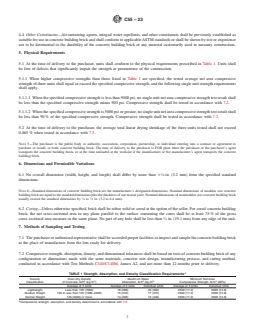
5.1 At the time of delivery to the purchaser, units shall conform to the physical requirements prescribed in Table 1. Units shall
be free of defects that significantly impair the strength or permanence of the construction.
5.1.1 When higher compressive strengths than those listed in Table 1 are specified, the tested average net area compressive
strength of three units shall equal or exceed the specified compressive strength, and the following single unit strength requirements
shall apply.
...