

ASTM C1623-23
(Specification)Standard Specification for Manufactured Concrete Masonry Lintels
General Information
- Abstract
ABSTRACT
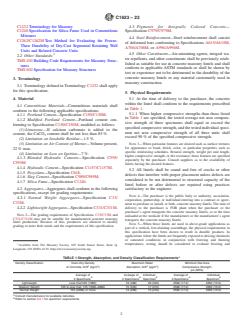
This specification covers concrete masonry lintels (beams) that are solid in cross-section, are reinforced for flexure, and are made from hydraulic cement, water, and mineral aggregates with or without the inclusion of other materials. These lintels are suitable for both loadbearing and nonloadbearing applications. Compression and absorption tests shall be performed to meet the specified requirements.
SCOPE
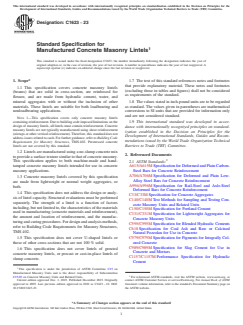
1.1 This specification covers concrete masonry lintels (beams) that are solid in cross-section, are reinforced for flexure, and are made from hydraulic cement, water, and mineral aggregates with or without the inclusion of other materials. These lintels are suitable for both loadbearing and nonloadbearing applications.
Note 1: This specification covers only concrete masonry lintels containing reinforcement. Due to building code imposed limitations on the design of masonry lintels, all lintels must contain reinforcement. Concrete masonry lintels are not typically manufactured using shear reinforcement (stirrups or other vertical reinforcement). Therefore, this standard does not address issues related to such. For further guidance, refer to Building Code Requirements for Masonry Structures, TMS 402. Prestressed concrete lintels are not covered by this standard.
1.2 Lintels are manufactured using a no-slump concrete mix to provide a surface texture similar to that of concrete masonry. This specification applies to both machine-made and hand-tamped concrete masonry lintels intended for use in concrete masonry applications.
1.3 Concrete masonry lintels covered by this specification are made from lightweight or normal weight aggregates, or both.
1.4 This specification does not address the design or analysis of lintel capacity. Structural evaluations must be performed separately. The strength of a lintel is a function of factors including, but not limited to, the characteristics of the materials used in manufacturing (concrete materials and reinforcement), the amount and location of reinforcement, and the manufacturing and curing procedures. For design and analysis methods, refer to Building Code Requirements for Masonry Structures, TMS 402.
1.5 This specification does not cover U-shaped lintels or those of other cross-sections that are not 100 % solid.
1.6 This specification does not cover lintels of grouted concrete masonry lintels, or precast or cast-in-place lintels of slump concrete.
1.7 The text of this standard references notes and footnotes that provide explanatory material. These notes and footnotes (excluding those in tables and figures) shall not be considered as requirements of the standard.
1.8 The values stated in inch-pound units are to be regarded as standard. The values given in parentheses are mathematical conversions to SI units that are provided for information only and are not considered standard.
1.9 This international standard was developed in accordance with internationally recognized principles on standardization established in the Decision on Principles for the Development of International Standards, Guides and Recommendations issued by the World Trade Organization Technical Barriers to Trade (TBT) Committee.
- Status
- Published
- Publication Date
- 30-Nov-2023
- Technical Committee
- C15 - Masonry – Manufactured Masonry Units, Mortars and Grouts
- Drafting Committee
- C15.03 - Concrete Masonry Units and Related Units
Buy Documents
ASTM C1623-23 - Standard Specification for Manufactured Concrete Masonry Lintels
REDLINE ASTM C1623-23 - Standard Specification for Manufactured Concrete Masonry Lintels
Overview
ASTM C1623-23: Standard Specification for Manufactured Concrete Masonry Lintels establishes comprehensive requirements for the production and quality assurance of solid, reinforced concrete lintels used in masonry construction. These lintels, manufactured from hydraulic cement, water, and mineral aggregates-with or without additional materials-are designed for both loadbearing and nonloadbearing applications. This ASTM specification promotes consistency, safety, and quality in the manufacture and utilization of concrete masonry lintels in the construction industry.
Key Topics
Scope and Coverage
- Applies to lintels (beams) that are solid in cross-section and reinforced for flexure.
- Encompasses both light and normal weight aggregate-based lintels.
- Excludes U-shaped lintels, non-solid cross-sections, grouted lintels, and prestressed or slump concrete products.
Material Requirements
- Specifies accepted cementitious materials, including portland cement and various blended cements.
- Outlines requirements for aggregates, pigments, and steel reinforcement.
- Details proper use and documentation of additives such as air entrainers and water repellents.
Physical and Performance Criteria
- Requires lintels to meet minimum compressive strength and maximum water absorption thresholds based on density classification (lightweight, medium weight, normal weight).
- Sets dimensional tolerances for width, height, length, and warpage to ensure proper fit and function.
- Mandates that lintels are free from detrimental cracks and defects.
Testing and Compliance
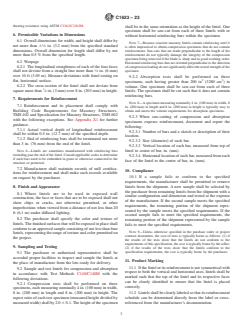
- Details requirements for sampling and testing, including compressive strength and absorption using standardized ASTM methods.
- Explains procedures for compliance and retesting if a shipment fails to meet specifications.
Reinforcement Specification
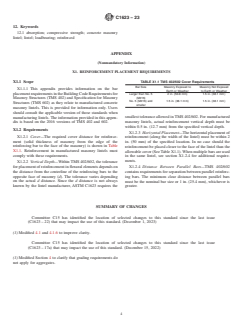
- All lintels must contain flexural reinforcement aligned with TMS 402 and TMS 602 requirements.
- Placement tolerances, bar cover distances, and documentation are clearly defined to ensure structural adequacy.
Finish and Marking
- Requirements for finish, color, and texture are to be specified by the purchaser to ensure appearance requirements are met for exposed applications.
- Prescribes product marking for identifiability and installation accuracy.
Applications
Manufactured concrete masonry lintels specified by ASTM C1623-23 are widely used in both structural and architectural masonry construction. Typical applications include:
- Loadbearing and nonloadbearing wall openings
- Support for masonry over doors, windows, and other architectural openings.
- Residential, commercial, and infrastructure projects
- Lintels help transfer loads above wall openings, ensuring building integrity and safety.
- Exterior and interior wall systems
- Use in exposed and concealed locations with specific requirements for finish and durability.
- Environments requiring durability
- Suitable for above-grade applications as part of vertical, free-draining assemblies; additional freeze-thaw resistance testing may be recommended for severe exposure conditions.
Choosing lintels complying with ASTM C1623-23 ensures builders and specifiers that the products meet agreed standards for strength, absorption, dimensional tolerances, and reinforcement integrity.
Related Standards
- TMS 402 - Building Code Requirements for Masonry Structures
- TMS 602 - Specification for Masonry Structures
- ASTM C33/C33M - Standard Specification for Concrete Aggregates
- ASTM C140/C140M - Standard Test Methods for Sampling and Testing Concrete Masonry Units and Related Units
- ASTM C150/C150M - Standard Specification for Portland Cement
- ASTM A615/A615M - Standard Specification for Deformed and Plain Carbon-Steel Bars for Concrete Reinforcement
Adherence to these related masonry and concrete standards, in conjunction with ASTM C1623-23, supports a resilient and standardized approach to structural masonry design and construction. For detailed design or analysis, consult the referenced masonry codes and standards.
Keywords: ASTM C1623-23, concrete masonry lintels, reinforced lintels, masonry construction, structural lintels, building standards, masonry codes, lintel performance, material requirements, compression testing, absorption testing.
Relations
- Effective Date
- 01-Dec-2023
- Effective Date
- 01-Feb-2024
- Effective Date
- 15-Dec-2023
- Effective Date
- 01-Dec-2023
- Effective Date
- 01-Jun-2023
- Effective Date
- 01-Jul-2022
- Effective Date
- 01-Dec-2021
- Effective Date
- 15-Jan-2016
- Effective Date
- 01-Dec-2023
Buy Documents
ASTM C1623-23 - Standard Specification for Manufactured Concrete Masonry Lintels
REDLINE ASTM C1623-23 - Standard Specification for Manufactured Concrete Masonry Lintels
Get Certified
Connect with accredited certification bodies for this standard

DIBt (Deutsches Institut für Bautechnik)
German Institute for Building Technology.
DIN CERTCO
DIN Group product certification.

Aboma Certification B.V.
Specialized in construction, metal, and transport sectors.
Sponsored listings
Frequently Asked Questions
ASTM C1623-23 is a technical specification published by ASTM International. Its full title is "Standard Specification for Manufactured Concrete Masonry Lintels". This standard covers: ABSTRACT This specification covers concrete masonry lintels (beams) that are solid in cross-section, are reinforced for flexure, and are made from hydraulic cement, water, and mineral aggregates with or without the inclusion of other materials. These lintels are suitable for both loadbearing and nonloadbearing applications. Compression and absorption tests shall be performed to meet the specified requirements. SCOPE 1.1 This specification covers concrete masonry lintels (beams) that are solid in cross-section, are reinforced for flexure, and are made from hydraulic cement, water, and mineral aggregates with or without the inclusion of other materials. These lintels are suitable for both loadbearing and nonloadbearing applications. Note 1: This specification covers only concrete masonry lintels containing reinforcement. Due to building code imposed limitations on the design of masonry lintels, all lintels must contain reinforcement. Concrete masonry lintels are not typically manufactured using shear reinforcement (stirrups or other vertical reinforcement). Therefore, this standard does not address issues related to such. For further guidance, refer to Building Code Requirements for Masonry Structures, TMS 402. Prestressed concrete lintels are not covered by this standard. 1.2 Lintels are manufactured using a no-slump concrete mix to provide a surface texture similar to that of concrete masonry. This specification applies to both machine-made and hand-tamped concrete masonry lintels intended for use in concrete masonry applications. 1.3 Concrete masonry lintels covered by this specification are made from lightweight or normal weight aggregates, or both. 1.4 This specification does not address the design or analysis of lintel capacity. Structural evaluations must be performed separately. The strength of a lintel is a function of factors including, but not limited to, the characteristics of the materials used in manufacturing (concrete materials and reinforcement), the amount and location of reinforcement, and the manufacturing and curing procedures. For design and analysis methods, refer to Building Code Requirements for Masonry Structures, TMS 402. 1.5 This specification does not cover U-shaped lintels or those of other cross-sections that are not 100 % solid. 1.6 This specification does not cover lintels of grouted concrete masonry lintels, or precast or cast-in-place lintels of slump concrete. 1.7 The text of this standard references notes and footnotes that provide explanatory material. These notes and footnotes (excluding those in tables and figures) shall not be considered as requirements of the standard. 1.8 The values stated in inch-pound units are to be regarded as standard. The values given in parentheses are mathematical conversions to SI units that are provided for information only and are not considered standard. 1.9 This international standard was developed in accordance with internationally recognized principles on standardization established in the Decision on Principles for the Development of International Standards, Guides and Recommendations issued by the World Trade Organization Technical Barriers to Trade (TBT) Committee.
ABSTRACT This specification covers concrete masonry lintels (beams) that are solid in cross-section, are reinforced for flexure, and are made from hydraulic cement, water, and mineral aggregates with or without the inclusion of other materials. These lintels are suitable for both loadbearing and nonloadbearing applications. Compression and absorption tests shall be performed to meet the specified requirements. SCOPE 1.1 This specification covers concrete masonry lintels (beams) that are solid in cross-section, are reinforced for flexure, and are made from hydraulic cement, water, and mineral aggregates with or without the inclusion of other materials. These lintels are suitable for both loadbearing and nonloadbearing applications. Note 1: This specification covers only concrete masonry lintels containing reinforcement. Due to building code imposed limitations on the design of masonry lintels, all lintels must contain reinforcement. Concrete masonry lintels are not typically manufactured using shear reinforcement (stirrups or other vertical reinforcement). Therefore, this standard does not address issues related to such. For further guidance, refer to Building Code Requirements for Masonry Structures, TMS 402. Prestressed concrete lintels are not covered by this standard. 1.2 Lintels are manufactured using a no-slump concrete mix to provide a surface texture similar to that of concrete masonry. This specification applies to both machine-made and hand-tamped concrete masonry lintels intended for use in concrete masonry applications. 1.3 Concrete masonry lintels covered by this specification are made from lightweight or normal weight aggregates, or both. 1.4 This specification does not address the design or analysis of lintel capacity. Structural evaluations must be performed separately. The strength of a lintel is a function of factors including, but not limited to, the characteristics of the materials used in manufacturing (concrete materials and reinforcement), the amount and location of reinforcement, and the manufacturing and curing procedures. For design and analysis methods, refer to Building Code Requirements for Masonry Structures, TMS 402. 1.5 This specification does not cover U-shaped lintels or those of other cross-sections that are not 100 % solid. 1.6 This specification does not cover lintels of grouted concrete masonry lintels, or precast or cast-in-place lintels of slump concrete. 1.7 The text of this standard references notes and footnotes that provide explanatory material. These notes and footnotes (excluding those in tables and figures) shall not be considered as requirements of the standard. 1.8 The values stated in inch-pound units are to be regarded as standard. The values given in parentheses are mathematical conversions to SI units that are provided for information only and are not considered standard. 1.9 This international standard was developed in accordance with internationally recognized principles on standardization established in the Decision on Principles for the Development of International Standards, Guides and Recommendations issued by the World Trade Organization Technical Barriers to Trade (TBT) Committee.
ASTM C1623-23 is classified under the following ICS (International Classification for Standards) categories: 91.100.30 - Concrete and concrete products. The ICS classification helps identify the subject area and facilitates finding related standards.
ASTM C1623-23 has the following relationships with other standards: It is inter standard links to ASTM C1623-22, ASTM C989/C989M-24, ASTM C1232-23, ASTM C140/C140M-23a, ASTM C140/C140M-23, ASTM C989/C989M-22, ASTM C1232-21a, ASTM A706/A706M-16, ASTM C1922-23. Understanding these relationships helps ensure you are using the most current and applicable version of the standard.
ASTM C1623-23 is available in PDF format for immediate download after purchase. The document can be added to your cart and obtained through the secure checkout process. Digital delivery ensures instant access to the complete standard document.
Standards Content (Sample)
This international standard was developed in accordance with internationally recognized principles on standardization established in the Decision on Principles for the
Development of International Standards, Guides and Recommendations issued by the World Trade Organization Technical Barriers to Trade (TBT) Committee.
Designation: C1623 − 23
Standard Specification for
Manufactured Concrete Masonry Lintels
This standard is issued under the fixed designation C1623; the number immediately following the designation indicates the year of
original adoption or, in the case of revision, the year of last revision. A number in parentheses indicates the year of last reapproval. A
superscript epsilon (´) indicates an editorial change since the last revision or reapproval.
1. Scope* 1.7 The text of this standard references notes and footnotes
that provide explanatory material. These notes and footnotes
1.1 This specification covers concrete masonry lintels
(excluding those in tables and figures) shall not be considered
(beams) that are solid in cross-section, are reinforced for
as requirements of the standard.
flexure, and are made from hydraulic cement, water, and
mineral aggregates with or without the inclusion of other 1.8 The values stated in inch-pound units are to be regarded
materials. These lintels are suitable for both loadbearing and as standard. The values given in parentheses are mathematical
nonloadbearing applications. conversions to SI units that are provided for information only
and are not considered standard.
NOTE 1—This specification covers only concrete masonry lintels
containing reinforcement. Due to building code imposed limitations on the 1.9 This international standard was developed in accor-
design of masonry lintels, all lintels must contain reinforcement. Concrete
dance with internationally recognized principles on standard-
masonry lintels are not typically manufactured using shear reinforcement
ization established in the Decision on Principles for the
(stirrups or other vertical reinforcement). Therefore, this standard does not
Development of International Standards, Guides and Recom-
address issues related to such. For further guidance, refer to Building Code
mendations issued by the World Trade Organization Technical
Requirements for Masonry Structures, TMS 402. Prestressed concrete
lintels are not covered by this standard. Barriers to Trade (TBT) Committee.
1.2 Lintels are manufactured using a no-slump concrete mix
2. Referenced Documents
to provide a surface texture similar to that of concrete masonry.
This specification applies to both machine-made and hand-
2.1 ASTM Standards:
tamped concrete masonry lintels intended for use in concrete A615/A615M Specification for Deformed and Plain Carbon-
masonry applications.
Steel Bars for Concrete Reinforcement
A706/A706M Specification for Deformed and Plain Low-
1.3 Concrete masonry lintels covered by this specification
Alloy Steel Bars for Concrete Reinforcement
are made from lightweight or normal weight aggregates, or
A996/A996M Specification for Rail-Steel and Axle-Steel
both.
Deformed Bars for Concrete Reinforcement
1.4 This specification does not address the design or analy-
C33/C33M Specification for Concrete Aggregates
sis of lintel capacity. Structural evaluations must be performed
C140/C140M Test Methods for Sampling and Testing Con-
separately. The strength of a lintel is a function of factors
crete Masonry Units and Related Units
including, but not limited to, the characteristics of the materials
C150/C150M Specification for Portland Cement
used in manufacturing (concrete materials and reinforcement),
C331/C331M Specification for Lightweight Aggregates for
the amount and location of reinforcement, and the manufac-
Concrete Masonry Units
turing and curing procedures. For design and analysis methods,
C595/C595M Specification for Blended Hydraulic Cements
refer to Building Code Requirements for Masonry Structures,
C618 Specification for Coal Ash and Raw or Calcined
TMS 402.
Natural Pozzolan for Use in Concrete
1.5 This specification does not cover U-shaped lintels or C979/C979M Specification for Pigments for Integrally Col-
those of other cross-sections that are not 100 % solid. ored Concrete
C989/C989M Specification for Slag Cement for Use in
1.6 This specification does not cover lintels of grouted
Concrete and Mortars
concrete masonry lintels, or precast or cast-in-place lintels of
C1157/C1157M Performance Specification for Hydraulic
slump concrete.
Cement
This specification is under the jurisdiction of ASTM Committee C15 on
Manufactured Masonry Units and is the direct responsibility of Subcommittee
C15.03 on Concrete Masonry Units and Related Units. For referenced ASTM standards, visit the ASTM website, www.astm.org, or
Current edition approved Dec. 1, 2023. Published December 2023. Originally contact ASTM Customer Service at service@astm.org. For Annual Book of ASTM
approved in 2005. Last previous edition approved in 2022 as C1623 – 22. DOI: Standards volume information, refer to the standard’s Document Summary page on
10.1520/C1623-23. the ASTM website.
*A Summary of Changes section appears at the end of this standard
Copyright © ASTM International, 100 Barr Harbor Drive, PO Box C700, West Conshohocken, PA 19428-2959. United States
C1623 − 23
C1232 Terminology for Masonry 4.3 Pigments for Integrally Colored Concrete—
C1240 Specification for Silica Fume Used in Cementitious Specification C979/C979M.
Mixtures
4.4 Steel Reinforcement—Steel reinforcement shall consist
C1262/C1262M Test Method for Evaluating the Freeze-
of deformed bars conforming to Specifications A615/A615M,
Thaw Durability of Dry-Cast Segmental Retaining Wall
A706/A706M, or A996/A996M.
Units and Related Concrete Units
4.5 Other Constituents—Air-entraining agents, integral wa-
2.2 Other Standards:
ter repellents, and other constituents shall be previously estab-
TMS 402 Building Code Requirements for Masonry Struc-
lished as suitable for use in concrete masonry lintels and shall
tures
conform to applicable ASTM standards or shall be shown by
TMS 602 Specification for Masonry Structures
test or experience not to be detrimental to the durability of the
concrete masonry lintels or any material customarily used in
3. Terminology
masonry construction.
3.1 Terminology defined in Terminology C1232 shall apply
for this specification.
5. Physical Requirements
5.1 At the time of delivery to the purchaser, the concrete
4. Material
within the lintel shall conform to the requirements prescribed
4.1 Cementitious Materials—Cementitious materials shall
in Table 1.
conform to the following applicable specifications:
5.1.1 When higher compressive strengths than those listed
4.1.1 Portland Cement—Specification C150/C150M.
in Table 1 are specified, the tested average net area compres-
4.1.2 Modified Portland Cement—Portland cement con-
sive strength of three specimens shall equal or exceed the
forming to Specification C150/C150M, modified as follows:
specified compressive strength, and the tested individual speci-
(1) Limestone—If calcium carbonate is added to the
men net area compressive strength of all three units shall
cement, the CaCO content shall be not less than 85 %.
exceed 90 % of the specified compressive strength.
(2) Limitation on Insoluble Residue—1.5 %.
(3) Limitation on Air Content of Mortar—Volume percent,
NOTE 3—When particular features are desired such as surface textures
for appearance or bond, finish, color, or particular properties such as
22 % max.
specific reinforcing schedules, flexural strength, weight per unit length,
(4) Limitation on Loss on Ignition—7 %.
higher compressive strength, or fire resistance, these features are specified
4.1.3 Blended Hydraulic Cements—Specification C595/
separately by the purchaser. Consult suppliers as to the availability of
C595M
lintels having the desired features.
4.1.4 Hydraulic Cement—Specification C1157/C1157M.
5.2 All lintels shall be sound and free of cracks or other
4.1.5 Pozzolans—Specification C618.
defects that interfere with proper placement unless defects are
4.1.6 Slag Cement—Specification C989/C989M.
considered to be not detrimental to structural capacity of the
4.1.7 Silica Fume—Specification C1240.
lintel before or after defects are repaired using practices
4.2 Aggregates—Aggregates shall conform to the following
satisfactory to the engineer.
specifications, except for grading requirements:
NOTE 4—The purchaser is the public body or authority, association,
4.2.1 Normal Weight Aggregates—Specification C33/
corporation, partnership, or individual entering into a contract or agree-
C33M.
ment to purchase or install, or both, concrete masonry lintels. The time of
4.2.2 Lightweight Aggregates—Specification C331/C331M.
delivery to the purchaser is FOB plant when the purchaser or the
purchaser’s agent transports the concrete masonry lintels, or at the time
NOTE 2—The grading requirements of Specifications C33/C33M and
unloaded at the worksite if the manufacturer or the manufacturer’s agent
C331/C331M may not be suitable for manufactured concrete masonry
transports the concrete masonry lintels.
lintel production. Because of this, producers are allowed to modify
NOTE 5—When these lintels are used in above-grade applications as
grading to meet their needs and the requirements of this specification.
part of a vertical, free-draining assemblage, the physical requirements in
this specification have been shown to result in durable products. In
applications where the lintels are frequently exposed to deicing chemicals
or saturated conditions in conjunction with freezing and thawing
3 temperatures, testing should be considered to evaluate freezing and
Available from The Masonry Society, 105 South Sunset Street, Suite Q,
Longmont, CO 80501–6172, https://www.masonrysociety.org.
A
TABLE 1 Strength, Absorption, and Density Classification Requirements
Density Classification Oven-Dry Density Maximum Water Minimum Net Area
3 3 3 3
of Concrete, lb/ft (kg/m ) Absorption, lb/ft (kg/m ) Compressive Strength,
psi (MPa)
Average of Average of Individual Average of Individual
B B B B B
3 Specimens 3 Specimens Specimen 3 Specimens Specimen
Lightweight Less than105 (1680) 18 (288) 20 (320) 2500 (17.2) 2250 (15.5)
Medium Weight 105 to less than 125 (1680–2000) 15 (240) 17 (272) 2500 (17.2) 2250 (15.5)
Normal Weight 125 (2000) or more 13 (208) 15 (240) 2500 (17.2) 2250 (15.5)
A
Consult manufacturers for available densities.
B
Refer to section 9.2.1 for spec
...
This document is not an ASTM standard and is intended only to provide the user of an ASTM standard an indication of what changes have been made to the previous version. Because
it may not be technically possible to adequately depict all changes accurately, ASTM recommends that users consult prior editions as appropriate. In all cases only the current version
of the standard as published by ASTM is to be considered the official document.
Designation: C1623 − 22 C1623 − 23
Standard Specification for
Manufactured Concrete Masonry Lintels
This standard is issued under the fixed designation C1623; the number immediately following the designation indicates the year of
original adoption or, in the case of revision, the year of last revision. A number in parentheses indicates the year of last reapproval. A
superscript epsilon (´) indicates an editorial change since the last revision or reapproval.
1. Scope*
1.1 This specification covers concrete masonry lintels (beams) that are solid in cross-section, are reinforced for flexure, and are
made from hydraulic cement, water, and mineral aggregates with or without the inclusion of other materials. These lintels are
suitable for both loadbearing and nonloadbearing applications.
NOTE 1—This specification covers only concrete masonry lintels containing reinforcement. Due to building code imposed limitations on the design of
masonry lintels, all lintels must contain reinforcement. Concrete masonry lintels are not typically manufactured using shear reinforcement (stirrups or
other vertical reinforcement). Therefore, this standard does not address issues related to such. For further guidance, refer to Building Code Requirements
for Masonry Structures, TMS 402. Prestressed concrete lintels are not covered by this standard.
1.2 Lintels are manufactured using a no-slump concrete mix to provide a surface texture similar to that of concrete masonry. This
specification applies to both machine-made and hand-tamped concrete masonry lintels intended for use in concrete masonry
applications.
1.3 Concrete masonry lintels covered by this specification are made from lightweight or normal weight aggregates, or both.
1.4 This specification does not address the design or analysis of lintel capacity. Structural evaluations must be performed
separately. The strength of a lintel is a function of factors including, but not limited to, the characteristics of the materials used
in manufacturing (concrete materials and reinforcement), the amount and location of reinforcement, and the manufacturing and
curing procedures. For design and analysis methods, refer to Building Code Requirements for Masonry Structures, TMS 402.
1.5 This specification does not cover U-shaped lintels or those of other cross-sections that are not 100 % solid.
1.6 This specification does not cover lintels of grouted concrete masonry lintels, or precast or cast-in-place lintels of slump
concrete.
1.7 The text of this standard references notes and footnotes that provide explanatory material. These notes and footnotes
(excluding those in tables and figures) shall not be considered as requirements of the standard.
1.8 The values stated in inch-pound units are to be regarded as standard. The values given in parentheses are mathematical
conversions to SI units that are provided for information only and are not considered standard.
This specification is under the jurisdiction of ASTM Committee C15 on Manufactured Masonry Units and is the direct responsibility of Subcommittee C15.03 on
Concrete Masonry Units and Related Units.
Current edition approved Dec. 15, 2022Dec. 1, 2023. Published January 2023December 2023. Originally approved in 2005. Last previous edition approved in 20172022
as C1623 – 17a.C1623 – 22. DOI: 10.1520/C1623-23.
*A Summary of Changes section appears at the end of this standard
Copyright © ASTM International, 100 Barr Harbor Drive, PO Box C700, West Conshohocken, PA 19428-2959. United States
C1623 − 23
1.9 This international standard was developed in accordance with internationally recognized principles on standardization
established in the Decision on Principles for the Development of International Standards, Guides and Recommendations issued
by the World Trade Organization Technical Barriers to Trade (TBT) Committee.
2. Referenced Documents
2.1 ASTM Standards:
A615/A615M Specification for Deformed and Plain Carbon-Steel Bars for Concrete Reinforcement
A706/A706M Specification for Deformed and Plain Low-Alloy Steel Bars for Concrete Reinforcement
A996/A996M Specification for Rail-Steel and Axle-Steel Deformed Bars for Concrete Reinforcement
C33/C33M Specification for Concrete Aggregates
C140/C140M Test Methods for Sampling and Testing Concrete Masonry Units and Related Units
C150/C150M Specification for Portland Cement
C331/C331M Specification for Lightweight Aggregates for Concrete Masonry Units
C595/C595M Specification for Blended Hydraulic Cements
C618 Specification for Coal Ash and Raw or Calcined Natural Pozzolan for Use in Concrete
C979/C979M Specification for Pigments for Integrally Colored Concrete
C989/C989M Specification for Slag Cement for Use in Concrete and Mortars
C1157/C1157M Performance Specification for Hydraulic Cement
C1232 Terminology for Masonry
C1240 Specification for Silica Fume Used in Cementitious Mixtures
C1262/C1262M Test Method for Evaluating the Freeze-Thaw Durability of Dry-Cast Segmental Retaining Wall Units and
Related Concrete Units
2.2 Other Standards:
TMS 402 Building Code Requirements for Masonry Structures
TMS 602 Specification for Masonry Structures
3. Terminology
3.1 Terminology defined in Terminology C1232 shall apply for this specification.
4. Material
4.1 Cementitious Materials—Materials Cementitious materials shall conform to the following applicable specifications:
4.1.1 Portland Cement—Specification C150/C150M.
4.1.2 Modified Portland Cement—Portland cement conforming to Specification C150/C150M, modified as follows:
(1) Limestone—If calcium carbonate is added to the cement, the CaCO content shall be not less than 85 %.
(2) Limitation on Insoluble Residue—1.5 %.
(3) Limitation on Air Content of Mortar—Volume percent, 22 % max.
(4) Limitation on Loss on Ignition—7 %.
4.1.3 Blended Hydraulic Cements—Specification C595/C595M
4.1.4 Hydraulic Cement—Specification C1157/C1157M.
4.1.5 Pozzolans—Specification C618.
4.1.6 Blast Furnace Slag Cement—Specification C989/C989M.
4.1.7 Silica Fume—Specification C1240.
4.2 Aggregates—Aggregates shall conform to the following specifications, except for grading requirements:
For referenced ASTM standards, visit the ASTM website, www.astm.org, or contact ASTM Customer Service at service@astm.org. For Annual Book of ASTM Standards
volume information, refer to the standard’s Document Summary page on the ASTM website.
Available from The Masonry Society, 105 South Sunset Street, Suite Q, Longmont, CO 80501–6172, https://www.masonrysociety.org.
C1623 − 23
4.2.1 Normal Weight Aggregates—Specification C33/C33M.
4.2.2 Lightweight Aggregates—Specification C331/C331M.
NOTE 2—The grading requirements of Specifications C33/C33M and C331/C331M may not be suitable for manufactured concrete masonry lintel
production. Because of this, producers are allowed to modify grading to meet their needs and the requirements of this specification.
4.3 Pigments for Integrally Colored Concrete—Specification C979/C979M.
4.4 Steel Reinforcement—Steel reinforcement shall consist of deformed bars conforming to Specifications A615/A615M,
A706/A706M, or A996/A996M.
4.5 Other Constituents—Air-entraining agents, integral water repellents, and other constituents shall be previously established as
suitable for use in concrete masonry lintels and shall conform to applicable ASTM standards or shall be shown by test or
experience not to be detrimental to the durability of the concrete masonry lintels or any material customarily used in masonry
construction.
5. Physical Requirements
5.1 At the time of delivery to the purchaser, the concrete within the lintel shall conform to the requirements prescribed in Table
1.
5.1.1 When higher compressive strengths than those listed in Table 1 are specified, the tested average net area compressive
strength of three specimens shall equal or exceed the specified compressive strength, and the tested individual specimen net area
compressive strength of all three units shall exceed 90 % of the specified compressive strength.
NOTE 3—When particular features are desired such as surface textures for appearance or bond, finish, color, or particular properties such as specific
reinforcing schedules, flexural strength, weight per unit length, higher compressive strength, or fire resistance, these features are specified separately by
the purchaser. Consult suppliers as to the availability of lintels having the desired features.
5.2 All lintels shall be sound and free of cracks or other defects that interfere with proper placement unless defects are considered
to be not detrimental to structural capacity of the lintel before or after defects are repaired using practices satisfactory to the
engineer.
NOTE 4—The purchaser is the public body or authority, association, corporation, partnership, or individual entering into a contract or agreement to
purchase or install, or both, concrete masonry lintels. The time of delivery to the purchaser is FOB plant when the purchaser or the purchaser’s agent
transports the concrete masonry lintels, or at the time unloaded at the worksite if the manufacturer or the manufacturer’s agent transports the concrete
masonry lintels.
NOTE 5—When these lintels are used in above-grade applications as part of a vertical, free-draining assemblage, the physical requirements in this
specification have been shown to result in durable products. In applications where the lintels are frequently exposed to deicing chemicals or saturated
conditions in conjunction with freezing and thawing temperatures, testing should be considered to evaluate freezing and thawing resistance using ASTM
C1262/C1262M.
A
TABLE 1 Strength, Absorption, and Density Classification Requirements
Density Classification Oven-Dry Density Maximum Water Minimum Net Area
3 3 3 3
of Concrete, lb/ft (kg/m ) Absorption, lb/ft (kg/m ) Compressive Strength,
psi (MPa)
Average of Average of Individual Average of Individual
B B B B B
3 Specimens 3 Specimens Specimen 3 Specimens Specimen
Lightweight Less than105 (1680) 18 (288) 20 (320) 2500 (17.2) 2250 (15.5)
Medium Weight 105 to less than 125 (1680–2000) 15 (240) 17 (272) 2500 (17.2) 2250 (15.5)
...