

ASTM C426-23
(Test Method)Standard Test Method for Linear Drying Shrinkage of Concrete Masonry Units
General Information
- Abstract
SIGNIFICANCE AND USE
4.1 This test method is intended to evaluate the drying shrinkage characteristics of a given unit. The results of this laboratory method are considered in determining concrete masonry crack control provisions.
Note 1: The testing laboratory performing this test method should be evaluated in accordance with Practice C1093.
SCOPE
1.1 This test method covers a routine standardized procedure for determining the linear drying shrinkage of concrete masonry units or related concrete units under specified accelerated drying conditions.
1.2 The text of this test method references notes and footnotes that provide explanatory material. These notes and footnotes (excluding those in tables and figures) shall not be considered as requirements of the standard.
1.3 The values stated in inch-pound units are to be regarded as standard. The values given in parentheses are mathematical conversions to SI units that are provided for information only and are not considered standard.
1.4 This standard does not purport to address all of the safety concerns, if any, associated with its use. It is the responsibility of the user of this standard to establish appropriate safety, health, and environmental practices and determine the applicability of regulatory limitations prior to use.
1.5 This international standard was developed in accordance with internationally recognized principles on standardization established in the Decision on Principles for the Development of International Standards, Guides and Recommendations issued by the World Trade Organization Technical Barriers to Trade (TBT) Committee.
- Status
- Published
- Publication Date
- 31-May-2023
- Technical Committee
- C15 - Masonry – Manufactured Masonry Units, Mortars and Grouts
- Drafting Committee
- C15.03 - Concrete Masonry Units and Related Units
Overview
ASTM C426-23 - Standard Test Method for Linear Drying Shrinkage of Concrete Masonry Units - is a critical standard developed by ASTM International for assessing the dimensional stability of concrete masonry units (CMUs) and related concrete products. This standard outlines a laboratory procedure for determining the linear drying shrinkage experienced by these units when exposed to specified accelerated drying conditions. The results are essential for evaluating crack control and ensuring the longevity of masonry structures.
Key Topics
- Linear Drying Shrinkage: Measures the change in length of concrete masonry units from a saturated condition to equilibrium under accelerated drying, providing insight into potential volume changes and movement in masonry assemblies.
- Test Apparatus & Specimens:
- Use of precision strain gauges or comparators to monitor length changes.
- Requirements for oven drying at controlled temperature and humidity.
- Methods for preparing, cutting, and handling test specimens to ensure accuracy.
- Test Procedure:
- Saturation of specimens in water followed by careful drying and periodic length measurement.
- Criteria for determining when specimens reach equilibrium as defined by minimal further change in dimension and weight.
- Reporting Results: Standardized calculation and reporting formats for linear drying shrinkage, including data on specimen identification, age, test conditions, and equilibrium shrinkage values.
- Significance for Quality Control: Enables manufacturers and engineers to anticipate shrinkage-related cracking and implement effective crack control measures.
Applications
Testing in accordance with ASTM C426-23 is widely used for:
- Quality Assurance: Ensuring that concrete masonry products meet dimensional stability criteria before use in construction.
- Research & Development: Comparing the performance of different CMU formulations, aggregates, or admixtures in minimizing shrinkage.
- Code Compliance: Providing shrinkage data required for compliance with building codes and standards for concrete masonry construction.
- Crack Control Design: Informing engineering decisions on the placement of control joints and reinforcement to mitigate the risk of shrinkage cracking in masonry walls.
- Specification Writing: Allowing architects and engineers to specify allowable shrinkage limits for projects, enhancing durability and performance.
Related Standards
The following standards and references are commonly used alongside ASTM C426-23:
- ASTM C490/C490M: Practice for Use of Apparatus for the Determination of Length Change of Hardened Cement Paste, Mortar, and Concrete.
- ASTM C1093: Practice for Accreditation of Testing Agencies for Masonry.
- ASTM C1232: Terminology for Masonry.
- ANSI B94.11M: Standard for Twist Drills (relevant for specimen preparation).
Practical Value
Adhering to ASTM C426-23 provides stakeholders in the concrete masonry industry with a reliable and standardized approach to measure and control drying shrinkage. This contributes to reduced risk of unsightly or structural cracking, leading to higher-quality and more durable masonry constructions. Accurate shrinkage data supports product innovation, regulatory compliance, and project-specific requirements, ultimately benefiting manufacturers, specifiers, and end-users committed to robust and sustainable built environments.
Keywords: ASTM C426-23, linear drying shrinkage, concrete masonry units, CMU testing, crack control, drying oven, strain gauge, comparator, masonry standards, dimensional stability.
Relations
- Effective Date
- 15-Dec-2023
- Effective Date
- 01-Jun-2017
- Effective Date
- 15-Dec-2015
- Effective Date
- 15-Dec-2015
- Effective Date
- 01-Sep-2015
- Effective Date
- 01-Jun-2015
- Effective Date
- 01-Jun-2015
- Effective Date
- 15-Dec-2013
- Effective Date
- 15-Dec-2013
- Effective Date
- 01-Jul-2013
- Effective Date
- 01-Jul-2012
- Effective Date
- 01-Jun-2012
- Effective Date
- 01-Oct-2011
- Effective Date
- 01-Oct-2011
- Effective Date
- 01-Jun-2011
Get Certified
Connect with accredited certification bodies for this standard

DIBt (Deutsches Institut für Bautechnik)
German Institute for Building Technology.
DIN CERTCO
DIN Group product certification.

Aboma Certification B.V.
Specialized in construction, metal, and transport sectors.
Sponsored listings
Frequently Asked Questions
ASTM C426-23 is a standard published by ASTM International. Its full title is "Standard Test Method for Linear Drying Shrinkage of Concrete Masonry Units". This standard covers: SIGNIFICANCE AND USE 4.1 This test method is intended to evaluate the drying shrinkage characteristics of a given unit. The results of this laboratory method are considered in determining concrete masonry crack control provisions. Note 1: The testing laboratory performing this test method should be evaluated in accordance with Practice C1093. SCOPE 1.1 This test method covers a routine standardized procedure for determining the linear drying shrinkage of concrete masonry units or related concrete units under specified accelerated drying conditions. 1.2 The text of this test method references notes and footnotes that provide explanatory material. These notes and footnotes (excluding those in tables and figures) shall not be considered as requirements of the standard. 1.3 The values stated in inch-pound units are to be regarded as standard. The values given in parentheses are mathematical conversions to SI units that are provided for information only and are not considered standard. 1.4 This standard does not purport to address all of the safety concerns, if any, associated with its use. It is the responsibility of the user of this standard to establish appropriate safety, health, and environmental practices and determine the applicability of regulatory limitations prior to use. 1.5 This international standard was developed in accordance with internationally recognized principles on standardization established in the Decision on Principles for the Development of International Standards, Guides and Recommendations issued by the World Trade Organization Technical Barriers to Trade (TBT) Committee.
SIGNIFICANCE AND USE 4.1 This test method is intended to evaluate the drying shrinkage characteristics of a given unit. The results of this laboratory method are considered in determining concrete masonry crack control provisions. Note 1: The testing laboratory performing this test method should be evaluated in accordance with Practice C1093. SCOPE 1.1 This test method covers a routine standardized procedure for determining the linear drying shrinkage of concrete masonry units or related concrete units under specified accelerated drying conditions. 1.2 The text of this test method references notes and footnotes that provide explanatory material. These notes and footnotes (excluding those in tables and figures) shall not be considered as requirements of the standard. 1.3 The values stated in inch-pound units are to be regarded as standard. The values given in parentheses are mathematical conversions to SI units that are provided for information only and are not considered standard. 1.4 This standard does not purport to address all of the safety concerns, if any, associated with its use. It is the responsibility of the user of this standard to establish appropriate safety, health, and environmental practices and determine the applicability of regulatory limitations prior to use. 1.5 This international standard was developed in accordance with internationally recognized principles on standardization established in the Decision on Principles for the Development of International Standards, Guides and Recommendations issued by the World Trade Organization Technical Barriers to Trade (TBT) Committee.
ASTM C426-23 is classified under the following ICS (International Classification for Standards) categories: 91.100.30 - Concrete and concrete products. The ICS classification helps identify the subject area and facilitates finding related standards.
ASTM C426-23 has the following relationships with other standards: It is inter standard links to ASTM C1232-23, ASTM C1232-17, ASTM C1093-15ae1, ASTM C1093-15a, ASTM C1232-15a, ASTM C1093-15, ASTM C1232-15, ASTM C1093-13a, ASTM C1093-13ae1, ASTM C1093-13, ASTM C1093-12, ASTM C1232-12, ASTM C490/C490M-11, ASTM C490/C490M-11e1, ASTM C1093-11. Understanding these relationships helps ensure you are using the most current and applicable version of the standard.
ASTM C426-23 is available in PDF format for immediate download after purchase. The document can be added to your cart and obtained through the secure checkout process. Digital delivery ensures instant access to the complete standard document.
Standards Content (Sample)
This international standard was developed in accordance with internationally recognized principles on standardization established in the Decision on Principles for the
Development of International Standards, Guides and Recommendations issued by the World Trade Organization Technical Barriers to Trade (TBT) Committee.
Designation: C426 − 23
Standard Test Method for
Linear Drying Shrinkage of Concrete Masonry Units
This standard is issued under the fixed designation C426; the number immediately following the designation indicates the year of
original adoption or, in the case of revision, the year of last revision. A number in parentheses indicates the year of last reapproval. A
superscript epsilon (´) indicates an editorial change since the last revision or reapproval.
This standard has been approved for use by agencies of the U.S. Department of Defense.
1. Scope* C1232 Terminology for Masonry
2.2 ANSI Standard:
1.1 This test method covers a routine standardized proce-
B94.11M—1993 Twist Drills
dure for determining the linear drying shrinkage of concrete
masonry units or related concrete units under specified accel-
3. Terminology
erated drying conditions.
3.1 Terminology defined in Terminology C1232 shall apply
1.2 The text of this test method references notes and
for this test method.
footnotes that provide explanatory material. These notes and
footnotes (excluding those in tables and figures) shall not be
3.2 Definitions of Terms Specific to This Standard:
considered as requirements of the standard.
3.2.1 linear drying shrinkage, n—in this test method, the
change in linear dimension of the test specimen due to drying
1.3 The values stated in inch-pound units are to be regarded
from a saturated condition to an equilibrium weight and length
as standard. The values given in parentheses are mathematical
under specified accelerated drying conditions.
conversions to SI units that are provided for information only
and are not considered standard.
4. Significance and Use
1.4 This standard does not purport to address all of the
4.1 This test method is intended to evaluate the drying
safety concerns, if any, associated with its use. It is the
shrinkage characteristics of a given unit. The results of this
responsibility of the user of this standard to establish appro-
laboratory method are considered in determining concrete
priate safety, health, and environmental practices and deter-
masonry crack control provisions.
mine the applicability of regulatory limitations prior to use.
1.5 This international standard was developed in accor-
NOTE 1—The testing laboratory performing this test method should be
dance with internationally recognized principles on standard- evaluated in accordance with Practice C1093.
ization established in the Decision on Principles for the
5. Apparatus
Development of International Standards, Guides and Recom-
mendations issued by the World Trade Organization Technical
5.1 Strain Gauge—The instruments for measuring linear
Barriers to Trade (TBT) Committee.
drying shrinkage shall be so designed as to permit or provide
the conditions described in 5.1.1 through 5.1.5.
2. Referenced Documents
NOTE 2—Strain gauges may be obtained with various gauge lengths.
2.1 ASTM Standards:
The 10-in. (254-mm) gauge length is recommended for use with regular
C490/C490M Practice for Use of Apparatus for the Deter-
concrete masonry units, however, particular sizes of products may require
other lengths. The length of the shrinkage specimen shall not be less than
mination of Length Change of Hardened Cement Paste,
required for a minimum gauge length (distance between gauge plugs) of
Mortar, and Concrete
6 in. (152.4 mm).
C1093 Practice for Accreditation of Testing Agencies for
5.1.1 A means of positive contact with the specimen that
Masonry
will ensure reproducible measurements of length.
5.1.2 Means for precise measurement, consisting of a dial
This test method is under the jurisdiction of ASTM Committee C15 on
micrometer or other measuring device graduated to read in
Manufactured Masonry Units and is the direct responsibility of Subcommittee
0.0001-in. (0.0025-mm) units, and accurate within 0.0001 in.
C15.03 on Concrete Masonry Units and Related Units.
Current edition approved June 1, 2023. Published June 2023. Originally (0.0025 mm) in any 0.0010-in. (0.025-mm) range, and within
approved in 1958. Last previous edition approved in 2022 as C426 – 22. DOI:
0.0002 in. (0.0050-mm) in any 0.0100-in. (0.254-mm) range.
10.1520/C0426-23.
For referenced ASTM standards, visit the ASTM website, www.astm.org, or
contact ASTM Customer Service at service@astm.org. For Annual Book of ASTM
Standards volume information, refer to the standard’s Document Summary page on Available from American National Standards Institute (ANSI), 25 W. 43rd St.,
the ASTM website. 4th Floor, New York, NY 10036, http://www.ansi.org.
*A Summary of Changes section appears at the end of this standard
Copyright © ASTM International, 100 Barr Harbor Drive, PO Box C700, West Conshohocken, PA 19428-2959. United States
C426 − 23
NOTE 1—Provide access to heaters.
NOTE 2—Insulating fill is recommended in cabinets having outer covers of sheet metal
NOTE 3—The following materials are required:
Quantity Description
1 5-in. (127-mm) fan assembly, as shown
1 ⁄30-hp (25-W) shaded-pole, fan-cooled, stud-mounted electric motor
75 ft (22.9 m) 1-in. (25.4-mm) angle, steel or aluminum
2 2
60 ft (5.6 m ) Outer cover, ⁄2-in. (12.7-mm) plywood or equivalent, faced with sheet metal or other material to provide a positive vapor barrier
2 2
60 ft (5.6 m ) Inner cover, ⁄8-in. (9.5-mm) asbestos board or equivalent
1 Heat baffle, 25 by 34-in. (635 by 864-mm), sheet metal
16 ft (4.8 m) ⁄2-in. iron pipe
4 100-W porcelain light fixtures
1 500-W thermostat
1 24 × 30 × 1 ⁄2-in. (610 × 762 × 38-mm) tray, borosilicate glass or equivalent
1 pr 8-in. (203-mm) hinges and hasp
FIG. 1 Drying Oven Suitable for Determining Drying Shrinkage of Concrete Block
5.1.3 Sufficient range to allow for small variations in the Practice C490/C490M may be used as an alternative to the
gauge lengths. strain gauge for measuring linear drying shrinkage.
NOTE 3—If the shrinkage reference points are set carefully to position, 5.3 Gauge Plugs—The gauge plugs shall be made from
a dial micrometer with a travel of 0.2 or 0.3 in. (5.1 or 7.6 mm) provides
metal that is resistant to corrosion. Plugs for use with strain
ample range in the instrument.
3 1 1
gauges shall be ⁄8 to ⁄2 in. (9.5 to 12.7 mm) in diameter and ⁄2
5.1.4 Means for checking the strain gauge at regular inter-
6 ⁄8 (12.7 6 3.2 mm) in thickness. Plugs for use with the
vals against a standard reference bar. The standard reference
comparator shall consist of ⁄4-in. (6.4-mm) diameter stainless
bar shall be protected from air currents by placing it inside a
steel gauge studs shown in Practice C490/C490M.
wooden box which should be closed except when the strain
5.4 Drying Oven—The oven shall be reasonably airtight and
gauge is being checked against it.
provide the features described in 5.4.1 through 5.4.4.
NOTE 4—A standard reference bar shall be furnished by the manufac-
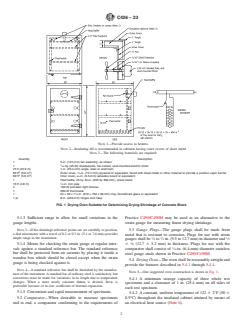
NOTE 5—One suggested oven construction is shown in Fig. 1.
turer of the instrument. A standard bar of ordinary steel is satisfactory, but
corrections must be made for variations in its length due to temperature
5.4.1 A minimum storage capacity of three whole test
changes. When a more nearly constant datum is desired, Invar is
specimens and a clearance of 1 in. (25.4 mm) on all sides of
preferable because of its low coefficient of thermal expansion.
each test specimen.
5.1.5 Convenient and rapid measurement of specimens.
5.4.2 A constant, uniform temperature of 122 6 2°F (50 6
5.2 Comparator—When desirable to measure specimens 0.9°C) throughout the insulated cabinet attained by means of
end to end, a comparator conforming to the requirements of an electrical heat source (Note 6).
C426 − 23
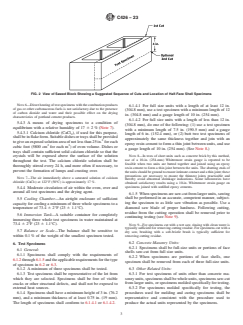
FIG. 2 View of Sawed Block Showing a Suggested Sequence of Cuts and Location of Half-Face Shell Specimens
NOTE 6—Direct heating of test specimens with the combustion products
6.1.4.1 For full size units with a length of at least 12 in.
of gas or other carbonaceous fuels is not satisfactory due to the presence
(304.8 mm), use a test specimen with a minimum length of 12
of carbon dioxide and water and their possible effect on the drying
in. (304.8 mm) and a gauge length of 10 in. (254 mm).
characteristics of portland cement products.
6.1.4.2 For full size units with a length of less than 12 in.
5.4.3 A means of drying specimens to a condition of
(304.8 mm), do one of the following: (1) use a test specimen
equilibrium with a relative humidity of 17 6 2 % (Note 7).
with a minimum length of 7.5 in. (190.5 mm) and a gauge
5.4.3.1 Calcium chloride (CaCl ), if used for this purpose,
length of 6 in. (152.4 mm), or (2) butt two test specimens of
shall be in flake form. Suitable dishes or trays shall be provided
approximately the same thickness together and join with an
to give an exposed solution area of not less than 25 in. for each
epoxy resin cement to form a thin joint between units, and use
2 3
cubic foot (5800 cm for each m ) of oven volume. Dishes or
a gauge length of 10 in. (254 mm). (See Note 8.)
trays shall contain sufficient solid calcium chloride so that the
NOTE 8—In tests of short units such as concrete brick by this method,
crystals will be exposed above the surface of the solution
use of a 10-in. (254-mm) Whittemore strain gauge is reported to be
throughout the test. The calcium chloride solution shall be
feasible when two units are butted together and joined using an epoxy
thoroughly stirred every 24 h, and more often if necessary, to
resin cement to form a thin joint between the units. The abutting ends of
prevent the formation of lumps and crusting over.
the units should be ground to ensure intimate contact and a thin joint; these
precautions are necessary to ensure the thinnest joints practicable and
NOTE 7—The air immediately above a saturated solution of calcium
thereby avoid abnormal shrinkage indications. Some laboratories have
chloride (CaCl ) at 122°F (50°C) is approximately 17 %.
obtained satisfactory results using a 10-in. Whittemore strain gauge on
5.4.4 Moderate circulation of air within the oven, over and specimens joined with unfilled epoxy cements.
around all test specimens and the drying agent.
6.1.5 When specimens are saw-cut from larger units, sawing
shall be performed in an accurate, competent manner, subject-
5.5 Cooling Chamber—An airtight enclosure of sufficient
ing the specimen to as little saw vibration as possible. Use a
capacity for cooling a minimum of three whole specimens to a
diamond saw blade of proper hardness. Following cutting,
temperature of 73.4 6 2°F (23 6 1.1°C).
residue from the cutting operation shall be removed prior to
5.6 Immersion Tank—A suitable container for completely
continuing testing (see Note 9).
immersing three whole test specimens in water maintained at
73.4 6 2°F (23 6 1.1°C).
NOTE 9—For specimens cut with a wet saw, rinsing with clean water is
typically sufficient for removing cutting residue. For specimens cut with a
5.7 Balance or Scale—The balance shall be sensitive to
dry saw, brushing with a soft-bristle brush is typically sufficient for
within 0.1 % of the weight of the smallest specimen tested.
removing cutting residue.
6.2 Concrete Masonry Units:
6. Test Specimens
6.2.1 Specimens shall be full-size units or portions of face
6.1 General:
shells saw-cut from full size units.
6.1.1 Specimens shall comply with the requirements of
6.2.2 When specimens are portions of face shells, one
6.1.2 through 6.1.5 and the applicable requirements for the type
specimen shall be removed from each of three full-size units.
of specimen in 6.2 or 6.3.
6.3 Other Related Units:
6.1.2 A minimum of three specimens shall be tested.
6.1.3 Test specimens shall be representative of the lot from 6.3.1 For test specimens of units other than concrete ma-
sonry units, specimens shall be whole units, specimens saw-cut
which they are selected. Specimens shall be free of visible
cracks or other structural defects, and shall not be exposed to from larger units, or specimens molded specifically for testing.
external heat sources. 6.3.2 For specimens molded specifically for testing, the
6.1.4 Specimens shall have a minimum height of 3 in. (76.2 procedures used for molding and curing specimens shall be
mm), and a minimum thickness of at least 0.75 in. (19 mm). representative and consistent with the procedure used to
The length of specimens shall conform to 6.1.4.1 or 6.1.4.2. produce the actual units represented by the specimens.
C426 − 23
6.4 Methods of Attaching Gauge Plugs to Specimens— 7.2 Take the initial reading of specimen length, at
Attach gauge plugs to specimens using one of the following saturation, with the unit positioned in the water tank so that its
procedures. gauge line is about at the level of the water surface to avoid
6.4.1 Gauge Plug Inserted into Specimen for Strain error due to cooling by evaporation. Take accompanying length
Gauge—Place a pair of gauge plugs at or near, and parallel to, readings of the standard reference bar. (See 8.1 and 8.2 for
the center line in each of two opposite faces of the specimen. methods of adjusting and correcting length readings.) Record
Drill plug holes with a drill that is slightly smaller in size than the temperature of the water as T .
x
the plug diameter so as to provide a snug fit (Note 10). The
7.3 Weigh and record the saturated surface-dry weight of
depth of the holes shall be such that the exposed surface of the
the test specimen by draining the test specimen for 1 min 6 5
inserted gauge plug is approximately ⁄8 in. (2.5 mm) below the
s over a ⁄8-in. (9.5-mm) (or larger) mesh and removing visible
...
This document is not an ASTM standard and is intended only to provide the user of an ASTM standard an indication of what changes have been made to the previous version. Because
it may not be technically possible to adequately depict all changes accurately, ASTM recommends that users consult prior editions as appropriate. In all cases only the current version
of the standard as published by ASTM is to be considered the official document.
Designation: C426 − 22 C426 − 23
Standard Test Method for
Linear Drying Shrinkage of Concrete Masonry Units
This standard is issued under the fixed designation C426; the number immediately following the designation indicates the year of
original adoption or, in the case of revision, the year of last revision. A number in parentheses indicates the year of last reapproval. A
superscript epsilon (´) indicates an editorial change since the last revision or reapproval.
This standard has been approved for use by agencies of the U.S. Department of Defense.
1. Scope*
1.1 This test method covers a routine standardized procedure for determining the linear drying shrinkage of concrete masonry units
or related concrete units under specified accelerated drying conditions.
1.2 The text of this test method references notes and footnotes that provide explanatory material. These notes and footnotes
(excluding those in tables and figures) shall not be considered as requirements of the standard.
1.3 The values stated in inch-pound units are to be regarded as standard. The values given in parentheses are mathematical
conversions to SI units that are provided for information only and are not considered standard.
1.4 This standard does not purport to address all of the safety concerns, if any, associated with its use. It is the responsibility
of the user of this standard to establish appropriate safety, health, and environmental practices and determine the applicability of
regulatory limitations prior to use.
1.5 This international standard was developed in accordance with internationally recognized principles on standardization
established in the Decision on Principles for the Development of International Standards, Guides and Recommendations issued
by the World Trade Organization Technical Barriers to Trade (TBT) Committee.
2. Referenced Documents
2.1 ASTM Standards:
C490C490/C490M Practice for Use of Apparatus for the Determination of Length Change of Hardened Cement Paste, Mortar,
and Concrete
C1093 Practice for Accreditation of Testing Agencies for Masonry
C1232 Terminology for Masonry
2.2 ANSI Standard:
B94.11M—1993 Twist Drills
3. Terminology
3.1 Terminology defined in Terminology C1232 shall apply for this test method.
This test method is under the jurisdiction of ASTM Committee C15 on Manufactured Masonry Units and is the direct responsibility of Subcommittee C15.03 on Concrete
Masonry Units and Related Units.
Current edition approved June 1, 2022June 1, 2023. Published July 2022June 2023. Originally approved in 1958. Last previous edition approved in 20162022 as
C426 – 16.C426 – 22. DOI: 10.1520/C0426-22.10.1520/C0426-23.
For referenced ASTM standards, visit the ASTM website, www.astm.org, or contact ASTM Customer Service at service@astm.org. For Annual Book of ASTM Standards
volume information, refer to the standard’s Document Summary page on the ASTM website.
Available from American National Standards Institute (ANSI), 25 W. 43rd St., 4th Floor, New York, NY 10036, http://www.ansi.org.
*A Summary of Changes section appears at the end of this standard
Copyright © ASTM International, 100 Barr Harbor Drive, PO Box C700, West Conshohocken, PA 19428-2959. United States
C426 − 23
3.2 Definitions of Terms Specific to This Standard:
3.2.1 linear drying shrinkage, n—in this test method, the change in linear dimension of the test specimen due to drying from a
saturated condition to an equilibrium weight and length under specified accelerated drying conditions.
4. Significance and Use
4.1 This test method is intended to evaluate the drying shrinkage characteristics of a given unit. The results of this laboratory
method are considered in determining concrete masonry crack control provisions.
NOTE 1—The testing laboratory performing this test method should be evaluated in accordance with Practice C1093.
5. Apparatus
5.1 Strain Gauge—The instruments for measuring linear drying shrinkage shall be so designed as to permit or provide the
conditions described in 5.1.1 through 5.1.5.
NOTE 2—Strain gauges may be obtained with various gauge lengths. The 10-in. (254-mm) gauge length is recommended for use with regular concrete
masonry units, however, particular sizes of products may require other lengths. The length of the shrinkage specimen shall not be less than required for
a minimum gauge length (distance between gauge plugs) of 6 in. (152.4 mm).
5.1.1 A means of positive contact with the specimen that will ensure reproducible measurements of length.
5.1.2 Means for precise measurement, consisting of a dial micrometer or other measuring device graduated to read in 0.0001-in.
(0.0025-mm) units, and accurate within 0.0001 in. (0.0025 mm) in any 0.0010-in. (0.025-mm) range, and within 0.0002 in.
(0.0050-mm) in any 0.0100-in. (0.254-mm) range.
5.1.3 Sufficient range to allow for small variations in the gauge lengths.
NOTE 3—If the shrinkage reference points are set carefully to position, a dial micrometer with a travel of 0.2 or 0.3 in. (5.1 or 7.6 mm) provides ample
range in the instrument.
5.1.4 Means for checking the strain gauge at regular intervals against a standard reference bar. The standard reference bar shall
be protected from air currents by placing it inside a wooden box which should be closed except when the strain gauge is being
checked against it.
NOTE 4—A standard reference bar shall be furnished by the manufacturer of the instrument. A standard bar of ordinary steel is satisfactory, but corrections
must be made for variations in its length due to temperature changes. When a more nearly constant datum is desired, Invar is preferable because of its
low coefficient of thermal expansion.
5.1.5 Convenient and rapid measurement of specimens.
5.2 Comparator—When desirable to measure specimens end to end, a comparator conforming to the requirements of Practice
C490C490/C490M may be used as an alternative to the strain gauge for measuring linear drying shrinkage.
5.3 Gauge Plugs—The gauge plugs shall be made from metal that is resistant to corrosion. Plugs for use with strain gauges shall
3 1 1 1
be ⁄8 to ⁄2 in. (9.5 to 12.7 mm) in diameter and ⁄2 6 ⁄8 (12.7 6 3.2 mm) in thickness. Plugs for use with the comparator shall
consist of ⁄4-in. (6.4-mm) diameter stainless steel gauge studs shown in Practice C490C490/C490M.
5.4 Drying Oven—The oven shall be reasonably airtight and provide the features described in 5.4.1 through 5.4.4.
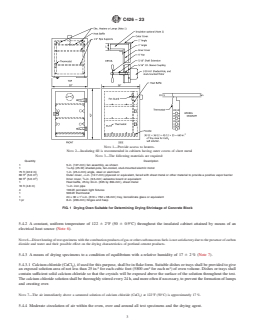
NOTE 5—One suggested oven construction is shown in Fig. 1.
5.4.1 A minimum storage capacity of three whole test specimens and a clearance of 1 in. (25.4 mm) on all sides of each test
specimen.
C426 − 23
NOTE 1—Provide access to heaters.
NOTE 2—Insulating fill is recommended in cabinets having outer covers of sheet metal
NOTE 3—The following materials are required:
Quantity Description
1 5-in. (127-mm) fan assembly, as shown
1 ⁄30-hp (25-W) shaded-pole, fan-cooled, stud-mounted electric motor
75 ft (22.9 m) 1-in. (25.4-mm) angle, steel or aluminum
2 2
60 ft (5.6 m ) Outer cover, ⁄2-in. (12.7-mm) plywood or equivalent, faced with sheet metal or other material to provide a positive vapor barrier
2 2 3
60 ft (5.6 m ) Inner cover, ⁄8-in. (9.5-mm) asbestos board or equivalent
1 Heat baffle, 25 by 34-in. (635 by 864-mm), sheet metal
16 ft (4.8 m) ⁄2-in. iron pipe
4 100-W porcelain light fixtures
1 500-W thermostat
1 24 × 30 × 1 ⁄2-in. (610 × 762 × 38-mm) tray, borosilicate glass or equivalent
1 pr 8-in. (203-mm) hinges and hasp
FIG. 1 Drying Oven Suitable for Determining Drying Shrinkage of Concrete Block
5.4.2 A constant, uniform temperature of 122 6 2°F (50 6 0.9°C) throughout the insulated cabinet attained by means of an
electrical heat source (Note 6).
NOTE 6—Direct heating of test specimens with the combustion products of gas or other carbonaceous fuels is not satisfactory due to the presence of carbon
dioxide and water and their possible effect on the drying characteristics of portland cement products.
5.4.3 A means of drying specimens to a condition of equilibrium with a relative humidity of 17 6 2 % (Note 7).
5.4.3.1 Calcium chloride (CaCl ), if used for this purpose, shall be in flake form. Suitable dishes or trays shall be provided to give
2 2 3
an exposed solution area of not less than 25 in. for each cubic foot (5800 cm for each m ) of oven volume. Dishes or trays shall
contain sufficient solid calcium chloride so that the crystals will be exposed above the surface of the solution throughout the test.
The calcium chloride solution shall be thoroughly stirred every 24 h, and more often if necessary, to prevent the formation of lumps
and crusting over.
NOTE 7—The air immediately above a saturated solution of calcium chloride (CaCl ) at 122°F (50°C) is approximately 17 %.
5.4.4 Moderate circulation of air within the oven, over and around all test specimens and the drying agent.
C426 − 23
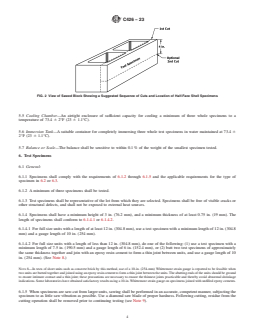
FIG. 2 View of Sawed Block Showing a Suggested Sequence of Cuts and Location of Half-Face Shell Specimens
5.5 Cooling Chamber—An airtight enclosure of sufficient capacity for cooling a minimum of three whole specimens to a
temperature of 73.4 6 2°F (23 6 1.1°C).
5.6 Immersion Tank—A suitable container for completely immersing three whole test specimens in water maintained at 73.4 6
2°F (23 6 1.1°C).
5.7 Balance or Scale—The balance shall be sensitive to within 0.1 % of the weight of the smallest specimen tested.
6. Test Specimens
6.1 General:
6.1.1 Specimens shall comply with the requirements of 6.1.2 through 6.1.5 and the applicable requirements for the type of
specimen in 6.2 or 6.3.
6.1.2 A minimum of three specimens shall be tested.
6.1.3 Test specimens shall be representative of the lot from which they are selected. Specimens shall be free of visible cracks or
other structural defects, and shall not be exposed to external heat sources.
6.1.4 Specimens shall have a minimum height of 3 in. (76.2 mm), and a minimum thickness of at least 0.75 in. (19 mm). The
length of specimens shall conform to 6.1.4.1 or 6.1.4.2.
6.1.4.1 For full size units with a length of at least 12 in. (304.8 mm), use a test specimen with a minimum length of 12 in. (304.8
mm) and a gauge length of 10 in. (254 mm).
6.1.4.2 For full size units with a length of less than 12 in. (304.8 mm), do one of the following: (1) use a test specimen with a
minimum length of 7.5 in. (190.5 mm) and a gauge length of 6 in. (152.4 mm), or (2) butt two test specimens of approximately
the same thickness together and join with an epoxy resin cement to form a thin joint between units, and use a gauge length of 10
in. (254 mm). (See Note 8.)
NOTE 8—In tests of short units such as concrete brick by this method, use of a 10-in. (254-mm) Whittemore strain gauge is reported to be feasible when
two units are butted together and joined using an epoxy resin cement to form a thin joint between the units. The abutting ends of the units should be ground
to ensure intimate contact and a thin joint; these precautions are necessary to ensure the thinnest joints practicable and thereby avoid abnormal shrinkage
indications. Some laboratories have obtained satisfactory results using a 10-in. Whittemore strain gauge on specimens joined with unfilled epoxy cements.
6.1.5 When specimens are saw-cut from larger units, sawing shall be performed in an accurate, competent manner, subjecting the
specimen to as little saw vibration as possible. Use a diamond saw blade of proper hardness. Following cutting, residue from the
cutting operation shall be removed prior to continuing testing (see Note 9).
C426 − 23
NOTE 9—For specimens cut with a wet saw, rinsing with clean water is typically sufficient for removing cutting residue. For specimens cut with a dry
saw, brushing with a soft-bristle brush is typically sufficient for removing cutting residue.
6.2 Concrete Masonry Units:
6.2.1 Specimens shall be full-size units or portions of face shells saw-cut from full size units.
6.2.2 When specimens are portions of face shells, one specimen shall be removed from each of three full-size units.
6.3 Other Related Units:
6.3.1 For test specimens of units other than concrete masonry units, specimens shall be whole units, specimens saw-cut from larger
units, or specimens molded specifically for testing.
6.3.2 For specimens molded specifically for testing, the procedures used for molding and curing specimens shall be representative
and consistent with the procedure used to produce the actual units represented by the specimens.
6.4 Methods of Attaching Gauge Plugs to Specimens—Attach gauge plugs to specimens using one of the following procedures.
6.4.1 Gauge Plug Inserted into Specimen for Strain Gauge—Place a pair of gauge plugs at or near, and parallel to, the center line
in each of two opposite faces of the specimen. Drill plug holes with a drill that is slightly smaller in size than the plug diameter
so as to provide a snug fit (Note 10). The depth of the holes shall be such that the exposed surface of the inserted gauge plug is
approximately ⁄8 in. (2.5 mm) below the surface of the specimen. Prior to setting of the plug, plug holes shall be dry and dust free.
After the bonding agent (Note 11) has been placed in the hole, insert the gauge plug and prick punch the plug to proper gauge
length with the gauge bar provided. Wipe off excessive bonding agent and allow the remainder to cure in accordance with the
bonding agent manufacturer’s instructions. After the bonding agent is cured, drill receiving holes for strain gauge points with a No.
56 to 60 twist drill.
5 3
NOTE 10—A ⁄16-in. (7.9-mm
...