

ASTM D7492/D7492M-16a(2024)
(Guide)Standard Guide for Use of Drainage System Media with Waterproofing Systems
General Information
- Abstract
SIGNIFICANCE AND USE
5.1 This guide provides information and guidelines for the selection and installation of drainage systems media that are in conjunction with waterproofing systems. This guide is intended to be used in conjunction with Guides C898/C898M, C981, C1471/C1471M, D5898/D5898M, and D6622/D6622M and to provide guidelines for the total waterproofing and drainage system.
SCOPE
1.1 This guide makes recommendations for the selection and application of prefabricated drainage media used in conjunction with waterproofing systems on horizontal and vertical surfaces. Drainage media considered include rigid and semi-rigid insulation boards and rigid materials including plastics. This guide considers drainage media as it relates to the performance of the waterproofing system, so its primary focus is draining water away from the membrane. This guide does not cover in detail other aspects or functions of drainage system performance such as efficiency of soil dewatering. The scope of this guide does not cover other drainage media including gravel and filter fabric systems that can be constructed. The scope of this guide does not cover drainage materials or drainage system designs used for vegetative roof systems. Vegetative roof systems require specialized designs.
1.2 The committee with jurisdiction over this standard is not aware of any other comparable standards published by other organizations.
1.3 The values stated in either SI units or inch-pound units are to be regarded separately as standard. The values stated in each system may not be exact equivalents; therefore, each system shall be used independently of the other. Combining values from the two systems may result in nonconformance with the standard.
1.4 This standard may involve hazardous materials, operations and equipment. This standard does not purport to address all of the safety concerns, if any, associated with its use. It is the responsibility of the user of this standard to establish appropriate safety, health, and environmental practices and determine the applicability of regulatory limitations prior to use.
1.5 This international standard was developed in accordance with internationally recognized principles on standardization established in the Decision on Principles for the Development of International Standards, Guides and Recommendations issued by the World Trade Organization Technical Barriers to Trade (TBT) Committee.
- Status
- Published
- Publication Date
- 31-Dec-2023
- Technical Committee
- D08 - Roofing and Waterproofing
- Drafting Committee
- D08.22 - Waterproofing and Dampproofing Systems
Overview
ASTM D7492/D7492M-16a(2024), Standard Guide for Use of Drainage System Media with Waterproofing Systems, is an essential international standard developed by ASTM International. This guide provides recommendations for selecting and applying prefabricated drainage media in conjunction with waterproofing systems on both horizontal and vertical surfaces. Its primary focus is on ensuring drainage media effectively direct water away from waterproofing membranes to enhance building durability and prevent moisture intrusion.
This guide does not cover the design or selection of drainage systems for soil dewatering, vegetative roof systems, or traditional gravel/filter fabric drainage systems, as those applications have unique requirements and fall outside its scope. ASTM D7492/D7492M is intended to work in conjunction with related guides and standards, ensuring comprehensive solutions for total waterproofing and drainage assemblies.
Key Topics
- Selection of Drainage Media: Provides guidance on materials such as rigid and semi-rigid insulation boards, rigid plastics, and fibrous or foam materials suitable for use alongside waterproofing membranes.
- Compatibility and Integration: Stresses the importance of compatibility between all waterproofing and drainage system components to create a seamless and effective barrier.
- Performance Requirements: Outlines requirements for drainage capacity (in-plane and through-the-face), compressive strength, flexural properties, puncture resistance, edge strength, and long-term durability.
- Installation Practices: Recommends best practices for attaching drainage media, including the use of adhesives or mechanical fasteners, prevention of membrane damage, and details important for effective lap joints, cutting, and conformity to irregular surfaces.
- Connections & Interfaces: Provides guidance on interfacing horizontal and vertical drainage media, connecting to foundation drainage systems, and ensuring effective transitions at terminations and penetrations.
- Resistance to Clogging: Emphasizes the importance of filter fabrics and proper design to prevent soil particles from clogging drainage paths.
- Material Durability: Addresses the necessity for materials to withstand environmental exposures and maintain performance throughout the service life of the assembly.
Applications
ASTM D7492/D7492M-16a(2024) is widely used in construction and civil engineering projects where reliable waterproofing and drainage are critical. Typical applications include:
- Basement and Below-Grade Walls: Utilized to prevent hydrostatic pressure buildup and direct water safely to perimeter drains.
- Plaza Decks and Roof Decks: Ensures proper drainage under pavers, pavements, or landscaping, protecting waterproof membranes from standing water and potential damage.
- Foundation Systems: Supports foundation waterproofing by providing managed drainage paths to auxiliary systems such as foundation drainpipes.
- Horizontal and Vertical Building Surfaces: Applied where efficient removal of water is integral to preserving waterproofing systems and the overall structural integrity.
The guide is essential for architects, specifiers, waterproofing contractors, and construction managers seeking to implement effective drainage solutions in both new construction and retrofit projects.
Related Standards
For a holistic approach to waterproofing and drainage, ASTM D7492/D7492M recommends use alongside the following ASTM standards:
- ASTM C898/C898M: Guide for Use of High Solids Content, Cold Liquid-Applied Elastomeric Waterproofing Membranes.
- ASTM C981: Guide for Design of Built-Up Bituminous Membrane Waterproofing Systems for Building Decks.
- ASTM C1471/C1471M: Guide for Use of High Solids Content, Cold Liquid-Applied Elastomeric Waterproofing on Vertical Surfaces.
- ASTM D5898/D5898M: Guide for Standard Details for Adhered Sheet Waterproofing.
- ASTM D6622/D6622M: Guide for Application of Fully Adhered Hot-Applied Reinforced Waterproofing Systems.
- ASTM D1079: Terminology Relating to Roofing and Waterproofing.
- ASTM D4716/D4716M: Test Method for Determining In-plane Flow Rate and Hydraulic Transmissivity of Geosynthetics.
Utilizing ASTM D7492/D7492M in conjunction with these standards supports the creation of integrated waterproofing and drainage systems, promoting long-term moisture control and structural performance.
Keywords: waterproofing systems, drainage media, foundation drainage, drainage composite, installation guidelines, ASTM D7492, geotextiles, building envelope protection.
Relations
- Replaces
ASTM D7492/D7492M-16a - Standard Guide for Use of Drainage System Media with Waterproofing Systems - Effective Date
- 01-Jan-2024
- Effective Date
- 01-Apr-2024
- Effective Date
- 01-Dec-2017
- Effective Date
- 01-Jan-2024
- Effective Date
- 01-Jan-2024
- Effective Date
- 01-Jan-2024
Get Certified
Connect with accredited certification bodies for this standard

DIBt (Deutsches Institut für Bautechnik)
German Institute for Building Technology.
DIN CERTCO
DIN Group product certification.

Aboma Certification B.V.
Specialized in construction, metal, and transport sectors.
Sponsored listings
Frequently Asked Questions
ASTM D7492/D7492M-16a(2024) is a guide published by ASTM International. Its full title is "Standard Guide for Use of Drainage System Media with Waterproofing Systems". This standard covers: SIGNIFICANCE AND USE 5.1 This guide provides information and guidelines for the selection and installation of drainage systems media that are in conjunction with waterproofing systems. This guide is intended to be used in conjunction with Guides C898/C898M, C981, C1471/C1471M, D5898/D5898M, and D6622/D6622M and to provide guidelines for the total waterproofing and drainage system. SCOPE 1.1 This guide makes recommendations for the selection and application of prefabricated drainage media used in conjunction with waterproofing systems on horizontal and vertical surfaces. Drainage media considered include rigid and semi-rigid insulation boards and rigid materials including plastics. This guide considers drainage media as it relates to the performance of the waterproofing system, so its primary focus is draining water away from the membrane. This guide does not cover in detail other aspects or functions of drainage system performance such as efficiency of soil dewatering. The scope of this guide does not cover other drainage media including gravel and filter fabric systems that can be constructed. The scope of this guide does not cover drainage materials or drainage system designs used for vegetative roof systems. Vegetative roof systems require specialized designs. 1.2 The committee with jurisdiction over this standard is not aware of any other comparable standards published by other organizations. 1.3 The values stated in either SI units or inch-pound units are to be regarded separately as standard. The values stated in each system may not be exact equivalents; therefore, each system shall be used independently of the other. Combining values from the two systems may result in nonconformance with the standard. 1.4 This standard may involve hazardous materials, operations and equipment. This standard does not purport to address all of the safety concerns, if any, associated with its use. It is the responsibility of the user of this standard to establish appropriate safety, health, and environmental practices and determine the applicability of regulatory limitations prior to use. 1.5 This international standard was developed in accordance with internationally recognized principles on standardization established in the Decision on Principles for the Development of International Standards, Guides and Recommendations issued by the World Trade Organization Technical Barriers to Trade (TBT) Committee.
SIGNIFICANCE AND USE 5.1 This guide provides information and guidelines for the selection and installation of drainage systems media that are in conjunction with waterproofing systems. This guide is intended to be used in conjunction with Guides C898/C898M, C981, C1471/C1471M, D5898/D5898M, and D6622/D6622M and to provide guidelines for the total waterproofing and drainage system. SCOPE 1.1 This guide makes recommendations for the selection and application of prefabricated drainage media used in conjunction with waterproofing systems on horizontal and vertical surfaces. Drainage media considered include rigid and semi-rigid insulation boards and rigid materials including plastics. This guide considers drainage media as it relates to the performance of the waterproofing system, so its primary focus is draining water away from the membrane. This guide does not cover in detail other aspects or functions of drainage system performance such as efficiency of soil dewatering. The scope of this guide does not cover other drainage media including gravel and filter fabric systems that can be constructed. The scope of this guide does not cover drainage materials or drainage system designs used for vegetative roof systems. Vegetative roof systems require specialized designs. 1.2 The committee with jurisdiction over this standard is not aware of any other comparable standards published by other organizations. 1.3 The values stated in either SI units or inch-pound units are to be regarded separately as standard. The values stated in each system may not be exact equivalents; therefore, each system shall be used independently of the other. Combining values from the two systems may result in nonconformance with the standard. 1.4 This standard may involve hazardous materials, operations and equipment. This standard does not purport to address all of the safety concerns, if any, associated with its use. It is the responsibility of the user of this standard to establish appropriate safety, health, and environmental practices and determine the applicability of regulatory limitations prior to use. 1.5 This international standard was developed in accordance with internationally recognized principles on standardization established in the Decision on Principles for the Development of International Standards, Guides and Recommendations issued by the World Trade Organization Technical Barriers to Trade (TBT) Committee.
ASTM D7492/D7492M-16a(2024) is classified under the following ICS (International Classification for Standards) categories: 91.100.50 - Binders. Sealing materials. The ICS classification helps identify the subject area and facilitates finding related standards.
ASTM D7492/D7492M-16a(2024) has the following relationships with other standards: It is inter standard links to ASTM D7492/D7492M-16a, ASTM C898/C898M-09(2024), ASTM C898/C898M-09(2017), ASTM E2777-20, ASTM C981-20, ASTM C1471/C1471M-22. Understanding these relationships helps ensure you are using the most current and applicable version of the standard.
ASTM D7492/D7492M-16a(2024) is available in PDF format for immediate download after purchase. The document can be added to your cart and obtained through the secure checkout process. Digital delivery ensures instant access to the complete standard document.
Standards Content (Sample)
This international standard was developed in accordance with internationally recognized principles on standardization established in the Decision on Principles for the
Development of International Standards, Guides and Recommendations issued by the World Trade Organization Technical Barriers to Trade (TBT) Committee.
Designation: D7492/D7492M − 16a (Reapproved 2024)
Standard Guide for
Use of Drainage System Media with Waterproofing Systems
This standard is issued under the fixed designation D7492/D7492M; the number immediately following the designation indicates the
year of original adoption or, in the case of revision, the year of last revision. A number in parentheses indicates the year of last
reapproval. A superscript epsilon (´) indicates an editorial change since the last revision or reapproval.
1. Scope mendations issued by the World Trade Organization Technical
Barriers to Trade (TBT) Committee.
1.1 This guide makes recommendations for the selection
and application of prefabricated drainage media used in con-
2. Referenced Documents
junction with waterproofing systems on horizontal and vertical
2.1 ASTM Standards:
surfaces. Drainage media considered include rigid and semi-
C165 Test Method for Measuring Compressive Properties of
rigid insulation boards and rigid materials including plastics.
Thermal Insulations
This guide considers drainage media as it relates to the
C898/C898M Guide for Use of High Solids Content, Cold
performance of the waterproofing system, so its primary focus
Liquid-Applied Elastomeric Waterproofing Membrane
is draining water away from the membrane. This guide does
with Separate Wearing Course
not cover in detail other aspects or functions of drainage
C981 Guide for Design of Built-Up Bituminous Membrane
system performance such as efficiency of soil dewatering. The
Waterproofing Systems for Building Decks
scope of this guide does not cover other drainage media
C1471/C1471M Guide for the Use of High Solids Content
including gravel and filter fabric systems that can be con-
Cold Liquid-Applied Elastomeric Waterproofing Mem-
structed. The scope of this guide does not cover drainage
brane on Vertical Surfaces
materials or drainage system designs used for vegetative roof
D896 Practice for Resistance of Adhesive Bonds to Chemi-
systems. Vegetative roof systems require specialized designs.
cal Reagents
1.2 The committee with jurisdiction over this standard is not
D1079 Terminology Relating to Roofing and Waterproofing
aware of any other comparable standards published by other
D2434 Test Methods for Measurement of Hydraulic Con-
organizations.
ductivity of Coarse-Grained Soils
D3273 Test Method for Resistance to Growth of Mold on the
1.3 The values stated in either SI units or inch-pound units
Surface of Interior Coatings in an Environmental Cham-
are to be regarded separately as standard. The values stated in
ber
each system may not be exact equivalents; therefore, each
D3385 Test Method for Infiltration Rate of Soils in Field
system shall be used independently of the other. Combining
Using Double-Ring Infiltrometer
values from the two systems may result in nonconformance
D4511 Test Method for Hydraulic Conductivity of Essen-
with the standard.
tially Saturated Peat
1.4 This standard may involve hazardous materials, opera-
D4630 Test Method for Determining Transmissivity and
tions and equipment. This standard does not purport to address
Storage Coefficient of Low-Permeability Rocks by In Situ
all of the safety concerns, if any, associated with its use. It is
Measurements Using the Constant Head Injection Test
the responsibility of the user of this standard to establish
D4716/D4716M Test Method for Determining the (In-plane)
appropriate safety, health, and environmental practices and
Flow Rate per Unit Width and Hydraulic Transmissivity
determine the applicability of regulatory limitations prior to
of a Geosynthetic Using a Constant Head
use.
D5898/D5898M Guide for Standard Details for Adhered
1.5 This international standard was developed in accor-
Sheet Waterproofing
dance with internationally recognized principles on standard-
D6622/D6622M Guide for Application of Fully Adhered
ization established in the Decision on Principles for the
Hot-Applied Reinforced Waterproofing Systems
Development of International Standards, Guides and Recom-
E154/E154M Test Methods for Water Vapor Retarders Used
in Contact with Earth Under Concrete Slabs, on Walls, or
as Ground Cover
This guide is under the jurisdiction of ASTM Committee D08 on Roofing and
Waterproofing and is the direct responsibility of Subcommittee D08.22 on Water-
proofing and Dampproofing Systems. For referenced ASTM standards, visit the ASTM website, www.astm.org, or
Current edition approved Jan. 1, 2024. Published January 2024. Originally contact ASTM Customer Service at service@astm.org. For Annual Book of ASTM
approved in 2011. Last previous edition approved in 2016 as D7492/D7492M – 16a. Standards volume information, refer to the standard’s Document Summary page on
DOI: 10.1520/D7492_D7492M-16AR24. the ASTM website.
Copyright © ASTM International, 100 Barr Harbor Drive, PO Box C700, West Conshohocken, PA 19428-2959. United States
D7492/D7492M − 16a (2024)
3. Terminology consist of one or more of the following basic components. The
basic components of typical drainage medium are a mounting
3.1 Refer to Terminology D1079 for definitions of terms
surface that is placed against the waterproofing membrane to
used in this guide.
prevent embedment of the media, a porous core that provides
a drainage path, and a filter surface, often a fabric bonded over
4. Summary of Practice
the porous core to prevent clogging of the drainage paths.
4.1 This guide describes a method to estimate the amount of
Fibrous and foam drainage media are homogeneous materials
water a drainage system may need to carry. The guide also
that are sufficiently dense that they can be placed directly
offers descriptions of the various drainage systems in existence
against the waterproofing membrane. However, fibrous and
today along with suggestions on how different building situa-
foam media may not function properly in horizontal or nearly
tions will require different performance characteristics from the
horizontal (<30°) orientations. Other foam boards merely
drainage medium chosen. Items to be aware of during the
provide periodic grooves creating paths to drain water away
installation of drainage systems are also covered along with
from the waterproofed surface. Where appropriate, a protection
illustrations of typical drainage systems.
board should be installed between the waterproofing and
drainage media to reduce embedment of drainage media into
5. Significance and Use
the waterproofing.
5.1 This guide provides information and guidelines for the
6.4 The drainage media selection should include a consid-
selection and installation of drainage systems media that are in
eration of the forces that will be placed on it, such as backfill
conjunction with waterproofing systems. This guide is intended
pressure, gravity loads, and shear loads both initially and over
to be used in conjunction with Guides C898/C898M, C981,
the expected useful life of the assembly.
C1471/C1471M, D5898/D5898M, and D6622/D6622M and to
provide guidelines for the total waterproofing and drainage
6.5 The construction of drainage media should be consid-
system.
ered relative to the strength and protection of the waterproofing
membrane. The bearing surface of drainage media should place
6. General
no sharp edges against the waterproofing membrane, which
6.1 In selecting a drainage medium for use with could puncture, abrade the membrane, or imprint itself in the
waterproofing, consideration should be given to the design of
membrane. The filter fabric and its bond to the drainage
the waterproofing system. In particular orientation of the medium core should resist impact, compressive, and shear
system, attachment recommendations, connections to interior
loads imposed by backfilling and compaction, and temporary
and exterior drainage systems, and external loads applied to the and permanent construction loads.
system. Additional considerations include the materials and
6.6 The drainage media should always be placed next to the
construction over the drainage medium, installation
waterproofing. This location minimizes the hydrostatic head on
recommendations, durability, and penetrations and joints. (See
top of the waterproofing. If insulation is required the insulation
Figs. 1-3.) In all designs, the potential slip planes should be
shall be specified to handle the environment that is present
considered.
outside the drainage media and waterproofing membrane. If the
6.2 Compatibility—It is essential that all components and
insulation is porous, the drainage media must allow the porous
contiguous elements of the waterproofing system are compat-
insulation to drain any water accumulated during construction
ible and that the design of the system’s waterproofing and
or during its service on the wall into either the drainage media
drainage is coordinated to form an integrated waterproofing
or the footing drain tile system. A non-porous insulation is any
system.
insulation with closed cells that prevent water from flowing in
or out, for example extruded polystyrene foam or polystyrene
6.3 Basic Components—The various types of drainage me-
foam bead boards. A porous insulation is any insulation that
dia available are outlined in Section 12 of this guide and all
has open channels that easily allow water to enter and leave the
insulation such as rigid fiberglass boards with a perm rating of
4.6 Darcy (k, mm/s) or more (see X1.1.3).
7. Drainage Capacity
7.1 General—The drainage capacity is the volume of water
that passes through drainage media in a specified direction
under a known hydraulic gradient. The two major drainage
capacities of interest are the in-plane and through-the-face
drainage capacities. The orientation of the media and any slope
of the substrate will have a major effect on the drainage
capacity.
7.1.1 Through-the-Face Drainage—Through-the-face
drainage is the flow or seepage of water perpendicular to the
longitudinal axis of the drainage media. When media are
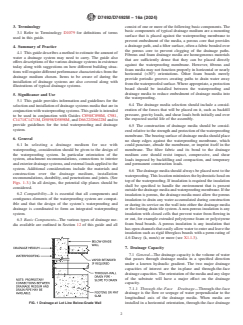
FIG. 1 Drainage at Lot Line Below-Grade Wall installed in a horizontal orientation, through-the-face drainage
D7492/D7492M − 16a (2024)
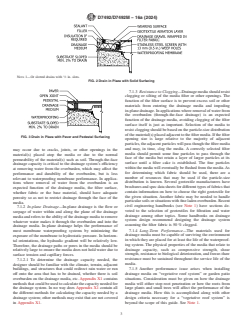
NOTE 1—Or slotted drains with ⁄2 in. slots.
FIG. 2 Drain in Plaza with Solid Surfacing
7.1.3 Resistance to Clogging—Drainage media should resist
clogging or silting of the media filter or other openings. The
function of the filter surface is to prevent excess soil or other
materials from entering the drainage media and impeding
in-plane drainage. In applications where removal of water from
the overburden (through-the-face drainage) is an expected
function of the drainage media, avoiding clogging of the filter
surface itself is just as important. Selection of the media to
resist clogging should be based on the particle-size distribution
of the material(s) placed adjacent to the filter media. If the filter
FIG. 3 Drain in Plaza with Paver and Pedestal Surfacing
opening size is large relative to the majority of adjacent
particles, the adjacent particles will pass though the filter media
and may, in time, clog the media. A correctly selected filter
may occur due to cracks, joints, or other openings in the
media should permit some fine particles to pass through the
material(s) placed atop the media or due to the normal
face of the media but retain a layer of larger particles at its
permeability of the material(s) such as soil. Through-the-face
surface until a filter cake is established. The fine particles
drainage capacity is critical to the drainage system’s efficiency
within the media will eventually be flushed from the media. As
at removing water from the overburden, which may affect the
for determining which fabric should be used, there are a
performance and durability of the overburden, but is less
number of resources that may be used if the particle-size
relevant to waterproofing membrane performance. In applica-
distribution is known. Several geotextile manufacturers have
tions where removal of water from the overburden is an
brochures and spec data sheets for different types of fabrics that
expected function of the drainage media, the filter surface,
contain information on how to choose the right geotextile for
whether fabric or the base material, should have adequate
the given situation. Another fabric may be needed to handle
porosity so as not to restrict drainage through the face of the
particular soils or situations with fine laden overburden. Recent
media.
civil engineering handbooks (see Note 1) have sections de-
7.1.2 In-plane Drainage—In-plane drainage is the flow or
voted to the selection of geotextiles for filtration and water
seepage of water within and along the plane of the drainage
drainage among other topics. Some handbooks on drainage
media and refers to the ability of the drainage media to remove
system design recommend designing the drainage system
whatever water makes it through the overburden and into the
assuming the filter fabric is 50 % clogged.
drainage media. In-plane drainage helps the performance of
7.1.4 Long-Term Performance—The materials used for
most membrane waterproofing systems by minimizing the
drainage media must be capable of surviving the environment
exposure of the membrane to hydrostatic pressure. In horizon-
in which they are placed for at least the life of the waterproof-
tal orientations, the hydraulic gradient will be relatively low.
ing system. The physical properties of the media that relate to
Therefore, the drainage paths or pores in the media should be
drainage capacity, such as compressive strength, shear
relatively large to ensure the media does not hold water due to
strength, resistance to biological deterioration, and freeze-thaw
surface tension and capillary forces.
resistance must be sustained throughout the service life of the
7.1.2.1 To determine the drainage capacity needed, the
media.
designer should be familiar with the climate, terrain, adjacent
buildings, and structures that could redirect rain water or run 7.1.5 Another performance issue arises when installing
off onto the area that has to be drained, whether there is soil drainage media on “vegetative roof system” or garden patio
overburden on the drainage media, etc. Appendix X1 contains situations. Consideration must be given on how the drainage
methods that could be used to calculate the capacity needed for media will either stop root penetration or how the roots from
the drainage system. In no way does Appendix X1 contain all large plants and small trees will affect the performance of the
the different methods for calculating the capacity needed by a drainage media. How this is accomplished along with other
drainage system; other methods may exist that are not covered design criteria necessary for a “vegetative roof system” is
in Appendix X1. beyond the scope of this guide. See Note 1.
D7492/D7492M − 16a (2024)
3,4
NOTE 1—The footnoted books on civil engineering and other relevant
used in the wearing course or from construction vehicle and
books may be found on websites such as Amazon.com and Barnesand-
foot traffic. Roots and sharp objects in the backfill can cause
noble.com.
puncture damage in vertical orientations.
7.1.6 Interfaces To Other Drainage Systems—The selection
8.5 Edge Strength—In vertical orientations, the filter media
of drainage media must take into consideration the joining of
must be capable of withstanding the vertical shear loads that
the installed media to other adjacent drainage systems that can
occur as the backfill settles. When drainage media is installed
be located inside (lagging walls, Fig. 1) and outside of a
over a smooth membrane, shear load from backfill consolida-
building or foundation. For a horizontal orientation, consider-
tion can be transmitted to the bottom edge of the drainage
ation must be given to adequately connecting the drainage
media, which must withstand these loads without crushing. If
media to vertically oriented drainage media. For a vertical
soils are designed and compacted correctly, the drainage media
application, consideration must be given to the connection with
should not experience this effect.
the drainage system at the base of the media, usually a
perimeter drain system.
9. Materials
8. Physical Properties
9.1 General—Drainage media must be compatible with the
waterproofing system and capable of withstanding cyclical
8.1 General—Drainage media used in conjunction with a
immersion and specified to be able to resist any chemical
liquid-applied waterproofing system should have certain physi-
attacks from any leachates found to be in the drainage flow. In
cal properties to provide some level of confidence that the
horizontal orientations, leachates can include salt solutions,
drainage media will perform as stated throughout its required
petroleum distillates, fertilizers, and chemical residues from
service life. Properties that are considered in this guide include
the waterproofing system’s primers and adhesives. In vertical
drainage capacity (discussed in Section 7), compressive
orientations, leachates can include soil salts, petroleum
strength, flexural strength, puncture resistance, edge strength,
distillates, and chemical residues from the waterproofing sys-
and embrittlement. Many ASTM standards are available to test
tem and any surface treatment placed over the above-grade
these properties and the ASTM tests will vary depending on the
portion of the drainage material. ASTM tests such as Test
drainage medium being tested. Test Methods D4716/D4716M
Methods D3273, D896, and E154/E154M, and others, can be
and C165 are just two of the many test methods referenced in
used to evaluate long-term performance of various drainage
product literature.
media. Again the type of drainage media used and the chemical
8.2 Compressive Strength—The drainage media should have
composition of the drainage will determine the appropriate
sufficient compressive strength to support weight of construc-
ASTM test method.
tion over the media as well as any external live loads placed
9.2 Materials used to hold drainage media in place, whether
upon it after installation. For horizontal orientations, these
an adhesive or mechanical fasteners, must maintain their
loads are installed atop the drainage media. For vertical
holding strength for such a period as required for external
orientations, the loads acting on the drainage media are
forces acting on the filter media to reach equilibrium. The
primarily soil pressure from backfill. Installations against
materials used to hold the filter media in place relative to the
lagging may also include the initial load of the cast-in-place
waterproofing membrane must retain this strength when sub-
concrete. Temporary loads, both gravity and shear and abuse
jected to chemical attack from trace chemical in the drainage
during construction, should also be considered. The porous
flow.
portion of the drainage media should have sufficient long-term
compressive strength to prevent excessive deformation or
10. Attachment Techniques
collapse of the media due to crushing, buckling, or creep,
which would constrict or close the drainage paths within the
10.1 General—Drainage media may need some form of
media.
attachment to the substrate. If adequate attachment is not
achieved, the drainage system media may be damaged or
8.3 Flexural Properties—The drainage media should have
dislodged, or both, by soil settlement or frost heaving. The
sufficient flexural strength or flexibility to withstand or accom-
attachment method should be coordinated with the expected
modate bending loads that occur in normal handling during
soil compaction methods and settlement, and the potential for
installation. The material should also be capable of bridging or
frost heaving where applicable. Attachment of drainage media
conforming to joints and uneven areas without cracking or
may be by adhesives, suitable mechanical fasteners, or by
breaking.
loading forces of adjacent material. With most waterproofing
8.4 Puncture Resistance—Drainage media should be able to
membranes, it is not advisable to penetrate the waterproofing
withstand possible damaging effects of subsequent construc-
with mechanical fasteners below grade; however, with some
tion work before being protected by other waterproofing
swelling-type waterproofing systems that are intended to be
system components. Damage in horizontal orientations could
mechanically attached, similar attachment may be used to
be punctured by reinforcing rod chairs and reinforcing rods
attach the drainage media. If the media require installation
according to prescribed requirements for orientation, care
Civil Engineering Handbook, 2nd edition, Liew, R. J. V. and Chen, W. F., should be taken to follow the drainage media manufacturer’s
editors, August 2002.
instructions regarding installation of the media.
Standard Handbook for Civil Engineers, Richards, J. T., Merritt, F. S., and
Loftin, M. K., editors, Dec 2003. 10.2 Adhesives:
D7492/D7492M − 16a (2024)
10.2.1 General—Adhesives can be used to hold drainage when the waterproofing system dead loads or live loads are
media in place relative to the waterproofing membrane, often applied to the system.
until additional courses are installed atop the media. The
10.3.1.3 Effect of Fastener on Substrate—The mechanical
adhesive must be applied over an area sufficient to provide the fasteners that are embedded into the substrate should be
required bonding strength.
avoided. Mechanical fasteners that are forced into the substrate
10.2.2 Compatibility—The cured adhesive must be compat- can cause spalling which may extend underneath the water-
ible with the waterproofing material and the drainage medium.
proofed surface.
Solvent in the adhesive must also be compatible with the
10.3.1.4 Fastener Geometry—Mechanical fasteners should
waterproofing as solvents can damage some waterproofing
be selected for their ability to not interfere with the integrity of
membranes.
the waterproofing system. The fasteners should sit flush with
10.2.3 Properties—Adhesives for drainage media must have
the surface of the drainage media if possible to avoid providing
sufficient tack upon initial installation to firmly hold the media
a point of extreme loading on the fastener from external loads.
in place until cure of the adhesive is complete. Wind uplift
Fasteners that are not flush with the surface of the drainage
forces can loosen the media in both horizontal and vertical
material can be knocked out by subsequent backfilling, com-
orientations if the initial bond forces are not sufficient. The
paction and other construction processes.
cured adhesive must have sufficient strength to hold the media
in place during subsequent construction operations and for
11. Installation Details
vertical orientations to resist any shear forces inadvertently
11.1 General—The waterproofing system designer should
created as the backfill settles. Most manufacturers will warrant
provide generic details similar to those contained in the
their anchorage designs only for adequate support of their
construction documents for properties required of the drainage
drainage media. Any forces created by backfill must be
media and including typical conditions, special conditions, and
carefully considered and minimized.
changes in plane, terminations, penetrations, and connections
10.2.4 Cure Time—The cure time of the adhesive should be
to other systems (Figs. 1-4). Proprietary systems have standard
taken into consideration in scheduling subsequent construction
details that may be included in the construction documents, but
tasks.
should always be submitted during the approval process via
10.3 Mechanical Fasteners:
submittals. Installation of drainage media should be in accor-
10.3.1 General—Mechanical fasteners that penetrate the
dance with the manufacturer’s written specifications and in-
waterproofing membrane should be avoided. Mechanical fas-
stallation instructions.
teners should be stainless steel to prevent corrosion from
11.2 Laps—Continuity of both the drainage path and the
completely destroying the fastener leaving a hole into the
filter fabric should be maintained at side laps and end laps in
substrate.
the drainage medium. Some products include a fabric selvedge
10.3.1.1 Effect of Fastener on Waterproofing—The area
at the side laps but not the end laps; in such cases an additional
around the fastener may require additional treatment to main-
strip of filter fabric, of width no less than twice the width of the
tain the integrity of the waterproofing membrane. The manu-
typical selvedge, should be installed to cover the end laps to
facturer’s literature for the membrane should be consulted to
prevent soil or debris from entering and clogging the drainage
ensure an appropriate fastener is used.
medium.
10.3.1.2 Mechanical Fasteners Can Damage Drainage
Media—If installed too tightly, drainage media can be 11.3 Cutting—Cutting drainage media to fit around penetra-
compressed, restricting drainage. If the fastener is loose, the tions and substrate protuberances should be done in such a
media can separate from the membrane, permitting debris to manner as to not damage the core material. Care should be
fill the space and possibly result in damage to the membrane or exercised to ensure that the media cut edges do not provide a
the drainage media. Loose attachments can also fail completely path for soil or debris to enter and clog the drainage medium.
FIG. 4 Drainage at Below-Grade Wall
D7492/D7492M − 16a (2024)
For drainage media that drain only on one side and do not 11.8.1 The drainage pipe when placed off the footing should
allow water
...