

ASTM F1702-10(2018)
(Test Method)Standard Test Method for Measuring Impact-Attenuation Characteristics of Natural Playing Surface Systems Using a Lightweight Portable Apparatus
General Information
- Abstract
SIGNIFICANCE AND USE
5.1 The g-max values obtained by these procedures are indicative of the impact attenuation characteristics of playing surfaces used for sports such as American football, soccer, baseball, lacrosse, rugby, etc. Optional time history data can be used to further describe these properties.
SCOPE
1.1 This test method is used to determine the impact-attenuation characteristics of natural turfgrass and soil playing surface systems with a lightweight portable apparatus. This test method can be used to compare the impact attenuation characteristics of natural playing surface systems, as well as assessing the effects of management practices on the impact attenuation characteristics. This test method also can be used to assess the compactibility of natural playing surfaces by recording g-max values or penetration of successive impacts, or both.
1.2 This test method provides a procedure for assessing impact attenuation characteristics in the field, on both actual playing surfaces and research plots. Numerical data will not be comparable to data obtained using a different missile mass or geometry, different drop height, or different standard method, for example, Test Method F1936.
1.3 The values stated in SI units are to be regarded as the standard. The values given in parentheses are for information only.
1.4 This standard does not purport to address all of the safety concerns, if any, associated with its use. It is the responsibility of the user of this standard to establish appropriate safety, health, and environmental practices and determine the applicability of regulatory limitations prior to use.
1.5 This international standard was developed in accordance with internationally recognized principles on standardization established in the Decision on Principles for the Development of International Standards, Guides and Recommendations issued by the World Trade Organization Technical Barriers to Trade (TBT) Committee.
- Status
- Published
- Publication Date
- 30-Nov-2018
- Technical Committee
- F08 - Sports Equipment, Playing Surfaces, and Facilities
- Drafting Committee
- F08.64 - Natural Playing Surfaces
Overview
ASTM F1702-10(2018) is the internationally recognized standard test method for measuring the impact-attenuation characteristics of natural playing surface systems using a lightweight portable apparatus. Developed by ASTM International, this standard provides a consistent procedure to evaluate the shock absorption properties-often measured as the g-max value-of natural turfgrass and soil sports surfaces, such as those used in American football, soccer, baseball, lacrosse, and rugby.
The standard enables field measurement and comparison of the impact attenuation characteristics across different playing surface systems and helps assess the effects of various management practices. Its portable nature facilitates in-situ testing both on actual sports fields and research plots, ensuring broad applicability and practical benefits for sports facility managers, turf professionals, and researchers.
Key Topics
- Impact Attenuation (g-max Value): The primary outcome of the test, representing the maximum acceleration experienced during an impact, which is directly related to surface hardness and player safety.
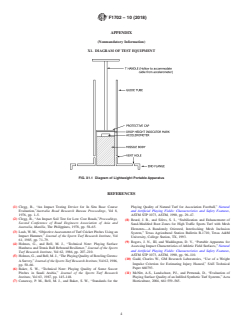
- Apparatus and Procedure: Utilizes a 2.25 kg missile dropped from a fixed height through a guide tube onto the playing surface. A built-in accelerometer measures and records g-max.
- Data Collection: The method prescribes collecting several measurements across different locations and conditions on a field to capture surface variability. Environmental conditions, vegetation characteristics, and soil properties are also recorded.
- Surface Comparisons: Enables direct comparison of g-max values among various natural surfaces, and evaluation of how factors such as use, wear, soil compaction, and turf management influence impact attenuation.
- Repeatability and Safety Considerations: Guidance is provided on consistent test execution, equipment calibration, and limitations regarding direct comparability with other test methods, such as ASTM F1936, due to differing equipment or procedures.
Applications
ASTM F1702-10(2018) is widely used in the following applications:
- Sports Field Testing: Assessing the safety and playing quality of sports fields by measuring surface hardness, which is linked to injury risk and athletic performance.
- Surface Management Evaluation: Monitoring the effects of turf management practices, such as aeration or irrigation, on field compactibility and shock attenuation.
- Field Maintenance Planning: Providing objective data to guide maintenance interventions for optimal surface performance and player safety.
- Comparative Research: Supporting research studies that compare the impact attenuation of different turfgrass varieties, soil types, or treatment methods.
- Compliance and Risk Management: Helping facility managers comply with safety guidelines for sports surfaces and identify potentially hazardous field conditions.
Related Standards
- ASTM F1936 - Specification for Impact Attenuation of Turf Playing Systems as Measured in the Field
- ASTM D5874 - Test Methods for Determination of the Impact Value (IV) of a Soil
- ASTM F355 - Test Method for Impact Attenuation of Playing Surface Systems, Other Protective Sport Systems, and Materials Used for Athletics, Recreation, and Play
- ASTM E105 - Practice for Probability Sampling of Materials
- ASTM E122 - Practice for Calculating Sample Size to Estimate the Average for a Characteristic of a Lot or Process
- ASTM F2650 - Terminology Relating to Impact Testing of Sports Surfaces and Equipment
- ASTM F2651 - Terminology Relating to Soil and Turfgrass Characteristics of Natural Playing Surfaces
These related standards reinforce the importance of consistent terminology, robust testing protocols, and accurate reporting in the safety and management of natural sports surfaces.
Keywords: ASTM F1702, impact attenuation, g-max, natural playing surface, turfgrass testing, sports field safety, portable apparatus, soil compaction, surface management, impact test method.
Relations
- Effective Date
- 01-Dec-2018
- Effective Date
- 01-Feb-2024
- Effective Date
- 01-Dec-2023
- Refers
ASTM F2650-17 - Standard Terminology Relating to Impact Testing of Sports Surfaces and Equipment - Effective Date
- 15-Sep-2017
- Refers
ASTM F2650-17e1 - Standard Terminology Relating to Impact Testing of Sports Surfaces and Equipment - Effective Date
- 15-Sep-2017
- Effective Date
- 01-Jul-2016
- Effective Date
- 01-Jul-2016
- Effective Date
- 01-Jan-2016
- Effective Date
- 01-Dec-2015
- Effective Date
- 01-Oct-2015
- Effective Date
- 01-May-2014
- Refers
ASTM F2650-13 - Standard Terminology Relating to Impact Testing of Sports Surfaces and Equipment - Effective Date
- 01-Jun-2013
- Effective Date
- 01-May-2013
- Effective Date
- 01-May-2013
- Effective Date
- 01-Nov-2011
Get Certified
Connect with accredited certification bodies for this standard

IMP NDT d.o.o.
Non-destructive testing services. Radiography, ultrasonic, magnetic particle, penetrant, visual inspection.
Inštitut za kovinske materiale in tehnologije
Institute of Metals and Technology. Materials testing, metallurgical analysis, NDT.
Q Techna d.o.o.
NDT and quality assurance specialist. 30+ years experience. NDT personnel certification per ISO 9712, nuclear and thermal power plant inspections, QA/
Sponsored listings
Frequently Asked Questions
ASTM F1702-10(2018) is a standard published by ASTM International. Its full title is "Standard Test Method for Measuring Impact-Attenuation Characteristics of Natural Playing Surface Systems Using a Lightweight Portable Apparatus". This standard covers: SIGNIFICANCE AND USE 5.1 The g-max values obtained by these procedures are indicative of the impact attenuation characteristics of playing surfaces used for sports such as American football, soccer, baseball, lacrosse, rugby, etc. Optional time history data can be used to further describe these properties. SCOPE 1.1 This test method is used to determine the impact-attenuation characteristics of natural turfgrass and soil playing surface systems with a lightweight portable apparatus. This test method can be used to compare the impact attenuation characteristics of natural playing surface systems, as well as assessing the effects of management practices on the impact attenuation characteristics. This test method also can be used to assess the compactibility of natural playing surfaces by recording g-max values or penetration of successive impacts, or both. 1.2 This test method provides a procedure for assessing impact attenuation characteristics in the field, on both actual playing surfaces and research plots. Numerical data will not be comparable to data obtained using a different missile mass or geometry, different drop height, or different standard method, for example, Test Method F1936. 1.3 The values stated in SI units are to be regarded as the standard. The values given in parentheses are for information only. 1.4 This standard does not purport to address all of the safety concerns, if any, associated with its use. It is the responsibility of the user of this standard to establish appropriate safety, health, and environmental practices and determine the applicability of regulatory limitations prior to use. 1.5 This international standard was developed in accordance with internationally recognized principles on standardization established in the Decision on Principles for the Development of International Standards, Guides and Recommendations issued by the World Trade Organization Technical Barriers to Trade (TBT) Committee.
SIGNIFICANCE AND USE 5.1 The g-max values obtained by these procedures are indicative of the impact attenuation characteristics of playing surfaces used for sports such as American football, soccer, baseball, lacrosse, rugby, etc. Optional time history data can be used to further describe these properties. SCOPE 1.1 This test method is used to determine the impact-attenuation characteristics of natural turfgrass and soil playing surface systems with a lightweight portable apparatus. This test method can be used to compare the impact attenuation characteristics of natural playing surface systems, as well as assessing the effects of management practices on the impact attenuation characteristics. This test method also can be used to assess the compactibility of natural playing surfaces by recording g-max values or penetration of successive impacts, or both. 1.2 This test method provides a procedure for assessing impact attenuation characteristics in the field, on both actual playing surfaces and research plots. Numerical data will not be comparable to data obtained using a different missile mass or geometry, different drop height, or different standard method, for example, Test Method F1936. 1.3 The values stated in SI units are to be regarded as the standard. The values given in parentheses are for information only. 1.4 This standard does not purport to address all of the safety concerns, if any, associated with its use. It is the responsibility of the user of this standard to establish appropriate safety, health, and environmental practices and determine the applicability of regulatory limitations prior to use. 1.5 This international standard was developed in accordance with internationally recognized principles on standardization established in the Decision on Principles for the Development of International Standards, Guides and Recommendations issued by the World Trade Organization Technical Barriers to Trade (TBT) Committee.
ASTM F1702-10(2018) is classified under the following ICS (International Classification for Standards) categories: 19.060 - Mechanical testing. The ICS classification helps identify the subject area and facilitates finding related standards.
ASTM F1702-10(2018) has the following relationships with other standards: It is inter standard links to ASTM F1702-10, ASTM D5874-24, ASTM F355-23, ASTM F2650-17, ASTM F2650-17e1, ASTM F355-16, ASTM F355-16e1, ASTM D5874-16, ASTM F1936-10(2015), ASTM F2651-10(2015), ASTM E177-14, ASTM F2650-13, ASTM E177-13, ASTM E691-13, ASTM E691-11. Understanding these relationships helps ensure you are using the most current and applicable version of the standard.
ASTM F1702-10(2018) is available in PDF format for immediate download after purchase. The document can be added to your cart and obtained through the secure checkout process. Digital delivery ensures instant access to the complete standard document.
Standards Content (Sample)
This international standard was developed in accordance with internationally recognized principles on standardization established in the Decision on Principles for the
Development of International Standards, Guides and Recommendations issued by the World Trade Organization Technical Barriers to Trade (TBT) Committee.
Designation: F1702 − 10 (Reapproved 2018) An American National Standard
Standard Test Method for
Measuring Impact-Attenuation Characteristics of Natural
Playing Surface Systems Using a Lightweight Portable
Apparatus
This standard is issued under the fixed designation F1702; the number immediately following the designation indicates the year of
original adoption or, in the case of revision, the year of last revision. A number in parentheses indicates the year of last reapproval. A
superscript epsilon (´) indicates an editorial change since the last revision or reapproval.
1. Scope 2. Referenced Documents
2.1 ASTM Standards:
1.1 This test method is used to determine the impact-
D5874 Test Methods for Determination of the Impact Value
attenuation characteristics of natural turfgrass and soil playing
(IV) of a Soil
surfacesystemswithalightweightportableapparatus.Thistest
E105 Practice for Probability Sampling of Materials
method can be used to compare the impact attenuation char-
E122 Practice for Calculating Sample Size to Estimate,With
acteristics of natural playing surface systems, as well as
Specified Precision, the Average for a Characteristic of a
assessing the effects of management practices on the impact
Lot or Process
attenuationcharacteristics.Thistestmethodalsocanbeusedto
E177 Practice for Use of the Terms Precision and Bias in
assess the compactibility of natural playing surfaces by record-
ASTM Test Methods
ing g-max values or penetration of successive impacts, or both.
E691 Practice for Conducting an Interlaboratory Study to
1.2 This test method provides a procedure for assessing
Determine the Precision of a Test Method
impact attenuation characteristics in the field, on both actual
F355 TestMethodforImpactAttenuationofPlayingSurface
playing surfaces and research plots. Numerical data will not be
Systems, Other Protective Sport Systems, and Materials
comparable to data obtained using a different missile mass or
Used for Athletics, Recreation and Play
geometry, different drop height, or different standard method,
F1936 Specification for Impact Attenuation of Turf Playing
for example, Test Method F1936.
Systems as Measured in the Field
F2650 Terminology Relating to Impact Testing of Sports
1.3 The values stated in SI units are to be regarded as the
Surfaces and Equipment
standard. The values given in parentheses are for information
F2651 Terminology Relating to Soil and Turfgrass Charac-
only.
teristics of Natural Playing Surfaces
1.4 This standard does not purport to address all of the
safety concerns, if any, associated with its use. It is the
3. Terminology
responsibility of the user of this standard to establish appro-
3.1 Definitions—Except as noted, definitions in this stan-
priate safety, health, and environmental practices and deter-
dard are in accordance with Terminologies F2650 and F2651.
mine the applicability of regulatory limitations prior to use.
1.5 This international standard was developed in accor-
4. Summary of Test Method
dance with internationally recognized principles on standard-
4.1 A 2.25-kg missile is dropped from a specific height,
ization established in the Decision on Principles for the
through a guide tube, onto a playing surface. A linear acceler-
Development of International Standards, Guides and Recom-
ometer mounted on the missile monitors the acceleration and
mendations issued by the World Trade Organization Technical
time history of the impact. The maximum acceleration during
Barriers to Trade (TBT) Committee.
the impact (relative to gravity) is recorded and reported as
g-max. Reporting the time history of the impact is optional.
This test method is under the jurisdiction of ASTM Committee F08 on Sports
Equipment, Playing Surfaces, and Facilities and is the direct responsibility of
Subcommittee F08.64 on Natural Playing Surfaces. For referenced ASTM standards, visit the ASTM website, www.astm.org, or
Current edition approved Dec. 1, 2018. Published December 2018. Originally contact ASTM Customer Service at service@astm.org. For Annual Book of ASTM
approved in 1996. Last previous edition approved in 2010 as F1702 – 10. DOI: Standards volume information, refer to the standard’s Document Summary page on
10.1520/F1702-10R18. the ASTM website.
Copyright © ASTM International, 100 Barr Harbor Drive, PO Box C700, West Conshohocken, PA 19428-2959. United States
F1702 − 10 (2018)
Depth of penetration from successive drops may also be the peak acceleration (g-max). Commercially available devices
recorded optionally as an indication of soil compactibility. have a band width of 7 kHz.
NOTE 1—This test method is based on an impact tester developed by
7. Test Unit
Clegg (1,2). See Test Method D5874. Such impact testers are commer-
ciallyavailable.CommerciallyavailableCleggImpactSoilTestersdisplay
7.1 The test unit will be either:
results in impact value units, where one impact value equals 10 g-max
7.1.1 An area of a playing surface system that has had
units (Test Method D5874), and typically do not display tenths of an
similar use and that has similar surface-system characteristics
impact value unit. For use in this standard, the display should be altered
by the manufacturer or authorized personnel to indicate tenths of an (for example, age, vegetation density, wear, soil moisture
impact value or 1 g-max unit. Also, other suitable recording equipment
content) within its limits, or
can be used to obtain resolution to 1 g-max. A 4.5-kg missile has been
7.1.2 An experimental area (plot) subjected to uniform
used to evaluate road base surfaces (1,2). A 0.5-kg poly(vinyl chloride)
treatment(s) that may or may not affect impact characteristics.
missile has been utilized to relate field surfaces to ball bounce (3-6),
player response (7), and performance including injury potential (8).
7.2 A test unit on a playing surface system should not
exceed approximately 1 m .
5. Significance and Use
5.1 The g-max values obtained by these procedures are
8. Number of Test Units
indicative of the impact attenuation characteristics of playing
8.1 Similar areas of use, wear, etc., may be used to replicate
surfaces used for sports such as American football, soccer,
test units on playing surfaces.
baseball, lacrosse, rugby, etc. Optional time history data can be
8.2 To characterize adequately the surface variability on a
used to further describe these properties.
natural surface of a sports field, areas having different levels of
6. Apparatus use, wear, soil compaction, vegetative cover, etc., should be
evaluated. If possible, replicate each type of use area.
6.1 Missile—Construct the 2.25 6 0.05-kg missile from
metal with a hardened steel impacting surface that is flat and 8.3 Use a minimum of three test units (replications) in
round with a 5.0 6 0.1-cm diameter and a rounded or beveled
research experiments.
edge of 0.5 to 1.0 mm. Include a T-shaped handle or other
8.4 Due to the variable nature of natural surfaces, measure
appropriate means for lifting the missile prior to dropping.The
and average at least four locations within a test unit to obtain
handle and accelerometer (rated at not less than 5000 g)
atestresult.Toobtainaspecificqualityassurancelevel,follow
constitute a portion of the missile mass. The missile should be
the sampling procedures of Practices E105 and E122.
marked around the circumference to obtain a reference point to
the guide tube top, which will indicate drop height.
9. Procedure
6.2 Guide Tube—Construct the vented guide tube from pipe
9.1 Operate and calibrate all recording equipment as recom-
having a smooth inside surface and a nominal inside diameter
mended by the manufacturer. Periodically, at least prior to and
of 5.4 cm (2.125 in.), such as not to restrict a free fall of the
after each series of impact tests, check the instrumentation
missile. The length of the pipe typically is approximately 61
output by dropping the missile on a standard surface, for
cm (24 in.). A bull’s eye level shall be attached to the guide
example, a stable synthetic material placed on a rigid concrete
tube to ensure that the tube is held in a vertical position during
or metal surface.
measurement. Constructing a circular end flange on the base of
9.2 Placetheguidetubeontheplayingsurfaceandmaintain
the tube helps to improve stability during measurement. The
in a vertical position during the drop.
bottom flange shall be milled so that it rests only on its
perimeter and vented either with a hole or holes located
9.3 Lift the missile to obtain a drop height of 45.7 6 0.3 cm
through the flange top surface or by means of a hole or holes
(18.0 6 0.1 in.) and an approximate impact velocity of 2.85
on the side of the guide tube just above the flange, or both, to
m/s (9). A mechanical stop may be attached to the top of the
allow for the escape of air under the compression of the falling
guide tube to aid in achieving the exact drop height.
missile.
9.4 Release the missile and record the g-max value. Lifting
6.3 Recording Equipment—Follow the criteria below when
the missile to an exact height and then releasing it freely is
using recording equipment:
possible with trained and experienced operators; however, a
6.3.1 g-max—Ensure that the recording system is capable of
mechanical holding/releasing mechanism is recommended to
measuring impacts of up to a g-max of 1000, as measured by
insure proper height and release with less-experienced opera-
an accelerometer mounted on the missile.
tors. Such a mechanism should not influence the impact
6.3.2 Acceleration-Time—The acceleration-time history
velocity to a greater extent than
...