

ASTM D6643-01(2023)
(Test Method)Standard Test Method for Testing Wood-Base Panel Corner Impact Resistance
General Information
- Abstract
SIGNIFICANCE AND USE
5.1 This test method determines the corner impact damage that could be used to measure the relative corner impact resistance.
SCOPE
1.1 This test method shall be used to measure the relative corner impact resistance and other damage that may occur during the rough handling of wood-base panels or composite materials. This test method is suitable for all wood-base panels such as plywood, oriented strand board, hardboard, particleboard and medium density fiberboard as well as other composite panel products.
1.2 This test method covers determination and evaluation of the effects of panels being dropped from various heights with a predetermined amount of dead load and angle of impact to simulate an equivalent field application.
1.3 The values stated in inch-pound units are to be regarded as standard. The values given in parentheses are mathematical conversions to SI units that are provided for information only and are not considered standard.
1.4 This standard does not purport to address all of the safety concerns, if any, associated with its use. It is the responsibility of the user of this standard to establish appropriate safety, health, and environmental practices and determine the applicability of regulatory limitations prior to use.
1.5 This international standard was developed in accordance with internationally recognized principles on standardization established in the Decision on Principles for the Development of International Standards, Guides and Recommendations issued by the World Trade Organization Technical Barriers to Trade (TBT) Committee.
- Status
- Published
- Publication Date
- 14-Aug-2023
- Technical Committee
- D07 - Wood
- Drafting Committee
- D07.03 - Panel Products

Overview
ASTM D6643-01(2023), published by ASTM International, provides a standardized test method for determining the corner impact resistance of wood-base panels and composite materials. This method evaluates the susceptibility of panels such as plywood, oriented strand board, hardboard, particleboard, and medium density fiberboard, as well as other composite panel products, to damage resulting from rough handling and impact events-particularly at their corners. The test simulates field conditions by dropping panel specimens from varying heights with a controlled load and angle, enabling manufacturers, engineers, and quality assurance professionals to assess product durability and performance.
Key Topics
- Corner Impact Resistance: Measures how wood-based panel corners withstand impact, mimicking real-world scenarios like drops and handling shocks.
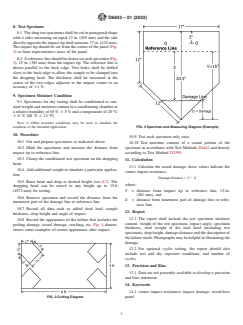
- Test Specimen Preparation: Uses pentagonal specimens cut from the panel corners, ensuring consistent measurement and reproducibility.
- Test Apparatus and Procedure: Employs a vertical drop frame with a dropping head and quick release mechanism to simulate varying impact forces.
- Measurement and Reporting:
- Distance of actual damage from corner tip
- Qualitative assessment of peeling, splintering, and other damage characteristics
- Documentation of moisture content, specimen weight, thickness, and failure mode
- Moisture Conditioning: Allows optional wet-dry cycling to replicate environmental exposure.
- Safety Requirements: Stresses the importance of protective measures due to potential hazards from flying debris during drop tests.
Applications
ASTM D6643-01(2023) is vital for industries relying on the structural integrity and durability of wood-based and composite panels. Typical applications include:
- Packaging and Shipping: Assessment of materials for pallets, cargo crates, fruit and vegetable boxes to ensure products can endure rough transportation and handling.
- Construction Materials: Evaluation of panels for concrete form boards and structural uses, determining their suitability for repeated impacts on job sites.
- Furniture Manufacturing: Testing panels used in furniture to reduce the risk of corner damage during shipping, storage, and everyday use.
- Quality Control and Research: Manufacturers and researchers use this standard to benchmark new products, refine manufacturing processes, or compare materials for procurement decisions.
By providing a comparative measure of impact resistance, this standard helps companies deliver safer, higher-quality products and streamline material selection for specific applications.
Related Standards
- ASTM D2395: Test methods for density and specific gravity (relative density) of wood and wood-based materials
- ASTM D4442: Test methods for direct moisture content measurement of wood and wood-based materials
These related standards support ASTM D6643 by standardizing the determination of material properties that impact test results, such as density and moisture content.
Keywords: ASTM D6643, wood-base panel impact resistance, corner impact test, composite panel durability, drop test method, plywood, oriented strand board, particleboard, furniture panel testing, cargo crate material testing, quality control wood panels.
Relations
- Effective Date
- 01-Mar-2020
- Effective Date
- 15-Nov-2016
- Effective Date
- 01-Jun-2015
- Effective Date
- 01-May-2014
- Effective Date
- 01-May-2014
- Effective Date
- 15-Nov-2007
- Refers
ASTM D2395-07ae1 - Standard Test Methods for Specific Gravity of Wood and Wood-Based Materials - Effective Date
- 01-Jul-2007
- Effective Date
- 01-Jul-2007
- Effective Date
- 01-Apr-2007
- Effective Date
- 01-Oct-2006
- Effective Date
- 10-Apr-2002
- Effective Date
- 10-Mar-1997
- Effective Date
- 15-Feb-1992
Get Certified
Connect with accredited certification bodies for this standard

Gozdarski inštitut Slovenije
Slovenian Forestry Institute. Forest management certification support, timber testing.
IMP NDT d.o.o.
Non-destructive testing services. Radiography, ultrasonic, magnetic particle, penetrant, visual inspection.
Inštitut za kovinske materiale in tehnologije
Institute of Metals and Technology. Materials testing, metallurgical analysis, NDT.
Sponsored listings
Frequently Asked Questions
ASTM D6643-01(2023) is a standard published by ASTM International. Its full title is "Standard Test Method for Testing Wood-Base Panel Corner Impact Resistance". This standard covers: SIGNIFICANCE AND USE 5.1 This test method determines the corner impact damage that could be used to measure the relative corner impact resistance. SCOPE 1.1 This test method shall be used to measure the relative corner impact resistance and other damage that may occur during the rough handling of wood-base panels or composite materials. This test method is suitable for all wood-base panels such as plywood, oriented strand board, hardboard, particleboard and medium density fiberboard as well as other composite panel products. 1.2 This test method covers determination and evaluation of the effects of panels being dropped from various heights with a predetermined amount of dead load and angle of impact to simulate an equivalent field application. 1.3 The values stated in inch-pound units are to be regarded as standard. The values given in parentheses are mathematical conversions to SI units that are provided for information only and are not considered standard. 1.4 This standard does not purport to address all of the safety concerns, if any, associated with its use. It is the responsibility of the user of this standard to establish appropriate safety, health, and environmental practices and determine the applicability of regulatory limitations prior to use. 1.5 This international standard was developed in accordance with internationally recognized principles on standardization established in the Decision on Principles for the Development of International Standards, Guides and Recommendations issued by the World Trade Organization Technical Barriers to Trade (TBT) Committee.
SIGNIFICANCE AND USE 5.1 This test method determines the corner impact damage that could be used to measure the relative corner impact resistance. SCOPE 1.1 This test method shall be used to measure the relative corner impact resistance and other damage that may occur during the rough handling of wood-base panels or composite materials. This test method is suitable for all wood-base panels such as plywood, oriented strand board, hardboard, particleboard and medium density fiberboard as well as other composite panel products. 1.2 This test method covers determination and evaluation of the effects of panels being dropped from various heights with a predetermined amount of dead load and angle of impact to simulate an equivalent field application. 1.3 The values stated in inch-pound units are to be regarded as standard. The values given in parentheses are mathematical conversions to SI units that are provided for information only and are not considered standard. 1.4 This standard does not purport to address all of the safety concerns, if any, associated with its use. It is the responsibility of the user of this standard to establish appropriate safety, health, and environmental practices and determine the applicability of regulatory limitations prior to use. 1.5 This international standard was developed in accordance with internationally recognized principles on standardization established in the Decision on Principles for the Development of International Standards, Guides and Recommendations issued by the World Trade Organization Technical Barriers to Trade (TBT) Committee.
ASTM D6643-01(2023) is classified under the following ICS (International Classification for Standards) categories: 19.060 - Mechanical testing; 79.060.01 - Wood-based panels in general. The ICS classification helps identify the subject area and facilitates finding related standards.
ASTM D6643-01(2023) has the following relationships with other standards: It is inter standard links to ASTM D4442-20, ASTM D4442-16, ASTM D4442-15, ASTM D2395-14e1, ASTM D2395-14, ASTM D4442-07, ASTM D2395-07ae1, ASTM D2395-07a, ASTM D2395-07, ASTM D2395-06, ASTM D2395-02, ASTM D4442-92(1997)e1, ASTM D4442-92(2003). Understanding these relationships helps ensure you are using the most current and applicable version of the standard.
ASTM D6643-01(2023) is available in PDF format for immediate download after purchase. The document can be added to your cart and obtained through the secure checkout process. Digital delivery ensures instant access to the complete standard document.
Standards Content (Sample)
This international standard was developed in accordance with internationally recognized principles on standardization established in the Decision on Principles for the
Development of International Standards, Guides and Recommendations issued by the World Trade Organization Technical Barriers to Trade (TBT) Committee.
Designation: D6643 − 01 (Reapproved 2023)
Standard Test Method for
Testing Wood-Base Panel Corner Impact Resistance
This standard is issued under the fixed designation D6643; the number immediately following the designation indicates the year of
original adoption or, in the case of revision, the year of last revision. A number in parentheses indicates the year of last reapproval. A
superscript epsilon (´) indicates an editorial change since the last revision or reapproval.
INTRODUCTION
Corner impact resistance may be an important property for wood-base panel applications such as
pallets, cargo crates, concrete form boards, fruit and vegetable boxes and furniture. There is a need to
have suitable corner impact resistance in such products to ensure satisfactory end-use performance.
This test method provides a technique to assess relative corner impact resistance of wood-base panels.
This test method uses a vertical test frame to create corner impact on a panel specimen. The test
specimen is held in a fixture that free-falls to the floor. The test specimen is examined for distance of
impact damage and for qualitative damage.
1. Scope 2. Referenced Documents
1.1 This test method shall be used to measure the relative 2.1 ASTM Standards:
corner impact resistance and other damage that may occur D2395 Test Methods for Density and Specific Gravity (Rela-
during the rough handling of wood-base panels or composite tive Density) of Wood and Wood-Based Materials
materials. This test method is suitable for all wood-base panels D4442 Test Methods for Direct Moisture Content Measure-
such as plywood, oriented strand board, hardboard, particle- ment of Wood and Wood-Based Materials
board and medium density fiberboard as well as other compos-
3. Terminology
ite panel products.
3.1 Definitions:
1.2 This test method covers determination and evaluation of
3.1.1 actual damage, n—distance of damage counted from
the effects of panels being dropped from various heights with
tip to damage line after dropping.
a predetermined amount of dead load and angle of impact to
3.1.2 damage line, n—the innermost line where crushing
simulate an equivalent field application.
occurs.
1.3 The values stated in inch-pound units are to be regarded
3.1.3 dropping head, n—the part of the machine connected
as standard. The values given in parentheses are mathematical
to the quick release mechanism that holds the test specimen
conversions to SI units that are provided for information only
and added amount of dead load. The dropping head free-falls to
and are not considered standard.
create the impact between the panel specimen and the floor.
1.4 This standard does not purport to address all of the
3.1.4 impact tip, n—the part of the specimen that will make
safety concerns, if any, associated with its use. It is the
initial contact with the floor after dropping.
responsibility of the user of this standard to establish appro-
priate safety, health, and environmental practices and deter-
3.1.5 peeling, n—the furthermost splintering from the dam-
mine the applicability of regulatory limitations prior to use. age line. This provides additional understanding of damage
1.5 This international standard was developed in accor- characteristics.
dance with internationally recognized principles on standard-
3.1.6 pull cord, n—cord that is connected to the quick
ization established in the Decision on Principles for the
release mechanism that allows a quick release of the dropping
Development of International Standards, Guides and Recom-
head by pulling.
mendations issued by the World Trade Organization Technical
3.1.7 quick release mechanism, n—the equipment that al-
Barriers to Trade (TBT) Committee.
lows for free release of the head when the pull cord is
activated.
This test method is under the jurisdiction of ASTM Committee D07 on Wood
and is the direct responsibility of Subcommittee D07.03 on Panel Products. For referenced ASTM standards, visit the ASTM website, www.astm.org, or
Current edition approved Aug. 15, 2023. Published August 2023. Originally contact ASTM Customer Service at service@astm.org. For Annual Book of ASTM
approved in 2001. Last previous edition approved in 2016 as D6643 – 01 (2016). Standards volume information, refer to the standard’s Document Summary page on
DOI: 10.1520/D6643-01R23. the ASTM website.
Copyright © ASTM International, 100 Barr Harbor Drive, PO Box C700, West Conshohocken, PA 19428-2959. United States
D6643 − 01 (2023)
3.1.8 reference line, n—line from which all measurements
are taken. This allows samples to be cut to approximate size
and still ensure accurate values.
4. Summary of Test Method
4.1 Specimens are cut from the corners of the sample panel.
The specimens are fastened to the lower edge of a dropping
head and clamped into position. The weight of the dropping
head is controlled to simulate the weight of the real application.
The dropping head is raised to specified heights and released to
fall to a rigid floor or other surface. The corner damage as well
as peeling is measured to indicate the corner impact resistance.
Peeling beyond the damage line may also be reported.
4.2 Optionally, sample can be subjected to wet-dry cycles to
simulate end-use applications.
5. Significance and Use
5.1 This test method determines the corner impact damage
that could be used to measure the relative corner impact
resistance.
6. Apparatus
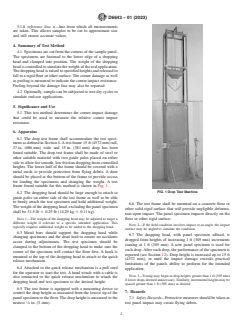
6.1 The drop test frame shall accommodate the test speci-
mens as defined in Section 8. A test frame 15 ft (4572 mm) tall,
27 in. (686 mm) wide and 15 in. (381 mm) deep has been
found suitable. The drop test frame shall be made of steel or
other suitable material with two guide poles placed on either
side to allow for smooth, low friction dropping from controlled
heights. The lower half of the frame should be covered with a
metal mesh to provide protection from flying debris. A door
should be placed at the bottom of the frame to provide access
for loading the specimens and changing the weight. A test
frame found suitable for this method is shown in Fig. 1.
FIG. 1 Drop Test Machine
6.2 The dropping head should be large enough to attach to
guide poles on either side of the test frame as well as be able
to firmly attach the test specimen and hold additional weight.
6.6 The test frame shall be mounted on a concrete floor or
The weight of the dropping head, excluding the panel specimen
other solid rigid surface that will pr
...