

ASTM E3039-20
(Test Method)Standard Test Method for Determination of Crack-Tip-Opening Angle of Ferritic Steels Using DWTT-Type Specimens
General Information
- Abstract
SCOPE
1.1 This test method covers the determination of fracture propagation toughness in terms of the steady-state crack-tip-opening angle (CTOA) using the drop-weight tear test (DWTT)-type specimen. The method is applicable to ferritic steels that exhibit predominantly ductile fracture with at least 85 % shear area measured according to Test Method E436 - Standard Test Method for Drop-Weight Tear Tests of Ferritic Steels. This test method applies to ferritic steels with thicknesses between 6 mm and 20 mm. Annex A1 describes the method to test ferritic steels with thicknesses between 20 mm to 32 mm.
1.2 In terms of apparatus, specimen design, and test methodology, this test method draws from Test Method E436 and API 5L3 - Recommended Practice for Conducting Drop-Weight Tear Tests on Line Pipe.
1.3 The development of this test method has been driven by the need to design for fast ductile fracture arrest of axial running cracks in steel high-pressure gas pipelines (1). 2The purpose has been to develop a test to characterize fracture propagation resistance in a form suitable for use as a pipe mill test (2). The traditional Charpy test has been shown to be inadequate for modern high toughness pipe steels (1). This test method measures fracture propagation resistance in terms of crack-tip opening angle, and is used to characterize ferritic steels.
1.4 The values stated in SI units are to be regarded as standard. No other units of measurement are included in this standard.
1.5 This standard does not purport to address all of the safety concerns, if any, associated with its use. It is the responsibility of the user of this standard to establish appropriate safety, health, and environmental practices and determine the applicability of regulatory limitations prior to use.
1.6 This international standard was developed in accordance with internationally recognized principles on standardization established in the Decision on Principles for the Development of International Standards, Guides and Recommendations issued by the World Trade Organization Technical Barriers to Trade (TBT) Committee.
- Status
- Published
- Publication Date
- 31-Aug-2020
- Technical Committee
- E08 - Fatigue and Fracture
- Drafting Committee
- E08.07 - Fracture Mechanics
Buy Documents
ASTM E3039-20 - Standard Test Method for Determination of Crack-Tip-Opening Angle of Ferritic Steels Using DWTT-Type Specimens
REDLINE ASTM E3039-20 - Standard Test Method for Determination of Crack-Tip-Opening Angle of Ferritic Steels Using DWTT-Type Specimens
Overview
ASTM E3039-20 is an international standard test method developed by ASTM International for the determination of the crack-tip-opening angle (CTOA) of ferritic steels using Drop-Weight Tear Test (DWTT)-type specimens. This method is designed to evaluate the fracture propagation toughness of ferritic pipe steels (commonly used in high-pressure gas pipelines) that display predominantly ductile fracture behavior. It is specifically applicable to ferritic steels with thicknesses ranging from 6 mm to 20 mm, with provisions for thicker specimens in the annex.
The CTOA measured through this standard provides critical information on a material's resistance to ductile fracture propagation, helping ensure the structural integrity and safety of pipelines and similar infrastructure applications.
Key Topics
- Crack-Tip-Opening Angle (CTOA): This method determines the steady-state CTOA, a key indicator of ductile fracture resistance, by measuring the angle created at the crack tip during propagation.
- DWTT-Type Specimens: Test specimens follow the design and preparation methods established in ASTM E436 and API 5L3, ensuring consistency across tests.
- Force and Displacement Measurements: The procedure relies on instrumented impact testing, capturing force-versus-displacement data to derive CTOA values using a simplified single-specimen method.
- Applicability: The standard is suitable for ferritic steels that show at least 85% shear area in fracture surfaces, making it relevant for modern high-toughness pipe steels.
- Test Conditions: The method allows testing across a broad temperature range, including sub-zero and elevated conditions, reflecting real-world pipeline environments.
- Precision and Repeatability: ASTM E3039-20 includes precision guidelines derived from interlaboratory studies, enabling high confidence in reproducibility.
Applications
ASTM E3039-20 serves an essential role for:
- Pipeline Industry: The standard addresses the need for reliable fracture propagation toughness testing in steel high-pressure gas pipelines, particularly for the fast arrest of axial running cracks, which is critical to pipeline safety.
- Pipe Mills: The CTOA test is valuable as a pipe mill test, characterizing fracture resistance during production to meet stringent safety and performance requirements.
- Material Development: As modern pipeline steels surpass traditional Charpy impact toughness requirements, CTOA measured by ASTM E3039-20 provides a more accurate assessment of fracture arrest capabilities.
- Quality Assurance: The method supports manufacturers and users in validating steel toughness, ensuring it meets the required mechanical performance for ductile fracture resistance.
Related Standards
- ASTM E436 - Standard Test Method for Drop-Weight Tear Tests of Ferritic Steels
- ASTM E2298 - Test Method for Instrumented Impact Testing of Metallic Materials
- API RP 5L3 - Recommended Practice for Conducting Drop-Weight Tear Tests on Line Pipe
- ISO 22889 - Metallic materials-Method of Test for the Determination of Resistance to Stable Crack Extension Using Specimens of Low Constraint
- ISO 14456 - Steel-Charpy V-notch Pendulum Impact Test-Instrumented Test Method
- ASTM E691 - Practice for Conducting an Interlaboratory Study to Determine the Precision of a Test Method
- ASTM E1823 - Terminology Relating to Fatigue and Fracture Testing
Practical Value
Implementing ASTM E3039-20 enables organizations to:
- Enhance Safety: By more accurately characterizing fracture propagation resistance, companies can design and operate safer pipelines.
- Comply with International Standards: Meet regulatory and industry expectations by adopting a globally recognized test for fracture toughness.
- Improve Material Selection: Select steels with proven resistance to ductile fracture, optimizing performance in demanding service conditions.
- Support Research and Development: Use CTOA data for the development of advanced steels and improved pipe manufacturing processes.
By establishing a standardized, precise method for determining crack-tip-opening angle, ASTM E3039-20 supports the pipeline and steel industries in advancing material quality and infrastructure reliability.
Relations
- Effective Date
- 15-Feb-2024
- Effective Date
- 01-Feb-2024
- Effective Date
- 01-Feb-2020
- Effective Date
- 01-Nov-2018
- Effective Date
- 01-Nov-2018
- Effective Date
- 01-Jun-2018
- Effective Date
- 01-Oct-2015
- Effective Date
- 01-May-2014
- Effective Date
- 01-May-2013
- Effective Date
- 01-May-2013
- Effective Date
- 01-Apr-2013
- Effective Date
- 15-Dec-2012
- Effective Date
- 15-Nov-2012
- Effective Date
- 01-Sep-2012
- Effective Date
- 01-Aug-2012
Buy Documents
ASTM E3039-20 - Standard Test Method for Determination of Crack-Tip-Opening Angle of Ferritic Steels Using DWTT-Type Specimens
REDLINE ASTM E3039-20 - Standard Test Method for Determination of Crack-Tip-Opening Angle of Ferritic Steels Using DWTT-Type Specimens
Get Certified
Connect with accredited certification bodies for this standard

Element Materials Technology
Materials testing and product certification.

Inštitut za kovinske materiale in tehnologije
Institute of Metals and Technology. Materials testing, metallurgical analysis, NDT.
Sponsored listings
Frequently Asked Questions
ASTM E3039-20 is a standard published by ASTM International. Its full title is "Standard Test Method for Determination of Crack-Tip-Opening Angle of Ferritic Steels Using DWTT-Type Specimens". This standard covers: SCOPE 1.1 This test method covers the determination of fracture propagation toughness in terms of the steady-state crack-tip-opening angle (CTOA) using the drop-weight tear test (DWTT)-type specimen. The method is applicable to ferritic steels that exhibit predominantly ductile fracture with at least 85 % shear area measured according to Test Method E436 - Standard Test Method for Drop-Weight Tear Tests of Ferritic Steels. This test method applies to ferritic steels with thicknesses between 6 mm and 20 mm. Annex A1 describes the method to test ferritic steels with thicknesses between 20 mm to 32 mm. 1.2 In terms of apparatus, specimen design, and test methodology, this test method draws from Test Method E436 and API 5L3 - Recommended Practice for Conducting Drop-Weight Tear Tests on Line Pipe. 1.3 The development of this test method has been driven by the need to design for fast ductile fracture arrest of axial running cracks in steel high-pressure gas pipelines (1). 2The purpose has been to develop a test to characterize fracture propagation resistance in a form suitable for use as a pipe mill test (2). The traditional Charpy test has been shown to be inadequate for modern high toughness pipe steels (1). This test method measures fracture propagation resistance in terms of crack-tip opening angle, and is used to characterize ferritic steels. 1.4 The values stated in SI units are to be regarded as standard. No other units of measurement are included in this standard. 1.5 This standard does not purport to address all of the safety concerns, if any, associated with its use. It is the responsibility of the user of this standard to establish appropriate safety, health, and environmental practices and determine the applicability of regulatory limitations prior to use. 1.6 This international standard was developed in accordance with internationally recognized principles on standardization established in the Decision on Principles for the Development of International Standards, Guides and Recommendations issued by the World Trade Organization Technical Barriers to Trade (TBT) Committee.
SCOPE 1.1 This test method covers the determination of fracture propagation toughness in terms of the steady-state crack-tip-opening angle (CTOA) using the drop-weight tear test (DWTT)-type specimen. The method is applicable to ferritic steels that exhibit predominantly ductile fracture with at least 85 % shear area measured according to Test Method E436 - Standard Test Method for Drop-Weight Tear Tests of Ferritic Steels. This test method applies to ferritic steels with thicknesses between 6 mm and 20 mm. Annex A1 describes the method to test ferritic steels with thicknesses between 20 mm to 32 mm. 1.2 In terms of apparatus, specimen design, and test methodology, this test method draws from Test Method E436 and API 5L3 - Recommended Practice for Conducting Drop-Weight Tear Tests on Line Pipe. 1.3 The development of this test method has been driven by the need to design for fast ductile fracture arrest of axial running cracks in steel high-pressure gas pipelines (1). 2The purpose has been to develop a test to characterize fracture propagation resistance in a form suitable for use as a pipe mill test (2). The traditional Charpy test has been shown to be inadequate for modern high toughness pipe steels (1). This test method measures fracture propagation resistance in terms of crack-tip opening angle, and is used to characterize ferritic steels. 1.4 The values stated in SI units are to be regarded as standard. No other units of measurement are included in this standard. 1.5 This standard does not purport to address all of the safety concerns, if any, associated with its use. It is the responsibility of the user of this standard to establish appropriate safety, health, and environmental practices and determine the applicability of regulatory limitations prior to use. 1.6 This international standard was developed in accordance with internationally recognized principles on standardization established in the Decision on Principles for the Development of International Standards, Guides and Recommendations issued by the World Trade Organization Technical Barriers to Trade (TBT) Committee.
ASTM E3039-20 is classified under the following ICS (International Classification for Standards) categories: 77.080.20 - Steels. The ICS classification helps identify the subject area and facilitates finding related standards.
ASTM E3039-20 has the following relationships with other standards: It is inter standard links to ASTM E1823-24a, ASTM E1823-24, ASTM E1823-20, ASTM E2472-12(2018)e3, ASTM E2472-12(2018), ASTM E1942-98(2018)e1, ASTM E2298-15, ASTM E177-14, ASTM E691-13, ASTM E177-13, ASTM E2298-13, ASTM E1823-12e, ASTM E1823-12d, ASTM E1823-12c, ASTM E1823-12b. Understanding these relationships helps ensure you are using the most current and applicable version of the standard.
ASTM E3039-20 is available in PDF format for immediate download after purchase. The document can be added to your cart and obtained through the secure checkout process. Digital delivery ensures instant access to the complete standard document.
Standards Content (Sample)
This international standard was developed in accordance with internationally recognized principles on standardization established in the Decision on Principles for the
Development of International Standards, Guides and Recommendations issued by the World Trade Organization Technical Barriers to Trade (TBT) Committee.
Designation: E3039 − 20
Standard Test Method for
Determination of Crack-Tip-Opening Angle of Ferritic Steels
Using DWTT-Type Specimens
This standard is issued under the fixed designation E3039; the number immediately following the designation indicates the year of
original adoption or, in the case of revision, the year of last revision. A number in parentheses indicates the year of last reapproval. A
superscript epsilon (´) indicates an editorial change since the last revision or reapproval.
1. Scope priate safety, health, and environmental practices and deter-
mine the applicability of regulatory limitations prior to use.
1.1 This test method covers the determination of fracture
1.6 This international standard was developed in accor-
propagation toughness in terms of the steady-state crack-tip-
dance with internationally recognized principles on standard-
opening angle (CTOA) using the drop-weight tear test
ization established in the Decision on Principles for the
(DWTT)-type specimen. The method is applicable to ferritic
Development of International Standards, Guides and Recom-
steels that exhibit predominantly ductile fracture with at least
mendations issued by the World Trade Organization Technical
85 % shear area measured according to Test Method E436 -
Barriers to Trade (TBT) Committee.
Standard Test Method for Drop-Weight Tear Tests of Ferritic
Steels. This test method applies to ferritic steels with thick-
2. Referenced Documents
nesses between 6 mm and 20 mm. Annex A1 describes the
2.1 ASTM Standards:
method to test ferritic steels with thicknesses between 20 mm
E177 Practice for Use of the Terms Precision and Bias in
to 32 mm.
ASTM Test Methods
1.2 In terms of apparatus, specimen design, and test
E436 Test Method for Drop-Weight Tear Tests of Ferritic
methodology, this test method draws from Test Method E436
Steels
and API 5L3 - Recommended Practice for Conducting Drop-
E691 Practice for Conducting an Interlaboratory Study to
Weight Tear Tests on Line Pipe.
Determine the Precision of a Test Method
1.3 The development of this test method has been driven by E1823 TerminologyRelatingtoFatigueandFractureTesting
E1942 Guide for Evaluating DataAcquisition Systems Used
the need to design for fast ductile fracture arrest of axial
running cracks in steel high-pressure gas pipelines (1). The in Cyclic Fatigue and Fracture Mechanics Testing
E2298 Test Method for Instrumented Impact Testing of
purpose has been to develop a test to characterize fracture
propagation resistance in a form suitable for use as a pipe mill Metallic Materials
E2472 Test Method for Determination of Resistance to
test (2). The traditional Charpy test has been shown to be
inadequate for modern high toughness pipe steels (1). This test Stable Crack Extension under Low-Constraint Conditions
method measures fracture propagation resistance in terms of
2.2 ISO Standards:
crack-tip opening angle, and is used to characterize ferritic
ISO 22889 Metallic materials — Method of Test for the
steels.
Determination of Resistance to Stable Crack Extension
Using Specimens of Low Constraint
1.4 The values stated in SI units are to be regarded as
ISO 14456 Steel — Charpy V-notch Pendulum Impact Test
standard. No other units of measurement are included in this
— Instrumented Test Method
standard.
2.3 API Recommended Practice:
1.5 This standard does not purport to address all of the
API Recommended Practice 5L3 Drop-WeightTearTests on
safety concerns, if any, associated with its use. It is the
Line Pipe
responsibility of the user of this standard to establish appro-
For referenced ASTM standards, visit the ASTM website, www.astm.org, or
This test method is under the jurisdiction ofASTM Committee E08 on Fatigue contact ASTM Customer Service at service@astm.org. For Annual Book of ASTM
and Fracture and is the direct responsibility of Subcommittee E08.07 on Fracture Standards volume information, refer to the standard’s Document Summary page on
Mechanics. the ASTM website.
Current edition approved Sept. 1, 2020. Published September 2020. Originally Available from International Organization for Standardization (ISO), ISO
ɛ1
approved in 2016. Last previous edition approved in 2018 as E3039–18 . DOI: Central Secretariat, BIBC II, Chemin de Blandonnet 8, CP 401, 1214 Vernier,
10.1520/E3039–20. Geneva, Switzerland, http://www.iso.org.
2 5
The boldface numbers in parentheses refer to a list of references at the end of Available from American Petroleum Institute (API), 1220 L. St., NW,
this standard. Washington, DC 20005-4070, http://www.api.org.
Copyright © ASTM International, 100 Barr Harbor Drive, PO Box C700, West Conshohocken, PA 19428-2959. United States
E3039 − 20
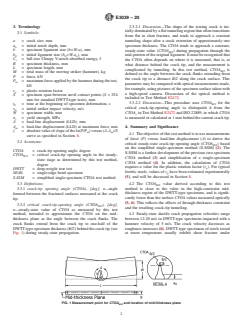
3. Terminology 3.3.2.1 Discussion—The shape of the tearing crack is ini-
tiallydominatedbyaflattunnelingregionthatoftentransitions
3.1 Symbols:
from flat to slant fracture, and tends to approach a constant
a = crack size, mm tunneling shape after a crack extension of approximately one
a = initial notch depth, mm specimen thickness. The CTOA tends to approach a constant,
n
b = specimen ligament size (b=W-a),mm
steady-state value (CTOA ) during propagation through the
B/2
b = initial ligament size (b =W-a ),mm
mid-portionoftheoriginalligament.Itmustberecognizedthat
0 0 n
C = full-size Charpy V-notch absorbed energy, J
v
the CTOA often depends on where it is measured, that is, at
B = specimen thickness, mm
what distance behind the crack tip, and the measurement is
L = specimen length, mm
complicated by tunneling. In this test method, CTOA is
B/2
M = total mass of the moving striker (hammer), kg
defined as the angle between the crack flanks extending from
P = force, kN
the crack tip to a distance B/2 along the crack surface. This
P = maximumforceappliedbythehammerduringthetest,
m
parameter may be compared with optical measurements made,
kN
for example, using pictures of the specimen surface taken with
r = plastic rotation factor
p
a high-speed camera. Discussion of the optical method is
S = specimen span between anvil contact points (S = 254
included in Test Method E2472.
mm for standard DWTT-type tests), mm
3.3.2.2 Discussion—This procedure uses CTOA for the
t = time at the beginning of specimen deformation, s B/2
critical crack-tip-opening angle to distinguish it from the
v = initial striker impact velocity, m/s
CTOA in Test Method E2472 and ISO 22889, in which CTOA
W = specimen width, mm
c
σ = yield strength, MPa is measured or calculated at 1 mm behind the current crack tip.
y
∆ = load-line displacement (LLD), mm
∆ = load-line displacement (LLD) at maximum force, mm
4. Summary and Significance
m
ξ = absolutevalueofslopeoftheln(P/P )versus(∆-∆ )/S
m m
4.1 Theobjectiveofthistestmethodistousemeasurements
curve as specified in Section 8.
of force (P) versus load-line displacement (∆) to derive the
3.2 Acronyms:
critical steady-state crack-tip opening angle (CTOA ) based
B/2
on the simplified single-specimen method (S-SSM) (2). The
CTOA = crack-tip opening angle, degree
S-SSM is a further development of the previous two-specimen
CTOA = critical crack-tip opening angle in the steady-
B/2
CTOA method (3) and simplification of a single-specimen
state stage as determined by this test method,
CTOA method (4). In addition, the calculation of CTOA
degree
requires a value for the plastic rotation factor (r ). For typical
p
DWTT = drop-weight tear test
ferritic steels, values of r have been estimated experimentally
p
SE(B) = single-edge bend specimen
(5), and will be discussed in Section 8.
S-SSM = simplified single-specimen CTOA test method
4.2 The CTOA value derived according to this test
3.3 Definitions: B/2
method is close to the value in the high-constraint mid-
3.3.1 crack-tip opening angle (CTOA), [deg], n—angle
thickness region of the DWTT-type specimens, and is signifi-
formed between the fractured surfaces measured at the crack
cantly lower than the surface CTOA values measured optically
tip.
(5, 6). This reflects the effects of through-thickness constraint
3.3.2 critical crack-tip-opening angle (CTOA ), [deg],
B/2
and the resulting crack-tip tunneling.
n—steady-state value of CTOA as measured by this test
method, intended to approximate the CTOA on the mid- 4.3 Steady-state ductile crack propagation velocities range
thickness plane as the angle between the crack flanks. The between 12-20 m/s in DWTT-type specimens impacted with a
crack flanks extend from the crack tip to one-half of the hammer velocity of 5 m/s. The crack velocity decreases as
DWTT-type specimen thickness (B/2) behind the crack tip (see toughness increases (6). DWTT-type specimens of steels tested
Fig. 1) during steady-state propagation. at room temperature usually exhibit shear fracture under
FIG. 1 Measurement point for CTOA and location of mid-thickness plane
B/2
E3039 − 20
impact loading; that is, the flat (tunnelling) morphology at 5.4 Force Measurement:
crack initiation usually transitions to a near-45° slant fracture
5.4.1 Force shall be measured by means of an electronic
that is considered to be a shear morphology. For pipe steels,
sensor (piezoelectric load cell, strain gauge load cell or a force
this mimics the fracture mode observed in full-scale pipe burst
measurement derived from an accelerometer).
tests.
5.4.2 The force measuring system (including strain gauges,
4.4 The apparatus, specimen dimensions and testing proce-
wiring, and amplifier) shall have a bandwidth of at least 100
dure in this test method are the same as those described in Test
kHz as discussed in Guide E1942.
Method E436 or API RP 5L3 and Test Method E2298, see
5.4.3 Thesignalshallberecordedwithoutfiltering.Post-test
Section 2. The intent is to adopt the standardized DWTT test
filtering, however, is allowed as detailed in Test Method
procedures, machines (for example, hammer and anvil
E2298, 7.2 but efforts should be taken to avoid introducing
supports), and instrumentation requirements to the maximum
errors through filtering, as discussed in Guide E1942.
extent possible. The following sections provide specific
5.4.4 Calibration of the recorder and measurement system
requirements, procedures and calculations for determining
may be performed statically in accordance with the accuracy
CTOA.
requirements given in 5.4.4.1. For pendulum machines, it is
5. Apparatus recommended that the force calibration be performed with the
striker attached to the pendulum assembly. The strain gauge
5.1 The test shall be conducted using a test machine that has
signal conditioning equipment, cables, and recording device
sufficient energy to completely break the specimen in one
shall be used in the calibration. In most cases, a computer is
impact. The key dimensions, shown in Fig. 2, are: distance
used for data acquisition and the calibration shall be performed
between supports (span) S = 254 mm (10 in.), radius of impact
with the voltage read from the computer. The intent is to
hammer striking edge = 25.4 mm (1 in.), and radius of fixed
calibrate with the electronics and cables which are used during
support anvils = 19 mm (0.75 in.). Drawings of the test fixture
actual testing.
and specimen can also be found in Test Method E436 or API
RP 5L3.
5.4.4.1 The static linearity and hysteresis error including all
parts of the force measurement system up to the recording
5.2 The initial velocity v of the hammer at impact shall be
apparatusshallbewithin 62%oftherecordedforce,between
5 m/s ≤ v ≤ 10 m/s and shall be known within 6 5%, as
50 % and 100 % of the nominal force range, and within 61%
discussed below.
of the full scale force value between 10 % and 50 % of the
5.3 For force measurement and displacement determination,
nominal force range as detailed inTest Method E2298, 7.2.4.1.
the provisions of Test Method E2298 shall apply. Instrumen-
tation shall be used to determine force-time or force-
NOTE 1—For testing in accordance with this test method, it is
displacement curves. recommended to calibrate the instrumented striker up to 500 kN.
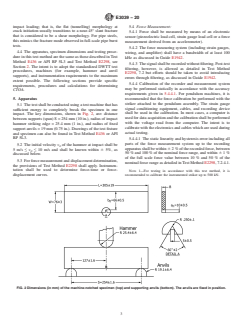
FIG. 2 Dimensions (in mm) of the machine-notched specimen (top) and supporting anvils (bottom). The anvils are fixed in position.
E3039 − 20
5.4.5 Recalibration shall be performed if the instrumented 6. Specimen
striker has undergone dismantling or repair, unless it can be
6.1 The specimen width and length shall beW= 76 mm and
shown that removal of the striker from the test machine and
L = 305 mm (Fig. 2). Any orientations and locations may be
subsequent re-attachment to the machine does not affect the
usedprovidedtheyareagreeduponbetweenthetestingfacility
calibration.
and the client and reported with the test results. For pipe steels,
the specimen preparation shall be according to 6.2, 6.3 and 6.4.
5.5 Displacement Determination:
6.2 For seamless pipes, the specimen can be removed at any
5.5.1 Displacement shall be measured using a non-
location,butforweldedpipesthespecimenshallbetakenfrom
contacting transducer according to 5.5.4 or calculated using
alocationapproximately90°fromtheweld (7).Thespecimens
force-time measurements with Newton’s equations of motion
shall be oriented in C-L orientation according to Terminology
as outlined in 5.5.2.
E1823-13. Other orientations and locations may be used
5.5.2 Assuming a rigid striker of mass m with an initial
provided they are agreed upon between the testing facility and
velocity v the velocity v(t) at the contact point as a function of
the client and reported with the test results. The specimen
elapsed time is calculated as:
width and length shall be W = 76 mm and L = 305 mm (Fig.
2).
1 t
v t 5 v 2 P t dt (1)
~ ! * ~ !
m t
6.3 Specimens shall have full pipe thickness to avoid any
If the specimen is assumed not to lift off at the anvils the
effect that a reduction in thickness might have on CTOA.
bending displacement ∆(t) is evaluated from:
6.4 The specimens shall be flattened to remove the pipe
t
∆ t 5 v t dt (2)
~ ! * ~ !
curvature from the test specimen according to Test Method
t
E436 or API RP 5L3.
5.5.3 For drop weight and pendulum machines, the initial
6.5 Acceptablenotchesareapressednotchwithdepth5mm
impact velocity needed to perform the above integrations is
6 0.5 mm as per Test Method E436 or API RP 5L3, or a
calculated from:
straightmachinednotchwithdepth10mm 60.5mmasshown
in Fig. 2. It has been shown that pressed notches and straight
v 5 =2gh (3)
0 0
notches produce equivalentCTOA values, that is, the type of
B/2
where:
notch does not strongly influence fracture propagation tough-
g = local acceleration due to gravity, and
ness or the slope of the force versus deflection curve beyond
h = height of striker from point of release to point of initial
the maximum force (8, 9). Because only the post-maximum-
impact.
force data is analyzed, other notch types with sharper notch tip
radii (for example, fatigue precrack or chevron notch) are also
5.5.3.1 Alternatively, for
...
This document is not an ASTM standard and is intended only to provide the user of an ASTM standard an indication of what changes have been made to the previous version. Because
it may not be technically possible to adequately depict all changes accurately, ASTM recommends that users consult prior editions as appropriate. In all cases only the current version
of the standard as published by ASTM is to be considered the official document.
´1
Designation: E3039 − 18 E3039 − 20
Standard Test Method for
Determination of Crack-Tip-Opening Angle of PipeFerritic
Steels Using DWTT-Type Specimens
This standard is issued under the fixed designation E3039; the number immediately following the designation indicates the year of
original adoption or, in the case of revision, the year of last revision. A number in parentheses indicates the year of last reapproval. A
superscript epsilon (´) indicates an editorial change since the last revision or reapproval.
ε NOTE—Fig 6. was editorially corrected in September 2019.
1. Scope
1.1 This test method covers the determination of fracture propagation toughness in terms of the steady-state crack-tip-opening
angle (CTOA) using the drop-weight tear test (DWTT)-type specimen. The method is applicable to pipeferritic steels that exhibit
predominantly ductile fracture with at least 85%85 % shear area measured according to Test Method E436 - Standard Test Method
for Drop-Weight Tear Tests of Ferritic Steels. This test method applies to steel pipesferritic steels with wall thicknesses between
6 mm and 20 mm. Annex A1 describes the method to test pipeferritic steels with wall thickness thicknesses between 20 mm to
32 mm.
1.2 In terms of apparatus, specimen design, and test methodology, this test method draws from Test Method E436 and API 5L3
- Recommended Practice for Conducting Drop-Weight Tear Tests on Line Pipe.
1.3 The development of this test method has been driven by the need to design for fast ductile fracture arrest of axial running
cracks in steel high-pressure gas pipelines (1). The purpose has been to develop a test to characterize fracture propagation
resistance in a form suitable for use as a pipe mill test (2). The traditional Charpy test has been shown to be inadequate for modern
high toughness pipe steels (1). This test method measures fracture propagation resistance in terms of crack-tip opening angle, and
is used to characterize pipeferritic steels.
1.4 The values stated in SI units are to be regarded as standard. No other units of measurement are included in this standard.
1.5 This standard does not purport to address all of the safety concerns, if any, associated with its use. It is the responsibility
of the user of this standard to establish appropriate safety, health, and environmental practices and determine the applicability of
regulatory limitations prior to use.
1.6 This international standard was developed in accordance with internationally recognized principles on standardization
established in the Decision on Principles for the Development of International Standards, Guides and Recommendations issued
by the World Trade Organization Technical Barriers to Trade (TBT) Committee.
2. Referenced Documents
2.1 ASTM Standards:
This test method is under the jurisdiction of ASTM Committee E08 on Fatigue and Fracture and is the direct responsibility of Subcommittee E08.07 on Fracture
Mechanics.
Current edition approved Nov. 1, 2018Sept. 1, 2020. Published January 2019September 2020. Originally approved in 2016. Last previous edition approved in 20162018
ɛ1
as E3039–16.–18 . DOI: 10.1520/E3039–18E0110.1520/E3039–20.
The boldface numbers in parentheses refer to a list of references at the end of this standard.
For referenced ASTM standards, visit the ASTM website, www.astm.org, or contact ASTM Customer Service at service@astm.org. For Annual Book of ASTM Standards
volume information, refer to the standard’s Document Summary page on the ASTM website.
Copyright © ASTM International, 100 Barr Harbor Drive, PO Box C700, West Conshohocken, PA 19428-2959. United States
E3039 − 20
E177 Practice for Use of the Terms Precision and Bias in ASTM Test Methods
E436 Test Method for Drop-Weight Tear Tests of Ferritic Steels
E691 Practice for Conducting an Interlaboratory Study to Determine the Precision of a Test Method
E1823 Terminology Relating to Fatigue and Fracture Testing
E1942 Guide for Evaluating Data Acquisition Systems Used in Cyclic Fatigue and Fracture Mechanics Testing
E2298 Test Method for Instrumented Impact Testing of Metallic Materials
E2472 Test Method for Determination of Resistance to Stable Crack Extension under Low-Constraint Conditions
2.2 ISO Standards:
ISO 22889 Metallic materials — Method of Test for the Determination of Resistance to Stable Crack Extension Using
Specimens of Low Constraint
ISO 14456 Steel — Charpy V-notch Pendulum Impact Test — Instrumented Test Method
2.3 API Recommended Practice:
API Recommended Practice 5L3 Drop-Weight Tear Tests on Line Pipe
3. Terminology
3.1 Symbols:
a = crack size, mm
a = initial notch depth, mm
n
b = specimen ligament size (b=W-a), mm
b = initial ligament size (b =W-a ), mm
0 0 n
C = full-size Charpy V-notch absorbed energy, J
v
B = specimen thickness, mm
L = specimen length, mm
M = total mass of the moving striker (hammer), kg
P = force, kN
P = maximum force applied by the hammer during the test, kN
m
r = plastic rotation factor
p
S = specimen span between anvil contact points (S = 254 mm for standard DWTT-type tests), mm
t = time at the beginning of specimen deformation, s
v = initial striker impact velocity, m/s
W = specimen width, mm
σ = yield strength, MPa
y
Δ = load-line displacement (LLD), mm
Δ = load-line displacement (LLD) at maximum force, mm
m
ξ = absolute value of slope of the ln(P/P ) versus (Δ-Δ )/S curve as specified in Section 8.
m m
3.2 Acronyms:
CTOA = crack-tip opening angle, degree
CTOA = critical crack-tip opening angle in the steady-state stage as determined by this test method, degree
B/2
DWTT = drop-weight tear test
SE(B) = single-edge bend specimen
S-SSM = simplified single-specimen CTOA test method
3.3 Definitions:
3.3.1 crack-tip opening angle (CTOA), [deg], n—angle formed between the fractured surfaces measured at the crack tip.
3.3.2 critical crack-tip-opening angle (CTOA ), [deg], n—steady-state value of CTOA as measured by this test method, intended
B/2
to approximate the CTOA on the mid-thickness plane as the angle between the crack flanks. The crack flanks extend from the crack
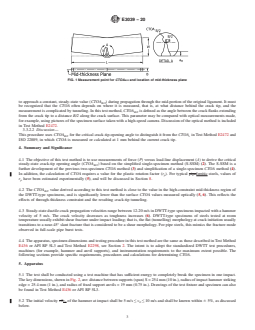
tip to one-half of the DWTT-type specimen thickness (B/2) behind the crack tip (see Fig. 1) during steady-state propagation.
3.3.2.1 Discussion—
The shape of the tearing crack is initially dominated by a flat tunneling region that often transitions from flat to slant fracture, and
tends to approach a constant tunneling shape after a crack extension of approximately one specimen thickness. The CTOA tends
Available from International Organization for Standardization (ISO), ISO Central Secretariat, BIBC II, Chemin de Blandonnet 8, CP 401, 1214 Vernier, Geneva,
Switzerland, http://www.iso.org.
Available from American Petroleum Institute (API), 1220 L. St., NW, Washington, DC 20005-4070, http://www.api.org.
E3039 − 20
FIG. 1 Measurement point for CTOA and location of mid-thickness plane
B/2
to approach a constant, steady-state value (CTOA ) during propagation through the mid-portion of the original ligament. It must
B/2
be recognized that the CTOA often depends on where it is measured, that is, at what distance behind the crack tip, and the
measurement is complicated by tunneling. In this test method, CTOA is defined as the angle between the crack flanks extending
B/2
from the crack tip to a distance B/2 along the crack surface. This parameter may be compared with optical measurements made,
for example, using pictures of the specimen surface taken with a high-speed camera. Discussion of the optical method is included
in Test Method E2472.
3.3.2.2 Discussion—
This procedure uses CTOA for the critical crack-tip-opening angle to distinguish it from the CTOA in Test Method E2472 and
B/2 c
ISO 22889, in which CTOA is measured or calculated at 1 mm behind the current crack tip.
4. Summary and Significance
4.1 The objective of this test method is to use measurements of force (P) versus load-line displacement (Δ) to derive the critical
steady-state crack-tip opening angle (CTOA ) based on the simplified single-specimen method (S-SSM) (2). The S-SSM is a
B/2
further development of the previous two-specimen CTOA method (3) and simplification of a single-specimen CTOA method (4).
In addition, the calculation of CTOA requires a value for the plastic rotation factor (r ). For typical pipeferritic steels, values of
p
r have been estimated experimentally (5), and will be discussed in Section 8.
p
4.2 The CTOA value derived according to this test method is close to the value in the high-constraint mid-thickness region of
B/2
the DWTT-type specimens, and is significantly lower than the surface CTOA values measured optically (5, 6). This reflects the
effects of through-thickness constraint and the resulting crack-tip tunneling.
4.3 Steady-state ductile crack propagation velocities range between 12-20 m/s in DWTT-type specimens impacted with a hammer
velocity of 5 m/s. The crack velocity decreases as toughness increases (6). DWTT-type specimens of steels tested at room
temperature usually exhibit shear fracture under impact loading; that is, the flat (tunnelling) morphology at crack initiation usually
transitions to a near-45° slant fracture that is considered to be a shear morphology. For pipe steels, this mimics the fracture mode
observed in full-scale pipe burst tests.
4.4 The apparatus, specimen dimensions and testing procedure in this test method are the same as those described in Test Method
E436 or API RP 5L3 and Test Method E2298, see Section 2. The intent is to adopt the standardized DWTT test procedures,
machines (for example, hammer and anvil supports), and instrumentation requirements to the maximum extent possible. The
following sections provide specific requirements, procedures and calculations for determining CTOA.
5. Apparatus
5.1 The test shall be conducted using a test machine that has sufficient energy to completely break the specimen in one impact.
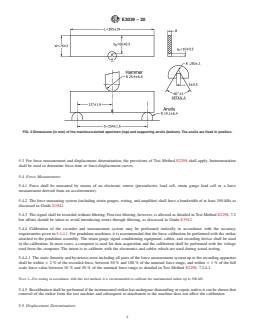
The key dimensions, shown in Fig. 2, are: distance between supports (span) S = 254 mm (10 in.), radius of impact hammer striking
edge = 25.4 mm (1 in.), and radius of fixed support anvils = 19 mm (0.75 in.). Drawings of the test fixture and specimen can also
be found in Test Method E436 or API RP 5L3.
5.2 The initial velocity v0v of the hammer at impact shall be 5 m/s ≤ v ≤ 10 m/s and shall be known within 6 5%, as discussed
0 0
below.
E3039 − 20
FIG. 2 Dimensions (in mm) of the machine-notched specimen (top) and supporting anvils (bottom). The anvils are fixed in position.
5.3 For force measurement and displacement determination, the provisions of Test Method E2298 shall apply. Instrumentation
shall be used to determine force-time or force-displacement curves.
5.4 Force Measurement:
5.4.1 Force shall be measured by means of an electronic sensor (piezoelectric load cell, strain gauge load cell or a force
measurement derived from an accelerometer).
5.4.2 The force measuring system (including strain gauges, wiring, and amplifier) shall have a bandwidth of at least 100 kHz as
discussed in Guide E1942.
5.4.3 The signal shall be recorded without filtering. Post-test filtering, however, is allowed as detailed in Test Method E2298, 7.2
but efforts should be taken to avoid introducing errors through filtering, as discussed in Guide E1942.
5.4.4 Calibration of the recorder and measurement system may be performed statically in accordance with the accuracy
requirements given in 5.4.4.1. For pendulum machines, it is recommended that the force calibration be performed with the striker
attached to the pendulum assembly. The strain gauge signal conditioning equipment, cables, and recording device shall be used
in the calibration. In most cases, a computer is used for data acquisition and the calibration shall be performed with the voltage
read from the computer. The intent is to calibrate with the electronics and cables which are used during actual testing.
5.4.4.1 The static linearity and hysteresis error including all parts of the force measurement system up to the recording apparatus
shall be within 6 2 % of the recorded force, between 50 % and 100 % of the nominal force range, and within 6 1 % of the full
scale force value between 10 % and 50 % of the nominal force range as detailed in Test Method E2298, 7.2.4.1.
NOTE 1—For testing in accordance with this test method, it is recommended to calibrate the instrumented striker up to 500 kN.
5.4.5 Recalibration shall be performed if the instrumented striker has undergone dismantling or repair, unless it can be shown that
removal of the striker from the test machine and subsequent re-attachment to the machine does not affect the calibration.
5.5 Displacement Determination:
E3039 − 20
5.5.1 Displacement shall be measured using a non-contacting transducer according to 5.5.4 or calculated using force-time
measurements with Newton’s equations of motion as outlined in 5.5.2.
5.5.2 Assuming a rigid striker of mass m with an initial velocity v the velocity v(t) at the contact point as a function of elapsed
time is calculated as:
1 t
v~t! 5 v 2 * P~t!dt (1)
t
m
If the specimen is assumed not to lift off at the anvils the bending displacement Δ(t) is evaluated from:
t
Δ t 5 v t dt (2)
~ ! * ~ !
t
5.5.3 For drop weight and pendulum machines, the initial impact velocity needed to perform the above integrations is calculated
from:
v 5=2gh (3)
0 0
where:
g = local acceleration due to gravity, and
h = height of striker from point of release to point of initial impact.
5.5.3.1 Alternatively, for drop weight and pendulum machines, it is acceptable to use for v the optically measured velocity
registered when the pendulum passes through its lowest position and strikes the specimen.
5.5.4 Displacement can also be determined by non-contacting measurement of the displacement of the striker relative to the anvil
using optical, inductive, or capacitive methods. The signal transfer characteristics of the displacement measurement system shall
correspond to that of the force measuring system in order to minimize phase difference and data skew errors, as discussed in Guide
E1942. The displacement measuring system shall be designed for maximum nominal values of 40 mm. Linearity errors in the
measuring system shall yield measured values to within 6 2 % over a range of 1 mm to 40 mm. Measurements up to 1 mm may
not be sufficiently accurate to determine the displacement within 6 2 %. In this case, the displacement of the specimen shall be
determined from the time measurement and the striker impact velocity as indicated in Eq 1 and Eq 2.
5.6 The recording apparatus (that is, high-speed data acquisition system and instrumented striker) shall comply with Test Method
E2298 Section 7. Data acquisition systems that are commercially available for instrumented Charpy tests are acceptable if they
meet the accuracy requirements defined here for this test. Force-time data acquisition at a rate of 10 /s (1 MHz) or greater is
required (5,6).
6. Specimen
6.1 The specimen width and length shall be W = 76 mm and L = 305 mm (Fig. 2). Any orientations and locations may be used
provided they are a
...