

ASTM E415-21
(Test Method)Standard Test Method for Analysis of Carbon and Low-Alloy Steel by Spark Atomic Emission Spectrometry
General Information
- Abstract
SIGNIFICANCE AND USE
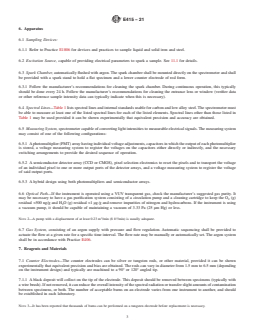
5.1 This test method for the spectrometric analysis of metals and alloys is primarily intended to test such materials for compliance with compositional specifications. It is assumed that all who use this test method will be analysts capable of performing common laboratory procedures skillfully and safely. It is expected that work will be performed in a properly equipped laboratory.
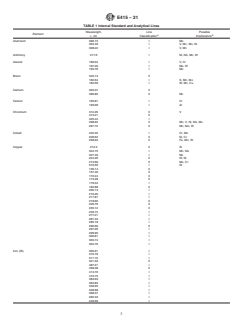
SCOPE
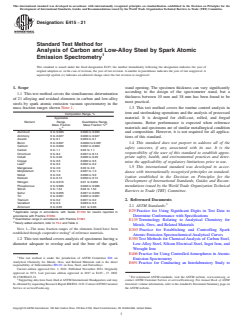
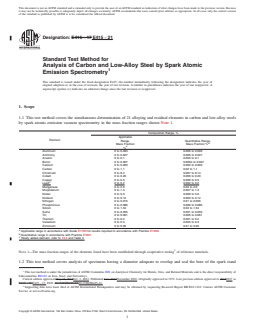
1.1 This test method covers the simultaneous determination of 21 alloying and residual elements in carbon and low-alloy steels by spark atomic emission vacuum spectrometry in the mass fraction ranges shown Note 1.
Element
Composition Range, %
Applicable Range,
Mass Fraction %A
Quantitative Range,
Mass Fraction %B
Aluminum
0 to 0.093
0.006 to 0.093
Antimony
0 to 0.027
0.006 to 0.027
Arsenic
0 to 0.1
0.003 to 0.1
Boron
0 to 0.007
0.0004 to 0.007
Calcium
0 to 0.003
0.002 to 0.003
Carbon
0 to 1.1
0.02 to 1.1
Chromium
0 to 8.2
0.007 to 8.14
Cobalt
0 to 0.20
0.006 to 0.20
Copper
0 to 0.5
0.006 to 0.5
LeadC
0 to 0.2
0.002 to 0.2
Manganese
0 to 2.0
0.03 to 2.0
Molybdenum
0 to 1.3
0.007 to 1.3
Nickel
0 to 5.0
0.006 to 5.0
Niobium
0 to 0.12
0.003 to 0.12
Nitrogen
0 to 0.015
0.01 to 0.055
Phosphorous
0 to 0.085
0.006 to 0.085
Silicon
0 to 1.54
0.02 to 1.54
Sulfur
0 to 0.055
0.001 to 0.055
Tin
0 to 0.061
0.005 to 0.061
Titanium
0 to 0.2
0.001 to 0.2
Vanadium
0 to 0.3
0.003 to 0.3
Zirconium
0 to 0.05
0.01 to 0.05
Note 1: The mass fraction ranges of the elements listed have been established through cooperative testing2 of reference materials.
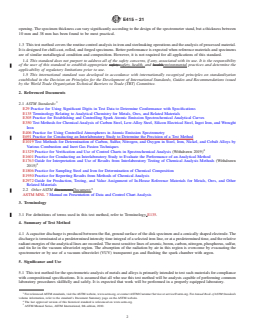
1.2 This test method covers analysis of specimens having a diameter adequate to overlap and seal the bore of the spark stand opening. The specimen thickness can vary significantly according to the design of the spectrometer stand, but a thickness between 10 mm and 38 mm has been found to be most practical.
1.3 This test method covers the routine control analysis in iron and steelmaking operations and the analysis of processed material. It is designed for chill-cast, rolled, and forged specimens. Better performance is expected when reference materials and specimens are of similar metallurgical condition and composition. However, it is not required for all applications of this standard.
1.4 This standard does not purport to address all of the safety concerns, if any, associated with its use. It is the responsibility of the user of this standard to establish appropriate safety, health, and environmental practices and determine the applicability of regulatory limitations prior to use.
1.5 This international standard was developed in accordance with internationally recognized principles on standardization established in the Decision on Principles for the Development of International Standards, Guides and Recommendations issued by the World Trade Organization Technical Barriers to Trade (TBT) Committee.
- Status
- Published
- Publication Date
- 30-Sep-2021
- Technical Committee
- E01 - Analytical Chemistry for Metals, Ores, and Related Materials
- Drafting Committee
- E01.01 - Iron, Steel, and Ferroalloys
Buy Documents
ASTM E415-21 - Standard Test Method for Analysis of Carbon and Low-Alloy Steel by Spark Atomic Emission Spectrometry
REDLINE ASTM E415-21 - Standard Test Method for Analysis of Carbon and Low-Alloy Steel by Spark Atomic Emission Spectrometry
Overview
ASTM E415-21 is an internationally recognized standard test method developed by ASTM International for the analysis of carbon and low-alloy steels using spark atomic emission spectrometry (SAES). This standard provides procedures for determining the chemical composition of up to 21 alloying and residual elements in steel by means of simultaneous spectrometric analysis. Designed for application in laboratories with the necessary equipment and skilled analysts, ASTM E415-21 plays a crucial role in ensuring that steel products conform to compositional specifications required for industrial, structural, and manufacturing applications.
Key Topics
Scope and Elements Analyzed
ASTM E415-21 covers the analysis of carbon and low-alloy steel samples, handling a broad range of element concentrations. The standard allows precise, simultaneous measurement of elements including carbon, manganese, silicon, chromium, nickel, molybdenum, copper, vanadium, titanium, and more, ensuring a comprehensive chemical profile.Sample Requirements
Specimens should have a diameter adequate to seal the spark stand opening and a thickness typically between 10 mm and 38 mm. The test is suitable for chill-cast, rolled, and forged steel forms.Spectrometric Methodology
The procedure utilizes spark discharge between the sample and an electrode to excite atoms, with resulting emissions measured by a spectrometer. This technique supports routine control analysis in iron and steelmaking, and is optimized for use with certified reference materials for calibration and standardization.Quality Control
The method emphasizes the importance of proper laboratory practices and regular instrument verification and standardization to maintain accuracy and repeatability. Reference materials and verification protocols help ensure data quality and regulatory compliance.
Applications
Routine Quality Control in Steel Production
ASTM E415-21 enables rapid, accurate compositional checks during steelmaking and material processing, reducing production errors and ensuring materials meet required specifications.Product Certification and Compliance
Manufacturers, quality assurance teams, and third-party labs rely on this standard to verify product chemistry for compliance with customer and regulatory requirements, facilitating traceability and market access.Metallurgical Research
The standard is also used in research and development to optimize alloy formulations, investigate performance characteristics, and support innovation in steel grades.Supply Chain Verification
By adopting ASTM E415-21, organizations across the supply chain can ensure consistency of raw materials and finished products, supporting global sourcing and standardized assessment practices.
Related Standards
Several other ASTM standards are commonly cited alongside or used in conjunction with ASTM E415-21 to ensure comprehensive metal analysis and laboratory quality control. Key related standards include:
- ASTM E29 - Practice for Using Significant Digits in Test Data to Determine Conformance with Specifications
- ASTM E350 - Test Methods for Chemical Analysis of Carbon Steel, Low-Alloy Steel, Silicon Electrical Steel, Ingot Iron, and Wrought Iron
- ASTM E406 - Practice for Using Controlled Atmospheres in Atomic Emission Spectrometry
- ASTM E1806 - Practice for Sampling Steel and Iron for Determination of Chemical Composition
- ASTM E1019 - Test Methods for Determination of Carbon, Sulfur, Nitrogen, and Oxygen in Steel, Iron, Nickel, and Cobalt Alloys by Various Combustion and Inert Gas Fusion Techniques
- ASTM E305 - Practice for Establishing and Controlling Spark Atomic Emission Spectrochemical Analytical Curves
Summary
ASTM E415-21 remains a foundational document supporting the chemical analysis of carbon and low-alloy steels by spark atomic emission spectrometry. Its rigorous approach to specimen handling, calibration, verification, and reporting ensures reliable and internationally accepted analytical results. Adhering to this standard benefits manufacturers, laboratories, and regulators by supporting product quality, traceability, and compliance throughout the global steel industry.
Keywords: ASTM E415-21, spark atomic emission spectrometry, alloy steel analysis, carbon steel analysis, steel composition, spectrometric analysis, laboratory standards, metal analysis, compositional specification, quality control.
Relations
- Effective Date
- 15-Nov-2023
- Effective Date
- 01-Jan-2020
- Effective Date
- 01-Nov-2019
- Refers
ASTM E406-19 - Standard Practice for Using Controlled Atmospheres in Atomic Emission Spectrometry - Effective Date
- 01-Oct-2019
- Effective Date
- 01-Oct-2019
- Effective Date
- 15-May-2019
- Effective Date
- 15-Nov-2017
- Effective Date
- 15-May-2016
- Effective Date
- 01-Jul-2015
- Effective Date
- 15-May-2015
- Effective Date
- 15-Feb-2015
- Effective Date
- 15-Aug-2014
- Effective Date
- 01-Apr-2014
- Effective Date
- 15-Feb-2014
- Effective Date
- 01-Dec-2013
Buy Documents
ASTM E415-21 - Standard Test Method for Analysis of Carbon and Low-Alloy Steel by Spark Atomic Emission Spectrometry
REDLINE ASTM E415-21 - Standard Test Method for Analysis of Carbon and Low-Alloy Steel by Spark Atomic Emission Spectrometry
Get Certified
Connect with accredited certification bodies for this standard

Element Materials Technology
Materials testing and product certification.

Inštitut za kovinske materiale in tehnologije
Institute of Metals and Technology. Materials testing, metallurgical analysis, NDT.
Sponsored listings
Frequently Asked Questions
ASTM E415-21 is a standard published by ASTM International. Its full title is "Standard Test Method for Analysis of Carbon and Low-Alloy Steel by Spark Atomic Emission Spectrometry". This standard covers: SIGNIFICANCE AND USE 5.1 This test method for the spectrometric analysis of metals and alloys is primarily intended to test such materials for compliance with compositional specifications. It is assumed that all who use this test method will be analysts capable of performing common laboratory procedures skillfully and safely. It is expected that work will be performed in a properly equipped laboratory. SCOPE 1.1 This test method covers the simultaneous determination of 21 alloying and residual elements in carbon and low-alloy steels by spark atomic emission vacuum spectrometry in the mass fraction ranges shown Note 1. Element Composition Range, % Applicable Range, Mass Fraction %A Quantitative Range, Mass Fraction %B Aluminum 0 to 0.093 0.006 to 0.093 Antimony 0 to 0.027 0.006 to 0.027 Arsenic 0 to 0.1 0.003 to 0.1 Boron 0 to 0.007 0.0004 to 0.007 Calcium 0 to 0.003 0.002 to 0.003 Carbon 0 to 1.1 0.02 to 1.1 Chromium 0 to 8.2 0.007 to 8.14 Cobalt 0 to 0.20 0.006 to 0.20 Copper 0 to 0.5 0.006 to 0.5 LeadC 0 to 0.2 0.002 to 0.2 Manganese 0 to 2.0 0.03 to 2.0 Molybdenum 0 to 1.3 0.007 to 1.3 Nickel 0 to 5.0 0.006 to 5.0 Niobium 0 to 0.12 0.003 to 0.12 Nitrogen 0 to 0.015 0.01 to 0.055 Phosphorous 0 to 0.085 0.006 to 0.085 Silicon 0 to 1.54 0.02 to 1.54 Sulfur 0 to 0.055 0.001 to 0.055 Tin 0 to 0.061 0.005 to 0.061 Titanium 0 to 0.2 0.001 to 0.2 Vanadium 0 to 0.3 0.003 to 0.3 Zirconium 0 to 0.05 0.01 to 0.05 Note 1: The mass fraction ranges of the elements listed have been established through cooperative testing2 of reference materials. 1.2 This test method covers analysis of specimens having a diameter adequate to overlap and seal the bore of the spark stand opening. The specimen thickness can vary significantly according to the design of the spectrometer stand, but a thickness between 10 mm and 38 mm has been found to be most practical. 1.3 This test method covers the routine control analysis in iron and steelmaking operations and the analysis of processed material. It is designed for chill-cast, rolled, and forged specimens. Better performance is expected when reference materials and specimens are of similar metallurgical condition and composition. However, it is not required for all applications of this standard. 1.4 This standard does not purport to address all of the safety concerns, if any, associated with its use. It is the responsibility of the user of this standard to establish appropriate safety, health, and environmental practices and determine the applicability of regulatory limitations prior to use. 1.5 This international standard was developed in accordance with internationally recognized principles on standardization established in the Decision on Principles for the Development of International Standards, Guides and Recommendations issued by the World Trade Organization Technical Barriers to Trade (TBT) Committee.
SIGNIFICANCE AND USE 5.1 This test method for the spectrometric analysis of metals and alloys is primarily intended to test such materials for compliance with compositional specifications. It is assumed that all who use this test method will be analysts capable of performing common laboratory procedures skillfully and safely. It is expected that work will be performed in a properly equipped laboratory. SCOPE 1.1 This test method covers the simultaneous determination of 21 alloying and residual elements in carbon and low-alloy steels by spark atomic emission vacuum spectrometry in the mass fraction ranges shown Note 1. Element Composition Range, % Applicable Range, Mass Fraction %A Quantitative Range, Mass Fraction %B Aluminum 0 to 0.093 0.006 to 0.093 Antimony 0 to 0.027 0.006 to 0.027 Arsenic 0 to 0.1 0.003 to 0.1 Boron 0 to 0.007 0.0004 to 0.007 Calcium 0 to 0.003 0.002 to 0.003 Carbon 0 to 1.1 0.02 to 1.1 Chromium 0 to 8.2 0.007 to 8.14 Cobalt 0 to 0.20 0.006 to 0.20 Copper 0 to 0.5 0.006 to 0.5 LeadC 0 to 0.2 0.002 to 0.2 Manganese 0 to 2.0 0.03 to 2.0 Molybdenum 0 to 1.3 0.007 to 1.3 Nickel 0 to 5.0 0.006 to 5.0 Niobium 0 to 0.12 0.003 to 0.12 Nitrogen 0 to 0.015 0.01 to 0.055 Phosphorous 0 to 0.085 0.006 to 0.085 Silicon 0 to 1.54 0.02 to 1.54 Sulfur 0 to 0.055 0.001 to 0.055 Tin 0 to 0.061 0.005 to 0.061 Titanium 0 to 0.2 0.001 to 0.2 Vanadium 0 to 0.3 0.003 to 0.3 Zirconium 0 to 0.05 0.01 to 0.05 Note 1: The mass fraction ranges of the elements listed have been established through cooperative testing2 of reference materials. 1.2 This test method covers analysis of specimens having a diameter adequate to overlap and seal the bore of the spark stand opening. The specimen thickness can vary significantly according to the design of the spectrometer stand, but a thickness between 10 mm and 38 mm has been found to be most practical. 1.3 This test method covers the routine control analysis in iron and steelmaking operations and the analysis of processed material. It is designed for chill-cast, rolled, and forged specimens. Better performance is expected when reference materials and specimens are of similar metallurgical condition and composition. However, it is not required for all applications of this standard. 1.4 This standard does not purport to address all of the safety concerns, if any, associated with its use. It is the responsibility of the user of this standard to establish appropriate safety, health, and environmental practices and determine the applicability of regulatory limitations prior to use. 1.5 This international standard was developed in accordance with internationally recognized principles on standardization established in the Decision on Principles for the Development of International Standards, Guides and Recommendations issued by the World Trade Organization Technical Barriers to Trade (TBT) Committee.
ASTM E415-21 is classified under the following ICS (International Classification for Standards) categories: 77.080.20 - Steels. The ICS classification helps identify the subject area and facilitates finding related standards.
ASTM E415-21 has the following relationships with other standards: It is inter standard links to ASTM E350-23, ASTM E135-20, ASTM E1601-19, ASTM E406-19, ASTM E2972-15(2019), ASTM E135-19, ASTM E1950-17, ASTM E135-16, ASTM E135-15a, ASTM E135-15, ASTM E2972-15, ASTM E135-14b, ASTM E135-14a, ASTM E135-14, ASTM E135-13a. Understanding these relationships helps ensure you are using the most current and applicable version of the standard.
ASTM E415-21 is available in PDF format for immediate download after purchase. The document can be added to your cart and obtained through the secure checkout process. Digital delivery ensures instant access to the complete standard document.
Standards Content (Sample)
This international standard was developed in accordance with internationally recognized principles on standardization established in the Decision on Principles for the
Development of International Standards, Guides and Recommendations issued by the World Trade Organization Technical Barriers to Trade (TBT) Committee.
Designation: E415 − 21
Standard Test Method for
Analysis of Carbon and Low-Alloy Steel by Spark Atomic
Emission Spectrometry
This standard is issued under the fixed designation E415; the number immediately following the designation indicates the year of
original adoption or, in the case of revision, the year of last revision. A number in parentheses indicates the year of last reapproval. A
superscript epsilon (´) indicates an editorial change since the last revision or reapproval.
1. Scope stand opening. The specimen thickness can vary significantly
according to the design of the spectrometer stand, but a
1.1 This test method covers the simultaneous determination
thickness between 10 mm and 38 mm has been found to be
of 21 alloying and residual elements in carbon and low-alloy
most practical.
steels by spark atomic emission vacuum spectrometry in the
mass fraction ranges shown Note 1. 1.3 This test method covers the routine control analysis in
iron and steelmaking operations and the analysis of processed
Composition Range, %
Applicable material. It is designed for chill-cast, rolled, and forged
Element Range, Quantitative Range,
specimens. Better performance is expected when reference
B
Mass Fraction Mass Fraction %
A materials and specimens are of similar metallurgical condition
%
Aluminum 0 to 0.093 0.006 to 0.093 and composition. However, it is not required for all applica-
Antimony 0 to 0.027 0.006 to 0.027
tions of this standard.
Arsenic 0 to 0.1 0.003 to 0.1
Boron 0 to 0.007 0.0004 to 0.007 1.4 This standard does not purport to address all of the
Calcium 0 to 0.003 0.002 to 0.003
safety concerns, if any, associated with its use. It is the
Carbon 0 to 1.1 0.02 to 1.1
responsibility of the user of this standard to establish appro-
Chromium 0 to 8.2 0.007 to 8.14
Cobalt 0 to 0.20 0.006 to 0.20
priate safety, health, and environmental practices and deter-
Copper 0 to 0.5 0.006 to 0.5
mine the applicability of regulatory limitations prior to use.
C
Lead 0 to 0.2 0.002 to 0.2
1.5 This international standard was developed in accor-
Manganese 0 to 2.0 0.03 to 2.0
Molybdenum 0 to 1.3 0.007 to 1.3
dance with internationally recognized principles on standard-
Nickel 0 to 5.0 0.006 to 5.0
ization established in the Decision on Principles for the
Niobium 0 to 0.12 0.003 to 0.12
Development of International Standards, Guides and Recom-
Nitrogen 0 to 0.015 0.01 to 0.055
Phosphorous 0 to 0.085 0.006 to 0.085
mendations issued by the World Trade Organization Technical
Silicon 0 to 1.54 0.02 to 1.54
Barriers to Trade (TBT) Committee.
Sulfur 0 to 0.055 0.001 to 0.055
Tin 0 to 0.061 0.005 to 0.061
2. Referenced Documents
Titanium 0 to 0.2 0.001 to 0.2
Vanadium 0 to 0.3 0.003 to 0.3
2.1 ASTM Standards:
Zirconium 0 to 0.05 0.01 to 0.05
E29 Practice for Using Significant Digits in Test Data to
A
Applicable range in accordance with Guide E1763 for results reported in
Determine Conformance with Specifications
accordance with Practice E1950.
B
Quantitative range in accordance with Practice E1601.
E135 Terminology Relating to Analytical Chemistry for
C
Newly added element, refer to 15.4 and Table 3.
Metals, Ores, and Related Materials
NOTE 1—The mass fraction ranges of the elements listed have been
E305 Practice for Establishing and Controlling Spark
established through cooperative testing of reference materials.
Atomic Emission Spectrochemical Analytical Curves
1.2 This test method covers analysis of specimens having a
E350 Test Methods for Chemical Analysis of Carbon Steel,
diameter adequate to overlap and seal the bore of the spark Low-Alloy Steel, Silicon Electrical Steel, Ingot Iron, and
Wrought Iron
E406 Practice for Using Controlled Atmospheres in Atomic
This test method is under the jurisdiction of ASTM Committee E01 on
Emission Spectrometry
Analytical Chemistry for Metals, Ores, and Related Materials and is the direct
E691 Practice for Conducting an Interlaboratory Study to
responsibility of Subcommittee E01.01 on Iron, Steel, and Ferroalloys.
Current edition approved Oct. 1, 2021. Published November 2021. Originally
approved in 1971. Last previous edition approved in 2017 as E415 – 17. DOI:
10.1520/E0415-21. For referenced ASTM standards, visit the ASTM website, www.astm.org, or
Supporting data have been filed at ASTM International Headquarters and may contact ASTM Customer Service at service@astm.org. For Annual Book of ASTM
be obtained by requesting Research Report RR:E01-1122. ContactASTM Customer Standards volume information, refer to the standard’s Document Summary page on
Service at service@astm.org. the ASTM website.
Copyright © ASTM International, 100 Barr Harbor Drive, PO Box C700, West Conshohocken, PA 19428-2959. United States
E415 − 21
Determine the Precision of a Test Method 6.2 Excitation Source, capable of providing electrical pa-
E1019 Test Methods for Determination of Carbon, Sulfur, rameters to spark a sample. See 11.1 for details.
Nitrogen, and Oxygen in Steel, Iron, Nickel, and Cobalt
6.3 Spark Chamber, automatically flushed with argon. The
Alloys by Various Combustion and Inert Gas Fusion
spark chamber shall be mounted directly on the spectrometer
Techniques
andshallbeprovidedwithasparkstandtoholdaflatspecimen
E1329 Practice for Verification and Use of Control Charts in
and a lower counter electrode of rod form.
Spectrochemical Analysis (Withdrawn 2019)
6.3.1 Follow the manufacturer’s recommendations for
E1601 Practice for Conducting an Interlaboratory Study to
cleaning the spark chamber. During continuous operation, this
Evaluate the Performance of an Analytical Method
typicallyshouldbedoneevery24h.Followthemanufacturer’s
E1763 Guide for Interpretation and Use of Results from
recommendations for cleaning the entrance lens or window
Interlaboratory Testing of Chemical Analysis Methods
(verifier data or other reference sample intensity data can
(Withdrawn 2015)
typically indicate when this is necessary).
E1806 Practice for Sampling Steel and Iron for Determina-
6.4 Spectral Lines—Table 1 lists spectral lines and internal
tion of Chemical Composition
standards usable for carbon and low alloy steel. The spectrom-
E1950 Practice for Reporting Results from Methods of
eter must be able to measure at least one of the listed spectral
Chemical Analysis
lines for each of the listed elements. Spectral lines other than
E2972 Guide for Production, Testing, and ValueAssignment
those listed in Table 1 may be used provided it can be shown
of In-House Reference Materials for Metals, Ores, and
experimentally that equivalent precision and accuracy are
Other Related Materials
obtained.
2.2 Other ASTM Document:
ASTM MNL 7 Manual on Presentation of Data and Control 6.5 Measuring System, spectrometer capable of converting
Chart Analysis lightintensitiestomeasurableelectricalsignals.Themeasuring
system may consist of one of the following configurations:
3. Terminology
6.5.1 A photomultiplier (PMT) array having individual
voltage adjustments, capacitors in which the output of each
3.1 For definitions of terms used in this test method, refer to
photomultiplier is stored, a voltage measuring system to
Terminology E135.
register the voltages on the capacitors either directly or
indirectly, and the necessary switching arrangements to pro-
4. Summary of Test Method
vide the desired sequence of operation.
4.1 A capacitor discharge is produced between the flat,
6.5.2 A semiconductor detector array (CCD or CMOS),
ground surface of the disk specimen and a conically shaped
pixel selection electronics to reset the pixels and to transport
electrode. The discharge is terminated at a predetermined
the voltage of an individual pixel to one or more output ports
intensity time integral of a selected iron line, or at a predeter-
of the detector arrays, and a voltage measuring system to
mined time, and the relative radiant energies of the analytical
register the voltage of said output ports.
lines are recorded. The most sensitive lines of arsenic, boron,
6.5.3 A hybrid design using both photomultipliers and
carbon, nitrogen, phosphorus, sulfur, and tin lie in the vacuum
semiconductor arrays.
ultraviolet region. The absorption of the radiation by air in this
regionisovercomebyevacuatingthespectrometerorbyuseof 6.6 Optical Path—If the instrument is operated using a
a vacuum ultraviolet (VUV) transparent gas and flushing the
VUV transparent gas, check the manufacturer’s suggested gas
spark chamber with argon. purity. It may be necessary to have a gas purification system
consisting of a circulation pump and a cleaning cartridge to
5. Significance and Use
keep the O (g) residual <500 ng/g and H O (g) residual
2 2
<1 µg⁄g and remove impurities of nitrogen and hydrocarbons.
5.1 Thistestmethodforthespectrometricanalysisofmetals
If the instrument is using a vacuum pump, it should be capable
and alloys is primarily intended to test such materials for
of maintaining a vacuum of 3.33 Pa (25 µm Hg) or less.
compliance with compositional specifications. It is assumed
that all who use this test method will be analysts capable of
NOTE 2—A pump with a displacement of at least 0.23 m /min (8
performing common laboratory procedures skillfully and
ft /min) is usually adequate.
safely. It is expected that work will be performed in a properly
6.7 Gas System, consisting of an argon supply with pressure
equipped laboratory.
andflowregulation.Automaticsequencingshallbeprovidedto
actuate the flow at a given rate for a specific time interval. The
6. Apparatus
flow rate may be manually or automatically set. The argon
6.1 Sampling Devices:
system shall be in accordance with Practice E406.
6.1.1 Refer to Practice E1806 for devices and practices to
sample liquid and solid iron and steel.
7. Reagents and Materials
7.1 Counter Electrodes—The counter electrodes can be
silver or tungsten rods, or other material, provided it can be
The last approved version of this historical standard is referenced on
shown experimentally that equivalent precision and bias are
www.astm.org.
ASTM Manual Series, ASTM International, 8th edition, 2010. obtained. The rods can vary in diameter from 1.5 mm to 6.5
E415 − 21
TABLE 1 Internal Standard and Analytical Lines
Wavelength, Line Possible
Element
A B
λ,nm Classification Interference
Aluminum 396.15 I Mo
394.40 I V, Mn, Mo, Ni
308.22 I V, Mn
Antimony 217.6 I Ni, Nb, Mn, W
Arsenic 189.04 I V, Cr
197.20 I Mo, W
193.76 I Mn
Boron 345.13 II
182.64 I S, Mn, Mo
182.59 I W, Mn, Cu
Calcium 393.37 II
396.85 II Nb
Carbon 165.81 I Cr
193.09 I Al
Chromium 312.26 II V
313.21 II
425.44 I
298.92 II Mn, V, Ni, Nb, Mo
267.72 II Mn, Mo, W
Cobalt 345.35 I Cr, Mo
228.62 II Ni, Cr
258.03 II Fe, Mn, W
Copper 212.3 II Si
324.75 I Mn, Nb
327.40 I Nb
224.26 II W, Ni
213.60 II Mo, Cr
510.55 I W
136.14 II
157.40 II
172.24 II
174.28 II
179.34 I
182.88 II
205.13 I
216.20 I
217.81 I
218.65 II
226.76 II
235.12 II
239.15 I
277.21 I
281.33 I
285.18 I
296.69 II
297.05 I
299.95 I
300.81 I
303.74 I
304.76 I
Iron (IS) 305.91 I
316.79 I
517.16 I
321.33 II
487.21 I
458.38 II
413.70 I
410.75 I
383.63 I
363.83 I
339.93 I
328.68 I
308.37 I
282.33 I
249.59 I
E415 − 21
TABLE 1 Continued
Wavelength, Line Possible
Element
A B
λ,nm Classification Interference
226.76 II
218.65 II
216.20 I
193.53 II
190.48 I
187.75 II
149.65 II
271.44 II
273.07 II
Co
492.39 I
Lead 405.75 I Mn
Manganese 293.31 II Cr, Mo, Ni
255.86 II Zr
263.82 II Al, W
Molybdenum 379.83 II
Mn
202.03 II
277.54 I Cu, V, Co, Mn
281.61 II Mn
386.41 I V, Cr
Nickel 471.44 I
227.73 II
341.48 I
352.45 I
231.60 II Co, Ti
227.02 II Nb, W
243.79 II Co, Fe, Ni
Niobium 313.08 II Ti, V
319.50 II Mo, Al, V
Nitrogen 149.26 I Fe, Ti, Si, Mn, Cu, Ni and nitride
forming elements such as Ti
Phosphorus 178.29 I Mo
Silicon 288.16 I Mo, Cr, W
251.61 I Fe, V
212.41 I Mo, Ni, V, Cu, Nb
390.55 I Cr, Cu, W, Ti
Sulfur 180.73 I Mn
Tin 147.52 II
189.99 II Mn, Mo, Al
Titanium 308.80 I Cu, Co
337.28 II Nb
Tungsten 324.20 II Nb
400.88 I
202.99 II Ti, V, Mn
220.50 II Co
Vanadium 437.92 I
310.23 II Fe, Mo, Nb, Ni
Zirconium 468.78 I
349.62 II
343.82 II W
206.19 II W
A
The numerals I or II in the line classification column indicate that the line has been classified in a term array and definitely assigned to the normal atom (I) or to the singly
ionized atom (II).
B
Interferences are dependent upon instrument design, spectrum line choices, and excitation conditions, and those listed require confirmation based upon specimens
selected especially to demonstrate suspected interferences.
mm (depending on the instrument design) and typically are 7.1.1 Ablack deposit will collect on the tip of the electrode.
machined to a 90° or 120° angled tip. This deposit should be removed between specimens (typically
E415 − 21
with a wire brush). If not removed, it can reduce the overall dry abrasive belt or disc. A finer abrasive grinding media (for
intensity of the spectral radiation or transfer slight amounts of example, 120-grit) may be used for the final grind, but is not
contamination between specimens, or both. The number of essential.
acceptable burns on an electrode varies from one instrument to
NOTE 5—Specimen porosity is undesirable because it leads to the
another, and should be established in each laboratory.
improper “diffuse-type” rather than the desired “concentrated-type” dis-
charge. The specimen surface should be kept clean because the specimen
NOTE 3—It has been reported that thousands of burns can be performed
is the electron emitter, and electron emission is inhibited by oily, dirty
on a tungsten electrode before replacement is necessary.
surfaces.
7.2 Inert Gas, Argon, in accordance with Practice E406.
9.2.1 Reference materials and specimens shall be refinished
dry on an abrasive belt or disc before being remeasured on the
8. Reference Materials
same area.
8.1 Certified Reference Materials (CRMs)—These are avail-
able from the National Institute of Standards and Technology
10. Preparation of Apparatus
(NIST) and other sources and span all or part of the mass
NOTE 6—The instructions given in this test method apply to most
spectrometers. However, some settings and adjustments may require
fraction ranges listed in 1.1. They are used to calibrate the
modification, and additional preparation of the equipment may be re-
spectrometer for the elements of interest or to validate the
quired. It is not within the scope of anASTM test method to prescribe the
performance of the test method. It is not recommended to use
minute details of the apparatus preparation, which may differ not only for
CRMs as verifiers or to establish the repeatability of the
each manufacturer, but also for different equipment from the same
manufacturer. For a description of and further details of operation for a
chemical measurement process.
particular spectrometer, refer to the manufacturer’s manual(s).
NOTE 4—Certified Reference Materials manufactured by NIST are
10.1 Program the spectrometer to use the internal standard
trademarked with the name, “Standard Reference Material.”
lines and one of the analytical lines for each element listed in
8.2 Reference Materials (RMs)—These are available from
Table 1. Multiple lines may be used for a given element (for
multiple suppliers or can be developed in house. Reference
example, nickel) depending on the mass fraction range and the
Materials are typically used in control procedures (verifiers)
individual spectrometer software.
and in drift correction (standardization) of the spectrometer,
10.2 Test the positioning of the spectrometer entrance slit to
and they may be useful in calibrations. These reference
ensure that peak radiation is entering the spectrometer cham-
materials shall be homogenous and contain appropriate mass
ber. This shall be done initially and as often as necessary to
fractions of each element for the intended purpose. Refer to
maintain proper entrance slit alignment. Follow the manufac-
Guide E2972 for production of your own reference materials.
turer’s recommended procedures. The laboratory will deter-
8.3 Several issues can impact the selection and use of
mine the frequency of positioning the alignment based on
CRMs and RMs:
instrument performance.
8.3.1 Samples and reference materials may exhibit differ-
10.3 Exit slit positioning and alignment is normally per-
ences in metallurgical structure, in particular having different
formed by the manufacturer at spectrometer assembly. Under
sizes, compositions, and distributions of inclusions. Inhomo-
normal circumstances, further exit slit alignment is not neces-
geneous distribution of inclusions can worsen repeatability of
sary (Note 7).
individual measurements of elements found in the inclusions.
Some inclusions may be removed during preburn steps prior to
NOTE 7—The manner and frequency of positioning or checking the
integration of intensities, causing low results. Typical samples
position of the exit slits will depend on factors such as the type of
spectrometer, the variety of analytical problems encountered, and the
can be used to determine repeatability of individual measure-
frequency of use. Each laboratory should establish a suitable check
ments to yield estimates consistent with performance for actual
procedure utilizing qualified service engineers.
samples.
8.3.2 For certain elements, there may be no available
11. Burn and Exposure
reference materials with metallurgical structure similar to
11.1 Electrical Parameters:
typical samples. Therefore, calibrations may be biased. It is
11.1.1 Burn parameters are normally established by the
recommended to validate results using typical samples ana-
spectrometer manufacturer. The following ranges are historical
lyzed using Test Methods E350 and E1019.
guidelines and newer instruments may vary from these:
9. Preparation of Specimens and Reference Materials Triggered Capacitor Discharge
Capacitance, µF 10 to 15
9.1 Thespecimensandreferencematerialsshallbeprepared
Inductance, µH 50 to 70
Resistance, Ω 3to5
in the same manner. A specimen cut from a large sample
Potential, V 940 to 1000
section shall be of sufficient size and thickness for preparation
Current, A, r-f 0.3 to 0.8
and to properly fit the spectrometer stand.A10-mm to 38-mm
Number of discharges 60
thick specimen is normally most practical.
11.1.2 When parameter values are established, maintain
them carefully. The variation of the power supply voltage shall
9.2 Ensurethatthespecimensarefreefromvoidsandpitsin
the region to be measured (Note 5). Initially, grind the surface not exceed 65 % and preferably should be held within 62%.
with a 50-grit to 80-grit abrasive belt or disc (wet or dry) or 11.1.3 Initiation Circuit—The initiator circuit parameters
mill the surface. If wet grinding, perform the final grind with a shall be adequate to uniformly trigger the capacitor discharge.
E415 − 21
The following settings are historical guidelines and newer that it is known or suspected that readings have shifted. Make
instruments may vary from these: thenecessarycorrectionseitherbyadjustingthecontrolsonthe
readout or by applying arithmetic corrections. Standardization
Capacitance, µF 0.0025
Inductance, µH residual
shall be done anytime verification indicates that readings have
Resistance, Ω 2.5
gone out of statistical control. In the case of automatic
Peak voltage, V 18 000
corrections conducted by the spectrometer software, observe
11.1.4 Other Electrical Parameters—Excitation units, on
the standardization factors or offsets, or both. The factors or
which the precise parameters given in 11.1.1 and 11.1.3 are not
offsets, or both, are often presented in the spectrometer
available, may be used provided that it can be shown experi-
software after standardization or stored in log files, or both.
mentally that equivalent precision and accuracy are obtained.
Refer to your instrument manual or instrument manufacturer
11.2 Burn and Measurement Conditions—The following for access to this information.
ranges are normally adequate:
12.3 Verification—Verify that the instrument’s standardiza-
Argon flush period, s 5 to 15
tion is valid immediately after each standardization an
...
This document is not an ASTM standard and is intended only to provide the user of an ASTM standard an indication of what changes have been made to the previous version. Because
it may not be technically possible to adequately depict all changes accurately, ASTM recommends that users consult prior editions as appropriate. In all cases only the current version
of the standard as published by ASTM is to be considered the official document.
Designation: E415 − 17 E415 − 21
Standard Test Method for
Analysis of Carbon and Low-Alloy Steel by Spark Atomic
Emission Spectrometry
This standard is issued under the fixed designation E415; the number immediately following the designation indicates the year of
original adoption or, in the case of revision, the year of last revision. A number in parentheses indicates the year of last reapproval. A
superscript epsilon (´) indicates an editorial change since the last revision or reapproval.
1. Scope
1.1 This test method covers the simultaneous determination of 21 alloying and residual elements in carbon and low-alloy steels
by spark atomic emission vacuum spectrometry in the mass fraction ranges shown Note 1.
Composition Range, %
Applicable
Element Range, Quantitative Range,
B
Mass Fraction Mass Fraction %
A
%
Aluminum 0 to 0.093 0.006 to 0.093
Antimony 0 to 0.027 0.006 to 0.027
Arsenic 0 to 0.1 0.003 to 0.1
Boron 0 to 0.007 0.0004 to 0.007
Calcium 0 to 0.003 0.002 to 0.003
Carbon 0 to 1.1 0.02 to 1.1
Chromium 0 to 8.2 0.007 to 8.14
Cobalt 0 to 0.20 0.006 to 0.20
Copper 0 to 0.5 0.006 to 0.5
C
Lead 0 to 0.2 0.002 to 0.2
Manganese 0 to 2.0 0.03 to 2.0
Molybdenum 0 to 1.3 0.007 to 1.3
Nickel 0 to 5.0 0.006 to 5.0
Niobium 0 to 0.12 0.003 to 0.12
Nitrogen 0 to 0.015 0.01 to 0.055
Phosphorous 0 to 0.085 0.006 to 0.085
Silicon 0 to 1.54 0.02 to 1.54
Sulfur 0 to 0.055 0.001 to 0.055
Tin 0 to 0.061 0.005 to 0.061
Titanium 0 to 0.2 0.001 to 0.2
Vanadium 0 to 0.3 0.003 to 0.3
Zirconium 0 to 0.05 0.01 to 0.05
A
Applicable range in accordance with Guide E1763 for results reported in accordance with Practice E1950.
B
Quantitative range in accordance with Practice E1601.
C
Newly added element, refer to 15.4 and Table 3.
NOTE 1—The mass fraction ranges of the elements listed have been established through cooperative testing of reference materials.
1.2 This test method covers analysis of specimens having a diameter adequate to overlap and seal the bore of the spark stand
This test method is under the jurisdiction of ASTM Committee E01 on Analytical Chemistry for Metals, Ores, and Related Materials and is the direct responsibility of
Subcommittee E01.01 on Iron, Steel, and Ferroalloys.
Current edition approved May 15, 2017Oct. 1, 2021. Published June 2017November 2021. Originally approved in 1971. Last previous edition approved in 20152017 as
E415 – 15.E415 – 17. DOI: 10.1520/E0415-15.10.1520/E0415-21.
Supporting data have been filed at ASTM International Headquarters and may be obtained by requesting Research Report RR:E01-1122. Contact ASTM Customer
Service at service@astm.org.
Copyright © ASTM International, 100 Barr Harbor Drive, PO Box C700, West Conshohocken, PA 19428-2959. United States
E415 − 21
opening. The specimen thickness can vary significantly according to the design of the spectrometer stand, but a thickness between
10 mm and 38 mm has been found to be most practical.
1.3 This test method covers the routine control analysis in iron and steelmaking operations and the analysis of processed material.
It is designed for chill-cast, rolled, and forged specimens. Better performance is expected when reference materials and specimens
are of similar metallurgical condition and composition. However, it is not required for all applications of this standard.
1.4 This standard does not purport to address all of the safety concerns, if any, associated with its use. It is the responsibility
of the user of this standard to establish appropriate safety safety, health, and healthenvironmental practices and determine the
applicability of regulatory limitations prior to use.
1.5 This international standard was developed in accordance with internationally recognized principles on standardization
established in the Decision on Principles for the Development of International Standards, Guides and Recommendations issued
by the World Trade Organization Technical Barriers to Trade (TBT) Committee.
2. Referenced Documents
2.1 ASTM Standards:
E29 Practice for Using Significant Digits in Test Data to Determine Conformance with Specifications
E135 Terminology Relating to Analytical Chemistry for Metals, Ores, and Related Materials
E305 Practice for Establishing and Controlling Spark Atomic Emission Spectrochemical Analytical Curves
E350 Test Methods for Chemical Analysis of Carbon Steel, Low-Alloy Steel, Silicon Electrical Steel, Ingot Iron, and Wrought
Iron
E406 Practice for Using Controlled Atmospheres in Atomic Emission Spectrometry
E691 Practice for Conducting an Interlaboratory Study to Determine the Precision of a Test Method
E1019 Test Methods for Determination of Carbon, Sulfur, Nitrogen, and Oxygen in Steel, Iron, Nickel, and Cobalt Alloys by
Various Combustion and Inert Gas Fusion Techniques
E1329 Practice for Verification and Use of Control Charts in Spectrochemical Analysis (Withdrawn 2019)
E1601 Practice for Conducting an Interlaboratory Study to Evaluate the Performance of an Analytical Method
E1763 Guide for Interpretation and Use of Results from Interlaboratory Testing of Chemical Analysis Methods (Withdrawn
2015)
E1806 Practice for Sampling Steel and Iron for Determination of Chemical Composition
E1950 Practice for Reporting Results from Methods of Chemical Analysis
E2972 Guide for Production, Testing, and Value Assignment of In-House Reference Materials for Metals, Ores, and Other
Related Materials
2.2 Other ASTM DocumentsDocument:
ASTM MNL 7 Manual on Presentation of Data and Control Chart Analysis
3. Terminology
3.1 For definitions of terms used in this test method, refer to Terminology E135.
4. Summary of Test Method
4.1 A capacitor discharge is produced between the flat, ground surface of the disk specimen and a conically shaped electrode. The
discharge is terminated at a predetermined intensity time integral of a selected iron line, or at a predetermined time, and the relative
radiant energies of the analytical lines are recorded. The most sensitive lines of arsenic, boron, carbon, nitrogen, phosphorus, sulfur,
and tin lie in the vacuum ultraviolet region. The absorption of the radiation by air in this region is overcome by evacuating the
spectrometer or by use of a vacuum ultraviolet (VUV) transparent gas and flushing the spark chamber with argon.
5. Significance and Use
5.1 This test method for the spectrometric analysis of metals and alloys is primarily intended to test such materials for compliance
with compositional specifications. It is assumed that all who use this test method will be analysts capable of performing common
laboratory procedures skillfully and safely. It is expected that work will be performed in a properly equipped laboratory.
For referenced ASTM standards, visit the ASTM website, www.astm.org, or contact ASTM Customer Service at service@astm.org. For Annual Book of ASTM Standards
volume information, refer to the standard’s Document Summary page on the ASTM website.
The last approved version of this historical standard is referenced on www.astm.org.
ASTM Manual Series, ASTM International, 8th edition, 2010.
E415 − 21
6. Apparatus
6.1 Sampling Devices:
6.1.1 Refer to Practice E1806 for devices and practices to sample liquid and solid iron and steel.
6.2 Excitation Source, capable of providing electrical parameters to spark a sample. See 11.1 for details.
6.3 Spark Chamber, automatically flushed with argon. The spark chamber shall be mounted directly on the spectrometer and shall
be provided with a spark stand to hold a flat specimen and a lower counter electrode of rod form.
6.3.1 Follow the manufacturer’s recommendations for cleaning the spark chamber. During continuous operation, this typically
should be done every 24 h. Follow the manufacturer’s recommendations for cleaning the entrance lens or window (verifier data
or other reference sample intensity data can typically indicate when this is necessary).
6.4 Spectral Lines—Table 1 lists spectral lines and internal standards usable for carbon and low alloy steel. The spectrometer must
be able to measure at least one of the listed spectral lines for each of the listed elements. Spectral lines other than those listed in
Table 1 may be used provided it can be shown experimentally that equivalent precision and accuracy are obtained.
6.5 Measuring System, spectrometer capable of converting light intensities to measurable electrical signals. The measuring system
may consist of one of the following configurations:
6.5.1 A photomultiplier (PMT) array having individual voltage adjustments, capacitors in which the output of each photomultiplier
is stored, a voltage measuring system to register the voltages on the capacitors either directly or indirectly, and the necessary
switching arrangements to provide the desired sequence of operation.
6.5.2 A semiconductor detector array (CCD or CMOS), pixel selection electronics to reset the pixels and to transport the voltage
of an individual pixel to one or more output ports of the detector arrays, and a voltage measuring system to register the voltage
of said output ports.
6.5.3 A hybrid design using both photomultipliers and semiconductor arrays.
6.6 Optical Path—If the instrument is operated using a VUV transparent gas, check the manufacturer’s suggested gas purity. It
may be necessary to have a gas purification system consisting of a circulation pump and a cleaning cartridge to keep the O (g)
residual <500 ng/g and H O (g) residual <1 μg ⁄g and remove impurities of nitrogen and hydrocarbons. If the instrument is using
a vacuum pump, it should be capable of maintaining a vacuum of 3.33 Pa (25 μm Hg) or less.
3 3
NOTE 2—A pump with a displacement of at least 0.23 m /min (8 ft /min) is usually adequate.
6.7 Gas System, consisting of an argon supply with pressure and flow regulation. Automatic sequencing shall be provided to
actuate the flow at a given rate for a specific time interval. The flow rate may be manually or automatically set. The argon system
shall be in accordance with Practice E406.
7. Reagents and Materials
7.1 Counter Electrodes—The counter electrodes can be silver or tungsten rods, or other material, provided it can be shown
experimentally that equivalent precision and bias are obtained. The rods can vary in diameter from 1.5 mm to 6.5 mm (depending
on the instrument design) and typically are machined to a 90° or 120° angled tip.
7.1.1 A black deposit will collect on the tip of the electrode. This deposit should be removed between specimens (typically with
a wire brush). If not removed, it can reduce the overall intensity of the spectral radiation or transfer slight amounts of contamination
between specimens, or both. The number of acceptable burns on an electrode varies from one instrument to another, and should
be established in each laboratory.
NOTE 3—It has been reported that thousands of burns can be performed on a tungsten electrode before replacement is necessary.
E415 − 21
TABLE 1 Internal Standard and Analytical Lines
Wavelength, Line Possible
Element
A B
λ, nm Classification Interference
Aluminum 396.15 I Mo
394.40 I V, Mn, Mo, Ni
308.22 I V, Mn
Antimony 217.6 I Ni, Nb, Mn, W
Arsenic 189.04 I V, Cr
197.20 I Mo, W
193.76 I Mn
Boron 345.13 II
182.64 I S, Mn, Mo
182.59 I W, Mn, Cu
Calcium 393.37 II
396.85 II Nb
Carbon 165.81 I Cr
193.09 I Al
Chromium 312.26 II V
313.21 II
425.44 I
298.92 II Mn, V, Ni, Nb, Mo
267.72 II Mn, Mo, W
Cobalt 345.35 I Cr, Mo
228.62 II Ni, Cr
258.03 II Fe, Mn, W
Copper 212.3 II Si
324.75 I Mn, Nb
327.40 I Nb
224.26 II W, Ni
213.60 II Mo, Cr
510.55 I W
136.14 II
157.40 II
172.24 II
174.28 II
179.34 I
182.88 II
205.13 I
216.20 I
217.81 I
218.65 II
226.76 II
235.12 II
239.15 I
277.21 I
281.33 I
285.18 I
296.69 II
297.05 I
299.95 I
300.81 I
303.74 I
304.76 I
Iron (IS) 305.91 I
316.79 I
517.16 I
321.33 II
487.21 I
458.38 II
413.70 I
410.75 I
383.63 I
363.83 I
339.93 I
328.68 I
308.37 I
282.33 I
249.59 I
E415 − 21
TABLE 1 Continued
Wavelength, Line Possible
Element
A B
λ, nm Classification Interference
226.76 II
218.65 II
216.20 I
193.53 II
190.48 I
187.75 II
149.65 II
271.44 II
273.07 II
Co
492.39 I
Lead 405.75 I Mn
Manganese 293.31 II Cr, Mo, Ni
255.86 II Zr
263.82 II Al, W
Molybdenum 379.83 II
Mn
202.03 II
277.54 I Cu, V, Co, Mn
281.61 II Mn
386.41 I V, Cr
Nickel 471.44 I
227.73 II
341.48 I
352.45 I
231.60 II Co, Ti
227.02 II Nb, W
243.79 II Co, Fe, Ni
Niobium 313.08 II Ti, V
319.50 II Mo, Al, V
Nitrogen 149.26 I Fe, Ti, Si, Mn, Cu, Ni and nitride
forming elements such as Ti
Phosphorus 178.29 I Mo
Silicon 288.16 I Mo, Cr, W
251.61 I Fe, V
212.41 I Mo, Ni, V, Cu, Nb
390.55 I Cr, Cu, W, Ti
Sulfur 180.73 I Mn
Tin 147.52 II
189.99 II Mn, Mo, Al
Titanium 308.80 I Cu, Co
337.28 II Nb
Tungsten 324.20 II Nb
400.88 I
202.99 II Ti, V, Mn
220.50 II Co
Vanadium 437.92 I
310.23 II Fe, Mo, Nb, Ni
Zirconium 468.78 I
349.62 II
343.82 II W
206.19 II W
A
The numerals I or II in the line classification column indicate that the line has been classified in a term array and definitely assigned to the normal atom (I) or to the singly
ionized atom (II).
B
Interferences are dependent upon instrument design, spectrum line choices, and excitation conditions, and those listed require confirmation based upon specimens
selected especially to demonstrate suspected interferences.
7.2 Inert Gas, Argon, in accordance with Practice E406.
E415 − 21
8. Reference Materials
8.1 Certified Reference Materials (CRMs)—These are available from the National Institute of Standards and Technology (NIST)
and other sources and span all or part of the mass fraction ranges listed in 1.1. They are used to calibrate the spectrometer for the
elements of interest or to validate the performance of the test method. It is not recommended to use CRMs as verifiers or to
establish the repeatability of the chemical measurement process.
NOTE 4—Certified Reference Materials manufactured by NIST are trademarked with the name, “Standard Reference Material.”
8.2 Reference Materials (RMs)—These are available from multiple suppliers or can be developed in house. Reference Materials
are typically used in control procedures (verifiers) and in drift correction (standardization) of the spectrometer, and they may be
useful in calibrations. These reference materials shall be homogenous and contain appropriate mass fractions of each element for
the intended purpose. Refer to Guide E2972 for production of your own reference materials.
8.3 Several issues can impact the selection and use of CRMs and RMs:
8.3.1 Samples and reference materials may exhibit differences in metallurgical structure, in particular having different sizes,
compositions, and distributions of inclusions. Inhomogeneous distribution of inclusions can worsen repeatability of individual
measurements of elements found in the inclusions. Some inclusions may be removed during preburn steps prior to integration of
intensities, causing low results. Typical samples can be used to determine repeatability of individual measurements to yield
estimates consistent with performance for actual samples.
8.3.2 For certain elements, there may be no available reference materials with metallurgical structure similar to typical samples.
Therefore, calibrations may be biased. It is recommended to validate results using typical samples analyzed using Test Methods
E350 and E1019.
9. Preparation of Specimens and Reference Materials
9.1 The specimens and reference materials shall be prepared in the same manner. A specimen cut from a large sample section shall
be of sufficient size and thickness for preparation and to properly fit the spectrometer stand. A 10-mm to 38-mm thick specimen
is normally most practical.
9.2 Ensure that the specimens are free from voids and pits in the region to be measured (Note 5). Initially, grind the surface with
a 50-grit to 80-grit abrasive belt or disc (wet or dry) or mill the surface. If wet grinding, perform the final grind with a dry abrasive
belt or disc. A finer abrasive grinding media (for example, 120-grit) may be used for the final grind, but is not essential.
NOTE 5—Specimen porosity is undesirable because it leads to the improper “diffuse-type” rather than the desired “concentrated-type” discharge. The
specimen surface should be kept clean because the specimen is the electron emitter, and electron emission is inhibited by oily, dirty surfaces.
9.2.1 Reference materials and specimens shall be refinished dry on an abrasive belt or disc before being remeasured on the same
area.
10. Preparation of Apparatus
NOTE 6—The instructions given in this test method apply to most spectrometers. However, some settings and adjustments may require modification, and
additional preparation of the equipment may be required. It is not within the scope of an ASTM test method to prescribe the minute details of the apparatus
preparation, which may differ not only for each manufacturer, but also for different equipment from the same manufacturer. For a description of and
further details of operation for a particular spectrometer, refer to the manufacturer’s manual(s).
10.1 Program the spectrometer to use the internal standard lines and one of the analytical lines for each element listed in Table
1. Multiple lines may be used for a given element (for example, nickel) depending on the mass fraction range and the individual
spectrometer software.
10.2 Test the positioning of the spectrometer entrance slit to ensure that peak radiation is entering the spectrometer chamber. This
shall be done initially and as often as necessary to maintain proper entrance slit alignment. Follow the manufacturer’s
recommended procedures. The laboratory will determine the frequency of positioning the alignment based on instrument
performance.
E415 − 21
10.3 Exit slit positioning and alignment is normally performed by the manufacturer at spectrometer assembly. Under normal
circumstances, further exit slit alignment is not necessary (Note 7).
NOTE 7—The manner and frequency of positioning or checking the position of the exit slits will depend on factors such as the type of spectrometer, the
variety of analytical problems encountered, and the frequency of use. Each laboratory should establish a suitable check procedure utilizing qualified
service engineers.
11. Burn and Exposure
11.1 Electrical Parameters:
11.1.1 Burn parameters are normally established by the spectrometer manufacturer. The following ranges are historical guidelines
and newer instruments may vary from these:
Triggered Capacitor Discharge
Capacitance, μF 10 to 15
Inductance, μH 50 to 70
Resistance, Ω 3 to 5
Potential, V 940 to 1000
Current, A, r-f 0.3 to 0.8
Number of discharges 60
11.1.2 When parameter values are established, maintain them carefully. The variation of the power supply voltage shall not exceed
65 % and preferably should be held within 62 %.
11.1.3 Initiation Circuit—The initiator circuit parameters shall be adequate to uniformly trigger the capacitor discharge. The
following settings are historical guidelines and newer instruments may vary from these:
Capacitance, μF 0.0025
Inductance, μH residual
Resistance, Ω 2.5
Peak voltage, V 18 000
11.1.4 Other Electrical Parameters—Excitation units, on which the precise parameters given in 11.1.1 and 11.1.3 are not
available, may be used provided that it can be shown experimentally that equivalent precision and accuracy are obtained.
11.2 Burn and Measurement Conditions—The following ranges are normally adequate:
Argon flush period, s 5 to 15
Preburn period, s 5 to 20
Exposure period, s 3 to 30
Argon flow ft /h L/min
Flush 5 to 45 2.5 to 25
Preburn 5 to 45 2.5 to 25
Exposure 5 to 30 2.5 to 15
11.2.1 Select preburn and exposure periods after a study of volatization rates during specimen burns. Once established, maintain
the parameters consistently.
11.2.2 A high-purity argon atmosphere is required at the analytical gap. Molecular gas impurities, such as nitrogen, oxygen,
hydrocarbons, or water vapor, either in the gas system or from improperly prepared specimens, should be minimized.
11.3 Electrode System—The specimen, electrically negative, serves as one electrode. The opposite electrode is a tungs
...