

ASTM C126-22
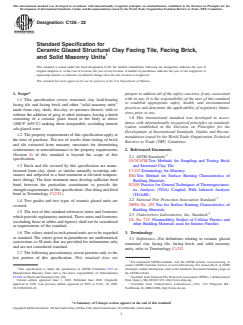
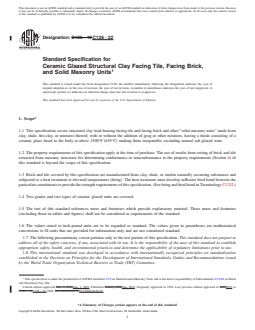
(Specification)Standard Specification for Ceramic Glazed Structural Clay Facing Tile, Facing Brick, and Solid Masonry Units
General Information
- Abstract
ABSTRACT
This specification covers structural clay load-bearing facing tile and facing brick and other “solid masonry units” made from clay, shale, fire-clay, or mixtures thereof, with or without the addition of grog or other mixtures, having a finish consisting of a ceramic glaze fused to the body at above a certain temperature making them inseparable, excluding natural salt-glazed ware. The following grades and types are covered: Grade S which is for use with comparatively narrow mortar joints, Grade SS which is for use where variation of face dimension must be very small, Type I or single-faced unit which is for general use where only one finished face will be exposed, and Type II or two-faced unit which is for general use where two opposite finished faces will be exposed. The brick and tile are manufactured from clay, shale, or similar naturally occurring substances and subjected to a heat treatment at elevated temperatures (firing). The heat treatment must develop sufficient fired bond between the particulate constituents to provide the strength requirements specified. The masonry units are classified as solid masonry unit and hollow masonry unit. The former is a unit whose net cross-sectional area in every plane parallel to the bearing surface is 75 % or more of its gross cross-sectional area measured in the same plane and the latter is a unit whose net cross-sectional area in any plane parallel to the bearing surface is less than 75 % of its gross cross-sectional area measured in the same plane. Different tests shall be performed in order to determine the following properties: compressive strength, imperviousness, opacity, resistance to fading, resistance to autoclave crazing, flame spread, fuel contribution, smoke density, toxic fumes, hardness, and abrasion resistance.
SCOPE
1.1 This specification covers structural clay load-bearing facing tile and facing brick and other “solid masonry units” made from clay, shale, fire-clay, or mixtures thereof, with or without the addition of grog or other mixtures, having a finish consisting of a ceramic glaze fused to the body at above 1500°F (655°C) making them inseparable, excluding natural salt-glazed ware.
1.2 The property requirements of this specification apply at the time of purchase. The use of results from testing of brick and tile extracted from masonry structures for determining conformance or nonconformance to the property requirements (Section 6) of this standard is beyond the scope of this specification.
1.3 Brick and tile covered by this specification are manufactured from clay, shale, or similar naturally occurring substances and subjected to a heat treatment at elevated temperatures (firing). The heat treatment must develop sufficient fired bond between the particulate constituents to provide the strength requirements of this specification. (See firing and fired bond in Terminology C1232.)
1.4 Two grades and two types of ceramic glazed units are covered.
1.5 The text of this standard references notes and footnotes which provide explanatory material. These notes and footnotes (excluding those in tables and figures) shall not be considered as requirements of the standard.
1.6 The values stated in inch-pound units are to be regarded as standard. The values given in parentheses are mathematical conversions to SI units that are provided for information only and are not considered standard.
1.7 The following precautionary caveat pertains only to the test portion of this specification. This standard does not purport to address all of the safety concerns, if any, associated with its use. It is the responsibility of the user of this standard to establish appropriate safety, health, and environmental practices and determine the applicability of regulatory limitations prior to use.
1.8 This international standard was developed in accordance with internationally recognized principles on standardization established in the Decision on Princip...
- Status
- Published
- Publication Date
- 31-May-2022
- Technical Committee
- C15 - Masonry – Manufactured Masonry Units, Mortars and Grouts
- Drafting Committee
- C15.02 - Brick and Structural Clay Tile
Buy Documents
ASTM C126-22 - Standard Specification for Ceramic Glazed Structural Clay Facing Tile, Facing Brick, and Solid Masonry Units
REDLINE ASTM C126-22 - Standard Specification for Ceramic Glazed Structural Clay Facing Tile, Facing Brick, and Solid Masonry Units
Overview
ASTM C126-22 is the standard specification set by ASTM International for ceramic glazed structural clay facing tile, facing brick, and solid masonry units. This standard applies to masonry units manufactured from clay, shale, fire-clay, or combinations of these materials. The specification focuses on units with a ceramic glaze finish that is permanently fused to the body, achieved through high-temperature firing, and excludes natural salt-glazed ware.
This standard defines requirements for two grades (S and SS) and two types (I and II) of glazed units, covering their dimensional tolerances, physical properties, finish, appearance, and related performance metrics to ensure consistent quality in structural applications. ASTM C126-22 is widely referenced in the construction industry to ensure safety, durability, and visual appeal in building facades and other masonry work.
Key Topics
Material Composition:
Covers structural clay units made from various types of clay and shale, with or without additives.Grades and Types:
- Grade S: For narrow mortar joints.
- Grade SS: For precise dimension consistency.
- Type I: Single-faced units (one finished face exposed).
- Type II: Two-faced units (two opposite finished faces exposed).
Manufacturing Process:
High-temperature firing fuses the ceramic glaze to the body, ensuring a durable and inseparable finish.Physical and Performance Properties:
- Compressive strength
- Dimensional tolerances for face and bed depth
- Warpage limitations
- Glaze properties: imperviousness, opacity, color fastness, resistance to crazing, flame spread, smoke density, release of toxic fumes, and hardness.
Appearance and Finish:
Specifies acceptable levels of chips, cracks, and imperfections, as well as uniformity in glaze quality and finish.Test Methods:
Includes standardized sampling and testing protocols for quality control.
Applications
ASTM C126-22 is applied in a range of construction projects where ceramic glazed clay masonry units are specified, particularly for architectural and structural purposes. Practical uses include:
Building Exteriors and Facades:
Provides a durable, aesthetically pleasing surface for commercial and institutional buildings, resistant to weathering and atmospheric pollutants.Interior Wall Construction:
Utilized for walls requiring high durability, easy maintenance, and decorative finish, such as in schools, hospitals, and public facilities.Decorative and Functional Masonry:
Ideal for structures where both structural integrity and design versatility are important, supporting innovative architecture.Fire-Resistant Construction:
The specification’s requirements for flame spread and smoke density make these units suitable for fire-rated assemblies and areas with strict code requirements.
By ensuring consistency in physical and performance properties, compliance with ASTM C126-22 helps builders, architects, and suppliers maintain high standards for safety, durability, and visual quality in masonry construction.
Related Standards
For comprehensive guidance and compliance in masonry construction with ceramic glazed units, consider these related ASTM and industry standards:
- ASTM C67/C67M - Test Methods for Sampling and Testing Brick and Structural Clay Tile
- ASTM C1232 - Terminology for Masonry
- ASTM E84 - Test Method for Surface Burning Characteristics of Building Materials
- ASTM E2105 - Practice for Thermogravimetric Analysis (TGA) Coupled With Infrared Analysis
- NFPA No. 255 - Test for Surface Burning Characteristics of Building Materials (National Fire Protection Association)
- UL No. 723 - Flammability Studies of Building Materials (Underwriters Laboratories)
Keywords: ceramic glazed brick, structural clay tile, ASTM C126, masonry units, building standards, construction materials, glaze properties, fire resistance, architectural masonry.
Relations
- Effective Date
- 15-Dec-2023
- Effective Date
- 01-Dec-2023
- Effective Date
- 01-Sep-2023
- Refers
ASTM C67/C67M-19 - Standard Test Methods for Sampling and Testing Brick and Structural Clay Tile - Effective Date
- 01-Jul-2019
- Effective Date
- 01-Jul-2019
- Effective Date
- 15-Apr-2019
- Effective Date
- 01-Mar-2019
- Effective Date
- 01-Oct-2018
- Effective Date
- 01-Jul-2018
- Effective Date
- 01-Mar-2018
- Refers
ASTM C67/C67M-18 - Standard Test Methods for Sampling and Testing Brick and Structural Clay Tile - Effective Date
- 01-Feb-2018
- Effective Date
- 01-Nov-2017
- Effective Date
- 01-Aug-2017
- Effective Date
- 01-Jun-2017
- Effective Date
- 01-Jul-2016
Buy Documents
ASTM C126-22 - Standard Specification for Ceramic Glazed Structural Clay Facing Tile, Facing Brick, and Solid Masonry Units
REDLINE ASTM C126-22 - Standard Specification for Ceramic Glazed Structural Clay Facing Tile, Facing Brick, and Solid Masonry Units
Get Certified
Connect with accredited certification bodies for this standard

DIBt (Deutsches Institut für Bautechnik)
German Institute for Building Technology.
DIN CERTCO
DIN Group product certification.

Aboma Certification B.V.
Specialized in construction, metal, and transport sectors.
Sponsored listings
Frequently Asked Questions
ASTM C126-22 is a technical specification published by ASTM International. Its full title is "Standard Specification for Ceramic Glazed Structural Clay Facing Tile, Facing Brick, and Solid Masonry Units". This standard covers: ABSTRACT This specification covers structural clay load-bearing facing tile and facing brick and other “solid masonry units” made from clay, shale, fire-clay, or mixtures thereof, with or without the addition of grog or other mixtures, having a finish consisting of a ceramic glaze fused to the body at above a certain temperature making them inseparable, excluding natural salt-glazed ware. The following grades and types are covered: Grade S which is for use with comparatively narrow mortar joints, Grade SS which is for use where variation of face dimension must be very small, Type I or single-faced unit which is for general use where only one finished face will be exposed, and Type II or two-faced unit which is for general use where two opposite finished faces will be exposed. The brick and tile are manufactured from clay, shale, or similar naturally occurring substances and subjected to a heat treatment at elevated temperatures (firing). The heat treatment must develop sufficient fired bond between the particulate constituents to provide the strength requirements specified. The masonry units are classified as solid masonry unit and hollow masonry unit. The former is a unit whose net cross-sectional area in every plane parallel to the bearing surface is 75 % or more of its gross cross-sectional area measured in the same plane and the latter is a unit whose net cross-sectional area in any plane parallel to the bearing surface is less than 75 % of its gross cross-sectional area measured in the same plane. Different tests shall be performed in order to determine the following properties: compressive strength, imperviousness, opacity, resistance to fading, resistance to autoclave crazing, flame spread, fuel contribution, smoke density, toxic fumes, hardness, and abrasion resistance. SCOPE 1.1 This specification covers structural clay load-bearing facing tile and facing brick and other “solid masonry units” made from clay, shale, fire-clay, or mixtures thereof, with or without the addition of grog or other mixtures, having a finish consisting of a ceramic glaze fused to the body at above 1500°F (655°C) making them inseparable, excluding natural salt-glazed ware. 1.2 The property requirements of this specification apply at the time of purchase. The use of results from testing of brick and tile extracted from masonry structures for determining conformance or nonconformance to the property requirements (Section 6) of this standard is beyond the scope of this specification. 1.3 Brick and tile covered by this specification are manufactured from clay, shale, or similar naturally occurring substances and subjected to a heat treatment at elevated temperatures (firing). The heat treatment must develop sufficient fired bond between the particulate constituents to provide the strength requirements of this specification. (See firing and fired bond in Terminology C1232.) 1.4 Two grades and two types of ceramic glazed units are covered. 1.5 The text of this standard references notes and footnotes which provide explanatory material. These notes and footnotes (excluding those in tables and figures) shall not be considered as requirements of the standard. 1.6 The values stated in inch-pound units are to be regarded as standard. The values given in parentheses are mathematical conversions to SI units that are provided for information only and are not considered standard. 1.7 The following precautionary caveat pertains only to the test portion of this specification. This standard does not purport to address all of the safety concerns, if any, associated with its use. It is the responsibility of the user of this standard to establish appropriate safety, health, and environmental practices and determine the applicability of regulatory limitations prior to use. 1.8 This international standard was developed in accordance with internationally recognized principles on standardization established in the Decision on Princip...
ABSTRACT This specification covers structural clay load-bearing facing tile and facing brick and other “solid masonry units” made from clay, shale, fire-clay, or mixtures thereof, with or without the addition of grog or other mixtures, having a finish consisting of a ceramic glaze fused to the body at above a certain temperature making them inseparable, excluding natural salt-glazed ware. The following grades and types are covered: Grade S which is for use with comparatively narrow mortar joints, Grade SS which is for use where variation of face dimension must be very small, Type I or single-faced unit which is for general use where only one finished face will be exposed, and Type II or two-faced unit which is for general use where two opposite finished faces will be exposed. The brick and tile are manufactured from clay, shale, or similar naturally occurring substances and subjected to a heat treatment at elevated temperatures (firing). The heat treatment must develop sufficient fired bond between the particulate constituents to provide the strength requirements specified. The masonry units are classified as solid masonry unit and hollow masonry unit. The former is a unit whose net cross-sectional area in every plane parallel to the bearing surface is 75 % or more of its gross cross-sectional area measured in the same plane and the latter is a unit whose net cross-sectional area in any plane parallel to the bearing surface is less than 75 % of its gross cross-sectional area measured in the same plane. Different tests shall be performed in order to determine the following properties: compressive strength, imperviousness, opacity, resistance to fading, resistance to autoclave crazing, flame spread, fuel contribution, smoke density, toxic fumes, hardness, and abrasion resistance. SCOPE 1.1 This specification covers structural clay load-bearing facing tile and facing brick and other “solid masonry units” made from clay, shale, fire-clay, or mixtures thereof, with or without the addition of grog or other mixtures, having a finish consisting of a ceramic glaze fused to the body at above 1500°F (655°C) making them inseparable, excluding natural salt-glazed ware. 1.2 The property requirements of this specification apply at the time of purchase. The use of results from testing of brick and tile extracted from masonry structures for determining conformance or nonconformance to the property requirements (Section 6) of this standard is beyond the scope of this specification. 1.3 Brick and tile covered by this specification are manufactured from clay, shale, or similar naturally occurring substances and subjected to a heat treatment at elevated temperatures (firing). The heat treatment must develop sufficient fired bond between the particulate constituents to provide the strength requirements of this specification. (See firing and fired bond in Terminology C1232.) 1.4 Two grades and two types of ceramic glazed units are covered. 1.5 The text of this standard references notes and footnotes which provide explanatory material. These notes and footnotes (excluding those in tables and figures) shall not be considered as requirements of the standard. 1.6 The values stated in inch-pound units are to be regarded as standard. The values given in parentheses are mathematical conversions to SI units that are provided for information only and are not considered standard. 1.7 The following precautionary caveat pertains only to the test portion of this specification. This standard does not purport to address all of the safety concerns, if any, associated with its use. It is the responsibility of the user of this standard to establish appropriate safety, health, and environmental practices and determine the applicability of regulatory limitations prior to use. 1.8 This international standard was developed in accordance with internationally recognized principles on standardization established in the Decision on Princip...
ASTM C126-22 is classified under the following ICS (International Classification for Standards) categories: 91.100.23 - Ceramic tiles. The ICS classification helps identify the subject area and facilitates finding related standards.
ASTM C126-22 has the following relationships with other standards: It is inter standard links to ASTM C1232-23, ASTM E84-23d, ASTM E84-23c, ASTM C67/C67M-19, ASTM E84-19b, ASTM E84-19a, ASTM E84-19, ASTM E84-18b, ASTM E84-18a, ASTM E84-18, ASTM C67/C67M-18, ASTM E84-17a, ASTM E84-17, ASTM C1232-17, ASTM E84-16. Understanding these relationships helps ensure you are using the most current and applicable version of the standard.
ASTM C126-22 is available in PDF format for immediate download after purchase. The document can be added to your cart and obtained through the secure checkout process. Digital delivery ensures instant access to the complete standard document.
Standards Content (Sample)
This international standard was developed in accordance with internationally recognized principles on standardization established in the Decision on Principles for the
Development of International Standards, Guides and Recommendations issued by the World Trade Organization Technical Barriers to Trade (TBT) Committee.
Designation:C126 −22
Standard Specification for
Ceramic Glazed Structural Clay Facing Tile, Facing Brick,
and Solid Masonry Units
This standard is issued under the fixed designation C126; the number immediately following the designation indicates the year of
original adoption or, in the case of revision, the year of last revision. A number in parentheses indicates the year of last reapproval. A
superscript epsilon (´) indicates an editorial change since the last revision or reapproval.
This standard has been approved for use by agencies of the U.S. Department of Defense.
1. Scope* purport to address all of the safety concerns, if any, associated
with its use. It is the responsibility of the user of this standard
1.1 This specification covers structural clay load-bearing
to establish appropriate safety, health, and environmental
facing tile and facing brick and other “solid masonry units”
practices and determine the applicability of regulatory limita-
made from clay, shale, fire-clay, or mixtures thereof, with or
tions prior to use.
without the addition of grog or other mixtures, having a finish
1.8 This international standard was developed in accor-
consisting of a ceramic glaze fused to the body at above
dance with internationally recognized principles on standard-
1500°F (655°C) making them inseparable, excluding natural
ization established in the Decision on Principles for the
salt-glazed ware.
Development of International Standards, Guides and Recom-
1.2 The property requirements of this specification apply at
mendations issued by the World Trade Organization Technical
the time of purchase. The use of results from testing of brick
Barriers to Trade (TBT) Committee.
and tile extracted from masonry structures for determining
conformance or nonconformance to the property requirements
2. Referenced Documents
(Section 6) of this standard is beyond the scope of this
2.1 ASTM Standards:
specification.
C67/C67M Test Methods for Sampling and Testing Brick
1.3 Brick and tile covered by this specification are manu-
and Structural Clay Tile
factured from clay, shale, or similar naturally occurring sub-
C1232 Terminology for Masonry
stances and subjected to a heat treatment at elevated tempera-
E84 Test Method for Surface Burning Characteristics of
tures (firing). The heat treatment must develop sufficient fired
Building Materials
bond between the particulate constituents to provide the
E2105 Practice for General Techniques of Thermogravimet-
strength requirements of this specification. (See firing and fired
ric Analysis (TGA) Coupled With Infrared Analysis
bond in Terminology C1232.)
(TGA/IR)
2.2 National Fire Protection Association Standard:
1.4 Two grades and two types of ceramic glazed units are
NFPA No. 255 Test for Surface Burning Characteristics of
covered.
Building Materials
1.5 The text of this standard references notes and footnotes
2.3 Underwriters Laboratories, Inc. Standard:
which provide explanatory material. These notes and footnotes
UL No. 723 Flammability Studies of Cellular Plastics and
(excluding those in tables and figures) shall not be considered
other Building Materials used for Interior Finishes
as requirements of the standard.
1.6 The values stated in inch-pound units are to be regarded 3. Terminology
as standard. The values given in parentheses are mathematical
3.1 Definitions—For definitions relating to ceramic glazed
conversions to SI units that are provided for information only
structural clay facing tile, facing brick, and solid masonry
and are not considered standard.
units, refer to Terminology C1232.
1.7 The following precautionary caveat pertains only to the
test portion of this specification. This standard does not
For referenced ASTM standards, visit the ASTM website, www.astm.org, or
contact ASTM Customer Service at service@astm.org. For Annual Book of ASTM
This specification is under the jurisdiction of ASTM Committee C15 on Standards volume information, refer to the standard’s Document Summary page on
Manufactured Masonry Units and is the direct responsibility of Subcommittee the ASTM website.
C15.02 on Brick and Structural Clay Tile. Available from National Fire Protection Association (NFPA), 1 Batterymarch
Current edition approved June 1, 2022. Published June 2022. Originally Park, Quincy, MA 02169-7471, http://www.nfpa.org.
approved in 1936. Last previous edition approved in 2019 as C126 – 19. DOI: Available from Underwriters Laboratories (UL), 333 Pfingsten Rd.,
10.1520/C0126-22. Northbrook, IL 60062-2096, http://www.ul.com.
*A Summary of Changes section appears at the end of this standard
Copyright © ASTM International, 100 Barr Harbor Drive, PO Box C700, West Conshohocken, PA 19428-2959. United States
C126−22
NOTE 2—Special duty units may be available from various manufac-
4. Classification
turers where higher compressive strengths are required.
4.1 Grades—Grades classify units according to their per-
7. Dimensions and Permissible Variations
missible tolerances. Two grades of ceramic glazed facing tile,
brick, and solid masonry units are covered. The requirements
7.1 The face sizes of ceramic glazed units and fittings
are given in Section 7.
therefore shall be as specified.
4.1.1 Grade S (select), for use with comparatively narrow
NOTE 3—The sizes shown in Table 2 are standard in the industry for
single-faced units (Type I).
mortar joints.
4.1.2 Grade SS (select sized or ground edge), for use where
7.2 Face Dimension Tolerances—The total variation in the
variation of face dimension must be very small.
finished face dimensions of units shall be not more than the
4.1.3 When the grade is not specified, the requirements for
values shown in Table 3.
Grade S shall govern.
7.3 Bed-Depth Dimension Tolerances—The total variation
4.2 Types—Two types of ceramic glazed facing tile, brick,
in the bed-depth (through the wall) dimension of units shall be
and solid masonry units are covered. The requirements are
not more than the value shown in Table 4.
given in Section 7.
7.4 Warpage Tolerances—The maximum permissible devia-
4.2.1 Type I (single-faced units), for general use where only
tion of the plane and the edges of the face of individual units
one finished face will be exposed.
fromaplanesurfaceandfromastraightline,respectively,shall
4.2.2 Type II (two-faced units), for use where two opposite
not exceed the value shown in Table 5.
finished faces will be exposed.
NOTE 4—When convex units are laid upon a plane surface, the apparent
4.2.3 When the type is not specified, the requirements for
variation is greater than the actual variation from the plane of the unit.
Type I shall govern.
8. Finish and Appearance
5. Ordering Information
8.1 The body of the units shall be free of cracks or other
5.1 Orders for material under this specification shall include
imperfections which would impair the strength or durability of
the following information:
the masonry.
5.1.1 Grade—When the grade is not specified, the require-
8.2 Unless otherwise agreed upon between the purchaser
ments for Grade S shall govern.
and the seller, a delivery of brick or tile shall not contain more
5.1.2 Type—When the type is not specified, the require-
than 3 % brick or tile that are chipped, cracked or broken.
ments for Type I shall govern.
5.1.3 Sizes and Shapes—The sizes and shapes shall be 8.3 The finished face (one face of stretcher units and the
finished faces of shapes) that will be exposed when in place
specified in accordance with Section 7.1.
5.1.4 Color and Texture of Finish—The color and texture of shall be covered with a ceramic glaze of uniform quality. The
glaze shall be free of chips, crazes, blisters, crawling, or other
the finish shall be specified in accordance with Section 8.6.
5.1.5 Back Surfaces—Unless otherwise specified, smooth, imperfections detracting from the appearance of the finished
scored, combed, or roughened unglazed backs and smooth wall when viewed from a distance of 5 ft (1.52 m) under
unselected glazed backs or a mixture thereof, are furnished. diffused lighting at right angles from the wall.
When plaster is to be applied, the back surface shall be
NOTE 5—The purchaser or his authorized representative shall be
specified in accordance with Section 8.5.
accorded opportunity for sampling and inspecting units at the place of
5.1.6 Coring—Unlessotherwisespecified,eitherstandardor
manufacture,priortoshipment.Atleast10daysfromthetimeofsampling
should be allowed for completion of the tests. Unless otherwise specified
special duty units as prescribed in Section 9 are furnished.
in the purchase order, the cost of tests is typically borne as follows: If the
5.1.7 Opacity—Where ceramic glazed units are not speci-
results of the tests show that the brick does not conform to the
fiedasopaque,theyneednotmeettherequirementsforopacity
requirements of this specification, the cost is typically borne by the seller.
prescribed in 8.4.2.
If the results of the tests show that the brick does conform to the
requirements of this specification, the cost is typically borne by the
5.1.8 Exterior Use—Where ceramic glazed units are re-
purchaser.
quiredforexterioruse,themanufacturersshallbeconsultedfor
material suitable for this purpose. 8.4 Properties of Glaze:
8.4.1 Imperviousness—After the imperviousness test, no
NOTE 1—The requirements included in this specification do not cover
stain seen from a distance of 5 ft (1.5 m) shall remain on or
minimum criteria for durability of units exposed to exterior environments.
beneath the surface, except a slight discoloration in the
6. Physical Properties
depressions on matt, stippled, or mottled finishes.
8.4.2 Opacity—Where opacity of finish is desired and so
6.1 The compressive strengths (based on gross area) of the
specified, discoloration of the body shall not be visible through
units shall be not less than the values prescribed in Table 1.
the glaze in the opacity test. Clear ceramic glazes and special
decorative glazes shall not be required to meet this require-
TABLE 1 Compressive Strengths of Units
ment.
Direction of Minimum Average of Five Individual Minimum, psi 8.4.3 Resistance to Fading—The color of the glaze shall not
Coring Tests, psi (MPa) (MPa)
change in the chemical resistance test. Finishes of metallic or
Vertical 3 000 (20.7) 2 500 (17.2)
special decorative glazes shall not be required to meet this
Horizontal 2 000 (13.8) 1 500 (10.3)
requirement.
C126−22
TABLE 2 Size of Single-Faced Units
Specified Face Dimensions
Series
Specified Thickness, in. (mm)
Designation
Height, in. (mm) Length, in. (mm)
1 5 3 5 5 5
4S 2 ⁄4 (57.2) 7 ⁄8 (193.7) 1 ⁄4,3 ⁄8,5 ⁄8,or7 ⁄8 (44.5, 92.1, 142.9, or 193.7)
5 5 3 5 5 5
4W 7 ⁄8 (193.7) 7 ⁄8 (193.7) 1 ⁄4,3 ⁄8,5 ⁄8,or7 ⁄8 (44.5, 92.1, 142.9, or 193.7)
5 5 3 5 5 5
6P 3 ⁄8 (92.1) 11 ⁄8 (295.3) 1 ⁄4,3 ⁄8,5 ⁄8,or7 ⁄8 (44.5, 92.1, 142.9, or 193.7)
11 3 5 5 5
6T 5 (127) 11 ⁄16 (296.9) 1 ⁄4,3 ⁄8,5 ⁄8,or7 ⁄8 (44.5, 92.1, 142.9, or 193.7)
5 5 3 5 5 5
8W 7 ⁄8 (193.7) 15 ⁄8 (396.9) 1 ⁄4,3 ⁄8,5 ⁄8,or7 ⁄8 (44.5, 92.1, 142.9, or 193.7)
TABLE 3 Permissible Variations in Face Dimensions TABLE 5 Permissible Warpage
NOTE 1—Permissible variations for units having specified dimensions
...
This document is not an ASTM standard and is intended only to provide the user of an ASTM standard an indication of what changes have been made to the previous version. Because
it may not be technically possible to adequately depict all changes accurately, ASTM recommends that users consult prior editions as appropriate. In all cases only the current version
of the standard as published by ASTM is to be considered the official document.
Designation: C126 − 19 C126 − 22
Standard Specification for
Ceramic Glazed Structural Clay Facing Tile, Facing Brick,
and Solid Masonry Units
This standard is issued under the fixed designation C126; the number immediately following the designation indicates the year of
original adoption or, in the case of revision, the year of last revision. A number in parentheses indicates the year of last reapproval. A
superscript epsilon (´) indicates an editorial change since the last revision or reapproval.
This standard has been approved for use by agencies of the U.S. Department of Defense.
1. Scope*
1.1 This specification covers structural clay load-bearing facing tile and facing brick and other “solid masonry units” made from
clay, shale, fire-clay, or mixtures thereof, with or without the addition of grog or other mixtures, having a finish consisting of a
ceramic glaze fused to the body at above 1500°F (655°C) making them inseparable, excluding natural salt-glazed ware.
1.2 The property requirements of this specification apply at the time of purchase. The use of results from testing of brick and tile
extracted from masonry structures for determining conformance or nonconformance to the property requirements (Section 6) of
this standard is beyond the scope of this specification.
1.3 Brick and tile covered by this specification are manufactured from clay, shale, or similar naturally occurring substances and
subjected to a heat treatment at elevated temperatures (firing). The heat treatment must develop sufficient fired bond between the
particulate constituents to provide the strength requirements of this specification. (See firing and fired bond in Terminology C1232.)
1.4 Two grades and two types of ceramic glazed units are covered.
1.5 The text of this standard references notes and footnotes which provide explanatory material. These notes and footnotes
(excluding those in tables and figures) shall not be considered as requirements of the standard.
1.6 The values stated in inch-pound units are to be regarded as standard. The values given in parentheses are mathematical
conversions to SI units that are provided for information only and are not considered standard.
1.7 The following precautionary caveat pertains only to the test portion of this specification. This standard does not purport to
address all of the safety concerns, if any, associated with its use. It is the responsibility of the user of this standard to establish
appropriate safety, health, and environmental practices and determine the applicability of regulatory limitations prior to use.
1.8 This international standard was developed in accordance with internationally recognized principles on standardization
established in the Decision on Principles for the Development of International Standards, Guides and Recommendations issued
by the World Trade Organization Technical Barriers to Trade (TBT) Committee.
This specification is under the jurisdiction of ASTM Committee C15 on Manufactured Masonry Units and is the direct responsibility of Subcommittee C15.02 on Brick
and Structural Clay Tile.
Current edition approved Dec. 1, 2019June 1, 2022. Published January 2020June 2022. Originally approved in 1936. Last previous edition approved in 20182019 as
C126 – 18.C126 – 19. DOI: 10.1520/C0126-19.10.1520/C0126-22.
*A Summary of Changes section appears at the end of this standard
Copyright © ASTM International, 100 Barr Harbor Drive, PO Box C700, West Conshohocken, PA 19428-2959. United States
C126 − 22
2. Referenced Documents
2.1 ASTM Standards:
C67/C67M Test Methods for Sampling and Testing Brick and Structural Clay Tile
C1232 Terminology for Masonry
E84 Test Method for Surface Burning Characteristics of Building Materials
E2105 Practice for General Techniques of Thermogravimetric Analysis (TGA) Coupled With Infrared Analysis (TGA/IR)
2.2 National Fire Protection Association Standard:
NFPA No. 255 Test for Surface Burning Characteristics of Building Materials
2.3 Underwriters Laboratories, Inc. Standard:
UL No. 723 Flammability Studies of Cellular Plastics and other Building Materials used for Interior Finishes
3. Terminology
3.1 Definitions—For definitions relating to ceramic glazed structural clay facing tile, facing brick, and solid masonry units, refer
to Terminology C1232.
4. Classification
4.1 Grades—Grades classify units according to their permissible variation in face dimensions and warpage. tolerances. Two grades
of ceramic glazed facing tile, brick, and solid masonry units are covered. The requirements are given in Section 7.
4.1.1 Grade S (select), for use with comparatively narrow mortar joints.
4.1.2 Grade SS (select sized or ground edge), for use where variation of face dimension must be very small.
4.1.3 When the grade is not specified, the requirements for Grade S shall govern.
4.2 Types—Two types of ceramic glazed facing tile, brick, and solid masonry units are covered. The requirements are given in
Section 7.
4.2.1 Type I (single-faced units), for general use where only one finished face will be exposed.
4.2.2 Type II (two-faced units), for use where two opposite finished faces will be exposed.
4.2.3 When the type is not specified, the requirements for Type I shall govern.
5. Ordering Information
5.1 Orders for material under this specification shall include the following information:
5.1.1 Grade—When the grade is not specified, the requirements for Grade S shall govern.
5.1.2 Type—When the type is not specified, the requirements for Type I shall govern.
5.1.3 Sizes and Shapes—The sizes and shapes shall be specified in accordance with Section 7.1.
5.1.4 Color and Texture of Finish—The color and texture of the finish shall be specified in accordance with Section 8.6.
5.1.5 Back Surfaces—Unless otherwise specified, smooth, scored, combed, or roughened unglazed backs and smooth unselected
glazed backs or a mixture thereof, are furnished. When plaster is to be applied, the back surface shall be specified in accordance
with Section 8.5.
For referenced ASTM standards, visit the ASTM website, www.astm.org, or contact ASTM Customer Service at service@astm.org. For Annual Book of ASTM Standards
volume information, refer to the standard’s Document Summary page on the ASTM website.
Available from National Fire Protection Association (NFPA), 1 Batterymarch Park, Quincy, MA 02169-7471, http://www.nfpa.org.
Available from Underwriters Laboratories (UL), 333 Pfingsten Rd., Northbrook, IL 60062-2096, http://www.ul.com.
C126 − 22
5.1.6 Coring—Unless otherwise specified, either standard or special duty units as prescribed in Section 9 are furnished.
5.1.7 Opacity—Where ceramic glazed units are not specified as opaque, they need not meet the requirements for opacity
prescribed in 8.4.2.
5.1.8 Exterior Use—Where ceramic glazed units are required for exterior use, the manufacturers shall be consulted for material
suitable for this purpose.
NOTE 1—The requirements included in this specification do not cover minimum criteria for durability of units exposed to exterior environments.
6. Physical Properties
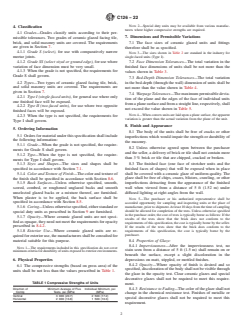
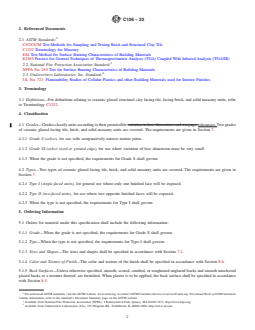
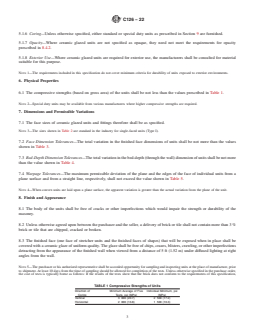
6.1 The compressive strengths (based on gross area) of the units shall be not less than the values prescribed in Table 1.
NOTE 2—Special duty units may be available from various manufacturers where higher compressive strengths are required.
7. Dimensions and Permissible Variations
7.1 The face sizes of ceramic glazed units and fittings therefore shall be as specified.
NOTE 3—The sizes shown in Table 2 are standard in the industry for single-faced units (Type I).
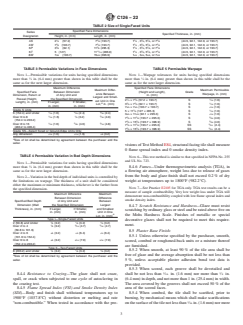
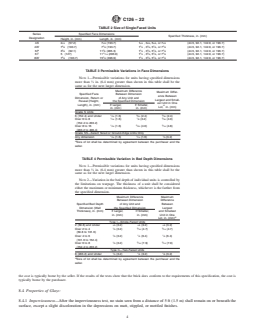
7.2 Face Dimension Tolerances—The total variation in the finished face dimensions of units shall be not more than the values
shown in Table 3.
7.3 Bed-Depth Dimension Tolerances—The total variation in the bed-depth (through the wall) dimension of units shall be not more
than the value shown in Table 4.
7.4 Warpage Tolerances—The maximum permissible deviation of the plane and the edges of the face of individual units from a
plane surface and from a straight line, respectively, shall not exceed the value shown in Table 5.
NOTE 4—When convex units are laid upon a plane surface, the apparent variation is greater than the actual variation from the plane of the unit.
8. Finish and Appearance
8.1 The body of the units shall be free of cracks or other imperfections which would impair the strength or durability of the
masonry.
8.2 Unless otherwise agreed upon between the purchaser and the seller, a delivery of brick or tile shall not contain more than 3 %
brick or tile that are chipped, cracked or broken.
8.3 The finished face (one face of stretcher units and the finished faces of shapes) that will be exposed when in place shall be
covered with a ceramic glaze of uniform quality. The glaze shall be free of chips, crazes, blisters, crawling, or other imperfections
detracting from the appearance of the finished wall when viewed from a distance of 5 ft (1.52 m) under diffused lighting at right
angles from the wall.
NOTE 5—The purchaser or his authorized representative shall be accorded opportunity for sampling and inspecting units at the place of manufacture, prior
to shipment. At least 10 days from the time of sampling should be allowed for completion of the tests. Unless otherwise specified in the purchase order,
the cost of tests is typically borne as follows: If the results of the tests show that the brick does not conform to the requirements of this specification,
TABLE 1 Compressive Strengths of Units
Direction of Minimum Average of Five Individual Minimum, psi
Coring Tests, psi (MPa) (MPa)
Vertical 3 000 (20.7) 2 500 (17.2)
Horizontal 2 000 (13.8) 1 500 (10.3)
C126 − 22
TABLE 2 Size of Single-Faced Units
Specified Face Dimensions
Series
Specified Thickness, in. (mm)
Designation
Height, in. (mm) Length, in. (mm)
1 5 3 5 5 5
4S 2 ⁄4 (57.2) 7 ⁄8 (193.7) 1 ⁄4 , 3 ⁄8, 5 ⁄8, or 7 ⁄8 (44.5, 92.1, 142.9, or 193.7)
5 5 3 5 5 5
4W 7 ⁄8 (193.7) 7 ⁄8 (193.7) 1 ⁄4 , 3 ⁄8, 5 ⁄8, or 7 ⁄8 (44.5, 92.1, 142.9, or 193.7)
5 5 3 5 5 5
6P 3 ⁄8 (92.1) 11 ⁄8 (295.3) 1 ⁄4 , 3 ⁄8, 5 ⁄8, or 7 ⁄8 (44.5, 92.1, 142.9, or 193.7)
11 3 5 5 5
6T 5 (127) 11 ⁄16 (296.9) 1 ⁄4 , 3 ⁄8, 5 ⁄8, or 7 ⁄8 (44.5, 92.1, 142.9, or 193.7)
5 5 3 5 5 5
8W 7 ⁄8 (193.7) 15 ⁄8 (396.9) 1 ⁄4 , 3 ⁄8, 5 ⁄8, or 7 ⁄8 (44.5, 92.1, 142.9, or 193.7)
TABLE 3 Permissible Variations in Face Dimensions
NOTE 1—Permissible variations for units having specified dimensions
more than ⁄4 in. (6.4 mm) greater than shown in this table shall be the
same as for the next larger dimension.
Maximum Difference
Maximum Differ-
Specified Face Between Dimension
ence Between
Dimension, Return or of Any Unit and
Largest and Small-
Reveal (Height, the Specified Dimension
est Unit in One
Length), in. (mm) If Larger, If Smaller,
A
Lot, in. (mm)
in. (mm) in. (mm)
Grade S Units
1 3 3
6 (152.4) and Under ⁄16 (1.6) ⁄32 (2.4) ⁄32 (2.4)
1 1 5
Over 6 to 8 ⁄16 (1.6) ⁄8 (3.2) ⁄32 (4.0)
(152.4 to 203.2)
1 5 3
Over 8 to 16 ⁄16 (1.6) ⁄32 (4.0) ⁄16 (4.8)
(203.2 to 406.4)
Grade SS—Select Sized or Ground-Edge Units Only
1 1 1
Any dimension ⁄16 (1.6) ⁄16 (1.6) ⁄8 (3.2)
A
Size of lot shall be determined by agreement between the purchaser and the
seller.
TABLE 4 Permissible Variation in Bed Depth Dimensions
NOTE 1—Permissible variations for units having specified dimensions
more than ⁄4 in. (6.4 mm) greater than shown in this table shall be the
same as for the next larger dimension.
NOTE 2—Variation in the bed depth of individual units is controlled by
the limitations
...