

ASTM D8351-22
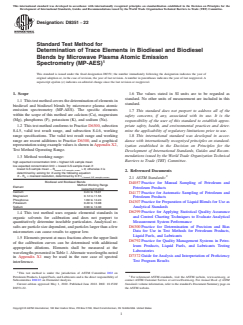
(Test Method)Standard Test Method for Determination of Trace Elements in Biodiesel and Biodiesel Blends by Microwave Plasma Atomic Emission Spectrometry (MP-AES)
General Information
- Abstract
SIGNIFICANCE AND USE
5.1 This test method covers the determination of five elements (Ca, Mg, K, Na, and P) in biodiesel and biodiesel blends.
5.2 The presence of metals and metalloids in engine fuels can influence the performance of engines and contribute to shortening the lifetime of the equipment. In addition, some elements act as catalyst poison contributing to increases in the amount of unwanted gases and particulate matter emitted by vehicles.
SCOPE
1.1 This test method covers the determination of elements in biodiesel and biodiesel blends by microwave plasma atomic emission spectrometry (MP-AES). The specific elements within the scope of this method are calcium (Ca), magnesium (Mg), phosphorus (P), potassium (K), and sodium (Na).
1.2 This test method conforms to Practice D6300, subection 8.4.5, valid test result range, and subsection 8.4.6, working range specifications. The valid test result range and working range are recent additions to Practice D6300, and a graphical representation using example values is shown in Appendix X2, Test Method Operating Range.
1.3 Method working range:
high expected concentration limit = highest ILS sample mean
low expected concentration limit = lowest ILS sample mean if:
lowest ILS sample mean − Rlowest ILS sample mean > 0; otherwise it is
determined by solving for X using the following equation:
X − RX = coarsest resolution, determined by 0.5*σr lowest ILS sample mean
Biodiesel and Biodiesel Blends
Element
Method Working Range
(expected mg/kg)
Calcium
0.24 to 15.01
Magnesium
0.12 to 11.55
Phosphorus
1.69 to 14.24
Potassium
0.49 to 13.98
Sodium
0.90 to 14.30
1.4 This test method uses organic elemental standards in organic solvents for calibration and does not purport to quantitatively determine insoluble particulates. Analytical results are particle size dependent, and particles larger than a few micrometers can cause results to appear low.
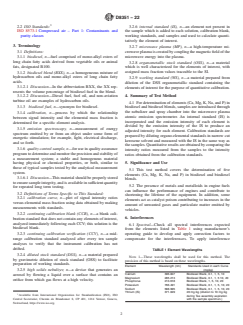
1.5 Elements present at mass fractions above the upper limit of the calibration curves can be determined with additional appropriate dilutions. Elements shall be measured at the wavelengths presented in Table 1. Alternate wavelengths noted in Appendix X1 may be used in the rare case of spectral interference.
1.6 The values stated in SI units are to be regarded as standard. No other units of measurement are included in this standard.
1.7 This standard does not purport to address all of the safety concerns, if any, associated with its use. It is the responsibility of the user of this standard to establish appropriate safety, health, and environmental practices and determine the applicability of regulatory limitations prior to use.
1.8 This international standard was developed in accordance with internationally recognized principles on standardization established in the Decision on Principles for the Development of International Standards, Guides and Recommendations issued by the World Trade Organization Technical Barriers to Trade (TBT) Committee.
- Status
- Published
- Publication Date
- 30-Apr-2022
- Technical Committee
- D02 - Petroleum Products, Liquid Fuels, and Lubricants
- Drafting Committee
- D02.03 - Elemental Analysis
Overview
ASTM D8351-22 specifies the standard test method for the determination of trace elements in biodiesel and biodiesel blends using Microwave Plasma Atomic Emission Spectrometry (MP-AES). The method focuses on five key elements: calcium (Ca), magnesium (Mg), phosphorus (P), potassium (K), and sodium (Na), providing reliable means to monitor and manage elemental impurities in biodiesel fuels. The presence of these trace metals is highly significant, as they can impact engine performance, emissions, and catalyst longevity. This standard addresses quality and performance issues of biodiesel by giving laboratories, producers, and regulators a robust analytical protocol.
Key Topics
- Target Elements: Calcium, magnesium, phosphorus, potassium, and sodium in biodiesel and its blends.
- Analytical Technique: Utilization of MP-AES for efficient, multi-elemental analysis.
- Concentration Range: Defined working ranges for each element, ensuring accurate detection within expected mg/kg values for each:
- Calcium: 0.24 to 15.01 mg/kg
- Magnesium: 0.12 to 11.55 mg/kg
- Phosphorus: 1.69 to 14.24 mg/kg
- Potassium: 0.49 to 13.98 mg/kg
- Sodium: 0.90 to 14.30 mg/kg
- Calibration: Employs organic elemental standards in organic solvents, aligned to Practice D6300 specifications for precision and bias.
- Sample Integrity: Emphasizes proper homogenization, sampling, and strict temperature control to ensure representative and repeatable results.
Applications
The ASTM D8351-22 method is practical and essential for several areas within the biodiesel supply and quality assurance chain:
- Biodiesel Production: Enables producers to monitor trace metal content, optimize refining processes, and minimize engine-wearing contaminants.
- Fuel Blending: Ensures biodiesel blends meet regulatory and engine manufacturer requirements by controlling specified trace elements.
- Engine and Emissions Performance: By tracking elements that can deteriorate engine components or act as catalyst poisons, this method helps prolong equipment life and reduce unwanted gaseous and particulate emissions.
- Regulatory Compliance: Essential for demonstrating adherence to international and national standards governing fuel quality.
- R&D and Laboratory Testing: Offers a reproducible method for research institutions and analytical labs engaged in fuel development or quality monitoring.
Related Standards
Organizations seeking comprehensive or complementary testing regimes should consider integrating ASTM D8351-22 with the following standards:
- ASTM D4057 – Manual sampling of petroleum and petroleum products.
- ASTM D4177 – Automatic sampling of petroleum and petroleum products.
- ASTM D4307 – Preparation of liquid blends for analytical standards.
- ASTM D6299 – Statistical quality assurance for analytical measurement systems.
- ASTM D6300 – Determination of precision and bias data in fuel testing.
- ASTM D6792 – Quality management for petroleum products testing laboratories.
- ISO 8573-1 – Compressed air purity and contaminant classes.
Practical Value
Adopting ASTM D8351-22 ensures:
- Accuracy and Repeatability: Standardized methodology assures reliable data across laboratories and test operators.
- Operational Efficiency: MP-AES offers rapid, simultaneous analysis of multiple elements, streamlining laboratory workflows.
- Protecting Equipment and Reducing Emissions: Early detection of damaging elements reduces maintenance costs and environmental impact.
- Global Recognition: Developed in accordance with WTO guidelines, supporting international trade and regulatory harmonization.
Keywords: ASTM D8351, MP-AES, biodiesel analysis, trace elements in biodiesel, fuel quality standards, calcium, magnesium, potassium, sodium, phosphorus, biodiesel blends, emission spectrometry, analytical methods for fuels.
Relations
- Effective Date
- 01-Mar-2024
- Effective Date
- 01-Dec-2023
- Effective Date
- 01-Dec-2023
- Effective Date
- 01-Nov-2023
- Effective Date
- 01-Oct-2023
- Effective Date
- 01-Dec-2019
- Effective Date
- 15-Dec-2017
- Effective Date
- 15-Nov-2017
- Effective Date
- 01-Jan-2017
- Effective Date
- 01-Apr-2016
- Effective Date
- 01-Oct-2015
- Effective Date
- 01-Jun-2015
- Effective Date
- 01-Jun-2014
- Effective Date
- 01-Jun-2014
- Effective Date
- 01-May-2014
Get Certified
Connect with accredited certification bodies for this standard

Element Materials Technology
Materials testing and product certification.

ABS Group Brazil
ABS Group certification services in Brazil.

ABS Quality Evaluations Inc.
American Bureau of Shipping quality certification.
Sponsored listings
Frequently Asked Questions
ASTM D8351-22 is a standard published by ASTM International. Its full title is "Standard Test Method for Determination of Trace Elements in Biodiesel and Biodiesel Blends by Microwave Plasma Atomic Emission Spectrometry (MP-AES)". This standard covers: SIGNIFICANCE AND USE 5.1 This test method covers the determination of five elements (Ca, Mg, K, Na, and P) in biodiesel and biodiesel blends. 5.2 The presence of metals and metalloids in engine fuels can influence the performance of engines and contribute to shortening the lifetime of the equipment. In addition, some elements act as catalyst poison contributing to increases in the amount of unwanted gases and particulate matter emitted by vehicles. SCOPE 1.1 This test method covers the determination of elements in biodiesel and biodiesel blends by microwave plasma atomic emission spectrometry (MP-AES). The specific elements within the scope of this method are calcium (Ca), magnesium (Mg), phosphorus (P), potassium (K), and sodium (Na). 1.2 This test method conforms to Practice D6300, subection 8.4.5, valid test result range, and subsection 8.4.6, working range specifications. The valid test result range and working range are recent additions to Practice D6300, and a graphical representation using example values is shown in Appendix X2, Test Method Operating Range. 1.3 Method working range: high expected concentration limit = highest ILS sample mean low expected concentration limit = lowest ILS sample mean if: lowest ILS sample mean − Rlowest ILS sample mean > 0; otherwise it is determined by solving for X using the following equation: X − RX = coarsest resolution, determined by 0.5*σr lowest ILS sample mean Biodiesel and Biodiesel Blends Element Method Working Range (expected mg/kg) Calcium 0.24 to 15.01 Magnesium 0.12 to 11.55 Phosphorus 1.69 to 14.24 Potassium 0.49 to 13.98 Sodium 0.90 to 14.30 1.4 This test method uses organic elemental standards in organic solvents for calibration and does not purport to quantitatively determine insoluble particulates. Analytical results are particle size dependent, and particles larger than a few micrometers can cause results to appear low. 1.5 Elements present at mass fractions above the upper limit of the calibration curves can be determined with additional appropriate dilutions. Elements shall be measured at the wavelengths presented in Table 1. Alternate wavelengths noted in Appendix X1 may be used in the rare case of spectral interference. 1.6 The values stated in SI units are to be regarded as standard. No other units of measurement are included in this standard. 1.7 This standard does not purport to address all of the safety concerns, if any, associated with its use. It is the responsibility of the user of this standard to establish appropriate safety, health, and environmental practices and determine the applicability of regulatory limitations prior to use. 1.8 This international standard was developed in accordance with internationally recognized principles on standardization established in the Decision on Principles for the Development of International Standards, Guides and Recommendations issued by the World Trade Organization Technical Barriers to Trade (TBT) Committee.
SIGNIFICANCE AND USE 5.1 This test method covers the determination of five elements (Ca, Mg, K, Na, and P) in biodiesel and biodiesel blends. 5.2 The presence of metals and metalloids in engine fuels can influence the performance of engines and contribute to shortening the lifetime of the equipment. In addition, some elements act as catalyst poison contributing to increases in the amount of unwanted gases and particulate matter emitted by vehicles. SCOPE 1.1 This test method covers the determination of elements in biodiesel and biodiesel blends by microwave plasma atomic emission spectrometry (MP-AES). The specific elements within the scope of this method are calcium (Ca), magnesium (Mg), phosphorus (P), potassium (K), and sodium (Na). 1.2 This test method conforms to Practice D6300, subection 8.4.5, valid test result range, and subsection 8.4.6, working range specifications. The valid test result range and working range are recent additions to Practice D6300, and a graphical representation using example values is shown in Appendix X2, Test Method Operating Range. 1.3 Method working range: high expected concentration limit = highest ILS sample mean low expected concentration limit = lowest ILS sample mean if: lowest ILS sample mean − Rlowest ILS sample mean > 0; otherwise it is determined by solving for X using the following equation: X − RX = coarsest resolution, determined by 0.5*σr lowest ILS sample mean Biodiesel and Biodiesel Blends Element Method Working Range (expected mg/kg) Calcium 0.24 to 15.01 Magnesium 0.12 to 11.55 Phosphorus 1.69 to 14.24 Potassium 0.49 to 13.98 Sodium 0.90 to 14.30 1.4 This test method uses organic elemental standards in organic solvents for calibration and does not purport to quantitatively determine insoluble particulates. Analytical results are particle size dependent, and particles larger than a few micrometers can cause results to appear low. 1.5 Elements present at mass fractions above the upper limit of the calibration curves can be determined with additional appropriate dilutions. Elements shall be measured at the wavelengths presented in Table 1. Alternate wavelengths noted in Appendix X1 may be used in the rare case of spectral interference. 1.6 The values stated in SI units are to be regarded as standard. No other units of measurement are included in this standard. 1.7 This standard does not purport to address all of the safety concerns, if any, associated with its use. It is the responsibility of the user of this standard to establish appropriate safety, health, and environmental practices and determine the applicability of regulatory limitations prior to use. 1.8 This international standard was developed in accordance with internationally recognized principles on standardization established in the Decision on Principles for the Development of International Standards, Guides and Recommendations issued by the World Trade Organization Technical Barriers to Trade (TBT) Committee.
ASTM D8351-22 is classified under the following ICS (International Classification for Standards) categories: 75.160.40 - Biofuels. The ICS classification helps identify the subject area and facilitates finding related standards.
ASTM D8351-22 has the following relationships with other standards: It is inter standard links to ASTM D6300-24, ASTM D6299-23a, ASTM D6300-23a, ASTM D6792-23c, ASTM D6792-23b, ASTM D6300-19a, ASTM D6299-17b, ASTM D6299-17a, ASTM D6299-17, ASTM D6300-16, ASTM D4307-99(2015), ASTM D6300-15, ASTM D6300-14ae1, ASTM D6300-14a, ASTM D6300-14. Understanding these relationships helps ensure you are using the most current and applicable version of the standard.
ASTM D8351-22 is available in PDF format for immediate download after purchase. The document can be added to your cart and obtained through the secure checkout process. Digital delivery ensures instant access to the complete standard document.
Standards Content (Sample)
This international standard was developed in accordance with internationally recognized principles on standardization established in the Decision on Principles for the
Development of International Standards, Guides and Recommendations issued by the World Trade Organization Technical Barriers to Trade (TBT) Committee.
Designation: D8351 − 22
Standard Test Method for
Determination of Trace Elements in Biodiesel and Biodiesel
Blends by Microwave Plasma Atomic Emission
Spectrometry (MP-AES)
This standard is issued under the fixed designation D8351; the number immediately following the designation indicates the year of
original adoption or, in the case of revision, the year of last revision. A number in parentheses indicates the year of last reapproval. A
superscript epsilon (´) indicates an editorial change since the last revision or reapproval.
1. Scope 1.6 The values stated in SI units are to be regarded as
standard. No other units of measurement are included in this
1.1 Thistestmethodcoversthedeterminationofelementsin
standard.
biodiesel and biodiesel blends by microwave plasma atomic
emission spectrometry (MP-AES). The specific elements
1.7 This standard does not purport to address all of the
within the scope of this method are calcium (Ca), magnesium
safety concerns, if any, associated with its use. It is the
(Mg), phosphorus (P), potassium (K), and sodium (Na).
responsibility of the user of this standard to establish appro-
priate safety, health, and environmental practices and deter-
1.2 This test method conforms to Practice D6300, subection
mine the applicability of regulatory limitations prior to use.
8.4.5, valid test result range, and subsection 8.4.6, working
range specifications. The valid test result range and working
1.8 This international standard was developed in accor-
range are recent additions to Practice D6300, and a graphical
dance with internationally recognized principles on standard-
representation using example values is shown in Appendix X2,
ization established in the Decision on Principles for the
Test Method Operating Range.
Development of International Standards, Guides and Recom-
mendations issued by the World Trade Organization Technical
1.3 Method working range:
Barriers to Trade (TBT) Committee.
high expected concentration limit = highest ILS sample mean
low expected concentration limit = lowest ILS sample mean if:
lowest ILS sample mean − R > 0; otherwise it is
lowest ILS sample mean
2. Referenced Documents
determined by solving for X using the following equation:
X −R = coarsest resolution, determined by 0.5*σ 2
X r lowest ILS sample mean
2.1 ASTM Standards:
Biodiesel and Biodiesel Blends
D4057 Practice for Manual Sampling of Petroleum and
Method Working Range
Element
Petroleum Products
(expected mg/kg)
Calcium 0.24 to 15.01 D4177 Practice for Automatic Sampling of Petroleum and
Magnesium 0.12 to 11.55
Petroleum Products
Phosphorus 1.69 to 14.24
D4307 Practice for Preparation of Liquid Blends for Use as
Potassium 0.49 to 13.98
Sodium 0.90 to 14.30
Analytical Standards
D6299 Practice for Applying Statistical Quality Assurance
1.4 This test method uses organic elemental standards in
and Control Charting Techniques to Evaluate Analytical
organic solvents for calibration and does not purport to
Measurement System Performance
quantitatively determine insoluble particulates. Analytical re-
D6300 Practice for Determination of Precision and Bias
sults are particle size dependent, and particles larger than a few
Data for Use in Test Methods for Petroleum Products,
micrometers can cause results to appear low.
Liquid Fuels, and Lubricants
1.5 Elementspresentatmassfractionsabovetheupperlimit
D6792 Practice for Quality Management Systems in Petro-
of the calibration curves can be determined with additional
leum Products, Liquid Fuels, and Lubricants Testing
appropriate dilutions. Elements shall be measured at the
Laboratories
wavelengths presented inTable 1.Alternate wavelengths noted
D7372 Guide for Analysis and Interpretation of Proficiency
in Appendix X1 may be used in the rare case of spectral
Test Program Results
interference.
This test method is under the jurisdiction of ASTM Committee D02 on
Petroleum Products, Liquid Fuels, and Lubricants and is the direct responsibility of For referenced ASTM standards, visit the ASTM website, www.astm.org, or
Subcommittee D02.03 on Elemental Analysis. contact ASTM Customer Service at service@astm.org. For Annual Book of ASTM
Current edition approved May 1, 2022. Published June 2022. DOI: 10.1520/ Standards volume information, refer to the standard’s Document Summary page on
D8351-22. the ASTM website.
Copyright © ASTM International, 100 Barr Harbor Drive, PO Box C700, West Conshohocken, PA 19428-2959. United States
D8351 − 22
2.2 ISO Standards: 3.2.6 internal standard (IS), n—an element not present in
ISO 8573-1 Compressed air – Part 1: Contaminants and the sample which is added to each solution, calibration blank,
purity classes working standards, and samples and used to calculate quanti-
tatively the element of interest.
3. Terminology
3.2.7 microwave plasma (MP), n—a high-temperature mi-
crowaveplasmaiscreatedbycouplingthemagneticfieldofthe
3.1 Definitions:
microwave energy into the plasma.
3.1.1 biodiesel, n—fuel comprised of mono-alkyl esters of
long chain fatty acids derived from vegetable oils or animal
3.2.8 organometallic stock standard (OSS), n—a material
fats, designated B100.
which is well characterized for the elements of interest, with
3.1.2 biodiesel blend (BXX), n—a homogeneous mixture of assigned mass fraction values traceable to the SI.
hydrocarbon oils and mono-alkyl esters of long chain fatty
3.2.9 working standard (WS), n—a material prepared from
acids.
dilution of the DSS organometallic standard containing the
3.1.2.1 Discussion—In the abbreviation BXX, the XX rep-
elements of interest for the purpose of quantitative calibration.
resents the volume percentage of biodiesel fuel in the blend.
4. Summary of Test Method
3.1.2.2 Discussion—Diesel fuel, fuel oil, and non-aviation
turbine oil are examples of hydrocarbon oils.
4.1 Fordeterminationofelements(Ca,Mg,K,Na,andP)in
3.1.3 biodiesel fuel, n—synonym for biodiesel. biodiesel and biodiesel blends, samples are introduced through
the nebulizer and spray chamber into the microwave plasma
3.1.4 calibration, n—process by which the relationship
atomic emission spectrometer. An internal standard (IS) is
between signal intensity and the elemental mass fraction is
incorporated and the emission intensity of each element is
determined for a specific element analysis.
divided by the emission intensity of the IS to produce an
3.1.5 emission spectroscopy, n—measurement of energy
adjusted intensity for each element. Calibration standards are
spectrum emitted by or from an object under some form of
prepared by diluting organo-elemental standards in narrow cut
energetic stimulation; for example, light, electrical discharge,
kerosene solvent and measured with the IS in the same way as
and so forth.
thesamples.Quantitativeresultsareobtainedbycomparingthe
3.1.6 quality control sample, n—for use in quality assurance
intensity ratios measured from the samples to the intensity
programtodetermineandmonitortheprecisionandstabilityof
ratios obtained from the calibration standards.
a measurement system; a stable and homogenous material
having physical or chemical properties, or both, similar to 5. Significance and Use
those of typical samples tested by the analytical measurement
5.1 This test method covers the determination of five
system.
elements (Ca, Mg, K, Na, and P) in biodiesel and biodiesel
3.1.6.1 Discussion—This material should be properly stored
blends.
toensuresampleintegrity,andisavailableinsufficientquantity
5.2 The presence of metals and metalloids in engine fuels
for repeated long term testing.
can influence the performance of engines and contribute to
3.2 Definitions of Terms Specific to This Standard:
shortening the lifetime of the equipment. In addition, some
3.2.1 calibration curve, n—plot of signal intensity ratios
elements act as catalyst poison contributing to increases in the
versus elemental mass fraction using data obtained by making
amount of unwanted gases and particulate matter emitted by
measurements with standards.
vehicles.
3.2.2 continuing calibration blank (CCB), n—a blank cali-
6. Interferences
bration standard that does not contain any elements of interest,
analyzed immediately following each CCV; this solution is the
6.1 Spectral—Check all spectral interferences expected
biodiesel blank.
from the elements listed in Table 1 using manufacturer’s
operating guide to develop and apply correction factors to
3.2.3 continuing calibration verification (CCV), n—a mid-
compensate for the interferences. To apply interference
range calibration standard analyzed after every ten sample
analyses to verify that the instrument calibration has not
drifted.
TABLE 1 Element Wavelengths
3.2.4 diluted stock standard (DSS), n—a material prepared
NOTE 1—These wavelengths shall be used for this method. The
by gravimetric dilution of stock standard (OSS) to facilitate
precision of this method is based on these wavelengths.
preparation of working standards.
Element Wavelength (nm) Standards Used in each Curve
(mg/kg)
3.2.5 high solids nebulizer, n—a device that generates an
Calcium 396.847 Biodiesel Blank, 0.1, 1, 5, 10
aerosol by flowing a liquid over a surface that contains an
Magnesium 285.213 Biodiesel Blank, 0.1, 1, 5 10, 20
orifice from which gas flows at a high velocity.
Phosphorus 213.618 Biodiesel Blank, 1, 5, 10, 20
Potassium 766.491 Biodiesel Blank, 0.1, 1, 5, 10, 20
Sodium 588.995 Biodiesel Blank, 0.1, 1, 5, 10, 20
Yttrium (IS) 371.029 20 mg ⁄kg (dilution to 10 mg ⁄kg
Available from International Organization for Standardization (ISO), ISO
during Tee assembly aspiration
Central Secretariat, Chemin de Blandonnet 8, CP 401, 1214 Vernier, Geneva, with the sample specimen.)
Switzerland, https://www.iso.org.
D8351 − 22
TABLE 3 Instrument Operating Conditions for Elemental
corrections, all mass fractions must be within the linear
Determination in Biodiesel Samples
response range of each element listed in Table 1.
Instrument Conditions MP-AES
6.1.1 Spectral interferences can usually be avoided by using
Pump rate 5 rpm
the specified wavelengths in Table 1. Guidance on spectral
Read time 3 to 10 s (to be determined experimentally in each
interference is in Appendix X1. Interference from copper may
lab)
affect the phosphorous measurement, refer to Appendix X2. Number of replicates 3
Sample uptake delay Approximately 60 s (depends on lab set-up, tubing
6.2 Particulates—Particulates can clog the nebulizer
configuration and tubing length to be determined
experimentally)
thereby causing erroneous results.
Stabilization delay Approximately 30 s (depends on lab set-up, tubing
configuration and tubing length to be determined
7. Apparatus
experimentally)
Background correction Auto
7.1 Balance, top loading or analytical, with automatic tare,
Air injection required Yes
that measures to at least 0.0001 g and with sufficient capacity
to weigh prepared solutions.
7.2 Microwave Plasma Atomic Emission Spectrometer —
7.3 Peristaltic Pump—A peristaltic pump is required for
MP-AES—A sequential, emission based multi-element ana-
sample introduction.The precision of this test method (Section
lytical technique that uses a microwave-induced plasma for
17) was determined using 5 rpm.
sample excitation. The operating software provides pro-
7.4 Test Specimen Containers, of appropriate size, glass or
grammed sequential sample operation and quantitative data
PTFE vials or bottles, with screw caps. Containers of other
processing.Atorch and microwave generator are used to form
suitable materials may be used but the user must evaluate them
a sustained plasma that can be used for making measurements
for use.
at the specified wavelengths.
7.5 Dispensing vessel, provides a consistent means for
7.2.1 SampleIntroductionSystem—Thesampleintroduction
dispensing of solutions more easily for gravimetric measure-
systemshallbecomposedofsolvent-resistanttubing,adouble-
ments; a pipette, volumetric dispenser, or similar device which
pass cyclonic chamber, and an inert high solids nebulizer. The
is used to add consistent quantities of internal standard to
nebulizer must provide a homogeneous aerosol, comprised of
samples and calibration standards, etc.
small droplets with a narrow distribution of droplet sizes.
7.2.2 Gas Control System—All gas flows shall be controlled
7.6 Internal Standard Peristaltic Tee Assembly—Any tee-
by automated flow control devices.
type fitting composed of solvent resistant material used to
7.2.3 Instrument Control Software for Background
facilitate the simultaneous addition of the internal standard and
Correction—Spectrum correction software which allows for
sample directly into the nebulizer.
manual or automated background correction. Software opti-
mizes nebulizer flow at each wavelength. Introduction condi- 8. Reagents and Materials
tions and settings are presented in Table 2. Instrument operat-
8.1 Purity of Reagents—Unless otherwise indicated, it is
ingconditionsforelementaldeterminationinbiodieselsamples
intended that all reagents conform to the specifications of the
are presented in Table 3.
Committee on Analytical Reagents of the American Chemical
Society where such specifications are available.
8.2 Organometallic Standards in Organic Matrix—
Commercial multi-element or mono-element stock solutions
4 may be purchased and prepared according to Practice D4307.
The sole source of supply of the Microwave Plasma Atomic Emission
equipment, OneNeb Series 2 and instrumentation known to the Committee at this
8.3 Biodiesel Blank—This fluid is intended for use as a
time is Agilent Technologies, Inc., 5301 Stevens Creek Blvd., Santa Clara, CA
calibration blank solution or diluent for the analysis of ele-
95051. Agilent Technologies also has authorized sales and service organizations in
selected geographical areas. If you are aware of alternative suppliers, please provide ments in biodiesel products. This fluid is also used as the
this information to ASTM International Headquarters. Your comments will receive
Continuing Calibration Blank (CCB). The solvent is consid-
careful consideration at a meeting of the responsible technical committee which you
ered acceptable for use under the condition where the solvent
may attend.
elemental (elements of interest) intensity response is equal to
or less than 25 % compared to the intensity response of the
TABLE 2 Sample Introduction Conditions for Elemental
lowest calibration point.
Determination in Biodiesel Samples
Instrument Parameter Operating Condition 8.4 Nitrogen—High purity from a compressed gas cylinder
Nebulizer Inert High Solids nebulizer (such as OneNeb or nitrogen generator. Working pressure is 450 kPa to 600 kPa
Series 2 nebulizer).
(65 psi to 87 psi).
Spray chamber Cyclonic double-pass.
Sample tubing Fluoroelastomer tubing can be used for this test
method. Other suitable tubing may be used
ACS Reagent Chemicals, Specifications and Procedures for Reagents and
and must be evaluated by the user.
Standard-Grade Reference Materials, American Chemical Society, Washington,
(0.38 mm ID). Internal standard and sample
DC. For suggestions on the testing of reagents not listed by theAmerican Chemical
tubing for teeing is orange/green (0.38 mm ID)
Society, see Analar Standards for Laboratory Chemicals, BDH Ltd., Poole, Dorset,
which provides a 1:1 ratio.
Waste tubing Fluoroelastomer Blue/blue 1.65 mm ID. U.K., and the United States Pharmacopeia and National Formulary, U.S. Pharma-
copeial Convention, Inc. (USPC), Rockville, MD.
D8351 − 22
8.4.1 Plasma Support Gas, 99.5 % purity nitrogen contain- 10. Preparation of Apparatus
ing <0.5 % oxygen and <4 ppm water vapor, supply at
10.1 Nitrogen Purge—Ensure that the gas lines are ad-
25 L⁄min.
equately purged with nitrogen before attempting to ignite the
plasma following the manufacturer’s recommended procedure.
8.5 Air—Air supply, as follows:
8.5.1 Specification—ISO 8573-1:2010 Class 1.4.3, recom-
10.2 Instrument MP Excitation Source—Initiate the plasma
mended pressure 500 kPa.
source according to manufacturer’s instructions allow at least
8.5.2 Pre-Optics-Purge (POP) Gas—Supply at 25 L⁄min.
30 min warm-up before performing the analysis. During this
8.5.3 Monochromator Optics Purge, 10 L⁄min. warm-up period, feed narrow cut kerosene solvent through the
sample introduction system. Inspect the torch for carbon
8.5.4 Plasma Air Addition, for organic analysis 1.5 L⁄min.
buildup during the warm-up period. If carbon buildup occurs,
8.6 Argon—Purity as specified by supplier specifications,
replace the torch immediately and consult the MP-AES Easy
supply at 0.5 L⁄min is only required during plasma ignition.
Fit Torch manufacturer’s maintenance guide to take proper
After the initial formation of argon plasma, the gas supply is
steps to remedy the situation.
switched to nitrogen used during the test operation.
10.3 Wavelength Calibration—Prepare the instrument for
8.7 Peristaltic Pump Tubing, (Solva or Viton)—The pump
analysis by performing a wavelength calibration, dark current
tubing must be able to withstand at least 6 h exposure to the
scan, and torch alignment scan in accordance with manufac-
dilution biodiesel and dilution solvent. Either Solva and Viton
turer’s instructions w
...