

ASTM E2997-16
(Test Method)Standard Test Method for Analysis of Biodiesel Products by Gas Chromatography-Mass Spectrometry
General Information
- Abstract
SIGNIFICANCE AND USE
4.1 This test method specifically identifies fatty acid methyl esters and petroleum distillates found in biodiesel products. Derivatization is not necessary to identify FAMEs.
4.1.1 This test method is useful when biodiesel products are suspected as a fuel source in a fire or a fuel product case and the identification of the “bio” portion of the fuel is of interest.
4.1.2 The identification of biodiesel in samples from a fire scene can support the field investigator’s opinion regarding the origin and cause of the fire or provide investigative leads.
4.1.3 The identification of biodiesel in a sample of fuel from a dispensing container or fuel tank can support the field investigator’s findings in a fuel product tampering investigation.
4.2 FAMEs can be identified in debris samples using headspace extraction techniques and GC-MS.
4.2.1 Solvent extraction may be required to further identify and characterize the FAME content in biodiesel.
4.2.2 The presence of FAMEs and petroleum diesel is a strong indication of a biodiesel product, as FAMEs are not naturally occurring.
4.3 Biodiesel products can be identified in liquid samples by GC-MS after appropriate solvent dilution or extraction.
4.4 Biodiesel is available in different blends, where B100 is 100 % biodiesel (typically 100 % transesterified vegetable oils or recycled restaurant greases) and B2 is 2 % biodiesel and 98 % petroleum diesel, with variations in between.
4.5 This test method is a sensitive technique and can detect quantities as small as 7 μL of biodiesel residue in an extract from a debris sample.
4.6 This test method can be hampered by coincident extraction of interfering compounds present in the debris samples.
4.7 Depending on the extraction method used, this could be a destructive technique and whenever possible the entire sample should not be used for the procedure. Solvent extracted portions of the sample are not suitable for resampling.
4.8 Alternate methods of e...
SCOPE
1.1 This test method covers the analysis and identification of the fatty acid methyl esters (FAMEs) and petroleum distillate components of biodiesel products.
1.2 This test method is suitable for identifying the components of biodiesel products in extracts of debris samples or in liquid samples.
1.3 The identification of a specific source of the FAMEs or the proportion of the blend of biodiesel requires additional analysis and is beyond the scope of this test method.
1.4 This test method cannot replace the requisite knowledge, skills, or abilities acquired through appropriate education, training, and experience and should be used in conjunction with sound professional judgment.
1.5 The values stated in SI units are to be regarded as standard. No other units of measurement are included in this standard.
1.6 This standard does not purport to address all of the safety concerns, if any, associated with its use. It is the responsibility of the user of this standard to establish appropriate safety and health practices and determine the applicability of regulatory limitations prior to use.
- Status
- Published
- Publication Date
- 29-Feb-2016
- Technical Committee
- E30 - Forensic Sciences
- Drafting Committee
- E30.01 - Criminalistics
Overview
ASTM E2997-16: Standard Test Method for Analysis of Biodiesel Products by Gas Chromatography-Mass Spectrometry (GC-MS) provides a reliable procedure for the identification of fatty acid methyl esters (FAMEs) and petroleum distillates in biodiesel products. Developed by ASTM International, this standard is widely used in forensic investigations, quality control, and regulatory compliance to analyze both liquid biodiesel samples and extracts from debris, particularly in fire and fuel tampering scenarios.
This test method does not require derivatization to identify FAMEs, which significantly streamlines the analysis process. Using GC-MS, analysts can detect distinguishing components of biodiesel and differentiate between biodiesel blends, such as pure biodiesel (B100) and lower-percentage blends like B2.
Key Topics
- Fatty Acid Methyl Esters (FAMEs) Identification: FAMEs are the key indicator compounds for the presence of biodiesel. They can be detected in both liquids and extract samples with high sensitivity, even in small quantities (as little as 7 μL).
- Petroleum Distillate Detection: The method simultaneously identifies petroleum diesel components present in biodiesel blends, providing full characterization of the sample.
- Sample Types: The method is suitable for both liquid fuels and extracts from debris, commonly encountered at fire scenes or in fuel storage investigations.
- Sample Preparation: Headspace extraction and solvent extraction techniques can be used based on the sample matrix.
- Sensitivity and Specificity: The method ensures minimal interference, but analysts should be aware that some consumer products may contain FAMEs.
- Destructive Nature: Some extraction techniques may consume the entire sample, thus it's important to reserve portions for possible re-extraction.
- Blends and Classifications: Differentiation between various biodiesel blends (e.g., B100, B20, B2) and classification according to established schemes is possible, though quantification of blend proportions requires additional testing.
Applications
ASTM E2997-16 is an essential GC-MS-based method used in a variety of practical contexts:
- Fire Debris Analysis: Identification of biodiesel as a potential fuel source at fire scenes. Detection of FAMEs can support investigative conclusions on the fire’s cause.
- Fuel Product Tampering: Used to detect and characterize biodiesel content in fuel tanks and dispensing containers, supporting fuel quality assurance and forensic investigations.
- Quality Control: Verification of biodiesel presence and blend composition for compliance with fuel standards.
- Environmental and Regulatory Compliance: Ensures that biodiesel products meet regulatory requirements and assists in environmental monitoring by identifying non-naturally occurring FAMEs.
- Forensic Science: In both criminal and civil cases, determination of the origin of fuels and residues using robust and reproducible analytical techniques.
Related Standards
Several ASTM standards complement or are referenced by ASTM E2997-16 to support comprehensive analysis of ignitable liquids and fire debris:
- ASTM E1618: Standard Test Method for Ignitable Liquid Residues in Extracts from Fire Debris Samples by GC-MS.
- ASTM E1492: Practice for Receiving, Documenting, Storing, and Retrieving Evidence in a Forensic Science Laboratory.
- ASTM E1386, E1412, E1413, E2154: Various practices for headspace and solvent extraction and concentration of ignitable liquid residues from fire debris samples.
- ASTM E2451: Practice for Preserving Ignitable Liquids and Ignitable Liquid Residue Extracts from Fire Debris Samples.
- ASTM E2881: Test Method for Extraction and Derivatization of Vegetable Oils and Fats from Fire Debris and Liquid Samples with Analysis by GC-MS.
Summary
ASTM E2997-16 is a critical international standard for the analysis of biodiesel products using gas chromatography-mass spectrometry. By providing clear guidelines for the identification of FAMEs and petroleum distillates, it ensures accurate and reliable results in forensic, quality assurance, fire investigation, and regulatory compliance contexts. Following ASTM E2997-16 and related standards ensures analytical integrity and robust support for investigative and quality control processes in the biodiesel and fuel industries.
Relations
- Effective Date
- 15-Jan-2016
- Effective Date
- 01-Mar-2015
- Effective Date
- 01-Jul-2014
- Effective Date
- 15-Aug-2013
- Effective Date
- 01-Jun-2013
- Effective Date
- 01-Jun-2013
- Effective Date
- 01-Jun-2012
- Effective Date
- 01-Jun-2011
- Effective Date
- 01-Jun-2011
- Effective Date
- 01-May-2011
- Effective Date
- 01-Feb-2010
- Effective Date
- 15-Jan-2010
- Effective Date
- 01-Nov-2009
- Effective Date
- 01-Mar-2008
- Effective Date
- 01-Feb-2008
Get Certified
Connect with accredited certification bodies for this standard

Element Materials Technology
Materials testing and product certification.

ABS Group Brazil
ABS Group certification services in Brazil.

ABS Quality Evaluations Inc.
American Bureau of Shipping quality certification.
Sponsored listings
Frequently Asked Questions
ASTM E2997-16 is a standard published by ASTM International. Its full title is "Standard Test Method for Analysis of Biodiesel Products by Gas Chromatography-Mass Spectrometry". This standard covers: SIGNIFICANCE AND USE 4.1 This test method specifically identifies fatty acid methyl esters and petroleum distillates found in biodiesel products. Derivatization is not necessary to identify FAMEs. 4.1.1 This test method is useful when biodiesel products are suspected as a fuel source in a fire or a fuel product case and the identification of the “bio” portion of the fuel is of interest. 4.1.2 The identification of biodiesel in samples from a fire scene can support the field investigator’s opinion regarding the origin and cause of the fire or provide investigative leads. 4.1.3 The identification of biodiesel in a sample of fuel from a dispensing container or fuel tank can support the field investigator’s findings in a fuel product tampering investigation. 4.2 FAMEs can be identified in debris samples using headspace extraction techniques and GC-MS. 4.2.1 Solvent extraction may be required to further identify and characterize the FAME content in biodiesel. 4.2.2 The presence of FAMEs and petroleum diesel is a strong indication of a biodiesel product, as FAMEs are not naturally occurring. 4.3 Biodiesel products can be identified in liquid samples by GC-MS after appropriate solvent dilution or extraction. 4.4 Biodiesel is available in different blends, where B100 is 100 % biodiesel (typically 100 % transesterified vegetable oils or recycled restaurant greases) and B2 is 2 % biodiesel and 98 % petroleum diesel, with variations in between. 4.5 This test method is a sensitive technique and can detect quantities as small as 7 μL of biodiesel residue in an extract from a debris sample. 4.6 This test method can be hampered by coincident extraction of interfering compounds present in the debris samples. 4.7 Depending on the extraction method used, this could be a destructive technique and whenever possible the entire sample should not be used for the procedure. Solvent extracted portions of the sample are not suitable for resampling. 4.8 Alternate methods of e... SCOPE 1.1 This test method covers the analysis and identification of the fatty acid methyl esters (FAMEs) and petroleum distillate components of biodiesel products. 1.2 This test method is suitable for identifying the components of biodiesel products in extracts of debris samples or in liquid samples. 1.3 The identification of a specific source of the FAMEs or the proportion of the blend of biodiesel requires additional analysis and is beyond the scope of this test method. 1.4 This test method cannot replace the requisite knowledge, skills, or abilities acquired through appropriate education, training, and experience and should be used in conjunction with sound professional judgment. 1.5 The values stated in SI units are to be regarded as standard. No other units of measurement are included in this standard. 1.6 This standard does not purport to address all of the safety concerns, if any, associated with its use. It is the responsibility of the user of this standard to establish appropriate safety and health practices and determine the applicability of regulatory limitations prior to use.
SIGNIFICANCE AND USE 4.1 This test method specifically identifies fatty acid methyl esters and petroleum distillates found in biodiesel products. Derivatization is not necessary to identify FAMEs. 4.1.1 This test method is useful when biodiesel products are suspected as a fuel source in a fire or a fuel product case and the identification of the “bio” portion of the fuel is of interest. 4.1.2 The identification of biodiesel in samples from a fire scene can support the field investigator’s opinion regarding the origin and cause of the fire or provide investigative leads. 4.1.3 The identification of biodiesel in a sample of fuel from a dispensing container or fuel tank can support the field investigator’s findings in a fuel product tampering investigation. 4.2 FAMEs can be identified in debris samples using headspace extraction techniques and GC-MS. 4.2.1 Solvent extraction may be required to further identify and characterize the FAME content in biodiesel. 4.2.2 The presence of FAMEs and petroleum diesel is a strong indication of a biodiesel product, as FAMEs are not naturally occurring. 4.3 Biodiesel products can be identified in liquid samples by GC-MS after appropriate solvent dilution or extraction. 4.4 Biodiesel is available in different blends, where B100 is 100 % biodiesel (typically 100 % transesterified vegetable oils or recycled restaurant greases) and B2 is 2 % biodiesel and 98 % petroleum diesel, with variations in between. 4.5 This test method is a sensitive technique and can detect quantities as small as 7 μL of biodiesel residue in an extract from a debris sample. 4.6 This test method can be hampered by coincident extraction of interfering compounds present in the debris samples. 4.7 Depending on the extraction method used, this could be a destructive technique and whenever possible the entire sample should not be used for the procedure. Solvent extracted portions of the sample are not suitable for resampling. 4.8 Alternate methods of e... SCOPE 1.1 This test method covers the analysis and identification of the fatty acid methyl esters (FAMEs) and petroleum distillate components of biodiesel products. 1.2 This test method is suitable for identifying the components of biodiesel products in extracts of debris samples or in liquid samples. 1.3 The identification of a specific source of the FAMEs or the proportion of the blend of biodiesel requires additional analysis and is beyond the scope of this test method. 1.4 This test method cannot replace the requisite knowledge, skills, or abilities acquired through appropriate education, training, and experience and should be used in conjunction with sound professional judgment. 1.5 The values stated in SI units are to be regarded as standard. No other units of measurement are included in this standard. 1.6 This standard does not purport to address all of the safety concerns, if any, associated with its use. It is the responsibility of the user of this standard to establish appropriate safety and health practices and determine the applicability of regulatory limitations prior to use.
ASTM E2997-16 is classified under the following ICS (International Classification for Standards) categories: 75.160.40 - Biofuels. The ICS classification helps identify the subject area and facilitates finding related standards.
ASTM E2997-16 has the following relationships with other standards: It is inter standard links to ASTM E1412-16, ASTM E2154-15, ASTM E1618-14, ASTM E1413-13, ASTM E2881-13, ASTM E2881-13e1, ASTM E1412-12, ASTM E1492-11, ASTM E1618-11, ASTM E620-11, ASTM E1386-10, ASTM E1618-10, ASTM E1386-09, ASTM E2451-08, ASTM E2154-01(2008). Understanding these relationships helps ensure you are using the most current and applicable version of the standard.
ASTM E2997-16 is available in PDF format for immediate download after purchase. The document can be added to your cart and obtained through the secure checkout process. Digital delivery ensures instant access to the complete standard document.
Standards Content (Sample)
This international standard was developed in accordance with internationally recognized principles on standardization established in the Decision on Principles for the
Development of International Standards, Guides and Recommendations issued by the World Trade Organization Technical Barriers to Trade (TBT) Committee.
Designation: E2997 − 16 An American National Standard
Standard Test Method for
Analysis of Biodiesel Products by Gas Chromatography-
Mass Spectrometry
This standard is issued under the fixed designation E2997; the number immediately following the designation indicates the year of
original adoption or, in the case of revision, the year of last revision. A number in parentheses indicates the year of last reapproval. A
superscript epsilon (´) indicates an editorial change since the last revision or reapproval.
1. Scope E1386 Practice for Separation of Ignitable Liquid Residues
from Fire Debris Samples by Solvent Extraction
1.1 This test method covers the analysis and identification
E1412 Practice for Separation of Ignitable Liquid Residues
of the fatty acid methyl esters (FAMEs) and petroleum distil-
from Fire Debris Samples by Passive Headspace Concen-
late components of biodiesel products.
tration with Activated Charcoal
1.2 This test method is suitable for identifying the compo-
E1413 Practice for Separation of Ignitable Liquid Residues
nents of biodiesel products in extracts of debris samples or in
from Fire Debris Samples by Dynamic Headspace Con-
liquid samples.
centration onto an Adsorbent Tube
1.3 The identification of a specific source of the FAMEs or
E1492 Practice for Receiving, Documenting, Storing, and
the proportion of the blend of biodiesel requires additional Retrieving Evidence in a Forensic Science Laboratory
analysis and is beyond the scope of this test method.
E1618 TestMethodforIgnitableLiquidResiduesinExtracts
from Fire Debris Samples by Gas Chromatography-Mass
1.4 This test method cannot replace the requisite
Spectrometry
knowledge, skills, or abilities acquired through appropriate
E2154 Practice for Separation and Concentration of Ignit-
education, training, and experience and should be used in
able Liquid Residues from Fire Debris Samples by Pas-
conjunction with sound professional judgment.
sive Headspace Concentration with Solid Phase Microex-
1.5 The values stated in SI units are to be regarded as
traction (SPME)
standard. No other units of measurement are included in this
E2451 Practice for Preserving Ignitable Liquids and Ignit-
standard.
able Liquid Residue Extracts from Fire Debris Samples
1.6 This standard does not purport to address all of the
E2881 Test Method for Extraction and Derivatization of
safety concerns, if any, associated with its use. It is the
Vegetable Oils and Fats from Fire Debris and Liquid
responsibility of the user of this standard to establish appro-
Samples with Analysis by Gas Chromatography-Mass
priate safety, health, and environmental practices and deter-
Spectrometry
mine the applicability of regulatory limitations prior to use.
1.7 This international standard was developed in accor-
3. Summary of Test Method
dance with internationally recognized principles on standard-
3.1 Traditional ignitable liquid analysis will be used to
ization established in the Decision on Principles for the
identify biodiesel products.
Development of International Standards, Guides and Recom-
mendations issued by the World Trade Organization Technical
3.2 The debris sample is extracted or an aliquot of a liquid
Barriers to Trade (TBT) Committee.
is extracted or diluted and analyzed by gas chromatography-
mass spectrometry (GC-MS).
2. Referenced Documents
3.3 If fatty acid methyl esters (FAMEs) are suspected,
2.1 ASTM Standards:
further solvent extraction and analysis on a FAME-specific
E620 Practice for Reporting Opinions of Scientific or Tech-
column may be required.
nical Experts
3.4 Specific chemical components (fatty acid methyl esters)
are identified by their retention times and mass spectra.
ThistestmethodisunderthejurisdictionofASTMCommitteeE30onForensic
Sciences and is the direct responsibility of Subcommittee E30.01 on Criminalistics.
Current edition approved March 1, 2016. Published April 2016. DOI: 10.1520/
4. Significance and Use
E2997-16.
For referenced ASTM standards, visit the ASTM website, www.astm.org, or
4.1 This test method specifically identifies fatty acid methyl
contact ASTM Customer Service at service@astm.org. For Annual Book of ASTM
esters and petroleum distillates found in biodiesel products.
Standards volume information, refer to the standard’s Document Summary page on
the ASTM website. Derivatization is not necessary to identify FAMEs.
Copyright © ASTM International, 100 Barr Harbor Drive, PO Box C700, West Conshohocken, PA 19428-2959. United States
E2997 − 16
4.1.1 This test method is useful when biodiesel products are 5.1.3 GC Oven—A column oven capable of reproducible
suspected as a fuel source in a fire or a fuel product case and temperature program operation in the range from 50 to 300°C.
the identification of the “bio” portion of the fuel is of interest.
5.2 Mass Spectrometer—Capable of acquiring mass spectra
4.1.2 The identification of biodiesel in samples from a fire
from m/z 40 to m/z 400 with unit resolution or better, with
scene can support the field investigator’s opinion regarding the
continuous data output.
origin and cause of the fire or provide investigative leads.
5.2.1 Sensitivity and Resolution—The system shall be ca-
4.1.3 Theidentificationofbiodieselinasampleoffuelfrom
pable of detecting each component of the reference or test
a dispensing container or fuel tank can support the field
mixture (see 6.6) and providing sufficient ion intensity data to
investigator’s findings in a fuel product tampering investiga-
identify each component, either by computer search of a mass
tion.
spectral library or by comparison with reference spectra.
4.2 FAMEs can be identified in debris samples using head-
5.3 Data Station—A computerized data station capable of
space extraction techniques and GC-MS.
storing time sequenced mass spectral data from sample runs.
4.2.1 Solvent extraction may be required to further identify
5.3.1 Data Handling—The data system shall be capable of
and characterize the FAME content in biodiesel.
performing, either through its operating system or by user
4.2.2 The presence of FAMEs and petroleum diesel is a
programming, various data handling functions, including input
strong indication of a biodiesel product, as FAMEs are not
and storage of sample data files, generation of extracted ion
naturally occurring.
profiles, searching data files for selected compounds, and
4.3 Biodieselproductscanbeidentifiedinliquidsamplesby
qualitative and semi-quantitative compound analysis.
GC-MS after appropriate solvent dilution or extraction.
5.3.2 Mass Spectral Libraries—The system shall be capable
4.4 Biodiesel is available in different blends, where B100 is
of retrieving a specified mass spectrum from a data file and
100 % biodiesel (typically 100 % transesterified vegetable oils
comparing it against a library of mass spectra available to the
or recycled restaurant greases) and B2 is 2 % biodiesel and 98
data system. This capability is considered an aid to the analyst,
% petroleum diesel, with variations in between.
who will use it in conjunction with chromatographic data and
4.5 This test method is a sensitive technique and can detect
known reference materials to identify unknown components.
quantities as small as 7 µL of biodiesel residue in an extract
5.4 Syringes—A syringe capable of introducing a sample
from a debris sample.
size in the range from 0.1 to 10.0 µL.
4.6 This test method can be hampered by coincident extrac-
5.5 Steam bath or heating device, for use in warming
tion of interfering compounds present in the debris samples.
sample extracts in containers used during evaporation steps.
4.7 Depending on the extraction method used, this could be
a destructive technique and whenever possible the entire
6. Reagents and Materials
sample should not be used for the procedure. Solvent extracted
6.1 Purity of Reagents—Reagent grade chemicals should be
portions of the sample are not suitable for resampling.
used in all tests. It is intended that all reagents conform to the
4.8 Alternate methods of extraction or analysis exist and
specifications of the Committee on Analytical Reagents of the
may be suitable for use in obtaining similar results and
American Chemical Society. Other grades may be used,
conclusions.
provided it is first ascertained that the reagent is of sufficiently
5. Apparatus
high purity to permit its use without lessening the accuracy of
the determination.
5.1 Gas Chromatograph—A chromatograph capable of us-
ing capillary columns and being interfaced to a mass spectrom-
6.2 Solvent—A suitable solvent, such as n-pentane, carbon
eter.
disulfide, or other solvent that will not interfere with the
5.1.1 Sample Inlet System—A sample inlet system that can
analysis.
be operated in either split or splitless mode with capillary
6.2.1 Solvent purity can be verified by evaporating to at
columns; the inlet system may use on-column technology.
least twice the extent used in the analysis and analyzing the
5.1.2 Column—A non-polar capillary, bonded phase, meth-
evaporated solvent in accordance with Test Method E1618.
ylsilicone or phenylmethylsilicone column or equivalent, or a
6.3 Filter apparatus, free of extractable hydrocarbons, oils,
polar capillary, bonded phase column, such as a cyanopropyl-
and fats.
based fatty acid specific column or equivalent, may be used to
determine the presence of fatty acids.
6.4 Evaporation accelerants, compressed dry nitrogen, fil-
5.1.2.1 A polar capillary, bonded phase column, such as a
tered air, or inert gas used in the concentration of solvent
cyanopropyl-based fatty acid specific column or equivalent
extracts.
shall be used to perform comparative analysis between speci-
6.5 Carrier gas, helium or hydrogen of purity 99.995 % or
mens of questioned neat liquid samples, debris extracts, or
higher.
both.
5.1.2.2 Any column length or temperature program condi-
tions may be used for the polar column provided that each
component of the reference mixture (see 6.6.2) is adequately
Reagent Chemicals, American Chemical Society Specifications, American
separated. Chemical Society, Washington, DC.
E2997 − 16
6.6 Reference and Test Mixtures: 8.4.2 Running solvent blanks between each specimen is
6.6.1 Refer to Test Method E1618, Section 6, for the recommended but not required if studies demonstrate that the
appropriate test mixture for the hydrocarbon portion of the cleaning procedure is adequate to prevent carryover.
analysis.
8.5 Maintain reference files of known biodiesel products
6.6.2 Refer to Test Method E2881, Section 6, for the
that have been prepared and analyzed in the same manner as
appropriate reference mixture for the “bio” portion of the
the questioned samples.
analysis.
8.6 Extract a fire debris sample using one or more tech-
6.6.3 Reference biodiesel products should be obtained for
niques as described in Practices E1386, E1412, E1413,or
comparison and identification purposes. Typical chromato-
E2154 to isolate ignitable liquid residues and FAME compo-
grams of B100 and B20 on a non-polar fire debris column are
nents for analysis.
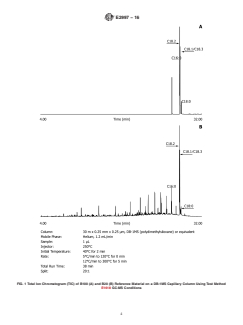
shown in Fig. 1. Typical chromatograms of B100 and B20 on
a fatty acid specific polar column are shown in Fig. 2. 8.7 Warning—Extract a fire debris sample using headspace
techniques prior
...