

ASTM F2896-23
(Specification)Standard Specification for Reinforced Polyethylene Composite Pipe For The Transport Of Oil And Gas And Hazardous Liquids
General Information
- Abstract
SCOPE
1.1 This specification covers requirements and test methods for materials, dimensions, workmanship, and markings for on-site manufactured multilayer reinforced polyethylene composite pipe. It covers nominal sizes 6 in. through 36 in. (150 mm through 915 mm). These multilayered reinforced polyethylene composite pipe products2 are assembled and installed in various lengths, including long continuous lengths. These products are intended for the transport of crude oil, natural gas and hazardous liquids in the rehabilitation of existing pipelines and for new pipelines.
Note 1: Hazardous liquids are those liquids defined by the U.S. Department of Transportation in 49 CFR 195.2.
1.2 The values stated in inch-pound units are to be regarded as standard. The values given in parentheses are mathematical conversions to SI units that are provided for information only and are not considered standard.
1.3 This standard does not purport to address all of the safety concerns, if any, associated with its use. It is the responsibility of the user of this standard to establish appropriate safety, health, and environmental practices and determine the applicability of regulatory limitations prior to use.
1.4 This international standard was developed in accordance with internationally recognized principles on standardization established in the Decision on Principles for the Development of International Standards, Guides and Recommendations issued by the World Trade Organization Technical Barriers to Trade (TBT) Committee.
- Status
- Published
- Publication Date
- 30-Jun-2023
- Technical Committee
- F17 - Plastic Piping Systems
- Drafting Committee
- F17.68 - Energy Piping Systems
Buy Documents
ASTM F2896-23 - Standard Specification for Reinforced Polyethylene Composite Pipe For The Transport Of Oil And Gas And Hazardous Liquids
REDLINE ASTM F2896-23 - Standard Specification for Reinforced Polyethylene Composite Pipe For The Transport Of Oil And Gas And Hazardous Liquids
Overview
ASTM F2896-23 is an international standard developed by ASTM International, specifying the requirements for reinforced polyethylene composite pipe used in the transport of crude oil, natural gas, and hazardous liquids. This standard covers on-site manufactured, multilayer, reinforced polyethylene composite pipes in nominal sizes ranging from 6 inches to 36 inches (150 mm to 915 mm). The products are designed for both rehabilitation of existing pipelines and new pipeline installations. ASTM F2896-23 includes specifications for materials, dimensions, workmanship, quality assurance, and required markings to ensure safe and reliable pipeline performance in challenging oil, gas, and hazardous liquid transport applications.
Key Topics
Material Requirements: Reinforced polyethylene composite pipes must use high-quality polyethylene in accordance with industry-recognized specifications, as well as engineered fiber reinforcements (such as polyamide, UHMW polyethylene, or polyester). The standard gives minimum property requirements for both fibers and fabrics used in the pipe construction.
Construction and Assembly: Pipes utilize a multilayer construction consisting of a polyethylene liner, helically wrapped reinforcement layers, and an outer protective thermoplastic layer. This structure provides the necessary strength and durability for pipeline service.
Dimensional Criteria: The standard covers nominal sizes from 6 to 36 inches, with pressure classes typically at 750 psi and 1500 psi. Dimensional tolerances for inner and outer diameters and wall thicknesses are established.
Joining and End Connections: Heat fusion joining is required for the polyethylene core pipe, with additional requirements for steel end connections to ensure leak-free performance and integrity.
Testing and Quality Assurance: Comprehensive test methods are specified, including diameter checks, hydrostatic pressure testing, burst strength, and qualification of end connections. Pipes must pass short-term burst and long-term hydrostatic pressure tests.
Marking and Traceability: Pipes must be clearly marked with key information, including designation, size, pressure rating, manufacturer details, construction description, and testing qualifications.
Installation Practices: The standard refers to established ASTM and industry practices for direct burial, sliplining, and the renewal of pipelines, ensuring proper installation for long-term performance.
Applications
ASTM F2896-23 applies to the following:
Transportation of Crude Oil and Natural Gas: Used for constructing new pipelines or rehabilitating old ones, particularly where corrosion resistance, flexibility, and long continuous lengths are valuable.
Hazardous Liquid Transport: Suited for fluids as defined by U.S. Department of Transportation regulations (49 CFR 195.2), providing a durable, leak-resistant solution for safety-critical applications.
Pipeline Rehabilitation: The multilayer reinforced polyethylene composite pipe is ideal for sliplining and renewal projects, extending the life of existing pipeline infrastructure without extensive excavation.
Installation Environments: Direct burial and trenchless technologies benefit from the pipe's flexibility, continuous lengths, and engineered strength.
High-Pressure Applications: With pressure classes up to 1500 psi, these pipes serve demanding oil and gas services, including cyclic pressure applications when properly qualified.
Related Standards
- ASTM F2619/F2619M: High-Density Polyethylene (PE) Line Pipe
- ASTM D2513: Polyethylene (PE) Gas Pressure Pipe, Tubing, and Fittings
- ASTM D2774: Practice for Underground Installation of Thermoplastic Pressure Piping
- ASTM F2620: Practice for Heat Fusion Joining of Polyethylene Pipe and Fittings
- API 15S: Spoolable Reinforced Plastic Line Pipe
- ANSI B16.5: Pipe, Flanges, and Flanged Fittings
- 49 CFR 195: U.S. DOT regulations for the transportation of hazardous liquids by pipeline
By adhering to ASTM F2896-23, asset owners, engineers, and contractors ensure that reinforced polyethylene composite pipes used in critical oil, gas, and hazardous liquid transport systems meet stringent material, installation, and performance requirements, supporting the safety, efficiency, and longevity of pipeline infrastructure.
Relations
- Effective Date
- 01-Apr-2024
- Effective Date
- 01-Mar-2024
- Effective Date
- 01-Jun-2020
- Effective Date
- 01-Apr-2020
- Effective Date
- 01-Apr-2020
- Effective Date
- 01-Sep-2019
- Effective Date
- 01-Jul-2019
- Effective Date
- 01-Mar-2019
- Effective Date
- 01-Jan-2019
- Effective Date
- 01-Sep-2018
- Refers
ASTM D2513-18 - Standard Specification for Polyethylene (PE) Gas Pressure Pipe, Tubing, and Fittings - Effective Date
- 15-Apr-2018
- Refers
ASTM D1600-18 - Standard Terminology for Abbreviated Terms Relating to Plastics (Withdrawn 2024) - Effective Date
- 01-Jan-2018
- Effective Date
- 01-Aug-2017
- Effective Date
- 01-Jul-2017
- Effective Date
- 01-Feb-2017
Buy Documents
ASTM F2896-23 - Standard Specification for Reinforced Polyethylene Composite Pipe For The Transport Of Oil And Gas And Hazardous Liquids
REDLINE ASTM F2896-23 - Standard Specification for Reinforced Polyethylene Composite Pipe For The Transport Of Oil And Gas And Hazardous Liquids
Get Certified
Connect with accredited certification bodies for this standard

Institut za varilstvo d.o.o. (Welding Institute)
Slovenia's leading welding institute since 1952. ISO 3834, EN 1090, pressure equipment certification, NDT personnel, welder qualification. Only IIW Au
Sponsored listings
Frequently Asked Questions
ASTM F2896-23 is a technical specification published by ASTM International. Its full title is "Standard Specification for Reinforced Polyethylene Composite Pipe For The Transport Of Oil And Gas And Hazardous Liquids". This standard covers: SCOPE 1.1 This specification covers requirements and test methods for materials, dimensions, workmanship, and markings for on-site manufactured multilayer reinforced polyethylene composite pipe. It covers nominal sizes 6 in. through 36 in. (150 mm through 915 mm). These multilayered reinforced polyethylene composite pipe products2 are assembled and installed in various lengths, including long continuous lengths. These products are intended for the transport of crude oil, natural gas and hazardous liquids in the rehabilitation of existing pipelines and for new pipelines. Note 1: Hazardous liquids are those liquids defined by the U.S. Department of Transportation in 49 CFR 195.2. 1.2 The values stated in inch-pound units are to be regarded as standard. The values given in parentheses are mathematical conversions to SI units that are provided for information only and are not considered standard. 1.3 This standard does not purport to address all of the safety concerns, if any, associated with its use. It is the responsibility of the user of this standard to establish appropriate safety, health, and environmental practices and determine the applicability of regulatory limitations prior to use. 1.4 This international standard was developed in accordance with internationally recognized principles on standardization established in the Decision on Principles for the Development of International Standards, Guides and Recommendations issued by the World Trade Organization Technical Barriers to Trade (TBT) Committee.
SCOPE 1.1 This specification covers requirements and test methods for materials, dimensions, workmanship, and markings for on-site manufactured multilayer reinforced polyethylene composite pipe. It covers nominal sizes 6 in. through 36 in. (150 mm through 915 mm). These multilayered reinforced polyethylene composite pipe products2 are assembled and installed in various lengths, including long continuous lengths. These products are intended for the transport of crude oil, natural gas and hazardous liquids in the rehabilitation of existing pipelines and for new pipelines. Note 1: Hazardous liquids are those liquids defined by the U.S. Department of Transportation in 49 CFR 195.2. 1.2 The values stated in inch-pound units are to be regarded as standard. The values given in parentheses are mathematical conversions to SI units that are provided for information only and are not considered standard. 1.3 This standard does not purport to address all of the safety concerns, if any, associated with its use. It is the responsibility of the user of this standard to establish appropriate safety, health, and environmental practices and determine the applicability of regulatory limitations prior to use. 1.4 This international standard was developed in accordance with internationally recognized principles on standardization established in the Decision on Principles for the Development of International Standards, Guides and Recommendations issued by the World Trade Organization Technical Barriers to Trade (TBT) Committee.
ASTM F2896-23 is classified under the following ICS (International Classification for Standards) categories: 23.040.20 - Plastics pipes. The ICS classification helps identify the subject area and facilitates finding related standards.
ASTM F2896-23 has the following relationships with other standards: It is inter standard links to ASTM A333/A333M-24, ASTM A312/A312M-24, ASTM F1249-20, ASTM F412-20, ASTM F2619/F2619M-20, ASTM F2619/F2619M-19, ASTM D5035-11(2019), ASTM D3850-19, ASTM F412-19, ASTM D1599-18, ASTM D2513-18, ASTM D1600-18, ASTM F412-17a, ASTM D1000-17, ASTM F412-17. Understanding these relationships helps ensure you are using the most current and applicable version of the standard.
ASTM F2896-23 is available in PDF format for immediate download after purchase. The document can be added to your cart and obtained through the secure checkout process. Digital delivery ensures instant access to the complete standard document.
Standards Content (Sample)
This international standard was developed in accordance with internationally recognized principles on standardization established in the Decision on Principles for the
Development of International Standards, Guides and Recommendations issued by the World Trade Organization Technical Barriers to Trade (TBT) Committee.
Designation: F2896 − 23
Standard Specification for
Reinforced Polyethylene Composite Pipe For The Transport
Of Oil And Gas And Hazardous Liquids
This standard is issued under the fixed designation F2896; the number immediately following the designation indicates the year of
original adoption or, in the case of revision, the year of last revision. A number in parentheses indicates the year of last reapproval. A
superscript epsilon (´) indicates an editorial change since the last revision or reapproval.
1. Scope* 2. Referenced Documents
1.1 This specification covers requirements and test methods 2.1 ASTM Standards:
for materials, dimensions, workmanship, and markings for A312/A312M Specification for Seamless, Welded, and
on-site manufactured multilayer reinforced polyethylene com- Heavily Cold Worked Austenitic Stainless Steel Pipes
posite pipe. It covers nominal sizes 6 in. through 36 in. (150 A333/A333M Specification for Seamless and Welded Steel
mm through 915 mm). These multilayered reinforced polyeth- Pipe for Low-Temperature Service and Other Applications
ylene composite pipe products are assembled and installed in with Required Notch Toughness
various lengths, including long continuous lengths. These A519 Specification for Seamless Carbon and Alloy Steel
products are intended for the transport of crude oil, natural gas Mechanical Tubing
and hazardous liquids in the rehabilitation of existing pipelines D624 Test Method for Tear Strength of Conventional Vul-
and for new pipelines. canized Rubber and Thermoplastic Elastomers
D638 Test Method for Tensile Properties of Plastics
NOTE 1—Hazardous liquids are those liquids defined by the U.S.
D792 Test Methods for Density and Specific Gravity (Rela-
Department of Transportation in 49 CFR 195.2.
tive Density) of Plastics by Displacement
1.2 The values stated in inch-pound units are to be regarded
D1000 Test Methods for Pressure-Sensitive Adhesive-
as standard. The values given in parentheses are mathematical
Coated Tapes Used for Electrical and Electronic Applica-
conversions to SI units that are provided for information only
tions
and are not considered standard.
D1598 Test Method for Time-to-Failure of Plastic Pipe
1.3 This standard does not purport to address all of the
Under Constant Internal Pressure
safety concerns, if any, associated with its use. It is the
D1599 Test Method for Resistance to Short-Time Hydraulic
responsibility of the user of this standard to establish appro-
Pressure of Plastic Pipe, Tubing, and Fittings
priate safety, health, and environmental practices and deter-
D1600 Terminology for Abbreviated Terms Relating to Plas-
mine the applicability of regulatory limitations prior to use.
tics
1.4 This international standard was developed in accor-
D1693 Test Method for Environmental Stress-Cracking of
dance with internationally recognized principles on standard-
Ethylene Plastics
ization established in the Decision on Principles for the
D2122 Test Method for Determining Dimensions of Ther-
Development of International Standards, Guides and Recom-
moplastic Pipe and Fittings
mendations issued by the World Trade Organization Technical
D2256/D2256M Test Method for Tensile Properties of Yarns
Barriers to Trade (TBT) Committee.
by the Single-Strand Method
D2513 Specification for Polyethylene (PE) Gas Pressure
Pipe, Tubing, and Fittings
This specification is under the jurisdiction of ASTM Committee F17 on Plastic
D2774 Practice for Underground Installation of Thermoplas-
Piping Systems and is the direct responsibility of Subcommittee F17.68 on Energy
tic Pressure Piping
Piping Systems.
D2837 Test Method for Obtaining Hydrostatic Design Basis
Current edition approved July 1, 2023. Published August 2023. Originally
approved in 2011. Last previous edition approved in 2017 as F2896–11(2017). DOI: for Thermoplastic Pipe Materials or Pressure Design Basis
10.1520/F2896–23.
The reinforced polyethylene composite pipe product described in this standard
is covered by patents. Interested parties are invited to submit information regarding For referenced ASTM standards, visit the ASTM website, www.astm.org, or
the identification of an alternative(s) to this patented item to the ASTM International contact ASTM Customer Service at service@astm.org. For Annual Book of ASTM
Headquarters. Your comments will receive careful consideration at a meeting of the Standards volume information, refer to the standard’s Document Summary page on
responsible technical committee, which you may attend. the ASTM website.
*A Summary of Changes section appears at the end of this standard
Copyright © ASTM International, 100 Barr Harbor Drive, PO Box C700, West Conshohocken, PA 19428-2959. United States
F2896 − 23
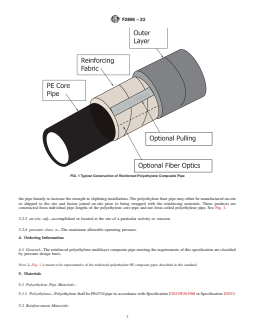
for Thermoplastic Pipe Products 3.2.1 Reinforced Polyethylene Composite Pipe (RPCP),
D2992 Practice for Obtaining Hydrostatic or Pressure De- n—Polyethylene piping helically wrapped with non-metallic
sign Basis for “Fiberglass” (Glass-Fiber-Reinforced reinforcing materials and then overwrapped with an outer
Thermosetting-Resin) Pipe and Fittings protective layer (Fig. 1).
D3350 Specification for Polyethylene Plastics Pipe and Fit-
3.2.2 core pipe, n—the inner liner or polyethylene pipe
tings Materials
3.2.2.1 Discussion—The typical reinforced polyethylene
D3850 Test Method for Rapid Thermal Degradation of Solid
composite pipe to be described in this standard is a multilayer
Electrical Insulating Materials By Thermogravimetric
pipe construction consisting of a polyethylene liner or core
Method (TGA)
pipe, co-helically wrapped with multiple layers (counter
D5035 Test Method for Breaking Force and Elongation of
wound in pairs) (of non-metallic reinforcing material, and then
Textile Fabrics (Strip Method)
wrapped with an outer polyethylene or other thermoplastic
F412 Terminology Relating to Plastic Piping Systems
protective layer. The polyethylene core pipe is heat fusion
F585 Guide for Insertion of Flexible Polyethylene Pipe Into
joined to make long continuous lengths of pipe. Longitudinal
Existing Sewers
direction reinforcing materials may be applied to reinforce the
F1249 Test Method for Water Vapor Transmission Rate
pipe linearly to increase the strength in sliplining installations.
Through Plastic Film and Sheeting Using a Modulated
The polyethylene liner pipe may either be manufactured on-site
Infrared Sensor
or shipped to the site and fusion joined on-site prior to being
F1606 Practice for Rehabilitation of Existing Sewers and
wrapped with the reinforcing materials. These products are
Conduits with Deformed Polyethylene (PE) Liner
constructed from individual pipe lengths of the polyethylene
F1668 Guide for Construction Procedures for Buried Plastic
core pipe and not from coiled polyethylene pipe. See Fig. 1.
Pipe
3.2.3 on-site, adj—accomplished or located at the site of a
F2619/F2619M Specification for High-Density Polyethylene
particular activity or concern.
(PE) Line Pipe
3.2.4 pressure class, n—The maximum allowable operating
F2620 Practice for Heat Fusion Joining of Polyethylene Pipe
pressure.
and Fittings
G14 Test Method for Impact Resistance of Pipeline Coatings
4. Ordering Information
(Falling Weight Test)
4.1 General—The reinforced polyethylene multilayer com-
2.2 ANSI Standards:
posite pipe meeting the requirements of this specification are
B 16.5 Pipe, Flanges, and Flanged Fittings
classified by pressure design basis.
2.3 API Standards:
NOTE 2—Fig. 1 is meant to be representative of the reinforced
15S Spoolable Reinforced Plastic Line Pipe
polyethylene PE composite pipes described in this standard.
17 J Unbonded Flexible Pipe – Unbonded Flexible Pipe
2.4 PPI Standards:
5. Materials
TR-3 HDB/HDS/PDB/SDB/MRS Policies – – Policies and
5.1 Polyethylene Pipe Materials :
Procedures for Developing Hydrostatic Design Basis
5.1.1 Polyethylene—Polyethylene shall be PE4710 pipe in
(HDB), Hydrostatic Design Stresses (HDS), Pressure
accordance with Specification F2619/F2619M or Specification
Design Basis (PDB), Strength Design Basis (SDB), Mini-
D2513.
mum Required Ballot (MRS) Ratings and Categorized
5.2 Reinforcement Materials:
Required Strength (CRS) for Thermoplastic Piping Mate-
5.2.1 Polyamide reinforcing fibers—Polyamide reinforcing
rials or Pipe
fibers used in the assembly of the Reinforced Polyethylene
2.5 Other Documents:
Composite Pipe shall have the minimum properties as shown in
49 CFR 195 Code of Federal Regulations - Transportation of
Table 1. Polyamide reinforcing fabrics shall have the minimum
Hazardous Liquids by Pipeline
properties as shown in Table 2.
5.2.2 Ultra high molecular weight polyethylene (UHMW)
3. Terminology
reinforcing fibers—Polyethylene reinforcing fibers used in the
3.1 Definitions are in accordance with Terminology F412
assembly of the Reinforced Polyethylene Composite Pipe shall
and abbreviations are accordance with Terminology D1600,
have the minimum properties as shown in Table 3. UHMW
unless otherwise specified.
Polyethylene reinforcing fabrics shall have the minimum
3.2 Definitions of Terms Specific to This Standard:
properties as shown in Table 4.
5.2.3 Polyester fibers—Polyester reinforcing fibers used in
the assembly of the Reinforced Polyethylene Composite Pipe
Available from Available from American National Standards Institute (ANSI),
shall have the minimum properties as shown in Table 5.
25 W. 43rd St., 4th Floor, New York, NY 10036, http://www.ansi.org.
Polyester reinforcing fabrics shall have the minimum proper-
Available from American Petroleum Institute (API), 1220 L. St., NW,
ties as shown in Table 6.
Washington, DC 20005-4070, http://www.api.org.
Available from Plastics Pipe Institute (PPI), 105 Decker Court, Suite 825,
5.3 Non-Structural Materials:
Irving, TX 75062, http://www.plasticpipe.org.
5.3.1 Polyester fibers—Polyester non-structural fibers used
Available online from the Department of Transportation at http://
setonresourcecenter.com/transportation/49CFR/172_101tb.pdf in the assembly of the Reinforced Polyethylene Composite
F2896 − 23
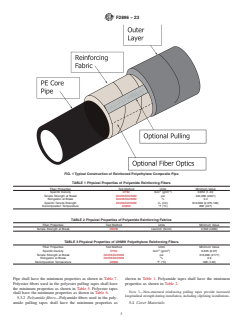
FIG. 1 Typical Construction of Reinforced Polyethylene Composite Pipe
TABLE 1 Physical Properties of Polyamide Reinforcing Fibers
Fiber Properties Test Method Units Minimum Value
3 3
Specific Density D792 lb/in (g/cm ) 0.052 (1.44)
Tensile Strength at Break D2256/D2256M psi 424,000 (2921)
Elongation at Break D2256/D2256M % 2.4
Specific Tensile Strength D2256/D2256M in. (cm) 815,000 (2,070,100)
Decomposition Temperature D3850 °F (°C) 800 (427)
TABLE 2 Physical Properties of Polyamide Reinforcing Fabrics
Fiber Properties Test Method Units Minimum Value
Tensile Strength at Break D5035 Lbs/inch (N/cm) 2,500 (4380)
TABLE 3 Physical Properties of UHMW Polyethylene Reinforcing Fibers
Fiber Properties Test Method Units Minimum Value
3 3
Specific Density D792 lb/in (g/cm ) 0.035 (0.97)
Tensile Strength at Break D2256/D2256M psi 316,000 (2177)
Elongation at Break D2256/D2256M % 2.9
Decomposition Temperature D3850 °F (°C) 300 (149)
Pipe shall have the minimum properties as shown in Table 7. shown in Table 1. Polyamide tapes shall have the minimum
Polyester fibers used in the polyester pulling tapes shall have
properties as shown in Table 2.
the minimum properties as shown in Table 5. Polyester tapes
NOTE 3—Non-structural reinforcing pulling tapes provide increased
shall have the minimum properties as shown in Table 6.
longitudinal strength during installation, including sliplining installations.
5.3.2 Polyamide fibers—Polyamide fibers used in the poly-
amide pulling tapes shall have the minimum properties as 5.4 Cover Materials:
F2896 − 23
TABLE 4 Physical Properties of UHMW Polyethylene Reinforcing Fabrics
Fiber Properties Units Test Method Minimum Value
Tensile Strength at Break D5035 Lbs/inch (N/cm) 2,500 (4380)
TABLE 5 Physical Properties of Polyester Reinforcing Fibers
Property Test Method Units Minimum Value
3 3
Specific Density D792 lb/in (g/cm ) 0.051 (1.41)
Tensile Strength at Break D2256/D2256M psi 400,000 (2756)
Elongation at Break D2256/D2256M % 3.8
TABLE 6 Physical Properties of Polyester Reinforcing Fabrics
Fiber Properties Test Method Units Minimum Value
Tensile Strength at Break D5035 Lbs/inch (N/cm) 2,500 (4380)
TABLE 7 Physical Properties of Polyester Non-Reinforcing Fibers
Property Test Method Units Minimum Value
3 3
Specific Density D792 lb/in (g/cm ) 0.051 (1.41)
Breakload (1000 denier fiber) D2256/D2256M g/denier 8.6
Elongation at Break D2256/D2256M % 10.6
NOTE 4—As these piping products are generally assembled on site, the
5.4.1 Polyethylene Cover Materials—Polyethylene coating
conditioning requirements that are specified in Test Method D2122
materials used in the assembly of the Reinforced Polyethylene
obviously cannot be applied. Other than conditioning, the measurement
Composite Pipe shall have the minimum properties as shown in
requirements of Test Method D2122 are to be followed in measuring the
Table 8. The UV resistance of the polyethylene cover materials
pipe dimensions.
shall be Code C or Code E as defined in Specification D3350.
6.5 Pressure Design Basis (PDB)—The multilayer rein-
5.4.2 Polyethylene/Butyl rubber tape—Polyethylene/Butyl
forced polyethylene composite pipe shall have an established
rubber coating materials used in the assembly of the Rein-
forced Polyethylene Composite Pipe shall have the minimum pressure design basis at 73 °F (23 °C) as listed in Table 10 and
properties as shown in Table 9. Table 11 and as per the requirements of Test Method D2837.
For higher temperature service applications, PDB values for
5.5 Rework materials—Reprocessed materials shall not be
those temperatures shall be provided based on Test Method
used.
D2837 or Practice D2992 analysis or by interpolation using
5.6 Steel End Connections—Steel materials in end connec-
higher temperature PDB values as described in PPI TR-3. The
tions shall meet the requirements of Specifications A312/
PDB shall be established for a minimum of one diameter of
A312M, A333/A333M or A519. Specialty steel grades re-
composite pipe in each of the diameter ranges as follows; 6
quested by the purchaser must meet the same minimum
inch to 16 inch, >16 inch to 24 inch, and >24 to 36 inch. The
performance requirements.
pressure design basis of other pipe sizes within the same
6. Requirements
pressure class having the same materials of construction,
reinforcement configuration shall be confirmed through testing
6.1 Workmanship—The polyethylene core pipe shall be
in accordance with 9.5. Changes in the reinforcing materials or
inspected for defects and damage prior to wrapping with the
changes in layer construction require that the PDB be estab-
reinforcing materials. The reinforcing layers shall be applied
lished for the new construction.
uniformly and be free from irregularities and visible defects. If
defects or damages are found the material is to be rejected.
6.6 Special Sizes—Inside and outside diameters not speci-
6.2 Core Pipe Dimensions—Polyethylene core pipe shall
fied in Table 10 or Table 11 are acceptable by agreement
comply with the requirements listed in Specification F2619/
between the manufacturer and the purchaser.
F2619M or Specification D2513.
6.7 Reconfirmation of PDB— Changes to the composite
6.3 Fabric Wrap—The fabric wrap shall be overlapped and
pipe construction with the same PDB and with the same
the fabric wrap angle is the natural wrap angle of 55°. The
materials of construction shall be confirmed through testing in
fabric warp angle shall be calibrated and controlled to within a
accordance with 9.5.
tolerance of 6 2 degrees of the design wrap angle. The fabric
wrap angle shall be measured and confirmed to 6 2 degrees of
6.8 Long Term Cyclic Hydrostatic Pressure—Multilayer
the design wrap angle every 300 feet (100m).
reinforced polyethylene composite pipe shall be qualified,
where intended for cyclic pressure service, to have a long term
6.4 Multilayer Pipe Dimensions—Pipe Dimensions shall
cyclic hydrostatic pressure design basis at the maximum
comply with Table 10 and Table 11, when measured in
accordance with Test Method D2122. service temperature as per the requirements of 9.3.
F2896 − 23
TABLE 8 Physical Properties of Polyethylene protective tape
Tape Properties Test Method Units Minimum Value
Tensile Strength at Break D1000 lbs/in 25
Elongation at Break D1000 % 20
Impact Resistance G14 in-lbs (Nm) 45 (5.0)
Water Vapor Transmission Rate, (100 °F, F1249 g/in /24hr, 0.03
100 % RH)
Water Vapor Transmission Rate, (100 °F, F1249 g/m 0.5
100 % RH)
TABLE 9 Physical Properties of polyethylene/butyl rubber protective tape
Tape Properties Test Method Units Minimum Value
Tensile Strength at Break D638 lb/in2, (kg/cm2) 1320 (92.8)
Tear Strength D624 lb/in, (kg/cm) 300 (53.7)
Elongation at Break D638 % 20
Environmental Stress Crack Resistance D1693, Condition C Hrs >500, no cracking
TABLE 10 Dimensions for Pressure Class 750 psi (5.17 MPa) Pipe
Nominal Pipe Size PDB, psi (MPa) Minimum Inside Diameter, in. (mm) Minimum Outside Diameter, in. (mm)
6 2000 (13.79) 6.095 (154.81) 7.07 (179.58)
8 2000 (13.79) 8.074 (205.08) 9.099 (231.11)
10 2000 (13.79) 10.062 (255.58) 11.340 (288.04)
12 2000 (13.79) 11.935 (303.15) 13.335 (388.71)
14 2000 (13.79) 13.104 (332.84) 14.610 (371.09)
16 2000 (13.79) 14.977 (380.42) 16.623 (422.22)
18 2000 (13.79) 16.685 (423.79) 18.700 (474.98)
20 2000 (13.79) 18.721 (475.51) 20.647 (524.43)
22 2000 (13.79) 20.255 (514.48) 22.710 (576.83)
24 2000 (13.79) 22.460 (570.48) 24.770 (629.16)
26 2000 (13.79) 23.914 (607.43) 26.780 (680.21)
28 2000 (13.79) 26.20 (655.48) 28.798 (731.47)
30 2000 (13.79) 27.617 (701.46) 30.820 (782.83)
32 2000 (13.79) 29.
...
This document is not an ASTM standard and is intended only to provide the user of an ASTM standard an indication of what changes have been made to the previous version. Because
it may not be technically possible to adequately depict all changes accurately, ASTM recommends that users consult prior editions as appropriate. In all cases only the current version
of the standard as published by ASTM is to be considered the official document.
Designation: F2896 − 11 (Reapproved 2017) F2896 − 23
Standard Specification for
Reinforced Polyethylene Composite Pipe For The Transport
Of Oil And Gas And Hazardous Liquids
This standard is issued under the fixed designation F2896; the number immediately following the designation indicates the year of
original adoption or, in the case of revision, the year of last revision. A number in parentheses indicates the year of last reapproval. A
superscript epsilon (´) indicates an editorial change since the last revision or reapproval.
1. Scope Scope*
1.1 This specification covers requirements and test methods for materials, dimensions, workmanship, and markings for on-site
manufactured multilayer reinforced polyethylene composite pipe. It covers nominal sizes 6 in. through 36 in. (150 mm through
915 mm). These multilayered reinforced polyethylene composite pipe products are assembled and installed in various lengths,
including long continuous lengths. These products are intended for the transport of crude oil, natural gas and hazardous liquids in
the rehabilitation of existing pipelines and for new pipelines.
NOTE 1—Hazardous liquids are those liquids defined by the U.S. Department of Transportation in 49 CFR 195.2.
1.2 The values stated in inch-pound units are to be regarded as standard. The values given in parentheses are mathematical
conversions to SI units that are provided for information only and are not considered standard.
1.3 This standard does not purport to address all of the safety concerns, if any, associated with its use. It is the responsibility
of the user of this standard to establish appropriate safety, health, and environmental practices and determine the applicability of
regulatory limitations prior to use.
1.4 This international standard was developed in accordance with internationally recognized principles on standardization
established in the Decision on Principles for the Development of International Standards, Guides and Recommendations issued
by the World Trade Organization Technical Barriers to Trade (TBT) Committee.
2. Referenced Documents
2.1 ASTM Standards:
A312/A312M Specification for Seamless, Welded, and Heavily Cold Worked Austenitic Stainless Steel Pipes
A333/A333M Specification for Seamless and Welded Steel Pipe for Low-Temperature Service and Other Applications with
Required Notch Toughness
A519 Specification for Seamless Carbon and Alloy Steel Mechanical Tubing
D624 Test Method for Tear Strength of Conventional Vulcanized Rubber and Thermoplastic Elastomers
D638 Test Method for Tensile Properties of Plastics
D792 Test Methods for Density and Specific Gravity (Relative Density) of Plastics by Displacement
This specification is under the jurisdiction of ASTM Committee F17 on Plastic Piping Systems and is the direct responsibility of Subcommittee F17.68 on Energy Piping
Systems.
Current edition approved Aug. 1, 2017July 1, 2023. Published September 2017August 2023. Originally approved in 2011. Last previous edition approved in 20112017
as F2896F2896–11(2017).–11. DOI: 10.1520/F2896–11R17.10.1520/F2896–23.
The reinforced polyethylene composite pipe product described in this standard is covered by patents. Interested parties are invited to submit information regarding the
identification of an alternative(s) to this patented item to the ASTM International Headquarters. Your comments will receive careful consideration at a meeting of the
responsible technical committee, which you may attend.
For referenced ASTM standards, visit the ASTM website, www.astm.org, or contact ASTM Customer Service at service@astm.org. For Annual Book of ASTM Standards
volume information, refer to the standard’s Document Summary page on the ASTM website.
*A Summary of Changes section appears at the end of this standard
Copyright © ASTM International, 100 Barr Harbor Drive, PO Box C700, West Conshohocken, PA 19428-2959. United States
F2896 − 23
D1000 Test Methods for Pressure-Sensitive Adhesive-Coated Tapes Used for Electrical and Electronic Applications
D1598 Test Method for Time-to-Failure of Plastic Pipe Under Constant Internal Pressure
D1599 Test Method for Resistance to Short-Time Hydraulic Pressure of Plastic Pipe, Tubing, and Fittings
D1600 Terminology for Abbreviated Terms Relating to Plastics
D1693 Test Method for Environmental Stress-Cracking of Ethylene Plastics
D2122 Test Method for Determining Dimensions of Thermoplastic Pipe and Fittings
D2256/D2256M Test Method for Tensile Properties of Yarns by the Single-Strand Method
D2513 Specification for Polyethylene (PE) Gas Pressure Pipe, Tubing, and Fittings
D2774 Practice for Underground Installation of Thermoplastic Pressure Piping
D2837 Test Method for Obtaining Hydrostatic Design Basis for Thermoplastic Pipe Materials or Pressure Design Basis for
Thermoplastic Pipe Products
D2992 Practice for Obtaining Hydrostatic or Pressure Design Basis for “Fiberglass” (Glass-Fiber-Reinforced Thermosetting-
Resin) Pipe and Fittings
D3350 Specification for Polyethylene Plastics Pipe and Fittings Materials
D3850 Test Method for Rapid Thermal Degradation of Solid Electrical Insulating Materials By Thermogravimetric Method
(TGA)
D5035 Test Method for Breaking Force and Elongation of Textile Fabrics (Strip Method)
F412 Terminology Relating to Plastic Piping Systems
F585 Guide for Insertion of Flexible Polyethylene Pipe Into Existing Sewers
F1249 Test Method for Water Vapor Transmission Rate Through Plastic Film and Sheeting Using a Modulated Infrared Sensor
F1606 Practice for Rehabilitation of Existing Sewers and Conduits with Deformed Polyethylene (PE) Liner
F1668 Guide for Construction Procedures for Buried Plastic Pipe
F2619/F2619M Specification for High-Density Polyethylene (PE) Line Pipe
F2620 Practice for Heat Fusion Joining of Polyethylene Pipe and Fittings
G14 Test Method for Impact Resistance of Pipeline Coatings (Falling Weight Test)
2.2 ANSI Standards:
B 16.5 Pipe, Flanges, and Flanged Fittings
2.3 API Standards:
15S Spoolable Reinforced Plastic Line Pipe
17 J Unbonded Flexible Pipe – Unbonded Flexible Pipe
2.4 PPI Standards:
TR-3/2010TR-3 HDB/HDS/PDB/SDB/MRS Policies – – Policies and Procedures for Developing Hydrostatic Design Basis
(HDB), Hydrostatic Design StressStresses (HDS), Pressure Design Basis (PDB), Strength Design Basis (SDB), and Minimum
Required StrengthBallot (MRS) Ratings and Categorized Required Strength (CRS) for Thermoplastic Piping Materials or
Pipe5Pipe
2.5 Other Documents:
49 CFR 195 Code of Federal Regulations - Transportation of Hazardous Liquids by Pipeline
3. Terminology
3.1 Definitions are in accordance with Terminology F412 and abbreviations are accordance with Terminology D1600, unless
otherwise specified.
3.2 Definitions of Terms Specific to This Standard:
3.2.1 Reinforced Polyethylene Composite Pipe (RPCP), n—Polyethylene piping helically wrapped with non-metallic reinforcing
materials and then overwrapped with an outer protective layer (Fig. 1).
3.2.2 core pipe, n—the inner liner or polyethylene pipe
3.2.2.1 Discussion—
The typical reinforced polyethylene composite pipe to be described in this standard is a multilayer pipe construction consisting of
a polyethylene liner or core pipe, co-helically wrapped with multiple layers (counter wound in pairs) (of non-metallic reinforcing
material, and then wrapped with an outer polyethylene or other thermoplastic protective layer. The polyethylene core pipe is heat
fusion joined to make long continuous lengths of pipe. Longitudinal direction reinforcing materials may be applied to reinforce
Available from Available from American National Standards Institute (ANSI), 25 W. 43rd St., 4th Floor, New York, NY 10036, http://www.ansi.org.
Available from American Petroleum Institute (API), 1220 L. St., NW, Washington, DC 20005-4070, http://www.api.org.
Available from Plastics Pipe Institute (PPI), 105 Decker Court, Suite 825, Irving, TX 75062, http://www.plasticpipe.org.
Available online from the Department of Transportation at http://setonresourcecenter.com/transportation/49CFR/172_101tb.pdf
F2896 − 23
FIG. 1 Typical Construction of Reinforced Polyethylene Composite Pipe
the pipe linearly to increase the strength in sliplining installations. The polyethylene liner pipe may either be manufactured on-site
or shipped to the site and fusion joined on-site prior to being wrapped with the reinforcing materials. These products are
constructed from individual pipe lengths of the polyethylene core pipe and not from coiled polyethylene pipe. See Fig. 1.
3.2.3 on-site, adj—accomplished or located at the site of a particular activity or concern.
3.2.4 pressure class, n—The maximum allowable operating pressure.
4. Ordering Information
4.1 General—The reinforced polyethylene multilayer composite pipe meeting the requirements of this specification are classified
by pressure design basis.
NOTE 2—Fig. 1 is meant to be representative of the reinforced polyethylene PE composite pipes described in this standard.
5. Materials
5.1 Polyethylene Pipe Materials :
5.1.1 Polyethylene—Polyethylene shall be PE4710 pipe in accordance with Specification F2619/F2619M or Specification D2513.
5.2 Reinforcement Materials:
F2896 − 23
TABLE 1 Physical Properties of Polyamide Reinforcing Fibers
Fiber Properties Test Method Units Minimum Value
3 3
Specific Density D792 lb/in (g/cm ) 0.052 (1.44)
Tensile Strength at Break D2256/D2256M psi 424,000 (2921)
Elongation at Break D2256/D2256M % 2.4
Specific Tensile Strength D2256/D2256M in. (cm) 815,000 (2,070,100)
Decomposition Temperature D3850 °F (°C) 800 (427)
5.2.1 Polyamide reinforcing fibers—Polyamide reinforcing fibers used in the assembly of the Reinforced Polyethylene Composite
Pipe shall have the minimum properties as shown in Table 1. Polyamide reinforcing fabrics shall have the minimum properties as
shown in Table 2.
5.2.2 Ultra high molecular weight polyethylene (UHMW) reinforcing fibers—Polyethylene reinforcing fibers used in the assembly
of the Reinforced Polyethylene Composite Pipe shall have the minimum properties as shown in Table 3. UHMW Polyethylene
reinforcing fabrics shall have the minimum properties as shown in Table 4.
5.2.3 Polyester fibers—Polyester reinforcing fibers used in the assembly of the Reinforced Polyethylene Composite Pipe shall
have the minimum properties as shown in Table 5. Polyester reinforcing fabrics shall have the minimum properties as shown in
Table 6.
5.3 Non-Structural Materials:
5.3.1 Polyester fibers—Polyester non-structural fibers used in the assembly of the Reinforced Polyethylene Composite Pipe shall
have the minimum properties as shown in Table 7. Polyester fibers used in the polyester pulling tapes shall have the minimum
properties as shown in Table 5. Polyester tapes shall have the minimum properties as shown in Table 6.
5.3.2 Polyamide fibers—Polyamide fibers used in the polyamide pulling tapes shall have the minimum properties as shown in
Table 1. Polyamide tapes shall have the minimum properties as shown in Table 2.
NOTE 3—Non-structural reinforcing pulling tapes provide increased longitudinal strength during installation, including sliplining installations.
5.4 External protective coating materials: Cover Materials:
5.4.1 Polyethylene tape—Cover Materials—Polyethylene coating materials used in the assembly of the Reinforced Polyethylene
Composite Pipe shall have the minimum properties as shown in Table 8. The UV resistance of the polyethylene cover materials
shall be Code C or Code E as defined in Specification D3350.
5.4.2 Polyethylene/Butyl rubber tape—Polyethylene/Butyl rubber coating materials used in the assembly of the Reinforced
Polyethylene Composite Pipe shall have the minimum properties as shown in Table 9.
5.5 Rework materials—Excluding the core pipe, reground or reprocessed polyethylene or other thermoplastic materials are not
permitted to be used. Reinforcing materials Reprocessed materials shall not be recovered and reused.used.
5.6 Steel End Connections—Steel materials in end connections shall meet the requirements of Specifications A312/A312M,
A333/A333M or A519. Specialty steel grades requested by the purchaser must meet the same minimum performance requirements.
6. Requirements
6.1 Workmanship—The polyethylene core pipe shall be inspected for defects and damage prior to wrapping with the reinforcing
materials. The reinforcing layers shall be applied uniformly and be free from irregularities and visible defects. If defects or
damages are found the material is to be rejected.
6.2 Core Pipe Dimensions—Polyethylene core pipe shall comply with the requirements listed in Specification F2619/F2619M or
Specification D2513.
F2896 − 23
TABLE 2 Physical Properties of Polyamide Reinforcing Fabrics
Fiber Properties Test Method Units Minimum Value
Tensile Strength at Break D5035 Lbs/inch (N/cm) 2,500 (4380)
TABLE 3 Physical Properties of UHMW Polyethylene Reinforcing Fibers
Fiber Properties Test Method Units Minimum Value
3 3
Specific Density D792 lb/in (g/cm ) 0.035 (0.97)
Tensile Strength at Break D2256/D2256M psi 316,000 (2177)
Elongation at Break D2256/D2256M % 2.9
Decomposition Temperature D3850 °F (°C) 300 (149)
TABLE 4 Physical Properties of UHMW Polyethylene Reinforcing Fabrics
Fiber Properties Units Test Method Minimum Value
Tensile Strength at Break D5035 Lbs/inch (N/cm) 2,500 (4380)
TABLE 5 Physical Properties of Polyester Reinforcing Fibers
Property Test Method Units Minimum Value
3 3
Specific Density D792 lb/in (g/cm ) 0.051 (1.41)
Tensile Strength at Break D2256/D2256M psi 400,000 (2756)
Elongation at Break D2256/D2256M % 3.8
TABLE 6 Physical Properties of Polyester Reinforcing Fabrics
Fiber Properties Test Method Units Minimum Value
Tensile Strength at Break D5035 Lbs/inch (N/cm) 2,500 (4380)
TABLE 7 Physical Properties of Polyester Non-Reinforcing Fibers
Property Test Method Units Minimum Value
3 3
Specific Density D792 lb/in (g/cm ) 0.051 (1.41)
Breakload (1000 denier fiber) D2256/D2256M g/denier 8.6
Elongation at Break D2256/D2256M % 10.6
TABLE 8 Physical Properties of Polyethylene protective tape
Tape Properties Test Method Units Minimum Value
Tensile Strength at Break D1000 lbs/in 25
Elongation at Break D1000 % 20
Impact Resistance G14 in-lbs (Nm) 45 (5.0)
Water Vapor Transmission Rate, (100°F, F1249 g/in /24hr, 0.03
100% RH)
Water Vapor Transmission Rate, (100 °F, F1249 g/in /24hr, 0.03
100 % RH)
Water Vapor Transmission Rate, (100°F, F1249 g/m 0.5
100% RH)
Water Vapor Transmission Rate, (100 °F, F1249 g/m 0.5
100 % RH)
6.3 Fabric Wrap—The fabric wrap shall be overlapped and the fabric wrap angle is the natural wrap angle of 55°. The fabric warp
angle shall be calibrated and controlled to within a tolerance of 6 2 degrees of the design wrap angle. The fabric wrap angle shall
be measured and confirmed to 6 2 degrees of the design wrap angle every 300 feet (100m).
6.4 Multilayer Pipe Dimensions—Pipe Dimensions shall comply with Table 10 and Table 11, when measured in accordance with
Test Method D2122.
NOTE 4—As these piping products are generally assembled on site, the conditioning requirements that are specified in Test Method D2122 obviously
cannot be applied. Other than conditioning, the measurement requirements of Test Method D2122 are to be followed in measuring the pipe dimensions.
6.5 Pressure Design Basis (PDB)—: The multilayer reinforced polyethylene composite pipe shall have an established pressure
F2896 − 23
TABLE 9 Physical Properties of polyethylene/butyl rubber protective tape
Tape Properties Test Method Units Minimum Value
Tensile Strength at Break D638 lb/in2, (kg/cm2) 1320 (92.8)
Tear Strength D624 lb/in, (kg/cm) 300 (53.7)
Elongation at Break D638 % 20
Environmental Stress Crack Resistance D1693, Condition C Hrs >500, no cracking
TABLE 10 Dimensions for Pressure Class 750 psi (5.17 MPa) Pipe
Nominal Pipe Size PDB, psi (MPa) Minimum Inside Diameter, in. (mm) Minimum Outside Diameter, in. (mm)
6 2000 (13.79) 6.095 (154.81) 7.07 (179.58)
8 2000 (13.79) 8.074 (205.08) 9.099 (231.11)
10 2000 (13.79) 10.062 (255.58) 11.340 (288.04)
12 2000 (13.79) 11.935 (303.15) 13.335 (388.71)
14 2000 (13.79) 13.104 (332.84) 14.610 (371.09)
16 2000 (13.79) 14.977 (380.42) 16.623 (422.22)
18 2000 (13.79) 16.685 (423.79) 18.700 (474.98)
20 2000 (13.79) 18.721 (475.51) 20.647 (524.43)
22 2000 (13.79) 20.255 (514.48) 22.710 (576.83)
24 2000 (13.79) 22.460 (570.48) 24.770 (629.16)
26 2000 (13.79) 23.914 (607.43) 26.780 (680.21)
28 2000 (13.79) 26.20 (655.48) 28.798 (731.47)
30 2000 (13.79) 27.617 (701.46) 30.820 (782.83)
32 2000 (13.79) 29.950 (760.73) 32.941 (836.70)
34 2000 (13.79) 31.345 (796.16) 34.950 (887.73)
36 2000 (13.79) 33.695 (855.85) 36.925 (937.90)
TABLE 11 Dimensions for Pressure Class 1500 psi (10.34 MPa) Pipe
Nominal Pipe Size PDB, psi (MPa) Minimum Inside Diameter, in. (mm) Minimum Outside Diameter, in. (mm)
6 4000 (27.58) 6.095 (154.81) 7.186 (182.52)
8 4000 (27.58) 8.074 (205.08) 9.161 (232.69)
10 4000 (27.58) 10.062 (255.58) 11.491 (291.87)
12 4000 (27.58) 11.935 (303.15) 13.454 (341.73)
14 4000 (27.58) 13.104 (332.84) 14.941 (379.50)
16 4000 (27.58) 14.977 (380.42) 16.918 (429.72)
18 4000 (27.58) 16.685 (423.79) 19.035 (483.49)
20 4000 (27.58) 18.721 (475.51) 21.151 (537.24)
22 4000 (27.58) 20.255 (514.48) 23.250 (590.55)
24 4000 (27.58) 22.460 (570.48) 25.350 (643.89)
26 4000 (27.58) 23.914 (607.43) 27.450 (697.23)
28 4000 (27.58) 26.20 (655.48) 29.550 (750.57)
30 4000 (27.58) 27.617 (701.46) 31.632 (803.46)
32 4000 (27.58) 29.950 (760.73) 33.501 (850.93)
34 4000 (27.58) 31.345 (796.16) 25.593 (904.06)
36 4000 (27.58) 33.695 (855.85) 37.685 (957.20)
design basis at 73°F (23°C)73 °F (23 °C) as listed in Table 10 and Table 11 and as per the requirements of Test Method D2837.
For higher temperature service applications, PDB values for those temper
...