

ASTM D3850-19
(Test Method)Standard Test Method for Rapid Thermal Degradation of Solid Electrical Insulating Materials By Thermogravimetric Method (TGA)
General Information
- Abstract
SIGNIFICANCE AND USE
5.1 Thermogravimetry is useful in determining the dynamic functional effect of temperature on the amount of volatile materials leaving a specimen as the latter is heated progressively to higher temperatures. TGA can be useful for process control, process development, material evaluation, and for identification and quality control in specifications.
5.2 The thermal stability of a material can be associated with the degree and time rate of mass loss as a function of temperature. TGA curves can, therefore, be used as a preliminary screen method in the evaluation of relative behavior of insulating materials of the same generic family.
5.3 The functional temperature-life relationship of an insulating material in any given application depends on a number of service and environmental factors. Therefore, the information obtained from TGA curves is not adequate by itself to describe the thermal capability of an insulating material.
5.4 Refer to the Appendix for further discussion of the interpretation of TGA data.
SCOPE
1.1 This test method outlines a procedure for obtaining thermogravimetric (TGA) data on solid polymeric materials intended for use as electrical insulating materials.
1.2 Do not use this standard to quantify an estimate of the long-term thermal capability for any electrical insulating material. If a relationship exists between TGA and the long-term thermal capabilities of a material, then that fact must be established and made public, preferably by comparing data between a candidate and another material known to display similar failure modes.
1.3 The values stated in SI units are the standard.
1.4 This standard does not purport to address all of the safety concerns, if any, associated with its use. It is the responsibility of the user of this standard to establish appropriate safety, health, and environmental practices and determine the applicability of regulatory limitations prior to use.
1.5 This international standard was developed in accordance with internationally recognized principles on standardization established in the Decision on Principles for the Development of International Standards, Guides and Recommendations issued by the World Trade Organization Technical Barriers to Trade (TBT) Committee.
- Status
- Published
- Publication Date
- 28-Feb-2019
- Technical Committee
- D09 - Electrical and Electronic Insulating Materials
- Drafting Committee
- D09.17 - Fire and Thermal Properties
Buy Documents
ASTM D3850-19 - Standard Test Method for Rapid Thermal Degradation of Solid Electrical Insulating Materials By Thermogravimetric Method (TGA)
REDLINE ASTM D3850-19 - Standard Test Method for Rapid Thermal Degradation of Solid Electrical Insulating Materials By Thermogravimetric Method (TGA)
Overview
ASTM D3850-19 - Standard Test Method for Rapid Thermal Degradation of Solid Electrical Insulating Materials by Thermogravimetric Method (TGA) - is a globally recognized standard published by ASTM International. This test method specifies procedures for evaluating the thermal degradation behavior of solid polymeric electrical insulating materials using thermogravimetric analysis (TGA).
Thermogravimetric analysis is a critical technique for measuring the mass loss of an insulating material as it is exposed to increasing temperatures in a controlled environment. The results, presented as TGA curves, help in understanding the dynamic response of materials to heat, aiding industries in material selection, quality control, and preliminary material screening.
Key Topics
Thermogravimetric Analysis (TGA) in Insulation Testing:
TGA measures how much mass a solid electrical insulating material loses as it is heated, indicating the presence and quantity of volatile compounds and the material's thermal resistance.Material Evaluation and Process Control:
By identifying temperature ranges where significant mass loss occurs, manufacturers can assess material stability, optimize production processes, and monitor quality during manufacturing.Limitations:
TGA does not provide direct data on the long-term thermal capability or performance life of an insulating material in service. Results are influenced by specimen configuration, test apparatus, and environmental conditions.Calibration and Repeatability:
Accurate TGA results depend on regular calibration of both the temperature and mass measurement systems, as well as careful control of the testing atmosphere and sample size.
Applications
ASTM D3850-19 is widely utilized across multiple industries to evaluate electrical insulating materials, including films, laminates, molded components, and coatings. Key practical applications include:
Material Comparison and Selection:
TGA data allows for preliminary screening of polymeric insulating materials, assisting engineers and designers in comparing thermal stability within the same material family.Quality Control and Specification Testing:
Manufacturers and laboratories use TGA to verify compliance of materials with specifications, detect inconsistencies, and identify degradation characteristics quickly and reliably.Process Development:
TGA provides valuable feedback in developing and refining manufacturing processes, particularly when new formulations or process changes are introduced.Research and Development:
Researchers employ TGA for material characterization, to better understand decomposition mechanisms, and to evaluate the effect of additives or manufacturing variations.
It is essential to note that while TGA offers rapid screening capability, further tests are required to fully assess the performance and temperature-life relationship of insulation materials in specific applications.
Related Standards
For organizations implementing ASTM D3850-19, familiarity with related terminology and calibration standards ensures accuracy and consistency in testing. Key referenced and related standards include:
- ASTM D883 – Terminology Relating to Plastics
- ASTM D1600 – Terminology for Abbreviated Terms Relating to Plastics
- ASTM D1711 – Terminology Relating to Electrical Insulation
- ASTM D2307 – Test Method for Thermal Endurance of Film-Insulated Round Magnet Wire
- ASTM E220 – Test Method for Calibration of Thermocouples by Comparison Techniques
- ASTM E473 – Terminology Relating to Thermal Analysis and Rheology
- ASTM E1582 – Test Method for Temperature Calibration of Thermogravimetric Analyzers
By adhering to ASTM D3850-19 and the related standards, organizations can ensure reliable, internationally recognized methods for evaluating the thermal degradation of electrical insulating materials, supporting product quality, innovation, and regulatory compliance.
Relations
- Effective Date
- 01-Mar-2019
- Effective Date
- 01-Mar-2024
- Effective Date
- 01-Feb-2024
- Effective Date
- 01-Nov-2023
- Effective Date
- 01-Oct-2023
- Effective Date
- 01-Jan-2020
- Effective Date
- 01-Aug-2019
- Effective Date
- 15-Apr-2019
- Effective Date
- 01-Feb-2019
- Effective Date
- 01-Dec-2018
- Effective Date
- 01-Nov-2018
- Refers
ASTM D1600-18 - Standard Terminology for Abbreviated Terms Relating to Plastics (Withdrawn 2024) - Effective Date
- 01-Jan-2018
- Effective Date
- 15-Aug-2017
- Effective Date
- 01-Nov-2015
- Effective Date
- 01-Nov-2014
Buy Documents
ASTM D3850-19 - Standard Test Method for Rapid Thermal Degradation of Solid Electrical Insulating Materials By Thermogravimetric Method (TGA)
REDLINE ASTM D3850-19 - Standard Test Method for Rapid Thermal Degradation of Solid Electrical Insulating Materials By Thermogravimetric Method (TGA)
Get Certified
Connect with accredited certification bodies for this standard

IMQ S.p.A. (Certification)
Italian electrical product certification.

SLG Prüf- und Zertifizierungs GmbH
German testing and certification body.

UL Solutions
Global safety science company with testing, inspection and certification.
Sponsored listings
Frequently Asked Questions
ASTM D3850-19 is a standard published by ASTM International. Its full title is "Standard Test Method for Rapid Thermal Degradation of Solid Electrical Insulating Materials By Thermogravimetric Method (TGA)". This standard covers: SIGNIFICANCE AND USE 5.1 Thermogravimetry is useful in determining the dynamic functional effect of temperature on the amount of volatile materials leaving a specimen as the latter is heated progressively to higher temperatures. TGA can be useful for process control, process development, material evaluation, and for identification and quality control in specifications. 5.2 The thermal stability of a material can be associated with the degree and time rate of mass loss as a function of temperature. TGA curves can, therefore, be used as a preliminary screen method in the evaluation of relative behavior of insulating materials of the same generic family. 5.3 The functional temperature-life relationship of an insulating material in any given application depends on a number of service and environmental factors. Therefore, the information obtained from TGA curves is not adequate by itself to describe the thermal capability of an insulating material. 5.4 Refer to the Appendix for further discussion of the interpretation of TGA data. SCOPE 1.1 This test method outlines a procedure for obtaining thermogravimetric (TGA) data on solid polymeric materials intended for use as electrical insulating materials. 1.2 Do not use this standard to quantify an estimate of the long-term thermal capability for any electrical insulating material. If a relationship exists between TGA and the long-term thermal capabilities of a material, then that fact must be established and made public, preferably by comparing data between a candidate and another material known to display similar failure modes. 1.3 The values stated in SI units are the standard. 1.4 This standard does not purport to address all of the safety concerns, if any, associated with its use. It is the responsibility of the user of this standard to establish appropriate safety, health, and environmental practices and determine the applicability of regulatory limitations prior to use. 1.5 This international standard was developed in accordance with internationally recognized principles on standardization established in the Decision on Principles for the Development of International Standards, Guides and Recommendations issued by the World Trade Organization Technical Barriers to Trade (TBT) Committee.
SIGNIFICANCE AND USE 5.1 Thermogravimetry is useful in determining the dynamic functional effect of temperature on the amount of volatile materials leaving a specimen as the latter is heated progressively to higher temperatures. TGA can be useful for process control, process development, material evaluation, and for identification and quality control in specifications. 5.2 The thermal stability of a material can be associated with the degree and time rate of mass loss as a function of temperature. TGA curves can, therefore, be used as a preliminary screen method in the evaluation of relative behavior of insulating materials of the same generic family. 5.3 The functional temperature-life relationship of an insulating material in any given application depends on a number of service and environmental factors. Therefore, the information obtained from TGA curves is not adequate by itself to describe the thermal capability of an insulating material. 5.4 Refer to the Appendix for further discussion of the interpretation of TGA data. SCOPE 1.1 This test method outlines a procedure for obtaining thermogravimetric (TGA) data on solid polymeric materials intended for use as electrical insulating materials. 1.2 Do not use this standard to quantify an estimate of the long-term thermal capability for any electrical insulating material. If a relationship exists between TGA and the long-term thermal capabilities of a material, then that fact must be established and made public, preferably by comparing data between a candidate and another material known to display similar failure modes. 1.3 The values stated in SI units are the standard. 1.4 This standard does not purport to address all of the safety concerns, if any, associated with its use. It is the responsibility of the user of this standard to establish appropriate safety, health, and environmental practices and determine the applicability of regulatory limitations prior to use. 1.5 This international standard was developed in accordance with internationally recognized principles on standardization established in the Decision on Principles for the Development of International Standards, Guides and Recommendations issued by the World Trade Organization Technical Barriers to Trade (TBT) Committee.
ASTM D3850-19 is classified under the following ICS (International Classification for Standards) categories: 29.035.01 - Insulating materials in general. The ICS classification helps identify the subject area and facilitates finding related standards.
ASTM D3850-19 has the following relationships with other standards: It is inter standard links to ASTM D3850-12, ASTM D1711-24, ASTM D883-24, ASTM D883-23, ASTM E473-23b, ASTM D883-20, ASTM D883-19c, ASTM D883-19a, ASTM D883-19, ASTM D883-18a, ASTM D883-18, ASTM D1600-18, ASTM D883-17, ASTM D1711-15, ASTM D1711-14a. Understanding these relationships helps ensure you are using the most current and applicable version of the standard.
ASTM D3850-19 is available in PDF format for immediate download after purchase. The document can be added to your cart and obtained through the secure checkout process. Digital delivery ensures instant access to the complete standard document.
Standards Content (Sample)
This international standard was developed in accordance with internationally recognized principles on standardization established in the Decision on Principles for the
Development of International Standards, Guides and Recommendations issued by the World Trade Organization Technical Barriers to Trade (TBT) Committee.
Designation: D3850 − 19
Standard Test Method for
Rapid Thermal Degradation of Solid Electrical Insulating
Materials By Thermogravimetric Method (TGA)
This standard is issued under the fixed designation D3850; the number immediately following the designation indicates the year of
original adoption or, in the case of revision, the year of last revision.Anumber in parentheses indicates the year of last reapproval.A
superscript epsilon (´) indicates an editorial change since the last revision or reapproval.
This standard has been approved for use by agencies of the U.S. Department of Defense.
1. Scope* D2307 Test Method for Thermal Endurance of Film-
Insulated Round Magnet Wire
1.1 This test method outlines a procedure for obtaining
E220Test Method for Calibration of Thermocouples By
thermogravimetric (TGA) data on solid polymeric materials
Comparison Techniques
intended for use as electrical insulating materials.
E473Terminology Relating to Thermal Analysis and Rhe-
1.2 Do not use this standard to quantify an estimate of the
ology
long-term thermal capability for any electrical insulating ma-
E1582Test Method forTemperature Calibration ofThermo-
terial. If a relationship exists between TGA and the long-term
gravimetric Analyzers
thermal capabilities of a material, then that fact must be
established and made public, preferably by comparing data
3. Terminology
between a candidate and another material known to display
3.1 Definitions—Definitions are in accordance with Termi-
similar failure modes.
nology D883, Terminology D1711, and Terminology E473.
1.3 The values stated in SI units are the standard.
3.2 Abbreviations—Abbreviations are in accordance with
1.4 This standard does not purport to address all of the
Terminology D1600, unless otherwise indicated.
safety concerns, if any, associated with its use. It is the
responsibility of the user of this standard to establish appro-
4. Summary of Test Method
priate safety, health, and environmental practices and deter-
4.1 This thermogravimetric technique uses the record of the
mine the applicability of regulatory limitations prior to use.
mass loss versus the temperature of the specimen during the
1.5 This international standard was developed in accor-
time of exposure to a specified prescribed environment using a
dance with internationally recognized principles on standard-
controlled time rate of heating.
ization established in the Decision on Principles for the
Development of International Standards, Guides and Recom-
4.2 The record is a TGAcurve, with percent of initial mass
mendations issued by the World Trade Organization Technical
astheordinateandtemperatureastheabscissa(seeFigs.1and
Barriers to Trade (TBT) Committee.
2).
4.3 The temperature is measured and recorded at specified
2. Referenced Documents
masslosspoints(recordedasaTGAcurve),usinganelectronic
2.1 ASTM Standards:
chart recorder or other suitable data acquisition device.
D883Terminology Relating to Plastics
D1600TerminologyforAbbreviatedTermsRelatingtoPlas-
5. Significance and Use
tics
5.1 Thermogravimetry is useful in determining the dynamic
D1711Terminology Relating to Electrical Insulation
functional effect of temperature on the amount of volatile
materials leaving a specimen as the latter is heated progres-
sively to higher temperatures. TGA can be useful for process
This test method is under the jurisdiction of ASTM Committee D09 on
control, process development, material evaluation, and for
Electrical and Electronic Insulating Materials and is the direct responsibility of
Subcommittee D09.17 on Fire and Thermal Properties.
identification and quality control in specifications.
Current edition approved March 1, 2019. Published March 2019. Originally
5.2 The thermal stability of a material can be associated
approved in 1979. Last previous edition approved in 2012 as D3850–12. DOI:
10.1520/D3850-19.
with the degree and time rate of mass loss as a function of
For referenced ASTM standards, visit the ASTM website, www.astm.org, or
temperature. TGAcurves can, therefore, be used as a prelimi-
contact ASTM Customer Service at service@astm.org. For Annual Book of ASTM
nary screen method in the evaluation of relative behavior of
Standards volume information, refer to the standard’s Document Summary page on
the ASTM website. insulating materials of the same generic family.
*A Summary of Changes section appears at the end of this standard
Copyright © ASTM International, 100 Barr Harbor Drive, PO Box C700, West Conshohocken, PA 19428-2959. United States
D3850 − 19
Sample 8.54 mg Heating Rate 5°C/min Purging Gas Flow 0.8 mL/s
FIG. 1 Curve No. 1, Typical TGA for Polyester Film
Sample 5.93 mg Heating Rate 5°C/min Purging Gas Flow 0.8 mL/s
FIG. 2 Curve No. 2, Typical TGA for Polyimide Film
D3850 − 19
5.3 The functional temperature-life relationship of an insu- 9.3 Adjust the purge rate to the specified value.
lating material in any given application depends on a number
9.4 Adjust the Y axis (mass) to chart zero.
of service and environmental factors. Therefore, the informa-
9.5 Adjust the X axis to the required temperature range.
tion obtained from TGA curves is not adequate by itself to
describe the thermal capability of an insulating material.
9.6 Place the specimen in the specimen holder and record
the initial mass.
5.4 Refer to the Appendix for further discussion of the
interpretation of TGA data.
9.7 Set the heating rate to 5°C/min rate of rise starting at
30ºC.
6. Apparatus
9.8 Start the heating program and record the mass change
6.1 Thermogravimetric Analyzer—A system of related in-
until there is no further mass loss.
struments comprising:
NOTE 3—Normally the purge rate is 0.7 to 1.6 mL/s. This is to avoid
6.1.1 Microbalance, of the null type, sensitive to 0.001 mg,
atmospheric stagnation around the specimen during the test.
6.1.2 Furnace, controllable at a constant rate over a tem-
perature range of interest, typically 25 to 1000°C,
10. Report
6.1.3 Temperature Programmer, capable of providing a
10.1 Report the following information:
linear rate of rise of the furnace at a predetermined value
10.1.1 Identification of the sample and apparatus,
(normally 5°C/min) with a tolerance of 6 0.1°C/min,
10.1.2 Curing time and temperature in the case of resin
6.1.4 Suitable Data Acquisition Device, and
specimens,
6.1.5 Supply of Purging Gas.
10.1.3 Mass, approximate dimensions and form (for
NOTE 1—For many applications, the purging gas is nitrogen or air
example, film, laminate, molded) of the specimen,
having a dew point of at or below−10°C.
10.1.4 Heating rate,
7. Sampling 10.1.5 Rate of flow and type of gas used for purging,
10.1.6 TGA curve of material evaluated, and
7.1 Usesamplingplansasdescribedinspecificationsortest
10.1.7 Temperatures at which losses of initial specimen
methods specific to individual electrical insulating materials.
mass, if obtained, of 10, 20, 30, 50, and 75% occur.
8. Test Specimens
NOTE 4—Do not list temperatures that exceed the resolution of the
instrumentation. Normally this is not to be greater than 2.5°C. Report the
8.1 Prepare test specimens in accordance with the test
resolution.
method applicable to the material under investigation.
8.2 Generally, it is found that specimens of 2 to 10mg are
11. Precision and Bias
satisfactory,dependingontheconfigurationandtestapparatus.
11.1 Thistestmethodisbasedonthedynamicmeasurement
Test results depend in part on the size and shape of specimen,
of mass loss as a function of increasing temperature. Devia-
due to thermal equilibrium and diffusion effects.
tions in results that affect precision are caused by variations in
NOTE2—Amorerepeatableresultisobtainedifasmallerspecimensize
a number of complex factors (for example, physical irregulari-
is used. When a large sample, exceeding 5mg is used it is recommended
that the specimen be cut into smaller pieces to increase surface area to
ties of the specimen, variations in the purging gas composition
achieve more uniform degradation.
and flow characteristics) and generally will
...
This document is not an ASTM standard and is intended only to provide the user of an ASTM standard an indication of what changes have been made to the previous version. Because
it may not be technically possible to adequately depict all changes accurately, ASTM recommends that users consult prior editions as appropriate. In all cases only the current version
of the standard as published by ASTM is to be considered the official document.
Designation: D3850 − 12 D3850 − 19
Standard Test Method for
Rapid Thermal Degradation of Solid Electrical Insulating
Materials By Thermogravimetric Method (TGA)
This standard is issued under the fixed designation D3850; the number immediately following the designation indicates the year of
original adoption or, in the case of revision, the year of last revision. A number in parentheses indicates the year of last reapproval. A
superscript epsilon (´) indicates an editorial change since the last revision or reapproval.
This standard has been approved for use by agencies of the U.S. Department of Defense.
1. Scope Scope*
1.1 This test method outlines a procedure for obtaining thermogravimetric (TGA) data on solid polymeric materials intended
for use as electrical insulating materials.
1.2 Do not use this standard to quantify an estimate of the long-term thermal capability for any electrical insulating material.
If a relationship exists between TGA and the long-term thermal capabilities of a material, then that fact must be established and
made public, preferably by comparing data between a candidate and another material known to display similar failure modes.
1.3 The values stated in SI units are the standard.
1.4 This standard does not purport to address all of the safety concerns, if any, associated with its use. It is the responsibility
of the user of this standard to establish appropriate safety safety, health, and healthenvironmental practices and determine the
applicability of regulatory limitations prior to use.
1.5 This international standard was developed in accordance with internationally recognized principles on standardization
established in the Decision on Principles for the Development of International Standards, Guides and Recommendations issued
by the World Trade Organization Technical Barriers to Trade (TBT) Committee.
2. Referenced Documents
2.1 ASTM Standards:
D883 Terminology Relating to Plastics
D1600 Terminology for Abbreviated Terms Relating to Plastics
D1711 Terminology Relating to Electrical Insulation
D2307 Test Method for Thermal Endurance of Film-Insulated Round Magnet Wire
E220 Test Method for Calibration of Thermocouples By Comparison Techniques
E473 Terminology Relating to Thermal Analysis and Rheology
E1582 Test Method for Temperature Calibration of Thermogravimetric Analyzers
3. Terminology
3.1 Definitions—Definitions are in accordance with Terminology D883, Terminology D1711, and Terminology E473.
3.2 Abbreviations—Abbreviations are in accordance with Terminology D1600, unless otherwise indicated.
4. Summary of Test Method
4.1 This thermogravimetric technique uses the record of the mass loss versus the temperature of the specimen during the time
of exposure to a specified prescribed environment using a controlled time rate of heating.
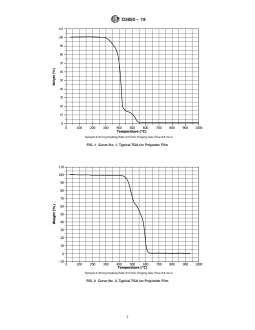
4.2 The record is a TGA curve, with percent of initial mass as the ordinate and temperature as the abscissa (see Figs. 1 and 2).
This test method is under the jurisdiction of ASTM Committee D09 on Electrical and Electronic Insulating Materials and is the direct responsibility of Subcommittee
D09.17 on Fire and Thermal CharacteristicsProperties.
Current edition approved Jan. 1, 2012March 1, 2019. Published February 2012March 2019. Originally approved in 1979. Last previous edition approved in 20062012 as
D3850 – 94D3850 – 12.(2006). DOI: 10.1520/D3850-12.10.1520/D3850-19.
For referenced ASTM standards, visit the ASTM website, www.astm.org, or contact ASTM Customer Service at service@astm.org. For Annual Book of ASTM Standards
volume information, refer to the standard’s Document Summary page on the ASTM website.
*A Summary of Changes section appears at the end of this standard
Copyright © ASTM International, 100 Barr Harbor Drive, PO Box C700, West Conshohocken, PA 19428-2959. United States
D3850 − 19
Sample 8.54 mg Heating Rate 5°C/min Purging Gas Flow 0.8 mL/s
FIG. 1 Curve No. 1, Typical TGA for Polyester Film
Sample 5.93 mg Heating Rate 5°C/min Purging Gas Flow 0.8 mL/s
FIG. 2 Curve No. 2, Typical TGA for Polyimide Film
D3850 − 19
4.3 The temperature is measured and recorded at specified mass loss points (recorded as a TGA curve), using an electronic chart
recorder or other suitable data acquisition device.
5. Significance and Use
5.1 Thermogravimetry is useful in determining the dynamic functional effect of temperature on the amount of volatile materials
leaving a specimen as the latter is heated progressively to higher temperatures. TGA can be useful for process control, process
development, material evaluation, and for identification and quality control in specifications.
5.2 The thermal stability of a material can be associated with the degree and time rate of mass loss as a function of temperature.
TGA curves can, therefore, be used as a preliminary screen method in the evaluation of relative behavior of insulating materials
of the same generic family.
5.3 The functional temperature-life relationship of an insulating material in any given application depends on a number of
service and environmental factors. Therefore, the information obtained from TGA curves is not adequate by itself to describe the
thermal capability of an insulating material.
5.4 Refer to the Appendix for further discussion of the interpretation of TGA data.
6. Apparatus
6.1 Thermogravimetric Analyzer—A system of related instruments comprising:
6.1.1 Microbalance, of the null type, sensitive to 0.001 mg,
6.1.2 Furnace, controllable at a constant rate over a temperature range of interest, typically 25 to 1000°C,
6.1.3 Temperature Programmer, capable of providing a linear rate of rise of the furnace at a predetermined value (normally
5°C/min) with a tolerance of 6 0.1°C/min,
6.1.4 Suitable Data Acquisition Device, and
6.1.5 Supply of Purging Gas.
NOTE 1—For many applications, the purging gas is nitrogen or air having a dew point of at or below −10°C.
7. Sampling
7.1 Use sampling plans as described in specifications or test methods specific to individual electrical insulating materials.
8. Test Specimens
8.1 Prepare test specimens in accordance with the test method applicable to the material under investigation.
8.2 Generally, it is found that specimens of 2 to 20 mg 10 mg are satisfactory, depending on the configuration and test apparatus.
Test results depend in part on the size and shape of specimen, due to thermal equilibrium and diffusion effects.
NOTE 2—A more repeatable result is obtained if a smaller specimen size is used. When a large sample, exceeding 5 mg is used it is recommended that
the specimen be cut into smaller pieces to increase surface area to achieve more uniform degradation.
8.3 When the specimen is a coating on a substrate, the total mass is greater unless the substrate is carefully separated, because
of the mass contribution of the substrate material.
9. Procedure
9.1 Calibrate the balance at full scale to within 6 0.01 mg, following the recommended procedure.
9.2 Calibrate the temperature-sensing system to within 6 1°C (see Method E220), following the recommended procedure.
9.2.1 Position the temperature sensor to prevent contact with specimens which can become distorted during heating.
9.2.2 Temperature calibration is critical and the method employed will vary with the apparatus. Calibrate in accordance with
Practice E1582.
9.3 Adjust the purge rate to the specified value.
9.4 Adjust the Y axis (mass) to chart zero.
9.5 Adjust the X axis to the required temperature range.
9.6 Place the specimen in the specimen holder and record the initial mass.
9.7 Set the heating rate to 5°C/min rate of rise.rise starting at 30ºC.
9.8 Start the heating program and record the mass change until there is no further mass loss.
NOTE 3—Normally the purge rate is 0.7 to 1.6 mL/s. This is to avoid atmospheric stagnation around the specimen during the test.
10. Report
10.1 Report the following information:
10.1.1 Identification of the sample and apparatus,
D3850 − 19
10.1.2 Curing time and temperature in the case of resin specimens,
10.1.3 Mass, approximate d
...