

ASTM A595/A595M-22
(Specification)Standard Specification for Steel Tubes, Low-Carbon or High-Strength Low-Alloy, Tapered for Structural Use
General Information
- Abstract
ABSTRACT
This specification covers three grades of seam-welded, round, tapered steel tubes for structural use. Grades A and B are of low-carbon steel or high-strength low-alloy steel composition and Grade C is of weather-resistance steel composition. The tube steel shall be hot-rolled aluminum-semikilled or fine-grained killed sheet or plate manufactured by one or more of the following processes: open-hearth, basic-oxygen, or electric-furnace. The tubes shall be made from trapezoidal sheet or plate that is preformed and then seam welded. They shall be brought to final size and properties by roll compressing cold on a hardened mandrel. A tensile test shall be done to determine the yield strength and the ultimate tensile strength of the tubes.
SCOPE
1.1 This specification covers three grades of seam-welded, round, tapered steel tubes for structural use. Grades A and B are of low-carbon steel or high-strength low-alloy steel composition and Grade C is of weather-resistant steel composition.
1.1.1 The product may be modified from its round cross section into other shapes without subsequent retesting.
1.2 This tubing is produced in welded sizes in a range of diameters from 2 3/8 to 30 in. [60 to 762 mm] inclusive. Wall thicknesses range from 0.1046 to 0.375 in. [2.66 to 9.53 mm]. Tapers are subject to agreement with the manufacturer.
1.3 The values stated in either SI units or inch-pound units are to be regarded separately as standard. The values stated in each system may not be exact equivalents; therefore, each system shall be used independently of the other. Combining values from the two systems may result in non-conformance with the standard.
1.4 This international standard was developed in accordance with internationally recognized principles on standardization established in the Decision on Principles for the Development of International Standards, Guides and Recommendations issued by the World Trade Organization Technical Barriers to Trade (TBT) Committee.
- Status
- Published
- Publication Date
- 31-Aug-2022
- Technical Committee
- A01 - Steel, Stainless Steel and Related Alloys
- Drafting Committee
- A01.09 - Carbon Steel Tubular Products
Buy Documents
ASTM A595/A595M-22 - Standard Specification for Steel Tubes, Low-Carbon or High-Strength Low-Alloy, Tapered for Structural Use
REDLINE ASTM A595/A595M-22 - Standard Specification for Steel Tubes, Low-Carbon or High-Strength Low-Alloy, Tapered for Structural Use
Overview
ASTM A595/A595M-22, published by ASTM International, is the standard specification for steel tubes, low-carbon or high-strength low-alloy, tapered for structural use. This specification covers three grades of seam-welded, round, tapered steel tubes designed for general structural applications. Grades A and B are made from low-carbon or high-strength low-alloy steel, while Grade C is composed of weather-resistant steel. The standard ensures consistent material quality, mechanical properties, and dimensional tolerances required for reliable and safe structural performance.
Key Topics
Scope and Coverage
- Covers seam-welded, round, tapered steel tubes for structural use.
- Applies to three grades: A and B (low-carbon or high-strength low-alloy steel), C (weather-resistant steel).
- Tubing available in diameters from 2 3/8 to 30 inches [60 to 762 mm] and wall thickness from 0.1046 to 0.375 inches [2.66 to 9.53 mm].
Manufacturing Process
- Tubes manufactured from hot-rolled aluminum-semikilled or fine-grained killed sheet or plate via open-hearth, basic-oxygen, or electric-furnace.
- Preformed, seam-welded trapezoidal sheets or plates are roll compressed cold on a hardened mandrel for final sizing and properties.
Mechanical and Chemical Requirements
- Specific chemical compositions for each grade, focusing on properties like yield and tensile strength.
- Tensile testing required to confirm compliance with minimum yield and tensile strength values.
Dimensions and Tolerances
- Strict tolerances for length, outside diameter, wall thickness, and straightness are specified.
- Products can be modified into non-round cross-sections without further testing.
Marking and Certification
- Tubes must be clearly marked with specification details, size, grade, and other identifying information.
- Certification and test reports available on request.
Applications
ASTM A595/A595M-22 steel tubes are utilized in a broad range of structural applications where strength, reliability, and uniformity are critical. Key applications include:
Structural Poles and Columns
- Widely used for street lighting poles, traffic signal structures, sign supports, and utility poles due to the tapered shape and high strength.
Building Construction
- Ideal for architectural and civil engineering structures requiring tapered steel tubes for columns, supports, and frameworks.
Infrastructure Projects
- Used in bridges, stadiums, and transport infrastructure where weather-resistant or high-strength properties are required.
Retrofit and Custom Fabrications
- Suitable for custom structural fabrications, repairs, and upgrades where consistent mechanical properties and dimensional stability are essential.
Related Standards
The following standards are frequently referenced or used in conjunction with ASTM A595/A595M-22:
- ASTM A370 - Test Methods and Definitions for Mechanical Testing of Steel Products
- ASTM A588/A588M - Specification for High-Strength Low-Alloy Structural Steel with Atmospheric Corrosion Resistance
- ASTM A606/A606M - Specification for High-Strength, Low-Alloy, Hot-Rolled and Cold-Rolled Steel with Improved Atmospheric Corrosion Resistance
- ASTM A751 - Test Methods and Practices for Chemical Analysis of Steel Products
- ASTM A1011 & A1018 - Specifications for Hot-Rolled, Carbon, and High-Strength Low-Alloy Steels
Summary
ASTM A595/A595M-22 provides comprehensive requirements for seam-welded, round, tapered steel tubes suitable for structural applications. The standard details manufacturing processes, materials, mechanical properties, and inspection protocols, ensuring consistent product quality and performance across a wide spectrum of construction and infrastructure uses. Compliance with ASTM A595/A595M-22 guarantees robust, reliable steel tubing designed to meet the evolving needs of modern structural design.
Relations
- Effective Date
- 01-Mar-2024
- Effective Date
- 01-Jul-2019
- Refers
ASTM A370-17a - Standard Test Methods and Definitions for Mechanical Testing of Steel Products - Effective Date
- 15-Nov-2017
- Effective Date
- 01-Jan-2017
- Effective Date
- 01-Nov-2015
- Effective Date
- 01-Nov-2015
- Effective Date
- 15-May-2014
- Effective Date
- 01-Mar-2014
- Effective Date
- 15-Nov-2013
- Refers
ASTM A370-12a - Standard Test Methods and Definitions for Mechanical Testing of Steel Products - Effective Date
- 15-Oct-2012
- Effective Date
- 15-Mar-2012
- Refers
ASTM A370-11a - Standard Test Methods and Definitions for Mechanical Testing of Steel Products - Effective Date
- 15-Nov-2011
- Effective Date
- 15-Jun-2010
- Effective Date
- 01-May-2010
- Refers
ASTM A370-09a - Standard Test Methods and Definitions for Mechanical Testing of Steel Products - Effective Date
- 01-Jun-2009
Buy Documents
ASTM A595/A595M-22 - Standard Specification for Steel Tubes, Low-Carbon or High-Strength Low-Alloy, Tapered for Structural Use
REDLINE ASTM A595/A595M-22 - Standard Specification for Steel Tubes, Low-Carbon or High-Strength Low-Alloy, Tapered for Structural Use
Get Certified
Connect with accredited certification bodies for this standard

Element Materials Technology
Materials testing and product certification.

Inštitut za kovinske materiale in tehnologije
Institute of Metals and Technology. Materials testing, metallurgical analysis, NDT.
Sponsored listings
Frequently Asked Questions
ASTM A595/A595M-22 is a technical specification published by ASTM International. Its full title is "Standard Specification for Steel Tubes, Low-Carbon or High-Strength Low-Alloy, Tapered for Structural Use". This standard covers: ABSTRACT This specification covers three grades of seam-welded, round, tapered steel tubes for structural use. Grades A and B are of low-carbon steel or high-strength low-alloy steel composition and Grade C is of weather-resistance steel composition. The tube steel shall be hot-rolled aluminum-semikilled or fine-grained killed sheet or plate manufactured by one or more of the following processes: open-hearth, basic-oxygen, or electric-furnace. The tubes shall be made from trapezoidal sheet or plate that is preformed and then seam welded. They shall be brought to final size and properties by roll compressing cold on a hardened mandrel. A tensile test shall be done to determine the yield strength and the ultimate tensile strength of the tubes. SCOPE 1.1 This specification covers three grades of seam-welded, round, tapered steel tubes for structural use. Grades A and B are of low-carbon steel or high-strength low-alloy steel composition and Grade C is of weather-resistant steel composition. 1.1.1 The product may be modified from its round cross section into other shapes without subsequent retesting. 1.2 This tubing is produced in welded sizes in a range of diameters from 2 3/8 to 30 in. [60 to 762 mm] inclusive. Wall thicknesses range from 0.1046 to 0.375 in. [2.66 to 9.53 mm]. Tapers are subject to agreement with the manufacturer. 1.3 The values stated in either SI units or inch-pound units are to be regarded separately as standard. The values stated in each system may not be exact equivalents; therefore, each system shall be used independently of the other. Combining values from the two systems may result in non-conformance with the standard. 1.4 This international standard was developed in accordance with internationally recognized principles on standardization established in the Decision on Principles for the Development of International Standards, Guides and Recommendations issued by the World Trade Organization Technical Barriers to Trade (TBT) Committee.
ABSTRACT This specification covers three grades of seam-welded, round, tapered steel tubes for structural use. Grades A and B are of low-carbon steel or high-strength low-alloy steel composition and Grade C is of weather-resistance steel composition. The tube steel shall be hot-rolled aluminum-semikilled or fine-grained killed sheet or plate manufactured by one or more of the following processes: open-hearth, basic-oxygen, or electric-furnace. The tubes shall be made from trapezoidal sheet or plate that is preformed and then seam welded. They shall be brought to final size and properties by roll compressing cold on a hardened mandrel. A tensile test shall be done to determine the yield strength and the ultimate tensile strength of the tubes. SCOPE 1.1 This specification covers three grades of seam-welded, round, tapered steel tubes for structural use. Grades A and B are of low-carbon steel or high-strength low-alloy steel composition and Grade C is of weather-resistant steel composition. 1.1.1 The product may be modified from its round cross section into other shapes without subsequent retesting. 1.2 This tubing is produced in welded sizes in a range of diameters from 2 3/8 to 30 in. [60 to 762 mm] inclusive. Wall thicknesses range from 0.1046 to 0.375 in. [2.66 to 9.53 mm]. Tapers are subject to agreement with the manufacturer. 1.3 The values stated in either SI units or inch-pound units are to be regarded separately as standard. The values stated in each system may not be exact equivalents; therefore, each system shall be used independently of the other. Combining values from the two systems may result in non-conformance with the standard. 1.4 This international standard was developed in accordance with internationally recognized principles on standardization established in the Decision on Principles for the Development of International Standards, Guides and Recommendations issued by the World Trade Organization Technical Barriers to Trade (TBT) Committee.
ASTM A595/A595M-22 is classified under the following ICS (International Classification for Standards) categories: 77.140.75 - Steel pipes and tubes for specific use. The ICS classification helps identify the subject area and facilitates finding related standards.
ASTM A595/A595M-22 has the following relationships with other standards: It is inter standard links to ASTM A370-24, ASTM A370-19, ASTM A370-17a, ASTM A370-17, ASTM A606/A606M-15, ASTM A370-15, ASTM A370-14, ASTM A751-14, ASTM A370-13, ASTM A370-12a, ASTM A370-12, ASTM A370-11a, ASTM A370-10, ASTM G101-04(2010), ASTM A370-09a. Understanding these relationships helps ensure you are using the most current and applicable version of the standard.
ASTM A595/A595M-22 is available in PDF format for immediate download after purchase. The document can be added to your cart and obtained through the secure checkout process. Digital delivery ensures instant access to the complete standard document.
Standards Content (Sample)
This international standard was developed in accordance with internationally recognized principles on standardization established in the Decision on Principles for the
Development of International Standards, Guides and Recommendations issued by the World Trade Organization Technical Barriers to Trade (TBT) Committee.
Designation:A595/A595M −22
Standard Specification for
Steel Tubes, Low-Carbon or High-Strength Low-Alloy,
Tapered for Structural Use
This standard is issued under the fixed designationA595/A595M; the number immediately following the designation indicates the year
of original adoption or, in the case of revision, the year of last revision.Anumber in parentheses indicates the year of last reapproval.
A superscript epsilon (´) indicates an editorial change since the last revision or reapproval.
This standard has been approved for use by agencies of the U.S. Department of Defense.
1. Scope* Improved Atmospheric Corrosion Resistance
A751Test Methods and Practices for Chemical Analysis of
1.1 This specification covers three grades of seam-welded,
Steel Products
round,taperedsteeltubesforstructuraluse.GradesAandBare
A1011Specification for Steel, Sheet and Strip, Hot-Rolled,
of low-carbon steel or high-strength low-alloy steel composi-
Carbon, Structural, High-Strength Low-Alloy, High-
tion and Grade C is of weather-resistant steel composition.
Strength Low-Alloy with Improved Formability, and
1.1.1 The product may be modified from its round cross
Ultra-High Strength
section into other shapes without subsequent retesting.
A1018Specification for Steel, Sheet and Strip, Heavy-
1.2 This tubing is produced in welded sizes in a range of
Thickness Coils, Hot-Rolled, Carbon, Commercial,
diameters from 2 ⁄8 to 30 in. [60 to 762 mm] inclusive. Wall
Drawing, Structural, High-Strength Low-Alloy, High-
thicknesses range from 0.1046 to 0.375 in. [2.66 to 9.53 mm].
Strength Low-Alloy with Improved Formability, and
Tapers are subject to agreement with the manufacturer.
Ultra-High Strength
1.3 The values stated in either SI units or inch-pound units G101Guide for Estimating the Atmospheric Corrosion Re-
sistance of Low-Alloy Steels
are to be regarded separately as standard. The values stated in
each system may not be exact equivalents; therefore, each
3. Ordering Information
system shall be used independently of the other. Combining
3.1 The inquiry and order should indicate the following:
values from the two systems may result in non-conformance
3.1.1 Large and small diameters (in.) [mm], length (ft) [m],
with the standard.
wall thickness (in.) [mm], taper (in./ft) [mm/m];
1.4 This international standard was developed in accor-
3.1.2 (see Table 1 and Table 2);
dance with internationally recognized principles on standard-
3.1.3 Extra test material requirements, if any; and
ization established in the Decision on Principles for the
3.1.4 Supplementary requirements, if any.
Development of International Standards, Guides and Recom-
mendations issued by the World Trade Organization Technical
4. General Requirements for Delivery
Barriers to Trade (TBT) Committee.
4.1 Required date of shipment or date of receipt, and
2. Referenced Documents
4.2 Special shipping instructions, if any.
2.1 ASTM Standards:
5. Manufacture
A370Test Methods and Definitions for Mechanical Testing
5.1 Tube steel shall be hot-rolled aluminum-semikilled or
of Steel Products
fine-grained killed sheet or plate manufactured by one or more
A606/A606MSpecification for Steel, Sheet and Strip, High-
of the following processes: open-hearth, basic-oxygen, or
Strength, Low-Alloy, Hot-Rolled and Cold-Rolled, with
electric-furnace.
5.2 Tubes shall be made from trapezoidal sheet or plate that
This specification is under the jurisdiction ofASTM Committee A01 on Steel,
is preformed and then seam welded. Tubes shall be brought to
Stainless Steel and RelatedAlloys and is the direct responsibility of Subcommittee
final size and properties by roll compressing cold on a
A01.09 on Carbon Steel Tubular Products.
hardened mandrel.
Current edition approved Sept. 1, 2022. Published September 2022. Originally
approved in 1969. Last previous edition approved in 2018 as A595/A595M–18.
6. Chemical Composition
DOI: 10.1520/A0595_A0595M-22.
For referenced ASTM standards, visit the ASTM website, www.astm.org, or
6.1 Steel shall conform to the requirements for chemical
contact ASTM Customer Service at service@astm.org. For Annual Book of ASTM
composition given in Table 1 and Table 3. Chemical require-
Standards volume information, refer to the standard’s Document Summary page on
the ASTM website. ments for high-strength low-alloy steels shall be found in
*A Summary of Changes section appears at the end of this standard
Copyright © ASTM International, 100 Barr Harbor Drive, PO Box C700, West Conshohocken, PA 19428-2959. United States
A595/A595M−22
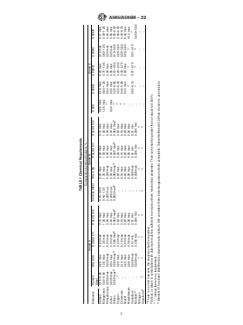
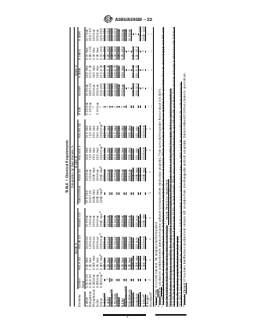
TABLE 1 Chemical Requirements
Composition by Heat Analysis, %
Grade A Grade B Grade C
Elements Carbon HSLA SS HSLAS Cl1 HSLAS Cl2 Carbon Steel HSLA SS HSLAS Cl1 HSLAS Cl2 A 606 A 588/A A 588/B A 588/C A 588/K
Steel
Carbon 0.15–0.25 0.25 max 0.23 max 0.15 max 0.15–0.25 0.25 max 0.26 max 0.15 max 0.22 max 0.19 max 0.20 max 0.15 max 0.17 max
Manganese 0.30–0.90 1.35 max 1.35 max 1.35 max 0.40–1.35 1.35 max 1.50 max 1.50 max 1.25 max 0.80–1.25 0.75–1.35 0.80–1.35 0.50–1.20
A
Phosphorous 0.035 max 0.035 max 0.04 max 0.04 max 0.035 max 0.035 max 0.04 max 0.04 max 0.04 max 0.04 max 0.04 max 0.04 max
Sulfur 0.035 max 0.04 max 0.04 max 0.04 max 0.035 max 0.04 max 0.04 max 0.04 max 0.04 max 0.05 max 0.05 max 0.05 max 0.05 max
B B B B B B B BA
Silicon 0.060 max 0.060 max 0.060 max 0.060 max 0.060 max 0.060 max 0.060 max 0.060 max 0.30–0.65 0.15–0.50 0.15–0.40 0.25–0.50
C A
Copper . 0.20 max 0.20 max 0.20 max . 0.20 max 0.20 max 0.20 max 0.25–0.40 0.20–0.40 0.20–0.50 0.30–0.50
A
Chromium . 0.15 max 0.15 max 0.15 max . 0.15 max 0.15 max 0.15 max 0.40–0.65 0.40–0.70 0.30–0.50 0.40–0.70
A
Nickel . 0.20 max 0.20 max 0.20 max . 0.20 max 0.20 max 0.20 max 0.40 max 0.50 max 0.25–0.50 0.40 max
AA A
Molybdenum . 0.06 max 0.06 max 0.06 max . 0.06 max 0.06 max 0.06 max . 0.10 max
A
Vanadium . 0.008 max 0.01 min 0.01 min . 0.008 max 0.01 min 0.01 min . 0.02–0.10 0.01–0.10 0.01–0.10
D AA A
Niobium . 0.008 max 0.005 min 0.005 min . 0.008 max 0.005 min 0.005 min . 0.005–0.05
AA A AA A
Nitrogen . . . . . . .
BA A A A A A A A
Aluminum . . . . .
A
There is no limit; however, the analysis shall be reported.
B
Silicon or silicon in combination with aluminum must be sufficient to ensure uniform mechanical properties. Their sum shall be greater than or equal to 0.020 %.
C
“{” means there is no requirement.
D
Element 41 has been identified as columbium and niobium. A01 considers them interchangeable and both acceptable. Subcommittee A01.09 has chosen to use niobium.
A595/A595M−22
TABLE 2 Tensile Requirements
8.2 Diameter—The outside diameter shall conform to the
Grade A Grade B Grade C specified dimensions with a tolerance of 6 ⁄16 in. [2 mm] as
Yield point, min, ksi [MPa] 55 [380] 60 [410] 60 [410] measured by girthing.
Ultimate tensile strength, min, 65 [450] 70 [480] 70 [480]
8.3 Wall Thickness—The tolerance for wall thickness exclu-
ksi [MPa]
Elongation in 2 in. [50 mm], 23 21 21
sive of the weld area shall be +10% or −5% of the nominal
min %
wall thickness specified.
8.4 Straightness—The permissible variation for straightness
of the tapered tube shall be 0.2% or less of the total length.
Specifications A1011 and A1018. Information regarding
9. Rework and Retreatment
chemical requirements for improved atmospheric corrosion
9.1 IncaseanytestfailstomeettherequirementsofSection
resistant steels shall be found in Specification A606/A606M.
7, the manufacturer may elect to retreat, rework, or otherwise
Chemical analysis shall be in accordance with Test Methods,
eliminate the condition responsible for failure to meet the
Practices, and Terminology A751.
specified requirements.Thereafter the material remaining from
6.2 For Grade C material, the atmospheric corrosion-
the respective class originally represented may be tested and
resistance index, calculated on the basis of the chemical
shall comply with all requirements of this specification.
composition of the steel, as described in Guide G101, shall be
9.2 Imperfectionsintheoutersurface,suchascracks,scabs,
6.0 or higher.
or excessive weld projections, shall be classed as injurious
NOTE1—Theuserisc
...
This document is not an ASTM standard and is intended only to provide the user of an ASTM standard an indication of what changes have been made to the previous version. Because
it may not be technically possible to adequately depict all changes accurately, ASTM recommends that users consult prior editions as appropriate. In all cases only the current version
of the standard as published by ASTM is to be considered the official document.
Designation: A595/A595M − 18 A595/A595M − 22
Standard Specification for
Steel Tubes, Low-Carbon or High-Strength Low-Alloy,
Tapered for Structural Use
This standard is issued under the fixed designation A595/A595M; the number immediately following the designation indicates the year
of original adoption or, in the case of revision, the year of last revision. A number in parentheses indicates the year of last reapproval.
A superscript epsilon (´) indicates an editorial change since the last revision or reapproval.
This standard has been approved for use by agencies of the U.S. Department of Defense.
1. Scope*
1.1 This specification covers three grades of seam-welded, round, tapered steel tubes for structural use. Grades A and B are of
low-carbon steel or high-strength low-alloy steel composition and Grade C is of weather-resistant steel composition.
1.1.1 The product may be modified from its round cross section into other shapes without subsequent retesting.
1.2 This tubing is produced in welded sizes in a range of diameters from 2 ⁄8 to 30 in. [60 to 762 mm] inclusive. Wall thicknesses
range from 0.1046 to 0.375 in. [2.66 to 9.53 mm]. Tapers are subject to agreement with the manufacturer.
1.3 The values stated in either SI units or inch-pound units are to be regarded separately as standard. The values stated in each
system may not be exact equivalents; therefore, each system shall be used independently of the other. Combining values from the
two systems may result in non-conformance with the standard.
1.4 This international standard was developed in accordance with internationally recognized principles on standardization
established in the Decision on Principles for the Development of International Standards, Guides and Recommendations issued
by the World Trade Organization Technical Barriers to Trade (TBT) Committee.
2. Referenced Documents
2.1 ASTM Standards:
A370 Test Methods and Definitions for Mechanical Testing of Steel Products
A588/A588M Specification for High-Strength Low-Alloy Structural Steel, up to 50 ksi [345 MPa] Minimum Yield Point, with
Atmospheric Corrosion Resistance
A606/A606M Specification for Steel, Sheet and Strip, High-Strength, Low-Alloy, Hot-Rolled and Cold-Rolled, with Improved
Atmospheric Corrosion Resistance
A751 Test Methods and Practices for Chemical Analysis of Steel Products
A1011 Specification for Steel, Sheet and Strip, Hot-Rolled, Carbon, Structural, High-Strength Low-Alloy, High-Strength
Low-Alloy with Improved Formability, and Ultra-High Strength
A1018 Specification for Steel, Sheet and Strip, Heavy-Thickness Coils, Hot-Rolled, Carbon, Commercial, Drawing, Structural,
High-Strength Low-Alloy, High-Strength Low-Alloy with Improved Formability, and Ultra-High Strength
This specification is under the jurisdiction of ASTM Committee A01 on Steel, Stainless Steel and Related Alloys and is the direct responsibility of Subcommittee A01.09
on Carbon Steel Tubular Products.
Current edition approved Nov. 1, 2018Sept. 1, 2022. Published November 2018September 2022. Originally approved in 1969. Last previous edition approved in 20142018
as A595/A595M – 14.A595/A595M – 18. DOI: 10.1520/A0595_A0595M-18.10.1520/A0595_A0595M-22.
For referenced ASTM standards, visit the ASTM website, www.astm.org, or contact ASTM Customer Service at service@astm.org. For Annual Book of ASTM Standards
volume information, refer to the standard’s Document Summary page on the ASTM website.
*A Summary of Changes section appears at the end of this standard
Copyright © ASTM International, 100 Barr Harbor Drive, PO Box C700, West Conshohocken, PA 19428-2959. United States
A595/A595M − 22
G101 Guide for Estimating the Atmospheric Corrosion Resistance of Low-Alloy Steels
3. Ordering Information
3.1 The inquiry and order should indicate the following:
3.1.1 Large and small diameters (in.) [mm], length (ft) [m], wall thickness (in.) [mm], taper (in./ft) [mm/m];
3.1.2 (see Table 1 and Table 2);
3.1.3 Extra test material requirements, if any; and
3.1.4 Supplementary requirements, if any.
4. General Requirements for Delivery
4.1 Required date of shipment or date of receipt, and
4.2 Special shipping instructions, if any.
5. Manufacture
5.1 Tube steel shall be hot-rolled aluminum-semikilled or fine-grained killed sheet or plate manufactured by one or more of the
following processes: open-hearth, basic-oxygen, or electric-furnace.
5.2 Tubes shall be made from trapezoidal sheet or plate that is preformed and then seam welded. Tubes shall be brought to final
size and properties by roll compressing cold on a hardened mandrel.
6. Chemical Composition
6.1 Steel shall conform to the requirements for chemical composition given in Tables 1 and 3Table 1 and Table 3. Chemical
requirements for high-strength low-alloy steels shall be found in Specifications A1011 and A1018. Information regarding chemical
requirements for improved atmospheric corrosion resistant steels shall be found in Specification A606/A606M. Chemical analysis
shall be in accordance with Test Methods, Practices, and Terminology A751.
6.2 For Grade C material, the atmospheric corrosion-resistance index, calculated on the basis of the chemical composition of the
steel, as described in Guide G101, shall be 6.0 or higher.
NOTE 1—The user is cautioned that the Guide G101 predictive equation for calculation of an atmospheric corrosion-resistance index has been verified
only for the composition limits stated in that guide.
6.3 When required by the purchase order, the manufacturer shall supply guidance concerning corrosion resistance that is
satisfactory to the purchaser.
7. Mechanical Properties
7.1 Tension Test:
7.1.1 Requirements—The material, as represented by the test specimens, shall conform to the requirements as to tensile properties
given in Table 2.
7.1.2 Number of Tests:
7.1.2.1 For coil—One or more tension tests as defined in Table 2 shall be made from the large end of one tube on each 100, or
fewer, tubes produced from each coil in the applicable thickness class (see Table 4).
7.1.2.2 For plate—One or more tension tests as defined in Table 2 shall be made from the large end of one tube on a lot produced
from a single heat of plate product of uniform thickness.
A595/A595M − 22
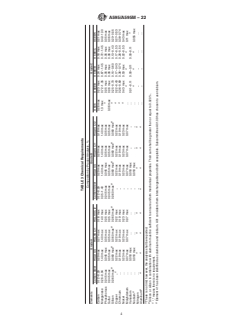
TABLE 1 Chemical Requirements
Composition by Heat Analysis, %
Grade A Grade B Grade C
Elements Carbon HSLA SS HSLAS Cl1 HSLAS Cl2 Carbon Steel HSLA SS HSLAS Cl1 HSLAS Cl2 A 606 A 588/A A 588/B A 588/C A 588/K
Steel
Carbon 0.15–0.25 0.25 max 0.23 max 0.15 max 0.15–0.25 0.25 max 0.26 max 0.15 max 0.22 max 0.19 max 0.20 max 0.15 max 0.17 max
Manganese 0.30–0.90 1.35 max 1.35 max 1.35 max 0.40–1.35 1.35 max 1.50 max 1.50 max 1.25 max 0.80–1.25 0.75–1.35 0.80–1.35 0.50–1.20
A
Phosphorous 0.035 max 0.035 max 0.04 max 0.04 max 0.035 max 0.035 max 0.04 max 0.04 max 0.04 max 0.04 max 0.04 max 0.04 max
Sulfur 0.035 max 0.04 max 0.04 max 0.04 max 0.035 max 0.04 max 0.04 max 0.04 max 0.04 max 0.05 max 0.05 max 0.05 max 0.05 max
B B B B B B B B A
Silicon 0.060 max 0.060 max 0.060 max 0.060 max 0.060 max 0.060 max 0.060 max 0.060 max 0.30–0.65 0.15–0.50 0.15–0.40 0.25–0.50
C,D A
Copper . 0.20 max 0.20 max 0.20 max . 0.20 max 0.20 max 0.20 max 0.25–0.40 0.20–0.40 0.20–0.50 0.30–0.50
C A
Copper . 0.20 max 0.20 max 0.20 max . 0.20 max 0.20 max 0.20 max 0.25–0.40 0.20–0.40 0.20–0.50 0.30–0.50
C,E A
Chromium . 0.15 max 0.15 max 0.15 max . 0.15 max 0.15 max 0.15 max 0.40–0.65 0.40–0.70 0.30–0.50 0.40–0.70
A
Chromium . 0.15 max 0.15 max 0.15 max . 0.15 max 0.15 max 0.15 max 0.40–0.65 0.40–0.70 0.30–0.50 0.40–0.70
C A
Nickel . 0.20 max 0.20 max 0.20 max . 0.20 max 0.20 max 0.20 max 0.40 max 0.50 max 0.25–0.50 0.40 max
A
Nickel . 0.20 max 0.20 max 0.20 max . 0.20 max 0.20 max 0.20 max 0.40 max 0.50 max 0.25–0.50 0.40 max
C,E A A A
Molybdenum . 0.06 max 0.06 max 0.06 max . 0.06 max 0.06 max 0.06 max . 0.10 max
A A A
Molybdenum . 0.06 max 0.06 max 0.06 max . 0.06 max 0.06 max 0.06 max . 0.10 max
F A
Vanadium . 0.008 max 0.01 min 0.01 min . 0.008 max 0.01 min 0.01 min . 0.02–0.10 0.01–0.10 0.01–0.10
A
Vanadium . 0.008 max 0.01 min 0.01 min . 0.008 max 0.01 min 0.01 min . 0.02–0.10 0.01–0.10 0.01–0.10
F,G A A A
Niobium . 0.008 max 0.005 min 0.005 min . 0.008 max 0.005 min 0.005 min . 0.005–0.05
D A A A
Niobium . 0.008 max 0.005 min 0.005 min . 0.008 max 0.005 min 0.005 min . 0.005–0.05
A A A A A A
Nitrogen . . . . . . .
B A A A A A A A A
Aluminum . . . . .
A
There There is no limit; however, the analysis shall be reported.
B
Silicon Silicon or silicon in combination with aluminum must be sufficient to ensure uniform mechanical properties. Their sum shall be greater than or equal to 0.020 %.
C
For HSLA steels the sum of copper, nickel, chromium, and molybdenum shall not exceed 0.50 % on heat analysis. When one of these elements are specified by the purchaser, the sum does not apply, in which case
only the individual limits of the remaining elements shall apply. “{” means there is no requirement.
D
For HSLA steels when copper is specified, the copper limit is a minimum requirement. When copper steel is not specified, the copper limit is a maximum requirement.
E
For SS steel the sum of chromium and molybdenum shall not exceed 0.16 % on heat analysis. When one or more of these elements are specified by the purchaser, the
...