

ASTM D5748-95(2019)
(Test Method)Standard Test Method for Protrusion Puncture Resistance of Stretch Wrap Film
General Information
- Abstract
SIGNIFICANCE AND USE
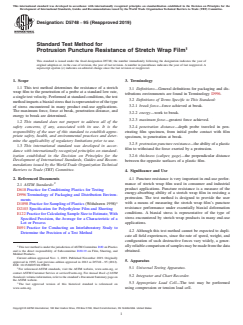
4.1 Puncture resistance is very important in end-use performance of stretch wrap film used in consumer and industrial product applications. Puncture resistance is a measure of the energy-absorbing ability of a stretch wrap film in resisting a protrusion. The test method is designed to provide the user with a means of measuring the stretch wrap film's puncture resistance performance under essentially biaxial deformation conditions. A biaxial stress is representative of the type of stress encountered by stretch wrap products in many end-use applications.
4.2 Although this test method cannot be expected to duplicate all field experiences, since the rate of speed, weight, and configuration of such destructive forces vary widely, a generally reliable comparison of samples may be made from the data obtained.
SCOPE
1.1 This test method determines the resistance of a stretch wrap film to the penetration of a probe at a standard low rate, a single test velocity. Performed at standard conditions, the test method imparts a biaxial stress that is representative of the type of stress encountered in many product end-use applications. The maximum force, force at break, penetration distance, and energy to break are determined.
1.2 This standard does not purport to address all of the safety concerns, if any, associated with its use. It is the responsibility of the user of this standard to establish appropriate safety, health, and environmental practices and determine the applicability of regulatory limitations prior to use.
1.3 This international standard was developed in accordance with internationally recognized principles on standardization established in the Decision on Principles for the Development of International Standards, Guides and Recommendations issued by the World Trade Organization Technical Barriers to Trade (TBT) Committee.
- Status
- Published
- Publication Date
- 31-Oct-2019
- Technical Committee
- D20 - Plastics
- Drafting Committee
- D20.19 - Film, Sheeting, and Molded Products

Overview
ASTM D5748-95(2019), developed by ASTM International, provides the standardized test method for measuring the protrusion puncture resistance of stretch wrap film. This method is essential for evaluating how stretch wrap films withstand puncture by a probe under biaxial deformation conditions-an important property for both consumer and industrial applications. The test results help manufacturers, suppliers, and users compare the durability and protective performance of various films in real-world scenarios. Measuring puncture resistance enables better material selection, process control, and overall product reliability in packaging and shipping environments.
Keywords: ASTM D5748, stretch wrap film, puncture resistance, protrusion puncture, packaging standards, test method
Key Topics
- Test Purpose: The standard measures the energy required for a probe to break through stretch wrap film, simulating the types of forces experienced during packaging, transit, and handling.
- Biaxial Stress Representation: The test imparts biaxial stress, closely representing real-world application conditions encountered by stretch wrap products.
- Performance Indicators:
- Maximum force achieved during puncture
- Force at break (when the film ruptures)
- Penetration distance (depth reached at break)
- Energy absorbed to break point
- Comparability: Provides a reliable method for comparing different stretch wrap films, ensuring consistency for quality control, product development, and competitive benchmarking.
- Standard Conditions: Ensures repeatable and consistent results by performing tests at specified temperature and humidity conditions.
- Limitations: While it offers a reliable comparative quantification, this test method cannot account for all possible field conditions due to variations in impact rate, weight, and object geometry.
Applications
ASTM D5748 is widely applied in sectors where stretch wrap film is critical for protecting goods. Practical applications of this standard include:
- Packaging and Shipping: Ensures stretch wrap films provide adequate protection against puncture during transport, storage, and handling, minimizing product loss or damage.
- Material Development: Guides research and development for new film formulations with improved puncture resistance and energy absorption characteristics.
- Quality Control: Assists manufacturers in verifying the uniformity and compliance of produced stretch wrap films, reducing variation and improving final product dependability.
- Supplier Evaluation: Enables procurement teams and customers to compare puncture resistance across different suppliers objectively, ensuring materials meet required performance standards for specific applications.
- Regulatory Compliance: Supports the documentation required for regulatory or customer audits by providing standardized test data.
Related Standards
Several ASTM standards complement or reference ASTM D5748-95(2019) in the context of plastics testing and packaging:
- ASTM D618: Practice for Conditioning Plastics for Testing, ensuring that specimens are tested under standard environmental conditions.
- ASTM D996: Terminology of Packaging and Distribution Environments, providing standard definitions applicable to packaging tests and environments.
- ASTM D2103: Specification for Polyethylene Film and Sheeting, referencing material specifications commonly used in stretch wraps.
- ASTM E122: Practice for Calculating Sample Size for Sampling and Testing, used in establishing statistically reliable testing protocols.
- ASTM E691: Practice for Conducting an Interlaboratory Study to Determine the Precision of a Test Method.
Using ASTM D5748 in conjunction with these related standards ensures a comprehensive approach to packaging material evaluation, supporting consistency and reliability throughout the product lifecycle.
ASTM D5748 is a critical test method for evaluating the protrusion puncture resistance of stretch wrap film, with broad practical significance in packaging, shipping, and material quality assurance. Adherence to this standard helps ensure robust protection for goods, enhances supply chain reliability, and fosters innovation in stretch film materials.
Relations
- Replaces
ASTM D5748-95(2012) - Standard Test Method for Protrusion Puncture Resistance of Stretch Wrap Film - Effective Date
- 01-Nov-2019
- Effective Date
- 01-Dec-2023
- Effective Date
- 15-Nov-2023
- Effective Date
- 29-Sep-2023
- Effective Date
- 01-Apr-2015
- Effective Date
- 01-May-2013
- Effective Date
- 01-Nov-2011
- Effective Date
- 01-Aug-2011
- Effective Date
- 01-Dec-2010
- Effective Date
- 01-Apr-2010
- Effective Date
- 01-Aug-2009
- Effective Date
- 01-Nov-2008
- Effective Date
- 01-Nov-2008
- Effective Date
- 01-Oct-2008
- Effective Date
- 01-Oct-2007
Get Certified
Connect with accredited certification bodies for this standard

IMP NDT d.o.o.
Non-destructive testing services. Radiography, ultrasonic, magnetic particle, penetrant, visual inspection.
Inštitut za kovinske materiale in tehnologije
Institute of Metals and Technology. Materials testing, metallurgical analysis, NDT.
Q Techna d.o.o.
NDT and quality assurance specialist. 30+ years experience. NDT personnel certification per ISO 9712, nuclear and thermal power plant inspections, QA/
Sponsored listings
Frequently Asked Questions
ASTM D5748-95(2019) is a standard published by ASTM International. Its full title is "Standard Test Method for Protrusion Puncture Resistance of Stretch Wrap Film". This standard covers: SIGNIFICANCE AND USE 4.1 Puncture resistance is very important in end-use performance of stretch wrap film used in consumer and industrial product applications. Puncture resistance is a measure of the energy-absorbing ability of a stretch wrap film in resisting a protrusion. The test method is designed to provide the user with a means of measuring the stretch wrap film's puncture resistance performance under essentially biaxial deformation conditions. A biaxial stress is representative of the type of stress encountered by stretch wrap products in many end-use applications. 4.2 Although this test method cannot be expected to duplicate all field experiences, since the rate of speed, weight, and configuration of such destructive forces vary widely, a generally reliable comparison of samples may be made from the data obtained. SCOPE 1.1 This test method determines the resistance of a stretch wrap film to the penetration of a probe at a standard low rate, a single test velocity. Performed at standard conditions, the test method imparts a biaxial stress that is representative of the type of stress encountered in many product end-use applications. The maximum force, force at break, penetration distance, and energy to break are determined. 1.2 This standard does not purport to address all of the safety concerns, if any, associated with its use. It is the responsibility of the user of this standard to establish appropriate safety, health, and environmental practices and determine the applicability of regulatory limitations prior to use. 1.3 This international standard was developed in accordance with internationally recognized principles on standardization established in the Decision on Principles for the Development of International Standards, Guides and Recommendations issued by the World Trade Organization Technical Barriers to Trade (TBT) Committee.
SIGNIFICANCE AND USE 4.1 Puncture resistance is very important in end-use performance of stretch wrap film used in consumer and industrial product applications. Puncture resistance is a measure of the energy-absorbing ability of a stretch wrap film in resisting a protrusion. The test method is designed to provide the user with a means of measuring the stretch wrap film's puncture resistance performance under essentially biaxial deformation conditions. A biaxial stress is representative of the type of stress encountered by stretch wrap products in many end-use applications. 4.2 Although this test method cannot be expected to duplicate all field experiences, since the rate of speed, weight, and configuration of such destructive forces vary widely, a generally reliable comparison of samples may be made from the data obtained. SCOPE 1.1 This test method determines the resistance of a stretch wrap film to the penetration of a probe at a standard low rate, a single test velocity. Performed at standard conditions, the test method imparts a biaxial stress that is representative of the type of stress encountered in many product end-use applications. The maximum force, force at break, penetration distance, and energy to break are determined. 1.2 This standard does not purport to address all of the safety concerns, if any, associated with its use. It is the responsibility of the user of this standard to establish appropriate safety, health, and environmental practices and determine the applicability of regulatory limitations prior to use. 1.3 This international standard was developed in accordance with internationally recognized principles on standardization established in the Decision on Principles for the Development of International Standards, Guides and Recommendations issued by the World Trade Organization Technical Barriers to Trade (TBT) Committee.
ASTM D5748-95(2019) is classified under the following ICS (International Classification for Standards) categories: 19.060 - Mechanical testing. The ICS classification helps identify the subject area and facilitates finding related standards.
ASTM D5748-95(2019) has the following relationships with other standards: It is inter standard links to ASTM D5748-95(2012), ASTM D2103-23a, ASTM D2103-23, ASTM D1898-68(1989), ASTM D2103-15, ASTM E691-13, ASTM E691-11, ASTM E122-09e1, ASTM D996-10a, ASTM D2103-10, ASTM E122-09, ASTM D2103-08, ASTM D618-08, ASTM E691-08, ASTM E122-07. Understanding these relationships helps ensure you are using the most current and applicable version of the standard.
ASTM D5748-95(2019) is available in PDF format for immediate download after purchase. The document can be added to your cart and obtained through the secure checkout process. Digital delivery ensures instant access to the complete standard document.
Standards Content (Sample)
This international standard was developed in accordance with internationally recognized principles on standardization established in the Decision on Principles for the
Development of International Standards, Guides and Recommendations issued by the World Trade Organization Technical Barriers to Trade (TBT) Committee.
Designation: D5748 − 95 (Reapproved 2019)
Standard Test Method for
Protrusion Puncture Resistance of Stretch Wrap Film
This standard is issued under the fixed designation D5748; the number immediately following the designation indicates the year of
original adoption or, in the case of revision, the year of last revision.Anumber in parentheses indicates the year of last reapproval.A
superscript epsilon (´) indicates an editorial change since the last revision or reapproval.
1. Scope 3. Terminology
1.1 This test method determines the resistance of a stretch
3.1 Definitions—General definitions for packaging and dis-
wrap film to the penetration of a probe at a standard low rate,
tributions environments are found in Terminology D996.
asingletestvelocity.Performedatstandardconditions,thetest
3.2 Definitions of Terms Specific to This Standard:
methodimpartsabiaxialstressthatisrepresentativeofthetype
3.2.1 break force—force achieved at break.
of stress encountered in many product end-use applications.
The maximum force, force at break, penetration distance, and
3.2.2 energy—work to break.
energy to break are determined.
3.2.3 maximum force—greatest force achieved.
1.2 This standard does not purport to address all of the
safety concerns, if any, associated with its use. It is the
3.2.4 penetration distance—depth probe traveled in pen-
responsibility of the user of this standard to establish appro-
etrating film specimen, from initial probe contact with film
priate safety, health, and environmental practices and deter-
specimen, to penetration at break.
mine the applicability of regulatory limitations prior to use.
3.2.5 protrusion puncture resistance—theabilityofaplastic
1.3 This international standard was developed in accor-
film to withstand the force exerted by a protrusion.
dance with internationally recognized principles on standard-
ization established in the Decision on Principles for the
3.2.6 thickness (caliper, gage)—the perpendicular distance
Development of International Standards, Guides and Recom-
between the opposite surfaces of a plastic film.
mendations issued by the World Trade Organization Technical
Barriers to Trade (TBT) Committee.
4. Significance and Use
4.1 Puncture resistance is very important in end-use perfor-
2. Referenced Documents
2 mance of stretch wrap film used in consumer and industrial
2.1 ASTM Standards:
product applications. Puncture resistance is a measure of the
D618Practice for Conditioning Plastics for Testing
energy-absorbing ability of a stretch wrap film in resisting a
D996Terminology of Packaging and Distribution Environ-
protrusion. The test method is designed to provide the user
ments
with a means of measuring the stretch wrap film’s puncture
D1898Practice for Sampling of Plastics (Withdrawn 1998)
resistance performance under essentially biaxial deformation
D2103Specification for Polyethylene Film and Sheeting
conditions. A biaxial stress is representative of the type of
E122PracticeforCalculatingSampleSizetoEstimate,With
stress encountered by stretch wrap products in many end-use
Specified Precision, the Average for a Characteristic of a
Lot or Process applications.
E691Practice for Conducting an Interlaboratory Study to
4.2 Although this test method cannot be expected to dupli-
Determine the Precision of a Test Method
cate all field experiences, since the rate of speed, weight, and
configuration of such destructive forces vary widely, a gener-
1 allyreliablecomparisonofsamplesmaybemadefromthedata
This test method is under the jurisdiction ofASTM Committee D20 on Plastics
and is the direct responsibility of Subcommittee D20.19 on Film, Sheeting, and
obtained.
Molded Products.
Current edition approved Nov. 1, 2019. Published November 2019. Originally
5. Apparatus
approved in 1995. Last previous edition approved in 2012 as D5748–95 (2012).
DOI: 10.1520/D5748-95R19.
2 5.1 Universal Testing Apparatus.
For referenced ASTM standards, visit the ASTM website, www.astm.org, or
contact ASTM Customer Service at service@astm.org. For Annual Book of ASTM
5.2 Integrator and Chart Recorder.
Standards volume information, refer to the standard’s Document Summary page on
the ASTM website.
3 5.3 Appropriate Load Cell—The test may be performed
The last approved version of this historical standard is referenced on
www.astm.org. using compression or tension load cell.
Copyright © ASTM International, 100 Barr Harbor Drive, PO Box C700, West Conshohocken, PA 19428-2959. United States
D5748 − 95 (2019)
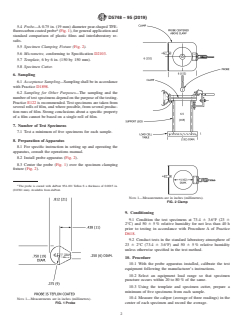
5.4 Probe—A0.75 in. (19 mm) diameter pear-shaped TFE-
fluorocarboncoatedprobe (Fig.1),forgeneralapplicationand
standard comparison of plastic films and interlaboratory re-
sults.
5.5 Specimen Clamping Fixture (Fig. 2).
5.6 Micrometre, conforming to Specification D2103.
5.7 Template, 6 by 6 in. (150 by 150 mm).
5.8 Specimen Cutter.
6. Sampling
6.1 Acceptance Sampling—Sampling shall be in accordance
with Practice D1898.
6.2 Sampling for Other Purposes—The sampling and the
numberoftestspecimensdependonthepurposeofthetesting.
Practice E122 is recommended.Test specimens are taken from
several rolls of film, and where possible, from several produc-
tion runs of film. Strong conclusions about a specific property
of a film cannot be based on a single roll of film.
7. Number of Test Specimens
7.1 Test a minimum of five specimens for each sample.
8. Preparation of Apparatus
8.1 For specific instruction in setting up and operating the
apparatus, consult the operations manual.
8.2 Install probe apparatus (Fig. 2).
8.3 Center the probe (Fig. 1) over the specimen clamping
fixture (Fig. 2).
The probe is coated with duPont 954-101 Teflon S a thickness of 0.0015 in.
(0.0381 mm). Available from duPont.
NOTE 1—Measurements are in inches (millimetres).
FIG. 2 Clamp
9. Conditioning
9.1 Condition the test specimens at 73.4 6 3.6°F (23 6
2°C) and 50 6 5% relative humidity for not less than 40 h
prior to testing in accordance with Procedure A of Practice
D618.
9.2 Conduct tests in the standard laboratory atmosphere of
23 6 2°C (73.4 6 3.6°F) and 50 6 5% relative humidity
unless otherwise specified in the test method.
10. Procedure
10.1 With the probe apparatus installed, calibrate the test
equipment following the manufacturer’s instructions.
10.2 Select an equipment load range so that specimen
puncture occurs within 20 to 80% of the same.
10.3 Using the template and specimen cutter, prepare a
minimum of five specimens from each sample.
10.4 Measure the caliper (average of three readings) in the
NOTE 1—Measurements are in inches (millimetres).
FIG. 1 Probe center of each specimen and record the average.
D5748 − 95 (2019)
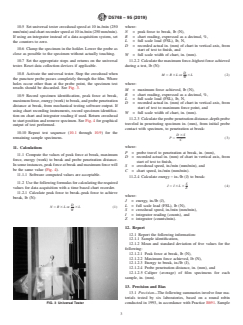
10.5 Set universal tester crosshead speed at 10 in./min (250 where:
mm/min)andchartrecorderspeedat10in./min(250mm/min).
N = peak
...