

ASTM E747-18
(Practice)Standard Practice for Design, Manufacture and Material Grouping Classification of Wire Image Quality Indicators (IQI) Used for Radiology
General Information
- Abstract
ABSTRACT
This practice covers the design, material grouping classification, and manufacture of wire image quality indicators (IQI) used to indicate the quality of radiologic images. This practice, applicable to X-ray and gamma-ray radiology, covers the use of wire penetrameters as the controlling image quality indicator for the material thickness range from 6.4 to 152 mm [0.25 to 6.0 in.]. The alloy group(s) of the material, the thickness or thickness range of the material, and the applicable IQI's that represent the required IQI thickness(s) and alloy(s) shall be considered when selecting IQI's.
SCOPE
1.1 This practice2 covers the design, material grouping classification, and manufacture of wire image quality indicators (IQI) used to indicate the quality of radiographic images.
1.2 This practice is applicable to X-ray and gamma-ray radiography.
1.3 This practice covers the use of wire penetrameters as the controlling image quality indicator for the material thickness range from 6.4 to 152 mm (0.25 to 6.0 in.).
1.4 The values stated in inch-pound units are to be regarded as standard.
1.5 This standard does not purport to address all of the safety concerns, if any, associated with its use. It is the responsibility of the user of this standard to establish appropriate safety, health, and environmental practices and determine the applicability of regulatory limitations prior to use.
1.6 This international standard was developed in accordance with internationally recognized principles on standardization established in the Decision on Principles for the Development of International Standards, Guides and Recommendations issued by the World Trade Organization Technical Barriers to Trade (TBT) Committee.
- Status
- Published
- Publication Date
- 31-May-2018
- Technical Committee
- E07 - Nondestructive Testing
- Drafting Committee
- E07.01 - Radiography (X and Gamma) Method
Buy Documents
ASTM E747-18 - Standard Practice for Design, Manufacture and Material Grouping Classification of Wire Image Quality Indicators (IQI) Used for Radiology
REDLINE ASTM E747-18 - Standard Practice for Design, Manufacture and Material Grouping Classification of Wire Image Quality Indicators (IQI) Used for Radiology
Overview
ASTM E747-18: Standard Practice for Design, Manufacture and Material Grouping Classification of Wire Image Quality Indicators (IQI) Used for Radiology is a key international standard from ASTM that defines requirements for wire image quality indicators-commonly known as wire IQIs or wire penetrameters-used to evaluate the quality of radiologic images. This standard is applicable to X-ray and gamma-ray radiography of materials with thicknesses ranging from 6.4 to 152 mm (0.25 to 6.0 in.), providing essential criteria for design, manufacture, and selection of IQIs based on material composition and thickness.
Key Topics
- Design and Identification: Outlines the construction of wire IQIs as sets of wires of increasing diameter, fabricated from specific materials or alloys, with each set clearly identified by grade and wire size.
- Material Group Classification: Specifies eight material groups based on radiographic absorption, covering light metals (magnesium, aluminum, titanium) and heavy metals (steel, copper-base, nickel-base alloys, brasses, bronzes).
- Manufacturing Requirements: Ensures dimensional tolerances and material verification to maintain consistency and match radiologic absorption properties.
- Applicability: Designed for use as image quality indicators in both X-ray and gamma-ray radiography methods, enhancing the reliability of nondestructive testing (NDT).
- Selection Criteria: Guidance for choosing appropriate IQIs based on alloy group, material thickness, and requisite imaging sensitivity.
- Certification: Requires documentation from IQI manufacturers attesting to compliance with ASTM E747-18 requirements.
- International Alignment: References ISO 19232-1 and other international standards to support global harmonization in radiographic quality assessment.
Applications
ASTM E747-18 is essential for industries and sectors where nondestructive testing and radiographic imaging are critical. Typical applications include:
- Aerospace and Automotive: Inspection of structural parts made of light and heavy metals for hidden defects.
- Manufacturing: Quality assurance of welds, castings, and components using X-ray or gamma-ray imaging.
- Petrochemical and Power Generation: Evaluating pipework, pressure vessels, and critical infrastructure through precise radiographic examination.
- Construction and Infrastructure: Radiography of steel, titanium, or copper-alloy components in bridges and buildings.
By defining strict tolerances and material matching, ASTM E747-18 supports accurate detection of discontinuities or flaws, contributing to industry-wide safety and reliability.
Related Standards
Several international and ASTM standards are referenced or aligned with ASTM E747-18 for comprehensive quality control in radiography:
- ASTM E1025: Practice for design and material grouping of hole-type image quality indicators (IQI) for radiography.
- ASTM E1316: Terminology for nondestructive examinations, providing definitions for radiographic testing.
- ISO 19232-1, ISO 19232-2, ISO 19232-3: International standards on wire and step/hole type IQIs and image quality assessment in radiography.
- ASME Boiler and Pressure Vessel Code: Related practice SE-747 covers IQI use in critical pressure systems.
Practical Value
Implementing ASTM E747-18 in radiographic testing ensures:
- Consistency: Standardized design and certification of wire IQIs improve test repeatability.
- Accuracy: Precise matching of IQIs to inspected material groups and thicknesses leads to reliable image quality assessment.
- Compliance: Alignment with global standards supports regulatory and contractual requirements in international projects.
- Risk Reduction: Enhanced flaw detection and documentation help prevent costly failures, especially in safety-critical applications.
By following ASTM E747-18, organizations benefit from a proven methodology for radiologic image quality control across diverse industries, promoting safer, more effective nondestructive testing processes.
Relations
- Effective Date
- 01-Apr-2024
- Effective Date
- 01-Feb-2024
- Effective Date
- 01-Dec-2019
- Effective Date
- 01-Apr-2019
- Effective Date
- 01-Apr-2019
- Effective Date
- 01-Apr-2019
- Effective Date
- 01-Mar-2019
- Effective Date
- 01-Feb-2018
- Effective Date
- 01-Jan-2018
- Effective Date
- 15-Jun-2017
- Effective Date
- 01-Apr-2017
- Effective Date
- 01-Feb-2017
- Effective Date
- 01-Aug-2016
- Effective Date
- 01-Feb-2016
- Effective Date
- 01-Dec-2015
Buy Documents
ASTM E747-18 - Standard Practice for Design, Manufacture and Material Grouping Classification of Wire Image Quality Indicators (IQI) Used for Radiology
REDLINE ASTM E747-18 - Standard Practice for Design, Manufacture and Material Grouping Classification of Wire Image Quality Indicators (IQI) Used for Radiology
Get Certified
Connect with accredited certification bodies for this standard

IMP NDT d.o.o.
Non-destructive testing services. Radiography, ultrasonic, magnetic particle, penetrant, visual inspection.
Inštitut za kovinske materiale in tehnologije
Institute of Metals and Technology. Materials testing, metallurgical analysis, NDT.
Q Techna d.o.o.
NDT and quality assurance specialist. 30+ years experience. NDT personnel certification per ISO 9712, nuclear and thermal power plant inspections, QA/
Sponsored listings
Frequently Asked Questions
ASTM E747-18 is a standard published by ASTM International. Its full title is "Standard Practice for Design, Manufacture and Material Grouping Classification of Wire Image Quality Indicators (IQI) Used for Radiology". This standard covers: ABSTRACT This practice covers the design, material grouping classification, and manufacture of wire image quality indicators (IQI) used to indicate the quality of radiologic images. This practice, applicable to X-ray and gamma-ray radiology, covers the use of wire penetrameters as the controlling image quality indicator for the material thickness range from 6.4 to 152 mm [0.25 to 6.0 in.]. The alloy group(s) of the material, the thickness or thickness range of the material, and the applicable IQI's that represent the required IQI thickness(s) and alloy(s) shall be considered when selecting IQI's. SCOPE 1.1 This practice2 covers the design, material grouping classification, and manufacture of wire image quality indicators (IQI) used to indicate the quality of radiographic images. 1.2 This practice is applicable to X-ray and gamma-ray radiography. 1.3 This practice covers the use of wire penetrameters as the controlling image quality indicator for the material thickness range from 6.4 to 152 mm (0.25 to 6.0 in.). 1.4 The values stated in inch-pound units are to be regarded as standard. 1.5 This standard does not purport to address all of the safety concerns, if any, associated with its use. It is the responsibility of the user of this standard to establish appropriate safety, health, and environmental practices and determine the applicability of regulatory limitations prior to use. 1.6 This international standard was developed in accordance with internationally recognized principles on standardization established in the Decision on Principles for the Development of International Standards, Guides and Recommendations issued by the World Trade Organization Technical Barriers to Trade (TBT) Committee.
ABSTRACT This practice covers the design, material grouping classification, and manufacture of wire image quality indicators (IQI) used to indicate the quality of radiologic images. This practice, applicable to X-ray and gamma-ray radiology, covers the use of wire penetrameters as the controlling image quality indicator for the material thickness range from 6.4 to 152 mm [0.25 to 6.0 in.]. The alloy group(s) of the material, the thickness or thickness range of the material, and the applicable IQI's that represent the required IQI thickness(s) and alloy(s) shall be considered when selecting IQI's. SCOPE 1.1 This practice2 covers the design, material grouping classification, and manufacture of wire image quality indicators (IQI) used to indicate the quality of radiographic images. 1.2 This practice is applicable to X-ray and gamma-ray radiography. 1.3 This practice covers the use of wire penetrameters as the controlling image quality indicator for the material thickness range from 6.4 to 152 mm (0.25 to 6.0 in.). 1.4 The values stated in inch-pound units are to be regarded as standard. 1.5 This standard does not purport to address all of the safety concerns, if any, associated with its use. It is the responsibility of the user of this standard to establish appropriate safety, health, and environmental practices and determine the applicability of regulatory limitations prior to use. 1.6 This international standard was developed in accordance with internationally recognized principles on standardization established in the Decision on Principles for the Development of International Standards, Guides and Recommendations issued by the World Trade Organization Technical Barriers to Trade (TBT) Committee.
ASTM E747-18 is classified under the following ICS (International Classification for Standards) categories: 19.100 - Non-destructive testing. The ICS classification helps identify the subject area and facilitates finding related standards.
ASTM E747-18 has the following relationships with other standards: It is inter standard links to ASTM B166-24, ASTM E1316-24, ASTM E1316-19b, ASTM B166-19, ASTM B164-03(2019), ASTM B161-05(2019), ASTM E1316-19, ASTM E1025-18, ASTM E1316-18, ASTM E1316-17a, ASTM B139/B139M-12(2017), ASTM E1316-17, ASTM E1316-16a, ASTM E1316-16, ASTM E1316-15a. Understanding these relationships helps ensure you are using the most current and applicable version of the standard.
ASTM E747-18 is available in PDF format for immediate download after purchase. The document can be added to your cart and obtained through the secure checkout process. Digital delivery ensures instant access to the complete standard document.
Standards Content (Sample)
This international standard was developed in accordance with internationally recognized principles on standardization established in the Decision on Principles for the
Development of International Standards, Guides and Recommendations issued by the World Trade Organization Technical Barriers to Trade (TBT) Committee.
Designation:E747 −18
Standard Practice for
Design, Manufacture and Material Grouping Classification of
Wire Image Quality Indicators (IQI) Used for Radiology
This standard is issued under the fixed designation E747; the number immediately following the designation indicates the year of
original adoption or, in the case of revision, the year of last revision.Anumber in parentheses indicates the year of last reapproval.A
superscript epsilon (´) indicates an editorial change since the last revision or reapproval.
1. Scope Shapes [Metric] (Withdrawn 2002)
B161Specification for Nickel Seamless Pipe and Tube
1.1 This practice covers the design, material grouping
B164Specification for Nickel-Copper Alloy Rod, Bar, and
classification, and manufacture of wire image quality indica-
Wire
tors (IQI) used to indicate the quality of radiographic images.
B166Specification for Nickel-Chromium-IronAlloys (UNS
1.2 This practice is applicable to X-ray and gamma-ray N06600, N06601, N06603, N06690, N06693, N06025,
radiography.
N06045, and N06696), Nickel-Chromium-Cobalt-
Molybdenum Alloy (UNS N06617), and Nickel-Iron-
1.3 Thispracticecoverstheuseofwirepenetrametersasthe
Chromium-TungstenAlloy (UNS N06674) Rod, Bar, and
controlling image quality indicator for the material thickness
Wire
range from 6.4 to 152 mm (0.25 to 6.0 in.).
E1025 Practice for Design, Manufacture, and Material
1.4 Thevaluesstatedininch-poundunitsaretoberegarded
Grouping Classification of Hole-Type Image Quality In-
as standard.
dicators (IQI) Used for Radiography
E1316Terminology for Nondestructive Examinations
1.5 This standard does not purport to address all of the
2.2 ISO Standards:
safety concerns, if any, associated with its use. It is the
ISO 19232–1Non-Destructive Testing—Image Quality of
responsibility of the user of this standard to establish appro-
Radiographs-Part 1: Image Quality Indicators (Wire-
priate safety, health, and environmental practices and deter-
Type)-Determination of Image Quality Value
mine the applicability of regulatory limitations prior to use.
ISO 19232–2Non-Destructive Testing—Image Quality of
1.6 This international standard was developed in accor-
Radiographs-Part 2: Determination of the Image Quality
dance with internationally recognized principles on standard-
Value using Step/hole Type Image Quality Iindicators
ization established in the Decision on Principles for the
ISO 19232–3Non-Destructive Testing—Image Quality of
Development of International Standards, Guides and Recom-
Radiographs-Part 3: Image Quality Classes
mendations issued by the World Trade Organization Technical
Barriers to Trade (TBT) Committee.
3. Terminology
3.1 Definitions—The definitions of terms in Terminology
2. Referenced Documents
E1316, Section D, relating to gamma and X-radiography, shall
2.1 ASTM Standards:
apply to the terms used in this practice.
B139/B139MSpecification for Phosphor Bronze Rod, Bar,
4. Wire IQI Requirements
and Shapes
B150MSpecification for Aluminum Bronze, Rod, Bar, and
4.1 The quality of all levels of examination shall be deter-
mined by a set of wires conforming to the following require-
ments:
1 4.1.1 Wires shall be fabricated from materials or alloys
This practice is under the jurisdiction of ASTM Committee E07 on Nonde-
structive Testing and is the direct responsibility of Subcommittee E07.01 on
identifiedorlistedinaccordancewith7.2.Othermaterialsmay
Radiology (X and Gamma) Method.
be used in accordance with 7.3.
Current edition approved June 1, 2018. Published September 2018. Originally
4.1.2 The IQI consists of sets of wires arranged in order of
approvedin1980.Lastpreviouseditionapprovedin2010asE747-04(2010).DOI:
increasingdiameter.ThediametersizesspecifiedinTable1are
10.1520/E0747-18.
For ASME Boiler and Pressure Vessel Code applications see related Practice
SE-747 in Section II of that Code.
3 4
For referenced ASTM standards, visit the ASTM website, www.astm.org, or The last approved version of this historical standard is referenced on
contact ASTM Customer Service at service@astm.org. For Annual Book of ASTM www.astm.org.
Standards volume information, refer to the standard’s Document Summary page on Available fromAmerican National Standards Institute (ANSI), 25 W. 43rd St.,
the ASTM website. 4th Floor, New York, NY 10036, http://www.ansi.org.
Copyright © ASTM International, 100 Barr Harbor Drive, PO Box C700, West Conshohocken, PA 19428-2959. United States
E747−18
TABLE 1 Wire IQI Sizes and Wire Identity Numbers
established from a consecutive series of numbers taken in
SET A SET B general from the ISO/R 10 series. The IQI shall be fabricated
Wire Diameter Wire Diameter in accordance with the requirements specified in Figs. 1-8 and
Wire Identity Wire Identity
in. (mm) in. (mm)
Tables 1-3. IQIs previously manufactured to the requirements
A
0.0032 (0.08) 1 0.010 (0.25) 6
of Appendix X1may be used as an alternate provided all other
0.004 (0.1) 2 0.013 (0.33) 7
requirements of this practice are met.
0.005 (0.13) 3 0.016 (0.4) 8
0.0063 (0.16) 4 0.020 (0.51) 9 4.1.3 Image quality indicator (IQI) designs other than those
0.008 (0.2) 5 0.025 (0.64) 10
shown in Figs. 1-8 and AnnexA1 are permitted by contractual
0.010 (0.25) 6 0.032 (0.81) 11
agreement. If an IQI set as listed in Table 1 or Annex A1 is
SET C SET D
Wire Diameter Wire Diameter
modifiedinsize,itmustcontainthegradenumber,setidentity,
Wire Identity Wire Identity
in. (mm) in. (mm)
and essential wire. It must also contain two additional wires
0.032 (0.81) 11 0.10 (2.5) 16
that are the next size larger and the next size smaller as
0.040 (1.02) 12 0.126 (3.2) 17
0.050 (1.27) 13 0.160 (4.06) 18
specified in the applicable set listed in Table 1.
0.063 (1.6) 14 0.20 (5.1) 19
4.1.4 Each set must be identified using letters and numbers
0.080 (2.03) 15 0.25 (6.4) 20
made of industrial grade lead or of a material of similar
0.100 (2.5) 16 0.32 (8) 21
radiographic density. Identification shall be as shown on Figs.
A
The 0.0032 wire may be used to establish a special quality level as agreed upon
between the purchaser and the supplier. 1-8 or Annex A1, unless otherwise specified by contractual
agreement.
4.1.5 ISOstandardISO19232-1containssimilarprovisions
TABLE 2 Wire Diameter Tolerances, mm
(with nominal differences-see Table A1.1) for wire image
Wire Diameter (d), mm Tolerance, mm
qualityindicatorsasthisstandard(E747).Internationalusersof
0.000 < d# 0.125 ±0.0025 thesetypeIQIstandardswhoprefertheuseofISO19232-1for
0.125 < d# 0.25 ±0.005
their particular applications should specify such alternate
0.25 < d# 0.5 ±0.01
provisions within separate contractual arrangements from this
0.50 < d# 1.6 ±0.02
1.6 < d# 4 ±0.03
standard.
4.0 < d# 8 ±0.05
5. Image Quality Indicator (IQI) Procurement
5.1 When selecting IQI’s for procurement, the following
TABLE 3 Wire Diameter Tolerances, in.
factors should be considered:
Wire Diameter (d), in. Tolerance, in.
5.1.1 Determine the alloy group(s) of the material to be
0.000 < d# 0.005 ±0.0001
examined.
0.005 < d# 0.010 ±0.0002
5.1.2 Determine the thickness or thickness range of the
0.010 < d# 0.020 ±0.0004
0.020 < d# 0.063 ±0.0008 material(s) to be examined.
0.063 < d# 0.160 ±0.0012
5.1.3 Select the applicable IQI’s that represent the required
0.160 < d# 0.320 ±0.0020
IQI thickness(s) and alloy(s).
FIG. 1 Set A/Alternate 1
E747−18
FIG. 2 Set A/Alternate 2
FIG. 3 Set B/Alternate 1
6. Image Quality Levels thicknessofmaterialtowhichthequalitylevelapplies.Careful
consideration of required quality levels is particularly impor-
6.1 The quality level required using wire penetrameters
tant.
shall be equivalent to the 2-2T level of Practice E1025 for
hole-type IQI’s unless a higher or lower quality level is agreed
7. Material Groups
upon between purchaser and supplier. The conversion of
plaque identification number to the equivalent wire diameter
7.1 General:
and identity as defined in this standard is provided in Annex
7.1.1 Materials have been designated in eight groups based
A1.
on their radiographic absorption characteristics: groups 03, 02,
and 01 for light metals and groups 1 through 5 for heavy
6.2 Inspecifyingqualitylevels,thecontract,purchaseorder,
product specification, or drawing should clearly indicate the metals.
E747−18
FIG. 4 Set B/Alternate 2
FIG. 5 Set C/Alternate 1
7.1.2 The light metal groups, magnesium (Mg), aluminum 7.1.4 Common trade names or alloy designations have been
(Al), and titanium (Ti) are identified 03, 02, and 01
used for clarification of the pertinent materials.
respectively, for their predominant alloying constituent. The
7.1.5 The materials from which the IQI for the group are to
materials are listed in order of increasing radiation absorption.
be made are designated in each case and these IQI’s are
7.1.3 The heavy metal groups, steel, copper-base, nickel-
applicableforallmaterialslistedinthatgroup.Inaddition,any
base, and kindred alloys are identified 1 through 5. The
group IQI may be used for any material with a higher group
materials increase in radiation absorption with increasing
number, provided the applicable quality level is maintained.
numerical designation.
E747−18
FIG. 6 Set C/Alternate 2
FIG. 7 Set D/Alternate 1
7.2 Materials Groups: 7.2.3.1 Image quality indicators (IQI’s) shall be made of
7.2.1 Materials Group 01: magnesium or magnesium shall be the predominant alloying
7.2.1.1 Image quality indicators (IQI’s) shall be made of constituent.
titaniumortitaniumshallbethepredominantalloyingconstitu- 7.2.3.2 Use on all alloys of which magnesium is the
ent. predominant alloying constituent.
7.2.1.2 Use on all alloys of which titanium is the predomi- 7.2.4 Materials Group 1:
nant alloying constituent. 7.2.4.1 Image quality indicators (IQI’s) shall be made of
7.2.2 Materials Group 02: carbon steel or Type 300 series stainless steel.
7.2.2.1 Image quality indicators (IQI’s) shall be made of 7.2.4.2 Use on all carbon steel, low-alloy steels, stainless
aluminum or aluminum shall be the predominant alloying steels, and manganese-nickel-aluminum bronze (Superston).
constituent. 7.2.5 Materials Group 2:
7.2.2.2 Useonallalloysofwhichaluminumisthepredomi-
nant alloying constituent.
7.2.3 Materials Group 03: Superston is a registered trademark of Superston Corp., Jersey City, NJ.
E747−18
FIG. 8 Set D/Alternate 2
7.2.5.1 Image quality indicators (IQI’s) shall be made of 7.2.8.2 Use on tin bronzes including gun-metal and valve
aluminum bronze (Alloy No. 623 of Specification B150M)or bronze, or leaded-tin bronze of higher lead content than valve
equivalent, or nickel-aluminum bronze (Alloy No. 630 of bronze. Group 5 IQI’s may include bronze of higher lead
Specification B150M) or equivalent. content since leaded bronze increases in attenuation with
7.2.5.2 Use on all aluminum bronzes and all nickel- increase in lead content. This would be equivalent to using a
aluminum bronzes. lower group IQI.
7.2.6 Materials Group 3:
NOTE 1—In developing the eight listed materials groups, a number of
7.2.6.1 Image quality indicators (IQI’s) shall be made of
othertradenamesorothernominalalloydesignationswereevaluated.For
nickel-chromium-iron alloy (UNS No. N06600) (Inconel).
the purpose of making this practice as useful as possible, these materials
are listed and categorized, by group, as follows:
(See Specification B166).
(1) Group 2—Haynes Alloy IN-100.
7.2.6.2 Use on nickel-chromium-iron alloy and 18 %
(2) Group 3—HaynesAlloyNo.713C,HastelloyD ,G.E.AlloySEL,
nickel-maraging steel.
Haynes Stellite Alloy No. 21, GMR-235 Alloy, Haynes Alloy No. 93,
7.2.7 Materials Group 4:
Inconel X , Inconel 718, and Haynes Stellite Alloy No. S-816.
7.2.7.1 Image quality indicators (IQI’s) shall be made of 70
(3) Group 4—Hastelloy Alloy F, Hastelloy Alloy X, and Multimeter
Alloy Rene 41.
to 30 nickel-copper alloy (Monel) (Class A or B of Specifi-
(4) Group5—Alloysinorderofincreasingattenuation:HastelloyAlloy
cation B164) or equivalent, or 70 to 30 copper-nickel alloy
B, Hastelloy Alloy C, Haynes Stellite Alloy No. 31, Thetaloy, Haynes
(Alloy G of Specification B161) or equivalent.
Stellite No. 3, Haynes Alloy No. 25. Image quality indicators (IQI’s) of
7.2.7.2 Use on nickel, copper, all nickel-copper series, or
any of these materials are considered applicable for the materials that
copper-nickel series of alloys, and all brasses (copper-zinc follow it.
NOTE 2—The committee formulating these recommendations recom-
alloys). Group 4 IQI’s may include the leaded brasses since
mend other materials may be added to the
...
This document is not an ASTM standard and is intended only to provide the user of an ASTM standard an indication of what changes have been made to the previous version. Because
it may not be technically possible to adequately depict all changes accurately, ASTM recommends that users consult prior editions as appropriate. In all cases only the current version
of the standard as published by ASTM is to be considered the official document.
Designation: E747 − 04 (Reapproved 2010) E747 − 18
Standard Practice for
Design, Manufacture and Material Grouping Classification of
Wire Image Quality Indicators (IQI) Used for Radiology
This standard is issued under the fixed designation E747; the number immediately following the designation indicates the year of
original adoption or, in the case of revision, the year of last revision. A number in parentheses indicates the year of last reapproval. A
superscript epsilon (´) indicates an editorial change since the last revision or reapproval.
1. Scope
1.1 This practice covers the design, material grouping classification, and manufacture of wire image quality indicators (IQI)
used to indicate the quality of radiologicradiographic images.
1.2 This practice is applicable to X-ray and gamma-ray radiology.radiography.
1.3 This practice covers the use of wire penetrameters as the controlling image quality indicator for the material thickness range
from 6.4 to 152 mm (0.25 to 6.0 in.).
1.4 The values stated in inch-pound units are to be regarded as standard.
1.5 This standard does not purport to address all of the safety concerns, if any, associated with its use. It is the responsibility
of the user of this standard to establish appropriate safety safety, health, and healthenvironmental practices and determine the
applicability of regulatory limitations prior to use.
1.6 This international standard was developed in accordance with internationally recognized principles on standardization
established in the Decision on Principles for the Development of International Standards, Guides and Recommendations issued
by the World Trade Organization Technical Barriers to Trade (TBT) Committee.
2. Referenced Documents
2.1 ASTM Standards:
B139/B139M Specification for Phosphor Bronze Rod, Bar, and Shapes
B150M Specification for Aluminum Bronze, Rod, Bar, and Shapes [Metric] (Withdrawn 2002)
B161 Specification for Nickel Seamless Pipe and Tube
B164 Specification for Nickel-Copper Alloy Rod, Bar, and Wire
B166 Specification for Nickel-Chromium-Iron Alloys (UNS N06600, N06601, N06603, N06690, N06693, N06025, N06045,
and N06696), Nickel-Chromium-Cobalt-Molybdenum Alloy (UNS N06617), and Nickel-Iron-Chromium-Tungsten Alloy
(UNS N06674) Rod, Bar, and Wire
E1025 Practice for Design, Manufacture, and Material Grouping Classification of Hole-Type Image Quality Indicators (IQI)
Used for Radiography
E1316 Terminology for Nondestructive Examinations
2.2 OtherISO Standards:
EN 462–1ISO 19232–1 Non-Destructive Testing—Image Quality of Radiographs-Part 1: Image Quality Indicators (Wire-Type)-
Determination of Image Quality Value
ISO 19232–2 Non-Destructive Testing—Image Quality of Radiographs-Part 2: Determination of the Image Quality Value using
Step/hole Type Image Quality Iindicators
ISO 19232–3 Non-Destructive Testing—Image Quality of Radiographs-Part 3: Image Quality Classes
This practice is under the jurisdiction of ASTM Committee E07 on Nondestructive Testing and is the direct responsibility of Subcommittee E07.01 on Radiology (X and
Gamma) Method.
Current edition approved Nov. 1, 2010June 1, 2018. Published March 2011September 2018. Originally approved in 1980. Last previous edition approved in 20042010
as E747 - 04.E747 - 04(2010). DOI: 10.1520/E0747-04R10.10.1520/E0747-18.
For ASME Boiler and Pressure Vessel Code applications see related Practice SE-747 in Section II of that Code.
For referenced ASTM standards, visit the ASTM website, www.astm.org, or contact ASTM Customer Service at service@astm.org. For Annual Book of ASTM Standards
volume information, refer to the standard’s Document Summary page on the ASTM website.
The last approved version of this historical standard is referenced on www.astm.org.
Available from American National Standards Institute (ANSI), 25 W. 43rd St., 4th Floor, New York, NY 10036, http://www.ansi.org.
Copyright © ASTM International, 100 Barr Harbor Drive, PO Box C700, West Conshohocken, PA 19428-2959. United States
E747 − 18
3. Terminology
3.1 Definitions—The definitions of terms in Terminology E1316, Section D, relating to gamma and X-radiology,X-radiography,
shall apply to the terms used in this practice.
4. Wire IQI Requirements
4.1 The quality of all levels of examination shall be determined by a set of wires conforming to the following requirements:
4.1.1 Wires shall be fabricated from materials or alloys identified or listed in accordance with 7.2. Other materials may be used
in accordance with 7.3.
4.1.2 The IQI consists of sets of wires arranged in order of increasing diameter. The diameter sizes specified in Table 1 are
established from a consecutive series of numbers taken in general from the ISO/R 10 series. The IQI shall be fabricated in
accordance with the requirements specified in Figs. 1-8 and Tables 1-3. IQIs previously manufactured to the requirements of Annex
A1Appendix X1 may be used as an alternate provided all other requirements of this practice are met.
4.1.3 Image quality indicator (IQI) designs other than those shown in Figs. 1-8 and Annex A1 are permitted by contractual
agreement. If an IQI set as listed in Table 1 or Annex A1 is modified in size, it must contain the grade number, set identity, and
essential wire. It must also contain two additional wires that are the next size larger and the next size smaller as specified in the
applicable set listed in Table 1.
4.1.4 Each set must be identified using letters and numbers made of industrial grade lead or of a material of similar radiographic
density. Identification shall be as shown on Figs. 1-8 or Annex A1, unless otherwise specified by contractual agreement.
4.1.5 EuropeanISO standard EN 462-1 ISO 19232-1 contains similar provisions (with nominal differences-see Table A1.1) for
wire image quality indicators as this standard (E747). International users of these type IQI standards who prefer the use of
EN 462-1 ISO 19232-1 for their particular applications should specify such alternate provisions within separate contractual
arrangements from this standard.
5. Image Quality Indicator (IQI) Procurement
5.1 When selecting IQI’s for procurement, the following factors should be considered:
5.1.1 Determine the alloy group(s) of the material to be examined.
5.1.2 Determine the thickness or thickness range of the material(s) to be examined.
5.1.3 Select the applicable IQI’s that represent the required IQI thickness(s) and alloy(s).
6. Image Quality Levels
6.1 The quality level required using wire penetrameters shall be equivalent to the 2-2T level of Practice E1025 for hole-type
IQI’s unless a higher or lower quality level is agreed upon between purchaser and supplier. Table 4 provides a list of various
hole-type IQI’s and the diameter of wires of corresponding equivalent penetrameter sensitivity (EPS) with the applicable 1T, 2T,
and 4T holes in the IQI. This table can be used for determining 1T, 2T, and 4T quality levels. The conversion of plaque
identification number to the equivalent wire diameter and identity as defined in this standard is provided in Appendix X1Annex
A1 gives the equation for calculating other equivalencies if needed.
6.2 In specifying quality levels, the contract, purchase order, product specification, or drawing should clearly indicate the
thickness of material to which the quality level applies. Careful consideration of required quality levels is particularly important.
TABLE 1 Wire IQI Sizes and Wire Identity Numbers
SET A SET B
Wire Diameter Wire Diameter
Wire Identity Wire Identity
in. (mm) in. (mm)
A
0.0032 (0.08) 1 0.010 (0.25) 6
0.004 (0.1) 2 0.013 (0.33) 7
0.005 (0.13) 3 0.016 (0.4) 8
0.0063 (0.16) 4 0.020 (0.51) 9
0.008 (0.2) 5 0.025 (0.64) 10
0.010 (0.25) 6 0.032 (0.81) 11
SET C SET D
Wire Diameter Wire Diameter
Wire Identity Wire Identity
in. (mm) in. (mm)
0.032 (0.81) 11 0.10 (2.5) 16
0.040 (1.02) 12 0.126 (3.2) 17
0.050 (1.27) 13 0.160 (4.06) 18
0.063 (1.6) 14 0.20 (5.1) 19
0.080 (2.03) 15 0.25 (6.4) 20
0.100 (2.5) 16 0.32 (8) 21
A
The 0.0032 wire may be used to establish a special quality level as agreed upon
between the purchaser and the supplier.
E747 − 18
TABLE 2 Wire Diameter Tolerances, mm
Wire Diameter (d), mm Tolerance, mm
0.000 < d# 0.125 ±0.0025
0.125 < d # 0.25 ±0.005
0.25 < d # 0.5 ±0.01
0.50 < d # 1.6 ±0.02
1.6 < d # 4 ±0.03
4.0 < d # 8 ±0.05
TABLE 3 Wire Diameter Tolerances, in.
Wire Diameter (d), in. Tolerance, in.
0.000 < d # 0.005 ±0.0001
0.005 < d # 0.010 ±0.0002
0.010 < d # 0.020 ±0.0004
0.020 < d # 0.063 ±0.0008
0.063 < d # 0.160 ±0.0012
0.160 < d # 0.320 ±0.0020
7. Material Groups
7.1 General:
7.1.1 Materials have been designated in eight groups based on their radiographic absorption characteristics: groups 03, 02, and
01 for light metals and groups 1 through 5 for heavy metals.
7.1.2 The light metal groups, magnesium (Mg), aluminum (Al), and titanium (Ti) are identified 03, 02, and 01 respectively, for
their predominant alloying constituent. The materials are listed in order of increasing radiation absorption.
7.1.3 The heavy metal groups, steel, copper-base, nickel-base, and kindred alloys are identified 1 through 5. The materials
increase in radiation absorption with increasing numerical designation.
7.1.4 Common trade names or alloy designations have been used for clarification of the pertinent materials.
7.1.5 The materials from which the IQI for the group are to be made are designated in each case and these IQI’s are applicable
for all materials listed in that group. In addition, any group IQI may be used for any material with a higher group number, provided
the applicable quality level is maintained.
7.2 Materials Groups:
7.2.1 Materials Group 01:
7.2.1.1 Image quality indicators (IQI’s) shall be made of titanium or titanium shall be the predominant alloying constituent.
7.2.1.2 Use on all alloys of which titanium is the predominant alloying constituent.
7.2.2 Materials Group 02:
7.2.2.1 Image quality indicators (IQI’s) shall be made of aluminum or aluminum shall be the predominant alloying constituent.
7.2.2.2 Use on all alloys of which aluminum is the predominant alloying constituent.
7.2.3 Materials Group 03:
7.2.3.1 Image quality indicators (IQI’s) shall be made of magnesium or magnesium shall be the predominant alloying
constituent.
7.2.3.2 Use on all alloys of which magnesium is the predominant alloying constituent.
7.2.4 Materials Group 1:
7.2.4.1 Image quality indicators (IQI’s) shall be made of carbon steel or Type 300 series stainless steel.
7.2.4.2 Use on all carbon steel, low-alloy steels, stainless steels, and manganese-nickel-aluminum bronze (Superston).
7.2.5 Materials Group 2:
7.2.5.1 Image quality indicators (IQI’s) shall be made of aluminum bronze (Alloy No. 623 of Specification B150M) or
equivalent, or nickel-aluminum bronze (Alloy No. 630 of Specification B150M) or equivalent.
7.2.5.2 Use on all aluminum bronzes and all nickel-aluminum bronzes.
7.2.6 Materials Group 3:
7.2.6.1 Image quality indicators (IQI’s) shall be made of nickel-chromium-iron alloy (UNS No. N06600) (Inconel). (See
Specification B166).
7.2.6.2 Use on nickel-chromium-iron alloy and 18 % nickel-maraging steel.
7.2.7 Materials Group 4:
7.2.7.1 Image quality indicators (IQI’s) shall be made of 70 to 30 nickel-copper alloy (Monel) (Class A or B of Specification
B164) or equivalent, or 70 to 30 copper-nickel alloy (Alloy G of Specification B161) or equivalent.
Superston is a registered trademark of Superston Corp., Jersey City, NJ.
Inconel is a registered trademark of The International Nickel Co., Inc., Huntington, WV 25720.
Monel is a registered trademark of The International Nickel Co., Inc., Huntington,, WV 25720.
E747 − 18
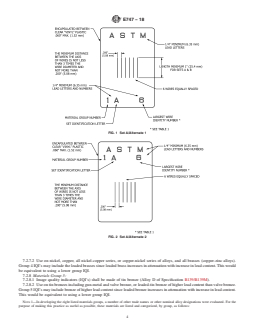
FIG. 1 Set A/Alternate 1
FIG. 2 Set A/Alternate 2
7.2.7.2 Use on nickel, copper, all nickel-copper series, or copper-nickel series of alloys, and all brasses (copper-zinc alloys).
Group 4 IQI’s may include the leaded brasses since leaded brass increases in attenuation with increase in lead content. This would
be equivalent to using a lower group IQI.
7.2.8 Materials Group 5:
7.2.8.1 Image quality indicators (IQI’s) shall be made of tin bronze (Alloy D of Specification B139/B139M).
7.2.8.2 Use on tin bronzes including gun-metal and valve bronze, or leaded-tin bronze of higher lead content than valve bronze.
Group 5 IQI’s may include bronze of higher lead content since leaded bronze increases in attenuation with increase in lead content.
This would be equivalent to using a lower group IQI.
NOTE 1—In developing the eight listed materials groups, a number of other trade names or other nominal alloy designations were evaluated. For the
purpose of making this practice as useful as possible, these materials are listed and categorized, by group, as follows:
E747 − 18
FIG. 3 Set B/Alternate 1
FIG. 4 Set B/Alternate 2
(1) Group 2—Haynes Alloy IN-100.
(1) Group 2—Haynes Alloy IN-100.
(2) Group 3—Haynes Alloy No. 713C, Hastelloy D , G.E. Alloy SEL, Haynes Stellite Alloy No. 21, GMR-235 Alloy, Haynes Alloy No. 93, Inconel
X , Inconel 718, and Haynes Stellite Alloy No. S-816.
(3) Group 4—Hastelloy Alloy F, Hastelloy Alloy X, and Multimeter Alloy Rene 41.
(4) Group 5—Alloys in order of increasing attenuation: Hastelloy Alloy B, Hastelloy Alloy C, Haynes Stellite Alloy No. 31, Thetaloy, Haynes Stellite
No. 3, Haynes Alloy No. 25. Image quality indicators (IQI’s) of any of these materials are considered applicable for the materials that follow it.
(2) Group 3—Haynes Alloy No. 713C, Hastelloy D , G.E. Alloy SEL, Haynes Stellite Alloy No. 21, GMR-235 Alloy, Haynes Alloy No. 93, Inconel
All Haynes alloys are registered trademarks of Union Carbide Corp., New York, NY.
All Hastelloys and Haynes Stellite alloys are registered trademarks of the Cabot Corp., Boston, MA.
E747 − 18
FIG. 5 Set C/Alternate 1
FIG. 6 Set C/Alternate 2
X , Inconel 718, and Haynes Stellite Alloy No. S-816.
(3) Group 4—Hastelloy Alloy F, Hastelloy Alloy X, and Multimeter Alloy Rene 41.
(4) Group 5—Alloys in order of increasing attenuation: Hastelloy Alloy B, Hastelloy Alloy C, Haynes Stellite Alloy No. 31, Thetaloy, Haynes Stellite
No. 3, Haynes Alloy No. 25. Image quality indicators (IQI’s) of any of these materials are considered applicable for the materials that follow it.
NOTE 2—The committee formulating these recommendations recommend other materials may be added to the materials groups listed as the need arises
or as more information is gained, or that additional materials groups may be added.
7.3 Method for Other Materials:
7.3.1 For materials not herein covered, IQI’s of the same materials, or any other material, may be used if the following
requi
...