

ASTM E3253-21
(Practice)Standard Practice for Establishing an Examination Scheme for Intact Explosives
General Information
- Abstract
SIGNIFICANCE AND USE
5.1 This practice is designed to assist the forensic explosives examiner in selecting and organizing an analytical scheme for identifying intact explosives. The amount and condition of the sample, as well as the availability of applicable instrumental techniques, will determine the selected analytical scheme.
5.2 The forensic explosives examiner considers relevant issues about the case investigation and submitted items, such as sample size, complexity and condition, environmental effects, and collection methods used. Considerations include test methods, sample preparation schemes, test sequences, and acceptable degrees of sample alteration and consumption that will be different for each case submission.
5.3 This practice provides the minimum criteria for identifying explosive material. The examiner determines an analytical scheme that uses techniques to correctly identify the material, which could include oxidizers, fuels, binders, and detection agents.
5.4 This practice is used in conjunction with the referenced documents.
5.5 This practice does not attempt to address all the issues regarding sample analyses. There could be additional tests or analyses performed to provide further discrimination and characterization of samples.
SCOPE
1.1 This practice covers the evaluation, selection, and application of techniques to establish examination schemes for use by forensic explosives examiners to identify intact (unexploded) low and high explosives. A foundation for a consistent approach to the analysis of intact explosives is provided. Methods for the development of identifying information that follows an efficient order of testing are described.
1.2 This practice establishes requirements for the use of visual, physical, analytical, and instrumental techniques that provide structural and chemical information for an identification of a high or low explosive material.
1.3 Techniques used in the examination of explosives include visual and microscopical inspection, physical characterization, ignition susceptibility testing, chemical and spot testing, and instrumental methods.
1.4 The minimum requirements for identification of commonly encountered explosives and explosive materials are listed.
1.5 This standard is intended for use by competent forensic science practitioners with the requisite formal education, discipline-specific training (see Practice E2917), and demonstrated proficiency to perform forensic casework (refer to the T/SWGFEX Suggested Guide for Explosives Analysis Training).
1.6 This standard does not purport to address all of the safety concerns, if any, associated with its use. It is the responsibility of the user of this standard to establish appropriate safety, health, and environmental practices and determine the applicability of regulatory limitations prior to use.
1.7 This international standard was developed in accordance with internationally recognized principles on standardization established in the Decision on Principles for the Development of International Standards, Guides and Recommendations issued by the World Trade Organization Technical Barriers to Trade (TBT) Committee.
- Status
- Published
- Publication Date
- 31-Oct-2021
- Technical Committee
- E30 - Forensic Sciences
- Drafting Committee
- E30.01 - Criminalistics
Overview
ASTM E3253-21: Standard Practice for Establishing an Examination Scheme for Intact Explosives is an international standard developed by ASTM to guide forensic explosives examiners in selecting and organizing analytical schemes for identifying intact (unexploded) low and high explosives. The standard outlines minimum requirements and systematic approaches for examination, ensuring reliable identification through a combination of visual, physical, analytical, and instrumental techniques. With a focus on forensic science best practices, ASTM E3253-21 supports consistent, defensible analyses in criminal and civil investigations involving explosive materials.
Key Topics
Examination Scheme Selection
Examiners are offered guidance to select suitable analytical procedures based on sample size, condition, complexity, environmental factors, and available instrumentation. The consideration of each case’s unique aspects is emphasized to ensure optimal results.Analytical Techniques
A diversity of techniques are listed and described, such as:- Macroscopical and microscopical examination
- Ignition susceptibility testing
- Chemical spot testing
- Polarized light microscopy
- Chromatographic and spectroscopic methods (e.g., FTIR, Raman, GC-MS, LC-MS)
- X-ray identification methods (SEM-EDS, XRF, XRD)
Documentation and Reporting
The standard mandates comprehensive documentation of each step in the examination and identification process, with sufficient detail to enable independent review. Reporting should adhere to established forensic science documentation practices.Minimum Identification Requirements
ASTM E3253-21 specifies the minimum analytical approaches needed to identify commonly encountered explosives, including black powder, smokeless powder, plastic bonded explosives, dynamite, and pyrotechnic mixtures.Safety and Quality Assurance
Users must ensure appropriate safety, health, and environmental precautions, referencing specific training and regulatory compliance. The standard complements other ASTM practices concerning quality assurance in forensic analyses.
Applications
Forensic Investigations
The standard is primarily designed for use by forensic science practitioners in criminalistics and explosive analysis. It provides a structured decision framework to analyze intact explosives found at crime scenes, in suspicious packages, or during post-blast investigations.Quality Control in Laboratories
Forensic laboratories use ASTM E3253-21 to ensure quality and consistency across examiners and cases. By adhering to a common set of minimum and best practices, labs can provide defensible, repeatable, and objective results in legal proceedings involving explosives.Training and Competency
The document serves as a foundational reference for the education and training of forensic explosives examiners, requiring practitioners to have proper discipline-specific training and proof of proficiency as outlined in related standards.Legal and Regulatory Compliance
Adherence to ASTM E3253-21 can demonstrate compliance with national and international expectations for forensic laboratory operations, especially in support of litigation or regulatory investigations concerning explosives.
Related Standards
- ASTM E2917 - Practice for Forensic Science Practitioner Training, Continuing Education, and Professional Development Programs
- ASTM E860 - Practice for Examining and Preparing Items that Are or May Become Involved in Criminal or Civil Litigation
- ASTM E2998 & E2999 - Practice and Test Methods for the Analysis and Characterization of Smokeless Powder
- ASTM E620 - Practice for Reporting Opinions of Scientific or Technical Experts
- ASTM E3196 - Terminology Relating to the Examination of Explosives
- ASTM E3255 - Practice for Quality Assurance of Forensic Science Service Providers Performing Forensic Chemical Analysis
Practical Value
ASTM E3253-21 is an essential resource for forensic laboratories and practitioners involved in explosives analysis. Its structured guidance ensures examinations are scientifically robust, tailored for each case, and meet international expectations. By leveraging the systematic approach outlined in this standard, organizations enhance their credibility, reduce examination errors, and strengthen the evidentiary value of explosive identification in the justice system.
Keywords: ASTM E3253-21, explosives analysis, forensic science, intact explosives examination, standards for explosives, forensic explosive identification, laboratory best practices, quality assurance, analytical scheme, explosive material identification.
Relations
- Effective Date
- 01-Feb-2024
- Effective Date
- 01-Feb-2024
- Effective Date
- 15-Feb-2019
- Effective Date
- 15-Jan-2019
- Effective Date
- 01-Nov-2018
- Effective Date
- 01-Jun-2018
- Effective Date
- 15-May-2018
- Effective Date
- 01-Sep-2017
- Effective Date
- 01-Jun-2013
- Effective Date
- 01-Jun-2013
- Effective Date
- 15-Jun-2012
- Effective Date
- 01-Oct-2011
- Effective Date
- 01-Oct-2011
- Effective Date
- 01-Jun-2011
- Effective Date
- 01-May-2011
Get Certified
Connect with accredited certification bodies for this standard

ECOCERT
Organic and sustainability certification.

Eurofins Food Testing Global
Global leader in food, environment, and pharmaceutical product testing.

Intertek Bangladesh
Intertek certification and testing services in Bangladesh.
Sponsored listings
Frequently Asked Questions
ASTM E3253-21 is a standard published by ASTM International. Its full title is "Standard Practice for Establishing an Examination Scheme for Intact Explosives". This standard covers: SIGNIFICANCE AND USE 5.1 This practice is designed to assist the forensic explosives examiner in selecting and organizing an analytical scheme for identifying intact explosives. The amount and condition of the sample, as well as the availability of applicable instrumental techniques, will determine the selected analytical scheme. 5.2 The forensic explosives examiner considers relevant issues about the case investigation and submitted items, such as sample size, complexity and condition, environmental effects, and collection methods used. Considerations include test methods, sample preparation schemes, test sequences, and acceptable degrees of sample alteration and consumption that will be different for each case submission. 5.3 This practice provides the minimum criteria for identifying explosive material. The examiner determines an analytical scheme that uses techniques to correctly identify the material, which could include oxidizers, fuels, binders, and detection agents. 5.4 This practice is used in conjunction with the referenced documents. 5.5 This practice does not attempt to address all the issues regarding sample analyses. There could be additional tests or analyses performed to provide further discrimination and characterization of samples. SCOPE 1.1 This practice covers the evaluation, selection, and application of techniques to establish examination schemes for use by forensic explosives examiners to identify intact (unexploded) low and high explosives. A foundation for a consistent approach to the analysis of intact explosives is provided. Methods for the development of identifying information that follows an efficient order of testing are described. 1.2 This practice establishes requirements for the use of visual, physical, analytical, and instrumental techniques that provide structural and chemical information for an identification of a high or low explosive material. 1.3 Techniques used in the examination of explosives include visual and microscopical inspection, physical characterization, ignition susceptibility testing, chemical and spot testing, and instrumental methods. 1.4 The minimum requirements for identification of commonly encountered explosives and explosive materials are listed. 1.5 This standard is intended for use by competent forensic science practitioners with the requisite formal education, discipline-specific training (see Practice E2917), and demonstrated proficiency to perform forensic casework (refer to the T/SWGFEX Suggested Guide for Explosives Analysis Training). 1.6 This standard does not purport to address all of the safety concerns, if any, associated with its use. It is the responsibility of the user of this standard to establish appropriate safety, health, and environmental practices and determine the applicability of regulatory limitations prior to use. 1.7 This international standard was developed in accordance with internationally recognized principles on standardization established in the Decision on Principles for the Development of International Standards, Guides and Recommendations issued by the World Trade Organization Technical Barriers to Trade (TBT) Committee.
SIGNIFICANCE AND USE 5.1 This practice is designed to assist the forensic explosives examiner in selecting and organizing an analytical scheme for identifying intact explosives. The amount and condition of the sample, as well as the availability of applicable instrumental techniques, will determine the selected analytical scheme. 5.2 The forensic explosives examiner considers relevant issues about the case investigation and submitted items, such as sample size, complexity and condition, environmental effects, and collection methods used. Considerations include test methods, sample preparation schemes, test sequences, and acceptable degrees of sample alteration and consumption that will be different for each case submission. 5.3 This practice provides the minimum criteria for identifying explosive material. The examiner determines an analytical scheme that uses techniques to correctly identify the material, which could include oxidizers, fuels, binders, and detection agents. 5.4 This practice is used in conjunction with the referenced documents. 5.5 This practice does not attempt to address all the issues regarding sample analyses. There could be additional tests or analyses performed to provide further discrimination and characterization of samples. SCOPE 1.1 This practice covers the evaluation, selection, and application of techniques to establish examination schemes for use by forensic explosives examiners to identify intact (unexploded) low and high explosives. A foundation for a consistent approach to the analysis of intact explosives is provided. Methods for the development of identifying information that follows an efficient order of testing are described. 1.2 This practice establishes requirements for the use of visual, physical, analytical, and instrumental techniques that provide structural and chemical information for an identification of a high or low explosive material. 1.3 Techniques used in the examination of explosives include visual and microscopical inspection, physical characterization, ignition susceptibility testing, chemical and spot testing, and instrumental methods. 1.4 The minimum requirements for identification of commonly encountered explosives and explosive materials are listed. 1.5 This standard is intended for use by competent forensic science practitioners with the requisite formal education, discipline-specific training (see Practice E2917), and demonstrated proficiency to perform forensic casework (refer to the T/SWGFEX Suggested Guide for Explosives Analysis Training). 1.6 This standard does not purport to address all of the safety concerns, if any, associated with its use. It is the responsibility of the user of this standard to establish appropriate safety, health, and environmental practices and determine the applicability of regulatory limitations prior to use. 1.7 This international standard was developed in accordance with internationally recognized principles on standardization established in the Decision on Principles for the Development of International Standards, Guides and Recommendations issued by the World Trade Organization Technical Barriers to Trade (TBT) Committee.
ASTM E3253-21 is classified under the following ICS (International Classification for Standards) categories: 71.100.30 - Explosives. Pyrotechnics and fireworks. The ICS classification helps identify the subject area and facilitates finding related standards.
ASTM E3253-21 has the following relationships with other standards: It is inter standard links to ASTM E2917-24, ASTM E1732-24, ASTM E2917-19, ASTM E1732-19, ASTM E1732-18b, ASTM E1732-18a, ASTM E1732-18, ASTM E1732-17, ASTM E860-07(2013)e1, ASTM E860-07(2013), ASTM E1732-12, ASTM E1732-11a, ASTM E1732-11b, ASTM E1732-11, ASTM E620-11. Understanding these relationships helps ensure you are using the most current and applicable version of the standard.
ASTM E3253-21 is available in PDF format for immediate download after purchase. The document can be added to your cart and obtained through the secure checkout process. Digital delivery ensures instant access to the complete standard document.
Standards Content (Sample)
This international standard was developed in accordance with internationally recognized principles on standardization established in the Decision on Principles for the
Development of International Standards, Guides and Recommendations issued by the World Trade Organization Technical Barriers to Trade (TBT) Committee.
Designation: E3253 − 21 An American National Standard
Standard Practice for
Establishing an Examination Scheme for Intact Explosives
This standard is issued under the fixed designation E3253; the number immediately following the designation indicates the year of
original adoption or, in the case of revision, the year of last revision. A number in parentheses indicates the year of last reapproval. A
superscript epsilon (´) indicates an editorial change since the last revision or reapproval.
1. Scope 2. Referenced Documents
2.1 ASTM Standards:
1.1 This practice covers the evaluation, selection, and ap-
E620 Practice for Reporting Opinions of Scientific or Tech-
plication of techniques to establish examination schemes for
nical Experts
use by forensic explosives examiners to identify intact (unex-
E860 Practice for Examining And Preparing Items That Are
ploded) low and high explosives.Afoundation for a consistent
Or May Become Involved In Criminal or Civil Litigation
approach to the analysis of intact explosives is provided.
E1732 Terminology Relating to Forensic Science
Methods for the development of identifying information that
E2917 Practice for Forensic Science Practitioner Training,
follows an efficient order of testing are described.
Continuing Education, and Professional Development
1.2 This practice establishes requirements for the use of
Programs
visual, physical, analytical, and instrumental techniques that
E2998 Practice for Characterization and Classification of
provide structural and chemical information for an identifica-
Smokeless Powder
tion of a high or low explosive material.
E2999 Test Method for Analysis of Organic Compounds in
1.3 Techniques used in the examination of explosives in- Smokeless Powder by Gas Chromatography-Mass Spec-
clude visual and microscopical inspection, physical
trometry and Fourier Transform Infrared Spectroscopy
characterization, ignition susceptibility testing, chemical and E3196 Terminology Relating to the Examination of Explo-
spot testing, and instrumental methods.
sives
E3255 Practice for Quality Assurance of Forensic Science
1.4 The minimum requirements for identification of com-
Service Providers Performing Forensic ChemicalAnalysis
monly encountered explosives and explosive materials are
2.2 Other Resources:
listed.
Technical/Scientific Working Group for Fire and Explosion
1.5 This standard is intended for use by competent forensic
Analysis (T/SWGFEX) Suggested Guide for Explosive
science practitioners with the requisite formal education,
Analysis Training
discipline-specific training (see Practice E2917), and demon-
3. Terminology
strated proficiency to perform forensic casework (refer to the
T/SWGFEX Suggested Guide for Explosives Analysis Train-
3.1 Definitions—For definitions of terms used in this stan-
ing).
dard other than those listed in 3.2, see Terminology E1732 and
Terminology E3196.
1.6 This standard does not purport to address all of the
safety concerns, if any, associated with its use. It is the
3.2 Definitions of Terms Specific to This Standard:
responsibility of the user of this standard to establish appro-
3.2.1 detection, n—an analytical signal from a recognized
priate safety, health, and environmental practices and deter-
analyte was generated and can be tentatively identified (1).
mine the applicability of regulatory limitations prior to use.
3.2.2 identification, n—assigning an analyte (analytical sig-
1.7 This international standard was developed in accor-
nal) to one of the set of known individual chemical compounds
dance with internationally recognized principles on standard-
or to a group/class of compounds.
ization established in the Decision on Principles for the
Development of International Standards, Guides and Recom-
For referenced ASTM standards, visit the ASTM website, www.astm.org, or
mendations issued by the World Trade Organization Technical
contact ASTM Customer Service at service@astm.org. For Annual Book of ASTM
Barriers to Trade (TBT) Committee.
Standards volume information, refer to the standard’s Document Summary page on
the ASTM website.
Available from National Institute of Standards and Technology (NIST), 100
Bureau Dr., Stop 1070, Gaithersburg, MD 20899-1070, https://www.nist.gov/
This practice is under the jurisdiction of ASTM Committee E30 on Forensic system/files/documents/2018/09/21/twgfex_suggest_guide_for_explosive_analysis
Sciences and is the direct responsibility of Subcommittee E30.01 on Criminalistics. _training.pdf.
Current edition approved Nov. 1, 2021. Published December 2021. DOI: The boldface numbers in parentheses refer to the list of references at the end of
10.1520/E3253-21. this standard.
Copyright © ASTM International, 100 Barr Harbor Drive, PO Box C700, West Conshohocken, PA 19428-2959. United States
E3253 − 21
3.2.2.1 Discussion—Identification of individual compounds analyses performed to provide further discrimination and
can be required to identify an analyzed sample as one of a characterization of samples.
definite kind/type/grade/brand of products, material
6. Analytical Scheme for Examination of Intact
compositions, formulations, etc. (1).
Explosives
3.2.3 ignition susceptibility test, IST, n—a qualitative and
6.1 The identification of an intact explosive is accomplished
destructive test in which a small amount of sample is exposed
by a variety of analytical techniques (2-5). A combination of
to a flame or heat.
multiple techniques and methodologies that provides structural
3.2.3.1 Discussion—Determining the reactivity of the
and chemical information about an explosive, could be re-
sample is useful in terms of initial characterization and safe
quired to make an identification. The examiner shall be
handling.
familiarwiththelimitationsandapplicabilityofeachtechnique
3.2.4 intact explosive, n—an explosive that has not under-
used (refer to T/SWGFEX Suggested Guide for Explosives
gone decomposition due to deflagration or detonation and
Analysis Training).
generally has a discernible morphology.
6.2 Some of the techniques listed below can alter or destroy
3.2.4.1 Discussion—Intact explosives can be present in
the sample. For example, an ignition susceptibility test (6.6)
large (grams) or small (single particle) quantities. Post-blast
consumes the material, solvent extraction alters the
explosive residues can contain both combustion products and
composition, and grinding a sample for X-ray powder diffrac-
intact explosive material.
tion (6.13) changes particle morphology. A portion of the
original sample should be preserved for potential future exami-
4. Summary of Practice
nation; however, preservation will depend on the submitted
sample size, sample preparation and analytical techniques
4.1 Multiple techniques and methods are used in the iden-
used.
tification of explosives.
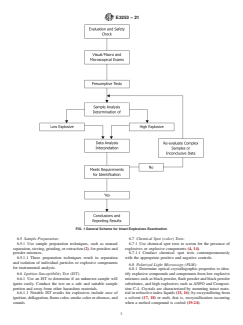
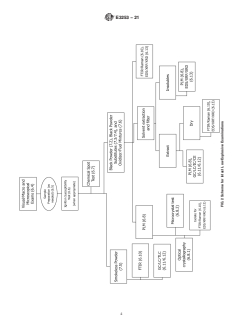
6.3 Areview of the general technique descriptions, listed in
4.2 Examination of suspected explosives starts with macro-
6.4 – 6.13 and outlined in Fig. 1, provides guidance for the
scopical and microscopical observations and, when
selection of appropriate methods. More detailed schemes for
appropriate, an ignition susceptibility test (IST). The interpre-
theexaminationofintactexplosivesareoutlinedinFig.2(Low
tation of these initial tests requires that the examiner has a
Explosives) and Fig. 3 (High Explosives). The major steps in
working knowledge of explosives. While characteristics ob-
Fig.2andFig.3arenumberedtocorrespondtothediscussions
served by visual examination and IST results can indicate an
presented in this standard (for example 6.6, Ignition Suscepti-
explosive, it is necessary to use additional analytical tech-
bility Test and 7.2, Black Powder). If limited sample is
niques to identify the suspected explosive compound or its key
available, use an analytical scheme that yields the most
components.
information and consumes the least amount of sample. Fig. 2
and Fig. 3 do not imply that other examinations should be
5. Significance and Use
excluded or that the order of the procedures in the figures is
5.1 This practice is designed to assist the forensic explo-
predetermined.
sives examiner in selecting and organizing an analytical
6.4 Visual/Macro and Microscopical Exams:
scheme for identifying intact explosives. The amount and
6.4.1 Begin with a review of the information submitted with
conditionofthesample,aswellastheavailabilityofapplicable
the evidence, including the condition of the packaging and
instrumental techniques, will determine the selected analytical
labeling, and document any potential for cross-contamination
scheme.
between samples.
5.2 The forensic explosives examiner considers relevant
6.4.1.1 Record any potential for cross-contamination or
issuesaboutthecaseinvestigationandsubmitteditems,suchas
discrepancies and take this into account in the final evaluation
sample size, complexity and condition, environmental effects,
of the analytical data.
and collection methods used. Considerations include test
6.4.2 Conduct a visual and stereo microscopical assessment
methods, sample preparation schemes, test sequences, and
of each item, prior to when the packaging permits, and after
acceptable degrees of sample alteration and consumption that
opening the evidence packaging. Provide a written description
will be different for each case submission.
of the general condition, size, shape, and color of each sample
and photograph when possible.
5.3 This practice provides the minimum criteria for identi-
6.4.2.1 This preliminary assessment provides information
fying explosive material. The examiner determines an analyti-
for the selection of an analytical scheme and can identify
cal scheme that uses techniques to correctly identify the
complexities in the review of analytical data obtained.
material, which could include oxidizers, fuels, binders, and
6.4.3 The processing of intact explosives should be sepa-
detection agents.
rated in space from residue evidence samples to prevent
5.4 This practice is used in conjunction with the referenced
incidental contamination. If space does not allow for this, then
documents.
process intact explosives and residue evidence separately by
5.5 This practice does not attempt to address all the issues time. Ensure appropriate precautions are in place to prevent
regarding sample analyses. There could be additional tests or contamination (6-13).
E3253 − 21
FIG. 1 General Scheme for Intact Explosives Examination
6.5 Sample Preparation: 6.7 Chemical Spot (color) Tests:
6.5.1 Use sample preparation techniques, such as manual 6.7.1 Use chemical spot tests to screen for the presence of
separation,sieving,grinding,orextraction (2),forpowdersand explosives or explosive components (4, 14).
powder mixtures. 6.7.1.1 Conduct chemical spot tests contemporaneously
6.5.1.1 These preparation techniques result in separation with the appropriate positive and negative controls.
and isolation of individual particles or explosive components
6.8 Polarized Light Microscopy (PLM):
for instrumental analysis.
6.8.1 Determine optical crystallographic properties to iden-
6.6 Ignition Susceptibility Test (IST): tify explosive compounds and components from low explosive
6.6.1 Use an IST to determine if an unknown sample will mixtures such as black powder, flash powder and black powder
ignite easily. Conduct the test on a safe and suitable sample substitutes, and high explosives such as ANFO and Composi-
portion and away from other hazardous materials. tion C-4. Crystals are characterized by mounting intact mate-
6.6.1.1 Notable IST results for explosives include ease of rial in refractive index liquids (15, 16); by recrystallizing from
ignition, deflagration, flame color, smoke color or absence, and a solvent (17, 18) or melt, that is, recrystallization occurring
sounds. when a melted compound is cooled (19-24).
E3253 − 21
FIG. 2 Scheme for Intact Low Explosive Examinations
E3253 − 21
FIG. 3 Scheme for Intact High Explosive Examinations
E3253 − 21
6.8.2 Usemicrocrystalteststoidentifyanionsandcationsof those composed of elements with relatively low atomic
oxidizers and metals (25-28). number, based on known elemental peak energies.
6.8.3 Use PLM to identify and isolate particles of interest
6.13.2 X-ray fluorescence (XRF) can be used to identify the
for other instrumental techniques (15). elemental composition of compounds, particularly those com-
posed of elements with relatively high atomic number, based
6.9 Instrumental Techniques:
upon known elemental peak energies.
6.9.1 Most of the analytical instruments found in forensic
6.13.3 X-ray diffraction (XRD) can be used to identify
laboratories lend themselves to the detection and identification
crystalline components.
of explosives and explosives-related compounds. Use the
following techniques to detect or identify explosives com-
7. Analytical Requirements for Identification
pounds and other components of explosives including, fuels,
binders, or detection agents (29).
7.1 The following sections list explosives or categories of
6.9.2 For chromatographic techniques (6.11, 6.12), compare
explosive materials and the minimum analytical requirements
the retention time (or retention factor for thin layer chroma-
for chemical identification (2, 36). Each section identifies an
tography) and mass spectra (if appropriate) to a reference
explosive or category of explosive materials, and the accept-
material analyzed under the same conditions.
able analytical technique or combination of techniques re-
6.9.2.1 Confirm chromatography detection results using an
quired to make a chemical identification.
additional separation technique with a different column or
7.2 Black Powder:
another technique, which is based on different principles and
7.2.1 The minimum requirements for identification are:
methodologies.
physical characteristics, IST (if sufficient sample), identifica-
6.9.3 Comparisontoareferencematerialisalsorequiredfor
tion of potassium nitrate (or sodium nitrate) and sulfur, and
identification when using Fourier transform infrared spectros-
characterization of charcoal (if appropriate).
copy (6.10), Raman spectroscopy (6.10), and X-ray diffraction
7.2.2 Identification of potassium nitrate (or sodium nitrate):
(6.13.3).
7.2.2.1 XRD or
6.10 Spectroscopy Identification:
7.2.2.2 FTIR or Raman and either SEM-EDS, XRF or PLM
6.10.1 Fourier transform infrared (FTIR) spectroscopy and
(using at least one of the following: optical crystallography or
Raman spectroscopy can be used to identify many organic and
microcrystal tests for anion and cation), or
inorganic explosive compounds (4, 5, 30).
7.2.2.3 Anion and cation analysis by IC and CE, or IC and
CE in combination with elemental analysis such as XRF or
6.11 Chromatography Identification:
SEM-EDS, or
6.11.1 Agas chromatograph coupled to a mass spectrometer
can be used for the identification of organic compounds (31, 7.2.2.4 PLM using a combination of optical crystallography
and microcrystal tests for the anion and cation.
32).
6.11.2 Aliquid chromatograph coupled to a mass spectrom- 7.2.2.5 Chemical spot tests can be used presumptively in
conjunction with the techniques listed above but are insuffi-
eter can be used for the identification of organic compounds
(33, 34). cient for unique identification.
6.11.3 An ion chromatograph coupled to a mass spectrom- 7.2.3 Identification of elemental sulfur:
eter can be used for the identification of ionic organic and 7.2.3.1 XRD, Raman, or GC-MS of an extract or
inorganic compounds. 7.2.3.2 PLM (optical crystallography, recrystallization) and
either SEM-EDS or XRF, or
6.12 Chromatography Detection:
7.2.3.3 SulfurchemicalspottestandeitherSEM-EDS,XRF
6.12.1 A gas chromatograph coupled to an electron capture
or PLM (optical crystallography).
(ECD), or chemiluminescence (also known as the thermal
7.2.4 Characterization of charcoal:
energy analyzer [TEA]) detector can be used for the detection
7.2.4.1 SEM-EDS (cellular structure and elemental carbon)
of organic compounds.
or PLM.
6.12.2 A liquid chromatograph coupled to an ultraviolet
7.2.4.2 The characterization of charcoal in commercial
(UV) detector or diode array detector (DAD) can be used for
black powder samples is optional.
the detection of organic compounds.
5 6
6.12.3 An ion chromatograph coupled to a conduc
...