

ASTM E3196-21
(Terminology)Standard Terminology Relating to the Examination of Explosives
General Information
- Abstract
SIGNIFICANCE AND USE
3.1 These terms have particular application to explosives analysis. In addition, several sources of definitions were used in the development of this terminology: Hawley’s Condensed Chemical Dictionary, Sixteenth Edition (1);3 Practical Bomb Scene Investigation, Third Edition (2); Forensic Investigation of Explosions (3); Chemistry of Pyrotechnics, Third Edition (4); Explosives, Seventh Completely Revised and Updated Edition (5); Dictionary of Explosions & Explosives (6); PICATINNY Encyclopedia of Explosives and Related Items (7, 8); Merriam-Webster.com Dictionary (9); and DOD Dictionary of Military and Associated Terms (10). A suitable definition was developed after all of the sources were found wanting.
SCOPE
1.1 This is a compilation of terms and corresponding definitions related to the analysis of explosives. Legal or scientific terms that are generally understood or defined adequately in other readily available sources may not be included.
1.2 The values stated in SI units are to be regarded as standard. No other units of measurement are included in this standard.
1.3 This international standard was developed in accordance with internationally recognized principles on standardization established in the Decision on Principles for the Development of International Standards, Guides and Recommendations issued by the World Trade Organization Technical Barriers to Trade (TBT) Committee.
- Status
- Published
- Publication Date
- 30-Sep-2021
- Technical Committee
- E30 - Forensic Sciences
- Drafting Committee
- E30.01 - Criminalistics
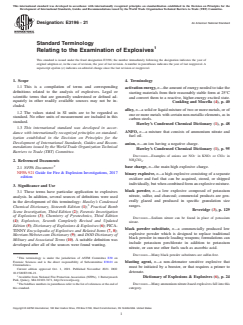
Overview
ASTM E3196-21: Standard Terminology Relating to the Examination of Explosives is an essential international standard published by ASTM International. This document provides a comprehensive glossary of terms and definitions used in the analysis of explosives, supporting professionals in forensic science, explosives investigation, and related disciplines. Developed in line with globally accepted principles under the World Trade Organization (WTO) guidelines, ASTM E3196-21 ensures clarity and consistency in the communication and reporting of explosives-related examinations.
Key Topics
The core value of ASTM E3196-21 lies in its authoritative compilation of terminology related specifically to the examination and analysis of explosives. Key areas covered include:
- Definitions of Explosive Materials: Clear, standardized descriptions of explosives, such as high explosives, low explosives, primary and secondary explosives, and plastic explosives.
- Components and Devices: Terms relating to the components of explosive devices (e.g., detonators, initiators, boosters, blasting caps, fuses, and primers).
- Chemical Compounds and Reactions: Definitions of chemical concepts essential to explosives investigation, such as activation energy, catalysts, oxidation, chain reactions, and energetic materials.
- Technology and Safety: Terminology associated with forensic examination, detection methods, and safety procedures during the investigation of explosive substances or events.
- Specialized Concepts: Explanations of unique industry terms like brisance, deflagration, detonation, shrapnel, taggant, and Munroe Effect.
The document is based on terminology from well-regarded sources, including Hawley’s Condensed Chemical Dictionary, the Dictionary of Explosions & Explosives, and various technical handbooks on forensic and explosive science.
Applications
ASTM E3196-21 delivers practical benefits for a wide array of professionals and organizations, including:
- Forensic Laboratories: Supports consistency and accuracy in forensic explosives analysis, aiding report writing, testimony, and inter-laboratory communication.
- Law Enforcement and Homeland Security: Provides reliable reference terminology for incident investigation, reporting, and evidence documentation.
- Explosives and Bomb Technicians: Facilitates common understanding among field responders, ensuring alignment in training, operations, and case management.
- Military and Defense: Offers standardized terminology for ordnance disposal, training documentation, and technical manuals concerning explosives and munitions.
- Regulatory and Compliance Bodies: Assists in the development of policies, regulatory documents, and guidelines that refer to the handling and examination of explosives.
- Academic and Training Institutions: Serves as an authoritative source for curriculum development and professional training in explosives analysis and related forensic sciences.
ASTM E3196-21 also underpins the use of SI units exclusively, ensuring uniformity in scientific communication.
Related Standards
For comprehensive coverage of explosives analysis, users may also refer to these related standards and guidelines:
- NFPA 921: Guide for Fire & Explosion Investigations, providing procedures and methodologies for analyzing explosion and fire scenes.
- ASTM E2451: Standard Practice for Preserving Explosives Evidence from the Scene of an Incident.
- ASTM E1588: Standard Guide for Gunshot Residue Analysis by Scanning Electron Microscopy/Energy Dispersive X-ray Spectrometry.
- ISO/IEC 17025: General requirements for the competence of testing and calibration laboratories.
- DOD Dictionary of Military and Associated Terms: A comprehensive glossary used in US Department of Defense documentation.
Conclusion
ASTM E3196-21 is a critical resource for professionals engaged in the examination, investigation, and analysis of explosives. By establishing precise and consistent terminology, it enhances communication, improves the reliability of forensic results, and supports operational safety and regulatory compliance in the handling of explosives. For anyone involved in explosives forensics or security, adhering to the terminology specified in this standard is essential for effective practice and collaboration.
Get Certified
Connect with accredited certification bodies for this standard

ECOCERT
Organic and sustainability certification.

Eurofins Food Testing Global
Global leader in food, environment, and pharmaceutical product testing.

Intertek Bangladesh
Intertek certification and testing services in Bangladesh.
Sponsored listings
Frequently Asked Questions
ASTM E3196-21 is a standard published by ASTM International. Its full title is "Standard Terminology Relating to the Examination of Explosives". This standard covers: SIGNIFICANCE AND USE 3.1 These terms have particular application to explosives analysis. In addition, several sources of definitions were used in the development of this terminology: Hawley’s Condensed Chemical Dictionary, Sixteenth Edition (1);3 Practical Bomb Scene Investigation, Third Edition (2); Forensic Investigation of Explosions (3); Chemistry of Pyrotechnics, Third Edition (4); Explosives, Seventh Completely Revised and Updated Edition (5); Dictionary of Explosions & Explosives (6); PICATINNY Encyclopedia of Explosives and Related Items (7, 8); Merriam-Webster.com Dictionary (9); and DOD Dictionary of Military and Associated Terms (10). A suitable definition was developed after all of the sources were found wanting. SCOPE 1.1 This is a compilation of terms and corresponding definitions related to the analysis of explosives. Legal or scientific terms that are generally understood or defined adequately in other readily available sources may not be included. 1.2 The values stated in SI units are to be regarded as standard. No other units of measurement are included in this standard. 1.3 This international standard was developed in accordance with internationally recognized principles on standardization established in the Decision on Principles for the Development of International Standards, Guides and Recommendations issued by the World Trade Organization Technical Barriers to Trade (TBT) Committee.
SIGNIFICANCE AND USE 3.1 These terms have particular application to explosives analysis. In addition, several sources of definitions were used in the development of this terminology: Hawley’s Condensed Chemical Dictionary, Sixteenth Edition (1);3 Practical Bomb Scene Investigation, Third Edition (2); Forensic Investigation of Explosions (3); Chemistry of Pyrotechnics, Third Edition (4); Explosives, Seventh Completely Revised and Updated Edition (5); Dictionary of Explosions & Explosives (6); PICATINNY Encyclopedia of Explosives and Related Items (7, 8); Merriam-Webster.com Dictionary (9); and DOD Dictionary of Military and Associated Terms (10). A suitable definition was developed after all of the sources were found wanting. SCOPE 1.1 This is a compilation of terms and corresponding definitions related to the analysis of explosives. Legal or scientific terms that are generally understood or defined adequately in other readily available sources may not be included. 1.2 The values stated in SI units are to be regarded as standard. No other units of measurement are included in this standard. 1.3 This international standard was developed in accordance with internationally recognized principles on standardization established in the Decision on Principles for the Development of International Standards, Guides and Recommendations issued by the World Trade Organization Technical Barriers to Trade (TBT) Committee.
ASTM E3196-21 is classified under the following ICS (International Classification for Standards) categories: 71.100.30 - Explosives. Pyrotechnics and fireworks. The ICS classification helps identify the subject area and facilitates finding related standards.
ASTM E3196-21 is available in PDF format for immediate download after purchase. The document can be added to your cart and obtained through the secure checkout process. Digital delivery ensures instant access to the complete standard document.
Standards Content (Sample)
This international standard was developed in accordance with internationally recognized principles on standardization established in the Decision on Principles for the
Development of International Standards, Guides and Recommendations issued by the World Trade Organization Technical Barriers to Trade (TBT) Committee.
Designation: E3196 − 21 An American National Standard
Standard Terminology
Relating to the Examination of Explosives
This standard is issued under the fixed designation E3196; the number immediately following the designation indicates the year of
original adoption or, in the case of revision, the year of last revision. A number in parentheses indicates the year of last reapproval. A
superscript epsilon (´) indicates an editorial change since the last revision or reapproval.
1. Scope 4. Terminology
1.1 This is a compilation of terms and corresponding
activation energy,n—the amount of energy needed to take the
definitions related to the analysis of explosives. Legal or
starting materials from their reasonably stable form at 25°C
scientific terms that are generally understood or defined ad-
and convert them to a reactive, higher-energy excited state.
equately in other readily available sources may not be in-
Conkling and Mocella (4), p. 40
cluded.
alloy, n—a solid or liquid mixture of two or more metals, or of
1.2 The values stated in SI units are to be regarded as
one or more metals with certain non-metallic elements, as in
standard. No other units of measurement are included in this
carbon steels.
standard.
Hawley’s Condensed Chemical Dictionary (1), p. 48
1.3 This international standard was developed in accor-
ANFO, n—a mixture that consists of ammonium nitrate and
dance with internationally recognized principles on standard-
fuel oil.
ization established in the Decision on Principles for the
Development of International Standards, Guides and Recom-
anion, n—an ion having a negative charge.
mendations issued by the World Trade Organization Technical
Hawley’s Condensed Chemical Dictionary (1), p. 95
Barriers to Trade (TBT) Committee.
- -
DISCUSSION—Examples of anions are NO in KNO or ClO in
3 3 4
NH ClO .
4 4
2. Referenced Documents
base charge, n—the main high explosive charge.
2.1 NFPA Document:
NFPA 921 Guide for Fire & Explosion Investigations, 2017
binary explosive, n—a high explosive consisting of a separate
edition
oxidizer and fuel that can be acquired, stored, or shipped
individually, but when combined form an explosive mixture.
3. Significance and Use
black powder, n—a low explosive composed of potassium
3.1 These terms have particular application to explosives
nitrate, sulfur, and charcoal; commercial products are gen-
analysis. In addition, several sources of definitions were used
erally glazed and produced in specific granulation size
in the development of this terminology: Hawley’s Condensed
ranges.
Chemical Dictionary, Sixteenth Edition (1); Practical Bomb
Beveridge (3), p. 129
Scene Investigation, Third Edition (2); Forensic Investigation
of Explosions (3); Chemistry of Pyrotechnics, Third Edition
DISCUSSION—Sodium nitrate can be found in place of potassium
(4); Explosives, Seventh Completely Revised and Updated
nitrate.
Edition (5); Dictionary of Explosions & Explosives (6); PICA-
black powder substitute, n—a commercially produced low
TINNY Encyclopedia of Explosives and Related Items (7, 8);
explosive powder which is designed to replace traditional
Merriam-Webster.com Dictionary (9); and DOD Dictionary of
black powder in muzzle loading weapons; formulations can
Military and Associated Terms (10). A suitable definition was
include potassium perchlorate in addition to potassium
developed after all of the sources were found wanting.
nitrate, or can use other fuels such as ascorbic acid.
DISCUSSION—Many black powder substitutes are sulfur-free.
This terminology is under the jurisdiction of ASTM Committee E30 on
Forensic Sciences and is the direct responsibility of Subcommittee E30.01 on
blasting agent, n—a non-detonator sensitive explosive that
Criminalistics.
must be initiated by a booster, or that requires a primer to
Current edition approved Oct. 1, 2021. Published November 2021. DOI:
detonate.
10.1520/E3196-21.
Available from National Fire Protection Association (NFPA), 1 Batterymarch Dictionary of Explosions & Explosives (6), p. 24
Park, Quincy, MA 02169-7471, http://www.nfpa.org.
DISCUSSION—Many ammonium nitrate-based explosives fall into this
The boldface numbers in parentheses refer to the list of references at the end of
this standard. category.
Copyright © ASTM International, 100 Barr Harbor Drive, PO Box C700, West Conshohocken, PA 19428-2959. United States
E3196 − 21
blasting cap, n—a cylindrical shell, usually of metal, contain- deflagration, n—propagation of a combustion zone at a
ing both a primary high explosive and a secondary high velocity that is less than the speed of sound in the unreacted
explosive, which is used to initiate other explosives; also medium. NFPA 921 3.3.43
known as a detonator or cap.
detection agent, n—a chemical marker added to plastic explo-
bomb, n—an explosive device, usually some kind of container sives to aid in detection by either instrumental or canine
filled with explosive, incendiary material, gas, or other screening; also known as detection taggant.
destructive substance, designed to cause damage by way of
DISCUSSION—Detection agents include DMDNB,
thermal, blast, or fragmentation effects on impact or when
o-mononitrotoluene, p-mononitrotoluene, and EGDN.
detonated by a time mechanism, switch, remote control
detonation, n—propagation of a reaction zone at a velocity
device, electric match, or lit fuse.
that is greater than the speed of sound in the unreacted
booby trap, n—a device with a hidden or concealed triggering
medium.
mechanism designed to be initiated by the victim; also
detonating cord, n—a flexible cord containing a central core
known as a victim-activated device.
of high explosives used to initiate high explosives along the
booster,n—adetonator-sensitivehighexplosivechargeusedto
cord’s length; also known as detcord/primacord.
initiate a main-charge explosive that is usually detonator
Thurman (2), p. 508
insensitive.
dynamite, n—a general term given to a class of explosives in
brisance, n—the ability of an explosive to shatter an object
which the principal organic energetic material is usually NG
when fired in direct contact or in its vicinity.
and/or EGDN, or other explosive oils.
Encyclopedia of Explosives and Related Items (7),
DISCUSSION—(1) Usually inorganic oxidizers such as nitrate salts and
p. B265
plantmaterialarealsoincluded.(2)Itshouldbenotedthatthisdoesnot
describe “military” type dynamites.
cap-sensitive, adj—reliably initiated with a detonator; also
electric match, n—a device, designed and used for the
known as detonator-sensitive.
electrical ignition of fireworks and pyrotechnic articles, that
Thurman (2), p. 13
contains a small amount of pyrotechnic material, which
ignites when a specified electric current flows through the
catalyst,n—anysubstanceofwhichasmallproportionnotably
leads.
affects the rate of a chemical reaction without itself being
Dictionary of Explosions and Explosives (6), p. 104
consumed or undergoing a chemical change.
Hawley’s Condensed Chemical Dictionary (1), p. 273
DISCUSSION—An electric current is passed through the bridgewire,
usingawirecircuit,andatemperatureriseoccursinthebridgewirethat
cation, n—an ion having a positive charge.
ignites a small dab of match composition.Aburst of flame is produced
Hawley’s Condensed Chemical Dictionary (1), p. 275
that ignites a section of fuse or a charge of pyrotechnic composition.
+ + Conkling and Mocella (4), p. 198
DISCUSSION—Examples of cations are K in KNO or NH in
3 4
NH ClO .
4 4
electric squib, n—a small tube or block containing a small
quantity of ignition composition in contact with a wire
chain reaction, n—a self-sustaining chemical or nuclear reac-
bridge.
tion yielding energy or products that cause further reactions
of the same kind.
emulsion explosive, n—a class of high explosive consisting of
Encyclopedia of Explosives and Related Items (8),
liquid solutions of an oxidizer, fuel, and water blended with
p. C146
a sensitizer and an emulsifier.
charcoal, n—a highly porous form of amorphous carbon. emulsion, n—a stable mixture of two or more immiscible
Hawley’s Condensed Chemical Dictionary (1), p. 294
liquids held in suspension by small percentages of substances
called emulsifiers.
chemical reaction bomb (CRB), n—a device designed to
Hawley’s Condensed Chemical Dictionary (1), p. 554
cause a mechanical explosion by overpressure of the con-
tainer due to a chemical reaction, generally produced by the energetic material, n—any mixture or single material able to
mixing of commonly available chemicals or products.
rapidly release energy upon initiation.
DISCUSSION—Examples include the mixing of hydrochloric acid and
explosion, n—the sudden conversion of potential energy
aluminum foil, and mixing sodium hydroxide, water and aluminum
(chemical or mechanical) into kinetic energy with the
foil.
productionandreleaseofgasesunderpressure,ortherelease
of gas under pressure; these high-pressure gases then do
combustion, n—a usually rapid chemical process (such as
mechanical work such as moving, changing, or shattering
oxidation) that produces heat and usually light.
nearby materials. NFPA 921 3.3.56
Merriam-Webster.com Dictionary
explosive, n—a single substance, or a mixture of substances,
thatiscapableofproducinganexplosionuponinitiation(see
Merriam-Webster.com Dictionary (9), 2021, s.v. “combustion.” high explosives and low explosives).
E3196 − 21
explosive compound, n—a single chemical compound that chemical, impact, mechanical, time, acceleration or
can produce an explosion. deceleration, and piezoelectric action, or a combination of
these.
explosivemixture,n—a mixture of separate fuel and oxidizer
Thurman (2), p. 510
components that together can produce an explosion.
gunpowder, n—a generic term used for propellant powders
explosive ordnance disposal (EOD), n—the detection,
used in firearms.
identification, on-site evaluation, rendering safe, recovery,
and final disposal of unexploded explosive ordnance; it may
high explosives, n—energetic materials that support a super-
also include explosive ordnance which has become hazard-
sonic detonation wave, irrespective of the ambient condition
ous by damage or deterioration.
of confinement; sometimes abbreviated HE.
DOD Dictionary of Military and Associated Terms
high order, adj—descriptive of an explosive that undergoes
(10), p. 78
complete reaction (or detonation) of the material as de-
DISCUSSION—(1) This term is also sometimes colloquially applied to
signed.
the same actions applied to improvised explosive devices (IEDs). (2)
The term “render safe” involves procedures utilized by EOD techni-
hoax device, n—a ‘dummy’ device designed to appear as a
cians or bomb technicians to make an explosive device safe.
bomb, but missing explosive or other components such that
the device would not function as a bomb.
exp
...