

ASTM E502-21a
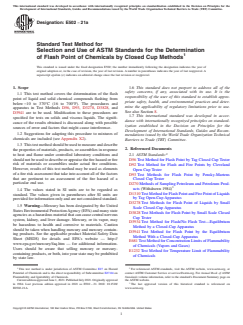
(Test Method)Standard Test Method for Selection and Use of ASTM Standards for the Determination of Flash Point of Chemicals by Closed Cup Methods
General Information
- Abstract
SIGNIFICANCE AND USE
5.1 The flash point measures the response of the sample to heat and flame under controlled laboratory conditions. It is only one of a number of properties that must be considered in assessing the overall flammability hazard of a material.
5.2 As a result of physical factors inherent in the apparatus and procedure, the closed cup flash point does not necessarily represent the minimum temperature at which a material can evolve flammable vapors, and the absence of a flash point does not guarantee nonflammability (see Appendix X1 and Appendix X2).
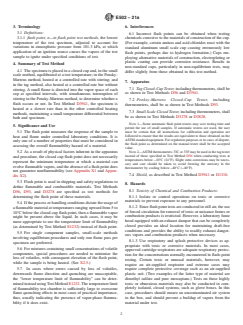
5.3 Flash point is used in shipping and safety regulations to define flammable and combustible materials. Test Methods D56, D93, and D3278 are specified as test methods for determining the flash point of these materials.
5.4 If the process or handling conditions dictate the usage of a flammable material at temperatures ranging upward from 5 to 10°C below the closed-cup flash point, then a flammable vapor might be present above the liquid. In such cases, it may be more appropriate to use the temperature limit of flammability (as determined by Test Method E1232) instead of flash point.
5.5 For single component samples, small-scale methods involving equilibrium procedures and only one flame pass per specimen are preferred.
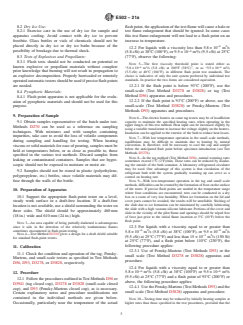
5.6 For mixtures containing small concentrations of volatile components, special procedures are needed to minimize the loss of volatiles, with consequent elevation of the flash point, while the sample is being heated. (See X2.5.)
5.7 In cases where errors caused by loss of volatiles, downwards flame direction and quenching are unacceptable, the “lower temperature limit of flammability” can be determined instead using Test Method E1232. The temperature limit of flammability test chamber is sufficiently large to overcome flame quenching effects in most cases of practical importance, thus, usually indicating the presence of vapor-phase flammability if it does exist.
SCOPE
1.1 This test method covers the determination of the flash point of liquid and solid chemical compounds flashing from below −10 to 370°C (16 to 700°F). The procedures and apparatus in Test Methods D56, D93, D3278, D3828, and D3941 are to be used. Modification to these procedures are specified for tests on solids and viscous liquids. The significance of the results obtained is discussed along with possible sources of error and factors that might cause interference.
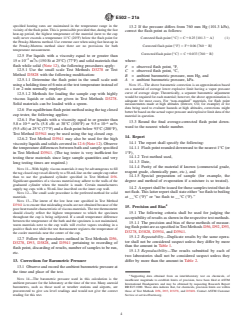
1.2 Suggestions for adapting this procedure to mixtures of chemicals are included (see Appendix X2).
1.3 This test method should be used to measure and describe the properties of materials, products, or assemblies in response to heat and flame under controlled laboratory conditions and should not be used to describe or appraise the fire hazard or fire risk of materials or assemblies under actual fire conditions. However, results of this test method may be used as elements of a fire risk assessment that take into account all of the factors that are pertinent to an assessment of the fire hazard of a particular end use.
1.4 The values stated in SI units are to be regarded as standard. The values given in parentheses after SI units are provided for information only and are not considered standard.
1.5 Warning—Mercury has been designated by the United States Environmental Protection Agency (EPA) and many state agencies as a hazardous material that can cause central nervous system, kidney, and liver damage. Mercury, or its vapor, may be hazardous to health and corrosive to materials. Caution should be taken when handling mercury and mercury containing products. See the applicable product Material Safety Data Sheet (MSDS) for details and EPA’s website — http://www.epa.gov/mercury/faq.htm — for additional information. Users should be aware that selling mercury or mercury-containing products, or both, into your state may be prohibited by state law.
1.6 This standard does not purport to ad...
- Status
- Published
- Publication Date
- 31-May-2021
- Technical Committee
- E27 - Hazard Potential of Chemicals
- Drafting Committee
- E27.04 - Flammability and Ignitability of Chemicals
Buy Documents
ASTM E502-21a - Standard Test Method for Selection and Use of ASTM Standards for the Determination of Flash Point of Chemicals by Closed Cup Methods
REDLINE ASTM E502-21a - Standard Test Method for Selection and Use of ASTM Standards for the Determination of Flash Point of Chemicals by Closed Cup Methods
Overview
ASTM E502-21a: Standard Test Method for Selection and Use of ASTM Standards for the Determination of Flash Point of Chemicals by Closed Cup Methods provides a comprehensive approach for evaluating the flash point of liquid and solid chemicals using closed cup techniques. The flash point is a critical property in assessing the potential fire hazard and flammability classification of chemicals under controlled laboratory conditions. This standard supports regulatory compliance for shipping and handling, aids in fire hazard assessment, and guides the proper selection of test methodologies and apparatus.
Key Topics
- Flash Point Determination: Defines procedures for measuring the temperature at which chemical specimens evolve enough vapor to ignite upon exposure to an ignition source in a closed environment.
- Test Apparatus: Specifies usage of Tag Closed-Cup (D56, D3941), Pensky-Martens Closed-Cup (D93), and Small Scale Closed-Cup (D3278, D3828) testers, with modifications for solids and viscous liquids.
- Significance of Flash Point:
- Indicates fire risk but does not always reflect the minimum temperature for vapor formation or guarantee nonflammability.
- Essential for hazard assessment, regulatory classification, and safe storage and transport of chemicals.
- Error Sources and Interference:
- Factors such as loss of volatiles, sample contamination, and apparatus material reactivity can affect results.
- Correction for barometric pressure deviations is required for accurate reporting.
- Application to Mixtures: Provides guidance on adapting procedures for chemical mixtures and highlights special considerations for volatile components.
Applications
The ASTM E502-21a test method is widely used in:
- Regulatory Compliance: Supports classification of flammable and combustible materials for shipping (per regulatory requirements) using validated closed cup test methods.
- Product Safety: Assists manufacturers and laboratories in evaluating chemical products’ ignition risk during processing, storage, and transportation.
- Fire Hazard Assessment: Supplies critical data for risk analysis in chemical plants, storage facilities, and industrial operations. Results can contribute to comprehensive fire risk assessments, when combined with additional tests and risk factors.
- Quality Assurance and Material Handling: Ensures consistency, safety, and compliance in the production and handling of a broad range of chemical products, including single substances and complex mixtures.
- Adaptation for Special Materials: Provides modifications for testing viscous liquids, solids, and chemically complex samples where standard procedures may lead to inaccurate results.
Related Standards
- ASTM D56 - Test Method for Flash Point by Tag Closed Cup Tester.
- ASTM D93 - Test Methods for Flash Point by Pensky-Martens Closed Cup Tester.
- ASTM D3278 - Test Methods for Flash Point of Liquids by Small Scale Closed-Cup Apparatus.
- ASTM D3828 - Test Methods for Flash Point by Small Scale Closed Cup Tester.
- ASTM D3941 - Test Method for Flash Point by the Equilibrium Method with Closed Cup Apparatus.
- ASTM E1232 - Test Method for Temperature Limit of Flammability of Chemicals.
- ASTM E681 - Test Method for Concentration Limits of Flammability of Chemicals (Vapors and Gases).
Practical Value
- Safety: Enables labs and facilities to determine flash point accurately, bolstering workplace safety and regulatory adherence.
- Versatility: Covers a wide temperature range (-10 to 370°C), applicable to a variety of chemical forms including liquids, solids, and complicated mixtures.
- Precision: Provides guidance on repeatability and reproducibility, contributing to reliable and industry-accepted measurements.
- Guidance for Special Cases: Includes recommendations to overcome common interferences and errors in flash point determination, particularly for complex mixtures and highly volatile components.
In summary, ASTM E502-21a ensures that organizations select and execute the most suitable closed cup flash point test methods for their materials, supporting robust chemical safety practices and regulatory compliance.
Relations
- Effective Date
- 01-Aug-2020
- Effective Date
- 01-Jun-2020
- Effective Date
- 01-Jun-2020
- Effective Date
- 01-Feb-2019
- Effective Date
- 01-Jun-2016
- Effective Date
- 01-Jun-2016
- Effective Date
- 15-Dec-2014
- Effective Date
- 15-Dec-2014
- Effective Date
- 01-Oct-2013
- Effective Date
- 15-Jul-2013
- Effective Date
- 15-Jul-2013
- Effective Date
- 01-Nov-2012
- Effective Date
- 01-Nov-2012
- Effective Date
- 15-May-2012
- Effective Date
- 15-Feb-2010
Buy Documents
ASTM E502-21a - Standard Test Method for Selection and Use of ASTM Standards for the Determination of Flash Point of Chemicals by Closed Cup Methods
REDLINE ASTM E502-21a - Standard Test Method for Selection and Use of ASTM Standards for the Determination of Flash Point of Chemicals by Closed Cup Methods
Get Certified
Connect with accredited certification bodies for this standard

ECOCERT
Organic and sustainability certification.

Eurofins Food Testing Global
Global leader in food, environment, and pharmaceutical product testing.

Intertek Bangladesh
Intertek certification and testing services in Bangladesh.
Sponsored listings
Frequently Asked Questions
ASTM E502-21a is a standard published by ASTM International. Its full title is "Standard Test Method for Selection and Use of ASTM Standards for the Determination of Flash Point of Chemicals by Closed Cup Methods". This standard covers: SIGNIFICANCE AND USE 5.1 The flash point measures the response of the sample to heat and flame under controlled laboratory conditions. It is only one of a number of properties that must be considered in assessing the overall flammability hazard of a material. 5.2 As a result of physical factors inherent in the apparatus and procedure, the closed cup flash point does not necessarily represent the minimum temperature at which a material can evolve flammable vapors, and the absence of a flash point does not guarantee nonflammability (see Appendix X1 and Appendix X2). 5.3 Flash point is used in shipping and safety regulations to define flammable and combustible materials. Test Methods D56, D93, and D3278 are specified as test methods for determining the flash point of these materials. 5.4 If the process or handling conditions dictate the usage of a flammable material at temperatures ranging upward from 5 to 10°C below the closed-cup flash point, then a flammable vapor might be present above the liquid. In such cases, it may be more appropriate to use the temperature limit of flammability (as determined by Test Method E1232) instead of flash point. 5.5 For single component samples, small-scale methods involving equilibrium procedures and only one flame pass per specimen are preferred. 5.6 For mixtures containing small concentrations of volatile components, special procedures are needed to minimize the loss of volatiles, with consequent elevation of the flash point, while the sample is being heated. (See X2.5.) 5.7 In cases where errors caused by loss of volatiles, downwards flame direction and quenching are unacceptable, the “lower temperature limit of flammability” can be determined instead using Test Method E1232. The temperature limit of flammability test chamber is sufficiently large to overcome flame quenching effects in most cases of practical importance, thus, usually indicating the presence of vapor-phase flammability if it does exist. SCOPE 1.1 This test method covers the determination of the flash point of liquid and solid chemical compounds flashing from below −10 to 370°C (16 to 700°F). The procedures and apparatus in Test Methods D56, D93, D3278, D3828, and D3941 are to be used. Modification to these procedures are specified for tests on solids and viscous liquids. The significance of the results obtained is discussed along with possible sources of error and factors that might cause interference. 1.2 Suggestions for adapting this procedure to mixtures of chemicals are included (see Appendix X2). 1.3 This test method should be used to measure and describe the properties of materials, products, or assemblies in response to heat and flame under controlled laboratory conditions and should not be used to describe or appraise the fire hazard or fire risk of materials or assemblies under actual fire conditions. However, results of this test method may be used as elements of a fire risk assessment that take into account all of the factors that are pertinent to an assessment of the fire hazard of a particular end use. 1.4 The values stated in SI units are to be regarded as standard. The values given in parentheses after SI units are provided for information only and are not considered standard. 1.5 Warning—Mercury has been designated by the United States Environmental Protection Agency (EPA) and many state agencies as a hazardous material that can cause central nervous system, kidney, and liver damage. Mercury, or its vapor, may be hazardous to health and corrosive to materials. Caution should be taken when handling mercury and mercury containing products. See the applicable product Material Safety Data Sheet (MSDS) for details and EPA’s website — http://www.epa.gov/mercury/faq.htm — for additional information. Users should be aware that selling mercury or mercury-containing products, or both, into your state may be prohibited by state law. 1.6 This standard does not purport to ad...
SIGNIFICANCE AND USE 5.1 The flash point measures the response of the sample to heat and flame under controlled laboratory conditions. It is only one of a number of properties that must be considered in assessing the overall flammability hazard of a material. 5.2 As a result of physical factors inherent in the apparatus and procedure, the closed cup flash point does not necessarily represent the minimum temperature at which a material can evolve flammable vapors, and the absence of a flash point does not guarantee nonflammability (see Appendix X1 and Appendix X2). 5.3 Flash point is used in shipping and safety regulations to define flammable and combustible materials. Test Methods D56, D93, and D3278 are specified as test methods for determining the flash point of these materials. 5.4 If the process or handling conditions dictate the usage of a flammable material at temperatures ranging upward from 5 to 10°C below the closed-cup flash point, then a flammable vapor might be present above the liquid. In such cases, it may be more appropriate to use the temperature limit of flammability (as determined by Test Method E1232) instead of flash point. 5.5 For single component samples, small-scale methods involving equilibrium procedures and only one flame pass per specimen are preferred. 5.6 For mixtures containing small concentrations of volatile components, special procedures are needed to minimize the loss of volatiles, with consequent elevation of the flash point, while the sample is being heated. (See X2.5.) 5.7 In cases where errors caused by loss of volatiles, downwards flame direction and quenching are unacceptable, the “lower temperature limit of flammability” can be determined instead using Test Method E1232. The temperature limit of flammability test chamber is sufficiently large to overcome flame quenching effects in most cases of practical importance, thus, usually indicating the presence of vapor-phase flammability if it does exist. SCOPE 1.1 This test method covers the determination of the flash point of liquid and solid chemical compounds flashing from below −10 to 370°C (16 to 700°F). The procedures and apparatus in Test Methods D56, D93, D3278, D3828, and D3941 are to be used. Modification to these procedures are specified for tests on solids and viscous liquids. The significance of the results obtained is discussed along with possible sources of error and factors that might cause interference. 1.2 Suggestions for adapting this procedure to mixtures of chemicals are included (see Appendix X2). 1.3 This test method should be used to measure and describe the properties of materials, products, or assemblies in response to heat and flame under controlled laboratory conditions and should not be used to describe or appraise the fire hazard or fire risk of materials or assemblies under actual fire conditions. However, results of this test method may be used as elements of a fire risk assessment that take into account all of the factors that are pertinent to an assessment of the fire hazard of a particular end use. 1.4 The values stated in SI units are to be regarded as standard. The values given in parentheses after SI units are provided for information only and are not considered standard. 1.5 Warning—Mercury has been designated by the United States Environmental Protection Agency (EPA) and many state agencies as a hazardous material that can cause central nervous system, kidney, and liver damage. Mercury, or its vapor, may be hazardous to health and corrosive to materials. Caution should be taken when handling mercury and mercury containing products. See the applicable product Material Safety Data Sheet (MSDS) for details and EPA’s website — http://www.epa.gov/mercury/faq.htm — for additional information. Users should be aware that selling mercury or mercury-containing products, or both, into your state may be prohibited by state law. 1.6 This standard does not purport to ad...
ASTM E502-21a is classified under the following ICS (International Classification for Standards) categories: 71.080.01 - Organic chemicals in general. The ICS classification helps identify the subject area and facilitates finding related standards.
ASTM E502-21a has the following relationships with other standards: It is inter standard links to ASTM D93-20, ASTM D3934-20, ASTM D3941-20, ASTM E1232-07(2019), ASTM D56-16, ASTM D3828-16, ASTM D3934-14, ASTM D3941-14, ASTM E1232-07(2013), ASTM D93-13, ASTM D93-13e1, ASTM D93-12, ASTM D92-12a, ASTM D3828-12, ASTM D93-10. Understanding these relationships helps ensure you are using the most current and applicable version of the standard.
ASTM E502-21a is available in PDF format for immediate download after purchase. The document can be added to your cart and obtained through the secure checkout process. Digital delivery ensures instant access to the complete standard document.
Standards Content (Sample)
This international standard was developed in accordance with internationally recognized principles on standardization established in the Decision on Principles for the
Development of International Standards, Guides and Recommendations issued by the World Trade Organization Technical Barriers to Trade (TBT) Committee.
Designation: E502 − 21a
Standard Test Method for
Selection and Use of ASTM Standards for the Determination
of Flash Point of Chemicals by Closed Cup Methods
This standard is issued under the fixed designation E502; the number immediately following the designation indicates the year of
original adoption or, in the case of revision, the year of last revision.Anumber in parentheses indicates the year of last reapproval.A
superscript epsilon (´) indicates an editorial change since the last revision or reapproval.
1. Scope 1.6 This standard does not purport to address all of the
safety concerns, if any, associated with its use. It is the
1.1 This test method covers the determination of the flash
responsibility of the user of this standard to establish appro-
point of liquid and solid chemical compounds flashing from
priate safety, health, and environmental practices and deter-
below−10 to 370°C (16 to 700°F). The procedures and
mine the applicability of regulatory limitations prior to use.
apparatus in Test Methods D56, D93, D3278, D3828, and
See also Section 8.
D3941 are to be used. Modification to these procedures are
1.7 This international standard was developed in accor-
specified for tests on solids and viscous liquids. The signifi-
dance with internationally recognized principles on standard-
cance of the results obtained is discussed along with possible
ization established in the Decision on Principles for the
sources of error and factors that might cause interference.
Development of International Standards, Guides and Recom-
1.2 Suggestions for adapting this procedure to mixtures of
mendations issued by the World Trade Organization Technical
chemicals are included (see Appendix X2).
Barriers to Trade (TBT) Committee.
1.3 Thistestmethodshouldbeusedtomeasureanddescribe
2. Referenced Documents
the properties of materials, products, or assemblies in response
to heat and flame under controlled laboratory conditions and
2.1 ASTM Standards:
shouldnotbeusedtodescribeorappraisethefirehazardorfire
D56Test Method for Flash Point by Tag Closed Cup Tester
risk of materials or assemblies under actual fire conditions.
D92Test Method for Flash and Fire Points by Cleveland
However, results of this test method may be used as elements
Open Cup Tester
ofafireriskassessmentthattakeintoaccountallofthefactors
D93Test Methods for Flash Point by Pensky-Martens
that are pertinent to an assessment of the fire hazard of a
Closed Cup Tester
particular end use.
D270Methods of Sampling Petroleum and Petroleum Prod-
ucts (Withdrawn 1984)
1.4 The values stated in SI units are to be regarded as
D1310TestMethodforFlashPointandFirePointofLiquids
standard. The values given in parentheses after SI units are
by Tag Open-Cup Apparatus
provided for informationonlyandarenotconsideredstandard.
D3278Test Methods for Flash Point of Liquids by Small
1.5 Warning—Mercury has been designated by the United
Scale Closed-Cup Apparatus
StatesEnvironmentalProtectionAgency(EPA)andmanystate
D3828Test Methods for Flash Point by Small Scale Closed
agenciesasahazardousmaterialthatcancausecentralnervous
Cup Tester
system, kidney, and liver damage. Mercury, or its vapor, may
D3934Test Method for Flash/No Flash Test—Equilibrium
be hazardous to health and corrosive to materials. Caution
Method by a Closed-Cup Apparatus
should be taken when handling mercury and mercury contain-
D3941Test Method for Flash Point by the Equilibrium
ing products. See the applicable product Material Safety Data
Method With a Closed-Cup Apparatus
Sheet (MSDS) for details and EPA’s website — http://
E681TestMethodforConcentrationLimitsofFlammability
www.epa.gov/mercury/faq.htm — for additional information.
of Chemicals (Vapors and Gases)
Users should be aware that selling mercury or mercury-
E1232Test Method for Temperature Limit of Flammability
containing products, or both, into your state may be prohibited
of Chemicals
by state law.
1 2
This test method is under jurisdiction of ASTM Committee E27 on Hazard For referenced ASTM standards, visit the ASTM website, www.astm.org, or
Potential of Chemicals and is the direct responsibility of Subcommittee E27.04 on contact ASTM Customer Service at service@astm.org. For Annual Book of ASTM
Flammability and Ignitability of Chemicals. Standards volume information, refer to the standard’s Document Summary page on
CurrenteditionapprovedJune1,2021.PublishedJuly2021.Originallyapproved the ASTM website.
in 1984. Last previous edition approved in 2021 as E502–21. DOI: 10.1520/ The last approved version of this historical standard is referenced on
E0502-21A. www.astm.org.
Copyright © ASTM International, 100 Barr Harbor Drive, PO Box C700, West Conshohocken, PA 19428-2959. United States
E502 − 21a
3. Terminology 6. Interferences
3.1 Definitions:
6.1 Incorrect flash points can be obtained when testing
3.1.1 flash point, n—in flash point test methods, the lowest
chemicalscorrosivetothematerialsofconstructionofthecup.
temperature of the test specimen, adjusted to account for
(For example, certain amines and acid chlorides react with the
variations in atmospheric pressure from 101.3 kPa, at which
standard aluminum small scale cup causing erroneously low
application of an ignition source causes the vapors of the test
flash points, perhaps due to hydrogen formation.) Cups em-
sample to ignite under specified conditions of test.
ploying alternative materials of construction, electroplating or
plastic coating can provide corrosion resistance. Results in
4. Summary of Test Method
non-standard cups, particularly in non-equilibrium tests, may
4.1 Thespecimenisplacedinaclosedcupand,inthesmall
differ slightly from those obtained in this test method.
scale method, equilibrated at a test temperature; in the Pensky-
Martens method, heated at a controlled rate with stirring; and
7. Apparatus
in the tag method, also heated at a controlled rate but without
7.1 Tag Closed-Cup Tester,includingthermometers,shallbe
stirring.Asmall flame is directed into the vapor space of each
as shown in Test Methods D56 and D3941.
cup at specified intervals, with simultaneous interruption of
stirring in the Pensky-Martens method, to determine whether a
7.2 Penksy-Martens Closed-Cup Tester, including
flash occurs or not. In Test Method D3941, the specimen is
thermometers, shall be as shown in Test Methods D93.
heated at a slower rate than in the other controlled heating
7.3 SmallScaleClosedTester,includingthermometers,shall
methods, maintaining a small temperature differential between
be as shown in Test Methods D3278 or D3828.
bath and specimen.
NOTE 1—Some automatic flash point testers may save testing time and
5. Significance and Use
permit the use of small samples. If automatic testers are used, the user
5.1 The flash point measures the response of the sample to
must be certain that all instructions for calibration and operation are
followed to ensure that the results are equivalent to those obtained on the
heat and flame under controlled laboratory conditions. It is
ASTMstandardequipment.Forregulationpurposesorincasesofdispute,
only one of a number of properties that must be considered in
the flash point as determined on the manual tester shall be the accepted
assessing the overall flammability hazard of a material.
value.
NOTE2—ASTMthermometers33Cor33Fmaybeusedinthetagtester
5.2 As a result of physical factors inherent in the apparatus
instead of those specified in Test Method D56 when conducting tests at
and procedure, the closed cup flash point does not necessarily
temperatures below−10°C (14°F). Slight stem corrections may be neces-
represent the minimum temperature at which a material can
sary and care should be taken to avoid freezing the mercury in the
evolveflammablevapors,andtheabsenceofaflashpointdoes
thermometer by cooling below−40°C (−40°F).
not guarantee nonflammability (see Appendix X1 and Appen-
7.4 Shield, as described in Test Method D3941 or D1310.
dix X2).
5.3 Flash point is used in shipping and safety regulations to
8. Hazards
define flammable and combustible materials. Test Methods
8.1 Toxicity of Chemical and Combustion Products:
D56, D93, and D3278 are specified as test methods for
determining the flash point of these materials. 8.1.1 Isolate or control operations on toxic or corrosive
materials to prevent exposure to any personnel.
5.4 Iftheprocessorhandlingconditionsdictatetheusageof
8.1.2 Sinceflashpointtestsareconductedinstillair,theuse
aflammablematerialattemperaturesrangingupwardfrom5to
of forced circulation for removal of toxic or nuisance fumes or
10°Cbelowtheclosed-cupflashpoint,thenaflammablevapor
combustion products is restricted. However, a laboratory fume
might be present above the liquid. In such cases, it may be
hood equipped with an exhaust damper that can be completely
more appropriate to use the temperature limit of flammability
closed provides an ideal location for maintaining draft-free
(as determined by Test Method E1232) instead of flash point.
conditions and provides the ability to readily exhaust danger-
5.5 For single component samples, small-scale methods
ous vapors and combustion products when necessary.
involving equilibrium procedures and only one flame pass per
8.1.3 Use respiratory and splash protective devices as ap-
specimen are preferred.
propriate with toxic or corrosive materials. In most cases,
5.6 For mixtures containing small concentrations of volatile
approved cartridge respirators are adequate respiratory protec-
components, special procedures are needed to minimize the
tion for the concentrations normally encountered in flash-point
loss of volatiles, with consequent elevation of the flash point,
testing. Certain toxic or unusual materials, however, may
while the sample is being heated. (See X2.5.)
require an air-supplied respirator and extreme cases may
5.7 In cases where errors caused by loss of volatiles, require complete protective coverage such as an air-supplied
downwards flame direction and quenching are unacceptable, plastic suit. (Two examples of the latter type of material are
the “lower temperature limit of flammability” can be deter- dimethyl sulfate and pure mercaptans.) Tests on these highly
minedinsteadusingTestMethodE1232.Thetemperaturelimit toxic or obnoxious materials may also be conducted in com-
of flammability test chamber is sufficiently large to overcome pletely isolated, closed systems, such as glove boxes. In this
flame quenching effects in most cases of practical importance, case, procedures should ensure an uncontaminated air system
thus, usually indicating the presence of vapor-phase flamma- in the box, and should prevent a buildup of vapors from the
bility if it does exist. material under test.
E502 − 21a
8.2 Dry Ice Use: flashpoint,theapplicationofthetestflamewillcauseahaloor
8.2.1 Exercise care in the use of dry ice for sample and test flame enlargement that should be ignored. In some cases
apparatus cooling. Avoid contact with dry ice to prevent this test flame enlargement will not lead to a flash point on an
frostbite. Glass bottles or vials of chemicals should not be increase in temperature.
placed directly in dry ice or dry ice baths because of the
−6 2
12.2 For liquids with a viscosity less than 5.8×10 m /s
possibility of breakage due to thermal shock. −6 2
(5.8 cSt) at 38°C (100°F), or 9.5×10 m /s (9.5 cSt) at 25°C
8.3 Tests of Explosives and Propellants:
(77°F), observe the following:
8.3.1 Flash tests should not be conducted on potential or
NOTE 5—The first viscosity threshold point is stated either as
known explosive or propellant materials without complete
−6 2 −6 2
“5.8×10 m /s (5.8 cSt) at 100°F (38°C)”, or as “5.5×10 m /s
prior knowledge that burning will not result in propagation to
(5.5cSt) at 40°C (104°F), in different flash point test standards. The
an explosive decomposition. Properly barricaded or remotely choice is indicative of only the unit system preferred by individual test
standards. In practice the two forms are considered equivalent.
operatedautomatictestersshouldbeusedifpreciseflashpoints
are needed.
12.2.1 If the flash point is below 93°C (200°F), use the
small-scale (Test Method D3278 or D3828) or tag (Test
8.4 Pyrophoric Materials:
Method D56) apparatus and procedures.
8.4.1 Flash point apparatus is not applicable for the evalu-
12.2.2 If the flash point is 93°C (200°F) or above, use the
ation of pyrophoric materials and should not be used for this
small-scale (Test Method D3828) or Pensky-Martens (Test
purpose.
Methods D93) apparatus and procedures.
9. Preparation of Sample
NOTE 6—The electric heaters on some tag testers may be of insufficient
capacity to maintain the specified heating rates when operating in the
9.1 Obtain samples representative of the batch under test.
upper ranges of this test method. Heat input can be increased slightly by
Methods D270 can be used as a reference on sampling
usingavariabletransformertoincreasethevoltageslightlyontheheaters.
techniques. With mixtures and with samples containing
Insulation can be applied to the exterior of the bath to reduce heat losses.
impurities, take care to avoid the loss of volatile components
NOTE 7—With low temperature operation in the small scale methods,
during sampling and handling for testing. When heating equilibrium may be difficult to maintain due to heating by natural
convection. It, therefore, will be necessary to cool the cup and sample
viscousorsolidmaterialsforeaseofpouring,samplesmustbe
below the anticipated flash point before specimen introduction (see Test
held at temperatures below, or as close as possible to, those
Methods D3278).
specified in the various test methods. Discard samples from
NOTE 8—In the tag method (Test Method D56), natural warming rates
leaking or contaminated containers. Samples that are hygro-
sometimes exceed 1°C (2°F)/min. These rates can be reduced by insulat-
scopic should not be exposed to moisture or moist air.
ing the outside of the bath container. A laboratory refrigerated circulator
may be used. One advantage of this system is that circulation of the
9.2 Samples should not be stored in plastic (polyethylene,
refrigerant bath with the system gradually warming up can serve as a
polypropylene, etc.) bottles, since volatile materials may dif-
control on heating rate.
fuse through the walls of the bottle.
NOTE 9—With low-temperature operation in the tag and small scale
methods,difficultiescanbecreatedbytheformationoffrostonthesurface
of the tester. If precise flash points are needed in the temperature range
10. Preparation of Apparatus
where frost conditions are encountered, tests can be conducted in a dry
10.1 Support the appropriate flash-point tester on a level,
box or a room of very low humidity. When ice formation on the lid and
steady work surface in a draft-free location. If a draft-free cover parts cannot be avoided, the results will be unreliable. Sticking of
the slide due to ice formation can be minimized by carefully lubricating
location is not available, use a shield surrounding the tester on
the slide with a high vacuum silicone lubricant. Portions of the cover and
three sides. The shield should be approximately 460mm
slide in the vicinity of the pilot flame and openings should be wiped free
(18in.) wide and 610mm (24in.) high.
of frost just prior to the initial flame insertion at 5°C (10°F) below the
flash point.
NOTE 3—An area capable of being partially darkened is advantageous
since it aids in the detection of the relatively nonluminous flames
12.3 For liquids with a viscosity equal to or greater than
−6 2 −6 2
sometimes encountered in flash-point testing.
5.8×10 m /s (5.8 cSt) at 38°C (100°F), or 9.5×10 m /s
NOTE 4—Test Method D1310 gives a design for a draft shield suitable
−3 2
(9.5 cSt) at 25°C (77°F) and less than 15×10 m /s (150 St)
for standard flash-point testers.
at 25°C (77°F), and a flash point below 110°C (230°F), the
following procedure applies:
11. Calibration
12.3.1 Use of Pensky-Martens (Test Methods D93)orthe
11.1 Check the condition and operation of the tag, Pensky-
small scale (Test Method D3278 or D3828) apparatus and
Martens, and small-scale testers as specified in Test Methods
procedure.
D56, D93, D3278,or D3828, respectively.
12.4 For liquids with a viscosity equal to or greater than
−6 2 −6 2
12. Procedure 5.8×10 m /s (5.8 cSt) at
...
This document is not an ASTM standard and is intended only to provide the user of an ASTM standard an indication of what changes have been made to the previous version. Because
it may not be technically possible to adequately depict all changes accurately, ASTM recommends that users consult prior editions as appropriate. In all cases only the current version
of the standard as published by ASTM is to be considered the official document.
Designation: E502 − 21 E502 − 21a
Standard Test Method for
Selection and Use of ASTM Standards for the Determination
of Flash Point of Chemicals by Closed Cup Methods
This standard is issued under the fixed designation E502; the number immediately following the designation indicates the year of
original adoption or, in the case of revision, the year of last revision. A number in parentheses indicates the year of last reapproval. A
superscript epsilon (´) indicates an editorial change since the last revision or reapproval.
1. Scope
1.1 This test method covers the determination of the flash point of liquid and solid chemical compounds flashing from below −10
to 370°C (16 to 700°F). The procedures and apparatus in Test Methods D56, D93, D3278, D3828, and D3941 are to be used.
Modification to these procedures are specified for tests on solids and viscous liquids. The significance of the results obtained is
discussed along with possible sources of error and factors that might cause interference.
1.2 Suggestions for adapting this procedure to mixtures of chemicals are included (see Appendix X2).
1.3 This test method should be used to measure and describe the properties of materials, products, or assemblies in response to
heat and flame under controlled laboratory conditions and should not be used to describe or appraise the fire hazard or fire risk
of materials or assemblies under actual fire conditions. However, results of this test method may be used as elements of a fire risk
assessment that take into account all of the factors that are pertinent to an assessment of the fire hazard of a particular end use.
1.4 The values stated in SI units are to be regarded as standard. The values given in parentheses after SI units are provided for
information only and are not considered standard.
1.5 Warning—Mercury has been designated by the United States Environmental Protection Agency (EPA) and many state
agencies as a hazardous material that can cause central nervous system, kidney, and liver damage. Mercury, or its vapor, may be
hazardous to health and corrosive to materials. Caution should be taken when handling mercury and mercury containing products.
See the applicable product Material Safety Data Sheet (MSDS) for details and EPA’s website — http://www.epa.gov/mercury/
faq.htm — for additional information. Users should be aware that selling mercury or mercury-containing products, or both, into
your state may be prohibited by state law.
1.6 This standard does not purport to address all of the safety concerns, if any, associated with its use. It is the responsibility
of the user of this standard to establish appropriate safety, health, and environmental practices and determine the applicability of
regulatory limitations prior to use. See also Section 8.
1.7 This international standard was developed in accordance with internationally recognized principles on standardization
established in the Decision on Principles for the Development of International Standards, Guides and Recommendations issued
by the World Trade Organization Technical Barriers to Trade (TBT) Committee.
This test method is under jurisdiction of ASTM Committee E27 on Hazard Potential of Chemicals and is the direct responsibility of Subcommittee E27.04 on
Flammability and Ignitability of Chemicals.
Current edition approved Feb. 15, 2021June 1, 2021. Published March 2021July 2021. Originally approved in 1984. Last previous edition approved in 20132021 as
E502 – 07 (2013).E502 – 21. DOI: 10.1520/E0502-21.10.1520/E0502-21A.
Copyright © ASTM International, 100 Barr Harbor Drive, PO Box C700, West Conshohocken, PA 19428-2959. United States
E502 − 21a
2. Referenced Documents
2.1 ASTM Standards:
D56 Test Method for Flash Point by Tag Closed Cup Tester
D92 Test Method for Flash and Fire Points by Cleveland Open Cup Tester
D93 Test Methods for Flash Point by Pensky-Martens Closed Cup Tester
D270 Methods of Sampling Petroleum and Petroleum Products (Withdrawn 1984)
D1310 Test Method for Flash Point and Fire Point of Liquids by Tag Open-Cup Apparatus
D3278 Test Methods for Flash Point of Liquids by Small Scale Closed-Cup Apparatus
D3828 Test Methods for Flash Point by Small Scale Closed Cup Tester
D3934 Test Method for Flash/No Flash Test—Equilibrium Method by a Closed-Cup Apparatus
D3941 Test Method for Flash Point by the Equilibrium Method With a Closed-Cup Apparatus
E681 Test Method for Concentration Limits of Flammability of Chemicals (Vapors and Gases)
E1232 Test Method for Temperature Limit of Flammability of Chemicals
3. Terminology
3.1 Definitions:
3.1.1 flash point, n—in flash point test methods, the lowest temperature of the test specimen, adjusted to account for variations in
atmospheric pressure from 101.3 kPa, at which application of an ignition source causes the vapors of the test sample to ignite under
specified conditions of test.
4. Summary of Test Method
4.1 The specimen is placed in a closed cup and, in the small scale method, equilibrated at a test temperature; in the Pensky-Martens
method, heated at a controlled rate with stirring; and in the tag method, also heated at a controlled rate but without stirring. A small
flame is directed into the vapor space of each cup at specified intervals, with simultaneous interruption of stirring in the
Pensky-Martens method, to determine whether a flash occurs or not. In Test Method D3941, the specimen is heated at a slower
rate than in the other controlled heating methods, maintaining a small temperature differential between bath and specimen.
5. Significance and Use
5.1 The flash point measures the response of the sample to heat and flame under controlled laboratory conditions. It is only one
of a number of properties that must be considered in assessing the overall flammability hazard of a material.
5.2 As a result of physical factors inherent in the apparatus and procedure, the closed cup flash point does not necessarily represent
the minimum temperature at which a material can evolve flammable vapors, and the absence of a flash point does not guarantee
nonflammability (see Appendix X1 and Appendix X2).
5.3 Flash point is used in shipping and safety regulations to define flammable and combustible materials. Test Methods D56, D93,
and D3278 are specified as test methods for determining the flash point of these materials.
5.4 If the process or handling conditions dictate the usage of a flammable material at temperatures ranging upward from 5 to 10°C
below the closed-cup flash point, then a flammable vapor might be present above the liquid. In such cases, it may be more
appropriate to use the temperature limit of flammability (as determined by Test Method E1232) instead of flash point.
5.5 Small scale For single component samples, small-scale methods involving equilibrium procedures and only one flame pass per
specimen are preferred.
5.6 For mixtures containing small concentrations of volatile components, special procedures are needed to minimize the loss of
volatiles, with consequent elevation of the flash point, while the sample is being heated. (See X2.5.)
For referenced ASTM standards, visit the ASTM website, www.astm.org, or contact ASTM Customer Service at service@astm.org. For Annual Book of ASTM Standards
volume information, refer to the standard’s Document Summary page on the ASTM website.
The last approved version of this historical standard is referenced on www.astm.org.
E502 − 21a
5.7 In cases where errors caused by loss of volatiles, downwards flame direction and quenching are unacceptable, the “lower
temperature limit of flammability” can be determined instead using Test Method E1232. The temperature limit of flammability test
chamber is sufficiently large to overcome flame quenching effects in most cases of practical importance, thus, usually indicating
the presence of vapor-phase flammability if it does exist.
6. Interferences
6.1 Incorrect flash points can be obtained when testing chemicals corrosive to the materials of construction of the cup. (For
example, certain amines and acid chlorides react with the standard aluminum small scale cup causing erroneously low flash points,
perhaps due to hydrogen formation.) Cups employing alternative materials of construction, electroplating or plastic coating can
provide corrosion resistance. Results in non-standard cups, particularly in non-equilibrium tests, may differ slightly from those
obtained in this test method.
7. Apparatus
7.1 Tag Closed-Cup Tester, including thermometers, shall be as shown in Test Methods D56 and D3941.
7.2 Penksy-Martens Closed-Cup Tester, including thermometers, shall be as shown in Test Methods D93.
7.3 Small Scale Closed Tester, including thermometers, shall be as shown in Test Methods D3278 or D3828.
NOTE 1—Some automatic flash point testers may save testing time and permit the use of small samples. If automatic testers are used, the user must be
certain that all instructions for calibration and operation are followed to ensure that the results are equivalent to those obtained on the ASTM standard
equipment. For regulation purposes or in cases of dispute, the flash point as determined on the manual tester shall be the accepted value.
NOTE 2—ASTM thermometers 33C or 33F may be used in the tag tester instead of those specified in Test Method D56 when conducting tests at
temperatures below −10°C (14°F). Slight stem corrections may be necessary and care should be taken to avoid freezing the mercury in the thermometer
by cooling below −40°C (−40°F).
7.4 Shield, as described in Test Method D3941 or D1310.
8. Hazards
8.1 Toxicity of Chemical and Combustion Products:
8.1.1 Isolate or control operations on toxic or corrosive materials to prevent exposure to any personnel.
8.1.2 Since flash point tests are conducted in still air, the use of forced circulation for removal of toxic or nuisance fumes or
combustion products is restricted. However, a laboratory fume hood equipped with an exhaust damper that can be completely
closed provides an ideal location for maintaining draft-free conditions and provides the ability to readily exhaust dangerous vapors
and combustion products when necessary.
8.1.3 Use respiratory and splash protective devices as appropriate with toxic or corrosive materials. In most cases, approved
cartridge respirators are adequate respiratory protection for the concentrations normally encountered in flash-point testing. Certain
toxic or unusual materials, however, may require an air-supplied respirator and extreme cases may require complete protective
coverage such as an air-supplied plastic suit. (Two examples of the latter type of material are dimethyl sulfate and pure
mercaptans.) Tests on these highly toxic or obnoxious materials may also be conducted in completely isolated, closed systems, such
as glove boxes. In this case, procedures should ensure an uncontaminated air system in the box, and should prevent a buildup of
vapors from the material under test.
E502 − 21a
8.2 Dry Ice Use:
8.2.1 Exercise care in the use of dry ice for sample and apparatus cooling. Avoid contact with dry ice to prevent frostbite. Glass
bottles or vials of chemicals should not be placed directly in dry ice or dry ice baths because of the possibility of breakage due
to thermal shock.
8.3 Tests of Explosives and Propellants:
8.3.1 Flash tests should not be conducted on potential or known explosive or propellant materials without complete prior
knowledge that burning will not result in propagation to an explosive decomposition. Properly barricaded or remotely operated
automatic testers should be used if precise flash points are needed.
8.4 Pyrophoric Materials:
8.4.1 Flash point apparatus is not applicable for the evaluation of pyrophoric materials and should not be used for this purpose.
9. Preparation of Sample
9.1 Obtain samples representative of the batch under test. Methods D270 can be used as a reference on sampling techniques. With
mixtures and with samples containing impurities, take care to avoid the loss of volatile components during sampling and handling
for testing. When heating viscous or solid materials for ease of pouring, samples must be held at temperatures below, or as close
as possible to, those specified in the various test methods. Discard samples from leaking or contaminated containers. Samples that
are hygroscopic should not be exposed to moisture or moist air.
9.2 Samples should not be stored in plastic (polyethylene, polypropylene, etc.) bottles, since volatile materials may diffuse through
the walls of the bottle.
10. Preparation of Apparatus
10.1 Support the appropriate flash-point tester on a level, steady work surface in a draft-free location. If a draft-free location is
not available, use a shield surrounding the tester on three sides. The shield should be approximately 460 mm (18 in.) wide and
610 mm (24 in.) high.
NOTE 3—An area capable of being partially darkened is advantageous since it aids in the detection of the relatively nonluminous flames sometimes
encountered in flash-point testing.
NOTE 4—Test Method D1310 gives a design for a draft shield suitable for standard flash-point testers.
11. Calibration
11.1 Check the condition and operation of the tag, Pensky-Martens, and small-scale testers as specified in Test Methods D56, D93,
D3278, or D3828, respectively.
12. Procedure
12.1 Follow the procedures outlined in Test Methods D56 or D3941 (tag closed cup), D3278 or D3828 (small-scale closed cup),
and D93 (Pensky-Martens closed cup), as is necessary. Certain explanatory notes and procedure modifications not contained in the
individual methods are given below. Occasionally, particularly near the temperature of the actual flash point, the application of the
test flame will cause a halo or test flame enlargement that should be ignored. In some cases this test flame enlargement will not
lead to a flash point on an increase in temperature.
−6 2 −6 2
12.2 For liquids with a viscosity less than 5.8 × 10 m /s (5.8 cSt) at 38°C (100°F), or 9.5 × 10 m /s (9.5 cSt) at 25°C (77°F),
observe the following:
−6 2 −6 2
NOTE 5—The first viscosity threshold point is stated either as “5.8 × 10 m /s (5.8 cSt) at 100°F (38°C)”, or as “5.5 × 10 m /s (5.5 cSt) at 40°C (104°F),
E502 − 21a
in different flash point test standards. The choice is indicative of only the unit system preferred by individual test standards. In practice the two forms
are considered equivalent.
12.2.1 If the flash point is below 93°C (200°F), use the small-scale (Test Method D3278 or D3828) or tag (Test Method D56)
apparatus and procedures.
12.2.2 If the flash point is 93°C (200°F) or above, use the small-scale (Test Method D3828) or Pensky-Martens (Test Methods
D93) apparatus and procedures.
NOTE 6—The electric heaters on some tag testers may be of insufficient capacity to maintain the specified heating rates when operating in the upper ranges
of this test method. Heat input can be increased slightly by using a variable transformer to increase the voltage slightly on the heaters. Insulation can be
applied to the exterior of the bath to reduce heat losses.
NOTE 7—With low temperature operation in the small scale methods, equilibrium may be difficult to maintain due to heating by natural convection. It,
therefore, will be necessary to cool the cup and sample below the anticipated flash point before specimen introduction (see Test Methods D3278).
NOTE 8—In the tag method (Test Method D56), natural warming rates sometimes exceed 1°C (2°F)/min. These rates can be reduced by insulating the
outside of the bath container. A laboratory refrigerated circulator may be used. One advantage of this system is that circulation of the refrigerant bath
with the system gradually warming up can serve as a control on heating rate.
NOTE 9—With low-temperature operation in the tag and small scale methods, difficulties can be created by the formation of frost on the surface of the
tester. If precise flash points are needed in the temperature range where frost conditions are encountered, tests can be conducted in a dry box or a room
of very low humidity. When ice formation on the lid and cover parts cannot be avoided, the results will be unreliable. Sticking of the slide due to ice
formation can be minimized by carefully lubricating the slide with a high vacuum silicone lubricant. Portions of the cover and slide in the vicinity of
the pilot flame and openings should be wiped free of frost just prior to the initial flame insertion at 5°C (10°F) below the flash point.
−6 2 −6 2
12.3 For liquids with a viscosity equal to or greater than 5.8 × 10 m /s (5.8 cSt) at 38°C (10
...