

ASTM F302-09(2021)
(Practice)Standard Practice for Field Sampling of Aerospace Fluids in Containers
General Information
- Abstract
SIGNIFICANCE AND USE
4.1 Samples obtained by use of this practice are intended for processing in accordance with Practice F311, Test Method D4898, and Test Method F314, and other chemical or physical methods of analysis.
SCOPE
1.1 This practice covers field sampling of fluids from hermetically sealed containers and other fluid containers of 208-L volume maximum. It may be utilized at manufacturing, storage, or use levels for obtaining representative fluid samples for chemical, physical, or particulate matter determinations.
1.2 Use of this practice depends upon variables such as fluid toxicity, restrictive fluid odors, fluid flammability, and so forth. It is suitable for most hydraulic fluids; however, care should be exercised in determining compatibility before use.2
1.3 The values stated in SI units are to be regarded as standard. No other units of measurement are included in this standard.
1.4 This standard does not purport to address all of the safety concerns, if any, associated with its use. It is the responsibility of the user of this standard to establish appropriate safety, health, and environmental practices and determine the applicability of regulatory limitations prior to use. For hazard statement, see 6.5.1.
1.5 This international standard was developed in accordance with internationally recognized principles on standardization established in the Decision on Principles for the Development of International Standards, Guides and Recommendations issued by the World Trade Organization Technical Barriers to Trade (TBT) Committee.
- Status
- Published
- Publication Date
- 31-Aug-2021
- Technical Committee
- E21 - Space Simulation and Applications of Space Technology
- Drafting Committee
- E21.05 - Contamination


Overview
ASTM F302-09(2021), Standard Practice for Field Sampling of Aerospace Fluids in Containers, establishes reliable procedures for sampling fluids from hermetically sealed and other fluid containers up to 208 liters in volume. Published by ASTM International, this standard is widely recognized in the aerospace industry for collecting representative samples for further chemical, physical, or particulate matter analysis. Its proper application ensures that aerospace hydraulic fluids, lubricants, and related substances can be evaluated accurately for contaminants or compliance with specification limits.
Key Topics
- Sampling Procedures: The standard details the correct techniques for sampling fluids from various containers, including requirements for agitating the container, sample withdrawal, and transfer to analysis vessels. These steps minimize contamination and improve reliability.
- Applicability: Suitable for hydraulic fluids and other compatible aerospace fluids. Users must evaluate compatibility based on aspects such as fluid toxicity, odor, and flammability.
- Equipment Requirements: Specifies key apparatus, such as volumetric pipets, sample bottles, solvent filtering dispensers, and appropriate solvents for surface cleaning.
- Contamination Control: Emphasizes preparation and cleanliness of sampling apparatus, including recommendations for filtering and storage of reagents to avoid sample contamination.
- Safety Precautions: Advises users to address all safety, health, and environmental concerns before performing sampling operations, particularly with flammable or toxic fluids.
- SI Units: All measurements and procedures in the standard are stated exclusively in SI units, promoting international consistency.
Applications
ASTM F302-09(2021) is essential in several areas within the aerospace sector:
- Quality Control: Manufacturers use this standard to obtain representative samples of hydraulic fluids or lubricants from containers during production, storage, or delivery, ensuring the products meet operational and safety specifications.
- Maintenance and Reliability: Maintenance crews and engineering teams apply the guideline for field sampling before routine analysis-such as for particulate contamination or chemical properties-helping identify fluid degradation, contamination, or out-of-spec characteristics.
- Compliance and Auditing: When verifying adherence to regulatory and customer standards, field sampling performed to ASTM F302 ensures data is consistent and defensible.
- Laboratory Analysis Preparation: The sampled fluids are subsequently analyzed using relevant ASTM test methods, including those for contamination (e.g., gravimetric analysis of particulates), aligning with broader quality assurance programs.
- Research and Development: R&D teams rely on this sampling standard to support new product evaluations, contamination studies, and performance testing under controlled, repeatable conditions.
Related Standards
Several ASTM standards are designed for use in conjunction with ASTM F302-09(2021):
- ASTM F311: Practice for Processing Aerospace Liquid Samples for Particulate Contamination Analysis Using Membrane Filters.
- ASTM D4898: Test Method for Insoluble Contamination of Hydraulic Fluids by Gravimetric Analysis.
- ASTM D1193: Specification for Reagent Water.
- ASTM D1836: Specification for Commercial Hexanes.
- Former Standards: Referenced but withdrawn standards include F314 (Test Methods for Identification of Metallic and Fibrous Contaminants) and D2021 (Specification for Neutral Detergent), supporting historical methodologies.
These related ASTM standards together enable comprehensive and standardized approaches for aerospace fluid analysis, contamination control, and safety. Following ASTM F302-09(2021) ensures that aerospace organizations and their service partners can achieve dependable, representative sampling results, supporting fluid quality and system reliability in critical aerospace applications.
Relations
- Effective Date
- 01-Dec-2023
- Effective Date
- 01-Apr-2020
- Effective Date
- 01-Jan-2016
- Effective Date
- 01-Nov-2013
- Effective Date
- 01-Oct-2010
- Effective Date
- 01-Oct-2010
- Effective Date
- 01-May-2008
- Effective Date
- 01-Jun-2007
- Effective Date
- 01-Mar-2006
- Effective Date
- 01-May-2005
- Effective Date
- 10-Dec-2002
- Effective Date
- 10-Apr-2000
- Effective Date
- 10-Dec-1999
- Effective Date
- 10-Feb-1999
- Effective Date
- 10-Feb-1999
Get Certified
Connect with accredited certification bodies for this standard

BUREAU VERITAS Certification Germany
Bureau Veritas certification in Germany.

Element Materials Technology
Materials testing and product certification.

AQMS Ltd.
AQMS provides ISO certification to SMEs across the UK.
Sponsored listings
Frequently Asked Questions
ASTM F302-09(2021) is a standard published by ASTM International. Its full title is "Standard Practice for Field Sampling of Aerospace Fluids in Containers". This standard covers: SIGNIFICANCE AND USE 4.1 Samples obtained by use of this practice are intended for processing in accordance with Practice F311, Test Method D4898, and Test Method F314, and other chemical or physical methods of analysis. SCOPE 1.1 This practice covers field sampling of fluids from hermetically sealed containers and other fluid containers of 208-L volume maximum. It may be utilized at manufacturing, storage, or use levels for obtaining representative fluid samples for chemical, physical, or particulate matter determinations. 1.2 Use of this practice depends upon variables such as fluid toxicity, restrictive fluid odors, fluid flammability, and so forth. It is suitable for most hydraulic fluids; however, care should be exercised in determining compatibility before use.2 1.3 The values stated in SI units are to be regarded as standard. No other units of measurement are included in this standard. 1.4 This standard does not purport to address all of the safety concerns, if any, associated with its use. It is the responsibility of the user of this standard to establish appropriate safety, health, and environmental practices and determine the applicability of regulatory limitations prior to use. For hazard statement, see 6.5.1. 1.5 This international standard was developed in accordance with internationally recognized principles on standardization established in the Decision on Principles for the Development of International Standards, Guides and Recommendations issued by the World Trade Organization Technical Barriers to Trade (TBT) Committee.
SIGNIFICANCE AND USE 4.1 Samples obtained by use of this practice are intended for processing in accordance with Practice F311, Test Method D4898, and Test Method F314, and other chemical or physical methods of analysis. SCOPE 1.1 This practice covers field sampling of fluids from hermetically sealed containers and other fluid containers of 208-L volume maximum. It may be utilized at manufacturing, storage, or use levels for obtaining representative fluid samples for chemical, physical, or particulate matter determinations. 1.2 Use of this practice depends upon variables such as fluid toxicity, restrictive fluid odors, fluid flammability, and so forth. It is suitable for most hydraulic fluids; however, care should be exercised in determining compatibility before use.2 1.3 The values stated in SI units are to be regarded as standard. No other units of measurement are included in this standard. 1.4 This standard does not purport to address all of the safety concerns, if any, associated with its use. It is the responsibility of the user of this standard to establish appropriate safety, health, and environmental practices and determine the applicability of regulatory limitations prior to use. For hazard statement, see 6.5.1. 1.5 This international standard was developed in accordance with internationally recognized principles on standardization established in the Decision on Principles for the Development of International Standards, Guides and Recommendations issued by the World Trade Organization Technical Barriers to Trade (TBT) Committee.
ASTM F302-09(2021) is classified under the following ICS (International Classification for Standards) categories: 49.100 - Ground service and maintenance equipment. The ICS classification helps identify the subject area and facilitates finding related standards.
ASTM F302-09(2021) has the following relationships with other standards: It is inter standard links to ASTM D4898-23, ASTM F311-08(2020), ASTM D4898-16, ASTM F311-08(2013), ASTM D4898-90(2010), ASTM D4898-90(2010)e1, ASTM F311-08, ASTM D1836-07, ASTM D1193-06, ASTM D4898-90(2005), ASTM D1836-02, ASTM D4898-90(2000)e1, ASTM D1836-99, ASTM D1193-99e1, ASTM D1193-99. Understanding these relationships helps ensure you are using the most current and applicable version of the standard.
ASTM F302-09(2021) is available in PDF format for immediate download after purchase. The document can be added to your cart and obtained through the secure checkout process. Digital delivery ensures instant access to the complete standard document.
Standards Content (Sample)
This international standard was developed in accordance with internationally recognized principles on standardization established in the Decision on Principles for the
Development of International Standards, Guides and Recommendations issued by the World Trade Organization Technical Barriers to Trade (TBT) Committee.
Designation: F302 − 09 (Reapproved 2021)
Standard Practice for
Field Sampling of Aerospace Fluids in Containers
ThisstandardisissuedunderthefixeddesignationF302;thenumberimmediatelyfollowingthedesignationindicatestheyearoforiginal
adoption or, in the case of revision, the year of last revision.Anumber in parentheses indicates the year of last reapproval.Asuperscript
epsilon (´) indicates an editorial change since the last revision or reapproval.
1. Scope D2021 SpecificationforNeutralDetergent,40PercentAlky-
lbenzene Sulfonate Type (Withdrawn 2000)
1.1 This practice covers field sampling of fluids from
D4898 Test Method for Insoluble Contamination of Hydrau-
hermetically sealed containers and other fluid containers of
lic Fluids by Gravimetric Analysis
208-L volume maximum. It may be utilized at manufacturing,
F311 Practice for Processing Aerospace Liquid Samples for
storage, or use levels for obtaining representative fluid samples
Particulate ContaminationAnalysis Using Membrane Fil-
for chemical, physical, or particulate matter determinations.
ters
1.2 Useofthispracticedependsuponvariablessuchasfluid
F314 Methods of Test for Identification of Metallic and
toxicity, restrictive fluid odors, fluid flammability, and so forth.
Fibrous Contaminants in Aerospace Fluids (Withdrawn
It is suitable for most hydraulic fluids; however, care should be
1990)
exercised in determining compatibility before use.
3. Summary of Practice
1.3 The values stated in SI units are to be regarded as
standard. No other units of measurement are included in this
3.1 The minimum requirements for container agitation,
standard. sample withdrawal, and sample transfer are given in this
practice. Precautions to ensure sampling reliability are in-
1.4 This standard does not purport to address all of the
cluded in the procedure to the extent required by normal
safety concerns, if any, associated with its use. It is the
processing conditions. The procedure involves agitating the
responsibility of the user of this standard to establish appro-
container, withdrawing with a suitable instrument capable of
priate safety, health, and environmental practices and deter-
creating a vacuum, a predetermined quantity of fluid, and
mine the applicability of regulatory limitations prior to use.
immediately transferring it to a vessel, properly identified, to
For hazard statement, see 6.5.1.
hold for analysis by a stipulated method.
1.5 This international standard was developed in accor-
dance with internationally recognized principles on standard-
4. Significance and Use
ization established in the Decision on Principles for the
4.1 Samplesobtainedbyuseofthispracticeareintendedfor
Development of International Standards, Guides and Recom-
processing in accordance with Practice F311, Test Method
mendations issued by the World Trade Organization Technical
D4898, and Test Method F314, and other chemical or physical
Barriers to Trade (TBT) Committee.
methods of analysis.
2. Referenced Documents
5. Apparatus
2.1 ASTM Standards:
5.1 Pipet, volumetric transfer or equivalent rubber-bulb
D1193 Specification for Reagent Water
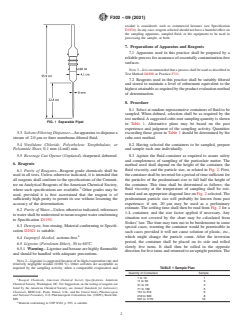
type. A taper-jointed type, as shown in Fig. 1, 560 mm long,
D1836 Specification for Commercial Hexanes
calibrated to deliver 100 mL at 20°C, is also acceptable. This
typeprovidesforeaseofmaintenancebybeingseparableatthe
This practice is under the jurisdiction of ASTM Committee E21 on Space
midpoint of the bulb.
Simulation andApplications of Space Technology and is the direct responsibility of
Subcommittee E21.05 on Contamination. NOTE 1—The volume capacities selected for the pipet and sample
Current edition approved Sept. 1, 2021. Published October 2021. Originally bottlesshallbeasrequiredforthesamplevolumedesired.Normallya100
approvedin1965.Lastpreviouseditionapprovedin2015asF302 – 09(2015).DOI:
6 5-mL sample is standard, which would require a capacity of approxi-
10.1520/F0302-09R21.
mately 125 mL. Unless otherwise indicated, it is intended that a sample
Where a special environment is required, a Proposed Laboratory Method for
volume of 100 6 5 mL be used for accomplishing the methods defined
Sampling Aerospace Fluids in Containers is under development in the committee.
herein.
For further information write to B. R. Hall, American Petroleum Institute, 1220 L
5.2 Bottles, sample, wide-mouth type (Note 1).
St., N.W., Washington, D. C. 20005.
For referenced ASTM standards, visit the ASTM website, www.astm.org, or
contact ASTM Customer Service at service@astm.org. For Annual Book of ASTM
Standards volume information, refer to the standard’s Document Summary page on The last approved version of this historical standard is referenced on
the ASTM website. www.astm.org.
Copyright © ASTM International, 100 Barr Harbor Drive, PO Box C700, West Conshohocken, PA 19428-2959. United States
F302 − 09 (2021)
residue is considered, such as commercial hexanes (see Specification
D1836). In any case, reagent selected should not have a harmful effect on
the sampling apparatus, sampled fluid, or the equipment to be used in
processing the sample, or both.
7. Preparations of Apparatus and Reagents
7.1 Apparatus used in this practice shall be prepared by a
reliable process for assurance of essentially contamination-free
surfaces.
NOTE 3—It is recommended that a process shall be used as described in
Test Method D4898 or Practice F311.
7.2 Reagents used in this practice shall be suitably filtered
and stored to maintain a level of refinement equivalent to the
highestattainableasrequiredbytheproductevaluationmethod
of determination.
8. Procedure
8.1 Select at random representative containers of fluid to be
sampled. When defined, selection shall be as required by the
test method.Asuggested cube-root sampling quantity is shown
FIG. 1 Separable Pipet
in Table 1. Alternative plans may be based on the past
experience and judgment of the sampling activity. Quantities
5.3 Solvent Filtering Dispenser—Anapparatustodispensea exceeding those given in Table 1 should be determined by the
stream of 2.0 µm or finer membrane-filtered fluid. cube-root method.
5.4 Vinylidene Chloride, Polyethylene Terephthalate, or 8.2 Having selected the containers to be sampled, prepare
Polyamide Sheet, 0.1 mm (4-mil) min. and sample each one individually.
5.5 Beverage Can Opener (Unplated), sharpened, deburred. 8.3 Agitate the fluid container as required to assure safety
and completeness of sampling of the particulate matter. The
6. Reagents
method used shall depend on the height of the container, the
fluid viscosity, and the particle size, as related in Fig. 2. First,
6.1 Purity of Reagents—Reagent grade chemicals shall be
thecontainershallbeinvertedforaperiodoftimesufficientfor
used in all tests. Unless otherwise indicated, it is intended that
the particles of the pred
...