

ASTM B85/B85M-18e1
(Specification)Standard Specification for Aluminum-Alloy Die Castings
General Information
- Abstract
ABSTRACT
This specification covers aluminum-alloy die castings of all compositions. Unless otherwise specified, only aluminum alloy conforming to the requirements of Specification B 179 or producer's foundry scrap shall be used in the remelting furnace from which molten metal is taken for pouring directly into castings. Additions of small amounts of modifiers and grain refining elements or alloys are permitted. Pure materials, recycled materials, and master alloys and material not conforming to Specification B 179 may be used to make alloys conforming to this specification, provided chemical analysis can be taken and adjusted to conform to the chemical requirements prior to pouring any castings. The castings shall be supplied such that they can be laid out and machined to the final dimensions specified on the blueprints or drawings.
SCOPE
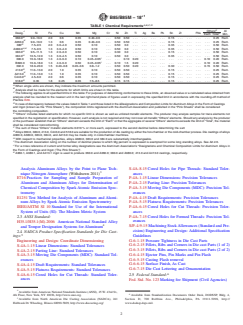
1.1 This specification covers aluminum-alloy die castings designated as shown in Table 1.
1.2 This specification is for aluminum-alloy die castings used in general purpose applications. It may not address the mechanical properties, integrity testing, and verification required for highly loaded or safety critical applications.
1.3 Alloy and temper designations are in accordance with ANSI H35.1/H35.1(M).
1.4 Unless the order specifies the “M” specification designation, the material shall be furnished to the inch-pound units.
1.5 For acceptance criteria for inclusion of new aluminum and aluminum alloys and their properties in this specification, see Annex A1 and Annex A2.
1.6 Units—The values stated in either SI units or inch-pound units are to be regarded separately as standard. The values stated in each system may not be exact equivalents; therefore, each system shall be used independently of the other. Combining values from the two systems may result in non-conformance with the standard.
1.7 This standard does not purport to address all of the safety concerns, if any, associated with its use. It is the responsibility of the user of this standard to establish appropriate safety, health, and environmental practices and determine the applicability of regulatory limitations prior to use.
1.8 This international standard was developed in accordance with internationally recognized principles on standardization established in the Decision on Principles for the Development of International Standards, Guides and Recommendations issued by the World Trade Organization Technical Barriers to Trade (TBT) Committee.
- Status
- Published
- Publication Date
- 30-Apr-2018
- Technical Committee
- B07 - Light Metals and Alloys
- Drafting Committee
- B07.01 - Aluminum Alloy Ingots and Castings
Overview
ASTM B85/B85M-18e1 is the standard specification developed by ASTM International for aluminum-alloy die castings. The standard encompasses all aluminum alloy compositions intended for general-purpose die casting applications. It provides critical guidelines for the use, chemical composition, ordering, manufacturing, and quality assurance of aluminum die castings. The standard ensures that die cast products meet consistent quality levels and are suitable for layout, machining, and final assembly as specified in design documentation.
ASTM B85/B85M applies to both inch-pound (imperial) and SI (metric) units and follows internationally recognized principles for standardization. It designates materials intended for non-critical, general-purpose applications and does not specifically address requirements for high-stress or safety-critical uses.
Key Topics
- Material Requirements: Specifies that only aluminum alloys conforming to ASTM B179 or certified foundry scrap should be used in remelting furnaces. Modifiers and grain refiners are permitted, and recycled or pure materials may also be used if final analysis complies with tabled chemical requirements before pouring.
- Chemical Composition: Enforces specific chemical composition limits for a variety of aluminum alloys used in die casting, as detailed in Table 1 of the standard. Chemical analysis methods and frequency of sampling are defined to ensure alloy consistency.
- Quality Assurance: Details the inspection and lot definition process, including frequency and methods for dimensional and chemical analysis. Specifies that testing should follow recognized ASTM methods, and mechanical properties are only verified if contractually required.
- Dimensional and Tolerance Specifications: References NADCA Product Specification Standards for tolerances related to linear dimensions, parting lines, die components, draft angles, flatness, and cored holes. This ensures that die castings are manufacturable and meet the intended fit and finish.
- Marking and Packaging: Sets forth requirements for product identification, marking, packaging, and labeling to ensure traceability and safe shipment.
- Certification and Acceptance: When required, producers must certify that lots conform to the specification, supporting customer confidence in material quality.
Applications
ASTM B85/B85M-18e1 is widely used by manufacturers, suppliers, and purchasers of aluminum die cast parts in industries such as:
- Automotive: Production of housings, brackets, engine and transmission parts, and structural components.
- Consumer Electronics: Manufacture of lightweight, precise casings and chassis for devices requiring dimensional stability.
- Aerospace and Defense: Non-critical interior components and assemblies where precise tolerances and material consistency are essential.
- Industrial Equipment: General-purpose machinery parts, enclosures, and fittings.
By adhering to ASTM B85/B85M, stakeholders benefit from:
- Consistent chemical and mechanical properties ensuring suitability for machining and assembly
- Well-defined acceptance criteria for new alloys and processes
- Standardized quality assurance reducing the risk of non-conformance and costly rework
- Clear purchasing guidelines supporting efficient procurement and supplier management
Related Standards
To ensure full compliance and optimize the use of aluminum alloy die castings, the following related standards should be consulted:
- ASTM B179: Specification for Aluminum Alloys in Ingot and Molten Forms for Castings
- ASTM B275: Practice for Codification of Certain Zinc, Tin, and Lead Die Castings
- ASTM B557 / B557M: Test Methods for Tension Testing Aluminum and Magnesium Alloy Products
- ASTM B660: Practices for Packaging/Packing Aluminum and Magnesium Products
- ASTM B666/B666M: Practice for Identification Marking
- ASTM B881: Terminology Relating to Aluminum and Magnesium Alloy Products
- NADCA Product Specification Standards: For comprehensive guidance on die casting tolerances and part features
Implementing ASTM B85/B85M-18e1 provides a structured framework for aluminum die casting processes, ensuring interoperability, reliability, and product quality in diverse manufacturing environments.
Relations
- Effective Date
- 01-Apr-2024
- Effective Date
- 01-Jan-2024
- Effective Date
- 01-Nov-2023
- Effective Date
- 01-Oct-2023
- Effective Date
- 15-May-2018
- Effective Date
- 01-May-2018
- Effective Date
- 01-Nov-2017
- Effective Date
- 01-Oct-2017
- Effective Date
- 01-Oct-2017
- Effective Date
- 15-Sep-2017
- Effective Date
- 01-Nov-2016
- Effective Date
- 15-Jul-2016
- Effective Date
- 01-Apr-2016
- Effective Date
- 01-Jan-2016
- Effective Date
- 01-Dec-2015
Get Certified
Connect with accredited certification bodies for this standard

Element Materials Technology
Materials testing and product certification.

Inštitut za kovinske materiale in tehnologije
Institute of Metals and Technology. Materials testing, metallurgical analysis, NDT.
Sponsored listings
Frequently Asked Questions
ASTM B85/B85M-18e1 is a technical specification published by ASTM International. Its full title is "Standard Specification for Aluminum-Alloy Die Castings". This standard covers: ABSTRACT This specification covers aluminum-alloy die castings of all compositions. Unless otherwise specified, only aluminum alloy conforming to the requirements of Specification B 179 or producer's foundry scrap shall be used in the remelting furnace from which molten metal is taken for pouring directly into castings. Additions of small amounts of modifiers and grain refining elements or alloys are permitted. Pure materials, recycled materials, and master alloys and material not conforming to Specification B 179 may be used to make alloys conforming to this specification, provided chemical analysis can be taken and adjusted to conform to the chemical requirements prior to pouring any castings. The castings shall be supplied such that they can be laid out and machined to the final dimensions specified on the blueprints or drawings. SCOPE 1.1 This specification covers aluminum-alloy die castings designated as shown in Table 1. 1.2 This specification is for aluminum-alloy die castings used in general purpose applications. It may not address the mechanical properties, integrity testing, and verification required for highly loaded or safety critical applications. 1.3 Alloy and temper designations are in accordance with ANSI H35.1/H35.1(M). 1.4 Unless the order specifies the “M” specification designation, the material shall be furnished to the inch-pound units. 1.5 For acceptance criteria for inclusion of new aluminum and aluminum alloys and their properties in this specification, see Annex A1 and Annex A2. 1.6 Units—The values stated in either SI units or inch-pound units are to be regarded separately as standard. The values stated in each system may not be exact equivalents; therefore, each system shall be used independently of the other. Combining values from the two systems may result in non-conformance with the standard. 1.7 This standard does not purport to address all of the safety concerns, if any, associated with its use. It is the responsibility of the user of this standard to establish appropriate safety, health, and environmental practices and determine the applicability of regulatory limitations prior to use. 1.8 This international standard was developed in accordance with internationally recognized principles on standardization established in the Decision on Principles for the Development of International Standards, Guides and Recommendations issued by the World Trade Organization Technical Barriers to Trade (TBT) Committee.
ABSTRACT This specification covers aluminum-alloy die castings of all compositions. Unless otherwise specified, only aluminum alloy conforming to the requirements of Specification B 179 or producer's foundry scrap shall be used in the remelting furnace from which molten metal is taken for pouring directly into castings. Additions of small amounts of modifiers and grain refining elements or alloys are permitted. Pure materials, recycled materials, and master alloys and material not conforming to Specification B 179 may be used to make alloys conforming to this specification, provided chemical analysis can be taken and adjusted to conform to the chemical requirements prior to pouring any castings. The castings shall be supplied such that they can be laid out and machined to the final dimensions specified on the blueprints or drawings. SCOPE 1.1 This specification covers aluminum-alloy die castings designated as shown in Table 1. 1.2 This specification is for aluminum-alloy die castings used in general purpose applications. It may not address the mechanical properties, integrity testing, and verification required for highly loaded or safety critical applications. 1.3 Alloy and temper designations are in accordance with ANSI H35.1/H35.1(M). 1.4 Unless the order specifies the “M” specification designation, the material shall be furnished to the inch-pound units. 1.5 For acceptance criteria for inclusion of new aluminum and aluminum alloys and their properties in this specification, see Annex A1 and Annex A2. 1.6 Units—The values stated in either SI units or inch-pound units are to be regarded separately as standard. The values stated in each system may not be exact equivalents; therefore, each system shall be used independently of the other. Combining values from the two systems may result in non-conformance with the standard. 1.7 This standard does not purport to address all of the safety concerns, if any, associated with its use. It is the responsibility of the user of this standard to establish appropriate safety, health, and environmental practices and determine the applicability of regulatory limitations prior to use. 1.8 This international standard was developed in accordance with internationally recognized principles on standardization established in the Decision on Principles for the Development of International Standards, Guides and Recommendations issued by the World Trade Organization Technical Barriers to Trade (TBT) Committee.
ASTM B85/B85M-18e1 is classified under the following ICS (International Classification for Standards) categories: 77.150.10 - Aluminium products. The ICS classification helps identify the subject area and facilitates finding related standards.
ASTM B85/B85M-18e1 has the following relationships with other standards: It is inter standard links to ASTM E23-24, ASTM E8/E8M-24, ASTM B660-23, ASTM D3951-18(2023), ASTM B179-18, ASTM D3951-18, ASTM B881-17, ASTM B179-17, ASTM E1251-17a, ASTM E1251-17, ASTM B985-12(2016), ASTM E8/E8M-16, ASTM E23-16a, ASTM E23-16, ASTM D3951-15. Understanding these relationships helps ensure you are using the most current and applicable version of the standard.
ASTM B85/B85M-18e1 is available in PDF format for immediate download after purchase. The document can be added to your cart and obtained through the secure checkout process. Digital delivery ensures instant access to the complete standard document.
Standards Content (Sample)
This international standard was developed in accordance with internationally recognized principles on standardization established in the Decision on Principles for the
Development of International Standards, Guides and Recommendations issued by the World Trade Organization Technical Barriers to Trade (TBT) Committee.
´1
Designation: B85/B85M −18
Standard Specification for
Aluminum-Alloy Die Castings
This standard is issued under the fixed designation B85/B85M; the number immediately following the designation indicates the year of
original adoption or, in the case of revision, the year of last revision. A number in parentheses indicates the year of last reapproval. A
superscript epsilon (´) indicates an editorial change since the last revision or reapproval.
This standard has been approved for use by agencies of the U.S. Department of Defense.
ε NOTE—Footnote C of Table X2.2 was revised editorially in August 2018.
1. Scope* 2. Referenced Documents
1.1 This specification covers aluminum-alloy die castings 2.1 The following documents of the issue in effect on date
designated as shown in Table 1. of order acceptance form a part of this specification to the
extent referenced herein:
1.2 This specification is for aluminum-alloy die castings
used in general purpose applications. It may not address the 2.2 ASTM Standards:
mechanical properties, integrity testing, and verification re- B179 Specification for Aluminum Alloys in Ingot and Mol-
quired for highly loaded or safety critical applications. ten Forms for Castings from All Casting Processes
B275 PracticeforCodificationofCertainZinc,TinandLead
1.3 Alloy and temper designations are in accordance with
Die Castings (Withdrawn 2020)
ANSI H35.1/H35.1(M).
B557 Test Methods for Tension Testing Wrought and Cast
1.4 Unless the order specifies the “M” specification
Aluminum- and Magnesium-Alloy Products
designation, the material shall be furnished to the inch-pound
B557M Test Methods for Tension Testing Wrought and Cast
units.
Aluminum- and Magnesium-Alloy Products (Metric)
B660 Practices for Packaging/Packing of Aluminum and
1.5 For acceptance criteria for inclusion of new aluminum
and aluminum alloys and their properties in this specification, Magnesium Products
B666/B666M Practice for Identification Marking of Alumi-
see Annex A1 and Annex A2.
num and Magnesium Products
1.6 Units—The values stated in either SI units or inch-
B881 Terminology Relating toAluminum- and Magnesium-
pound units are to be regarded separately as standard. The
Alloy Products
values stated in each system may not be exact equivalents;
B985 Practice for SamplingAluminum Ingots, Billets, Cast-
therefore,eachsystemshallbeusedindependentlyoftheother.
ings and Finished or Semi-Finished Wrought Aluminum
Combining values from the two systems may result in non-
Products for Compositional Analysis
conformance with the standard.
D3951 Practice for Commercial Packaging
1.7 This standard does not purport to address all of the
E8/E8M Test Methods for Tension Testing of Metallic Ma-
safety concerns, if any, associated with its use. It is the
terials
responsibility of the user of this standard to establish appro-
E23 Test Methods for Notched Bar Impact Testing of Me-
priate safety, health, and environmental practices and deter-
tallic Materials
mine the applicability of regulatory limitations prior to use.
E29 Practice for Using Significant Digits in Test Data to
1.8 This international standard was developed in accor-
Determine Conformance with Specifications
dance with internationally recognized principles on standard-
E34 Test Methods for Chemical Analysis of Aluminum and
ization established in the Decision on Principles for the 3
Aluminum-Base Alloys (Withdrawn 2017)
Development of International Standards, Guides and Recom-
E505 Reference Radiographs for Inspection of Aluminum
mendations issued by the World Trade Organization Technical
and Magnesium Die Castings
Barriers to Trade (TBT) Committee.
E607 Test Method for Atomic Emission Spectrometric
1 2
This specification is under the jurisdiction of ASTM Committee B07 on Light For referenced ASTM standards, visit the ASTM website, www.astm.org, or
Metals and Alloys and is the direct responsibility of Subcommittee B07.01 on contact ASTM Customer Service at service@astm.org. For Annual Book of ASTM
Aluminum Alloy Ingots and Castings. Standards volume information, refer to the standard’s Document Summary page on
Current edition approved May 1, 2018. Published May 2018. Originally the ASTM website.
approved in 1931. Last previous edition approved in 2014 as B85/B85M – 14. DOI: The last approved version of this historical standard is referenced on
10.1520/B0085_B0085M-18E01. www.astm.org.
*A Summary of Changes section appears at the end of this standard
Copyright © ASTM International, 100 Barr Harbor Drive, PO Box C700, West Conshohocken, PA 19428-2959. United States
´1
B85/B85M − 18
A,B,C,D
TABLE 1 Chemical Requirements
E
Others Al
J
Desig. Si Fe Cu Mn Mg Cr Ni Zn Ti Ag Be Pb Sn Zr FNs
F
Each Total Min.
G
360.0 9.0–10.0 2.0 0.6 0.35 0.40–0.6 . . . 0.50 0.50 . . . . . . . . . . . . 0.15 . . . . . . . . . . . . 0.25 Rem.
K
A360.0 9.0–10.0 1.3 0.6 0.35 0.40–0.6 . . . 0.50 0.50 . . . . . . . . . . . . 0.15 . . . . . . . . . . . . 0.25 Rem.
G
380 7.5–9.5 2.0 3.0–4.0 0.50 0.10 . . . 0.50 3.0 . . . . . . . . . . . . 0.35 . . . . . . . . . . . . 0.50 Rem.
H,K
A380.0 7.5–9.5 1.3 3.0–4.0 0.50 0.10 . . . 0.50 3.0 . . . . . . . . . . . . 0.35 . . . . . . . . . . . . 0.50 Rem.
H
383.0 9.5–11.5 1.3 2.0–3.0 0.50 0.10 . . . 0.30 3.0 . . . . . . . . . . . . 0.15 . . . . . . . . . . . . 0.50 Rem.
H
384.0 10.5–12.0 1.3 3.0–4.5 0.50 0.10 . . . 0.50 3.0 . . . . . . . . . . . . 0.35 . . . . . . . . . . . . 0.50 Rem.
I
390.0 16.0–18.0 1.3 4.0–5.0 0.10 0.45–0.65 . . . . . . 0.10 0.20 . . . . . . . . . . . . . . . . . . . . . 0.10 0.20 Rem.
I
B390.0 16.0–18.0 1.3 4.0–5.0 0.50 0.45–0.65 . . . 0.10 1.5 0.20 . . . . . . . . . . . . . . . . . . . . . 0.10 0.20 Rem.
392.0 18.0–20.0 1.5 0.40–0.8 0.20–0.6 0.8–1.2 . . . 0.50 0.50 0.20 . . . . . . . . . 0.30 . . . . . . . . . 0.15 0.50 Rem.
G
413.0 11.0–13.0 2.0 1.0 0.35 0.10 . . . 0.50 0.50 . . . . . . . . . . . . 0.15 . . . . . . . . . . . . 0.25 Rem.
K
A413.0 11.0–13.0 1.3 1.0 0.35 0.10 . . . 0.50 0.50 . . . . . . . . . . . . 0.15 . . . . . . . . . . . . 0.25 Rem.
G
C443.0 4.5–6.0 2.0 0.6 0.35 0.10 . . . 0.50 0.50 . . . . . . . . . . . . 0.15 . . . . . . . . . . . . 0.25 Rem.
G
518.0 0.35 1.8 0.25 0.35 7.5–8.5 . . . 0.15 0.15 . . . . . . . . . . . . 0.15 . . . . . . . . . . . . 0.25 Rem.
A
When single units are shown, they indicate the maximum amounts permitted.
B
Analysis shall be made for the elements for which limits are shown in this table.
C
The following applies to all specified limits in this table: For purposes of determining conformance to these limits, an observed value or a calculated value obtained from
analysis shall be rounded to the nearest unit in the last right-hand place of figures used in expressing the specified limit in accordance with the rounding-off method of
Practice E29.
D
In case of discrepancy between the values listed in Table 1 and those listed in the âDesignations and Composition Limits for Aluminum Alloys in the Form of Castings
and Ingot (known as the “Pink Sheets”), the composition limits registered with the Aluminum Association and published in the “Pink Sheets” shall be considered
the controlling composition.
E
“Others” includes listed elements for which no specific limit is shown as well as unlisted metallic elements. The producer may analyze samples for trace elements not
specified in the registration or specification. However, such analysis is not required and may not cover all metallic “Others” elements. Should any analysis by the producer
or the purchaser establish that an “Others” element exceeds the limit of “Each” or that the aggregate of several “Others” elements exceeds the limit of “Total”, the material
shall be considered nonconforming.
F
The sum of those “Others” metallic elements 0.010 % or more each, expressed to the second decimal before determining the sum
G
Alloys 360.0, 380.0, 413.0, C443.0 and 518.0 are suitable for the production of die casting by either the hot-chamber or the cold-chamber process. Die castings of alloys
A360.0, A380.0, 383.0, 384.0, and A413.0 may be made only in cold-chamber machines.
H
With respect to mechanical properties, alloys A380.0, 383.0 and 384.0 are substantially interchangeable.
I
The Aluminum Association ruling on the number of decimal places to which Mg percent is expressed is exempted for some long standing alloys. See A2.2.6.
J
For a cross reference of current and former alloy designations see the Aluminum Association’s “Designations and Chemical Composition Limits for Aluminum Alloys in
the Form of Castings and Ingot (‘The Pink Sheets’)”.
K
A360.1, A380.1, and A413.1 ingot is used to produce 360.0 and A360.0; 380.0 and A380.0; 413.0 and A413.0 castings, respectively.
Analysis Aluminum Alloys by the Point to Plane Tech- S-4A-8-15 Cored Holes for Pipe Threads: Standard Toler-
nique Nitrogen Atmosphere (Withdrawn 2011) ances
E716 Practices for Sampling and Sample Preparation of P-4A-1-15 Linear Dimensions: Precision Tolerances
Aluminum and Aluminum Alloys for Determination of P-4A-2-15 Parting Line: Precision Tolerances
Chemical Composition by Spark Atomic Emission Spec- P-4A-3-15 Moving Die Components (MDC): Precision Tol-
trometry erances
E1251 Test Method for Analysis of Aluminum and Alumi- P-4A-4-15 Draft Requirements: Precision Tolerances
num Alloys by Spark Atomic Emission Spectrometry P-4A-5-15 Flatness Requirements: Precision Tolerances
IEEE/ASTM SI 10 Standard for Use of the International P-4A-6-15 Cored Holes for Cut Threads: Precision Toler-
System of Units (SI): The Modern Metric System ances
P-4A-7-15 Cored Holes for Formed Threads: Precision Tol-
2.3 ANSI Standard:
erances
H35.1/H35.1(M)-2006 American National Standard Alloy
S/P-4-9-15 Machining StockAllowances (Standard and Pre-
and Temper Designation Systems for Aluminum
cision) Engineering and Design: Additional Specification
2.4 NADCA Product Specification Standards for Die Cast-
Guidelines
ings:
G-6-1-15 Pressure Tightness in Die Cast Parts
Engineering and Design: Coordinate Dimensioning
G-6-2-15 Fillets, Ribs and Corners in Die cast Parts (1 of 2)
S-4A-1-15 Linear Dimensions: Standard Tolerances
G-6-3-15 Fillets, Ribs and Corners in Die cast Parts (2 of 2)
S-4A-2-15 Parting Line: Standard Tolerances
G-6-4-15 Ejector Pins, Pin Marks and Pin Flash
S-4A-3-15 Moving Die Components (MDC): Standard Tol-
G-6-5-15 Casting Flash removal
erances
G-6-6-15 Surface Finish, As Cast
S-4A-4-15 Draft Requirements: Standard Tolerances
G-6-7-15 Die Cast Lettering and Ornamentation
S-4A-5-15 Flatness Requirements: Standard Tolerances
S-4A-6-15 Cored Holes for Cut Threads: Standard Toler-
2.5 Federal Standard:
ances
Fed. Std. No. 123 Marking for Shipment (Civil Agencies)
Available fromAmerican National Standards Institute (ANSI), 25 W. 43rd St.,
4th Floor, New York, NY 10036, http://www.ansi.org. Available from Standardization Documents Order Desk, DODSSP, Bldg. 4,
Available from North American Die Casting Association (NADCA), 241 Section D, 700 Robbins Ave., Philadelphia, PA 19111-5098, http://
Holbrook Dr Wheeling, Illinois 60090-5809, http://www.diecasting.org/ www.dodssp.daps.mil.
´1
B85/B85M − 18
2.6 Military Standard: 4.2.8 Whether marking in accordance with Fed. Std. 123 or
MIL-STD-129 Marking for Shipment and Storage (Military ASTM D3951 (16.2) or MIL-STD-129 applies (16.2).
Agencies) 4.2.9 Whether Practices B660 applies and, if so, the levels
2.7 Aluminum Association Standard: of preservation, packaging and packing required (16.4),
Designations and Chemical Composition Limits forAlumi-
num Alloys in the Form of Castings and Ingot (The Pink 5. Materials
Sheets)
5.1 Unless otherwise specified, only aluminum alloy con-
2.8 Other Standard:
forming to the requirements of Specification B179 or produc-
EN 14242 Aluminum and Aluminum Alloys – Chemical
er’s foundry scrap (identified as being made from alloy
Analysis – inductively Coupled plasms Optical Emission
conforming to Specification B179) shall be used in the remelt-
Spectral Analysis
ing furnace from which molten metal is taken for pouring
directly into castings.Additions of small amounts of modifiers
3. Terminology
and grain refining elements or alloys are permitted.
3.1 Definitions—Refer to Terminology B881 for definitions
5.1.1 Pure materials, recycled materials, and master alloys
of product terms used in this specification.
and material not conforming to Specification B179 may be
used to make alloys conforming to this specification, provided
4. Ordering Information
chemical analysis can be taken and adjusted to conform to
4.1 Orders for material under this specification shall include
Table 1 prior to pouring any castings.
the following information:
4.1.1 This specification designation (which includes the
6. Manufacture
number, the year, and the revision letter, if applicable),
6.1 The responsibility of furnishing die castings that can be
NOTE 1—For inch-pound application, specify Specification B85 and for
laid out and machined to the final dimensions within the
metric application specify Specification B85M. Do not mix units.
permissible variations specified, as shown on the blueprints or
4.1.2 The quantity in either pieces or pounds [kilograms],
drawings, shall rest with the producer, except when the die is
4.1.3 Part name and number, furnished by the purchaser.
4.1.4 Alloy (see Section 8 and Table 1), and
4.1.5 Drawing of die casting, when required, giving all
7. Quality Assurance
necessary dimensions and showing latest revisions and allow-
7.1 Responsibility for Inspection—When specified in the
ancesforlineardimensions(10.2),partinglines(10.3),moving
contract or purchase order, the producer or supplier is respon-
die components (10.4), draft (10.5), flatness (10.6), cored hole
sible for the performance of all inspection and test require-
threads(10.7–10.9),andmachiningstock(10.10).Locationof
ments specified herein. Except as otherwise specified in the
ejector pin marks or parting lines shall be at the option of the
contract or order, the producer or supplier may use his own or
producer; unless specifically designated on the drawing.
any other suitable facilities for the performance of the inspec-
4.2 Additional tests, options and special inspection require-
tion and test requirements specified herein, unless disapproved
ments as provided below should be justified only on the basis
by the purchaser. The purchaser shall have the right to perform
of need. These shall be specified in the contract or purchase
any of the inspections and tests set forth in this specification.
order,asadditionalproceduresandextendeddeliverytimemay
Quality assurance standards shall be agreed upon between the
be involved.
producer or supplier and purchaser at the time a contract or
4.2.1 Whether chemical analysis reports are required (8.3
order is placed.
and Table 1),
7.2 Lot Definition—An inspection lot shall be defined as
4.2.2 Whether additional quality assurance requirements are
follows:
required (7.1),
7.2.1 An inspection lot shall consist of the production from
4.2.3 Whether special proof tests or mechanical property
each die or compound die on each machine for each 24 h
tests are required (Section 9),
during the first week of normal operation and the production
4.2.4 Whether there are additional general quality require-
for each 48 h thereafter of normal operation. Any significant
ments for internal soundness (11.2), pressure tightness (11.3),
change in the machine, composition, die or continuity of
fillets, ribs and corners (11.4), ejector pins, pin marks, pin flash
operation shall be considered as the start of a new lot. Die
and flash removal (11.5), casting flash removal (11.6), surface
castings inspected by this method shall be so marked or
finish (11.7), die cast lettering and ornamentation (11.8)or
handled during the finishing operations as not to lose their
workmanship (11.10),
identity.
4.2.5 Whether source inspection is required (Section 12),
7.2.2 Each die casting of a randomly selected sample shall
4.2.6 Whether certification is required (Section 14),
be examined to determine conformance to the requirements
4.2.7 Marking for identification (Section 15), and
with respect to general quality, dimensions, and identification
marking. The producer or supplier may use a system of
Available from Aluminum Association, Inc., 1400 Crystal Drive Suite 430 statistical quality control for such examinations.
Arlington, VA 22202, http://www.aluminum.org.
7.3 All testing shall be performed in accordance to appli-
Available from European Committee for Standardization (CEN), 36 rue de
Stassart, B-1050, Brussels, Belgium, http://www.cen.eu. cable ASTM test methods.
´1
B85/B85M − 18
8. Chemical Composition Standard S-4A-1-15, Standard Tolerances, or by agreement
between the producer and the supplier, P-4A-1-15, Precision
8.1 The product shall conform to the requirements as to
Tolerances.
chemical composition prescribed in Table 1. Conformance
shall be determined by the producer by analyzing samples 10.3 Parting Lines—Unless otherwise specified on the
taken at the time castings are poured in accordance with drawing or in the contract or purchase order, parting line
Practice E716 and analyzed in accordance with Test Methods dimension tolerances shall conform to NADCAProduct Speci-
E34, E607,or E1251, or EN 14242. If the producer has fication Standard S-4A-2-15, StandardTolerances, or by agree-
determined the chemical composition of the metal during the ment between the producer and the supplier, P-4A-2-15,
course of manufacture, he shall not be required to sample and Precision Tolerances.
analyze the finished product.
10.4 Moving Die Components—Unless otherwise specified
8.1.1 A sample for determination of chemical composition
on the drawing or in the contract or purchase order, moving die
shall be taken to represent one of the following:
component dimension tolerances shall conform to NADCA
8.1.2 For production runs of less than 8 h, one sample from
Product Specification Standard S-4A-3-15, Standard
each die or compound die on each machine.
Tolerances, or by agreement between the producer and the
8.1.3 For production runs of more than 8 hours, one sample
supplier, P-4A-3-15, Precision Tolerances.
from each die or compound die on each machine every 8 h.
10.5 Draft—Unlessotherwisespecifiedonthedrawingorin
8.2 If it becomes necessary to analyze castings for confor-
the contract or purchase order, draft tolerance dimensions shall
mance to chemical composition limits, the method used to
conform to NADCA Product Specification Standard S-4A-4-
sample castings for the determination of chemical composition
15, Standard Tolerances, or by agreement between the pro-
shall be in accordance with Practice B985. Analysis shall be
ducer and the supplier, P-4A-4-15, Precision Tolerances.
performed in accordance with Practice E716, Test Methods
10.6 Flatness—Unless otherwise specified on the drawing
E34, E607,or E1251, or EN 14242 (ICP method).
or in the contract or purchase order, flatness dimensional
8.3 Whenachemicalanalysisisrequiredwithashipment,it
tolerances shall conform to NADCA Product Specification
shall be called for in the contract or purchase order.
Standard S-4A-5-15, Standard Tolerances, or by agreement
between the producer and the supplier, P-4A-5-15, Precision
8.4 If the producer’s or supplier’s method of composition
control is acceptable, sampling for chemical analysis may be Tolerances.
waived at the discretion of the purchaser.
10.7 Cored Holes for Cut Threads—Unless otherwise speci-
fied on the drawing or in the contract or purchase order, the
8.5 By agreement, an appropriate spectrographic sample
dimensional tolerances for cored holes for cut threads shall
may be prepared at time of manufacture.
conform to NADCA Product Specification Standard S-4A-6-
9. Mechanical Properties
15, Standard Tolerances, or by agreement between the pro-
ducer and the supplier, P-4A-6-15, Precision Tolerances.
9.1 Unless specified in the contract or purchase order or
specifically guaranteed by the manufacturer, acceptance of die
10.8 Cored Holes for Pipe Threads—Unless otherwise
castings under these specifications shall not depend on me-
specified on the drawing or in the contract or purchase order,
chanical properties determined by tension or impact tests.
the dimensional tolerances for cored holes for cut threads shall
Table X2.1 [Table X2.2] shows typical mechanical properties
conform to NADCA Product Specification Standard S-4A-8-
that may be expected of test specimens when cast in a separate 15.
tensile t
...