

ASTM B753-07(2018)
(Specification)Standard Specification for Thermostat Component Alloys
General Information
- Abstract
ABSTRACT
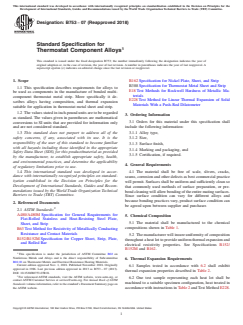
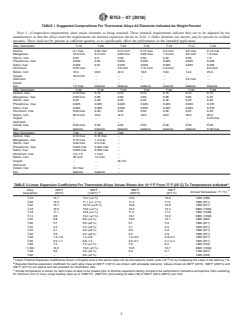
This specification details the requirements for alloys to be used as components in the manufacture of bonded multi-component thermostat metal strip. It describes alloys having composition, and thermal expansion suitable for application in thermostat metal sheet and strip. The material shall be free of scale, slivers, cracks, seams, corrosion and other defects as best commercial practice will permit. Surfaces shall be uniform and sufficiently clean. Product surface condition can be agreed upon between supplier and purchaser since surface condition can vary for different alloys and because bonding practices vary. The material shall be made of carbon, manganese, silicon, phosphorus, sulfur, chromium, nickel, copper, aluminum, cobalt, and iron. This product shall be supplied in the condition agreed upon by purchaser and seller. Hardness shall be measured on representative samples from each heat treat lot.
SCOPE
1.1 This specification describes requirements for alloys to be used as components in the manufacture of bonded multi-component thermostat metal strip. More specifically it describes alloys having composition, and thermal expansion suitable for application in thermostat metal sheet and strip.
1.2 The values stated in inch-pound units are to be regarded as standard. The values given in parentheses are mathematical conversions to SI units that are provided for information only and are not considered standard.
1.3 This standard does not purport to address all of the safety concerns, if any, associated with its use. It is the responsibility of the user of this standard to become familiar with all hazards including those identified in the appropriate Safety Data Sheet (SDS) for this product/material as provided by the manufacturer, to establish appropriate safety, health, and environmental practices, and determine the applicability of regulatory limitations prior to use.
1.4 This international standard was developed in accordance with internationally recognized principles on standardization established in the Decision on Principles for the Development of International Standards, Guides and Recommendations issued by the World Trade Organization Technical Barriers to Trade (TBT) Committee.
- Status
- Published
- Publication Date
- 31-Oct-2018
- Technical Committee
- B02 - Nonferrous Metals and Alloys
- Drafting Committee
- B02.10 - Thermostat Metals and Electrical Resistance Heating Materials

Overview
ASTM B753-07(2018): Standard Specification for Thermostat Component Alloys provides comprehensive requirements for alloys used in bonded multi-component thermostat metal strips. Developed by ASTM International, this standard addresses the chemical composition, thermal expansion, hardness, surface condition, and dimensional tolerances necessary for alloys applied in thermostat sheet and strip production. The specification is vital for ensuring reliability and consistency in materials that experience temperature-driven mechanical changes, playing a critical role in the manufacture of devices requiring precise thermal control.
Key Topics
- Alloy Composition: The specification defines requirements for alloys based on elements like carbon, manganese, silicon, phosphorus, sulfur, chromium, nickel, copper, aluminum, cobalt, and iron. These are tailored to achieve controlled thermal expansion and electrical resistivity.
- Thermal Expansion: Stringent controls are set for linear thermal expansion coefficients, assessed for each alloy type via designated ASTM test methods. This ensures alloys meet critical application demands for dimensional stability in varying temperatures.
- Surface and Physical Quality: All materials supplied must be free of scale, slivers, cracks, seams, corrosion, and other defects as permitted by best commercial practices. Surface condition and finish can be mutually agreed upon, accommodating different alloys or bonding processes.
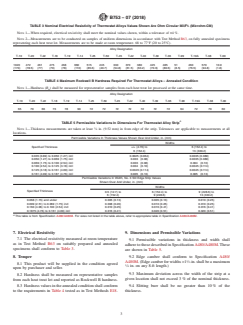
- Hardness and Temper: The standard specifies maximum Rockwell B hardness values for thermostat alloys in annealed condition, ensuring functional performance.
- Electrical Resistivity: For applications requiring specific electrical properties, the standard provides nominal values for electrical resistivity, with testing procedures outlined for compliance.
- Dimensional Tolerances: ASTM B753-07(2018) includes permissible variations in thickness and width, drawing on related standards for flat-rolled products to guarantee interchangeability and fit.
- Certification and Marking: There is a clear mandate for manufacturer certification regarding alloy type, composition, key physical properties, and full traceability through marking and packaging requirements.
Applications
ASTM B753-07(2018) is essential for manufacturers involved in:
- Thermostat Metal Strip Production: Used in the creation of precision thermostat metal sheets and strips for temperature-sensitive switches and controls.
- Temperature Control Devices: Integral for bimetallic strips in thermostats, which operate based on differential thermal expansion of bonded metals to open or close electrical circuits.
- HVAC Controls: Widely utilized in heating, ventilation, and air conditioning systems, ensuring reliable thermal actuation.
- Industrial and Automotive Applications: Applies to relay switches, temperature sensors, appliance controls, and numerous automotive devices where thermal regulation is critical.
- Custom Alloy Orders: Enables supplier and purchaser to specify alloy types, sizes, surface finishes, and certification requirements tailored to unique applications.
By adhering to ASTM B753-07(2018), stakeholders ensure that their thermostat metal components exhibit consistent, predictable responses to temperature changes, supporting product safety, efficiency, and durability.
Related Standards
- ASTM B388 - Standard Specification for Thermostat Metal Sheet and Strip: Addresses final product requirements for thermostat metals, complementing B753 for base alloys.
- ASTM B152/B152M - Specification for Copper Sheet, Strip, Plate, and Rolled Bar: Relevant for copper-based alloys.
- ASTM B162 - Specification for Nickel Plate, Sheet, and Strip: Governs the use of nickel, a key element in many thermostat alloys.
- ASTM E18 - Test Methods for Rockwell Hardness of Metallic Materials: Specifies procedures for hardness measurement.
- ASTM E228 - Test Method for Linear Thermal Expansion of Solid Materials: Provides the methodology for assessing alloy thermal expansion.
- ASTM A480/A480M - General Requirements for Flat-Rolled Stainless and Heat-Resisting Steel Plate, Sheet, and Strip: Used for guidance on dimensional tolerances and processing.
Adherence to these standards ensures harmonization across supply chains, supports international trade, and provides a reliable framework for thermostat alloy applications worldwide.
Relations
- Effective Date
- 01-Nov-2018
- Effective Date
- 01-Nov-2023
- Effective Date
- 01-Oct-2019
- Effective Date
- 01-Sep-2019
- Effective Date
- 01-Apr-2019
- Effective Date
- 01-Sep-2018
- Effective Date
- 01-Jul-2018
- Effective Date
- 01-Apr-2018
- Effective Date
- 01-Nov-2017
- Effective Date
- 01-Jul-2017
- Effective Date
- 01-Dec-2016
- Effective Date
- 01-Sep-2016
- Effective Date
- 15-Apr-2016
- Effective Date
- 01-Feb-2016
- Effective Date
- 01-Sep-2015
Get Certified
Connect with accredited certification bodies for this standard

Element Materials Technology
Materials testing and product certification.

Inštitut za kovinske materiale in tehnologije
Institute of Metals and Technology. Materials testing, metallurgical analysis, NDT.
Sponsored listings
Frequently Asked Questions
ASTM B753-07(2018) is a technical specification published by ASTM International. Its full title is "Standard Specification for Thermostat Component Alloys". This standard covers: ABSTRACT This specification details the requirements for alloys to be used as components in the manufacture of bonded multi-component thermostat metal strip. It describes alloys having composition, and thermal expansion suitable for application in thermostat metal sheet and strip. The material shall be free of scale, slivers, cracks, seams, corrosion and other defects as best commercial practice will permit. Surfaces shall be uniform and sufficiently clean. Product surface condition can be agreed upon between supplier and purchaser since surface condition can vary for different alloys and because bonding practices vary. The material shall be made of carbon, manganese, silicon, phosphorus, sulfur, chromium, nickel, copper, aluminum, cobalt, and iron. This product shall be supplied in the condition agreed upon by purchaser and seller. Hardness shall be measured on representative samples from each heat treat lot. SCOPE 1.1 This specification describes requirements for alloys to be used as components in the manufacture of bonded multi-component thermostat metal strip. More specifically it describes alloys having composition, and thermal expansion suitable for application in thermostat metal sheet and strip. 1.2 The values stated in inch-pound units are to be regarded as standard. The values given in parentheses are mathematical conversions to SI units that are provided for information only and are not considered standard. 1.3 This standard does not purport to address all of the safety concerns, if any, associated with its use. It is the responsibility of the user of this standard to become familiar with all hazards including those identified in the appropriate Safety Data Sheet (SDS) for this product/material as provided by the manufacturer, to establish appropriate safety, health, and environmental practices, and determine the applicability of regulatory limitations prior to use. 1.4 This international standard was developed in accordance with internationally recognized principles on standardization established in the Decision on Principles for the Development of International Standards, Guides and Recommendations issued by the World Trade Organization Technical Barriers to Trade (TBT) Committee.
ABSTRACT This specification details the requirements for alloys to be used as components in the manufacture of bonded multi-component thermostat metal strip. It describes alloys having composition, and thermal expansion suitable for application in thermostat metal sheet and strip. The material shall be free of scale, slivers, cracks, seams, corrosion and other defects as best commercial practice will permit. Surfaces shall be uniform and sufficiently clean. Product surface condition can be agreed upon between supplier and purchaser since surface condition can vary for different alloys and because bonding practices vary. The material shall be made of carbon, manganese, silicon, phosphorus, sulfur, chromium, nickel, copper, aluminum, cobalt, and iron. This product shall be supplied in the condition agreed upon by purchaser and seller. Hardness shall be measured on representative samples from each heat treat lot. SCOPE 1.1 This specification describes requirements for alloys to be used as components in the manufacture of bonded multi-component thermostat metal strip. More specifically it describes alloys having composition, and thermal expansion suitable for application in thermostat metal sheet and strip. 1.2 The values stated in inch-pound units are to be regarded as standard. The values given in parentheses are mathematical conversions to SI units that are provided for information only and are not considered standard. 1.3 This standard does not purport to address all of the safety concerns, if any, associated with its use. It is the responsibility of the user of this standard to become familiar with all hazards including those identified in the appropriate Safety Data Sheet (SDS) for this product/material as provided by the manufacturer, to establish appropriate safety, health, and environmental practices, and determine the applicability of regulatory limitations prior to use. 1.4 This international standard was developed in accordance with internationally recognized principles on standardization established in the Decision on Principles for the Development of International Standards, Guides and Recommendations issued by the World Trade Organization Technical Barriers to Trade (TBT) Committee.
ASTM B753-07(2018) is classified under the following ICS (International Classification for Standards) categories: 77.120.01 - Non-ferrous metals in general. The ICS classification helps identify the subject area and facilitates finding related standards.
ASTM B753-07(2018) has the following relationships with other standards: It is inter standard links to ASTM B753-07(2013), ASTM A480/A480M-23b, ASTM B152/B152M-19, ASTM A480/A480M-19, ASTM B162-99(2019), ASTM A480/A480M-18, ASTM E18-18, ASTM B388-06(2018), ASTM A480/A480M-17, ASTM E18-17, ASTM A480/A480M-16b, ASTM E228-11(2016), ASTM A480/A480M-16a, ASTM A480/A480M-16, ASTM A480/A480M-15. Understanding these relationships helps ensure you are using the most current and applicable version of the standard.
ASTM B753-07(2018) is available in PDF format for immediate download after purchase. The document can be added to your cart and obtained through the secure checkout process. Digital delivery ensures instant access to the complete standard document.
Standards Content (Sample)
This international standard was developed in accordance with internationally recognized principles on standardization established in the Decision on Principles for the
Development of International Standards, Guides and Recommendations issued by the World Trade Organization Technical Barriers to Trade (TBT) Committee.
Designation:B753 −07 (Reapproved 2018)
Standard Specification for
Thermostat Component Alloys
This standard is issued under the fixed designation B753; the number immediately following the designation indicates the year of
original adoption or, in the case of revision, the year of last revision. A number in parentheses indicates the year of last reapproval. A
superscript epsilon (´) indicates an editorial change since the last revision or reapproval.
1. Scope B162 Specification for Nickel Plate, Sheet, and Strip
B388 Specification for Thermostat Metal Sheet and Strip
1.1 This specification describes requirements for alloys to
E18 Test Methods for Rockwell Hardness of Metallic Ma-
be used as components in the manufacture of bonded multi-
terials
component thermostat metal strip. More specifically it de-
E228 Test Method for Linear Thermal Expansion of Solid
scribes alloys having composition, and thermal expansion
Materials With a Push-Rod Dilatometer
suitable for application in thermostat metal sheet and strip.
1.2 The values stated in inch-pound units are to be regarded
3. Ordering Information
as standard. The values given in parentheses are mathematical
3.1 Orders for this material under this specification shall
conversions to SI units that are provided for information only
and are not considered standard. include the following information:
3.1.1 Alloy type,
1.3 This standard does not purport to address all of the
safety concerns, if any, associated with its use. It is the
3.1.2 Size,
responsibility of the user of this standard to become familiar
3.1.3 Surface finish,
with all hazards including those identified in the appropriate
3.1.4 Marking and packaging, and
Safety Data Sheet (SDS) for this product/material as provided
3.1.5 Certification, if required.
by the manufacturer, to establish appropriate safety, health,
and environmental practices, and determine the applicability
4. General Requirements
of regulatory limitations prior to use.
1.4 This international standard was developed in accor-
4.1 The material shall be free of scale, slivers, cracks,
dance with internationally recognized principles on standard-
seams, corrosion and other defects as best commercial practice
ization established in the Decision on Principles for the
will permit. Surfaces shall be uniform and sufficiently clean so
Development of International Standards, Guides and Recom-
that commonly used methods of surface preparation, or pre-
mendations issued by the World Trade Organization Technical
bond cleaning will allow bonding of the entire mating surfaces.
Barriers to Trade (TBT) Committee.
Since surface condition can vary for different alloys and
because bonding practices vary, product surface condition can
2. Referenced Documents
be agreed upon between supplier and purchaser.
2.1 ASTM Standards:
A480/A480M Specification for General Requirements for
5. Chemical Composition
Flat-Rolled Stainless and Heat-Resisting Steel Plate,
5.1 The material shall be manufactured to the chemical
Sheet, and Strip
compositions shown in Table 1.
B63 Test Method for Resistivity of Metallically Conducting
Resistance and Contact Materials
5.2 The manufacturer will insure uniformity of composition
B152/B152M Specification for Copper Sheet, Strip, Plate,
throughoutaheatlottoprovideuniformthermalexpansionand
and Rolled Bar
electrical resistivity properties. See Specifications B152/
B152M and B162.
This specification is under the jurisdiction of ASTM Committee B02 on
Nonferrous Metals and Alloys and is the direct responsibility of Subcommittee
6. Thermal Expansion Requirements
B02.10 on Thermostat Metals and Electrical Resistance Heating Materials.
Current edition approved Nov. 1, 2018. Published November 2018. Originally
6.1 Samples tested in accordance with 6.2 shall exhibit
approved in 1986. Last previous edition approved in 2013 as B753 – 07 (2013).
thermal expansion properties described in Table 2.
DOI: 10.1520/B0753-07R18.
For referenced ASTM standards, visit the ASTM website, www.astm.org, or
6.2 One test sample representing each heat lot shall be
contact ASTM Customer Service at service@astm.org. For Annual Book of ASTM
machined to a suitable specimen configuration, heat treated in
Standards volume information, refer to the standard’s Document Summary page on
the ASTM website. accordance with instructions in Table 2 andTest Method E228.
Copyright © ASTM International, 100 Barr Harbor Drive, PO Box C700, West Conshohocken, PA 19428-2959. United States
B753−07 (2018)
TABLE 1 Suggested Compositions For Thermostat Alloys All Elements Indicated As Weight Percent
NOTE 1—Composition requirements show major elements as being nominal. These nominal requirements indicate they are to be adjusted by the
manufacturer so that the alloys meet the requirements for thermal expansion shown in Table 2. Other elements not shown, may be present in residual
amounts. These shall not be present in sufficient quantity as to significantly affect the performance in the intended application.
Alloy Description T-10 T-20 T-22 T-18 T-19 T-14 T-25
Carbon 0.1 max 0.05 max 0.12 nom 0.15 max 0.5 nom 0.5 max 0.15 max
Manganese 72.0 nom 6.5 nom 0.60 max 0.80 max 1.0 nom 9.0 nom 1.0 max
Silicon, max 0.25 0.3 0.30 0.50 0.40 0.30 1.0
Phosphorus, max 0.030 0.02 0.025 0.025 0.025 0.025 0.025
Sulfur, max 0.030 0.01 0.025 0.025 0.025 0.025 0.025
Chromium 0.25 max . 3.0 nom 11.0 nom 2.0 nom . 8.0 nom
Nickel, nom 10.0 20.0 22.0 18.0 19.0 14.0 25.0
Copper 18.0 nom . . . . . .
Aluminum . . . . . 5.0 nom .
Cobalt . . . . . . .
Iron 1.0 max balance balance balance balance balance balance
Alloy Description T-50 T-45 T-42 T-40 T-39 T-36 T-99
Carbon, max 0.15 max 0.15 0.15 0.15 0.15 0.15 0.15
Manganese, max 0.60 max 0.60 0.60 0.60 0.60 0.60 0.35
Silicon, max 0.40 0.40 0.40 0.40 0.40 0.40 0.35
Phosphorus, max 0.025 0.025 0.025 0.025 0.025 0.025 0.015
Sulfur, max 0.025 0.025 0.025 0.025 0.025 0.025 0.010
Chromium, max 0.50 max 0.50 0.50 0.50 0.50 0.25 0.50
Nickel, nom 50.0 nom 45.0 42.0 40.0 39.0 36.0 99.5
Copper . . . . . . 0.25 max
Aluminum . . . . . . .
Cobalt, max 0.50 max 0.50 0.50 0.50 0.50 0.50 0.50
Iron balance balance balance balance balance balance 0.40 max
Alloy Description T-38 T-19A T-00
Carbon, max 0.12 max 0.15 max .
Manganese, max 0.75 max 1.0 max .
Silicon, max 0.30 max 0.3 max .
Phosphorus, max 0.025 max 0.025 max .
Sulfur, max 0.025 max 0.025 max .
Chromium, max 7.0–7.5 7 nom .
Nickel, nom 38 nom 19 nom .
Copper . . 94 min
Aluminum . . .
Cobalt, max 0.5 max . .
Iron balance balance .
−6 A
TABLE 2 Linear Expansion Coefficients For Thermostat Alloys Values Shown Are 10 /°F From 77°F (25°C) To Temperatures Indicated
Alloy 200°F 300°F 500°F 700°F
C
Anneal Temperature °F (°C)
B
Description (93°C) (149°C) (260°C) (371°C)
T-10 15.1 15.4 (±4 %) 15.6 16.6 1450 (788)
T-20 10.9 11.1 (±1–4 %) 11.4 11.5 1600 (871)
T-22 10.7 10.75 (±4.5 %) 10.9 10.9 1600 (871)
T-18 10.0 10.0 (±4 %) 10.2 10.4 2000 (1093)
T-19 11.1 10.8 (±4 %) 11.2 11.2 1900 (1038)
T-14 9.8 10.4 (±4 %) 10.7 10.9 2000 (1093)
T-2
...