

ASTM B928/B928M-15(2023)e1
(Specification)Standard Specification for High Magnesium Aluminum-Alloy Products for Marine Service and Similar Environments
General Information
- Abstract
ABSTRACT
This specification covers high magnesium marine application aluminum-alloy in those alloy tempers for flat sheet, coiled sheet, and plate, in the mill finish that are intended for marine and similar environments. An inspection lot shall consist of an identifiable quantity of material of the same mill form, alloy, temper, cast or melt lot, and thickness, subjected to inspection at one time. The material shall be supplied in the mill finish and shall be uniform as defined by the requirements of this specification and shall be commercially sound. Each coil, sheet and plate shall be examined to determine conformance to this specification with respect to general quality and identification marking. One sample shall be taken from each end of each parent coil, or parent plate. Alloy-tempers are manufactured and corrosion tested for intended use in marine hull construction or in marine applications where frequent or constant direct contact with seawater is expected. The specimen shall be capable of exhibiting resistance to intergranular corrosion as indicated by an acceptable mass-loss when tested and shall also be capable of exhibiting no evidence of exfoliation or corrosion. Under metallographic examination, the microstructure of a sample from each production lot shall be compared to that of the producer-established reference photomicrograph of acceptable material, in the same thickness range. Each shipping container shall be marked with the purchase order number, material size, specification number, alloy and temper, gross and net weights, and the producer's name or trademark.
SCOPE
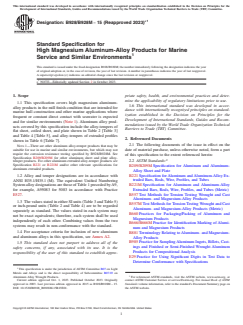
1.1 This specification covers high magnesium aluminum-alloy products in the mill finish condition that are intended for marine hull construction and other marine applications where frequent or constant direct contact with seawater is expected and for similar environments (Note 1). Aluminum alloy products covered by this specification include the alloy-tempers of flat sheet, coiled sheet, and plate shown in Table 2 [Table 3] and Table 4 [Table 5], and alloy-tempers of extruded profiles shown in Table 6 [Table 7].
Note 1: There are other aluminum alloy-temper products that may be suitable for use in marine and similar environments, but which may not require the corrosion resistance testing specified by B928/B928M. See Specification B209/B209M for other aluminum sheet and plate alloy-temper products. For other aluminum extruded alloy-temper products see Specification B221 or B221M and/or other relevant specifications for aluminum extruded products.
1.2 Alloy and temper designations are in accordance with ANSI H35.1/H35.1 (M). The equivalent Unified Numbering System alloy designations are those of Table 1 preceded by A9, for example, A95083 for 5083 in accordance with Practice E527.
1.3 The values stated in either SI units (Table 3 and Table 5) or inch-pound units (Table 2 and Table 4) are to be regarded separately as standard. The values stated in each system may not be exact equivalents; therefore, each system shall be used independently of each other. Combining values from the two systems may result in non-conformance with the standard.
1.4 For acceptance criteria for inclusion of new aluminum and aluminum alloys in this specification, see Annex A2.
1.5 This standard does not purport to address all of the safety concerns, if any, associated with its use. It is the responsibility of the user of this standard to establish appropriate safety, health, and environmental practices and determine the applicability of regulatory limitations prior to use.
1.6 This international standard was developed in accordance with internationally recognized principles on standardization established in the Decision on Principles for the Development of International Standards, Guides and Recommendations issued by the World Trade Organization Technical Barriers to Trade (TBT) Committee.
- Status
- Published
- Publication Date
- 30-Sep-2023
- Technical Committee
- B07 - Light Metals and Alloys
- Drafting Committee
- B07.03 - Aluminum Alloy Wrought Products
Overview
ASTM B928/B928M-15(2023)e1 is an international standard specification developed by ASTM International for high magnesium aluminum-alloy products designed specifically for marine service and similar environments. This standard details the requirements for aluminum alloys, particularly the 5xxx series (containing 3% or more nominal magnesium), in mill-finish conditions as flat sheet, coiled sheet, plate, and extruded profiles. Intended applications include situations where materials are subjected to frequent or constant direct contact with seawater or similar corrosive environments. The specification ensures that the aluminum-alloy products meet defined mechanical and corrosion-resistance properties, making them suitable for demanding marine applications.
Key Topics
Scope of Coverage:
The standard specifies alloy-tempers for flat and coiled sheet, plate, and extruded profiles intended for marine hull construction and other environments with direct seawater exposure.Product Requirements:
- Products are supplied in mill finish condition.
- The material must be uniform, commercially sound, and conform to the specified chemical composition, mechanical properties, and corrosion-resistance criteria.
Quality Assurance:
- Inspections are required to confirm product identity, quality, and marking.
- Testing includes both mechanical properties (tensile strength, yield strength, elongation) and resistance to exfoliation and intergranular corrosion.
Corrosion Resistance:
- Products, particularly in H116 and H321 tempers, are tested to ensure resistance to both exfoliation and intergranular corrosion using ASTM-defined test methods.
- Reference microstructures and photomicrographs are used for process qualification and ongoing quality checks.
Ordering & Marking:
Detailed requirements for how materials must be specified in orders (alloy, temper, dimensions, etc.) and how shipping containers are to be marked for traceability.Units:
The standard allows the use of both SI and inch-pound units, but values must not be mixed within a specification or order.
Applications
ASTM B928/B928M-15(2023)e1 applies to a diverse range of marine and industrial environments requiring durable, corrosion-resistant sheet, plate, and extruded aluminum products. Practical uses include:
Marine Hull Construction:
Aluminum alloys covered by this standard are widely used in ships, boats, offshore platforms, and naval vessels due to their high resistance to saltwater corrosion, lightweight, and structural integrity.Coastal and Offshore Structures:
Ideal for harbors, docks, ramps, and components exposed to tidal and splash zones.Transport and Storage:
Utilized in making lightweight, corrosion-resistant containers, tanks, and cargo holds for marine transport.General Industrial Use:
Suitable for any application where frequent contact with corrosive environments, such as brine or industrial chemicals, is expected and a robust aluminum alloy is required.
Related Standards
To ensure comprehensive compliance and product suitability, consider referencing these related standards:
- ASTM B209/B209M: Specification for Aluminum and Aluminum-Alloy Sheet and Plate for products not requiring enhanced corrosion testing.
- ASTM B221/B221M: Specification for Aluminum and Aluminum-Alloy Extruded Bars, Rods, Wire, Profiles, and Tubes.
- ANSI H35.1/H35.1(M): Alloy and Temper Designation Systems for Aluminum.
- ASTM B660: Practices for Packaging/Packing of Aluminum and Magnesium Products.
- ASTM G66 & G67: Standard test methods for visual assessment of exfoliation corrosion and intergranular corrosion susceptibility in 5xxx series aluminum alloys.
By adhering to ASTM B928/B928M-15(2023)e1, manufacturers, engineers, and purchasers working in marine and harsh industrial sectors can ensure the selection of appropriate high magnesium aluminum alloys that provide superior performance and longevity in corrosive environments. This standard bridges the requirements for safety, quality, and material consistency crucial for marine applications and beyond.
Relations
- Effective Date
- 01-Oct-2023
- Effective Date
- 15-Jan-2024
- Effective Date
- 01-Dec-2023
- Effective Date
- 01-Nov-2023
- Effective Date
- 01-Apr-2023
- Effective Date
- 01-Apr-2023
- Effective Date
- 01-Sep-2021
- Effective Date
- 01-Oct-2018
- Effective Date
- 01-Oct-2018
- Effective Date
- 01-Oct-2023
- Effective Date
- 01-Oct-2023
- Referred By
ASTM B209/B209M-21a - Standard Specification for Aluminum and Aluminum-Alloy Sheet and Plate - Effective Date
- 01-Oct-2023
Get Certified
Connect with accredited certification bodies for this standard

DNV
DNV is an independent assurance and risk management provider.

Lloyd's Register
Lloyd's Register is a global professional services organisation specialising in engineering and technology.

Element Materials Technology
Materials testing and product certification.
Sponsored listings
Frequently Asked Questions
ASTM B928/B928M-15(2023)e1 is a technical specification published by ASTM International. Its full title is "Standard Specification for High Magnesium Aluminum-Alloy Products for Marine Service and Similar Environments". This standard covers: ABSTRACT This specification covers high magnesium marine application aluminum-alloy in those alloy tempers for flat sheet, coiled sheet, and plate, in the mill finish that are intended for marine and similar environments. An inspection lot shall consist of an identifiable quantity of material of the same mill form, alloy, temper, cast or melt lot, and thickness, subjected to inspection at one time. The material shall be supplied in the mill finish and shall be uniform as defined by the requirements of this specification and shall be commercially sound. Each coil, sheet and plate shall be examined to determine conformance to this specification with respect to general quality and identification marking. One sample shall be taken from each end of each parent coil, or parent plate. Alloy-tempers are manufactured and corrosion tested for intended use in marine hull construction or in marine applications where frequent or constant direct contact with seawater is expected. The specimen shall be capable of exhibiting resistance to intergranular corrosion as indicated by an acceptable mass-loss when tested and shall also be capable of exhibiting no evidence of exfoliation or corrosion. Under metallographic examination, the microstructure of a sample from each production lot shall be compared to that of the producer-established reference photomicrograph of acceptable material, in the same thickness range. Each shipping container shall be marked with the purchase order number, material size, specification number, alloy and temper, gross and net weights, and the producer's name or trademark. SCOPE 1.1 This specification covers high magnesium aluminum-alloy products in the mill finish condition that are intended for marine hull construction and other marine applications where frequent or constant direct contact with seawater is expected and for similar environments (Note 1). Aluminum alloy products covered by this specification include the alloy-tempers of flat sheet, coiled sheet, and plate shown in Table 2 [Table 3] and Table 4 [Table 5], and alloy-tempers of extruded profiles shown in Table 6 [Table 7]. Note 1: There are other aluminum alloy-temper products that may be suitable for use in marine and similar environments, but which may not require the corrosion resistance testing specified by B928/B928M. See Specification B209/B209M for other aluminum sheet and plate alloy-temper products. For other aluminum extruded alloy-temper products see Specification B221 or B221M and/or other relevant specifications for aluminum extruded products. 1.2 Alloy and temper designations are in accordance with ANSI H35.1/H35.1 (M). The equivalent Unified Numbering System alloy designations are those of Table 1 preceded by A9, for example, A95083 for 5083 in accordance with Practice E527. 1.3 The values stated in either SI units (Table 3 and Table 5) or inch-pound units (Table 2 and Table 4) are to be regarded separately as standard. The values stated in each system may not be exact equivalents; therefore, each system shall be used independently of each other. Combining values from the two systems may result in non-conformance with the standard. 1.4 For acceptance criteria for inclusion of new aluminum and aluminum alloys in this specification, see Annex A2. 1.5 This standard does not purport to address all of the safety concerns, if any, associated with its use. It is the responsibility of the user of this standard to establish appropriate safety, health, and environmental practices and determine the applicability of regulatory limitations prior to use. 1.6 This international standard was developed in accordance with internationally recognized principles on standardization established in the Decision on Principles for the Development of International Standards, Guides and Recommendations issued by the World Trade Organization Technical Barriers to Trade (TBT) Committee.
ABSTRACT This specification covers high magnesium marine application aluminum-alloy in those alloy tempers for flat sheet, coiled sheet, and plate, in the mill finish that are intended for marine and similar environments. An inspection lot shall consist of an identifiable quantity of material of the same mill form, alloy, temper, cast or melt lot, and thickness, subjected to inspection at one time. The material shall be supplied in the mill finish and shall be uniform as defined by the requirements of this specification and shall be commercially sound. Each coil, sheet and plate shall be examined to determine conformance to this specification with respect to general quality and identification marking. One sample shall be taken from each end of each parent coil, or parent plate. Alloy-tempers are manufactured and corrosion tested for intended use in marine hull construction or in marine applications where frequent or constant direct contact with seawater is expected. The specimen shall be capable of exhibiting resistance to intergranular corrosion as indicated by an acceptable mass-loss when tested and shall also be capable of exhibiting no evidence of exfoliation or corrosion. Under metallographic examination, the microstructure of a sample from each production lot shall be compared to that of the producer-established reference photomicrograph of acceptable material, in the same thickness range. Each shipping container shall be marked with the purchase order number, material size, specification number, alloy and temper, gross and net weights, and the producer's name or trademark. SCOPE 1.1 This specification covers high magnesium aluminum-alloy products in the mill finish condition that are intended for marine hull construction and other marine applications where frequent or constant direct contact with seawater is expected and for similar environments (Note 1). Aluminum alloy products covered by this specification include the alloy-tempers of flat sheet, coiled sheet, and plate shown in Table 2 [Table 3] and Table 4 [Table 5], and alloy-tempers of extruded profiles shown in Table 6 [Table 7]. Note 1: There are other aluminum alloy-temper products that may be suitable for use in marine and similar environments, but which may not require the corrosion resistance testing specified by B928/B928M. See Specification B209/B209M for other aluminum sheet and plate alloy-temper products. For other aluminum extruded alloy-temper products see Specification B221 or B221M and/or other relevant specifications for aluminum extruded products. 1.2 Alloy and temper designations are in accordance with ANSI H35.1/H35.1 (M). The equivalent Unified Numbering System alloy designations are those of Table 1 preceded by A9, for example, A95083 for 5083 in accordance with Practice E527. 1.3 The values stated in either SI units (Table 3 and Table 5) or inch-pound units (Table 2 and Table 4) are to be regarded separately as standard. The values stated in each system may not be exact equivalents; therefore, each system shall be used independently of each other. Combining values from the two systems may result in non-conformance with the standard. 1.4 For acceptance criteria for inclusion of new aluminum and aluminum alloys in this specification, see Annex A2. 1.5 This standard does not purport to address all of the safety concerns, if any, associated with its use. It is the responsibility of the user of this standard to establish appropriate safety, health, and environmental practices and determine the applicability of regulatory limitations prior to use. 1.6 This international standard was developed in accordance with internationally recognized principles on standardization established in the Decision on Principles for the Development of International Standards, Guides and Recommendations issued by the World Trade Organization Technical Barriers to Trade (TBT) Committee.
ASTM B928/B928M-15(2023)e1 is classified under the following ICS (International Classification for Standards) categories: 47.020.01 - General standards related to shipbuilding and marine structures; 77.120.01 - Non-ferrous metals in general. The ICS classification helps identify the subject area and facilitates finding related standards.
ASTM B928/B928M-15(2023)e1 has the following relationships with other standards: It is inter standard links to ASTM B928/B928M-15(2023), ASTM G67-24, ASTM G66-23, ASTM B660-23, ASTM B557M-15(2023), ASTM B557-15(2023), ASTM B660-21, ASTM G67-18, ASTM G66-99(2018)e1, ASTM B881-17, ASTM C1802-23, ASTM B209/B209M-21a. Understanding these relationships helps ensure you are using the most current and applicable version of the standard.
ASTM B928/B928M-15(2023)e1 is available in PDF format for immediate download after purchase. The document can be added to your cart and obtained through the secure checkout process. Digital delivery ensures instant access to the complete standard document.
Standards Content (Sample)
This international standard was developed in accordance with internationally recognized principles on standardization established in the Decision on Principles for the
Development of International Standards, Guides and Recommendations issued by the World Trade Organization Technical Barriers to Trade (TBT) Committee.
´1
Designation: B928/B928M − 15 (Reapproved 2023)
Standard Specification for
High Magnesium Aluminum-Alloy Products for Marine
Service and Similar Environments
This standard is issued under the fixed designation B928/B928M; the number immediately following the designation indicates the year
of original adoption or, in the case of revision, the year of last revision. A number in parentheses indicates the year of last reapproval.
A superscript epsilon (´) indicates an editorial change since the last revision or reapproval.
ε NOTE—Editorially updated Section 2 in October 2023.
1. Scope priate safety, health, and environmental practices and deter-
mine the applicability of regulatory limitations prior to use.
1.1 This specification covers high magnesium aluminum-
1.6 This international standard was developed in accor-
alloy products in the mill finish condition that are intended for
dance with internationally recognized principles on standard-
marine hull construction and other marine applications where
ization established in the Decision on Principles for the
frequent or constant direct contact with seawater is expected
Development of International Standards, Guides and Recom-
and for similar environments (Note 1). Aluminum alloy prod-
mendations issued by the World Trade Organization Technical
ucts covered by this specification include the alloy-tempers of
Barriers to Trade (TBT) Committee.
flat sheet, coiled sheet, and plate shown in Table 2 [Table 3]
and Table 4 [Table 5], and alloy-tempers of extruded profiles
2. Referenced Documents
shown in Table 6 [Table 7].
2.1 The following documents of the issue in effect on the
NOTE 1—There are other aluminum alloy-temper products that may be
suitable for use in marine and similar environments, but which may not
date of material purchase, unless otherwise noted, form a part
require the corrosion resistance testing specified by B928/B928M. See
of this specification to the extent referenced herein:
Specification B209/B209M for other aluminum sheet and plate alloy-
temper products. For other aluminum extruded alloy-temper products see 2.2 ASTM Standards:
Specification B221 or B221M and/or other relevant specifications for
B209/B209M Specification for Aluminum and Aluminum-
aluminum extruded products.
Alloy Sheet and Plate
B221 Specification for Aluminum and Aluminum-Alloy Ex-
1.2 Alloy and temper designations are in accordance with
ANSI H35.1/H35.1 (M). The equivalent Unified Numbering truded Bars, Rods, Wire, Profiles, and Tubes
B221M Specification for Aluminum and Aluminum-Alloy
System alloy designations are those of Table 1 preceded by A9,
for example, A95083 for 5083 in accordance with Practice Extruded Bars, Rods, Wire, Profiles, and Tubes (Metric)
B557 Test Methods for Tension Testing Wrought and Cast
E527.
Aluminum- and Magnesium-Alloy Products
1.3 The values stated in either SI units (Table 3 and Table 5)
B557M Test Methods for Tension Testing Wrought and Cast
or inch-pound units (Table 2 and Table 4) are to be regarded
Aluminum- and Magnesium-Alloy Products (Metric)
separately as standard. The values stated in each system may
B660 Practices for Packaging/Packing of Aluminum and
not be exact equivalents; therefore, each system shall be used
Magnesium Products
independently of each other. Combining values from the two
B666/B666M Practice for Identification Marking of Alumi-
systems may result in non-conformance with the standard.
num and Magnesium Products
1.4 For acceptance criteria for inclusion of new aluminum
B881 Terminology Relating to Aluminum- and Magnesium-
and aluminum alloys in this specification, see Annex A2.
Alloy Products
B985 Practice for Sampling Aluminum Ingots, Billets, Cast-
1.5 This standard does not purport to address all of the
ings and Finished or Semi-Finished Wrought Aluminum
safety concerns, if any, associated with its use. It is the
Products for Compositional Analysis
responsibility of the user of this standard to establish appro-
E29 Practice for Using Significant Digits in Test Data to
Determine Conformance with Specifications
This specification is under the jurisdiction of ASTM Committee B07 on Light
Metals and Alloys and is the direct responsibility of Subcommittee B07.03 on
Aluminum Alloy Wrought Products. For referenced ASTM standards, visit the ASTM website, www.astm.org, or
Current edition approved Oct. 1, 2023. Published October 2023. Originally contact ASTM Customer Service at service@astm.org. For Annual Book of ASTM
approved in 2003. Last previous edition approved in 2015 as B928/B928M – 15. Standards volume information, refer to the standard’s Document Summary page on
DOI: 10.1520/B0928_B0928M-15R23E01. the ASTM website.
Copyright © ASTM International, 100 Barr Harbor Drive, PO Box C700, West Conshohocken, PA 19428-2959. United States
´1
B928/B928M − 15 (2023)
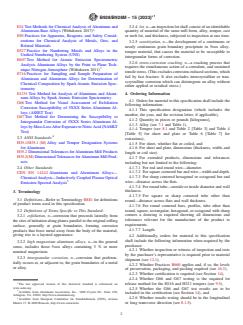
E34 Test Methods for Chemical Analysis of Aluminum and 3.2.4 lot, n—an inspection lot shall consist of an identifiable
Aluminum-Base Alloys (Withdrawn 2017) quantity of material of the same mill form, alloy, temper, cast
E50 Practices for Apparatus, Reagents, and Safety Consid- or melt lot, and thickness, subjected to inspection at one time.
erations for Chemical Analysis of Metals, Ores, and
3.2.5 sensitization, n—the development of a continuous or
Related Materials
nearly continuous grain boundary precipitate in 5xxx alloy-
E527 Practice for Numbering Metals and Alloys in the
temper material, that causes the material to be susceptible to
Unified Numbering System (UNS)
intergranular forms of corrosion.
E607 Test Method for Atomic Emission Spectrometric
3.2.6 stress-corrosion cracking, n—a cracking process that
Analysis Aluminum Alloys by the Point to Plane Tech-
requires the simultaneous action of a corrodent, and sustained
nique Nitrogen Atmosphere (Withdrawn 2011)
tensile stress. (This excludes corrosion-reduced sections, which
E716 Practices for Sampling and Sample Preparation of
fail by fast fracture. It also excludes intercrystalline or tran-
Aluminum and Aluminum Alloys for Determination of
scrystalline corrosion which can disintegrate an alloy without
Chemical Composition by Spark Atomic Emission Spec-
either applied or residual stress.)
trometry
E1251 Test Method for Analysis of Aluminum and Alumi-
4. Ordering Information
num Alloys by Spark Atomic Emission Spectrometry
4.1 Orders for material to this specification shall include the
G66 Test Method for Visual Assessment of Exfoliation
following information:
Corrosion Susceptibility of 5XXX Series Aluminum Al-
4.1.1 This specification designation (which includes the
loys (ASSET Test)
number, the year, and the revision letter, if applicable),
G67 Test Method for Determining the Susceptibility to
4.1.2 Quantity in pieces or pounds [kilograms],
Intergranular Corrosion of 5XXX Series Aluminum Al-
4.1.3 Alloy (see 7.1 and Table 1),
loys by Mass Loss After Exposure to Nitric Acid (NAMLT
4.1.4 Temper (see 8.1 and Table 2 [Table 3] and Table 4
Test)
[Table 5] for sheet and plate or Table 6 [Table 7] for
2.3 ANSI Standards:
extrusions),
H35.1/H35.1 (M) Alloy and Temper Designation Systems
4.1.5 For sheet, whether flat or coiled, and
for Aluminum
4.1.6 For sheet and plate, dimensions (thickness, width, and
H35.2 Dimensional Tolerances for Aluminum Mill Products
length or coil size).
H35.2(M) Dimensional Tolerances for Aluminum Mill Prod-
4.1.7 For extruded products, dimensions and tolerances
ucts
including but not limited to the following:
4.1.7.1 For rod and round wire—diameter.
2.4 Other Standards:
4.1.7.2 For square cornered bar and wire—width and depth.
CEN EN 14242 Aluminum and Aluminum Alloys—
4.1.7.3 For sharp cornered hexagonal or octagonal bar and
Chemical Analysis—Inductively Coupled Plasma Optical
wire—distance across the flats.
Emission Spectral Analysis
4.1.7.4 For round tube—outside or inside diameter and wall
thickness.
3. Terminology
4.1.7.5 For square or sharp cornered tube other than
3.1 Definitions—Refer to Terminology B881 for definitions
round—distance across flats and wall thickness.
of product terms used in this specification.
4.1.7.6 For round cornered bars, profiles, tube other than
round, square, rectangular, hexagonal, or octagonal with sharp
3.2 Definitions of Terms Specific to This Standard:
corners a drawing is required showing all dimensions and
3.2.1 exfoliation, n—corrosion that proceeds laterally from
tolerances relevant for the manufacture of the product to
the sites of initiation along planes parallel to the original rolling
requirements.
surface, generally at grain boundaries, forming corrosion
4.1.7.7 Length.
products that force metal away from the body of the material,
giving rise to a layered appearance.
4.2 Additionally, orders for material to this specification
shall include the following information when required by the
3.2.2 high magnesium aluminum alloys, n—in the general
purchaser:
sense, includes those 5xxx alloys containing 3 % or more
4.2.1 Whether inspection or witness of inspection and tests
nominal magnesium.
by the purchaser’s representative is required prior to material
3.2.3 intergranular corrosion, n—corrosion that preferen-
shipment (see 12.1),
tially occurs at, or adjacent to, the grain boundaries of a metal
4.2.2 Whether Practices B660 applies and, if so, the levels
or alloy.
of preservation, packaging, and packing required (see 16.3),
4.2.3 Whether certification is required (see Section 14),
4.2.4 Whether G66 and G67 testing is the required lot
release method for the H116 and H321 tempers (see 9.5),
The last approved version of this historical standard is referenced on
www.astm.org.
4.2.5 Whether the G66 and G67 test results are to be
Available from Aluminum Association, Inc., 1400 Crystal Dr., Suite 430,
included in the certification (see Section 14), and
Arlington, VA, 22202, http://www.aluminum.org.
4.2.6 Whether tensile testing should be in the longitudinal
Available from European Committee for Standardization (CEN), Avenue
Marnix 17, B-1000 Brussels, http://www.cenorm.be. or long transverse direction (see 8.1.5).
´1
B928/B928M − 15 (2023)
5. Responsibility for Quality Assurance 7.2 If it becomes necessary to analyze the finished or
semifinished product for conformance to chemical composition
5.1 Responsibility for Inspection and Tests—Unless other-
limits, the methods of sampling and methods of analysis shall
wise specified in the contract or purchase order, the producer is
be as provided in the following:
responsible for the performance of all inspection and test
7.2.1 Methods of Sampling—Samples for chemical analysis
requirements specified herein. Producers may use their own or
shall be taken in accordance with Practice B985.
any other suitable facilities for the performance of the inspec-
7.2.2 Methods of Analysis—Analysis shall be performed in
tion and test requirements specified herein, unless disapproved
accordance with Test Methods E607, E1251, or E34, or CEN
by the purchaser in the order or at the time of contract signing.
EN 14242 (ICP method).
The purchaser shall have the right to perform any of the
inspections and tests set forth in this specification where such
8. Tensile Properties of Material as Supplied
inspections are deemed necessary to ensure that material
8.1 Tensile Properties for Sheet and Plate Products:
conforms to prescribed requirements.
8.1.1 Limits—The sheet and plate shall conform to the
6. General Quality requirements for tensile properties as specified in Table 2
[Table 3] or Table 4 [Table 5]. Table 2 [Table 3] includes
6.1 Unless otherwise specified, the material shall be sup-
specification limits for tensile properties in the longitudinal
plied in the mill finish, shall be uniform as defined by the
direction. Table 4 [Table 5] includes specification limits for
requirements of this specification and shall be commercially
tensile properties in the long transverse direction.
sound. Any requirement not so covered is subject to negotia-
8.1.1.1 Tensile property limits for sizes not covered in Table
tion between producer and purchaser.
2 [Table 3] or Table 4 [Table 5] shall be as agreed upon
6.2 Each coil, sheet and plate, or extrusion lot shall be
between the producer and purchaser and shall be so specified in
examined to determine conformance to this specification with
the contract or purchase order.
respect to general quality and identification marking. On
8.1.2 Number of Samples—One sample shall be taken from
approval of the purchaser, however, the producer may use a
each end of each parent coil, or parent plate, but no more than
system of statistical quality control for such examinations.
one sample per 2000 lb [1000 kg] of sheet or 4000 lb [2000 kg]
of plate, or part thereof, in a lot shall be required. Other
7. Chemical Composition
procedures for selecting samples may be employed if agreed
7.1 Limits—The sheet and plate shall conform to the chemi- upon between the producer and purchaser.
cal composition limits specified in Table 1. Conformance shall 8.1.3 Test Specimens—Geometry of test specimens and the
location in the product from which they are taken shall be as
be determined by the producer, by taking samples in accor-
dance with Practices E716 when the ingots are poured and specified in Test Methods B557 or B557M, with the exception
that the test direction will be as specified in 8.1.5.
analyzing those samples in accordance with Test Methods
E607, E1251, E34 or EN 14242. At least one sample shall be 8.1.4 Test Methods—The tension test shall be made in
taken for each group of ingots poured simultaneously from the accordance with Test Methods B557 or B557M.
same source of molten metal. If the producer has determined 8.1.5 Testing Direction—Tensile testing shall be in the
the chemical composition during pouring of the ingots, they longitudinal direction unless the long transverse direction is
shall not be required to sample and analyze the finished specified in the contract or purchase order. Tensile testing
product. direction shall be noted on all documentation.
A,B,C,H
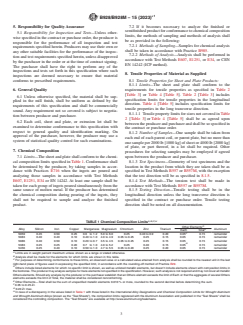
TABLE 1 Chemical Composition Limits
D
Other Elements
Alloy Silicon Iron Copper Manganese Magnesium Chromium Zinc Titanium Aluminum
E
Each Total
F
5059 0.45 0.50 0.25 0.6 to 1.2 5.0 to 6.0 0.25 0.40 to 0.9 0.20 0.05 0.15 remainder
5083 0.40 0.40 0.10 0.40 to 1.0 4.0 to 4.9 0.05 to 0.25 0.25 0.15 0.05 0.15 remainder
5086 0.40 0.50 0.10 0.20 to 0.7 3.5 to 4.5 0.05 to 0.25 0.25 0.15 0.05 0.15 remainder
G
5383 0.25 0.25 0.20 0.7 to 1.0 4.0 to 5.2 0.25 0.40 0.15 0.05 0.15 remainder
5456 0.25 0.40 0.10 0.50 to 1.0 4.7 to 5.5 0.05 to 0.20 0.25 0.20 0.05 0.15 remainder
A
Limits are in weight percent maximum unless shown as a range or stated otherwise.
B
Analysis shall be made for the elements for which limits are shown in this table.
C
For purposes of determining conformance to these limits, an observed value or a calculated value attained from analysis shall be rounded to the nearest unit in the last
right-hand place of figures used in expressing the specified limit, in accordance with the rounding-off method of Practice E29.
D
Others include listed elements for which no specific limit is shown, as well as unlisted metallic elements, but doesn’t include elements shown with composition limits in
the footnotes. The producer may analyze samples for trace elements not specified in the specification. However, such analysis is not required and may not cover all metallic
Others elements. Should any analysis by the producer or the purchaser establish that an Others element exceeds the limit of Each or that the aggregate of several Others
elements exceeds the limit of Total, the material shall be considered nonconforming.
E
Other Elements—Total shall be the sum of unspecified metallic elements 0.010 % or more, rounded to the second decimal before determining the sum.
F
0.05 to 0.25 Zr.
G
0.20 Zr max.
H
In case of a discrepancy in the values listed in Table 1 with those listed in the International Alloy Designations and Chemical Composition Limits for Wrought Aluminum
and Wrought Aluminum Alloys (known as the “Teal Sheets”), the composition limits registered with the Aluminum Association and published in the “Teal Sheets” shall be
considered the controlling composition. The “Teal Sheets” are available at http://www.aluminum.org/tealsheets.
´1
B928/B928M − 15 (2023)
A,B
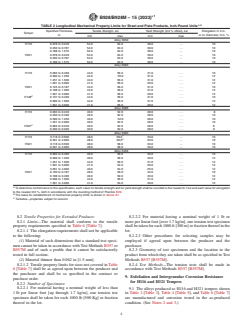
TABLE 2 Longitudinal Mechanical Property Limits for Sheet and Plate Products, Inch-Pound Units
Tensile Strength, ksi Yield Strength (0.2 % offset), ksi
Specified Thickness, Elongation in 2 in.
Temper
in. or 4× Diameter, min, %
min max min max
Alloy 5059
H116 0.078 to 0.249 54.0 64.0 39.0 . 10
0.250 to 0.787 54.0 64.0 39.0 . 10
0.788 to 1.575 52.0 64.0 38.0 . 10
H321 0.078 to 0.249 54.0 64.0 39.0 . 10
0.250 to 0.787 54.0 64.0 39.0 . 10
0.788 to 1.575 52.0 64.0 38.0 . 10
Alloy 5083
H116 0.063 to 0.499 44.0 56.0 31.0 . . . 10
0.500 to 1.250 44.0 56.0 31.0 . . . 12
1.251 to 1.500 44.0 56.0 31.0 . . . 12
1.501 to 3.000 41.0 56.0 29.0 . . . 12
H321 0.125 to 0.187 44.0 56.0 31.0 . . . 10
0.188 to 1.500 44.0 56.0 31.0 . . . 12
1.501 to 3.000 41.0 56.0 29.0 . . . 12
C
H128 0.157 to 0.499 44.0 56.0 31.0 . . . 10
0.500 to 1.500 44.0 56.0 31.0 . . . 12
1.501 to 3.000 41.0 56.0 29.0 . . . 12
Alloy 5086
H116 0.063 to 0.249 40.0 52.0 28.0 . . . 8
0.250 to 0.499 40.0 52.0 28.0 . . . 10
0.500 to 1.250 40.0 52.0 28.0 . . . 10
1.251 to 2.000 40.0 52.0 28.0 . . . 10
C
H321 0.063 to 0.249 40.0 52.0 28.0 . . . 8
0.250 to 0.320 40.0 52.0 28.0 . . . 9
Alloy 5383
C
H116 0.118 to 0.500 48.0 58.0 33.0 . 10
C
0.501 to 2.000 48.0 58.0 33.0 . 10
H321 0.118 to 0.500 48.0 58.0 33.0 . 10
0.501 to 2.000 48.0 58.0 33.0 . 10
Alloy 5456
H116 0.063 to 0.499 46.0 59.0 33.0 . . . 10
0.500 to 1.250 46.0 56.0 33.0 . . . 12
1.251 to 1.500 44.0 56.0 31.0 . . . 12
1.501 to 3.000 41.0 54.0 29.0 . . . 12
3.001 to 4.000 40.0 54.0 25.0 . . . 12
H321 0.100 to 0.187 48.0 59.0 34.0 . . . 10
0.188 to 0.499 46.0 59.0 33.0 . . . 12
0.500 to 1.500 44.0 56.0 31.0 . . . 12
1.501 to 3.000 41.0 54.0 29.0 . . . 12
A
To determine conformance to this specification, each value for tensile strength and for yield strength shall be rounded to the nearest 0.1 ksi and each value for elongation
to the nearest 0.5 %, both in accordance with the rounding method of Practice E29.
B
The basis for establishment of mechanical property limits is shown in Annex A1.
C
Tentative—properties subject to revision.
8.2 Tensile Properties for Extruded Products: 8.2.2.2 For material having a nominal weight of 1 lb or
8.2.1 Limits—The material shall conform to the tensile more per linear foot [over 1.7 kg/m], one tension test specimen
property requirements specified in Table 6 [Table 7]. shall be taken for each 1000 ft [300 m] or fraction thereof in the
8.2.1.1 The elongation requirements shall not be applicable lot.
to the following: 8.2.2.3 Other procedures for selecting samples may be
(1) Material of such dimensions that a standard test speci- employed if agreed upon between the producer and the
men cannot be taken in accordance with Test Methods B557 or purchaser.
B557M and of such a profile that it cannot be satisfactorily 8.2.3 Geometry of test specimens and the location in the
tested in full section. product from which they are taken shall be as specified in Test
(2) Material thinner than 0.062 in [1.5 mm]. Methods B557 [B557M].
8.2.1.2 Tensile property limits for sizes not covered in Table 8.2.4 Test Methods—The tension tests shall be made in
6 [Table 7] shall be as agreed upon between the producer and accordance with Test Methods B557 [B557M].
the purchaser and shall be so specified in the contract or
9. Exfoliation and Intergranular Corrosion Resistance
purchase order.
for H116 and H321 Tempers
8.2.2 Number of Specimens:
8.2.2.1 For material having a nominal weight of less than 9.1 The alloys produced as H116 and H321 tempers shown
1 lb per linear foot [up through 1.7 kg/m], one tension test in Table 2 [Table 3], Table 4 [Table 5], and Table 6 [Table 7]
specimen shall be taken for each 1000 lb [500 Kg] or fraction are manufactured and corrosion tested in the as-produced
thereof in the lot. condition. (See Notes 2 and 3.)
´1
B928/B928M − 15 (2023)
A,B
TABLE 3 Longitudinal Mechanical Property Limits for Sheet and Plate Products, [SI Units]
Yield Strength (0.2 % offset),
C
Specified Thickness, mm Tensile Strength, MPa Elongation, min, %
MPa
Temper
over through min max min max in 50 mm in 5× Diameter
Alloy 5059
H116 1.99 6.30 370 440 270 . 10 .
6.30 12.50 370 440 270 . 10 .
12.50 20.00 370 440 270 . . 10
20.00 40.00 360 440 260 . . 10
H321 1.99 6.30 370 440 270 . 10 .
6.30 12.50 370 440 270 . 10 .
12.50 20.00 370 440 270 . . 10
20.00 40.00 360 440 260 . . 10
Alloy 5083
H116 1.60 12.50 305 385 215 . . . 10 . . .
12.50 30.00 305 385 215 . . . . . . 10
30.00 40.00 305 385 215 . . . . . . 10
40.00 80.00 285 385 200 . . . . . . 10
H321 3.20 5.00 305 385 215 . . . 10 . . .
5.00 12.50 305 385 215 . . . 12 . . .
12.50 40.00 305 385 215 . . . . . . 10
40.00 80.00 285 385 200 . . . . . . 10
D
H128 4.00 12.50 305 385 215 . . . 10 . . .
12.50 40.00 305 385 215 . . . . . . 10
40.00 80.00 285 385 200 . . . . . . 10
Alloy 5086
H116 1.60 6.30 275 360 195 . . . 8 . . .
6.30 12.50 275 360 195 . . . 10 . . .
12.50 30.00 275 360 195 . . . . . . 9
30.00 50.00 275 360 195 . . . . . . 9
D
H321 1.60 6.30 275 360 195 . . . 8 . . .
6.30 8.00 275 360 195 . . . 9 . . .
Alloy 5383
D
H116 3.00 12.50 330 400 230 . 10 .
D
12.50 50.00 330 400 230 . . 10
H321 3.00 12.50 330 400 230 . 10 .
12.50 50.00 330 400 230 . . 10
Alloy 5456
H116 1.60 12.50 315 405 230 . . . 10 . . .
12.50 30.00 315 385 230 . . . . . . 10
30.00 40.00 305 385 215 . . . . . . 10
40.00 80.00 285 370 200 . . . . . . 10
80.00 110.00 275 370 170 . . . . . . 10
H321 2.50 4.00 330 405 235 . . . 10 . . .
4.00 12.50 315 405 230 12 . . .
12.50 40.00 305 385 215 . . . 10
40.00 80.00 285 370 200 . . . 10
A
To determine conformance to this specification, each value for tensile strength and for yield strength shall be rounded to the nearest 1 MPa and each value for elongation
to the nearest 0.5 %, both in accordance with the rounding method of Practice E29.
B
The basis for establishment of mechanical property limits is shown in Annex A1.
C
Elongations in 50 mm apply for thicknesses up through 12.50 mm and in 5× diameter for thicknesses over 12.50 mm.
D
Tentative—properties subject to revision.
´1
B928/B928M − 15 (2023)
A,B
TABLE 4 Long Transverse Mechanical Property Limits for Sheet and Plate Products, Inch-Pound Units
Elongation in 2 in.
Specified Thickness, in. Tensile Strength, ksi Yield Strength (0.2 % offset), ksi
Temper or ×4 Diameter,
min max min max
min, %
Alloy 5083
H116 0.118 to 0.249 44.0 . . . 31.0 . . . 10
0.250 to 0.499 44.0 . . . 31.0 . . . 10
H321 0.118 to 0.236 44.0 55.0 31.0 . . . 10
C
H128 0.157 to 0.499 44.0 56.0 31.0 . . . 10
0.500 to 1.500 44.0 56.0 31.0 . . . 12
1.501 to 3.000 41.0 56.0 29.0 . . . 12
Alloy 5086
C
H321 0.250 to 0.320 40.0 52.0 28.0 . . . 10
A
To determine conformance to this specification, each value for tensile strength and for yield strength shall be rounded to the nearest 0.1 ksi and each value for elongation
to the nearest 0.5 %, both in accordance with the rounding method of Practice E29.
B
The basis for establishment of mechanical property limits is shown in Annex A1.
C
Tentative—properties subject to revision.
A,B
TABLE 5 Long Transverse Mechanical Property Limits for Sheet and Plate Products, [SI Units]
C
Temper Specified Thickness, mm Tensile Strength, MPa Yield Strength (0.2 % offset), MPa Elongation, min, %
over through min max min max in 50 mm in 5x Diameter
Alloy 5083
H116 3.00 6.00 305 . . . 215 . . . 10 . . .
6.00 12.50 305 . . . 215 . . . 10 . . .
H321 3.00 6.00 305 380 215 . . . 10 . . .
D
H128 4.00 12.50 305 385 215 . . . 10 . . .
12.50 40.00 305 385 215 . . . . . . 10
40.00 80.00 285 385 200 . . . . . . 10
Alloy 5086
D
H321 6.30 8.00 275 360 195 . . . 10 . . .
A
To determine conformance to this specification, each value for tensile strength shall be rounded to the nearest 1 MPa and each value for elongation to the nearest 0.5 %,
both in accordance with the rounding method of Practice E29.
B
The basis for establishment of mechanical property limits is shown in Annex A1.
C
Elongations in 50 mm apply for thicknesses up through 12.50 mm and in 5× diameter for thicknesses over 12.50 mm.
D
Tentative—properties subject to revision.
A,B
TABLE 6 Longitudinal Mechanical Property Limits for Extruded Profiles, Inch-Pound Units
Elongation in 2
Specified Section Tensile Strength, ksi Yield Strength (0.2 % offset), ksi
in. or 4×
Temper or Wall Area, in.
Diameter, min,
Thickness, in. min max min max
C,D
%
Alloy 5383
H116 0.078-0.315 Up thru 2.5 45.0 53.0 28.0 . . . 12
A
To determine conformance to this specification, each value shall be rounded to the nearest 0.1 ksi for strength and nearest 0.5 % for elongation in accordance with the
rounding-off method of Practice E29.
B
The basis for establishment of tensile property limits is shown in Annex A1.
C
Elongation of full-section and cut-out sheet-type specimens is measured in 2 in. Elongation of cut-out round specimens is measured in 4× specimen diameter.
D
See 8.2.1 for conditions under which measurements are not required.
NOTE 2—Background Information—Aluminum-magnesium-alloy prod- 150 °F [65 °C] (whether continuous exposure or discontinuous exposure)
ucts that have a continuous or nearly continuous grain boundary precipi-
because of the risk of sensitization and the resulting susceptibility to
tate are susceptible to intergranular forms of corrosion (that is, IGC, SCC, exfoliation and other forms of intergranular corrosion and stress corrosion
or exfoliation corrosion). Examples of varying degrees of grain boundary
cracking. Cold forming can also increase susceptibility to intergranular
precipitate continuity are shown in Figs. 1-3. The term “sensitization” is
corrosion and stress corrosion cracking.
used to describe the development of this susceptible microstructure. The
Warning—It is possible to meet the requirements of Test Method G66
type of corrosion that occurs in a sensitized 5xxx alloy will depend
(ASSET) and fail the requirements of Test Method G67 (NAMLT).
primarily on the morphology of the grain structure and on the residual and
Therefore both tests shall be performed for process qualification (see 9.4),
applied stresses that are present. The extent of corrosion that will occur
for lot release, that is, in developing producer-established reference
depends on the degree of continuity of the grain boundary precipitation
photomicrographs (see 9.6), and for surveillance (see 9.8).
and the corrosiveness of the environment. Both recrystallized and unre-
9.2 Exfoliation-Corrosion Resistance—Sheet and plate in
crystallized 5xxx alloys that have been sensitized, are susceptible to
intergranular corrosion, and when subjected to sustained tensile stress,
the H116 and H321 tempers listed in Table 2 [Table 3] and
may exhibit intergranular stress corrosion cracking. Unrecrystallized 5xxx
Table 4 [Table 5] or extrusions in the H116 temper listed in
alloys that have been sensitized are also susceptible to exfoliation
Table 6 [Table 7] shall be capable of exhibiting no evidence of
corrosion.
exfoliation corrosion and a pitting rating of PB or better when
NOTE 3—Alloys 5059, 5083, 5086, 5383, and 5456 should not be used
for service, which provides prolonged exposure to temperatures exceeding subjected to the test described in Test Method G66 (ASSET).
´1
B928/B928M − 15 (2023)
A,B
TABLE 7 Longitudinal Mechanical Property Limits for Extruded Profiles, [SI Units]
Specified Section or Wall Yield Strength (0.2 %
2 C,D
Area, mm Tensile Strength, MPa Elongation, min, %
Thickness, mm offset), MPa
Temper in 5x
over thru over thru min max min max On 50 mm Diameter
(5.65=A)
Alloy 5383
H116 2.00 8.00 1600 310 365 190 . 12
A
To determine conformance to this specification, each value for tensile strength and for yield strength shall be rounded to the nearest 1 MPa and each value for elongation
to the nearest 0.5 %, both in accordance with the rounding method of Practice E29.
B
The basis for establishment of mechanical property limits is shown in Annex A1.
C
Elongations in 50 mm apply to rectangular bar up through 12.5 mm thickness from which a standard rectangular tension test specimen is machined. The 5× diameter
(5.65=A) requirements, where A is cross-sectional area of the specimen, apply to round specimens tested in full-section or to standard or proportional, round-machined,
tension test spec
...