

ASTM B162-99(2019)
(Specification)Standard Specification for Nickel Plate, Sheet, and Strip
General Information
- Abstract
ABSTRACT
This specification covers rolled nickel (UNS N02200) and low-carbon nickel (UNS N02201) plate, sheet, and strip. The material shall conform to the chemical requirements for nickel, copper, iron, manganese, carbon, silicon, and sulfur. The material shall conform to the mechanical property requirements for tensile strength, yield strength, elongation, and Rockwell hardness. For deep drawing and spinning quality sheet and strip, the material shall conform to specified values for grain size and hardness properties. The material shall be uniform in quality and temper, smooth, commercially straight or flat, and free of injurious imperfections. Test methods (chemical analysis, mechanical test, grain size test) shall be performed in accordance to referenced ASTM documents itemized herein.
SCOPE
1.1 This specification2 covers rolled nickel (UNS N02200) and low-carbon nickel (UNS N02201)3 plate, sheet, and strip.
1.2 The values stated in inch-pound units are to be regarded as standard. The values given in parentheses are mathematical conversions to SI units that are provided for information only and are not considered standard.
1.3 This standard does not purport to address all of the safety concerns, if any, associated with its use. It is the responsibility of the user of this standard to establish appropriate safety, health, and environmental practices and determine the applicability of regulatory limitations prior to use.
1.4 This international standard was developed in accordance with internationally recognized principles on standardization established in the Decision on Principles for the Development of International Standards, Guides and Recommendations issued by the World Trade Organization Technical Barriers to Trade (TBT) Committee.
- Status
- Published
- Publication Date
- 31-Mar-2019
- Technical Committee
- B02 - Nonferrous Metals and Alloys
- Drafting Committee
- B02.07 - Refined Nickel and Cobalt and Their Alloys
Overview
ASTM B162-99(2019): Standard Specification for Nickel Plate, Sheet, and Strip sets essential requirements for rolled nickel (UNS N02200) and low-carbon nickel (UNS N02201) products. Developed and maintained by ASTM International, this standard is recognized for specifying the physical, chemical, and mechanical properties needed for reliable nickel plate, sheet, and strip materials. It covers multiple product forms and provides buyers and manufacturers with a clear reference for producing, ordering, and verifying high-purity nickel materials for industrial and commercial applications.
Key Topics
- Material Grades: Defines specifications for nickel (UNS N02200) and low-carbon nickel (UNS N02201).
- Chemical Composition: Stipulates minimum and maximum percentages for elements such as nickel, copper, iron, manganese, carbon, silicon, and sulfur.
- Mechanical Requirements: Specifies performance criteria in areas such as tensile strength, yield strength, elongation, and Rockwell hardness.
- Product Forms: Applies to plates, sheets, and strips produced by hot-rolling or cold-rolling methods, including deep-drawing and spinning quality materials.
- Dimensional Tolerances and Quality: Describes permissible variations in thickness, width, length, surface finish, grain size, and flatness to ensure material uniformity.
- Workmanship and Appearance: Products must be smooth, commercially straight or flat, uniform in temper, and free from injurious imperfections.
- Testing and Inspection: Chemical, mechanical, hardness, and grain size testing are required per referenced ASTM test methods.
- Certification and Marking: Provides guidance on certification requirements and product marking for traceability and quality assurance.
Applications
ASTM B162-99(2019) is crucial across a variety of industries due to nickel’s exceptional corrosion resistance, workability, and performance in demanding environments. Typical applications include:
- Chemical Processing Equipment: Storage tanks, process vessels, and piping used in handling caustic solutions and acids.
- Electronics and Electrical Components: Manufacture of connectors, lead frames, and battery components.
- Aerospace and Defense: Fabrication of components requiring high strength and thermal stability.
- Power Generation: Utilized in heat exchangers, boiler components, and reactor vessels.
- General Fabrication: Used for parts that require reliable forming, welding, deep drawing, or spinning quality sheet and strip.
This standard helps ensure that nickel products meet stringent reliability and performance expectations, enabling safe and effective use in critical applications.
Related Standards
Several standards are referenced within ASTM B162-99(2019) or commonly used alongside it:
- ASTM B160: Specification for Nickel Rod and Bar
- ASTM B880: Specification for General Requirements for Chemical Check Analysis Limits for Nickel, Nickel Alloys, and Cobalt Alloys
- ASTM E8/E8M: Test Methods for Tension Testing of Metallic Materials
- ASTM E10 & E18: Test Methods for Brinell and Rockwell Hardness of Metallic Materials
- ASTM E112: Test Methods for Determining Average Grain Size
- ASTM E140: Hardness Conversion Tables for Metals
- ASME SB-162: Specification used in pressure vessel construction
Together, these standards form the basis for quality, consistency, and process control necessary for nickel plate, sheet, and strip products.
Keywords: ASTM B162, nickel plate specification, nickel sheet, UNS N02200, UNS N02201, low-carbon nickel, mechanical properties, chemical composition, dimensional tolerances, material certification, corrosion-resistant nickel, industrial nickel materials, nonferrous metals standard.
Relations
- Effective Date
- 01-Apr-2019
- Effective Date
- 01-Apr-2024
- Effective Date
- 01-Jan-2024
- Effective Date
- 01-Jul-2018
- Effective Date
- 01-Jul-2017
- Effective Date
- 15-Jul-2016
- Effective Date
- 01-Feb-2015
- Effective Date
- 01-May-2014
- Effective Date
- 01-Jun-2013
- Effective Date
- 01-Dec-2012
- Effective Date
- 15-Nov-2012
- Effective Date
- 01-Jan-2012
- Effective Date
- 01-Dec-2011
- Effective Date
- 01-Nov-2011
- Effective Date
- 01-Nov-2010
Get Certified
Connect with accredited certification bodies for this standard

Element Materials Technology
Materials testing and product certification.

Inštitut za kovinske materiale in tehnologije
Institute of Metals and Technology. Materials testing, metallurgical analysis, NDT.
Sponsored listings
Frequently Asked Questions
ASTM B162-99(2019) is a technical specification published by ASTM International. Its full title is "Standard Specification for Nickel Plate, Sheet, and Strip". This standard covers: ABSTRACT This specification covers rolled nickel (UNS N02200) and low-carbon nickel (UNS N02201) plate, sheet, and strip. The material shall conform to the chemical requirements for nickel, copper, iron, manganese, carbon, silicon, and sulfur. The material shall conform to the mechanical property requirements for tensile strength, yield strength, elongation, and Rockwell hardness. For deep drawing and spinning quality sheet and strip, the material shall conform to specified values for grain size and hardness properties. The material shall be uniform in quality and temper, smooth, commercially straight or flat, and free of injurious imperfections. Test methods (chemical analysis, mechanical test, grain size test) shall be performed in accordance to referenced ASTM documents itemized herein. SCOPE 1.1 This specification2 covers rolled nickel (UNS N02200) and low-carbon nickel (UNS N02201)3 plate, sheet, and strip. 1.2 The values stated in inch-pound units are to be regarded as standard. The values given in parentheses are mathematical conversions to SI units that are provided for information only and are not considered standard. 1.3 This standard does not purport to address all of the safety concerns, if any, associated with its use. It is the responsibility of the user of this standard to establish appropriate safety, health, and environmental practices and determine the applicability of regulatory limitations prior to use. 1.4 This international standard was developed in accordance with internationally recognized principles on standardization established in the Decision on Principles for the Development of International Standards, Guides and Recommendations issued by the World Trade Organization Technical Barriers to Trade (TBT) Committee.
ABSTRACT This specification covers rolled nickel (UNS N02200) and low-carbon nickel (UNS N02201) plate, sheet, and strip. The material shall conform to the chemical requirements for nickel, copper, iron, manganese, carbon, silicon, and sulfur. The material shall conform to the mechanical property requirements for tensile strength, yield strength, elongation, and Rockwell hardness. For deep drawing and spinning quality sheet and strip, the material shall conform to specified values for grain size and hardness properties. The material shall be uniform in quality and temper, smooth, commercially straight or flat, and free of injurious imperfections. Test methods (chemical analysis, mechanical test, grain size test) shall be performed in accordance to referenced ASTM documents itemized herein. SCOPE 1.1 This specification2 covers rolled nickel (UNS N02200) and low-carbon nickel (UNS N02201)3 plate, sheet, and strip. 1.2 The values stated in inch-pound units are to be regarded as standard. The values given in parentheses are mathematical conversions to SI units that are provided for information only and are not considered standard. 1.3 This standard does not purport to address all of the safety concerns, if any, associated with its use. It is the responsibility of the user of this standard to establish appropriate safety, health, and environmental practices and determine the applicability of regulatory limitations prior to use. 1.4 This international standard was developed in accordance with internationally recognized principles on standardization established in the Decision on Principles for the Development of International Standards, Guides and Recommendations issued by the World Trade Organization Technical Barriers to Trade (TBT) Committee.
ASTM B162-99(2019) is classified under the following ICS (International Classification for Standards) categories: 77.150.40 - Nickel and chromium products. The ICS classification helps identify the subject area and facilitates finding related standards.
ASTM B162-99(2019) has the following relationships with other standards: It is inter standard links to ASTM B162-99(2014), ASTM B160-24, ASTM E8/E8M-24, ASTM E18-18, ASTM E18-17, ASTM E8/E8M-16, ASTM E8/E8M-15, ASTM E10-14, ASTM E8/E8M-13, ASTM E18-12, ASTM E112-12, ASTM E10-12, ASTM E8/E8M-11, ASTM E18-11, ASTM E112-10. Understanding these relationships helps ensure you are using the most current and applicable version of the standard.
ASTM B162-99(2019) is available in PDF format for immediate download after purchase. The document can be added to your cart and obtained through the secure checkout process. Digital delivery ensures instant access to the complete standard document.
Standards Content (Sample)
This international standard was developed in accordance with internationally recognized principles on standardization established in the Decision on Principles for the
Development of International Standards, Guides and Recommendations issued by the World Trade Organization Technical Barriers to Trade (TBT) Committee.
Designation:B162 −99 (Reapproved 2019)
Standard Specification for
Nickel Plate, Sheet, and Strip
This standard is issued under the fixed designation B162; the number immediately following the designation indicates the year of
original adoption or, in the case of revision, the year of last revision. A number in parentheses indicates the year of last reapproval. A
superscript epsilon (´) indicates an editorial change since the last revision or reapproval.
This standard has been approved for use by agencies of the U.S. Department of Defense.
1. Scope E29 Practice for Using Significant Digits in Test Data to
2 Determine Conformance with Specifications
1.1 This specification covers rolled nickel (UNS N02200)
3 E39 Methods for Chemical Analysis of Nickel (Withdrawn
and low-carbon nickel (UNS N02201) plate, sheet, and strip.
1995)
1.2 The values stated in inch-pound units are to be regarded
E112 Test Methods for Determining Average Grain Size
as standard. The values given in parentheses are mathematical
E140 Hardness Conversion Tables for Metals Relationship
conversions to SI units that are provided for information only
Among Brinell Hardness, Vickers Hardness, Rockwell
and are not considered standard.
Hardness, Superficial Hardness, Knoop Hardness, Sclero-
1.3 This standard does not purport to address all of the
scope Hardness, and Leeb Hardness
safety concerns, if any, associated with its use. It is the F155 Method of Test for Temper of Strip and Sheet Metals
responsibility of the user of this standard to establish appro-
for Electronic Devices (Spring-Back Method)(Withdrawn
priate safety, health, and environmental practices and deter- 1982)
mine the applicability of regulatory limitations prior to use.
3. Terminology
1.4 This international standard was developed in accor-
dance with internationally recognized principles on standard-
3.1 Definitions of Terms Specific to This Standard:
ization established in the Decision on Principles for the
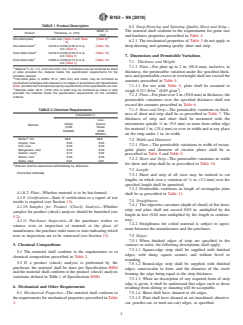
3.1.1 The terms given in Table 1 shall apply.
Development of International Standards, Guides and Recom-
mendations issued by the World Trade Organization Technical
4. Ordering Information
Barriers to Trade (TBT) Committee.
4.1 It is the responsibility of the purchaser to specify all
requirements that are necessary for the safe and satisfactory
2. Referenced Documents
performance of material ordered under this specification.
2.1 ASTM Standards:
Examples of such requirements include, but are not limited to,
B160 Specification for Nickel Rod and Bar
the following:
B880 Specification for General Requirements for Chemical
4.1.1 Alloy—Name and UNS number. (See Table 2.)
Check Analysis Limits for Nickel, Nickel Alloys and
4.1.2 ASTM Designation, including year of issue.
Cobalt Alloys
4.1.3 Condition. (See 6.1, 6.2, and Appendix X1.)
E8/E8M Test Methods for Tension Testing of Metallic Ma-
4.1.4 Finish. (See Appendix X1.)
terials
4.1.5 Dimensions—Thickness, width, and length.
E10 Test Method for Brinell Hardness of Metallic Materials
4.1.6 Quantity.
E18 Test Methods for Rockwell Hardness of Metallic Ma-
4.1.7 Optional Requirements:
terials
4.1.7.1 Sheet and Strip—Whether to be furnished in coil, in
cut straight lengths, or in random straight lengths.
This specification is under the jurisdiction of ASTM Committee B02 on
4.1.7.2 Strip—Whether to be furnished with commercial slit
Nonferrous Metals and Alloys and is the direct responsibility of Subcommittee
edge, square edge, or round edge.
B02.07 on Refined Nickel and Cobalt and Their Alloys.
Current edition approved April 1, 2019. Published April 2019. Originally
4.1.7.3 Plate—Whether to be furnished specially flattened
approved in 1941. Last previous edition approved in 2014 as B162 – 99 (2014).
(see 7.7.2); also how plate is to be cut (see 7.2.1 and 7.3.2).
DOI: 10.1520/B0162-99R19.
4.1.8 Fabrication Details—Not mandatory but helpful to
For ASME Boiler and Pressure Vessel Code applications, see related Specifi-
cation SB-162 in Section II of that Code.
the manufacturer.
New designation established in accordance with Practice E527 and SAE J1086,
4.1.8.1 Welding or Brazing—Process to be employed.
Practice for Numbering Metals and Alloys (UNS).
For referenced ASTM standards, visit the ASTM website, www.astm.org, or
contact ASTM Customer Service at service@astm.org. For Annual Book of ASTM
Standards volume information, refer to the standard’s Document Summary page on The last approved version of this historical standard is referenced on
the ASTM website. www.astm.org.
Copyright © ASTM International, 100 Barr Harbor Drive, PO Box C700, West Conshohocken, PA 19428-2959. United States
B162−99 (2019)
TABLE 1 Product Description
6.2 Deep-Drawing and Spinning Quality Sheet and Strip—
Width, in. The material shall conform to the requirements for grain size
Product Thickness, in. (mm)
(mm)
and hardness properties prescribed in Table 4.
A B
Hot-rolled plate ⁄16 and over (Table 5 and Table (Table 8)
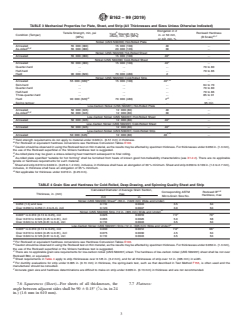
6.2.1 The mechanical properties of Table 3 do not apply to
6)
A
Hot-rolled sheet 0.018 to 0.250 (0.46 to 6.4), (Table 10) deep-drawing and spinning quality sheet and strip.
incl (Table 7)
C
Cold-rolled sheet 0.018 to 0.250 (0.46 to 6.4), (Table 10)
7. Dimensions and Permissible Variations
incl (Table 7)
C
Cold-rolled strip 0.005 to 0.250 (0.13 to 6.4), (Table 10)
7.1 Thickness and Weight:
incl (Table 7)
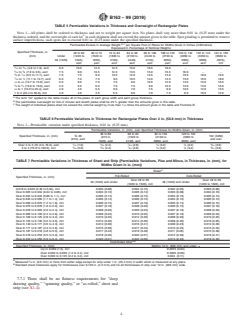
7.1.1 Plate—For plate up to 2 in. (50.8 mm), inclusive, in
A
3 1
Material ⁄16 to ⁄4 in.(4.8to6.4mm),incl,inthicknessmaybefurnishedassheet
thickness, the permissible variation under the specified thick-
or plate provided the material meets the specification requirements for the
condition ordered.
ness and permissible excess in overweight shall not exceed the
B
Hot-rolled plate, in widths 10 in. (254 mm) and under, may be furnished as
amounts prescribed in Table 5.
hot-finishedrectangleswithshearedorcutedgesinaccordancewithSpecification
7.1.1.1 For use with Table 5, plate shall be assumed to
B160,providedthemechanicalpropertyrequirementsofthisspecificationaremet.
C
3 3
Material under 48 in. (1219 mm) in width may be furnished as sheet or strip
weigh 0.321 lb/in. (8.89 g/cm ).
provided the material meets the specification requirements for the condition
7.1.2 Plate—For plate over 2 in. (50.8 mm) in thickness, the
ordered.
permissible variations over the specified thickness shall not
exceed the amounts prescribed in Table 6.
7.1.3 Sheet and Strip—The permissible variations in thick-
TABLE 2 Chemical Requirements
ness of sheet and strip shall be as prescribed in Table 7. The
Composition,%
thickness of strip and sheet shall be measured with the
Low-
Nickel Carbon micrometer spindle ⁄8 in. (9.5 mm) or more from either edge
Element
(UNS Nickel
for material 1 in. (25.4 mm) or over in width and at any place
N02200) (UNS
on the strip under 1 in. in width.
N02201)
A
Nickel, min 99.0 99.0
7.2 Width and Diameter:
Copper, max 0.25 0.25
7.2.1 Plate—The permissible variations in width of rectan-
Iron, max 0.40 0.40
Manganese, max 0.35 0.35 gular plates and diameter of circular plates shall be as
Carbon, max† 0.15 0.02
prescribed in Table 8 and Table 9.
Silicon, max 0.35 0.35
7.2.2 Sheet and Strip—The permissible variations in width
Sulfur, max 0.01 0.01
for sheet and strip shall be as prescribed in Table 10.
A
Element shall be determined arithmetically by difference.
7.3 Length:
†Corrected editorially.
7.3.1 Sheet and strip of all sizes may be ordered to cut
lengths, in which case a variation of ⁄8 in. (3.2 mm) over the
specified length shall be permitted.
7.3.2 Permissible variations in length of rectangular plate
4.1.8.2 Plate—Whether material is to be hot-formed.
shall be as prescribed in Table 11.
4.1.9 Certification—State if certification or a report of test
7.4 Straightness:
results is required (see Section 15).
7.4.1 The edgewise curvature (depth of chord) of flat sheet,
4.1.10 Samples for Product (Check) Analysis—Whether
strip, and plate shall not exceed 0.05 in. multiplied by the
samples for product (check) analysis should be furnished (see
length in feet (0.04 mm multiplied by the length in centime-
5.2).
tres).
4.1.11 Purchaser Inspection—If the purchaser wishes to
7.4.2 Straightness for coiled material is subject to agree-
witness tests or inspection of material at the place of
ment between the manufacturer and the purchaser.
manufacture, the purchase order must so state indicating which
tests or inspections are to be witnessed (see Section 13). 7.5 Edges:
7.5.1 When finished edges of strip are specified in the
5. Chemical Compositions contract or order, the following descriptions shall apply:
7.5.1.1 Square-edge strip shall be supplied with finished
5.1 The material shall conform to the requirements as to
edges, with sharp, square corners, and without bevel or
chemical composition prescribed in Table 2.
rounding.
5.2 If a product (check) analysis is performed by the
7.5.1.2 Round-edge strip shall be supplied with finished
purchaser, the material shall be done per Specification B880
edges, semicircular in form, and the diameter of the circle
and the material shall conform to the product (check) analysis
forming the edge being equal to the strip thickness.
variations defined in Table 1 of Specification B880.
7.5.1.3 When no description of any required form of strip
edge is given, it shall be understood that edges such as those
6. Mechanical and Other Requirements
resulting from slitting or shearing will be acceptable.
6.1 Mechanical Properties—The material shall conform to 7.5.1.4 Sheet shall have sheared or slit edges.
the requirements for mechanical properties prescribed in Table 7.5.1.5 Plate shall have sheared or cut (machined, abrasive-
3. cut, powder-cut, or inert-arc-cut) edges, as specified.
B162−99 (2019)
TABLE 3 Mechanical Properties for Plate, Sheet, and Strip (All Thicknesses and Sizes Unless Otherwise Indicated)
Elongation in 2
A
Tensile Strength, min, psi Rockwell Hardness
Yield Strength (0.2 %
Condition (Temper) in.or50mm,
B,C
offset), min, psi (MPa)
(MPa) (B Scale)
or 4D,min,%
Nickel (UNS N02200) Hot-Rolled Plate
Annealed 55 000 (380) 15 000 (100) 40 .
D,E
As-rolled 55 000 (380) 20 000 (135) 30 .
Nickel (UNS N02200) Hot-Rolled Sheet
F
...
Annealed 55 000 (380) 15 000 (100) 40
Nickel (UNS N02200) Cold-Rolled Sheet
F
Annealed 55 000 (380) 15 000 (100) 40 .
Quarter-hard . . . 70 to 80
Half-hard . . . 79 to 86
Hard 90 000 (620) 70 000 (480) 2 .
Nickel (UNS N02200) Cold-Rolled Strip
G F,G
Annealed 55 000 (380) 15 000 (100) 40 .
Skin-hard . . . 64 to 70
Quarter-hard . . . 70 to 80
Half-hard . . . 79 to 86
Three-quarter-hard . . . 85 to 91
G G
Hard 90 000 (620) 70 000 (480) 2 .
Spring temper . . . 95 min
Low-Carbon Nickel (UNS N02201) Hot-Rolled Plate
Annealed 50 000 (345) 12 000 (80) 40 .
D,E
As-rolled 50 000 (345) 12 000 (80) 30 .
Low-Carbon Nickel (UNS N02201) Hot-Rolled Sheet
F
Annealed 50 000 (345) 12 000 (80) 40 .
Low-Carbon Nickel (UNS N02201) Cold-Rolled Sheet
F
Annealed 50 000 (345) 12 000 (80) 40 .
Low-Carbon Nickel (UNS N02201) Cold-Rolled Strip
G F,G
Annealed 50 000 (345) 12 000 (80) 40 .
A
Yield strength requirements do not apply to material under 0.020 in. (0.51 mm) in thickness.
B
For Rockwell or equivalent hardness conversions see Hardness Conversion Tables E140.
C
CautionshouldbeobservedinusingtheRockwelltestonthinmaterial,astheresultsmaybeaffectedbyspecimenthickness.Forthicknessesunder0.050in.(1.3mm),
the use of the Rockwell superficial or the Vickers hardness test is suggested.
D
As-rolled plate may be given a stress-relieving heat treatment subsequent to final rolling.
E
As-rolled plate specified “suitable for hot forming” shall be furnished from heats of known good hot-malleability characteristics (see X1.2.2). There are no applicable
tensile or hardness requirements for such material.
F
Sheetandstrip0.010to0.049in.(0.25to1.2mm),inclusive,inthicknessshallhaveanelongationof30 %minimum.Sheetandstrip0.050to0.109in.(1.3to2.7mm),
inclusive, in thickness shall have an elongation of 35 % minimum.
G
Not applicable for thickness under 0.010 in. (0.25 mm).
TABLE 4 Grain Size and Hardness for Cold-Rolled, Deep-Drawing, and Spinning Quality Sheet and Strip
Calculated Diameter of Average Grain Section,
A,B
Corresponding ASTM Rockwell B
Thickness, in. (mm) max
Hardness, max
Micro-Grain Size No.
mm in.
C
Nickel (UNS N02200) Sheet (56 in. (1420 mm) Wide and Under)
0.050 (1.3) and less 0.110 0.0043 3.5 64
Over 0.050 to 0.250 (1.3 to 6.4), incl 0.120 0.0047 3.0 64
D
Nickel (UNS N02200) Strip (12 in. (305 mm) Wide and Under)
E F F
0.005 to 0.010 (0.13 to 0.25), incl 0.025 0.0010 7.5 70
Over 0.010 to 0.024 (0.25 to 0.61), incl 0.065 0.0026 5.0 68
Over 0.024 to 0.125 (0.61 to 3.2), incl 0.110 0.0043 3.5 64
D
Low-Carbon Nickel (UNS N02201) Strip (12 in. (305 mm) Wide and Under)
E F F
0.005 to 0.010 (0.13 to 0.25), incl 0.030 0.0012 7.0 66
Over 0.010 to 0.024 (0.25 to 0.61), incl 0.075 0.0030 4.5 64
Over 0.024 to 0.125 (0.61 to 3.2), incl 0.110 0.0043 3.5 64
A
For Rockwell or equivalent hardness conversions see Hardness Conversion Tables E140.
B
CautionshouldbeobservedinusingtheRockwelltestonthinmaterial,astheresultsmaybeaffectedbyspecimenthickness.Forthicknessesunder0.050in.(1.3mm),
the use of the Rockwell superficial or the Vickers hardness test is suggested.
C
There are no applicable grain size requirements for low-carbon nickel (UNS N02201) sheet. The hardness of low-carbon nickel (UNS N02201) sheet shall be not over
Rockwell B64, or equivalent.
D
Sheet requirements in Table 4 apply to strip thicknesses over 0.125 in. (3.2 mm), and for all thicknesses of strip over 12 in. (305 mm) in width.
E
For ductility evaluations for strip under 0.005 in. (0.13 mm) in thickness, the spring-back test, such as that described in Test Method F155, is often used and the
manufacturer should be consulted.
F
Accurate grain size and hardness determinations are difficult to make on strip under 0.005 in. (0.13 mm) in thickness and are not recommended.
7.6 Squareness (Sheet)—For sheets of all thicknesses, the 7.7 Flatness:
angle between adjacent sides shall be 90 6 0.15° ( ⁄16 in. in 24
in.) (1.6 mm in 610 mm).
B162−99 (2019)
TABLE 5 Permissible Variations in Thickness and Overweight of Rectangular Plates
NOTE 1—All plates shall be ordered to thickness and not to weight per square foot. No plates shall vary more than 0.01 in. (0.25 mm) under the
A
thickness ordered, and the overweight of each lot in each shipment shall not exceed the amount given in the table. Spot grinding is permitted to remove
surface imperfections, such spots not to exceed 0.01 in. (0.25 mm) under the specified thickness.
B,C
Permissible Excess in Average Weight, per Square Foot of Plates for Widths Given in Inches (millimetres)
Expressed in Percentage of Nominal Weights
Specified Thickness, in.
48 to 60 60 to 72 72 to 84 84 to 96 96 to 108 108 to 120 120 to 132 132 to 144 144 to 160
(mm)
Under (1220 to (1520 to (1830 to (2130 to (2440 to (2740 to (3050 to (3350 to (3660 to
48 (1220) 1520), 1830), 2130), 2440), 2740), 3050), 3350), 3660), 4070),
excl excl excl excl excl excl excl excl incl
3 5
⁄16 to ⁄16 (4.8 to 7.9), excl 9.0 10.5 12.0 13.5 15.0 16.5 18.0 . . .
5 3
⁄16 to ⁄8 (7.9 to 9.5), excl 7.5 9.0 10.5 12.0 13.5 15.0 16.5 18.0 . .
3 7
⁄8 to ⁄16 (9.5 to 11.1), excl 7.0 7.5 9.0 10.5 12.0 13.5 15.0 16.5 18.0 19.5
7 1
⁄16 to ⁄2 (11.1 to 12.7), excl 6.0 7.0 7.5 9.0 10.5 12.0 13.5 15.0 16.5 18.0
1 5
⁄2 to ⁄8 (12.7 to 15.9), excl 5.0 6.0 7.0 7.5 9.0 10.5 12.0 13.5 15.0 16.5
5 3
⁄8 to ⁄4 (15.9 to 19.0), excl 4.5 5.5 6.0 7.0 7.5 9.0 10.5 12.0 13.5 15.0
⁄4 to 1 (19.0 to 25.4), excl 4.0 4.5 5.5 6.0 7.0 7.5 9.0 10.5 12.0 13.5
1 to 2 (25.4 to 50.8), incl 4.0 4.0 4.5 5.5 6.0 7.0 7.5 9.0 10.5 12.0
A
The term “lot” applied to this table means all of the plates of each group width and each group thickness.
B
The permissible overweight for lots of circular and sketch plates shall be 25 % greater than the amounts given in this table.
C
The weight of individual plates shall not exceed the nominal weight by more than 1 ⁄4 times the amount given in the table and Footnote B.
TABLE 6 Permissible Variations in Thickness for Rectangular Plates Over 2 in. (50.8 mm) in Thickness
NOTE 1—Permissible variation under specified thickness, 0.01 in. (0.25 mm).
Permissible Variations, in. (mm), over Specified Thickness for Widths Given, in. (mm)
36 to 60 60 to 84 84 to 120 120 to 132
Specified Thickness, in. (mm) To 36 132 (3350)
(915 to (1520 to (2130 to (3050 to
(915), excl and over
1520), excl 2130), excl 3050), excl 3350), excl
1 3 7 1 1 9
Over 2 to 3 (51.0 to 76.0), excl ⁄16 (1.6) ⁄32 (2.4) ⁄64 (2.8) ⁄8 (3.2) ⁄8 (3.2) ⁄64 (3.6)
5 3 7 1 1 9
3 to 4 (76.0 to 102.0), incl ⁄64 (2.0) ⁄32 (2.4) ⁄64 (2.8) ⁄8 (3.2) ⁄8 (3.2) ⁄64 (3.6)
TABLE 7 Permissible Variations in Thickness of Sheet and Strip (Permissible Variations, Plus and Minus, in Thickness, in. (mm), for
Widths Given in in. (mm))
A
Sheet
Hot-Rolled Cold-Rolled
Specified Thickness, in. (mm)
Over 48 to 60 Over 48 to 60
48 (1220) and Under 48 (1220) and Under
(1220 to 1520), incl (1220 to 1520), incl
0.018 to 0.025 (0.46 to 0.64), incl 0.003 (0.08) 0.004 (0.10) 0.002 (0.05) 0.003 (0.08)
Over 0.025 to 0.034 (0.64 to 0.86), incl 0.004 (0.10) 0.005 (0.13) 0.003 (0.08) 0.004 (0.10)
Over 0.034 to 0.043 (0.86 to 1.1), incl 0.005 (0.13) 0.006 (0.15) 0.004 (0.10) 0.005 (0.13)
Over 0.043 to 0.056 (1.1 to 1.4), incl 0.005 (0.13) 0.006 (0.15) 0.004 (0.10) 0.005 (0.13)
Over 0.056 to 0.070 (1.4 to 1.8), incl 0.006 (0.15) 0.007 (0.18) 0.005 (0.13) 0.006 (0.15)
Over 0.070 to 0.078 (1.8 to 2.0), incl 0.007 (0.18) 0.008 (0.20) 0.006 (0.15) 0.007 (0.18)
Over 0.078 to 0.093 (2.0 to 2.4), incl 0.008 (0.20) 0.009 (0.23) 0.007 (0.18) 0.008 (0.20)
Over 0.093 to 0.109 (2.4 to 2.8), incl 0.009 (0.23) 0.010 (0.25) 0.007 (0.18) 0.009 (0.23)
Over 0.109 to 0.125 (2.8 to 3.2), incl 0.010 (0.25) 0.012 (0.30) 0.008 (0.20) 0.010 (0.25)
Over 0.125 to 0.140 (3.2 to 3.6), incl 0.012 (0.30) 0.014 (0.36) 0.008 (0.20) 0.010 (0.25)
Over 0.140 to 0.171 (3.6 to 4.3), incl 0.014 (0.36) 0.016 (0.41) 0.009 (0.23) 0.012 (0.30)
Over 0.171 to 0.187 (4.3 to 4.8), incl 0.015 (0.38) 0.017 (0.43) 0.010 (0.25) 0.013 (0.33)
Over 0.187 to 0.218 (4.8 to 5.5), incl 0.017 (0.43) 0.019 (0.48) 0.011 (0.28) 0.015 (0.38)
Over 0.218 to 0.234 (5.5 to 5.9), incl 0.018 (0.46) 0.020 (0.51) 0.012 (0.30) 0.016 (0.41)
Over 0.234 to 0.250 (5.9 to 6.4), incl 0.020 (0.51) 0.022 (0.56) 0.013 (0.33) 0.018 (0.46)
A,B
Cold-Rolled Strip
Specified Thickness, in. (mm) Widths 12 in. (305 mm) and under, ±
Up to 0.050 (1.3), incl 0.0015 (0.04)
Over 0.050 to 0.093 (1.3 to 2.4), incl 0.0025 (0.06)
Over 0.093 to 0.125 (2.4 to 3.2), incl 0.004 (0.11)
A
Measured ⁄8 in. (9.5 mm) or more from either edge except for strip under 1 in. (25.4 mm) in width which is measured at any place.
B
Standard sheet tolerances apply for thicknesses over 0.125 in. (3.2 mm) and for all thicknesses of strip over 12 in. (305 mm) wide.
7.7.1 There shall be no flatness requirements for “deep
drawing quality,” “spinning quality,” or “as rolled,” sheet and
strip (see X1.4).
B162−99 (2019)
A B,C
TABLE 8 Permissible Variations in Width of Sheared, Plasma-Torch-Cut, and Abrasive-Cut Rectangular Plate
Permissible Variations in Widths for Widths Given in in. (mm)
Up to 30 (760), Over 30 to 72 Over 72 to 108 Over 108 to 144 Over 144 to 160
Specified Thickness incl (760 to 1830), (1830 to 2740), (2740 to 3660), (3660 to 4070),
incl incl incl incl
+− + −+−+−+−
Inches
D
Sheared:
3 5 3 1 1 1 3 1 1 1
⁄
...