

ASTM B774/B774M-21
(Specification)Standard Specification for Low Melting Point Alloys and Solders
General Information
- Abstract
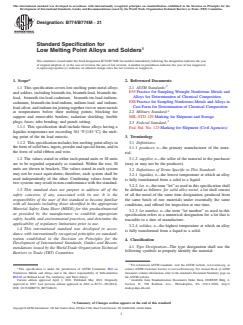
ABSTRACT
This specification covers low-melting point metal alloys and soldiers, including bismuth-tin, bismuth-lead, bismuth-tin-lead, bismuth-tin-lead-cadmium, bismuth-tin-lead-indium-cadmium, bismuth-tin-lead-indium, indium-lead, indium-lead-silver, and indium-tin joining together two or more metals at temperatures below their melting points; blocking for support and removable borders; radiation shielding; fusible plugs; fuses; tube bending; and punch setting. This specification shall include those alloys having liquidus temperature not exceeding the melting point of the tin lead eutectic, and alloys in the form of solid bars, ingots, powder and special forms, and in the form of solid ribbon and wire. The composition of the alloys shall conform to the chemical requirements for bismuth, lead, tin, cadmium, indium, silver, copper, antimony, and zinc. Alloys shall be tested and shall conform to specified values for alloy freezing point, and powder mesh size.
SCOPE
1.1 This specification covers low-melting point metal alloys and solders, including bismuth-tin, bismuth-lead, bismuth-tin-lead, bismuth-tin-lead-cadmium, bismuth-tin-lead-indium-cadmium, bismuth-tin-lead-indium, indium-lead, and indium-lead-silver, and indium-tin joining together two or more metals at temperatures below their melting points; blocking for support and removable borders; radiation shielding; fusible plugs; fuses; tube bending; and punch setting.
1.1.1 This specification shall include those alloys having a liquidus temperature not exceeding 361 °F [183 °C], the melting point of the tin lead eutectic.
1.1.2 This specification includes low-melting point alloys in the form of solid bars, ingots, powder and special forms, and in the form of solid ribbon and wire.
1.2 The values stated in either inch-pound units or SI units are to be regarded separately as standard. Within the text, SI units are shown in brackets. The values stated in each system may not be exact equivalents; therefore, each system shall be used independently of the other. Combining values from the two systems may result in non-conformance with the standard.
1.3 This standard does not purport to address all of the safety concerns, if any, associated with its use. It is the responsibility of the user of this standard to become familiar with all hazards including those identified in the appropriate Material Safety Data Sheet (MSDS) for this product/material as provided by the manufacturer, to establish appropriate safety, health, and environmental practices, and determine the applicability of regulatory limitations prior to use.
1.4 This international standard was developed in accordance with internationally recognized principles on standardization established in the Decision on Principles for the Development of International Standards, Guides and Recommendations issued by the World Trade Organization Technical Barriers to Trade (TBT) Committee.
- Status
- Published
- Publication Date
- 31-Mar-2021
- Technical Committee
- B02 - Nonferrous Metals and Alloys
- Drafting Committee
- B02.02 - Refined Lead, Tin, Antimony, and Their Alloys
Buy Documents

ASTM B774/B774M-21 - Standard Specification for Low Melting Point Alloys and Solders
REDLINE ASTM B774/B774M-21 - Standard Specification for Low Melting Point Alloys and Solders
Overview
ASTM B774/B774M-21 is the Standard Specification for Low Melting Point Alloys and Solders, developed by ASTM International. This specification provides requirements for the chemical composition, forms, and testing of low-melting point metal alloys and solders typically used for joining metals at temperatures below their own melting points. The covered alloys include various combinations based on bismuth, tin, lead, cadmium, indium, and silver. These alloys are extensively used in applications such as soldering, radiation shielding, thermal protection, fusible plugs, fuses, tube bending, blocking for support, and removable borders.
Key Topics
- Alloy Compositions: Includes bismuth-tin, bismuth-lead, bismuth-tin-lead, bismuth-tin-lead-cadmium, bismuth-tin-lead-indium-cadmium, bismuth-tin-lead-indium, indium-lead, indium-lead-silver, and indium-tin alloys.
- Form Factors: Low-melting point alloys covered by this standard are available as solid bars, ingots, powder, ribbon, wire, pellets, preforms, and other special forms.
- Melting Point Range: Specifies only those alloys with a liquidus temperature not exceeding the melting point of the tin-lead eutectic (361°F [183°C]).
- Chemical Composition Requirements: Regulates the allowable content of elements such as bismuth, tin, lead, cadmium, indium, silver, copper, antimony, and zinc.
- Quality Control: Includes requirements for alloy uniformity, appearance, marking, packaging, and adherence to specified powder mesh sizes and freezing points.
- Sampling and Testing: Specifies procedures for sampling, chemical analysis, and performance testing to ensure conformity with the standard.
Applications
ASTM B774/B774M-21 is widely used in industries that require the reliable, safe joining of metals at low temperatures or need materials with controlled melting points. Practical applications include:
- Electronic soldering: For circuit assembly where low heat input is essential to protect components.
- Radiation shielding: Alloys are used due to their density and ability to form complex shapes for effective shielding.
- Thermal protection devices: Such as fusible plugs and fuses intended to melt at specific temperatures to prevent overheating.
- Metal fabrication and forming: Tube bending and punch setting processes leverage the low-melting characteristics of these alloys for intricate work.
- Support and tooling: Used as blocking materials or to create removable borders where temporary support is needed.
- Powder metallurgy and additive manufacturing: Thanks to defined mesh size requirements for alloy powders.
Related Standards
When implementing ASTM B774/B774M-21, the following related standards often play a complementary role:
- ASTM E55: Practice for Sampling Wrought Nonferrous Metals and Alloys for Determination of Chemical Composition.
- ASTM E88: Practice for Sampling Nonferrous Metals and Alloys in Cast Form for Determination of Chemical Composition.
- MIL-STD 129: Marking for Shipment and Storage (for military applications).
- Federal Standard No. 123: Marking for Shipment (for civil agencies).
These referenced documents enhance traceability, quality control, and compliance throughout materials handling and use.
By adhering to ASTM B774/B774M-21, manufacturers and users benefit from well-defined requirements for low melting point alloys and solders, ensuring consistent performance, safety, and reliability in critical industrial, electronic, and safety applications.
Relations
- Effective Date
- 01-Sep-2017
- Effective Date
- 01-May-2011
- Effective Date
- 01-Oct-2005
- Effective Date
- 01-Oct-2005
- Effective Date
- 01-Jan-2001
- Effective Date
- 01-Jan-2001
- Effective Date
- 01-Jan-2001
- Effective Date
- 01-Jan-2001
Buy Documents
ASTM B774/B774M-21 - Standard Specification for Low Melting Point Alloys and Solders
REDLINE ASTM B774/B774M-21 - Standard Specification for Low Melting Point Alloys and Solders
Get Certified
Connect with accredited certification bodies for this standard

Element Materials Technology
Materials testing and product certification.

Inštitut za kovinske materiale in tehnologije
Institute of Metals and Technology. Materials testing, metallurgical analysis, NDT.
Sponsored listings
Frequently Asked Questions
ASTM B774/B774M-21 is a technical specification published by ASTM International. Its full title is "Standard Specification for Low Melting Point Alloys and Solders". This standard covers: ABSTRACT This specification covers low-melting point metal alloys and soldiers, including bismuth-tin, bismuth-lead, bismuth-tin-lead, bismuth-tin-lead-cadmium, bismuth-tin-lead-indium-cadmium, bismuth-tin-lead-indium, indium-lead, indium-lead-silver, and indium-tin joining together two or more metals at temperatures below their melting points; blocking for support and removable borders; radiation shielding; fusible plugs; fuses; tube bending; and punch setting. This specification shall include those alloys having liquidus temperature not exceeding the melting point of the tin lead eutectic, and alloys in the form of solid bars, ingots, powder and special forms, and in the form of solid ribbon and wire. The composition of the alloys shall conform to the chemical requirements for bismuth, lead, tin, cadmium, indium, silver, copper, antimony, and zinc. Alloys shall be tested and shall conform to specified values for alloy freezing point, and powder mesh size. SCOPE 1.1 This specification covers low-melting point metal alloys and solders, including bismuth-tin, bismuth-lead, bismuth-tin-lead, bismuth-tin-lead-cadmium, bismuth-tin-lead-indium-cadmium, bismuth-tin-lead-indium, indium-lead, and indium-lead-silver, and indium-tin joining together two or more metals at temperatures below their melting points; blocking for support and removable borders; radiation shielding; fusible plugs; fuses; tube bending; and punch setting. 1.1.1 This specification shall include those alloys having a liquidus temperature not exceeding 361 °F [183 °C], the melting point of the tin lead eutectic. 1.1.2 This specification includes low-melting point alloys in the form of solid bars, ingots, powder and special forms, and in the form of solid ribbon and wire. 1.2 The values stated in either inch-pound units or SI units are to be regarded separately as standard. Within the text, SI units are shown in brackets. The values stated in each system may not be exact equivalents; therefore, each system shall be used independently of the other. Combining values from the two systems may result in non-conformance with the standard. 1.3 This standard does not purport to address all of the safety concerns, if any, associated with its use. It is the responsibility of the user of this standard to become familiar with all hazards including those identified in the appropriate Material Safety Data Sheet (MSDS) for this product/material as provided by the manufacturer, to establish appropriate safety, health, and environmental practices, and determine the applicability of regulatory limitations prior to use. 1.4 This international standard was developed in accordance with internationally recognized principles on standardization established in the Decision on Principles for the Development of International Standards, Guides and Recommendations issued by the World Trade Organization Technical Barriers to Trade (TBT) Committee.
ABSTRACT This specification covers low-melting point metal alloys and soldiers, including bismuth-tin, bismuth-lead, bismuth-tin-lead, bismuth-tin-lead-cadmium, bismuth-tin-lead-indium-cadmium, bismuth-tin-lead-indium, indium-lead, indium-lead-silver, and indium-tin joining together two or more metals at temperatures below their melting points; blocking for support and removable borders; radiation shielding; fusible plugs; fuses; tube bending; and punch setting. This specification shall include those alloys having liquidus temperature not exceeding the melting point of the tin lead eutectic, and alloys in the form of solid bars, ingots, powder and special forms, and in the form of solid ribbon and wire. The composition of the alloys shall conform to the chemical requirements for bismuth, lead, tin, cadmium, indium, silver, copper, antimony, and zinc. Alloys shall be tested and shall conform to specified values for alloy freezing point, and powder mesh size. SCOPE 1.1 This specification covers low-melting point metal alloys and solders, including bismuth-tin, bismuth-lead, bismuth-tin-lead, bismuth-tin-lead-cadmium, bismuth-tin-lead-indium-cadmium, bismuth-tin-lead-indium, indium-lead, and indium-lead-silver, and indium-tin joining together two or more metals at temperatures below their melting points; blocking for support and removable borders; radiation shielding; fusible plugs; fuses; tube bending; and punch setting. 1.1.1 This specification shall include those alloys having a liquidus temperature not exceeding 361 °F [183 °C], the melting point of the tin lead eutectic. 1.1.2 This specification includes low-melting point alloys in the form of solid bars, ingots, powder and special forms, and in the form of solid ribbon and wire. 1.2 The values stated in either inch-pound units or SI units are to be regarded separately as standard. Within the text, SI units are shown in brackets. The values stated in each system may not be exact equivalents; therefore, each system shall be used independently of the other. Combining values from the two systems may result in non-conformance with the standard. 1.3 This standard does not purport to address all of the safety concerns, if any, associated with its use. It is the responsibility of the user of this standard to become familiar with all hazards including those identified in the appropriate Material Safety Data Sheet (MSDS) for this product/material as provided by the manufacturer, to establish appropriate safety, health, and environmental practices, and determine the applicability of regulatory limitations prior to use. 1.4 This international standard was developed in accordance with internationally recognized principles on standardization established in the Decision on Principles for the Development of International Standards, Guides and Recommendations issued by the World Trade Organization Technical Barriers to Trade (TBT) Committee.
ASTM B774/B774M-21 is classified under the following ICS (International Classification for Standards) categories: 77.120.01 - Non-ferrous metals in general. The ICS classification helps identify the subject area and facilitates finding related standards.
ASTM B774/B774M-21 has the following relationships with other standards: It is inter standard links to ASTM E88-11(2017), ASTM E88-11, ASTM E55-91(2005), ASTM E88-91(2005), ASTM E88-91(2001), ASTM E55-91(1996), ASTM E88-91(1996), ASTM E55-91(2001). Understanding these relationships helps ensure you are using the most current and applicable version of the standard.
ASTM B774/B774M-21 is available in PDF format for immediate download after purchase. The document can be added to your cart and obtained through the secure checkout process. Digital delivery ensures instant access to the complete standard document.
Standards Content (Sample)
This international standard was developed in accordance with internationally recognized principles on standardization established in the Decision on Principles for the
Development of International Standards, Guides and Recommendations issued by the World Trade Organization Technical Barriers to Trade (TBT) Committee.
Designation:B774/B774M −21
Standard Specification for
Low Melting Point Alloys and Solders
This standard is issued under the fixed designation B774/B774M; the number immediately following the designation indicates the year
of original adoption or, in the case of revision, the year of last revision. A number in parentheses indicates the year of last reapproval.
A superscript epsilon (´) indicates an editorial change since the last revision or reapproval.
1. Scope* 2. Referenced Documents
2.1 ASTM Standards:
1.1 This specification covers low-melting point metal alloys
E55 Practice for Sampling Wrought Nonferrous Metals and
and solders, including bismuth-tin, bismuth-lead, bismuth-tin-
Alloys for Determination of Chemical Composition
lead, bismuth-tin-lead-cadmium, bismuth-tin-lead-indium-
E88 Practice for Sampling Nonferrous Metals and Alloys in
cadmium, bismuth-tin-lead-indium, indium-lead, and indium-
Cast Form for Determination of Chemical Composition
lead-silver, and indium-tin joining together two or more metals
at temperatures below their melting points; blocking for 2.2 Military Standard:
support and removable borders; radiation shielding; fusible MIL-STD 129 Marking for Shipment and Storage
plugs; fuses; tube bending; and punch setting.
2.3 Federal Standard:
1.1.1 This specification shall include those alloys having a Fed. Std. No. 123 Marking for Shipment (Civil Agencies)
liquidus temperature not exceeding 361 °F [183 °C], the melt-
3. Terminology
ing point of the tin lead eutectic.
1.1.2 This specification includes low-melting point alloys in
3.1 Definitions:
the form of solid bars, ingots, powder and special forms, and in
3.1.1 producer, n—the primary manufacturer of the mate-
the form of solid ribbon and wire.
rial.
3.1.2 supplier, n—the seller of the material to the purchaser
1.2 The values stated in either inch-pound units or SI units
(may or may not be the producer).
are to be regarded separately as standard. Within the text, SI
units are shown in brackets. The values stated in each system
3.2 Definitions of Terms Specific to This Standard:
may not be exact equivalents; therefore, each system shall be
3.2.1 liquidus, n—the lowest temperature at which an alloy
used independently of the other. Combining values from the
is fully transformed from a solid to a liquid.
two systems may result in non-conformance with the standard.
3.2.2 lot, n—the term “lot” as used in this specification shall
1.3 This standard does not purport to address all of the
be defined as follows: for solid alloy metal, a lot shall consist
safety concerns, if any, associated with its use. It is the of all the metal of the same time designation, produced from
responsibility of the user of this standard to become familiar
the same batch of raw materials under essentially the same
with all hazards including those identified in the appropriate conditions, and offered for inspection at one time.
Material Safety Data Sheet (MSDS) for this product/material
3.2.3 lot number, n—the term “lot number” as used in this
as provided by the manufacturer, to establish appropriate
specification refers to a numerical designation for a lot that is
safety, health, and environmental practices, and determine the
traceable to a date of manufacture.
applicability of regulatory limitations prior to use.
3.2.4 solidus, n—the highest temperature at which an alloy
1.4 This international standard was developed in accor-
is fully transformed from a liquid to a solid.
dance with internationally recognized principles on standard-
ization established in the Decision on Principles for the
4. Classification
Development of International Standards, Guides and Recom-
4.1 Type Designation—The type designation shall use the
mendations issued by the World Trade Organization Technical
following symbols to properly identify the material:
Barriers to Trade (TBT) Committee.
For referenced ASTM standards, visit the ASTM website, www.astm.org, or
This specification is under the jurisdiction of ASTM Committee B02 on contact ASTM Customer Service at service@astm.org. For Annual Book of ASTM
Nonferrous Metals and Alloys and is the direct responsibility of Subcommittee Standards volume information, refer to the standard’s Document Summary page on
B02.02 on Refined Lead, Tin, Antimony, and Their Alloys. the ASTM website.
Current edition approved April 1, 2021. Published May 2021. Originally Available from Standardization Documents Order Desk, DODSSP, Bldg. 4,
approved in 1987. Last previous edition approved in 2014 as B774 – 00 (2014). Section D, 700 Robbins Ave., Philadelphia, PA 19111-5098, http://
DOI: 10.1520/B0774_B0774M-21. dodssp.daps.dla.mil.
*A Summary of Changes section appears at the end of this standard
Copyright © ASTM International, 100 Barr Harbor Drive, PO Box C700, West Conshohocken, PA 19428-2959. United States
B774/B774M−21
TABLE 2 Powder Mesh Size
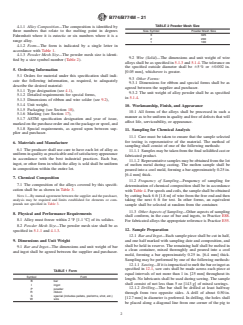
4.1.1 Alloy Composition—The composition is identified by
three numbers that relate to the melting point in degrees Size Symbol Powder Mesh Size
3 325
Fahrenheit where it is eutectic or six numbers where it is a
2 200
range alloy.
1 100
4.1.2 Form—The form is indicated by a single letter in
accordance with Table 1.
4.1.3 Powder Mesh Size—The powder mesh size is identi-
9.2 Wire (Solid)—The dimensions and unit weight of wire
fied by a size symbol number (Table 2).
alloys shall be as specified in 5.1.3 and 5.1.4. The tolerance on
the specified outside diameter shall be 65% or 60.002 in.
5. Ordering Information
[0.05 mm], whichever is greater.
5.1 Orders for material under this specification shall indi-
9.3 Other Forms:
cate the following information, as required, to adequately
9.3.1 Dimensions for ribbon and special forms shall be as
describe the desired material:
agreed between the supplier and purchaser.
5.1.1 Type designation (see 4.1),
9.3.2 The unit weight of alloy powder shall be as specified
5.1.2 Detailed requirements for special forms,
in 5.1.4.
5.1.3 Dimensions of ribbon and wire solder (see 9.2),
5.1.4 Unit weight,
10. Workmanship, Finish, and Appearance
5.1.5 Packaging (see Section 18),
10.1 All forms of the alloys shall be processed in such a
5.1.6 Marking (see Section 17),
manner as to be uniform in quality and free of defects that will
5.1.7 ASTM specification designation and year of issue,
affect life, serviceability, or appearance.
marked on the purchase order and on the package or spool, and
5.1.8 Special requirements, as agreed upon between sup-
11. Sampling for Chemical Analysis
plier and purchaser.
11.1 Care must be taken to ensure that the sample selected
for testing is representative of the material. The method of
6. Materials and Manufacture
sampling shall consist of one of the following methods:
6.1 The producer shall use care to have each lot of alloy as
11.1.1 Samplesmaybetakenfromthefinalsolidifiedcastor
uniforminqualityaspracticableandofsatisfactoryappearance
fabricated product.
in accordance with the best industrial practices. Each bar,
11.1.2 Representative samples may be obtained from the lot
ingot, or other form in which the alloy is sold shall be uniform
of molten metal during casting. The molten sample shall be
in composition within the entire lot.
poured into a cool mold, forming a bar approximately 0.25 in.
[6.4 mm] thick.
7. Chemical Composition
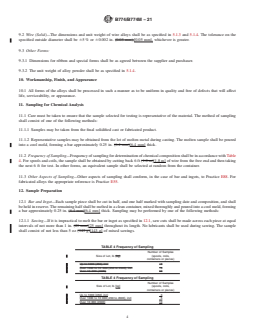
11.2 Frequency of Sampling—Frequency of sampling for
7.1 The composition of the alloys covered by this specifi-
determination of chemical composition shall be in accordance
cation shall be as shown in Table 3.
with Table 4. For spools and coils, the sample shall be obtained
by cutting back 6 ft [1.8 m] of wire from the free end and then
NOTE 1—By mutual agreement between the supplier and the purchaser,
analysis may be required and limits established for elements or com- taking the next 6 ft for test. In other forms, an equivalent
pounds not specified in Table 3.
sample shall be selected at random from the container.
11.3 Other Aspects of Sampling—Other aspects of sampling
8. Physical and Performance Requirements
shall conform, in the case of bar and ingots, to Practice E88.
8.1 Alloy must freeze within 2 °F [1.1 °C] of its solidus.
For fabricated alloys the appropriate reference is Practice E55.
8.2 Powder Mesh Size—The powder mesh size shall be as
12. Sample Preparation
specified in 5.1.1 and 4.1.3.
12.1 Bar and Ingot—Each sample piece shall be cut in half,
9. Dimensions and Unit Weight and one half marked with sampling date and composition, and
shall be held in reserve. The remaining half shall be melted in
9.1 Bar and Ingot—The dimensions and unit weight of bar
a clean container, mixed thoroughly and poured into a cool
and ingot shall be agreed between the supplier and purchaser.
mold, forming a bar approximately 0.25 in. [6.4 mm] thick.
Sampling may be performed by one of the following methods:
12.1.1 Sawing—Ifitisimpracticaltomeltthebaroringotas
specified in 12.1, saw cuts shall be made across each piece at
TABLE 1 Form
equal intervals of not more than 1 in. [25 mm] throughout its
Symbol Form
length. No lubricants shall be used during sawing. The sa
...
This document is not an ASTM standard and is intended only to provide the user of an ASTM standard an indication of what changes have been made to the previous version. Because
it may not be technically possible to adequately depict all changes accurately, ASTM recommends that users consult prior editions as appropriate. In all cases only the current version
of the standard as published by ASTM is to be considered the official document.
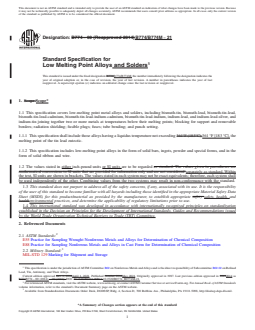
Designation: B774 − 00 (Reapproved 2014) B774/B774M − 21
Standard Specification for
Low Melting Point Alloys and Solders
This standard is issued under the fixed designation B774;B774/B774M; the number immediately following the designation indicates the
year of original adoption or, in the case of revision, the year of last revision. A number in parentheses indicates the year of last
reapproval. A superscript epsilon (´) indicates an editorial change since the last revision or reapproval.
1. Scope Scope*
1.1 This specification covers low-melting point metal alloys and solders, including bismuth-tin, bismuth-lead, bismuth-tin-lead,
bismuth-tin-lead-cadmium, bismuth-tin-lead-indium-cadmium, bismuth-tin-lead-indium, indium-lead, and indium-lead-silver, and
indium-tin joining together two or more metals at temperatures below their melting points; blocking for support and removable
borders; radiation shielding; fusible plugs; fuses; tube bending; and punch setting.
1.1.1 This specification shall include those alloys having a liquidus temperature not exceeding 361°F (183°C),361 °F [183 °C], the
melting point of the tin lead eutectic.
1.1.2 This specification includes low-melting point alloys in the form of solid bars, ingots, powder and special forms, and in the
form of solid ribbon and wire.
1.2 The values stated in either inch-pound units or SI units are to be regarded as standard. The values given in parentheses are
mathematical conversions to SI units that are provided for information only and are not considered separately as standard. Within
the text, SI units are shown in brackets. The values stated in each system may not be exact equivalents; therefore, each system shall
be used independently of the other. Combining values from the two systems may result in non-conformance with the standard.
1.3 This standard does not purport to address all of the safety concerns, if any, associated with its use. It is the responsibility
of the user of this standard to become familiar with all hazards including those identified in the appropriate Material Safety Data
Sheet (MSDS) for this product/material as provided by the manufacturer, to establish appropriate safety safety, health, and
healthenvironmental practices, and determine the applicability of regulatory limitations prior to use.
1.4 This international standard was developed in accordance with internationally recognized principles on standardization
established in the Decision on Principles for the Development of International Standards, Guides and Recommendations issued
by the World Trade Organization Technical Barriers to Trade (TBT) Committee.
2. Referenced Documents
2.1 ASTM Standards:
E55 Practice for Sampling Wrought Nonferrous Metals and Alloys for Determination of Chemical Composition
E88 Practice for Sampling Nonferrous Metals and Alloys in Cast Form for Determination of Chemical Composition
2.2 Military Standard:
MIL-STD 129 Marking for Shipment and Storage
This specification is under the jurisdiction of ASTM Committee B02 on Nonferrous Metals and Alloys and is the direct responsibility of Subcommittee B02.02 on Refined
Lead, Tin, Antimony, and Their Alloys.
Current edition approved Oct. 1, 2014April 1, 2021. Published October 2014May 2021. Originally approved in 1987. Last previous edition approved in 20102014 as
B774B774 – 00 (2014). – 00 (2010). DOI: 10.1520/B0774-00R14.10.1520/B0774_B0774M-21.
For referenced ASTM standards, visit the ASTM website, www.astm.org, or contact ASTM Customer Service at service@astm.org. For Annual Book of ASTM Standards
volume information, refer to the standard’s Document Summary page on the ASTM website.
Available from Standardization Documents Order Desk, DODSSP, Bldg. 4, Section D, 700 Robbins Ave., Philadelphia, PA 19111-5098, http://dodssp.daps.dla.mil.
*A Summary of Changes section appears at the end of this standard
Copyright © ASTM International, 100 Barr Harbor Drive, PO Box C700, West Conshohocken, PA 19428-2959. United States
B774/B774M − 21
2.3 Federal Standard:
Fed. Std. No. 123 Marking for Shipment (Civil Agencies)
3. Terminology
3.1 Definitions:
3.1.1 producer, n—the primary manufacturer of the material.
3.1.2 supplier, n—the seller of the material to the purchaser (may or may not be the producer).
3.2 Definitions of Terms Specific to This Standard:
3.2.1 liquidus, n—the lowest temperature at which an alloy is fully transformed from a solid to a liquid.
3.2.2 lot, n—the term “lot” as used in this specification shall be defined as follows: for solid alloy metal, a lot shall consist of all
the metal of the same time designation, produced from the same batch of raw materials under essentially the same conditions, and
offered for inspection at one time.
3.2.3 lot number, n—the term “lot number” as used in this specification refers to a numerical designation for a lot that is traceable
to a date of manufacture.
3.2.4 solidus, n—the highest temperature at which an alloy is fully transformed from a liquid to a solid.
4. Classification
4.1 Type Designation—The type designation shall use the following symbols to properly identify the material:
4.1.1 Alloy Composition—The composition is identified by three numbers that relate to the melting point in degrees Fahrenheit
where it is eutectic or six numbers where it is a range alloy.
4.1.2 Form—The form is indicated by a single letter in accordance with Table 1.
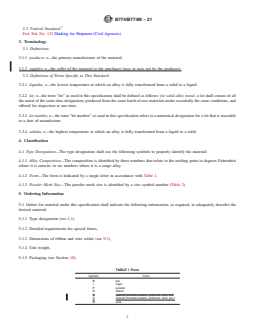
4.1.3 Powder Mesh Size—The powder mesh size is identified by a size symbol number (Table 2).
5. Ordering Information
5.1 Orders for material under this specification shall indicate the following information, as required, to adequately describe the
desired material:
5.1.1 Type designation (see 4.1),
5.1.2 Detailed requirements for special forms,
5.1.3 Dimensions of ribbon and wire solder (see 9.2),
5.1.4 Unit weight,
5.1.5 Packaging (see Section 18),
TABLE 1 Form
Symbol Form
B bar
I ingot
P powder
R ribbon
S special (includes pellets, preforms, shot, etc.
S special (includes pellets, preforms, shot, etc.)
W wire
B774/B774M − 21
TABLE 2 Powder Mesh Size
Size Symbol Powder Mesh Size
3 325
2 200
1 100
5.1.6 Marking (see Section 17),
5.1.7 ASTM specification designation and year of issue, marked on the purchase order and on the package or spool, and
5.1.8 Special requirements, as agreed upon between supplier and purchaser.
6. Materials and Manufacture
6.1 The producer shall use care to have each lot of alloy as uniform in quality as practicable and of satisfactory appearance in
accordance with the best industrial practices. Each bar, ingot, or other form in which the alloy is sold shall be uniform in
composition within the entire lot.
7. Chemical Composition
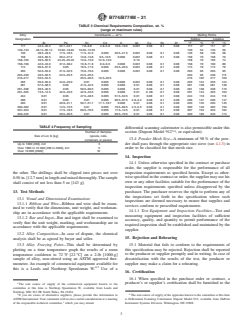
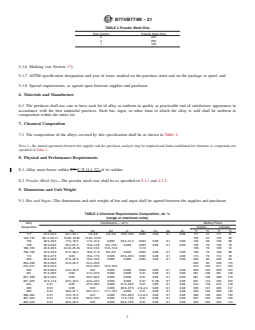
7.1 The composition of the alloys covered by this specification shall be as shown in Table 3.
NOTE 1—By mutual agreement between the supplier and the purchaser, analysis may be required and limits established for elements or compounds not
specified in Table 3.
8. Physical and Performance Requirements
8.1 Alloy must freeze within 2°F 2 °F [1.1 °C] of its solidus.
8.2 Powder Mesh Size—The powder mesh size shall be as specified in 5.1.1 and 4.1.3.
9. Dimensions and Unit Weight
9.1 Bar and Ingot—The dimensions and unit weight of bar and ingot shall be agreed between the supplier and purchaser.
TABLE 3 Chemical Requirements Composition, wt. %
(range or maximum rules)
Alloy Constituents — wt % Melting Points
Designation Solidus Liquidus
Bi Pb Sn Cd In Ag Cu Sb Zn °F °C °F °C
117 44.2–45.2 22.1–23.1 7.8–8.8 4.8–5.8 18.6–19.6 0.001 0.08 0.1 0.08 117 47 117 47
129–133 48.14–50.14 16.92–18.92 10.55–12.55 129 54 133 56
136 48.5–49.5 17.5–18.5 11.5–12.5 0.005 20.5–21.5 0.001 0.08 0.1 0.08 136 58 136 58
158 49.5–50.5 26.2–27.2 12.8–13.8 9.5–10.5 0.008 0.001 0.08 0.1 0.08 158 70 158 70
158–165 49.5–50.5 24.45–25.45 12.0–13.0 12.0–13.0 0.10 158 70 165 74
158–190 42.0–43.0 37.2–38.2 10.8–11.8 8.0–9.0 0.008 0.001 0.08 0.1 0.08 158 70 190 88
174 56.5–57.5 0.05 16.5–17.5 0.005 25.5–26.5 0.001 0.08 0.1 0.08 174 79 174 79
203 52.0–53.0 31.5–32.5 15.0–16.0 0.005 0.008 0.001 0.08 0.1 0.08 203 95 203 95
203–239 49.5–50.5 24.5–25.5 24.5–25.5 203 95 239 115
216–217 53.5–54.5 25.5–26.5 19.5–20.5 216 102 217 103
255 55.0–56.0 44.0–45.0 0.01 0.005 0.008 0.001 0.08 0.1 0.08 255 124 255 124
281 57.5–58.5 0.05 41.5–42.5 0.005 0.008 0.01 0.08 0.1 0.08 281 138 281 138
281–338 39.5–40.5 0.05 59.5–60.5 0.005 0.008 0.01 0.08 0.1 0.08 281 138 338 170
291–325 13.5–14.5 42.5–43.5 42.5–43.5 0.005 0.008 0.01 0.08 0.1 0.08 291 144 325 163
244 0.01 0.05 47.5–48.5 0.005 51.5–52.5 0.01 0.08 0.1 0.08 244 118 244 118
296 0.01 0.05 0.01 0.005 96.5–97.5 2.8–3.2 0.08 0.1 0.08 296 147 296 147
293 0.01 29.9–31.1 50.7–51.7 17.7–18.7 0.008 0.01 0.08 0.1 0.08 293 145 293 145
300–302 0.01 14.5–15.5 0.01 0.005 79.5–80.5 4.5–5.5 0.08 0.1 0.08 300 149 302 150
307–323 0.01 17.5–18.5 69.5–70.5 0.005 11.5–12.5 0.01 0.08 0.1 0.08 307 153 323 162
320–345 0.01 29.5–30.5 0.01 0.005 69.5–70.5 0.01 0.08 0.1 0.08 320 160 345 174
B774/B774M − 21
9.2 Wire (Solid)—The dimensions and unit weight of wire alloys shall be as specified in 5.1.3 and 5.1.4. The tolerance on the
specified outside diameter shall be 65 % or 60.002 in. (0.05 mm),[0.05 mm], whichever is greater.
9.3 Other Forms:
9.3.1 Dimensions for ribbon and special forms shall be as agreed between the supplier and p
...