

ASTM B865-20
(Specification)Standard Specification for Precipitation Hardening Nickel-Copper-Aluminum Alloy Bar, Rod, Wire, Forgings, and Forging Stock
General Information
- Abstract
ABSTRACT
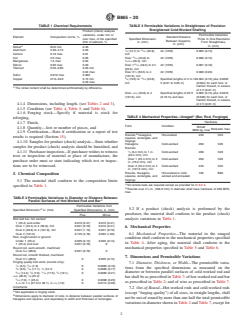
This specification covers UNS N05500 nickel-copper-aluminum alloy rounds, squares, hexagons, rectangles, and forgings and forging stocks manufactured by either hot working or cold working, and cold-worked wire. The material should conform to the required mechanical properties in both aged and unaged conditions. Precipitation hardening is accomplished by holding the material at a high temperature, followed by furnace cooling and then air cooling.
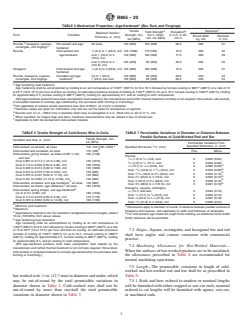
SCOPE
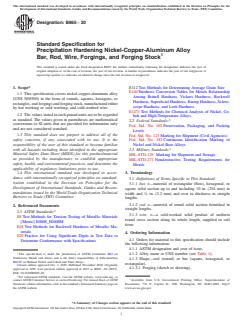
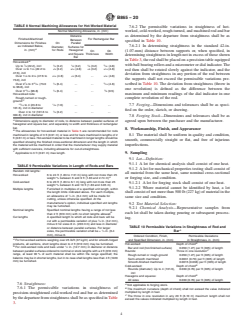
1.1 This specification covers nickel-copper-aluminum alloy (UNS N05500) in the form of rounds, squares, hexagons, or rectangles, and forgings and forging stock, manufactured either by hot working or cold working, and cold-worked wire.
1.2 The values stated in inch-pound units are to be regarded as standard. The values given in parentheses are mathematical conversions to SI units that are provided for information only and are not considered standard.
1.3 This standard does not purport to address all of the safety concerns, if any, associated with its use. It is the responsibility of the user of this standard to become familiar with all hazards including those identified in the appropriate Material Safety Data Sheet (MSDS) for this product/material as provided by the manufacturer, to establish appropriate safety, health, and environmental practices, and determine the applicability of regulatory limitations prior to use.
1.4 This international standard was developed in accordance with internationally recognized principles on standardization established in the Decision on Principles for the Development of International Standards, Guides and Recommendations issued by the World Trade Organization Technical Barriers to Trade (TBT) Committee.
- Status
- Published
- Publication Date
- 30-Sep-2020
- Technical Committee
- B02 - Nonferrous Metals and Alloys
- Drafting Committee
- B02.07 - Refined Nickel and Cobalt and Their Alloys
Buy Documents
ASTM B865-20 - Standard Specification for Precipitation Hardening Nickel-Copper-Aluminum Alloy<brk/> Bar, Rod, Wire, Forgings, and Forging Stock
REDLINE ASTM B865-20 - Standard Specification for Precipitation Hardening Nickel-Copper-Aluminum Alloy<brk/> Bar, Rod, Wire, Forgings, and Forging Stock
Overview
ASTM B865-20 is the internationally recognized standard specification for precipitation hardening nickel-copper-aluminum alloy products (UNS N05500), covering a broad range of forms including bar, rod, wire, forgings, and forging stock. Developed by ASTM Committee B02 on Nonferrous Metals and Alloys, this standard outlines the requirements for manufacturing, testing, and certifying nickel-copper-aluminum alloys designed for enhanced mechanical properties through precipitation hardening. The specification supports both hot and cold working processes and ensures compliance with stringent chemical and mechanical property requirements in both aged and unaged conditions.
Key Topics
Scope and Material Forms
- Applies to nickel-copper-aluminum alloy (UNS N05500) as rounds, squares, hexagons, rectangles, forgings, and forging stock.
- Products may be supplied in hot worked, cold worked, or cold-worked wire forms.
Precipitation Hardening Process
- Specifies the aging treatment to achieve optimal mechanical performance.
- Ensures conformity in properties after controlled heat treatment cycles.
Mechanical and Chemical Properties
- Establishes minimum requirements for tensile strength, yield strength, elongation, and hardness in both aged and unaged states.
- Defines permitted variation in chemical composition with clear test methodologies.
Dimensional Tolerances and Quality
- Lists permissible variations in dimensions, straightness, and machining allowances.
- Details requirements for finish, appearance, and absence of detrimental imperfections.
Testing and Certification
- Specifies procedures for sampling, test frequency, and specimen preparation.
- Outlines certification and product marking requirements for traceability and compliance.
Safety and Regulatory Compliance
- Stresses the user's responsibility for safety, health, and environmental practices, including reference to applicable Material Safety Data Sheets (MSDS).
Applications
The nickel-copper-aluminum alloy covered by ASTM B865-20 is widely utilized for its superior combination of strength, corrosion resistance, and toughness, making it suitable for demanding environments. Typical applications include:
- Marine Engineering: Shafts, fasteners, propeller shafts, and valve components exposed to saltwater and high mechanical stress.
- Oil and Gas Industry: High-strength non-magnetic components in drilling equipment, well tools, and valves operating in corrosive offshore conditions.
- Aerospace and Defense: Components requiring resistance to both mechanical fatigue and corrosion, such as landing gear, actuators, and critical hardware.
- Chemical Processing: Pump and valve parts, mixers, and processing equipment encountering harsh chemicals.
- Power Generation: Turbine parts, connectors, and other high-reliability components.
Related Standards
Products referenced or tested under ASTM B865-20 often require adherence to, or compatibility with, several related standards, including:
- ASTM E8 / E8M: Test methods for tension testing of metallic materials.
- ASTM E18: Rockwell hardness testing methods for metals.
- ASTM E29: Practice for using significant digits in test data.
- ASTM E112: Methods for determining average grain size.
- ASTM E140: Hardness conversion tables for metals.
- ASTM E1473: Chemical analysis methods for nickel, cobalt, and high-temperature alloys.
- Federal and Military Standards: For packaging, labeling, identification, and nondestructive testing requirements.
By following ASTM B865-20 specifications, manufacturers and users ensure the high quality, reliability, and traceability of nickel-copper-aluminum alloy products across industries with rigorous mechanical and environmental demands.
Relations
- Effective Date
- 01-Jul-2018
- Effective Date
- 01-Jul-2017
- Effective Date
- 01-Dec-2012
- Effective Date
- 15-Nov-2012
- Effective Date
- 01-Nov-2011
- Effective Date
- 01-Nov-2010
- Effective Date
- 01-Oct-2008
- Effective Date
- 15-May-2008
- Effective Date
- 15-Jan-2008
- Effective Date
- 01-Apr-2007
- Effective Date
- 15-Nov-2006
- Effective Date
- 23-Oct-2006
- Effective Date
- 15-Sep-2006
- Effective Date
- 01-May-2006
- Effective Date
- 01-Apr-2005
Buy Documents
ASTM B865-20 - Standard Specification for Precipitation Hardening Nickel-Copper-Aluminum Alloy<brk/> Bar, Rod, Wire, Forgings, and Forging Stock
REDLINE ASTM B865-20 - Standard Specification for Precipitation Hardening Nickel-Copper-Aluminum Alloy<brk/> Bar, Rod, Wire, Forgings, and Forging Stock
Get Certified
Connect with accredited certification bodies for this standard

Element Materials Technology
Materials testing and product certification.

Inštitut za kovinske materiale in tehnologije
Institute of Metals and Technology. Materials testing, metallurgical analysis, NDT.
Sponsored listings
Frequently Asked Questions
ASTM B865-20 is a technical specification published by ASTM International. Its full title is "Standard Specification for Precipitation Hardening Nickel-Copper-Aluminum Alloy<brk/> Bar, Rod, Wire, Forgings, and Forging Stock". This standard covers: ABSTRACT This specification covers UNS N05500 nickel-copper-aluminum alloy rounds, squares, hexagons, rectangles, and forgings and forging stocks manufactured by either hot working or cold working, and cold-worked wire. The material should conform to the required mechanical properties in both aged and unaged conditions. Precipitation hardening is accomplished by holding the material at a high temperature, followed by furnace cooling and then air cooling. SCOPE 1.1 This specification covers nickel-copper-aluminum alloy (UNS N05500) in the form of rounds, squares, hexagons, or rectangles, and forgings and forging stock, manufactured either by hot working or cold working, and cold-worked wire. 1.2 The values stated in inch-pound units are to be regarded as standard. The values given in parentheses are mathematical conversions to SI units that are provided for information only and are not considered standard. 1.3 This standard does not purport to address all of the safety concerns, if any, associated with its use. It is the responsibility of the user of this standard to become familiar with all hazards including those identified in the appropriate Material Safety Data Sheet (MSDS) for this product/material as provided by the manufacturer, to establish appropriate safety, health, and environmental practices, and determine the applicability of regulatory limitations prior to use. 1.4 This international standard was developed in accordance with internationally recognized principles on standardization established in the Decision on Principles for the Development of International Standards, Guides and Recommendations issued by the World Trade Organization Technical Barriers to Trade (TBT) Committee.
ABSTRACT This specification covers UNS N05500 nickel-copper-aluminum alloy rounds, squares, hexagons, rectangles, and forgings and forging stocks manufactured by either hot working or cold working, and cold-worked wire. The material should conform to the required mechanical properties in both aged and unaged conditions. Precipitation hardening is accomplished by holding the material at a high temperature, followed by furnace cooling and then air cooling. SCOPE 1.1 This specification covers nickel-copper-aluminum alloy (UNS N05500) in the form of rounds, squares, hexagons, or rectangles, and forgings and forging stock, manufactured either by hot working or cold working, and cold-worked wire. 1.2 The values stated in inch-pound units are to be regarded as standard. The values given in parentheses are mathematical conversions to SI units that are provided for information only and are not considered standard. 1.3 This standard does not purport to address all of the safety concerns, if any, associated with its use. It is the responsibility of the user of this standard to become familiar with all hazards including those identified in the appropriate Material Safety Data Sheet (MSDS) for this product/material as provided by the manufacturer, to establish appropriate safety, health, and environmental practices, and determine the applicability of regulatory limitations prior to use. 1.4 This international standard was developed in accordance with internationally recognized principles on standardization established in the Decision on Principles for the Development of International Standards, Guides and Recommendations issued by the World Trade Organization Technical Barriers to Trade (TBT) Committee.
ASTM B865-20 is classified under the following ICS (International Classification for Standards) categories: 77.120.01 - Non-ferrous metals in general. The ICS classification helps identify the subject area and facilitates finding related standards.
ASTM B865-20 has the following relationships with other standards: It is inter standard links to ASTM E18-18, ASTM E18-17, ASTM E18-12, ASTM E112-12, ASTM E18-11, ASTM E112-10, ASTM E29-08, ASTM E18-08a, ASTM E18-08, ASTM E18-07, ASTM E29-06b, ASTM E112-96(2004)e2, ASTM E29-06a, ASTM E29-06, ASTM E140-05. Understanding these relationships helps ensure you are using the most current and applicable version of the standard.
ASTM B865-20 is available in PDF format for immediate download after purchase. The document can be added to your cart and obtained through the secure checkout process. Digital delivery ensures instant access to the complete standard document.
Standards Content (Sample)
This international standard was developed in accordance with internationally recognized principles on standardization established in the Decision on Principles for the
Development of International Standards, Guides and Recommendations issued by the World Trade Organization Technical Barriers to Trade (TBT) Committee.
Designation:B865 −20
Standard Specification for
Precipitation Hardening Nickel-Copper-Aluminum Alloy
Bar, Rod, Wire, Forgings, and Forging Stock
This standard is issued under the fixed designation B865; the number immediately following the designation indicates the year of
original adoption or, in the case of revision, the year of last revision. A number in parentheses indicates the year of last reapproval. A
superscript epsilon (´) indicates an editorial change since the last revision or reapproval.
1. Scope* E112 Test Methods for Determining Average Grain Size
E140 Hardness Conversion Tables for Metals Relationship
1.1 This specification covers nickel-copper-aluminum alloy
Among Brinell Hardness, Vickers Hardness, Rockwell
(UNS N05500) in the form of rounds, squares, hexagons, or
Hardness, Superficial Hardness, Knoop Hardness, Sclero-
rectangles,andforgingsandforgingstock,manufacturedeither
scope Hardness, and Leeb Hardness
by hot working or cold working, and cold-worked wire.
E1473 Test Methods for Chemical Analysis of Nickel, Co-
1.2 The values stated in inch-pound units are to be regarded
balt and High-Temperature Alloys
as standard. The values given in parentheses are mathematical 3
2.2 Federal Standards:
conversions to SI units that are provided for information only
Fed. Std. No. 102 Preservation, Packaging, and Packing
and are not considered standard.
Levels
1.3 This standard does not purport to address all of the
Fed. Std. No. 123 Marking for Shipment (Civil Agencies)
safety concerns, if any, associated with its use. It is the
Fed. Std. No. 182 Continuous Identification Marking of
responsibility of the user of this standard to become familiar
Nickel and Nickel-Base Alloys
with all hazards including those identified in the appropriate
2.3 Military Standards:
Material Safety Data Sheet (MSDS) for this product/material
MIL-STD-129 Marking for Shipment and Storage
as provided by the manufacturer, to establish appropriate
MIL-STD-271 Nondestructive Testing Requirements for
safety, health, and environmental practices, and determine the
Metals
applicability of regulatory limitations prior to use.
3. Terminology
1.4 This international standard was developed in accor-
dance with internationally recognized principles on standard-
3.1 Definitions of Terms Specific to This Standard:
ization established in the Decision on Principles for the
3.1.1 bar, n—material of rectangular (flats), hexagonal, or
Development of International Standards, Guides and Recom-
square solid section up to and including 10 in. (254 mm) in
mendations issued by the World Trade Organization Technical 1
width and ⁄8 in. (3.2 mm) and over in thickness in straight
Barriers to Trade (TBT) Committee.
lengths.
3.1.2 rod, n—material of round solid section furnished in
2. Referenced Documents
straight lengths.
2.1 ASTM Standards:
3.1.3 wire, n—a cold-worked solid product of uniform
E8 Test Methods for Tension Testing of Metallic Materials
round cross section along its whole length, supplied in coil
[Metric] E0008_E0008M
form.
E18 Test Methods for Rockwell Hardness of Metallic Ma-
terials
4. Ordering Information
E29 Practice for Using Significant Digits in Test Data to
4.1 Orders for material to this specification should include
Determine Conformance with Specifications
the following information:
4.1.1 ASTM designation and year of issue,
This specification is under the jurisdiction of ASTM Committee B02 on 4.1.2 Alloy name or UNS number (see Table 1),
Nonferrous Metals and Alloys and is the direct responsibility of Subcommittee
4.1.3 Shape—rod (round) or bar (square, hexagonal, or
B02.07 on Refined Nickel and Cobalt and Their Alloys.
rectangular),
Current edition approved Oct. 1, 2020. Published November 2020. Originally
4.1.3.1 Forging (sketch or drawing),
approved in 1995. Last previous edition approved in 2015 as B865 – 04 (2015).
DOI: 10.1520/B0865-20.
For referenced ASTM standards, visit the ASTM website, www.astm.org, or
contact ASTM Customer Service at service@astm.org. For Annual Book of ASTM Available from U.S. Government Printing Office, Superintendent of
Standards volume information, refer to the standard’s Document Summary page on Documents, 732 N. Capitol St., NW, Washington, DC 20401-0001, http://
the ASTM website. www.access.gpo.gov.
*A Summary of Changes section appears at the end of this standard
Copyright © ASTM International, 100 Barr Harbor Drive, PO Box C700, West Conshohocken, PA 19428-2959. United States
B865−20
TABLE 1 Chemical Requirements TABLE 3 Permissible Variations in Straightness of Precision
Straightened Cold-Worked Shafting
Product (check) analysis
variations, under min or
Permissible Variations
Element Composition Limits, %
Standard Distance
over max, of the specified
Specified Dimension, Throw In One Revolution
Between Supports,
limit of element, %
in. (mm) From Straightness,
in. (mm)
A
in. (mm)
Nickel 63.0 min 0.45
1 15
Aluminum 2.30–3.15 0.20
⁄2 (12.7) to ⁄16 (23.8), 42 (1070) 0.005 (0.13)
Carbon 0.18 max 0.01
incl
Iron 2.0 max 0.05
Over ⁄16 (23.8) to 42 (1070) 0.006 (0.15)
Manganese 1.5 max 0.04
1 ⁄16 (49.2), incl
15 1
Silicon 0.50 max 0.03 Over 1 ⁄16 (49.2) to 2 ⁄2 42 (1070) 0.007 (0.18)
Titanium 0.35–0.85 0.03 min
(63.5), incl
0.04 max Over 2 ⁄2 (63.5) to 4 42 (1070) 0.008 (0.20)
Sulfur 0.010 max 0.003
(101.6), incl
3 15
Copper 27.0–33.0 0.15 min ⁄4 (19.0) to ⁄16 (23.8), Specified lengths of 3 to 100.004 (0.10) plus 0.0025
0.20 max
incl ft (0.91 to 3.05 m) (0.064) for each foot, or
fraction thereof, in excess
A
The nickel content shall be determined arithmetically by difference.
of 3 ft (0.91 m)
Over ⁄16 (23.8) to 4 Specified lengths of 20 ft 0.005 (0.13) plus 0.0015
(101.6), incl (6.10 m) and less (0.038) for each foot, or
fraction thereof, in excess
4.1.4 Dimensions, including length, (see Tables 2 and 3), of 3 ft (0.91 m)
4.1.5 Condition (see Table 4, Table 5, and Table 6),
4.1.6 Forging stock—Specify if material is stock for
A
TABLE 4 Mechanical Properties—Unaged (Bar, Rod, Forgings)
reforging,
Hardness
4.1.7 Finish,
Form Condition
Brinell
4.1.8 Quantity—feet or number of pieces, and
Rockwell, max
3000 kg, max
4.1.9 Certification—State if certification or a report of test
B
Rounds, hexagons, Hot-worked 245 C23
results is required (Section 15),
squares, rectangles, and
forgings
4.1.10 Samples for product (check) analysis—State whether
Hexagons Cold-worked 260 C26
samples for product (check) analysis should be furnished, and
Rounds:
4.1.11 Purchaser inspection—If purchaser wishes to witness ⁄4 (6.4 mm) to 1 in. Cold-worked 280 C29
(25.4 mm), incl
tests or inspection of material at place of manufacture, the
Over 1 (25.4 mm) to 3 Cold-worked 260 C26
purchase order must so state indicating which test or inspec-
in. (76.2 mm), incl
tions are to be witnessed. Over 3 (76.2 mm) to 4 Cold-worked 240 C22
in. (101.6 mm), incl
Rounds, hexagons, Hot-worked or cold- 185 B90
5. Chemical Composition
squares, rectangles, and worked and annealed
forgings
5.1 The material shall conform to the composition limits
A
No tensile tests are required except as provided for in 9.2.3.
specified in Table 1.
B
Rounds over 4 ⁄4 in. (108.0 mm) in diameter shall have hardness of 260 BHN,
max.
TABLE 2 Permissible Variations in Diameter or Distance Between
A
Parallel Surfaces of Hot-Worked Rod and Bar
Permissible Variations from
B 5.2 If a product (check) analysis is performed by the
Specified Dimensions, in. (mm)
Specified Dimension, in. (mm)
purchaser, the material shall conform to the product (check)
Plus Minus
analysis variations in Table 1.
Rod and bar, hot worked:
1 (25.4) and under 0.016 (0.41) 0.016 (0.41)
Over 1 (25.4) to 2 (50.8), incl 0.031 (0.79) 0.016 (0.41)
6. Mechanical Properties
Over 2 (50.8) to 4 (101.6), incl 0.047 (1.19) 0.031 (0.79)
Over 4 (101.6) 0.125 (3.18) 0.063 (1.60) 6.1 Mechanical Properties—The material in the unaged
Rod, rough-turned or ground:
condition shall conform to the mechanical properties specified
Under 1 (25.4) 0.005 (0.13) 0.005 (0.13)
in Table 4. After aging, the material shall conform to the
1 (25.4) and over 0.031 (0.79) 0
Round rod, semi-smooth, machined: mechanical properties specified in Table 5 and Table 6.
Over 3 ⁄2 (88.9) 0.031 (0.79) 0
Round rod, smooth finished, machined:
7. Dimensions and Permissible Variations
Over 3 ⁄2 (88.9) 0 0.005 (0.13)
Forging quality bolt stock (rounds only):
7.1 Diameter, Thickness, or Width—The permissible varia-
1 5
⁄4 (6.4), ⁄16 (7.9) 0 0.0062 (0.16)
tions from the specified dimensions as measured on the
3 7 1
⁄8 (9.5), ⁄16 (11.1), ⁄2 (12.7) 0 0.0066 (0.17)
9 5 11 3
diameter or between parallel surfaces of cold-worked rod and
⁄16 (14.3), ⁄8 (7.9), ⁄16 (17.5), ⁄4 (19.1), 0 0.0082 (0.21)
13 7
⁄16 (20.6), ⁄8 (22.2)
bar shall be as prescribed in Table 7; of hot-worked rod and bar
⁄16 (7.9), 1 (25.4) 0 0.0098 (0.25)
as prescribed in Table 2; and of wire as prescribed in Table 7.
1 1 1
1 ⁄16 to 1 ⁄2 (27.0 to 38.1), in ⁄16 (1.6) 0 0.0112 (0.28)
increments
7.2 Out-of-Round—Hot-worked rods and cold-worked rods
A
Not applicable to forging stock.
(except “forging quality”) of all sizes, in straight lengths, shall
B
Dimensions apply to diameter of rods, to distance between parallel surfaces of
not be out-of-round by more than one half the total permissible
hexagons and squares, and separately to width and thickness of rectangles.
variations in diameter shown in Table 2 and Table 7, except for
B865−20
A
TABLE 5 Mechanical Properties—Age-Hardened (Bar, Rod, and Forgings)
C
Hardness
B B
Tensile
Yield Strength , Elongation
Maximum Section
Form Condition Strength, min, 0.2 % offset, in 2 in. or 4D,
Brinell 3000 Rockwell
Thickness, in. (mm)
min, ksi (MPa) min,%
ksi (MPa)
kg, min C, min
D
Rounds, hexagons, squares, Hot-worked and age- All sizes 140 (965) 100 (690) 20.0 265 27
E
rectangles, and forgings
hardened
Rounds Cold-worked and ⁄4 (6.4) to 1 (25.4), incl 145 (1000) 110 (760) 15.0 300 32
age-hardened over 1 (25.4) to 3 140 (965) 100 (690) 17.0 280 29
(76.2), incl
over 3 (76.2) to 4 135 (930) 95 (655) 20.0 255 25
(101.6), incl
Hexagons Cold-worked and age- ⁄4 (6.4) to 2 (50.8), incl 140 (965) 100 (690) 15.0 265 27
hardened
Rounds, hexagons, squares, Annealed and age- Up to 1 (25.4) 130 (895) 90 (620) 20.0 250 24
F
rectangles, and forgings hardened 1 (25.4) and over 130 (895) 85 (585) 20.0 250 24
A
Age hardening heat treatment:
Age hardening shall be accomplished by holding at an aim temperature of 1100°F (595°C) for 8 to 16 h followed by furnace cooling to 900°F (480°C) at a rate of 15
to 25°F (10 to 15°C) per hour and then air cooling.An alternate procedure consists of holding at 1100°F (595°C) for up to 16 h, furnace cooling to 1000°F (540°C), holding
for approximately 6 h, furnace cooling to 900°F (480°C), holding for approximately 8 h, and air cooling to room temperature.
(Mill age-hardened products have been precipitation heat treated by the manufacturer and further thermal treatment normally is not required. Hot-worked, cold-worked,
or annealed material is normally age hardened by the purchaser after forming or machining.)
B
Not applicable to subsize tensile specimens less than 0.250 in. (6.4 mm) in diameter.
C
Hardness values are given for information only and are not the basis for acceptance or rejection.
D
Rounds over 4 ⁄4 in. (108.0 mm) in diameter shall have an elongation in 2 in. (50.8 mm) or 4D of 17 %, min.
E
When specified, for forged rings and discs, hardness measurements may be utilized in lieu of tensile test.
F
Applicable to both hot-worked and cold-worked material.
TABLE 6 Tensile Strength of Cold-Drawn Wire in Coils TABLE 7 Permissible Variations in Diameter or Distance Between
Parallel Surfaces of Cold-Worked Rod and Bar
Tensile Strength, min,
Condition and Size, in. (mm)
ksi (MPa)
Permissible Variations From
A
A Specified Dimension, in. (mm)
Cold-worked, as-worked, all sizes 110–155 (760–1070) Specified Dimension, in. (mm)
B
Cold-worked and annealed, all sizes 110 (760)
Plus Minus
Cold-worked, spring temper, as-drawn 0.057 (1.45) 165 (1140)
Rounds:
C
and less
1 3
⁄16 (1.6) to ⁄16 (4.8), excl 0 0.002 (0.05)
Over 0.057 to 0.114 (1.45 to 2.90), incl 155 (1070)
3 1
⁄16 (4.8) to ⁄2 (12.7), excl 0 0.003 (0.08)
Over 0.114 to 0.229 (2.90 to 5.82), incl 150 (1035)
B
1 15
⁄2 (12.7) to ⁄16 (23.8), incl 0 0.002 (0.05)
Over 0.229 to 0.312 (5.82 to 7.92), incl 145 (1000)
B
15 15
Over ⁄16 (23.8) to 1 ⁄16 (49.2), incl 0 0.003 (0.08)
Over 0.312 to 0.375 (7.92 to 9.52), incl 135 (930)
15 1 B
Over 1 ⁄16 (49.2) to 2 ⁄2 (63.5), incl 0 0.004 (0.10)
Over 0.375 to 0.437 (9.52 to 11.10), incl 125 (860)
B
Over 2 ⁄2 (63.5) to 3 (76.2), incl 0 0.005 (0.13)
Over 0.437 to 0.563 (11.10 to 14.30), incl 120 (825)
B
Over 3 (76.2) to 3 ⁄2 (88.9), incl 0 0.006 (0.15)
D
Cold-worked, annealed, and age-hardened, all sizes 130 (895)
B
Over 3 ⁄2 (88.9) to 4 (101.6), incl 0 0.007 (0.18)
D
Cold-worked, as drawn, age-hardened, all sizes 155 (1070)
Hexagons, squares, rectangles:
D
Cold-worked, spring temper, and age-hardened
⁄2 (12.7) and less 0 0.004 (0.10)
Up to 0.114 (2.90), incl 180 (1240)
1 7
Over ⁄2 (12.7) to ⁄8 (22.2), incl 0 0.005 (0.13)
Over 0.114 to 0.375 (2.90 to 9.52), incl 170 (1170)
7 1
Over ⁄8 (22.2) to 1 ⁄4 (31.8), incl 0 0.007 (0.18)
Over 0.375 to 0.563 (9.52 to 14.30), incl 160 (1105)
Over 1 ⁄4 (31.8) to 2 (50.8), incl 0 0.009 (0.23)
A
Minimum and maximum.
A
Dimensionsapplytodiameterofrounds,todistancebetweenparallelsurfacesof
B
Maximum.
hexagons and squares, and separately to width and thickness of rectangles.
C
Applicabletomaterialincoil.Formaterialinstraightenedandcutlengths,deduct
B
For cold-worked, age-hardened, bright finish shafting, an additional minus 0.002
15 ksi (105 MPa) from above values.
(0.05) tolerance will be permitted.
D
Age hardening heat treatment:
Age hardening shall be accomplished by holding at an aim temperature of
1100°F(595°C)for8to16hfollowedbyfurnacecoolingto900°F(480°C)atarate
7.3 Edges—Square, rectangular, and hexagonal bar and rod
of 15 to 25°F (10 to 15°C) per hour and then air cooling. An alternate procedure
consists of holding at 1100°F (595°C) for up to 16 h, furnace cooling to 1000°F
shall have angles and corners consistent with commercial
(540°C), holding for approximately 6 h, furnace cooling to 900°F (480°C), holding
practice.
for approximately 8 h, and air cooling to room temperature.
(Mill age-hardened products have been precipitation heat treated by the
7.4 Machining Allowances for Hot-Worked Materials—
manufacturer a
...
This document is not an ASTM standard and is intended only to provide the user of an ASTM standard an indication of what changes have been made to the previous version. Because
it may not be technically possible to adequately depict all changes accurately, ASTM recommends that users consult prior editions as appropriate. In all cases only the current version
of the standard as published by ASTM is to be considered the official document.
Designation: B865 − 04 (Reapproved 2015) B865 − 20
Standard Specification for
Precipitation Hardening Nickel-Copper-Aluminum Alloy
(UNS N05500) Bar, Rod, Wire, Forgings, and Forging Stock
This standard is issued under the fixed designation B865; the number immediately following the designation indicates the year of
original adoption or, in the case of revision, the year of last revision. A number in parentheses indicates the year of last reapproval. A
superscript epsilon (´) indicates an editorial change since the last revision or reapproval.
1. Scope Scope*
1.1 This specification covers nickel-copper-aluminum alloy (UNS N05500) in the form of rounds, squares, hexagons, or
rectangles, and forgings and forging stock, manufactured either by hot working or cold working, and cold-worked wire.
1.2 The values stated in inch-pound units are to be regarded as standard. The values given in parentheses are mathematical
conversions to SI units that are provided for information only and are not considered standard.
1.3 This standard does not purport to address all of the safety concerns, if any, associated with its use. It is the responsibility
of the user of this standard to become familiar with all hazards including those identified in the appropriate Material Safety Data
Sheet (MSDS) for this product/material as provided by the manufacturer, to establish appropriate safety safety, health, and
healthenvironmental practices, and determine the applicability of regulatory limitations prior to use.
1.4 This international standard was developed in accordance with internationally recognized principles on standardization
established in the Decision on Principles for the Development of International Standards, Guides and Recommendations issued
by the World Trade Organization Technical Barriers to Trade (TBT) Committee.
2. Referenced Documents
2.1 ASTM Standards:
E8 Test Methods for Tension Testing of Metallic Materials [Metric] E0008_E0008M
E18 Test Methods for Rockwell Hardness of Metallic Materials
E29 Practice for Using Significant Digits in Test Data to Determine Conformance with Specifications
E112 Test Methods for Determining Average Grain Size
E140 Hardness Conversion Tables for Metals Relationship Among Brinell Hardness, Vickers Hardness, Rockwell Hardness,
Superficial Hardness, Knoop Hardness, Scleroscope Hardness, and Leeb Hardness
E602 Test Method for Sharp-Notch Tension Testing with Cylindrical Specimens (Withdrawn 2010)
E1473 Test Methods for Chemical Analysis of Nickel, Cobalt and High-Temperature Alloys
2.2 Federal Standards:
Fed. Std. No. 102 Preservation, Packaging, and Packing Levels
Fed. Std. No. 123 Marking for Shipment (Civil Agencies)
Fed. Std. No. 182 Continuous Identification Marking of Nickel and Nickel-Base Alloys
This specification is under the jurisdiction of ASTM Committee B02 on Nonferrous Metals and Alloys and is the direct responsibility of Subcommittee B02.07 on Refined
Nickel and Cobalt and Their Alloys.
Current edition approved May 1, 2015Oct. 1, 2020. Published May 2015November 2020. Originally approved in 1995. Last previous edition approved in 20102015 as
B865 – 04 (2010).(2015). DOI: 10.1520/B0865-04R15.10.1520/B0865-20.
For referenced ASTM standards, visit the ASTM website, www.astm.org, or contact ASTM Customer Service at service@astm.org. For Annual Book of ASTM Standards
volume information, refer to the standard’s Document Summary page on the ASTM website.
The last approved version of this historical standard is referenced on www.astm.org.Available from U.S. Government Printing Office, Superintendent of Documents, 732
N. Capitol St., NW, Washington, DC 20401-0001, http://www.access.gpo.gov.
*A Summary of Changes section appears at the end of this standard
Copyright © ASTM International, 100 Barr Harbor Drive, PO Box C700, West Conshohocken, PA 19428-2959. United States
B865 − 20
2.3 Military Standards:
MIL-STD-129 Marking for Shipment and Storage
MIL-STD-271 Nondestructive Testing Requirements for Metals
3. Terminology
3.1 Definitions of Terms Specific to This Standard:
3.1.1 bar, n—material of rectangular (flats), hexagonal, or square solid section up to and including 10 in. (254 mm) in width and
⁄8 in. (3.2 mm) and over in thickness in straight lengths.
3.1.2 rod, n—material of round solid section furnished in straight lengths.
3.1.3 wire, n—a cold-worked solid product of uniform round cross section along its whole length, supplied in coil form.
4. Ordering Information
4.1 Orders for material to this specification should include the following information:
4.1.1 ASTM designation and year of issue,
4.1.2 Alloy name or UNS number (see Table 1),
4.1.3 Shape—rod (round) or bar (square, hexagonal, or rectangular),
4.1.3.1 Forging (sketch or drawing),
4.1.4 Dimensions, including length, (see Tables 2 and 3),
4.1.5 Condition (see Table 4, Table 5, and Table 6),
4.1.6 Forging stock—Specify if material is stock for reforging,
4.1.7 Finish,
4.1.8 Quantity—feet or number of pieces, and
4.1.9 Certification—State if certification or a report of test results is required (Section 15),
4.1.10 Samples for product (check) analysis—State whether samples for product (check) analysis should be furnished, and
4.1.11 Purchaser inspection—If purchaser wishes to witness tests or inspection of material at place of manufacture, the purchase
order must so state indicating which test or inspections are to be witnessed.
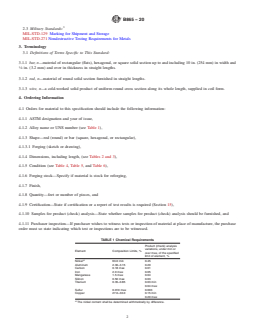
TABLE 1 Chemical Requirements
Product (check) analysis
variations, under min or
Element Composition Limits, %
over max, of the specified
limit of element, %
A
Nickel 63.0 min 0.45
Aluminum 2.30–3.15 0.20
Carbon 0.18 max 0.01
Iron 2.0 max 0.05
Manganese 1.5 max 0.04
Silicon 0.50 max 0.03
Titanium 0.35–0.85 0.03 min
0.04 max
Sulfur 0.010 max 0.003
Copper 27.0–33.0 0.15 min
0.20 max
A
The nickel content shall be determined arithmetically by difference.
B865 − 20
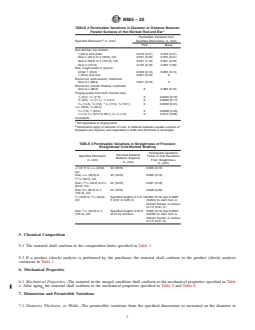
TABLE 2 Permissible Variations in Diameter or Distance Between
A
Parallel Surfaces of Hot-Worked Rod and Bar
Permissible Variations from
B
Specified Dimensions, in. (mm)
Specified Dimension, in. (mm)
Plus Minus
Rod and bar, hot worked:
1 (25.4) and under 0.016 (0.41) 0.016 (0.41)
Over 1 (25.4) to 2 (50.8), incl 0.031 (0.79) 0.016 (0.41)
Over 2 (50.8) to 4 (101.6), incl 0.047 (1.19) 0.031 (0.79)
Over 4 (101.6) 0.125 (3.18) 0.063 (1.60)
Rod, rough-turned or ground:
Under 1 (25.4) 0.005 (0.13) 0.005 (0.13)
1 (25.4) and over 0.031 (0.79) 0
Round rod, semi-smooth, machined:
Over 3 ⁄2 (88.9) 0.031 (0.79) 0
Round rod, smooth finished, machined:
Over 3 ⁄2 (88.9) 0 0.005 (0.13)
Forging quality bolt stock (rounds only):
1 5
⁄4 (6.4), ⁄16 (7.9) 0 0.0062 (0.16)
3 7 1
⁄8 (9.5), ⁄16 (11.1), ⁄2 (12.7) 0 0.0066 (0.17)
9 5 11 3
⁄16 (14.3), ⁄8 (7.9), ⁄16 (17.5), ⁄4 (19.1), 0 0.0082 (0.21)
13 7
⁄16 (20.6), ⁄8 (22.2)
⁄16 (7.9), 1 (25.4) 0 0.0098 (0.25)
1 1 1
1 ⁄16 to 1 ⁄2 (27.0 to 38.1), in ⁄16 (1.6) 0 0.0112 (0.28)
increments
A
Not applicable to forging stock.
B
Dimensions apply to diameter of rods, to distance between parallel surfaces of
hexagons and squares, and separately to width and thickness of rectangles.
TABLE 3 Permissible Variations in Straightness of Precision
Straightened Cold-Worked Shafting
Permissible Variations
Standard Distance
Specified Dimension, Throw In One Revolution
Between Supports,
in. (mm) From Straightness,
in. (mm)
in. (mm)
1 15
⁄2 (12.7) to ⁄16 (23.8), 42 (1070) 0.005 (0.13)
incl
Over ⁄16 (23.8) to 42 (1070) 0.006 (0.15)
1 ⁄16 (49.2), incl
15 1
Over 1 ⁄16 (49.2) to 2 ⁄2 42 (1070) 0.007 (0.18)
(63.5), incl
Over 2 ⁄2 (63.5) to 4 42 (1070) 0.008 (0.20)
(101.6), incl
3 15
⁄4 (19.0) to ⁄16 (23.8), Specified lengths of 3 to 100.004 (0.10) plus 0.0025
incl ft (0.91 to 3.05 m) (0.064) for each foot, or
fraction thereof, in excess
of 3 ft (0.91 m)
Over ⁄16 (23.8) to 4 Specified lengths of 20 ft 0.005 (0.13) plus 0.0015
(101.6), incl (6.10 m) and less (0.038) for each foot, or
fraction thereof, in excess
of 3 ft (0.91 m)
5. Chemical Composition
5.1 The material shall conform to the composition limits specified in Table 1.
5.2 If a product (check) analysis is performed by the purchaser, the material shall conform to the product (check) analysis
variations in Table 1.
6. Mechanical Properties
6.1 Mechanical Properties—The material in the unaged condition shall conform to the mechanical properties specified in Table
4. After aging, the material shall conform to the mechanical properties specified in Table 5 and Table 6.
7. Dimensions and Permissible Variations
7.1 Diameter, Thickness, or Width—The permissible variations from the specified dimensions as measured on the diameter or
B865 − 20
A
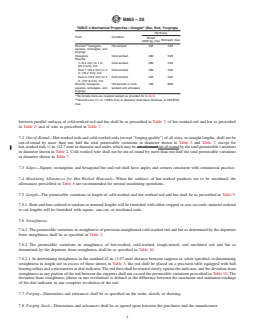
TABLE 4 Mechanical Properties—Unaged (Bar, Rod, Forgings)
Hardness
Form Condition
Brinell
Rockwell, max
3000 kg, max
B
Rounds, hexagons, Hot-worked 245 C23
squares, rectangles, and
forgings
Hexagons Cold-worked 260 C26
Rounds:
⁄4 (6.4 mm) to 1 in. Cold-worked 280 C29
(25.4 mm), incl
Over 1 (25.4 mm) to 3 Cold-worked 260 C26
in. (76.2 mm), incl
Over 3 (76.2 mm) to 4 Cold-worked 240 C22
in. (101.6 mm), incl
Rounds, hexagons, Hot-worked or cold- 185 B90
squares, rectangles, and worked and annealed
forgings
A
No tensile tests are required except as provided for in 9.2.3.
B
Rounds over 4 ⁄4 in. (108.0 mm) in diameter shall have hardness of 260 BHN,
max.
between parallel surfaces of cold-worked rod and bar shall be as prescribed in Table 7; of hot-worked rod and bar as prescribed
in Table 2; and of wire as prescribed in Table 7.
7.2 Out-of-Round—Hot-worked rods and cold-worked rods (except “forging quality”) of all sizes, in straight lengths, shall not be
out-of-round by more than one half the total permissible variations in diameter shown in Table 2 and Table 7, except for
hot-worked rods ⁄2 in. (12.7 mm) in diameter and under, which may be cut-of-roundout-of-round by the total permissible variations
in diameter shown in Table 2. Cold-worked wire shall not be out-of-round by more than one-half the total permissible variations
in diameter shown in Table 7.
7.3 Edges—Square, rectangular, and hexagonal bar and rod shall have angles and corners consistent with commercial practice.
7.4 Machining Allowances for Hot-Worked Materials—When the surfaces of hot-worked products are to be machined, the
allowances prescribed in Table 8 are recommended for normal machining operations.
7.5 Length—The permissible variations in length of cold-worked and hot-worked rod and bar shall be as prescribed in Table 9.
7.5.1 Rods and bars ordered to random or nominal lengths will be furnished with either cropped or saw-cut ends; material ordered
to cut lengths will be furnished with square, saw-cut, or machined ends.
7.6 Straightness:
7.6.1 The permissible variations in straightness of precision-straightened cold-worked rod and bar as determined by the departure
from straightness shall be as specified in Table 3.
7.6.2 The permissible variations in straightness of hot-worked, cold-worked, rough-turned, and machined rod and bar as
determined by the departure from straightness shall be as specified in Table 10.
7.6.2.1 In determining straightness in the standard 42-in. (1.07-mm) distance between supports or, when specified, in determining
straightness in length not in excess of those shown in Table 3, the rod shall be placed on a precision table equipped with ball
bearing rollers and a micrometer or dial indicator. The rod then shall be rotated slowly against the indicator, and the deviation from
straightness in any portion of the rod between the supports shall not exceed the permissible variations prescribed in Table 10. The
deviation from straightness (throw in one revolution) is defined as the difference between the maximum and minimum readings
of the dial indicator in one complete revolution of the rod.
7.7 Forging—Dimensions and tolerances shall be as specified on the order, sketch, or drawing.
7.8 Forging Stock—Dimensions and tolerances shall be as agreed upon between the purchaser and the manufacturer.
B865 − 20
A
TABLE 5 Mechanical Properties—Age-Hardened (Bar, Rod, and Forgings)
C
Hardness
B B
Tensile
Yield Strength , Elongation
Maximum Section
Form Condition Strength, min, 0.2 % offset, in 2 in. or 4D,
Brinell 3000 Rockwell
Thickness, in. (mm)
min, ksi (MPa) min,%
ksi (MPa)
kg, min C, min
D
Rounds, hexagons, squares, Hot-worked and age- All sizes 140 (965) 100 (690) 20.0 265 27
E
rectangles, and forgings
hardened
Rounds Cold-worked and ⁄4 (6.4) to 1 (25.4), incl 145 (1000) 110 (760) 15.0 300 32
age-hardened over 1 (25.4) to 3 140 (965) 100 (690) 17.0 280 29
(76.2), incl
over 3 (76.2) to 4 135 (930) 95 (655) 20.0 255 25
(101.6), incl
Hexagons Cold-worked and age- ⁄4 (6.4) to 2 (50.8), incl 140 (965) 100 (690) 15.0 265 27
hardened
Rounds, hexagons, squares, Annealed and age- Up to 1 (25.4) 130 (895) 90 (620) 20.0 250 24
F
rectangles, and forgings hardened 1 (25.4) and over 130 (895) 85 (585) 20.0 250 24
A
Age hardening heat treatment:
Age hardening shall be accomplished by holding at an aim temperature of 1100°F (595°C) for 8 to 16 h followed by furnace cooling to 900°F (480°C) at a rate of 15
to 25°F (10 to 15°C) per hour and then air cooling. An alternate procedure consists of holding at 1100°F (595°C) for up to 16 h, furnace cooling to 1000°F (540°C), holding
for approximately 6 h, furnace cooling to 900°F (480°C), holding for approximately 8 h, and air cooling to room temperature.
(Mill age-hardened products have been precipitation heat treated by the manufacturer and further thermal treatment normally is not required. Hot-worked, cold-worked,
or annealed material is normally age hardened by the purchaser after forming or machining.)
B
Not applicable to subsize tensile specimens less than 0.250 in. (6.4 mm) in diameter.
C
Hardness values are given for information only and are not the basis for acceptance or rejection.
D
Rounds over 4 ⁄4 in. (108.0 mm) in diameter shall have an elongation in 2 in. (50.8 mm) or 4D of 17 %, min.
E
When specified, for forged rings and discs, hardness measurements may be utilized in lieu of tensile test.
F
Applicable to both hot-worked and cold-worked material.
TABLE 6 Tensile Strength of Cold-Drawn Wire in Coils
Tensile Strength, min,
Condition and Size, in. (mm)
ksi (MPa)
A
Cold-worked, as-worked, all sizes 110–155 (760–1070)
B
Cold-worked and annealed, all sizes 110 (760)
Cold-worked, spring temper, as-drawn 0.057 (1.45) 165 (1140)
C
and less
Over 0.057 to 0.114 (1.45 to 2.90), incl 155 (1070)
Over 0.114 to 0.229 (2.90 to 5.82), incl 150 (1035)
Over 0.229 to 0.312 (5.82 to 7.92), incl 145 (1000)
Over 0.312 to 0.375 (7.92 to 9.52), incl 135 (930)
Over 0.375 to 0.437 (9.52 to 11.10), incl 125 (860)
Over 0.437 to 0.563 (11.10 to 14.30), incl 120 (825)
D
Cold-w
...