

ASTM F2059-21
(Test Method)Standard Test Method for Laboratory Oil Spill Dispersant Effectiveness Using the Swirling Flask
General Information
- Abstract
SIGNIFICANCE AND USE
5.1 A standard test is necessary to establish a baseline performance parameter so that dispersants can be compared, a given dispersant can be compared for effectiveness on different oils, and at different oil weathering stages, and batches of dispersant or oils can be checked for effectiveness changes with time or other factors. This test method provides a test at low mixing energy that is useful for discriminating subtle changes in effectiveness between variables when dispersant efficacy is high. A higher energy test alternative is the Baffled Flask (Test Method F3251).
5.2 Dispersant effectiveness varies with oil type, sea energy, oil conditions, salinity, and many other factors. Test results from this test method form a baseline, but are not to be taken as the absolute measure of performance at sea. Actual field effectiveness could be more or less than this value.
5.3 Many dispersant tests have been developed around the world. This test has been developed over many years using findings from world-wide testing to use standardized equipment, test procedures, and to overcome difficulties noted in other test procedures.
SCOPE
1.1 This test method covers the procedure to determine the effectiveness of oil spill dispersants on various oils in the laboratory. This test method is not applicable to other chemical agents nor to the use of such products or dispersants in open waters.
1.2 This test method covers the use of the swirling flask test apparatus and does not cover other apparatuses nor are the analytical procedures described in this report directly applicable to such procedures.
1.3 The test results obtained using this test method are intended to provide baseline effectiveness values used to compare dispersants and oil types under conditions analogous to those used in the test.
1.4 The test results obtained using this test method are effectiveness values that should be cited as test values derived from this standard test. Dispersant effectiveness values do not directly relate to effectiveness at sea or in other apparatuses. Actual effectiveness at sea is dependent on sea energy, oil state, temperature, salinity, actual dispersant dosage, and amount of dispersant that interacts with the oil.
1.5 The decision to use or not use a dispersant on an oil should not be based solely on this or any other laboratory test method.
1.6 The values stated in SI units are to be regarded as standard. No other units of measurement are included in this standard.
1.7 This standard does not purport to address all of the safety concerns, if any, associated with its use. It is the responsibility of the user of this standard to establish appropriate safety, health, and environmental practices and determine the applicability of regulatory limitations prior to use.
1.8 This international standard was developed in accordance with internationally recognized principles on standardization established in the Decision on Principles for the Development of International Standards, Guides and Recommendations issued by the World Trade Organization Technical Barriers to Trade (TBT) Committee.
- Status
- Published
- Publication Date
- 31-Aug-2021
- Technical Committee
- F20 - Hazardous Substances and Oil Spill Response
- Drafting Committee
- F20.13 - Treatment
Buy Documents
ASTM F2059-21 - Standard Test Method for Laboratory Oil Spill Dispersant Effectiveness Using the Swirling Flask
REDLINE ASTM F2059-21 - Standard Test Method for Laboratory Oil Spill Dispersant Effectiveness Using the Swirling Flask
Overview
ASTM F2059-21 is a key international standard developed by ASTM International for assessing oil spill dispersant effectiveness in the laboratory using the Swirling Flask method. This test method enables the comparison of dispersant products and oil types under controlled, low-energy mixing conditions, providing critical baseline data for oil spill response planning and research. The standard is intended to ensure repeatability and comparability of results, forming a consistent benchmark for evaluating different dispersants and oils across a wide range of variables.
Key Topics
- Standardized Test Method: The Swirling Flask test establishes a repeatable laboratory procedure for assessing how effectively a chemical dispersant can disperse oil in water under specific, low-energy conditions.
- Baseline Performance: The method provides baseline effectiveness values for dispersant products, allowing for consistent comparison both among dispersants and across oil types and conditions.
- Discriminating Variable Effects: By operating at low mixing energy, the swirling flask test can highlight subtle differences in dispersant performance that might be missed at higher energies.
- Laboratory Scope: This standard is strictly intended for laboratory tests using the swirling flask apparatus; it does not directly replicate or predict open water or high-energy conditions.
- Quality Assurance: Emphasizes the importance of rigorous cleaning, proper equipment calibration, and methodical sample handling to minimize error and interferences.
- Test Limitations: Results are not intended as absolute indicators of field performance, as actual dispersant effectiveness in the environment may vary due to additional influencing factors like sea energy, salinity, temperature, and oil weathering.
Applications
ASTM F2059-21 is widely utilized in the following contexts:
- Research and Product Development: Manufacturers and academic researchers employ this method to develop and refine new oil spill dispersants and to evaluate their efficacy on different crude oils and oil types.
- Regulatory Compliance and Certification: Environmental agencies and oversight bodies use the test results to help guide approval and listing processes for dispersant products, ensuring that only effective agents are used in remediation efforts.
- Quality Control: Oil and dispersant producers leverage this test to monitor product consistency, detect batch-to-batch variations, and track changes in effectiveness over time, including impacts resulting from oil weathering.
- Comparative Analysis: The standard facilitates head-to-head comparison of dispersant products or variations in oil composition under repeatable laboratory conditions.
- Education and Training: Laboratory personnel, researchers, and regulatory staff are trained using this method for proficiency in oil spill response evaluation.
Related Standards
To ensure comprehensive oil spill response strategies and standardized measurement of dispersant effectiveness, several related ASTM standards should be considered:
- ASTM F3251 - Standard Test Method for Laboratory Oil Spill Dispersant Effectiveness Using the Baffled Flask (high-energy alternative).
- ASTM F631 - Standard Guide for Collecting Skimmer Performance Data in Controlled Environments.
- ASTM F1413 - Standard Guide for Oil Spill Dispersant Application Equipment: Boom and Nozzle Systems.
- ASTM F1129 - Standard Guide for Laboratory Testing of Oil Spill Dispersants.
- ISO Standards covering performance and environmental testing of dispersants.
Summary
The ASTM F2059-21 Standard Test Method for Laboratory Oil Spill Dispersant Effectiveness Using the Swirling Flask is essential in providing a consistent and reliable approach for evaluating and comparing dispersant products in the laboratory. While not predictive of real-world ocean performance, its controlled methodology offers indispensable baseline data that underpins effective oil spill response strategies, product development, regulatory compliance, and ongoing research in oil spill mitigation. Utilizing this standard, along with its related ASTM and international standards, ensures best practices in laboratory dispersant effectiveness testing and oil spill response planning.
Keywords: ASTM F2059-21, oil spill, dispersant effectiveness, swirling flask test, laboratory test method, oil spill response, dispersant comparison, environmental standards, oil weathering, baseline testing.
Buy Documents
ASTM F2059-21 - Standard Test Method for Laboratory Oil Spill Dispersant Effectiveness Using the Swirling Flask
REDLINE ASTM F2059-21 - Standard Test Method for Laboratory Oil Spill Dispersant Effectiveness Using the Swirling Flask
Get Certified
Connect with accredited certification bodies for this standard

Element Materials Technology
Materials testing and product certification.

ABS Group Brazil
ABS Group certification services in Brazil.

ABS Quality Evaluations Inc.
American Bureau of Shipping quality certification.
Sponsored listings
Frequently Asked Questions
ASTM F2059-21 is a standard published by ASTM International. Its full title is "Standard Test Method for Laboratory Oil Spill Dispersant Effectiveness Using the Swirling Flask". This standard covers: SIGNIFICANCE AND USE 5.1 A standard test is necessary to establish a baseline performance parameter so that dispersants can be compared, a given dispersant can be compared for effectiveness on different oils, and at different oil weathering stages, and batches of dispersant or oils can be checked for effectiveness changes with time or other factors. This test method provides a test at low mixing energy that is useful for discriminating subtle changes in effectiveness between variables when dispersant efficacy is high. A higher energy test alternative is the Baffled Flask (Test Method F3251). 5.2 Dispersant effectiveness varies with oil type, sea energy, oil conditions, salinity, and many other factors. Test results from this test method form a baseline, but are not to be taken as the absolute measure of performance at sea. Actual field effectiveness could be more or less than this value. 5.3 Many dispersant tests have been developed around the world. This test has been developed over many years using findings from world-wide testing to use standardized equipment, test procedures, and to overcome difficulties noted in other test procedures. SCOPE 1.1 This test method covers the procedure to determine the effectiveness of oil spill dispersants on various oils in the laboratory. This test method is not applicable to other chemical agents nor to the use of such products or dispersants in open waters. 1.2 This test method covers the use of the swirling flask test apparatus and does not cover other apparatuses nor are the analytical procedures described in this report directly applicable to such procedures. 1.3 The test results obtained using this test method are intended to provide baseline effectiveness values used to compare dispersants and oil types under conditions analogous to those used in the test. 1.4 The test results obtained using this test method are effectiveness values that should be cited as test values derived from this standard test. Dispersant effectiveness values do not directly relate to effectiveness at sea or in other apparatuses. Actual effectiveness at sea is dependent on sea energy, oil state, temperature, salinity, actual dispersant dosage, and amount of dispersant that interacts with the oil. 1.5 The decision to use or not use a dispersant on an oil should not be based solely on this or any other laboratory test method. 1.6 The values stated in SI units are to be regarded as standard. No other units of measurement are included in this standard. 1.7 This standard does not purport to address all of the safety concerns, if any, associated with its use. It is the responsibility of the user of this standard to establish appropriate safety, health, and environmental practices and determine the applicability of regulatory limitations prior to use. 1.8 This international standard was developed in accordance with internationally recognized principles on standardization established in the Decision on Principles for the Development of International Standards, Guides and Recommendations issued by the World Trade Organization Technical Barriers to Trade (TBT) Committee.
SIGNIFICANCE AND USE 5.1 A standard test is necessary to establish a baseline performance parameter so that dispersants can be compared, a given dispersant can be compared for effectiveness on different oils, and at different oil weathering stages, and batches of dispersant or oils can be checked for effectiveness changes with time or other factors. This test method provides a test at low mixing energy that is useful for discriminating subtle changes in effectiveness between variables when dispersant efficacy is high. A higher energy test alternative is the Baffled Flask (Test Method F3251). 5.2 Dispersant effectiveness varies with oil type, sea energy, oil conditions, salinity, and many other factors. Test results from this test method form a baseline, but are not to be taken as the absolute measure of performance at sea. Actual field effectiveness could be more or less than this value. 5.3 Many dispersant tests have been developed around the world. This test has been developed over many years using findings from world-wide testing to use standardized equipment, test procedures, and to overcome difficulties noted in other test procedures. SCOPE 1.1 This test method covers the procedure to determine the effectiveness of oil spill dispersants on various oils in the laboratory. This test method is not applicable to other chemical agents nor to the use of such products or dispersants in open waters. 1.2 This test method covers the use of the swirling flask test apparatus and does not cover other apparatuses nor are the analytical procedures described in this report directly applicable to such procedures. 1.3 The test results obtained using this test method are intended to provide baseline effectiveness values used to compare dispersants and oil types under conditions analogous to those used in the test. 1.4 The test results obtained using this test method are effectiveness values that should be cited as test values derived from this standard test. Dispersant effectiveness values do not directly relate to effectiveness at sea or in other apparatuses. Actual effectiveness at sea is dependent on sea energy, oil state, temperature, salinity, actual dispersant dosage, and amount of dispersant that interacts with the oil. 1.5 The decision to use or not use a dispersant on an oil should not be based solely on this or any other laboratory test method. 1.6 The values stated in SI units are to be regarded as standard. No other units of measurement are included in this standard. 1.7 This standard does not purport to address all of the safety concerns, if any, associated with its use. It is the responsibility of the user of this standard to establish appropriate safety, health, and environmental practices and determine the applicability of regulatory limitations prior to use. 1.8 This international standard was developed in accordance with internationally recognized principles on standardization established in the Decision on Principles for the Development of International Standards, Guides and Recommendations issued by the World Trade Organization Technical Barriers to Trade (TBT) Committee.
ASTM F2059-21 is classified under the following ICS (International Classification for Standards) categories: 75.180.30 - Volumetric equipment and measurements. The ICS classification helps identify the subject area and facilitates finding related standards.
ASTM F2059-21 is available in PDF format for immediate download after purchase. The document can be added to your cart and obtained through the secure checkout process. Digital delivery ensures instant access to the complete standard document.
Standards Content (Sample)
This international standard was developed in accordance with internationally recognized principles on standardization established in the Decision on Principles for the
Development of International Standards, Guides and Recommendations issued by the World Trade Organization Technical Barriers to Trade (TBT) Committee.
Designation: F2059 − 21
Standard Test Method for
Laboratory Oil Spill Dispersant Effectiveness Using the
Swirling Flask
This standard is issued under the fixed designation F2059; the number immediately following the designation indicates the year of
original adoption or, in the case of revision, the year of last revision. A number in parentheses indicates the year of last reapproval. A
superscript epsilon (´) indicates an editorial change since the last revision or reapproval.
1. Scope ization established in the Decision on Principles for the
Development of International Standards, Guides and Recom-
1.1 This test method covers the procedure to determine the
mendations issued by the World Trade Organization Technical
effectiveness of oil spill dispersants on various oils in the
Barriers to Trade (TBT) Committee.
laboratory.This test method is not applicable to other chemical
agents nor to the use of such products or dispersants in open
2. Referenced Documents
waters.
2.1 ASTM Standards:
1.2 This test method covers the use of the swirling flask test
F3251 Test Method for Laboratory Oil Spill Dispersant
apparatus and does not cover other apparatuses nor are the
Effectiveness Using the Baffled Flask
analytical procedures described in this report directly appli-
cable to such procedures.
3. Terminology
1.3 The test results obtained using this test method are
3.1 Definitions:
intended to provide baseline effectiveness values used to
3.1.1 effectiveness, n—the capability of producing a desired
compare dispersants and oil types under conditions analogous
result – which is this case is the dispersion of oil into water.
to those used in the test.
3.1.1.1 Discussion—Effectiveness is given here as the per-
cent of oil dispersed into the water column as a result of
1.4 The test results obtained using this test method are
dispersant action and energy.
effectiveness values that should be cited as test values derived
from this standard test. Dispersant effectiveness values do not
4. Summary of Test Method
directly relate to effectiveness at sea or in other apparatuses.
Actualeffectivenessatseaisdependentonseaenergy,oilstate, 4.1 Dispersant is pre-mixed with oil and placed on water in
temperature, salinity, actual dispersant dosage, and amount of a test vessel. The test vessel is agitated on a moving table
dispersant that interacts with the oil.
shaker. At the end of the shaking period, a settling period is
specified and then a sample of water taken.The oil in the water
1.5 The decision to use or not use a dispersant on an oil
column is extracted from the water using a dichloromethane
should not be based solely on this or any other laboratory test
solvent and analyzed using gas chromatography.
method.
4.2 The extract is analyzed for oil using a gas chromato-
1.6 The values stated in SI units are to be regarded as
graph equipped with a flame ionization detector, (GC-FID).
standard. No other units of measurement are included in this
Quantification is by means of the internal standard method.
standard.
Effectiveness values are derived by comparison with a cali-
1.7 This standard does not purport to address all of the
bratedsetofeffectivenessvaluesobtainedatthesametimeand
safety concerns, if any, associated with its use. It is the
by the same method.
responsibility of the user of this standard to establish appro-
priate safety, health, and environmental practices and deter-
5. Significance and Use
mine the applicability of regulatory limitations prior to use.
5.1 A standard test is necessary to establish a baseline
1.8 This international standard was developed in accor-
performance parameter so that dispersants can be compared, a
dance with internationally recognized principles on standard-
given dispersant can be compared for effectiveness on different
oils, and at different oil weathering stages, and batches of
This test method is under the jurisdiction of ASTM Committee F20 on
Hazardous Substances and Oil Spill Response and is the direct responsibility of
Subcommittee F20.13 on Treatment. For referenced ASTM standards, visit the ASTM website, www.astm.org, or
Current edition approved Sept. 1, 2021. Published September 2021. Originally contact ASTM Customer Service at service@astm.org. For Annual Book of ASTM
approved in 2000. Last previous edition approved in 2017 as F2059 – 17. DOI: Standards volume information, refer to the standard’s Document Summary page on
10.1520/F2059-21 the ASTM website.
Copyright © ASTM International, 100 Barr Harbor Drive, PO Box C700, West Conshohocken, PA 19428-2959. United States
F2059 − 21
dispersant or oils can be checked for effectiveness changes 6.7 Following surfactant addition, vigorous mixing is re-
with time or other factors. This test method provides a test at quired to thoroughly homogenize the sample. Sharp, manual
low mixing energy that is useful for discriminating subtle strokes are suggested for light oils, while very heavy oils may
changes in effectiveness between variables when dispersant require stirring with a clean glass rod or spatula.
efficacy is high. A higher energy test alternative is the Baffled
6.8 There are indications that the results for some premixed
Flask (Test Method F3251).
dispersant/oilcombinationschangeovertime.Itisnecessaryto
5.2 Dispersant effectiveness varies with oil type, sea energy,
take precautions against this potential source of variation.As a
oil conditions, salinity, and many other factors. Test results
precaution it is highly recommended that the testing should be
from this test method form a baseline, but are not to be taken
conducted as soon as practical following preparation of the
as the absolute measure of performance at sea. Actual field
premix, generally within a few hours, and not stored for use at
effectiveness could be more or less than this value.
a later time. Results from samples stored for periods as long as
a week should not be considered reliable.
5.3 Many dispersant tests have been developed around the
world. This test has been developed over many years using
6.9 Since the performance of the dispersant is affected by
findings from world-wide testing to use standardized
salinity, the salt water should be thoroughly mixed, stored in
equipment, test procedures, and to overcome difficulties noted
airtight containers, and checked with a salinity meter prior to
in other test procedures.
use. Salinity should be 3.3 % 6 0.1 %.
6. Interferences and Sources of Error
6.10 Temperature is a factor in dispersion, so it is important
that all components (salt water, pre-mix, and temperature
6.1 Interferences can be caused by contaminants, particu-
controlled chamber) are stable at 20 °C (or the chosen operat-
larly residual oil or surfactants in solvents, on glassware, and
ing temperature) before starting.
other sample processing apparatus that lead to discrete artifacts
or elevated baselines in gas chromatograms. All glassware
NOTE 1—The normal operating temperature is 20 °C (6 1 °C). An
must be thoroughly cleaned. The cleaning process includes
alternate temperature may be selected based on test requirements.
thorough rinsing with dichloromethane to remove the oil,
6.11 Extreme care should be taken when applying the oil to
followed by rinsing three times each with tap water, purified
thesurfacesothatmixingdoesnotoccur.Theoilshouldgently
water (reverse osmosis or similar), and acetone. Once cleaned,
glide across the water to form a slick. If the oil streams out into
precautionsmustbetakentominimizecontactoftheglassware
the water, the agitation can disperse the oil, increasing the
with surfactants to prevent undesired interferences.
amount of oil dispersed and erroneously raising the final
6.2 Dispersant effectiveness is very susceptible to energy
dispersion result.
levels. Table top shakers generally start and stop slowly.
6.12 Dispersion effectiveness generally declines with in-
Shakers that start motion rapidly and stop suddenly impart a
creasedevaporationofoilcomponents.Careshouldbetakento
high energy to the system and thus cause more dispersion than
avoid unnecessary exposure of the oil and dispersant/oil
would be the case with a normal shaker. Furthermore, this
premix before and during the test procedure to protect sample
variation would not be repeatable. The shaker table used
integrity and minimize variability related to oil weathering.
shouldbeobservedforrapidmovementsorstopstoensurethat
Special care should be taken to minimize the time to apply the
it is usable for these tests. The rotational speed of the shaker
dispersant-oil premix to all six vessels in a test run.
should be verified with a tachometer periodically.
6.3 The Erlenmeyer flasks used in this test are tapered and 6.13 A slick may form at the water surface in the spout of
the swirling flask during mixing and settling. It is important
the energy level varies with the amount of fill.
thisoildoesnotenterthewatersampledforanalysis.Therefore
6.4 The output is highly sensitive to the volume of oil,
it is important to drain the contents of the spout (about 3 mL)
water, and extractant delivered. All pipets and dispensers
prior to sampling, and ensure any adhering droplets do not
should be calibrated frequently and verified daily.
enter the sample.
6.5 Theuseofpositivedisplacementpipetsismandatoryfor
6.14 The procedure is time critical for the elements of
all controlled volumes of microlitre quantities. Use of volume
mixing, settling, and sampling. Care should be taken to adhere
displacement pipets will result in erroneous results due to the
to the times indicated in the procedure for both the mixing and
viscosity of the dispersants and oils, the variable viscosity of
settling element, as variations in energy input, and especially
the oils to be tested (some semi-solid), and the density of
time allowed for droplet creaming, can impact results. Since
dichloromethane.
the water samples cannot be sampled simultaneously, this step
6.6 The order of addition of the dispersant and oil has
must be performed with as much careful haste as possible, to
effectsontheaccuracyofresults,asthedispersantmayinteract
reduce the difference in settling times experienced by the
with the vessel walls if added first, thereby reducing the
samples in the test run.
quantityavailableinthepremix.Itisthereforeimportanttoadd
oil to the vessel first, and add the dispersant directly to the oil. 6.15 Analysis of the gas chromatograph-detectable Total
Asecondadditionofoilissuggestedsimplybecauseitiseasier Petroleum Hydrocarbon (TPH) content is subject to variability
to control a large volume of oil than a minute volume of in GC operation and repeatability. Therefore, it is imperative
dispersant when attempting to achieve a specific ratio of 1:25 that a rigorous quality assurance program is in place to ensure
(dispersant:oil). the GC is functioning properly and valid results are obtained.
F2059 − 21
6.16 Care should be taken to determine the baseline in a 7.4.2 Twelve Erlenmeyer Flasks, 125 mL Glass, modified
valid and repeatable manner for both samples and calibration with the addition of a drain spout attached to base,
sets. 7.4.3 Six Graduated Mixing Cylinders and Stoppers, 25 mL
glass,
6.17 The accuracy and repeatability of the test can be
7.4.4 Six Separatory Funnels and Stoppers, glass, 125 mL,
verified and compared using standard oil and dispersant
7.4.5 Six Graduated Mixing Cylinders and Stoppers, glass,
samples
100 mL,
7.4.6 Six Separatory Funnels and Stoppers, glass, 250 mL,
7. Apparatus
7.4.7 Six Graduated Cylinders, glass, 50 mL,
7.1 Modified 120-mL Erlenmeyer Flask, used as the test
7.4.8 Six Dispenser or Glass Graduated Cylinders,5mLto
vessel.Aside spout is added to a standard Erlenmeyer flask to
25 mL,
enable sampling from the water column with minimal distur-
7.4.9 Positive Displacement Pipet, 10 µL to 100 µL,
bance of resurfaced oil. This vessel is illustrated in Fig. 1.
7.4.10 Positive Displacement Pipet, variable volume, 1 mL,
7.4.11 Two Digital Timers,
7.2 Moving-Table Shaker, with an orbital motion of 1 in.
7.4.12 Dispenser or Graduated Cylinders, 20 mL to 100
(25.4 mm) and fitted with flask holders. Ideally such shakers
mL, and
should be constructed inside temperature-controlled chambers.
7.4.13 One Plastic Carboy, 20 L.
Ifsuchanenclosedchamberisnotused,themeasurementmust
be conducte
...
This document is not an ASTM standard and is intended only to provide the user of an ASTM standard an indication of what changes have been made to the previous version. Because
it may not be technically possible to adequately depict all changes accurately, ASTM recommends that users consult prior editions as appropriate. In all cases only the current version
of the standard as published by ASTM is to be considered the official document.
Designation: F2059 − 17 F2059 − 21
Standard Test Method for
Laboratory Oil Spill Dispersant Effectiveness Using the
Swirling Flask
This standard is issued under the fixed designation F2059; the number immediately following the designation indicates the year of
original adoption or, in the case of revision, the year of last revision. A number in parentheses indicates the year of last reapproval. A
superscript epsilon (´) indicates an editorial change since the last revision or reapproval.
1. Scope
1.1 This test method covers the procedure to determine the effectiveness of oil spill dispersants on various oils in the laboratory.
This test method is not applicable to other chemical agents nor to the use of such products or dispersants in open waters.
1.2 This test method covers the use of the swirling flask test apparatus and does not cover other apparatuses nor are the analytical
procedures described in this report directly applicable to such procedures.
1.3 The test results obtained using this test method are intended to provide baseline effectiveness values used to compare
dispersants and oil types under conditions analogous to those used in the test.
1.4 The test results obtained using this test method are effectiveness values that should be cited as test values derived from this
standard test. Dispersant effectiveness values do not directly relate to effectiveness at sea or in other apparatuses. Actual
effectiveness at sea is dependantdependent on sea energy, oil state, temperature, salinity, actual dispersant dosage, and amount of
dispersant that enters interacts with the oil.
1.5 The decision to use or not use a dispersant on an oil should not be based solely on this or any other laboratory test method.
1.6 The values stated in SI units are to be regarded as standard. No other units of measurement are included in this standard.
1.7 This standard does not purport to address all of the safety concerns, if any, associated with its use. It is the responsibility
of the user of this standard to establish appropriate safety safety, health, and healthenvironmental practices and determine the
applicability of regulatory limitations prior to use.
1.8 This international standard was developed in accordance with internationally recognized principles on standardization
established in the Decision on Principles for the Development of International Standards, Guides and Recommendations issued
by the World Trade Organization Technical Barriers to Trade (TBT) Committee.
2. Referenced Documents
2.1 ASTM Standards:
This test method is under the jurisdiction of ASTM Committee F20 on Hazardous Substances and Oil Spill Response and is the direct responsibility of Subcommittee
F20.13 on Treatment.
Current edition approved April 15, 2017Sept. 1, 2021. Published April 2017September 2021. Originally approved in 2000. Last previous edition approved in 20122017
ɛ1
as F2059 – 06F2059 – 17.(2012) . DOI: 10.1520/F2059-1710.1520/F2059-21
The normal operating temperature is 20°C (6 1°C). An alternate temperature may be selected based For referenced ASTM standards, visit the ASTM website,
www.astm.org, or contact ASTM Customer Service at service@astm.org. For Annual Book of ASTM Standardson test requirements. volume information, refer to the
standard’s Document Summary page on the ASTM website.
Copyright © ASTM International, 100 Barr Harbor Drive, PO Box C700, West Conshohocken, PA 19428-2959. United States
F2059 − 21
F3251 Test Method for Laboratory Oil Spill Dispersant Effectiveness Using the Baffled Flask
3. Terminology
3.1 Definitions:
3.1.1 effectiveness, n—the capability of producing a desired result – which is this case is the dispersion of oil into water.
3.1.1.1 Discussion—
Effectiveness is given here as the percent of oil dispersed into the water column as a result of dispersant action and energy.
4. Summary of Test Method
4.1 Dispersant is pre-mixed with oil and placed on water in a test vessel. The test vessel is agitated on a moving table shaker. At
the end of the shaking period, a settling period is specified and then a sample of water taken. The oil in the water column is
extracted from the water using a dichloromethane solvent and analyzed using gas chromatography.
4.2 The extract is analyzed for oil using a gas chromatograph equipped with a flame ionization detector, (GC-FID). Quantification
is by means of the internal standard method. Effectiveness values are derived by comparison with a calibrated set of effectiveness
values obtained at the same time and by the same method.
5. Significance and Use
5.1 A standard test is necessary to establish a baseline performance parameter so that dispersants can be compared, a given
dispersant can be compared for effectiveness on different oils, and at different oil weathering stages, and batches of dispersant or
oils can be checked for effectiveness changes with time or other factors. This test method provides a test at low mixing energy that
is useful for discriminating subtle changes in effectiveness between variables when dispersant efficacy is high. A higher energy test
alternative is the Baffled Flask (Test Method F3251).
5.2 Dispersant effectiveness varies with oil type, sea energy, oil conditions, salinity, and many other factors. Test results from this
test method form a baseline, but are not to be taken as the absolute measure of performance at sea. Actual field effectiveness could
be more or less than this value.
5.3 Many dispersant tests have been developed around the world. This test has been developed over many years using findings
from world-wide testing to use standardized equipment, test procedures, and to overcome difficulties noted in other test procedures.
6. Interferences and Sources of Error
6.1 Interferences can be caused by contaminants, particularly residual oil or surfactants in solvents, on glassware, and other sample
processing apparatus that lead to discrete artifacts or elevated baselines in gas chromatograms. All glassware must be thoroughly
cleaned. The cleaning process includes thorough rinsing with dichloromethane to remove the oil, followed by rinsing three times
each with tap water, purified water (reverse osmosis), osmosis or similar), and acetone. Once cleaned, precautions must be taken
to minimize contact of the glassware with surfactants to prevent undesired interferences.
6.2 Dispersant effectiveness is very susceptible to energy levels. Table top shakers generally start and stop slowly. Shakers that
start motion rapidly and stop suddenly impart a high energy to the system and thus cause more dispersion than would be the case
with a normal shaker. Furthermore, this variation would not be repeatable. The shaker table used should be observed for rapid
movements or stops to ensure that it is usable for these tests. The rotational speed of the shaker should be checkedverified with
a tachometer every week.periodically.
6.3 The Erlenmeyer flasks used in this test are tapered and the energy level varies with the amount of fill.
6.4 The output is highly sensitive to the volume of oil, water, and extractant delivered. All pipets and dispensers should be
calibrated frequently and verified daily.
6.5 The use of positive displacement pipets is mandatory for all controlled volumes of microlitre quantities. Use of volume
displacement pipets will result in erroneous results due to the viscosity of the dispersants and oils, the variable viscosity of the oils
to be tested (some semi-solid), and the density of dichloromethane.
F2059 − 21
6.6 The order of addition of the dispersant and oil has effects on the accuracy of results, as the dispersant may interact with the
vessel walls if added first, thereby reducing the quantity available in the premix. It is therefore important to add oil to the vessel
first, and add the dispersant directly to the oil. A second addition of oil is suggested simply because it is easier to control a large
volume of oil than a minute volume of dispersant when attempting to achieve a specific ratio of 25:1.1:25 (dispersant:oil).
6.7 Following surfactant addition, vigorous mixing is required to thoroughly homogenize the sample. Sharp, manual strokes are
suggested for light oils, while very heavy oils may require stirring with a clean glass rod or spatula.
6.8 There are indications that the results for some premixed dispersant/oil combinations change over time. It is necessary to take
precautions against this potential source of variation. The As a precaution it is highly recommended that the testing should be
concludedconducted as soon as possible after the premix is prepared,practical following preparation of the premix, generally within
a few hours. hours, and not stored for use at a later time. Results from samples stored for periods as long as a week should not
be considered reliable.
6.9 Since the performance of the dispersant is affected by salinity, the salt water should be thoroughly mixed, stored in airtight
containers, and checked with a salinity meter prior to use. Salinity should be 3.33.3 % 6 .1%.0.1 %.
6.10 Temperature is a factor in dispersion, so it is important that all components (salt water, pre-mix, and temperature controlled
chamber) are stable at 20°C20 °C (or the chosen operating temperature) before starting.
NOTE 1—The normal operating temperature is 20 °C (6 1 °C). An alternate temperature may be selected based on test requirements.
6.11 Extreme care should be taken when applying the oil to the surface so that mixing does not occur. The oil should gently glide
across the water to form a slick. If the oil streams out into the water, the agitation can disperse the oil, increasing the amount of
oil dispersed and erroneously raising the final dispersion result.
6.12 Dispersion effectiveness generally declines with increased evaporation of oil components. Care should be taken to avoid
unnecessary exposure of the oil and dispersant/oil premix before and during the test procedure to protect sample integrity and
minimize variability related to oil weathering. Special care should be taken to minimize the time to apply the dispersant-oil premix
to all six vessels in a test run.
6.13 A slick may form at the water surface in the spout of the swirling flask during mixing and settling. It is important this oil
does not enter the water sampled for analysis. Therefore it is important to drain the contents of the spout (about 3 mL) prior to
sampling, and ensure any adhering droplets do not enter the sample.
6.14 The procedure is time critical for the elements of mixing, settling, and sampling. Care should be taken to adhere to the times
indicated in the procedure for both the mixing and settling element, as variations in energy input, and especially time allowed for
droplet creaming, can impact results. Since the water samples cannot be sampled simultaneously, this step must be performed with
as much careful haste as possible, to reduce the difference in settling times experienced by the samples in the test run.
6.15 Analysis of the gas chromatograph-detectable Total Petroleum Hydrocarbon (TPH) content is subject to variability in GC
operation and repeatability. Therefore, it is imperative that a rigorous quality assurance program is in place to ensure the GC is
functioning properly and valid results are obtained.
6.16 Care should be taken to determine the baseline in a valid and repeatable manner for both samples and calibration sets.
6.17 The accuracy and repeatability of the test can be verified and compared using standard oil and dispersant samples
7. Apparatus
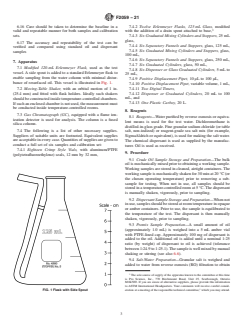
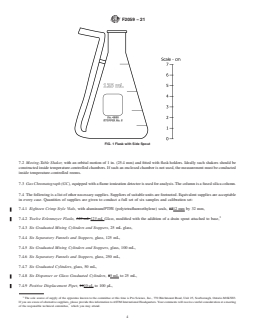
7.1 Modified 120-mL Erlenmeyer Flask, used as the test vessel. A side spout is added to a standard Erlenmeyer flask to enable
sampling from the water column with minimal disturbance of resurfaced oil. This vessel is illustrated in Fig. 1.
F2059 − 21
FIG. 1 Flask with Side Spout
7.2 Moving-Table Shaker, with an orbital motion of 1 in. (25.4 mm) and fitted with flask holders. Ideally such shakers should be
constructed inside temperature-controlled chambers. If such an enclosed chamber is not used, the measurement must be conducted
inside temperature-controlled rooms.
7.3 Gas Chromatograph (GC), equipped with a flame ionization detector is used for analysis. The column is a fused silica column.
7.4 The following is a list of other necessary supplies. Suppliers of suitable units are footnoted. Equivalent supplies are acceptable
in every case. Quantities of supplies are given to conduct a full set of six samples and calibration set:
7.4.1 Eighteen Crimp Style Vials, with aluminum/PTFE (polytetrafluoroethylene) seals, 1212 mm by 32 mm,
7.4.2 Twelve Erlenmeyer Flasks, 125 mL 125 mL Glass, modified with the addition of a drain spout attached to base,
7.4.3 Six Graduated Mixing Cylinders and Stoppers, 25 mL glass,
7.4.4 Six Separatory Funnels and Stoppers, glass, 125 mL,
7.4.5 Six Graduated Mixing Cylinders and Stoppers, glass, 100 mL,
7.4.6 Six Separatory Funnels and Stoppers, glass, 250 mL,
7.4.7 Six Graduated Cylinders, glass, 50 mL,
7.4.8 Six Dispenser or Glass Graduated Cylinders, 55 mL to 25 mL,
7.4.9 Positive Displacement Pipet, 1010 μ
...