

ASTM E2432-23
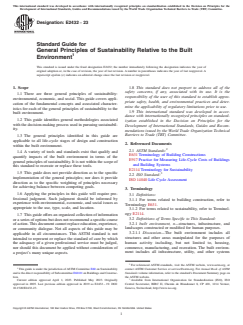
(Guide)Standard Guide for General Principles of Sustainability Relative to the Built Environment
General Information
- Abstract
SIGNIFICANCE AND USE
4.1 The built environment has environmental, economic, and social impacts. These impacts occur at all life-cycle stages in multiple ways and on local, regional, and global scales. It is imperative to understand the nature of these impacts and their relationship to the general principles of sustainability in order to address the opportunities and challenges they present.
4.1.1 It is necessary to identify the environmental impacts in order to promote the positive and mitigate the negative.
4.1.2 It is necessary to quantify the economic impacts in order to improve life-cycle costs and benefits.
4.1.3 It is necessary to identify the social impacts in order to contribute to a positive quality of life for current and future generations.
4.2 The general principles of sustainability—environmental, economic, and social—are interrelated. Decisions founded on the opportunities and challenges of any of the principles will have impacts relative to all of the principles. However, to facilitate clarity in the presentation of the general principles, they are discussed individually in Section 5.
4.3 The practical application of the general principles of sustainability relies upon balancing environmental, economic, and social impacts and committing to continual improvement. Section 6 discusses this balancing of environmental, economic, and social impacts in pursuit of sustainability.
4.4 This guide provides an overview of sustainability, as it is applicable to the built environment. This guide provides general guidance but does not prescribe a specific course of action.
4.5 This guide is intended to inform professionals associated with the building industry.
4.5.1 The general principles identified in this guide are intended to assist users in making decisions that advance sustainability.
4.5.2 The general principles identified in this guide are intended to inform the development and refinement of tools and standards to qualify and quantify impacts of the bu...
SCOPE
1.1 There are three general principles of sustainability: environmental, economic, and social. This guide covers application of the fundamental concepts and associated characteristics for each of the general principles of sustainability to the built environment.
1.2 This guide identifies general methodologies associated with the decision-making process used in pursuing sustainability.
1.3 The general principles identified in this guide are applicable to all life-cycle stages of design and construction within the built environment.
1.4 A variety of tools and standards exist that qualify and quantify impacts of the built environment in terms of the general principles of sustainability. It is not within the scope of this standard to recreate or replace these tools.
1.5 This guide does not provide direction as to the specific implementation of the general principles; nor does it provide direction as to the specific weighting of principles necessary for achieving balance between competing goals.
1.6 Applying the principles in this guide will require professional judgment. Such judgment should be informed by experience with environmental, economic, and social issues as appropriate to the use, type, scale, and location.
1.7 This guide offers an organized collection of information or a series of options but does not recommend a specific course of action. This document cannot replace education, experience, or community dialogue. Not all aspects of this guide may be applicable in all circumstances. This ASTM standard is not intended to represent or replace the standard of care by which the adequacy of a given professional service must be judged, nor should this document be applied without consideration of a project’s many unique aspects.
1.8 This standard does not purport to address all of the safety concerns, if any, associated with its use. It is the responsibility of the user of this standard to establish a...
- Status
- Published
- Publication Date
- 31-Mar-2023
- Technical Committee
- E60 - Sustainability
- Drafting Committee
- E60.01 - Buildings and Construction
Buy Documents
ASTM E2432-23 - Standard Guide for General Principles of Sustainability Relative to the Built Environment
REDLINE ASTM E2432-23 - Standard Guide for General Principles of Sustainability Relative to the Built Environment
Overview
ASTM E2432-23: Standard Guide for General Principles of Sustainability Relative to the Built Environment provides foundational guidance for integrating sustainability principles into all aspects of the built environment. Issued by ASTM International, this standard emphasizes the importance of understanding and balancing environmental, economic, and social impacts across every stage of a building's life cycle.
The guide does not dictate a specific course of action but instead offers a broad framework for considering sustainability in building design, construction, operation, and decommissioning. Its core goal is to inform professionals in the building industry and support decision-making that advances sustainable development, addressing both opportunities and challenges.
Key Topics
Three Pillars of Sustainability in the Built Environment
Environmental Principles:
- Identification and mitigation of negative environmental impacts
- Protection of ecosystems, biodiversity, and natural resources
- Application of practices like energy efficiency, green roofs, and water stewardship
Economic Principles:
- Quantitative assessment of life-cycle costs and benefits for buildings and materials
- Evaluation of both direct (life-cycle) and indirect (external) economic impacts
- Consideration of first costs, operating costs, and end-of-life value
Social Principles:
- Focus on health, safety, and welfare for building occupants and communities
- Commitment to equity and intergenerational responsibility
- Emphasis on inclusive, transparent decision-making processes
Life-Cycle Application
- Recommends evaluating sustainability at every phase: raw material extraction, manufacturing, construction, operation, maintenance, renovation, deconstruction, and disposal.
Decision-Making Methodologies
- Encourages use of tools such as life-cycle assessment (LCA) for environmental impact and life-cycle cost (LCC) analysis for economic impact
- Emphasizes the importance of social assessment, including community engagement and impact forecasting
Continual Improvement
- Promotes ongoing reassessment and adaptation of sustainability measures at local, regional, and global scales
Applications
The standard is broadly applicable to all professionals involved in the building and construction sectors, including:
- Designers and architects
- Urban planners
- Developers and construction managers
- Facility owners and operators
- Product manufacturers
- Policymakers and regulatory authorities
Practical Implementations Include:
- Enhancing energy and resource efficiency in new and existing buildings
- Evaluating materials for their environmental and social impacts throughout their life cycles
- Structuring projects for long-term economic value and lower operational costs
- Fostering healthier, safer, and more equitable communities through responsible building practices
- Informing procurement decisions and corporate sustainability initiatives
- Assisting in the refinement and development of sustainability-related tools and standards
Related Standards
Professionals using ASTM E2432-23 may also benefit from referencing the following related standards and resources:
- ASTM E631 - Terminology of Building Constructions
- ASTM E917 - Practice for Measuring Life-Cycle Costs of Buildings and Building Systems
- ASTM E2114 - Terminology for Sustainability
- ISO 14040 - Life Cycle Assessment Standards
Key terms: sustainability in the built environment, life-cycle assessment, economic and social impacts, sustainable development, green building standards, ASTM E2432, continual improvement, environmental stewardship
By integrating the principles outlined in ASTM E2432-23, stakeholders in the building industry can make informed choices that contribute to long-term environmental, economic, and social value, moving the sector closer to truly sustainable development.
Relations
- Refers
ASTM E917-17 - Standard Practice for Measuring Life-Cycle Costs of Buildings and Building Systems - Effective Date
- 01-Sep-2017
- Refers
ASTM E2114-17 - Standard Terminology for Sustainability Relative to the Performance of Buildings - Effective Date
- 01-Feb-2017
- Refers
ASTM E917-15 - Standard Practice for Measuring Life-Cycle Costs of Buildings and Building Systems - Effective Date
- 01-Oct-2015
- Effective Date
- 01-Mar-2015
- Effective Date
- 01-Nov-2014
- Refers
ASTM E917-13 - Standard Practice for Measuring Life-Cycle Costs of Buildings and Building Systems - Effective Date
- 01-Sep-2013
- Effective Date
- 01-Apr-2010
- Refers
ASTM E2114-08 - Standard Terminology for Sustainability Relative to the Performance of Buildings - Effective Date
- 01-Nov-2008
- Refers
ASTM E2114-06a - Standard Terminology for Sustainability Relative to the Performance of Buildings - Effective Date
- 01-Dec-2006
- Effective Date
- 01-Jun-2006
- Refers
ASTM E2114-06 - Standard Terminology for Sustainability Relative to the Performance of Buildings - Effective Date
- 15-Feb-2006
- Refers
ASTM E917-05e1 - Standard Practice for Measuring Life-Cycle Costs of Buildings and Building Systems - Effective Date
- 01-Oct-2005
- Refers
ASTM E917-05 - Standard Practice for Measuring Life-Cycle Costs of Buildings and Building Systems - Effective Date
- 01-Oct-2005
- Refers
ASTM E2114-05a - Standard Terminology for Sustainability Relative to the Performance of Buildings - Effective Date
- 01-Jun-2005
- Refers
ASTM E2114-05 - Standard Terminology for Sustainability Relative to the Performance of Buildings - Effective Date
- 01-Feb-2005
Buy Documents
ASTM E2432-23 - Standard Guide for General Principles of Sustainability Relative to the Built Environment
REDLINE ASTM E2432-23 - Standard Guide for General Principles of Sustainability Relative to the Built Environment
Get Certified
Connect with accredited certification bodies for this standard

DIBt (Deutsches Institut für Bautechnik)
German Institute for Building Technology.
DIN CERTCO
DIN Group product certification.

Aboma Certification B.V.
Specialized in construction, metal, and transport sectors.
Sponsored listings
Frequently Asked Questions
ASTM E2432-23 is a guide published by ASTM International. Its full title is "Standard Guide for General Principles of Sustainability Relative to the Built Environment". This standard covers: SIGNIFICANCE AND USE 4.1 The built environment has environmental, economic, and social impacts. These impacts occur at all life-cycle stages in multiple ways and on local, regional, and global scales. It is imperative to understand the nature of these impacts and their relationship to the general principles of sustainability in order to address the opportunities and challenges they present. 4.1.1 It is necessary to identify the environmental impacts in order to promote the positive and mitigate the negative. 4.1.2 It is necessary to quantify the economic impacts in order to improve life-cycle costs and benefits. 4.1.3 It is necessary to identify the social impacts in order to contribute to a positive quality of life for current and future generations. 4.2 The general principles of sustainability—environmental, economic, and social—are interrelated. Decisions founded on the opportunities and challenges of any of the principles will have impacts relative to all of the principles. However, to facilitate clarity in the presentation of the general principles, they are discussed individually in Section 5. 4.3 The practical application of the general principles of sustainability relies upon balancing environmental, economic, and social impacts and committing to continual improvement. Section 6 discusses this balancing of environmental, economic, and social impacts in pursuit of sustainability. 4.4 This guide provides an overview of sustainability, as it is applicable to the built environment. This guide provides general guidance but does not prescribe a specific course of action. 4.5 This guide is intended to inform professionals associated with the building industry. 4.5.1 The general principles identified in this guide are intended to assist users in making decisions that advance sustainability. 4.5.2 The general principles identified in this guide are intended to inform the development and refinement of tools and standards to qualify and quantify impacts of the bu... SCOPE 1.1 There are three general principles of sustainability: environmental, economic, and social. This guide covers application of the fundamental concepts and associated characteristics for each of the general principles of sustainability to the built environment. 1.2 This guide identifies general methodologies associated with the decision-making process used in pursuing sustainability. 1.3 The general principles identified in this guide are applicable to all life-cycle stages of design and construction within the built environment. 1.4 A variety of tools and standards exist that qualify and quantify impacts of the built environment in terms of the general principles of sustainability. It is not within the scope of this standard to recreate or replace these tools. 1.5 This guide does not provide direction as to the specific implementation of the general principles; nor does it provide direction as to the specific weighting of principles necessary for achieving balance between competing goals. 1.6 Applying the principles in this guide will require professional judgment. Such judgment should be informed by experience with environmental, economic, and social issues as appropriate to the use, type, scale, and location. 1.7 This guide offers an organized collection of information or a series of options but does not recommend a specific course of action. This document cannot replace education, experience, or community dialogue. Not all aspects of this guide may be applicable in all circumstances. This ASTM standard is not intended to represent or replace the standard of care by which the adequacy of a given professional service must be judged, nor should this document be applied without consideration of a project’s many unique aspects. 1.8 This standard does not purport to address all of the safety concerns, if any, associated with its use. It is the responsibility of the user of this standard to establish a...
SIGNIFICANCE AND USE 4.1 The built environment has environmental, economic, and social impacts. These impacts occur at all life-cycle stages in multiple ways and on local, regional, and global scales. It is imperative to understand the nature of these impacts and their relationship to the general principles of sustainability in order to address the opportunities and challenges they present. 4.1.1 It is necessary to identify the environmental impacts in order to promote the positive and mitigate the negative. 4.1.2 It is necessary to quantify the economic impacts in order to improve life-cycle costs and benefits. 4.1.3 It is necessary to identify the social impacts in order to contribute to a positive quality of life for current and future generations. 4.2 The general principles of sustainability—environmental, economic, and social—are interrelated. Decisions founded on the opportunities and challenges of any of the principles will have impacts relative to all of the principles. However, to facilitate clarity in the presentation of the general principles, they are discussed individually in Section 5. 4.3 The practical application of the general principles of sustainability relies upon balancing environmental, economic, and social impacts and committing to continual improvement. Section 6 discusses this balancing of environmental, economic, and social impacts in pursuit of sustainability. 4.4 This guide provides an overview of sustainability, as it is applicable to the built environment. This guide provides general guidance but does not prescribe a specific course of action. 4.5 This guide is intended to inform professionals associated with the building industry. 4.5.1 The general principles identified in this guide are intended to assist users in making decisions that advance sustainability. 4.5.2 The general principles identified in this guide are intended to inform the development and refinement of tools and standards to qualify and quantify impacts of the bu... SCOPE 1.1 There are three general principles of sustainability: environmental, economic, and social. This guide covers application of the fundamental concepts and associated characteristics for each of the general principles of sustainability to the built environment. 1.2 This guide identifies general methodologies associated with the decision-making process used in pursuing sustainability. 1.3 The general principles identified in this guide are applicable to all life-cycle stages of design and construction within the built environment. 1.4 A variety of tools and standards exist that qualify and quantify impacts of the built environment in terms of the general principles of sustainability. It is not within the scope of this standard to recreate or replace these tools. 1.5 This guide does not provide direction as to the specific implementation of the general principles; nor does it provide direction as to the specific weighting of principles necessary for achieving balance between competing goals. 1.6 Applying the principles in this guide will require professional judgment. Such judgment should be informed by experience with environmental, economic, and social issues as appropriate to the use, type, scale, and location. 1.7 This guide offers an organized collection of information or a series of options but does not recommend a specific course of action. This document cannot replace education, experience, or community dialogue. Not all aspects of this guide may be applicable in all circumstances. This ASTM standard is not intended to represent or replace the standard of care by which the adequacy of a given professional service must be judged, nor should this document be applied without consideration of a project’s many unique aspects. 1.8 This standard does not purport to address all of the safety concerns, if any, associated with its use. It is the responsibility of the user of this standard to establish a...
ASTM E2432-23 is classified under the following ICS (International Classification for Standards) categories: 91.040.01 - Buildings in general. The ICS classification helps identify the subject area and facilitates finding related standards.
ASTM E2432-23 has the following relationships with other standards: It is inter standard links to ASTM E917-17, ASTM E2114-17, ASTM E917-15, ASTM E631-15, ASTM E631-14, ASTM E917-13, ASTM E917-05(2010), ASTM E2114-08, ASTM E2114-06a, ASTM E631-06, ASTM E2114-06, ASTM E917-05e1, ASTM E917-05, ASTM E2114-05a, ASTM E2114-05. Understanding these relationships helps ensure you are using the most current and applicable version of the standard.
ASTM E2432-23 is available in PDF format for immediate download after purchase. The document can be added to your cart and obtained through the secure checkout process. Digital delivery ensures instant access to the complete standard document.
Standards Content (Sample)
This international standard was developed in accordance with internationally recognized principles on standardization established in the Decision on Principles for the
Development of International Standards, Guides and Recommendations issued by the World Trade Organization Technical Barriers to Trade (TBT) Committee.
Designation: E2432 − 23
Standard Guide for
General Principles of Sustainability Relative to the Built
Environment
This standard is issued under the fixed designation E2432; the number immediately following the designation indicates the year of
original adoption or, in the case of revision, the year of last revision. A number in parentheses indicates the year of last reapproval. A
superscript epsilon (´) indicates an editorial change since the last revision or reapproval.
1. Scope 1.8 This standard does not purport to address all of the
safety concerns, if any, associated with its use. It is the
1.1 There are three general principles of sustainability:
responsibility of the user of this standard to establish appro-
environmental, economic, and social. This guide covers appli-
priate safety, health, and environmental practices and deter-
cation of the fundamental concepts and associated character-
mine the applicability of regulatory limitations prior to use.
istics for each of the general principles of sustainability to the
1.9 This international standard was developed in accor-
built environment.
dance with internationally recognized principles on standard-
1.2 This guide identifies general methodologies associated
ization established in the Decision on Principles for the
with the decision-making process used in pursuing sustainabil-
Development of International Standards, Guides and Recom-
ity.
mendations issued by the World Trade Organization Technical
Barriers to Trade (TBT) Committee.
1.3 The general principles identified in this guide are
applicable to all life-cycle stages of design and construction
2. Referenced Documents
within the built environment.
2.1 ASTM Standards:
1.4 A variety of tools and standards exist that qualify and
E631 Terminology of Building Constructions
quantify impacts of the built environment in terms of the
E917 Practice for Measuring Life-Cycle Costs of Buildings
general principles of sustainability. It is not within the scope of
and Building Systems
this standard to recreate or replace these tools.
E2114 Terminology for Sustainability
1.5 This guide does not provide direction as to the specific
2.2 ISO Standard:
implementation of the general principles; nor does it provide
ISO 14040 Life Cycle Assessment
direction as to the specific weighting of principles necessary
for achieving balance between competing goals.
3. Terminology
1.6 Applying the principles in this guide will require pro-
3.1 Definitions:
fessional judgment. Such judgment should be informed by
3.1.1 For terms related to building construction, refer to
experience with environmental, economic, and social issues as
Terminology E631.
appropriate to the use, type, scale, and location.
3.1.2 For terms related to sustainability, refer to Terminol-
ogy E2114.
1.7 This guide offers an organized collection of information
3.2 Definitions of Terms Specific to This Standard:
or a series of options but does not recommend a specific course
3.2.1 built environment, n—structures, infrastructure, and
of action. This document cannot replace education, experience,
landscapes constructed or modified for human purposes.
or community dialogue. Not all aspects of this guide may be
3.2.1.1 Discussion—The built environment includes all
applicable in all circumstances. This ASTM standard is not
structures and other areas manipulated for the purposes of
intended to represent or replace the standard of care by which
human activity including, but not limited to, housing,
the adequacy of a given professional service must be judged,
commerce, manufacturing, and recreation. The built environ-
nor should this document be applied without consideration of
ment includes all infrastructure, utility, and other systems
a project’s many unique aspects.
For referenced ASTM standards, visit the ASTM website, www.astm.org, or
This guide is under the jurisdiction of ASTM Committee E60 on Sustainability contact ASTM Customer Service at service@astm.org. For Annual Book of ASTM
and is the direct responsibility of Subcommittee E60.01 on Buildings and Construc- Standards volume information, refer to the standard’s Document Summary page on
tion. the ASTM website.
Current edition approved April 1, 2023. Published May 2023. Originally Available from International Organization for Standardization (ISO), ISO
approved in 2005. Last previous edition approved in 2019 as E2432 – 19. DOI: Central Secretariat, BIBC II, Chemin de Blandonnet 8, CP 401, 1214 Vernier,
10.1520/E2432-23. Geneva, Switzerland, http://www.iso.org.
Copyright © ASTM International, 100 Barr Harbor Drive, PO Box C700, West Conshohocken, PA 19428-2959. United States
E2432 − 23
designed or otherwise installed for the service and support of 4.5.1 The general principles identified in this guide are
structures and areas accommodating human activity. intended to assist users in making decisions that advance
sustainability.
3.2.2 carbon sinking, n—an approach to offset carbon diox-
4.5.2 The general principles identified in this guide are
ide emissions through the absorption potential of forests and
intended to inform the development and refinement of tools
other vegetation.
and standards to qualify and quantify impacts of the built
3.2.3 Design for the Environment (DfE), n—the systemic
environment.
consideration of design performance with respect to
environmental, health, and safety objectives over the full
5. Principles of Sustainability Relative to the Built
product life cycle.
Environment
3.2.4 external costs/benefits, n—economic impact associ-
5.1 Environmental Principles—Raw materials sourcing,
ated with the action of a party that is not borne by that party,
production of components, construction, day-to-day
but rather by a third party or parties.
operations, periodic maintenance, and the final disposition of
3.2.4.1 Discussion—This is intended to include economic
the components, impact on the environment. Environmental
costs and benefits associated with environmental and social
impacts affect ecosystems, biodiversity, and natural resources.
impacts arising out of the action.
In order to advance sustainability, it is necessary to identify
3.2.5 green roof system, n—an assembly that supports an
environmental impacts, mitigate negative environmental
area of planting/landscaping, built up on a waterproofed
impacts, and promote positive environmental impacts.
substrate at any level that is separated from the natural ground
5.1.1 Fundamental Concepts:
by a human-made structure.
5.1.1.1 Ecosystems—Ecosystems provide critical services
3.2.6 heat island effect, n—a phenomenon in which urban
that support life on the earth and the continued viability of a
air and surface temperatures are higher than nearby rural areas
large range of flora and fauna. Sustainability protects existing
due to the replacement of natural land cover with pavement,
ecosystems and strives to restore damaged ecosystems.
buildings, and other infrastructure.
5.1.1.2 Biodiversity—Biodiversity provides environmental
options, both known and unknown, that contribute to the
4. Significance and Use
genetic resilience of the earth’s flora and fauna. Sustainability
4.1 The built environment has environmental, economic, protects or enhances the biodiversity and interdependencies of
and social impacts. These impacts occur at all life-cycle stages
species.
in multiple ways and on local, regional, and global scales. It is
5.1.1.3 Natural Resources—Natural resources provide the
imperative to understand the nature of these impacts and their
basic requirements of life and the material/energy from which
relationship to the general principles of sustainability in order
all human-made material/energy is derived. Sustainability
to address the opportunities and challenges they present.
balances the use of earth’s renewable, non-renewable, and
4.1.1 It is necessary to identify the environmental impacts in
perpetual resources in order to preserve these resources for
order to promote the positive and mitigate the negative.
future generations.
4.1.2 It is necessary to quantify the economic impacts in
5.1.2 Associated Characteristics:
order to improve life-cycle costs and benefits.
5.1.2.1 Ecosystems—Sustainable construction integrates
4.1.3 It is necessary to identify the social impacts in order to
features that protect or enhance local, regional, and global
contribute to a positive quality of life for current and future
ecosystems. For example, energy efficiency features, both
generations.
active and passive, can reduce the amount of energy used by a
4.2 The general principles of sustainability— building. This approach can reduce the regional impacts
associated with air emissions from electric power generation
environmental, economic, and social—are interrelated. Deci-
sions founded on the opportunities and challenges of any of the facilities and reduce the local impacts of the heat island effect.
principles will have impacts relative to all of the principles.
5.1.2.2 Biodiversity—Sustainable construction integrates
However, to facilitate clarity in the presentation of the general
features that protect or enhance species’ habitats. For example,
principles, they are discussed individually in Section 5.
a green roof system can retain and utilize stormwater through
the use of climate-appropriate plants. This approach can reduce
4.3 The practical application of the general principles of
the amount of polluted stormwater runoff and creates new
sustainability relies upon balancing environmental, economic,
habitats within the built environment.
and social impacts and committing to continual improvement.
5.1.2.3 Natural Resources—Sustainable construction maxi-
Section 6 discusses this balancing of environmental, economic,
mizes effective use of resources by maintaining or improving
and social impacts in pursuit of sustainability.
the balance between resources and their rate of consumption.
4.4 This guide provides an overview of sustainability, as it
For example, water resource stewardship approaches such as
is applicable to the built environment. This guide provides
water-efficient, native landscaping, and permeable surfaces can
general guidance but does not prescribe a specific course of
reduce the use of water and help to naturally filter contami-
action.
nants. These approaches can assist in recharging groundwater
4.5 This guide is intended to inform professionals associ- resources. Similarly, wood building products obtained from
ated with the building industry. sustainably managed forests can contribute to the preservation
E2432 − 23
of forests for future generations. This approach can support indoor environmental quality of a finished building. Improved
biodiversity and contribute to carbon sinking. indoor environmental quality may contribute to worker pro-
ductivity.
5.2 Economic Principles—The built environment has both
(2) Environmental Costs/Benefits—Sustainable construc-
inherent direct and indirect economic impacts. Direct costs/
tion can reduce environmental costs and provide environmental
benefits are typically evaluated using life-cycle cost (LCC)
benefits to society. For example, landscaping with indigenous
methods. Indirect economic impacts are those associated with
plants can contribute to wildlife corridors. This approach can
external costs/benefits. In order to advance sustainability, it is
support both local ecosystems and migratory species, many of
necessary to quantify and optimize direct and indirect eco-
which are pollinators vital to the economic foundation of the
nomic impacts to the greatest extent possible.
agricultural industry.
5.2.1 Fundamental Concepts:
5.2.2.2 Life-Cycle Costs/Benefits—Sustainable practices
5.2.1.1 External Costs/Benefits—Sustainable practices may
strive to provide the best comprehensive value over the life
reduce external costs while promoting external benefits asso-
cycle of a structure.
ciated with social and environmental impacts.
(1) First Costs—Sustainable construction does not need to
(1) Social Costs/Benefits—Sustainability promotes econo-
be more costly when measured on a first cost basis. Integrating
mies with diverse job opportunities, equitable distribution of
features early in the planning and design process controls
resources, and educated, healthy workers.
initial costs. For example, native landscaping techniques incor-
(2) Environmental Costs/Benefits—Sustainability promotes
porate water-efficient plants. This approach can negate the
healthy, functioning ecosystems that provide services that
necessity for supplemental watering and the costs associated
support local, regional, and global economies. Such services
with labor and materials to install an irrigation system.
include pollination of crops, cleansing of water and air, the
(2) Operating Costs—Sustainable practices apply efficien-
decomposing of detritus for food, and the regulation of disease
cies of operation, reducing associated operating costs. For
and pests.
example, selecting durable materials can reduce the need for
5.2.1.2 Life-Cycle Costs/Benefits—Sustainability recognizes
repair and replacement. This approach cannot only minimize
the costs/benefits associated with all stages of the full life
costs associated with labor and materials for repair/
cycle. Economic evaluation is based on the procedures delin-
replacement but also the costs associated with possible disrup-
eated in Practice E917.
tion in the operations and services of a structure.
(1) First Costs/Benefits—First costs/benefits
...
This document is not an ASTM standard and is intended only to provide the user of an ASTM standard an indication of what changes have been made to the previous version. Because
it may not be technically possible to adequately depict all changes accurately, ASTM recommends that users consult prior editions as appropriate. In all cases only the current version
of the standard as published by ASTM is to be considered the official document.
Designation: E2432 − 19 E2432 − 23
Standard Guide for
General Principles of Sustainability Relative to Buildingsthe
Built Environment
This standard is issued under the fixed designation E2432; the number immediately following the designation indicates the year of
original adoption or, in the case of revision, the year of last revision. A number in parentheses indicates the year of last reapproval. A
superscript epsilon (´) indicates an editorial change since the last revision or reapproval.
1. Scope
1.1 Sustainabilty has three types of general principles: There are three general principles of sustainability: environmental,
economic, and social. This guide covers application of the fundamental concepts and associated building characteristics for each
of the general principles of sustainability.sustainability to the built environment.
1.2 This guide distinguishes between ideal sustainability and applied sustainability. Ideally, human activities would not require
making trade-offs among environmental, economic, and social goals. However, this guide recognizes that, in applying
sustainability principles to buildings, decision makers must often balance opportunities and challenges associated with each of the
general principles.
1.2 This guide identifies general methodologies associated with the decision-making process used in pursuing sustainability.
1.3 This guide addresses buildings individually and in aggregate (collectively).The general principles identified in this guide are
applicable to all life-cycle stages of design and construction within the built environment.
1.4.1 The general principles identified in this guide are applicable to all scales of building projects, including: interior spaces,
individual buildings and groups of buildings, infrastructure systems, and land use.
1.4.2 The general principles identified in this guide are applicable to all life-cycle stages of a building and its components,
including: material extraction, product manufacturing, product transportation, planning, siting, design, specification, construction,
operation, maintenance, renovation, retrofit, reuse, deconstruction, and waste disposal of buildings.
1.4 A variety of tools and standards exist that qualify and quantify impacts of buildings, building materials, and building methods
the built environment in terms of one or more of the general principles of sustainability. It is not within the scope of this standard
to recreate or replace these tools.
1.5 This guide does not provide direction as to the specific implementation of the general principles; nor does it provide direction
as to the specific weighting of principles necessary for achieving balance.balance between competing goals.
1.6 Applying the principles in this guide will require professional judgment. Such judgment should be informed by experience
with environmental, economic, and social issues as appropriate to the building use, type, scale, and location.
This guide is under the jurisdiction of ASTM Committee E60 on Sustainability and is the direct responsibility of Subcommittee E60.01 on Buildings and Construction.
Current edition approved July 1, 2019April 1, 2023. Published July 2019May 2023. Originally approved in 2005. Last previous edition approved in 20172019 as
E2432E2432 – 19.–17. DOI: 10.1520/E2432–19.10.1520/E2432-23.
Copyright © ASTM International, 100 Barr Harbor Drive, PO Box C700, West Conshohocken, PA 19428-2959. United States
E2432 − 23
1.7 This guide offers an organized collection of information or a series of options andbut does not recommend a specific course
of action. This document cannot replace education or experience and should be used in conjunction with professional judgment.
education, experience, or community dialogue. Not all aspects of this guide may be applicable in all circumstances. This ASTM
standard is not intended to represent or replace the standard of care by which the adequacy of a given professional service must
be judged, nor should this document be applied without consideration of a project’s many unique aspects. The word “Standard”
in the title of this document means only that the document has been approved through the ASTM consensus process.
1.8 This standard does not purport to address all of the safety concerns, if any, associated with its use. It is the responsibility
of the user of this standard to establish appropriate safety, health, and environmental practices and determine the applicability of
regulatory limitations prior to use.
1.9 This international standard was developed in accordance with internationally recognized principles on standardization
established in the Decision on Principles for the Development of International Standards, Guides and Recommendations issued
by the World Trade Organization Technical Barriers to Trade (TBT) Committee.
2. Referenced Documents
2.1 ASTM Standards:
E631 Terminology of Building Constructions
E917 Practice for Measuring Life-Cycle Costs of Buildings and Building Systems
E2114 Terminology for Sustainability
2.2 ISO Standard:
ISO 14040 Life Cycle Assessment
3. Terminology
3.1 Definitions:
3.1.1 For terms related to building construction, refer to Terminology E631.
3.1.2 For terms related to sustainability relative to the performance of buildings, sustainability, refer to Terminology E2114.
3.2 Definitions of Terms Specific to This Standard:
3.2.1 built environment, n—structures, infrastructure, and landscapes constructed or modified for human purposes.
3.2.1.1 Discussion—
The built environment includes all structures and other areas manipulated for the purposes of human activity including, but not
limited to, housing, commerce, manufacturing, and recreation. The built environment includes all infrastructure, utility, and other
systems designed or otherwise installed for the service and support of structures and areas accommodating human activity.
3.2.2 carbon sinking, n—an approach to offset carbon dioxide emissions through the absorption potential of forests and other
vegetation.
3.2.3 Design for the Environment (DfE), n—the systemic consideration of design performance with respect to environmental,
health, and safety objectives over the full product life-cycle.life cycle.
3.2.4 external costs/benefits, n—economic impact associated with the action of a party that is not borne by that party, but rather
by a third party or parties.
3.2.4.1 Discussion—
This is intended to include economic costs and benefits associated with environmental and social impacts arising out of the action.
3.2.5 green roof system, n—an assembly that supports an area of planting/landscaping, built up on a waterproofed substrate at any
level that is separated from the natural ground by a human-made structure.
For referenced ASTM standards, visit the ASTM website, www.astm.org, or contact ASTM Customer Service at service@astm.org. For Annual Book of ASTM Standards
volume information, refer to the standard’s Document Summary page on the ASTM website.
Available from International Organization for Standardization (ISO), ISO Central Secretariat, BIBC II, Chemin de Blandonnet 8, CP 401, 1214 Vernier, Geneva,
Switzerland, http://www.iso.org.
E2432 − 23
3.2.6 heat island effect, n—a phenomenon in which urban air and surface temperatures are higher than nearby rural areas due to
the replacement of natural land cover with pavement, buildings, and other infrastructure.
4. Significance and Use
4.1 Every building and building product The built environment has environmental, economic, and social impacts. These impacts
occur at all life-cycle stages in multiple ways and on local, regional, and global scales. It is imperative to understand the nature
of these impacts and their relationship to the general principles of sustainability in order to address the opportunities and challenges
they present in buildings.present.
4.1.1 Buildings impact the environment. In order to advance sustainability, it It is necessary to identify environmental impacts,
mitigate negative environmental impacts, and promote positive environmental impacts.the environmental impacts in order to
promote the positive and mitigate the negative.
4.1.2 Buildings have economic impacts. In order to advance sustainability, it It is necessary to quantify and optimize life-cycle
costs/benefits and external costs/benefits to the greatest extent possible.the economic impacts in order to improve life-cycle costs
and benefits.
4.1.3 Buildings impact society. In order to advance sustainability, it It is necessary to identify the health, safety, and welfare
impacts, and social impacts in order to contribute to a positive quality of life for current and future generations.
4.2 The general principles of sustainability—environmental, economic, and social—are interrelated. Decisions founded on the
opportunities and challenges of any of the principles will have impacts relative to all of the principles. However, to facilitate clarity
in the presentation of the general principles of sustainability relative to buildings, principles, they are discussed individually in
Section 5.
4.3 Sustainability is an ideal. The practical application of the general principles of sustainability relies upon balancing
environmental, economic, and social impacts and committing to continual improvement to approach this ideal. improvement.
Section 6 discusses this balancing of environmental, economic, and social impacts in pursuit of sustainability.
4.4 The marketplace is evolving as technology, economics, and society become globalized. The range of topics and approaches
to standards development has evolved in tandem with the changes in the marketplace. This guide addresses one of the primary
issues of today’s global marketplace—sustainability. It This guide provides an overview of sustainability, as it is applicable to
buildings. It the built environment. This guide provides general guidance but does not prescribe a specific course of action.
4.5 This guide is intended to inform professionals associated with the building industry, including specifiers, planners, developers,
architects, landscapers, engineers, general contractors, subcontractors, owners, facility managers, financial organizations related to
the building industry, product manufacturers, and government agencies including building officials, and other building
professionals.industry.
4.5.1 The general principles identified in this guide are intended to assist users in making decisions that advance sustainability.
4.5.2 The general principles identified in this guide are intended to inform the development and refinement of tools and standards
to qualify and quantify impacts of buildings, building materials, and building methods.the built environment.
5. Principles of Ideal Sustainability Relative to Buildings the Built Environment
5.1 Environmental Principles—Buildings impact the environment. From gathering raw materials, Raw materials sourcing,
production of components, assembly into structures, construction, day-to-day operations, periodic maintenance, toand the final
disposition of the components, there are impacts impact on the environment. Environmental impacts affect ecosystems,
biodiversity, and natural resources. In order to advance sustainability, it is necessary to identify environmental impacts, mitigate
negative environmental impacts, and promote positive environmental impacts.
5.1.1 Fundamental Concepts:
E2432 − 23
5.1.1.1 Ecosystems—Ecosystems provide critical services that support life on the earth and the continued viability of a large range
of flora and fauna. Sustainability protects existing ecosystems and strives to restore damaged ecosystems.
5.1.1.2 Biodiversity—Biodiversity provides environmental options, both known and unknown, that contribute to the genetic
resilience of the earth’s flora and fauna. Sustainability protects or enhances the biodiversity and interdependencies of species.
5.1.1.3 Natural Resources—Natural resources provide the basic requirements of life and the material/energy from which all
human-made material/energy is derived. Sustainability balances the use of earth’s renewable, non-renewable, and perpetual
resources in order to preserve these resources for future generations.
5.1.2 Associated Building Characteristics:
5.1.2.1 Ecosystems—Sustainable buildings containconstruction integrates features that protect or enhance local, regional, and
global ecosystems. For example, energy efficiency features, both active and passive, can reduce the amount of energy used by thea
building. This approach can reduce the regional impacts associated with air emissions from electric power generation facilities and
reduce the local impacts of the heat island effect.
5.1.2.2 Biodiversity—Sustainable buildings containconstruction integrates features that protect or enhance species’ habitats. For
example, a green roof system can retain and utilize stormwater through the use of climate-appropriate plants. This approach can
reduce the amount of polluted stormwater runoff and creates new habitats within the built environment.
5.1.2.3 Natural Resources—Sustainable buildings maximize the construction maximizes effective use of resources. Sustainable
buildings preserve or enhance the quality of resources and do not adversely alter the balance between renewable resources by
maintaining or improving the balance between resources and their rate of consumption for building-related purposes. consumption.
For example, water resource stewardship approaches such as water-efficient, native landscaping, and permeable surfaces can
reduce the use of water and help to naturally filter contaminants. These approaches can assist in recharging groundwater resources.
Similarly, wood building products obtained from sustainably managed forests offer a renewable resource that can contribute to the
preservation of forests for future generations. This approach can support biodiversity and contribute to carbon sinking.
5.2 Economic Principles—Buildings have both The built environment has both inherent direct and indirect economic impacts that
are inherent to the process of their acquisition, construction, use, maintenance, and disposition. Direct economic impacts are those
associated with the life-cycle costs/benefits of materials, land, and labor directly attributable to the building. impacts. Direct
costs/benefits are typically evaluated using life-cycle cost (LCC) methods. Indirect economic impacts are those associated with
external costs/benefits. External costs/benefits accrue to those indirectly impacted by the building. In order to advance
sustainability, it is necessary to quantify and optimize direct and indirect economic impacts to the greatest extent possible.
5.2.1 Fundamental Concepts:
5.2.1.1 External Costs/Benefits—Sustainability reduces external costs associated with social and environmental impacts
Sustainable practices may reduce external costs while promoting external benefits associated with social and environmental
impacts.
(1) Social Costs/Benefits—Sustainability requirespromotes economies with diverse job opportunities, equitable distribution of
resources, and educated, healthy workers.
(2) Environmental Costs/Benefits—Sustainability requirespromotes healthy, functioning ecosystems that provide services that
support local, regional, and global economies. Such services include pollination of crops, cleansing of water and air, the
decomposing of detritus for food, and the regulation of disease and pests.
5.2.1.2 Life-Cycle Costs/Benefits—Sustainability recognizes the full life-cycle costs/benefits of a building, including costs/benefits
associated with designing, purchasing/leasing, constructing/installing, using/operating, maintaining, repairing, replacing, and
disposing/deconstructing of buildings. Economic evaluation of sustainable buildings costs/benefits associated with all stages of the
full life cycle. Economic evaluation is based on the evaluation procedures delineated in Practice E917.
(1) First Costs/Benefits—First costs/benefits include the costs associated with design and construction of the building and the
acquisition of land on which to build. Sustainable building design, acquisition of land, and construction. Sustainable practices rely
on first costs/benefits being evaluated with consideration of associated cost/benefits for operation, deconstruction, and reuse or
disposal.
(2) Operating Costs/Benefits—Operating costs/benefits include utility costs,
...