

ASTM F2219-23
(Test Method)Standard Test Methods for Measuring High-Speed Bat Performance
General Information
- Abstract
SIGNIFICANCE AND USE
4.1 These test methods offer a laboratory means to quantitatively compare the performance of baseball and softball bats.
4.2 Use of these test methods can provide quantitative metrics of bat performance.
SCOPE
1.1 A method for determining bat performance by measuring the bat-ball coefficient of restitution (BBCOR), deriving the collision efficiency (ea), and calculating a batted-ball speed (BBS). It is applicable to baseball and softball bats of any construction or material. The test methods provide quantitative measures of bat dynamic performance that may be used for comparison purposes.
1.2 The BBCOR and BBS are each calculated from measurements taken in the laboratory on test equipment meeting the requirements defined in this standard.
1.3 Bat performance is found in this standard assuming the bat is unconstrained.
1.4 The values stated in inch-pound units are to be regarded as standard. The values given in parentheses are mathematical conversions to SI units that are provided for information only and are not considered standard.
1.5 This standard does not purport to address all of the safety concerns, if any, associated with its use. It is the responsibility of the user of this standard to establish appropriate safety, health, and environmental practices and determine the applicability of regulatory limitations prior to use.
1.6 This international standard was developed in accordance with internationally recognized principles on standardization established in the Decision on Principles for the Development of International Standards, Guides and Recommendations issued by the World Trade Organization Technical Barriers to Trade (TBT) Committee.
- Status
- Published
- Publication Date
- 31-Mar-2023
- Technical Committee
- F08 - Sports Equipment, Playing Surfaces, and Facilities
- Drafting Committee
- F08.26 - Baseball and Softball Equipment
Overview
ASTM F2219-23: Standard Test Methods for Measuring High-Speed Bat Performance provides a laboratory-based methodology to quantitatively assess the performance of baseball and softball bats. The standard is applicable to bats of any material or construction and covers key metrics such as the bat-ball coefficient of restitution (BBCOR), collision efficiency, and batted-ball speed (BBS). Developed by ASTM International, this standard ensures consistent, reproducible, and comparable measurements for bat dynamic performance. It supports manufacturers, regulators, and laboratories in ensuring that bats meet required performance and safety benchmarks in both baseball and softball.
Key Topics
- BBCOR (Bat-Ball Coefficient of Restitution): Measures the efficiency of energy transfer from bat to ball during impact, a key indicator of bat performance.
- Collision Efficiency (ea): Assesses how effectively the bat converts the inbound kinetic energy of the ball into outbound speed.
- Batted-Ball Speed (BBS): Calculates the expected ball speed off the bat in play conditions, based on specific pitch and swing parameters.
- Standardized Test Apparatus: Defines requirements for laboratory equipment, including ball cannons, speed gates, high-speed cameras, and bat support systems to ensure accurate and repeatable results.
- Environmental Controls: Specifies bat and ball conditioning, including temperature and humidity requirements to standardize testing conditions.
- Reporting Requirements: Outlines critical data to collect, including bat model, test equipment, environmental conditions, and all measured parameters for transparency and traceability.
- Comparison Across Bat Types: Enables objective comparison of bats regardless of construction or material through normalized performance values.
Applications
- Bat Manufacturers: Supports research and development by providing reliable methods to evaluate and compare new bat designs according to industry-accepted metrics, such as BBCOR and BBS.
- Sports Regulatory Bodies: Facilitates compliance verification, enforcing standards for bat performance to ensure player safety and fair play in baseball and softball leagues.
- Accredited Test Laboratories: Offers a detailed protocol for consistent, reproducible testing of bat performance, supporting certifications, and product verifications.
- Sports Equipment Retailers: Helps communicate the performance characteristics of bats to customers based on standardized test data.
- Collegiate and Professional Organizations: Assists in policy-making regarding allowable bat performance, using quantifiable and internationally recognized measures.
Related Standards
ASTM F2219-23 is part of a suite of standards for sports equipment performance. Key related documents include:
- ASTM F2398: Methods for measuring moment of inertia and balance point of bats, supporting calculations outlined in F2219-23.
- ASTM F1887: Test method for the coefficient of restitution of baseballs and softballs, providing critical input data for bat performance testing.
- ASTM F1888: Compression-displacement testing of balls, aiding in normalization and comparison procedures.
- ASTM F2845: Methods for measuring dynamic stiffness and cylindrical coefficient of restitution (CCOR) of balls, used in standardizing ball response in bat tests.
Practical Value
Adopting ASTM F2219-23 enables objective, internationally recognized measurement of high-speed bat performance. This standard:
- Drives consistency in product development and regulatory compliance across baseball and softball equipment.
- Promotes player safety by enforcing limits on bat performance.
- Provides transparent data for manufacturers, leagues, and consumers to make informed decisions.
- Supports innovation by allowing new bat technologies to be fairly and accurately evaluated.
Keywords: high-speed bat performance, ASTM F2219-23, baseball bats, softball bats, BBCOR, BBS, collision efficiency, laboratory testing, bat testing standard, sports equipment compliance, bat-ball coefficient of restitution.
Relations
- Effective Date
- 01-Jul-2020
- Effective Date
- 01-Apr-2019
- Effective Date
- 01-Apr-2019
- Effective Date
- 01-Oct-2015
- Effective Date
- 01-May-2014
- Refers
ASTM F1888-09(2014) - Standard Test Method for Compression-Displacement of Baseballs and Softballs - Effective Date
- 01-Mar-2014
- Effective Date
- 01-Apr-2011
- Effective Date
- 01-Apr-2011
- Effective Date
- 01-May-2010
- Effective Date
- 01-May-2010
- Effective Date
- 01-Jun-2009
- Effective Date
- 01-Jun-2009
- Effective Date
- 01-May-2004
- Effective Date
- 01-May-2004
- Effective Date
- 10-Dec-2002
Frequently Asked Questions
ASTM F2219-23 is a standard published by ASTM International. Its full title is "Standard Test Methods for Measuring High-Speed Bat Performance". This standard covers: SIGNIFICANCE AND USE 4.1 These test methods offer a laboratory means to quantitatively compare the performance of baseball and softball bats. 4.2 Use of these test methods can provide quantitative metrics of bat performance. SCOPE 1.1 A method for determining bat performance by measuring the bat-ball coefficient of restitution (BBCOR), deriving the collision efficiency (ea), and calculating a batted-ball speed (BBS). It is applicable to baseball and softball bats of any construction or material. The test methods provide quantitative measures of bat dynamic performance that may be used for comparison purposes. 1.2 The BBCOR and BBS are each calculated from measurements taken in the laboratory on test equipment meeting the requirements defined in this standard. 1.3 Bat performance is found in this standard assuming the bat is unconstrained. 1.4 The values stated in inch-pound units are to be regarded as standard. The values given in parentheses are mathematical conversions to SI units that are provided for information only and are not considered standard. 1.5 This standard does not purport to address all of the safety concerns, if any, associated with its use. It is the responsibility of the user of this standard to establish appropriate safety, health, and environmental practices and determine the applicability of regulatory limitations prior to use. 1.6 This international standard was developed in accordance with internationally recognized principles on standardization established in the Decision on Principles for the Development of International Standards, Guides and Recommendations issued by the World Trade Organization Technical Barriers to Trade (TBT) Committee.
SIGNIFICANCE AND USE 4.1 These test methods offer a laboratory means to quantitatively compare the performance of baseball and softball bats. 4.2 Use of these test methods can provide quantitative metrics of bat performance. SCOPE 1.1 A method for determining bat performance by measuring the bat-ball coefficient of restitution (BBCOR), deriving the collision efficiency (ea), and calculating a batted-ball speed (BBS). It is applicable to baseball and softball bats of any construction or material. The test methods provide quantitative measures of bat dynamic performance that may be used for comparison purposes. 1.2 The BBCOR and BBS are each calculated from measurements taken in the laboratory on test equipment meeting the requirements defined in this standard. 1.3 Bat performance is found in this standard assuming the bat is unconstrained. 1.4 The values stated in inch-pound units are to be regarded as standard. The values given in parentheses are mathematical conversions to SI units that are provided for information only and are not considered standard. 1.5 This standard does not purport to address all of the safety concerns, if any, associated with its use. It is the responsibility of the user of this standard to establish appropriate safety, health, and environmental practices and determine the applicability of regulatory limitations prior to use. 1.6 This international standard was developed in accordance with internationally recognized principles on standardization established in the Decision on Principles for the Development of International Standards, Guides and Recommendations issued by the World Trade Organization Technical Barriers to Trade (TBT) Committee.
ASTM F2219-23 is classified under the following ICS (International Classification for Standards) categories: 97.220.01 - Sports equipment and facilities in general. The ICS classification helps identify the subject area and facilitates finding related standards.
ASTM F2219-23 has the following relationships with other standards: It is inter standard links to ASTM F2398-11(2020), ASTM F1887-14(2019)e1, ASTM F1887-14(2019), ASTM F2398-11(2015), ASTM F1887-14, ASTM F1888-09(2014), ASTM F2845-11, ASTM F2398-11, ASTM F2845-10, ASTM F2398-10, ASTM F1888-09, ASTM F1887-09, ASTM F2398-04e1, ASTM F2398-04, ASTM F1887-02. Understanding these relationships helps ensure you are using the most current and applicable version of the standard.
ASTM F2219-23 is available in PDF format for immediate download after purchase. The document can be added to your cart and obtained through the secure checkout process. Digital delivery ensures instant access to the complete standard document.
Standards Content (Sample)
This international standard was developed in accordance with internationally recognized principles on standardization established in the Decision on Principles for the
Development of International Standards, Guides and Recommendations issued by the World Trade Organization Technical Barriers to Trade (TBT) Committee.
Designation: F2219 − 23 An American National Standard
Standard Test Methods for
Measuring High-Speed Bat Performance
This standard is issued under the fixed designation F2219; the number immediately following the designation indicates the year of
original adoption or, in the case of revision, the year of last revision. A number in parentheses indicates the year of last reapproval. A
superscript epsilon (´) indicates an editorial change since the last revision or reapproval.
1. Scope F1888 Test Method for Compression-Displacement of Base-
balls and Softballs
1.1 A method for determining bat performance by measur-
F2398 Test Method for Measuring Moment of Inertia and
ing the bat-ball coefficient of restitution (BBCOR), deriving
Center of Percussion of a Baseball or Softball Bat
the collision efficiency (e ), and calculating a batted-ball speed
a
F2845 Test Method for Measuring the Dynamic Stiffness
(BBS). It is applicable to baseball and softball bats of any
(DS) and Cylindrical Coefficient of Restitution (CCOR) of
construction or material. The test methods provide quantitative
Baseballs and Softballs
measures of bat dynamic performance that may be used for
comparison purposes.
3. Terminology
1.2 The BBCOR and BBS are each calculated from mea-
3.1 Definitions of Terms Specific to This Standard:
surements taken in the laboratory on test equipment meeting
3.1.1 balance point (BP), n—distance to the center of mass
the requirements defined in this standard.
from the knob end of the bat.
1.3 Bat performance is found in this standard assuming the
3.1.2 bat-ball coeffıcient of restitution (BBCOR), n—COR
bat is unconstrained.
of a specific ball colliding with a bat.
1.4 The values stated in inch-pound units are to be regarded
3.1.3 batted ball speed (BBS), n—the speed that a ball
as standard. The values given in parentheses are mathematical
would be hit off a bat in play based on given pitch and bat
conversions to SI units that are provided for information only
speeds.
and are not considered standard.
3.1.4 coeffıcient of restitution (COR), n—measure of impact
1.5 This standard does not purport to address all of the
efficiency calculated as the relative speed of the objects after
safety concerns, if any, associated with its use. It is the
impact divided by the relative speed of the objects before
responsibility of the user of this standard to establish appro-
impact.
priate safety, health, and environmental practices and deter-
3.1.5 collision effıciency (e ), n—ratio of ball exit speed to
a
mine the applicability of regulatory limitations prior to use.
the ball inbound speed.
1.6 This international standard was developed in accor-
3.1.6 cylindrical coeffıcient of restitution (CCOR), n—the
dance with internationally recognized principles on standard-
ratio of the rebound to incoming speed of a ball impacting a
ization established in the Decision on Principles for the
solid rigid cylinder.
Development of International Standards, Guides and Recom-
mendations issued by the World Trade Organization Technical
3.1.7 dynamic stiffness (DS), n—a normalized measure of
Barriers to Trade (TBT) Committee.
the ball impact force having units of stiffness (lb/in. or kN/m).
It is obtained by dividing the square of the peak force between
2. Referenced Documents
the ball and impact surface by the ball mass and the square of
the incoming ball speed.
2.1 ASTM Standards:
F1887 Test Method for Measuring the Coefficient of Resti-
3.1.8 moment of inertia (MOI), n—measure of mass distri-
tution (COR) of Baseballs and Softballs
bution relative to an axis of rotation. It is the product of the
mass multiplied by the square of the distance to the mass,
summed over the entire bat.
These test methods are under the jurisdiction of ASTM Committee F08 on
Sports Equipment, Playing Surfaces, and Facilities and are the direct responsibility
3.1.9 test sponsor, n—group, association or individual speci-
of Subcommittee F08.26 on Baseball and Softball Equipment.
fying test requirements including ball specifications, perfor-
Current edition approved April 1, 2023. Published April 2023. Originally
mance measure, and test speed.
approved in 2002. Last previous edition approved in 2022 as F2219 – 14 (2022).
DOI: 10.1520/F2219-23.
For referenced ASTM standards, visit the ASTM website, www.astm.org, or 4. Significance and Use
contact ASTM Customer Service at service@astm.org. For Annual Book of ASTM
4.1 These test methods offer a laboratory means to quanti-
Standards volume information, refer to the standard’s Document Summary page on
the ASTM website. tatively compare the performance of baseball and softball bats.
Copyright © ASTM International, 100 Barr Harbor Drive, PO Box C700, West Conshohocken, PA 19428-2959. United States
F2219 − 23
4.2 Use of these test methods can provide quantitative 5.2.3.1 Angled Light Gates—A light trap device capable of
metrics of bat performance. measuring the ball rebound angle after impact with a bat (see
Fig. 2). The device shall measure across a length of no less than
5. Apparatus and Equipment
half the ball diameter to avoid centering error. The vertical
rebound angle gate shall be mounted at approximately 45°
5.1 Test Balls—Baseballs or softballs as determined by the
relative to the inbound ball path. The horizontal rebound angle
test sponsor.
gate shall be mounted at approximately 25° relative to the
5.1.1 Ball specification values are to be recorded and traced
inbound ball path (to provide room for the speed gates).
to individual balls.
(Appendix X1.)
5.2 Bat-Ball Test Apparatus:
5.2.3.2 High Speed Camera—A high speed video camera
5.2.1 Ball Cannon—A device capable of shooting a ball at
capable of recording the ball rebound path. If a mirror is placed
speeds up to 220 ft/s (67.1 m/s, 150 mph). Balls shall be
at 45° atop the light box, one video camera can observe both
oriented to impact the strike surface between the stitches.
the horizontal and vertical planes. (Appendix X2.)
Typical pitching machines cannot yield the aiming accuracy
5.2.4 Bat Pivot Support—A turntable, rotating in the hori-
required by these test methods. Cannon exhaust air must not
zontal plane, with clamps to support and align the bat in the
cause motion of the bat in the absence of an impact.
path of the ball. The rotating clamp and shaft assembly shall
5.2.2 Ball Speed Gate—Light screens capable of measuring
not weigh more than 6 lb (2.7 kg) and shall spin freely via ball
a ball traveling at speeds up to 220 ft/s (67.1 m/s, 150 mph),
bearings (see Fig. 1). The MOI of the clamp turntable assembly
with an accuracy of at least 60.7 ft/s (60.2 m/s). The device
shall be determined, recorded, and used in the performance
shall measure across a length of no less than half the ball
calculations. The MOI for the clamp turntable assembly shall
diameter to avoid centering error. The first sensor shall be
2 2
not exceed 300 oz-in. (5498 kg-mm ).
located no more than 12.0 in. (304.8 mm) from the bat surface.
The second sensor shall be located 6 6 0.03 in. (152 6 0.8 5.2.5 Bat Speed Sensor—Device to measure bat rotational
mm) after the first sensor (see Fig. 1). The ball speed gate must speed for at least 100° after impact. Device shall read speeds
measure the ball rebound speed. up to 3000°/s with an accuracy of at least 1°/s (found to be
5.2.3 Ball Angle Measurement—Measure and record the achievable using an optical encoder). Bat speed is taken from
ball vertical and horizontal rebound angles within 1°, using at the slope of the linear least-squares fit to the bat rotation versus
least one of the following or equivalent devices. time data between 5° and 95° after impact.
FIG. 1 Bat Testing Machine
F2219 − 23
FIG. 2 Diagram Showing Light Gate Arrangement to Measure the Ball Speed, the Horizontal Rebound Angle,
and the Vertical Rebound Angle
6. Calibration and Standardization 7.1.3 Relative humidity (RH) is to be maintained between
40 and 60 %.
6.1 Ball Speed Gate—The distance between the sensors of
7.1.4 Temperature and relative humidity are to be measured
the speed gates should be measured and recorded.
and recorded hourly within 60.5°F (60.3°C) and 62 % RH
6.2 Reference Standards and Blanks—A standard bat and
over the conditioning and test duration.
ball shall be used for monthly reference purposes to verify
proper machine operation.
8. Procedure
6.3 Location Tolerance:
8.1 Determination of Bat Features and Test Location—
6.3.1 Bat—Coat the impact area of the bat with a removable
Determine bat balance point (BP) and bat MOI in accordance
material (dry erase marker or powder).
with Test Method F2398.
6.3.2 Ball—Impact the bat with a solid coverless ball such
8.2 Select a performance measure (BBCOR or BBS) as
as a pitching machine baseball or softball core.
specified by the test sponsor.
6.3.3 Location—For each impact, use the average of the ball
contact edges on the bat as the impact location. The impact
8.3 Bat Test Procedure:
location is the average location from six balls.
8.3.1 Select a test ball meeting requirement of 5.1. Rotate
6.3.4 Tolerance—The standard deviation of the six impacts
the ball in the cannon between impacts so that the impact area
must be less than 0.125 in. The difference between the target
of the ball is different for each impact. Record the ball weight,
location and the average location from the six impacts must be
compression (Test Method F1888), COR (Test Method F1887),
less than 0.125 in.
and circumference. If the results are normalized, record the
values of DS and CCOR (Test Method F2845).
7. Conditioning
8.3.2 Set ball cannon to fire the ball at the desired test speed
(60 to 150 mph) as determined by the test sponsor.
7.1 Ball and Bat Conditioning and Test Room Conditions:
8.3.3 Mount the bat in the clamps of the bat pivot support.
7.1.1 Test balls shall be stored in an environmentally
controlled space for at least 14 days immediately before Locate the bat pivot to provide a ball impact near the maximum
performance location (often 6 in. from the barrel end of the
testing. Wood bats shall be stored at these environmental
conditions for at least 24 h prior to testing. Non-wood bats bat).
8.3.4 Locate the bat against the start position (see Fig. 1
...
This document is not an ASTM standard and is intended only to provide the user of an ASTM standard an indication of what changes have been made to the previous version. Because
it may not be technically possible to adequately depict all changes accurately, ASTM recommends that users consult prior editions as appropriate. In all cases only the current version
of the standard as published by ASTM is to be considered the official document.
Designation: F2219 − 14 (Reapproved 2022) F2219 − 23 An American National Standard
Standard Test Methods for
Measuring High-Speed Bat Performance
This standard is issued under the fixed designation F2219; the number immediately following the designation indicates the year of
original adoption or, in the case of revision, the year of last revision. A number in parentheses indicates the year of last reapproval. A
superscript epsilon (´) indicates an editorial change since the last revision or reapproval.
1. Scope
1.1 A method for determining bat performance by measuring the bat-ball coefficient of restitution (BBCOR), deriving the ball exit
speedcollision efficiency (e ratio (BESR), ), and calculating a batted-ball speed (BBS). It is applicable to baseball and softball bats
a
of any construction or material. The test methods provide quantitative measures of bat dynamic performance that may be used for
comparison purposes.
1.2 The BBCOR, BESR, BBCOR and BBS are each calculated from measurements taken in the laboratory on test equipment
meeting the requirements defined in this standard.
1.3 Bat performance is found in this standard assuming the bat is unconstrained.
1.4 The values stated in inch-pound units are to be regarded as standard. The values given in parentheses are mathematical
conversions to SI units that are provided for information only and are not considered standard.
1.5 This standard does not purport to address all of the safety concerns, if any, associated with its use. It is the responsibility
of the user of this standard to establish appropriate safety, health, and environmental practices and determine the applicability of
regulatory limitations prior to use.
1.6 This international standard was developed in accordance with internationally recognized principles on standardization
established in the Decision on Principles for the Development of International Standards, Guides and Recommendations issued
by the World Trade Organization Technical Barriers to Trade (TBT) Committee.
2. Referenced Documents
2.1 ASTM Standards:
F1887 Test Method for Measuring the Coefficient of Restitution (COR) of Baseballs and Softballs
F1888 Test Method for Compression-Displacement of Baseballs and Softballs
F2398 Test Method for Measuring Moment of Inertia and Center of Percussion of a Baseball or Softball Bat
F2845 Test Method for Measuring the Dynamic Stiffness (DS) and Cylindrical Coefficient of Restitution (CCOR) of Baseballs
and Softballs
3. Terminology
3.1 Definitions of Terms Specific to This Standard:
These test methods are under the jurisdiction of ASTM Committee F08 on Sports Equipment, Playing Surfaces, and Facilities and are the direct responsibility of
Subcommittee F08.26 on Baseball and Softball Equipment.
Current edition approved May 1, 2022April 1, 2023. Published June 2022April 2023. Originally approved in 2002. Last previous edition approved in 20142022 as
F2219 – 14.F2219 – 14 (2022). DOI: 10.1520/F2219-14R22.10.1520/F2219-23.
For referenced ASTM standards, visit the ASTM website, www.astm.org, or contact ASTM Customer Service at service@astm.org. For Annual Book of ASTM Standards
volume information, refer to the standard’s Document Summary page on the ASTM website.
Copyright © ASTM International, 100 Barr Harbor Drive, PO Box C700, West Conshohocken, PA 19428-2959. United States
F2219 − 23
3.1.1 balance point (BP), n—distance to the center of mass from the knob end of the bat.
3.1.2 ball exit speed ratio (BESR), n—ratio of ball exit speed to the ball inbound speed plus ⁄2 .
3.1.2 bat-ball coeffıcient of restitution (BBCOR), n—COR of a specific ball colliding with a bat.
3.1.3 batted ball speed (BBS), n—the speed that a ball would be hit off a bat in play based on given pitch and bat speeds.
3.1.4 coeffıcient of restitution (COR), n—measure of impact efficiency calculated as the relative speed of the objects after impact
divided by the relative speed of the objects before impact.
3.1.5 collision effıciency (e ), n—ratio of ball exit speed to the ball inbound speed.
a
3.1.6 cylindrical coeffıcient of restitution (CCOR), n—the ratio of the rebound to incoming speed of a ball impacting a solid rigid
cylinder.
3.1.7 dynamic stiffness (DS), n—a normalized measure of the ball impact force having units of stiffness (lb/in. or kN/m). It is
obtained by dividing the square of the peak force between the ball and impact surface by the ball mass and the square of the
incoming ball speed.
3.1.8 moment of inertia (MOI), n—measure of mass distribution relative to an axis of rotation. It is the product of the mass
multiplied by the square of the distance to the mass, summed over the entire bat.
3.1.9 test sponsor, n—group, association or individual specifying test requirements including ball specifications, performance
measure, and test speed.
4. Significance and Use
4.1 These test methods offer a laboratory means to quantitatively compare the performance of baseball and softball bats.
4.2 Use of these test methods can provide quantitative metrics of bat performance.
5. Apparatus and Equipment
5.1 Test Balls—Baseballs or softballs as determined by the test sponsor.
5.1.1 Ball specification values are to be recorded and traced to individual balls.
5.2 Bat-Ball Test Apparatus:
5.2.1 Ball Cannon—A device capable of shooting a ball at speeds up to 220 ft/s (67.1 m/s, 150 mph). Balls shall be oriented to
impact the strike surface between the stitches. Typical pitching machines cannot yield the aiming accuracy required by these test
methods. Cannon exhaust air must not cause motion of the bat in the absence of an impact.
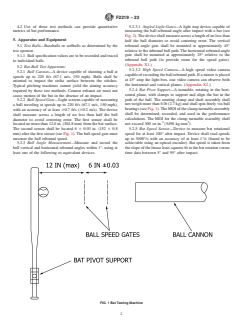
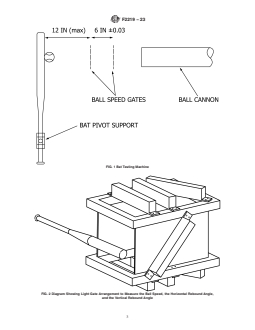
5.2.2 Ball Speed Gate—Light screens capable of measuring a ball traveling at speeds up to 220 ft/s (67.1 m/s, 150 mph), with an
accuracy of at least 60.7 ft/s (60.2 m/s). The device shall measure across a length of no less than half the ball diameter to avoid
centering error. The first sensor shall be located no more than 12.0 in. (304.8 mm) from the bat surface. The second sensor shall
be located 6 6 0.03 in. (152 6 0.8 mm) after the first sensor (see Fig. 1). The ball speed gate must measure the ball rebound speed.
5.2.3 Ball Angle Measurement—Measure and record the ball vertical and horizontal rebound angles within 1°, using at least one
of the following or equivalent devices.
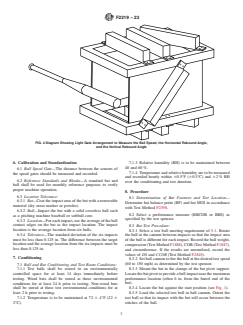
5.2.3.1 Angled Light Gates—A light trap device capable of measuring the ball rebound angle after impact with a bat (see Fig. 2).
The device shall measure across a length of no less than half the ball diameter to avoid centering error. The vertical rebound angle
F2219 − 23
FIG. 1 Bat Testing Machine
FIG. 2 Diagram Showing Light Gate Arrangement to Measure the Ball Speed, the Horizontal Rebound Angle,
and the Vertical Rebound Angle
F2219 − 23
gate shall be mounted at approximately 45° relative to the inbound ball path. The horizontal rebound angle gate shall be mounted
at approximately 25° relative to the inbound ball path (to provide room for the speed gates). (Appendix X1.)
5.2.3.2 High Speed Camera—A high speed video camera capable of recording the ball rebound path. If a mirror is placed at 45°
atop the light box, one video camera can observe both the horizontal and vertical planes. (Appendix X2.)
5.2.4 Bat Pivot Support—A turntable, rotating in the horizontal plane, with clamps to support and align the bat in the path of the
ball. The rotating clamp and shaft assembly shall not weigh more than 6 lb (2.7 kg) and shall spin freely via ball bearings (see
Fig. 1). The MOI of the clamp turntable assembly shall be determined, recorded, and used in the performance calculations. The
2 2
MOI for the clamp turntable assembly shall not exceed 300 oz-in. (5498 kg-mm ).
5.2.5 Bat Speed Sensor—Device to measure bat rotational speed for at least 100° after impact. Device shall read speeds up to
3000°/s with an accuracy of at least 1°/s (found to be achievable using an optical encoder). Bat speed is taken from the slope of
the linear least-squares fit to the bat rotation versus time data between 5° and 95° after impact.
6. Calibration and Standardization
6.1 Ball Speed Gate—The distance between the sensors of the speed gates should be measured and recorded.
6.2 Reference Standards and Blanks—A standard bat and ball shall be used for monthly reference purposes to verify proper
machine operation.
6.3 Location Tolerance:
6.3.1 Bat—Coat the impact area of the bat with a removable material (dry erase marker or powder).
6.3.2 Ball—Impact the bat with a solid coverless ball such as a pitching machine baseball or softball core.
6.3.3 Location—For each impact, use the average of the ball contact edges on the bat as the impact location. The impact location
is the average location from six balls.
6.3.4 Tolerance—The standard deviation of the six impacts must be less than 0.125 in. The difference between the target location
and the average location from the six impacts must be less than 0.125 in.
7. Conditioning
7.1 Ball and Bat Conditioning and Test Room Conditions:
7.1.1 Test balls shall be stored in an environmentally controlled space for at least 14 days immediately before testing. Wood bats
shall be stored at these environmental conditions for at least 24 h prior to testing. Non-wood bats shall be stored at these test
environmental conditions for at least 2 h prior to testing.
7.1.2 Temperature is to be maintained at 72 6 4°F (22 6 2°C).
7.1.3 Relative humidity (RH) is to be maintained between 40 and 60 %.
7.1.4 Temperature and relative humidity are to be measured and recorded hourly within 60.5°F (60.3°C) and 62 % RH over the
conditioning and test duration.
8. Procedure
8.1 Determination of Bat Features and Test Location—Determine bat balance point (BP) and bat MOI in accordance with Test
Method F2398.
8.2 Select a performance measure (BBCOR, BESR, (BBCOR or BBS) as specified by the test sponsor.
8.3 Bat Test Procedure:
F2219 − 23
8.3.1 Select a test ball meeting requirement of 5.1. Rotate the ball in the cannon between impacts so that the impact area of the
ball is different for each impact. Record the ball weight, compression (Test Method F1888), COR (Test Method F1887), and
circumference. If the results are normalized, record the values of DS and CCOR (Test Method F2845).
8.3.2 Set ball cannon to fire the ball at the desired test speed (60 to 150 mph) as determined by the test sponsor.
8.3.3 Mount the bat in the clamps of the bat pivot support. Locate the bat pivot to provide a ball impact near the maximum
performance location (often 6 in. from the barrel end of the bat).
8.3.4 Locate the
...